Japan Turbocharger Components Market Size & Growth Rate
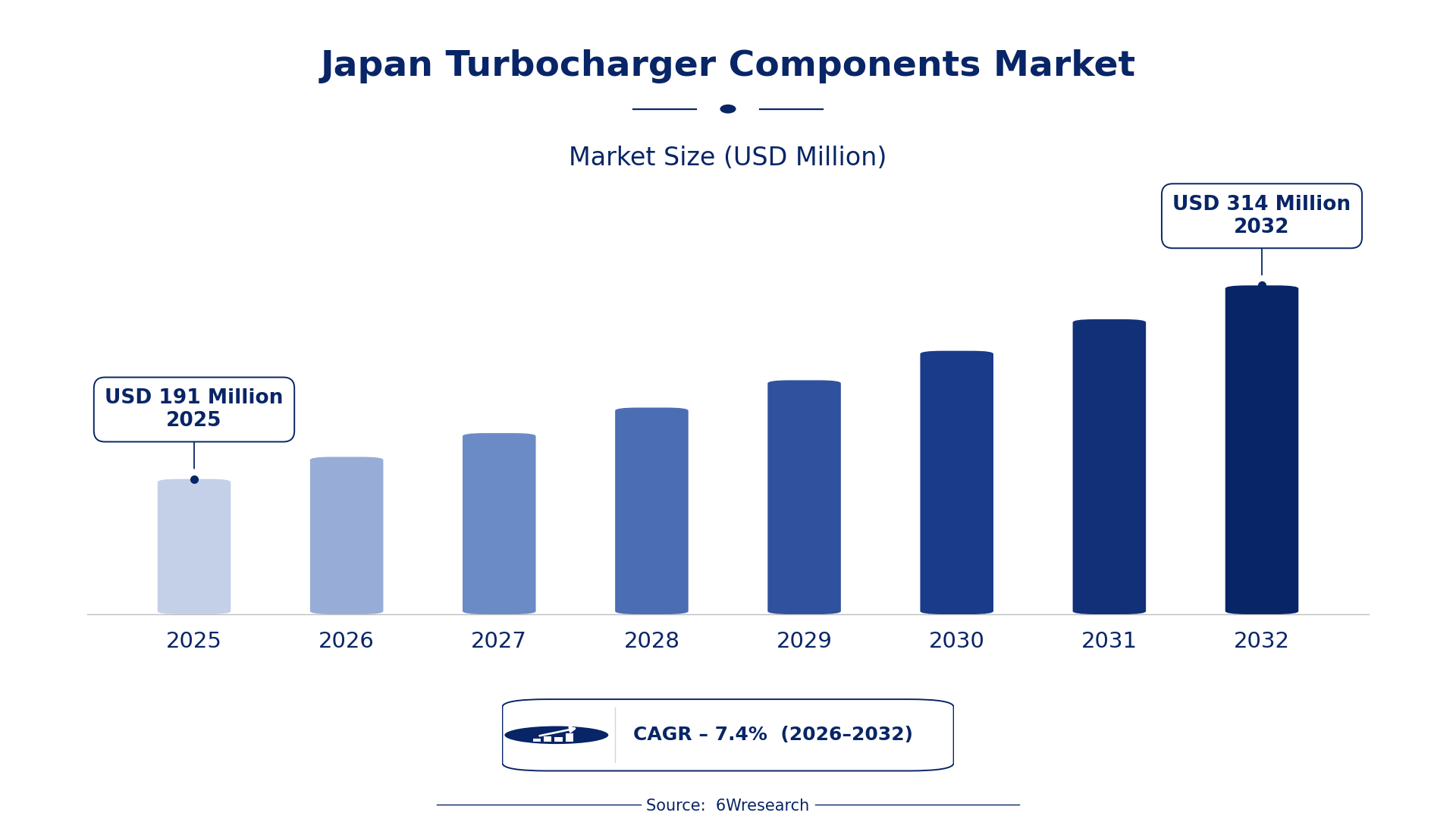
According to 6Wresearch internal database and industry insights, the Japan Turbocharger Components Market was valued at USD 191 Million in 2025 and is projected to reach USD 314 Million by 2032, growing at a CAGR of approximately 7.4% during 2026–2032.
Japan Turbocharger Components Market Highlights
| Report Metric | Details |
| Report Name | Japan Turbocharger Components Market (2026-2032) |
| Market Size 2025 | USD 191 Million |
| Market Size 2032 | USD 314 Million |
| Absolute Growth 2025–2032 | USD 123 Million |
| CAGR 2026–2032 | 7.4% |
| Peak Annual Growth | 7.9% in 2030 |
| Forecast Period | 2026–2032 |
| Historical Data | 2022–2025 |
| Base Year | 2025 |
| Leading Component Type, 2025 | Turbine Housing (47% share) |
| Leading Material Used, 2025 | Cast Iron (38% share) |
| Leading Engine Compatibility, 2025 | Diesel Engines (45% share) |
| Leading End User, 2025 | Automotive OEMs (35% share) |
| Fastest-Growing Component Type | Compressor Wheel (10.3% CAGR) |
| Fastest-Growing Material Used | Aluminum Alloy (10.7% CAGR) |
| Fastest-Growing Engine Compatibility | Passenger Vehicles (9.9% CAGR) |
| Fastest-Growing End User | Turbocharger Makers (9.5% CAGR) |
| Growing Sector | Automotive |
| Key End Users | Automotive OEMs, Turbocharger Makers, Engine System Integrators |
Japan Turbocharger Components Market Year-wise Growth Rate and Key Drivers (2022–2032)
This graph illustrates the annual growth rates of the market from 2022 to 2032, highlighting a steady upward trajectory and projected market expansion over the forecast period.
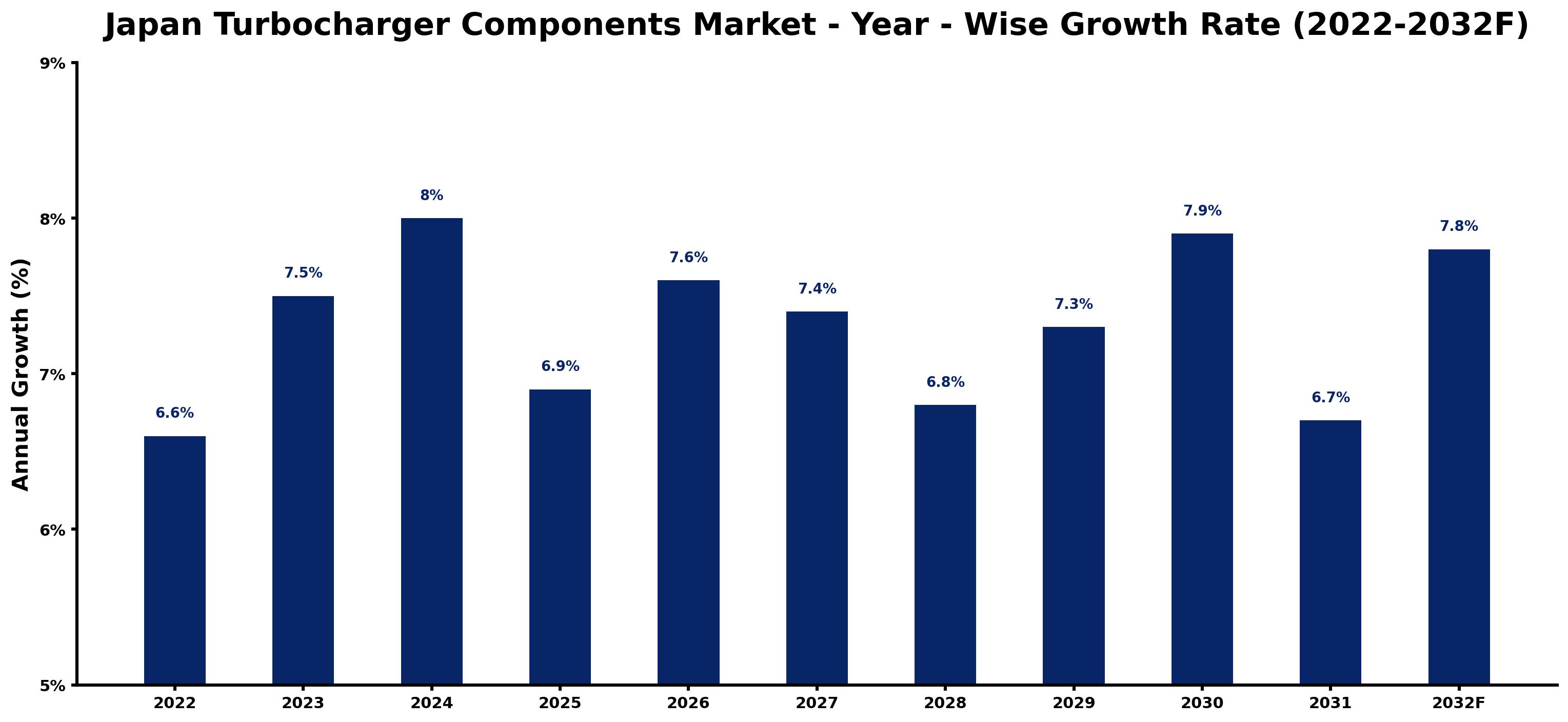
The yearly estimates that follow link every growth rate to its principal driver, so readers can see why the pace changed in each period.
| Year | Estimated Annual Growth (%) | Market Rationale |
| 2022 | 6.6 | The automotive sector was stable, with established demand for turbocharger components. |
| 2023 | 7.5 | Production increased due to a rise in vehicle manufacturing and exports. |
| 2024 | 8.0 | Demand peaked as automotive manufacturers focused on enhancing engine performance. |
| 2025 | 6.9 | Growth slowed slightly as certain vehicle segments reached saturation. |
| 2026 | 7.6 | Investment in eco-friendly vehicle technology is projected to boost component demand. |
| 2027 | 7.4 | The market is anticipated to experience a slowdown as manufacturers adapt to evolving regulations. |
| 2028 | 6.8 | Demand is expected to continue growing, driven by rising interest in hybrid vehicle technology. |
| 2029 | 7.3 | Consumer preference is shifting towards more fuel-efficient vehicles, increasing component demand. |
| 2030 | 7.9 | The market is expected to peak again as turbocharger adoption in vehicles reaches new heights. |
| 2031 | 6.7 | Growth is projected to slow as the market stabilises after several years of rapid expansion. |
| 2032 | 7.8 | Demand is expected to rise as automotive manufacturers innovate with turbocharging. |
Note: Market size estimations and growth projections presented in this report are based on 6Wresearch's proprietary forecasting methodology, utilizing the latest available industry data, government publications, and primary research inputs.
Japan Turbocharger Components Market Synopsis
Turbocharger components are mechanical parts that improve engine efficiency and performance by forcing more air into combustion chambers. The Japan Turbocharger Components Market is primarily driven by the automotive sector, valued at approximately $200 billion as of 2023, which produced 4.5 million vehicles in 2022. Key growth factors include technological advancements, increased production of eco-friendly vehicles, and a rising installed base of turbocharged vehicles, projected to reach 2 million by 2025.
Market Dynamics Impact Analysis (2026–2032)
| Factor | Type | Impact | Primary Segment Affected |
| Rising vehicle production in Japan | Driver | High | Turbine Housing |
| Shift towards eco-friendly vehicles | Driver | High | Compressor Wheel |
| Growing demand for lightweight materials | Opportunity | Medium | Aluminum Alloy |
| Increasing exports of turbocharged vehicles | Opportunity | Medium | Diesel Engines |
| High production costs of advanced materials | Restraint | High | Wastegate Valve |
| Regulatory compliance for emissions standards | Restraint | High | Actuator |
| Supply chain disruptions affecting production | Challenge | High | Turbocharger Makers |
| Limited skilled workforce in manufacturing | Challenge | Medium | Engine System Integrators |
Evaluation of Drivers in Japan Turbocharger Components Market (2026–2032)
The main growth drivers and the segments they affect most are set out below.
| Drivers | Primary Segment Affected | Why It Matters (Evidence) |
| Increased vehicle production | Turbine Housing | Japan produced 4.5 million vehicles in 2022, boosting demand for turbocharger components. |
| Shift towards eco-friendly vehicles | Compressor Wheel | The 2023 government programme promoting eco-friendly vehicles drives higher turbocharger use. |
| Demand for lightweight materials | Aluminum Alloy | Aluminum alloy is preferred for compressor wheels due to its lightweight properties. |
| Growing exports of turbocharged vehicles | Diesel Engines | Japan's automotive exports reached 1.3 million units in 2022, influencing component demand. |
| Technological advancements in turbocharging | Wastegate Valve | The rise of hybrid engines increases the need for advanced turbocharger components. |
Volumes grow on the back of increased vehicle production, with Japan producing 4.5 million vehicles in 2022, which drives the need for turbocharger components. Demand for lightweight materials rises, as aluminum alloy is preferred for compressor wheels due to its efficiency. Exports of turbocharged vehicles, reaching 1.3 million units in 2022, further increase component requirements. Advancements in turbocharging for hybrid engines also contribute to rising volumes.
Evaluation of Restraints in Japan Turbocharger Components Market
These restraints slow adoption and weigh on supplier margins.
| Market Restraint | Primary Segment Affected | Why It Matters (Evidence) |
| Rising material costs | Compressor Wheel | The increasing price of aluminum alloy impacts the production costs of compressor wheels, forcing manufacturers to adjust pricing strategies. |
| Regulatory compliance costs | Turbine Housing | Compliance with the JIS B 8418 standard requires investments in testing and certification, raising operational expenses for turbine housing producers. |
| Supply chain disruptions | Wastegate Valve | Global supply chain issues can delay the availability of critical materials for wastegate valves, affecting production schedules. |
| Technological adaptation delays | Actuator | The need for advanced actuators in eco-friendly vehicles requires significant R&D investment, which can slow down production timelines. |
| Market competition pressures | Turbocharger Makers | Intense competition among turbocharger makers drives down prices, impacting profit margins and investment in innovation. |
Japan Turbocharger Components Market Challenges
Producers encounter delays in component delivery due to the growing demand for eco-friendly vehicles, necessitating adaptations in production processes. This shift can extend timelines by six months, affecting automotive manufacturers reliant on just-in-time inventory. Skills shortages in advanced manufacturing techniques restrict production capacity, leading to potential revenue losses of approximately 15% for producers. Supply chain disruptions from global material shortages can increase lead times by 20%, compelling buyers to hold excess inventory and significantly raising their operational costs.
Trends in the Japan Turbocharger Components Market
The trends below show where the Japan Turbocharger Components Market is heading.
- Automotive OEMs Increasing Turbocharger Adoption: Automotive OEMs are integrating turbochargers into more passenger vehicles, with a projected increase of 15% in turbocharged models by 2025. This trend is evident in regions like Tokyo, where manufacturers are focusing on fuel efficiency.
- Implementation of JIS B 8418 Standard: The JIS B 8418 standard is driving manufacturers to improve the quality of turbocharger components. Compliance rates are projected to reach 90% by 2025, enhancing reliability across the market.
- Tokyo and Aichi as Automotive Hubs: Key regions for automotive manufacturing, Tokyo and Aichi, contribute significantly to the turbocharger components market. With a combined output of over 4 million vehicles in 2022, these regions are vital for component demand.
- Rising Installed Base of Turbocharged Vehicles: The installed base of turbocharged vehicles in Japan is expected to reach 2 million by 2025, indicating a strong market for turbocharger components. This growth reflects the increasing preference for fuel-efficient vehicles among consumers.
Investment Opportunities in the Japan Turbocharger Components Market
The opportunities below stand out in the Japan Turbocharger Components Market for new entrants and existing suppliers.
- Local Partnerships for Production: Local partnerships are essential for entering the turbocharger components market, especially in regions like Aichi. Investing in joint ventures can improve production capabilities and meet rising demands.
- Automotive OEMs Seeking Lightweight Materials: Automotive OEMs are increasingly seeking lightweight materials for improved fuel efficiency. With the growing demand for aluminum alloy components, suppliers can enter the market by offering certified products.
- Investment in Eco-Friendly Technologies: The current push for eco-friendly technologies presents an opportunity for suppliers to invest in advanced turbocharger components. The 2023 government programme supports this shift, with potential growth in component demand.
- Expansion in Diesel Engine Applications: With diesel engines holding a 45% share in 2025, there is an opportunity for suppliers to cater to this segment. Focusing on high-performance components can capture this growing market.
Government Initiatives in the Japan Turbocharger Components Market
The Economic Security Promotion Act, enacted in 2022, affects buyers of turbocharger components by supporting supply-chain resilience for critical products. This law encourages manufacturers to invest in local production capabilities, ensuring a steady supply of essential components for the automotive sector. The act aims to strengthen the domestic supply chain, with an emphasis on critical materials and components.
In 2023, the Japanese government launched a programme with a budget of $500 million to promote eco-friendly vehicles, administered by the Ministry of Economy, Trade and Industry (METI). This initiative aims to increase the adoption of turbocharger components in environmentally friendly vehicles.
Future Insight of the Japan Turbocharger Components Market
By 2032, buyers will benefit from improved engine performance and fuel efficiency as turbocharger technology advances. New standards will ensure better quality and safety in components, promoting greater reliability. The installed base of 2 million turbocharged vehicles will drive consistent demand for parts. A government programme promoting eco-friendly vehicles will encourage suppliers to adopt advanced manufacturing techniques and invest in sustainable materials.
Market Segmentation Analysis
Japan Turbocharger Components Market report covers a detailed analysis of the following market segments:
By Component Type – Turbine Housing Leads, Compressor Wheel Expected to Grow Fastest
According to Saurav Kr Singh, Senior Research Analyst at 6Wresearch, with 47% of component type revenue in 2025, Turbine Housing was the largest category. Turbine Housing commands the largest share because it is essential for turbocharger assembly, directly influencing engine performance. The production of 4.5 million vehicles in Japan in 2022 has reinforced its demand among automotive manufacturers. Compressor Wheel is projected to grow fastest, at a CAGR of 10.3% during 2026–2032. The Compressor Wheel is growing rapidly as it is critical for air compression, particularly with the increasing focus on efficient engine technologies. The government's 2023 initiative to promote eco-friendly vehicles has further intensified the need for effective air management solutions. Suppliers should prioritise production capabilities for Compressor Wheels to align with the rising demand.
By Material Used – Cast Iron Leads, Aluminum Alloy Expected to Grow Fastest
Cast Iron held 38% of the Japan Turbocharger Components Market by material used in 2025. Cast Iron is the leading material due to its durability and strength, making it the preferred choice for many turbocharger components. Its widespread use in the automotive sector, valued at approximately $200 billion, reinforces its dominance. Aluminum Alloy is set to record the highest CAGR in this split, 10.7% over 2026–2032. Aluminum Alloy is growing rapidly because of its lightweight and efficient properties, which are increasingly favoured in modern automotive designs. The shift towards more fuel-efficient vehicles is driving manufacturers to adopt this material more frequently. Buyers should consider sourcing more Aluminum Alloy components to align with the industry's shift towards lightweight solutions.
By Engine Compatibility – Diesel Engines Lead, Passenger Vehicles Expected to Grow Fastest
In 2025, Diesel Engines led the engine compatibility split with a 45% share. Diesel Engines dominate this segment due to their extensive application in commercial vehicles that necessitate efficient turbocharger systems for enhanced performance. The expected increase in the installed base of turbocharged vehicles to 2 million by 2025 underscores the sustained demand for these engines. Over 2026–2032, Passenger Vehicles are expected to post the fastest growth, at a CAGR of 9.9%. Passenger Vehicles are the fastest-growing segment as they are increasingly favoured in modern automotive designs, reflecting a shift towards improved fuel efficiency and performance. This trend will likely continue as manufacturers adopt more turbocharging technology in response to consumer preferences. Suppliers should direct their efforts towards Passenger Vehicle manufacturers to meet the rising demand for turbocharger components.
By End User – Automotive OEMs Lead, Turbocharger Makers Expected to Grow Fastest
Automotive OEMs accounted for 35% of the market by end user in 2025. Automotive OEMs are the largest end users as they serve as the primary purchasers of turbocharger components, significantly impacting production volumes in the automotive sector. Their central role in vehicle manufacturing ensures a steady demand for these components across various models. The quickest growth will come from Turbocharger Makers, forecast to expand at a CAGR of 9.5% between 2026 and 2032. Turbocharger Makers are witnessing the fastest growth as they are crucial in producing turbo systems that are increasingly in demand due to the push for eco-friendly vehicles. Their focus on developing advanced turbocharging solutions aligns with government initiatives promoting sustainable automotive technologies. Suppliers should enhance collaboration with Turbocharger Makers to leverage the growing market for advanced turbo systems.
Key Attractiveness of the Report
- 10 Years of Market Numbers
- Historical Data Starting from 2022 to 2025
- Base Year 2025
- Forecast Data until 2032
- Key Performance Indicators Impacting the Market
- Major Upcoming Developments and Projects
Key Highlights of the Report:
- Japan Turbocharger Components Market Outlook
- Market Size of Japan Turbocharger Components Market, 2025
- Forecast of Japan Turbocharger Components Market, 2032
- Historical Data and Forecast of Japan Turbocharger Components Revenues & Volume for the Period 2022-2032F
- Japan Turbocharger Components Market Trend Evolution
- Japan Turbocharger Components Market Drivers and Challenges
- Japan Turbocharger Components Price Trends
- Japan Turbocharger Components Porter's Five Forces
- Japan Turbocharger Components Industry Life Cycle
- Historical Data and Forecast of Japan Turbocharger Components Market Revenues & Volume By Component Type for the Period 2022-2032F
- Historical Data and Forecast of Japan Turbocharger Components Market Revenues & Volume By Turbine Housing for the Period 2022-2032F
- Historical Data and Forecast of Japan Turbocharger Components Market Revenues & Volume By Compressor Wheel for the Period 2022-2032F
- Historical Data and Forecast of Japan Turbocharger Components Market Revenues & Volume By Actuator for the Period 2022-2032F
- Historical Data and Forecast of Japan Turbocharger Components Market Revenues & Volume By Wastegate Valve for the Period 2022-2032F
- Historical Data and Forecast of Japan Turbocharger Components Market Revenues & Volume By Material Used for the Period 2022-2032F
- Historical Data and Forecast of Japan Turbocharger Components Market Revenues & Volume By Cast Iron for the Period 2022-2032F
- Historical Data and Forecast of Japan Turbocharger Components Market Revenues & Volume By Aluminum Alloy for the Period 2022-2032F
- Historical Data and Forecast of Japan Turbocharger Components Market Revenues & Volume By Electric / Pneumatic for the Period 2022-2032F
- Historical Data and Forecast of Japan Turbocharger Components Market Revenues & Volume By Stainless Steel for the Period 2022-2032F
- Historical Data and Forecast of Japan Turbocharger Components Market Revenues & Volume By Engine Compatibility for the Period 2022-2032F
- Historical Data and Forecast of Japan Turbocharger Components Market Revenues & Volume By Diesel Engines for the Period 2022-2032F
- Historical Data and Forecast of Japan Turbocharger Components Market Revenues & Volume By Passenger Vehicles for the Period 2022-2032F
- Historical Data and Forecast of Japan Turbocharger Components Market Revenues & Volume By Hybrid Engines for the Period 2022-2032F
- Historical Data and Forecast of Japan Turbocharger Components Market Revenues & Volume By Gasoline Engines for the Period 2022-2032F
- Historical Data and Forecast of Japan Turbocharger Components Market Revenues & Volume By End User for the Period 2022-2032F
- Historical Data and Forecast of Japan Turbocharger Components Market Revenues & Volume By Automotive OEMs for the Period 2022-2032F
- Historical Data and Forecast of Japan Turbocharger Components Market Revenues & Volume By Turbocharger Makers for the Period 2022-2032F
- Historical Data and Forecast of Japan Turbocharger Components Market Revenues & Volume By Engine System Integrators for the Period 2022-2032F
- Historical Data and Forecast of Japan Turbocharger Components Market Revenues & Volume By Tier 1 Suppliers for the Period 2022-2032F
- Japan Turbocharger Components Import Export Trade Statistics
- Market Opportunity Assessment By Component Type
- Market Opportunity Assessment By Material Used
- Market Opportunity Assessment By Engine Compatibility
- Market Opportunity Assessment By End User
- Japan Turbocharger Components Top Companies Market Share
- Japan Turbocharger Components Competitive Benchmarking By Technical and Operational Parameters
- Japan Turbocharger Components Company Profiles
- Japan Turbocharger Components Key Strategic Recommendations
Market Covered
This report examines the market across the segments below.
By Component Type
- Turbine Housing
- Compressor Wheel
- Actuator
- Wastegate Valve
By Material Used
- Cast Iron
- Aluminum Alloy
- Electric / Pneumatic
- Stainless Steel
By Engine Compatibility
- Diesel Engines
- Passenger Vehicles
- Hybrid Engines
- Gasoline Engines
By End User
- Automotive OEMs
- Turbocharger Makers
- Engine System Integrators
- Tier 1 Suppliers































