Japan Turbocharger Intercooler System Market Size & Growth Rate
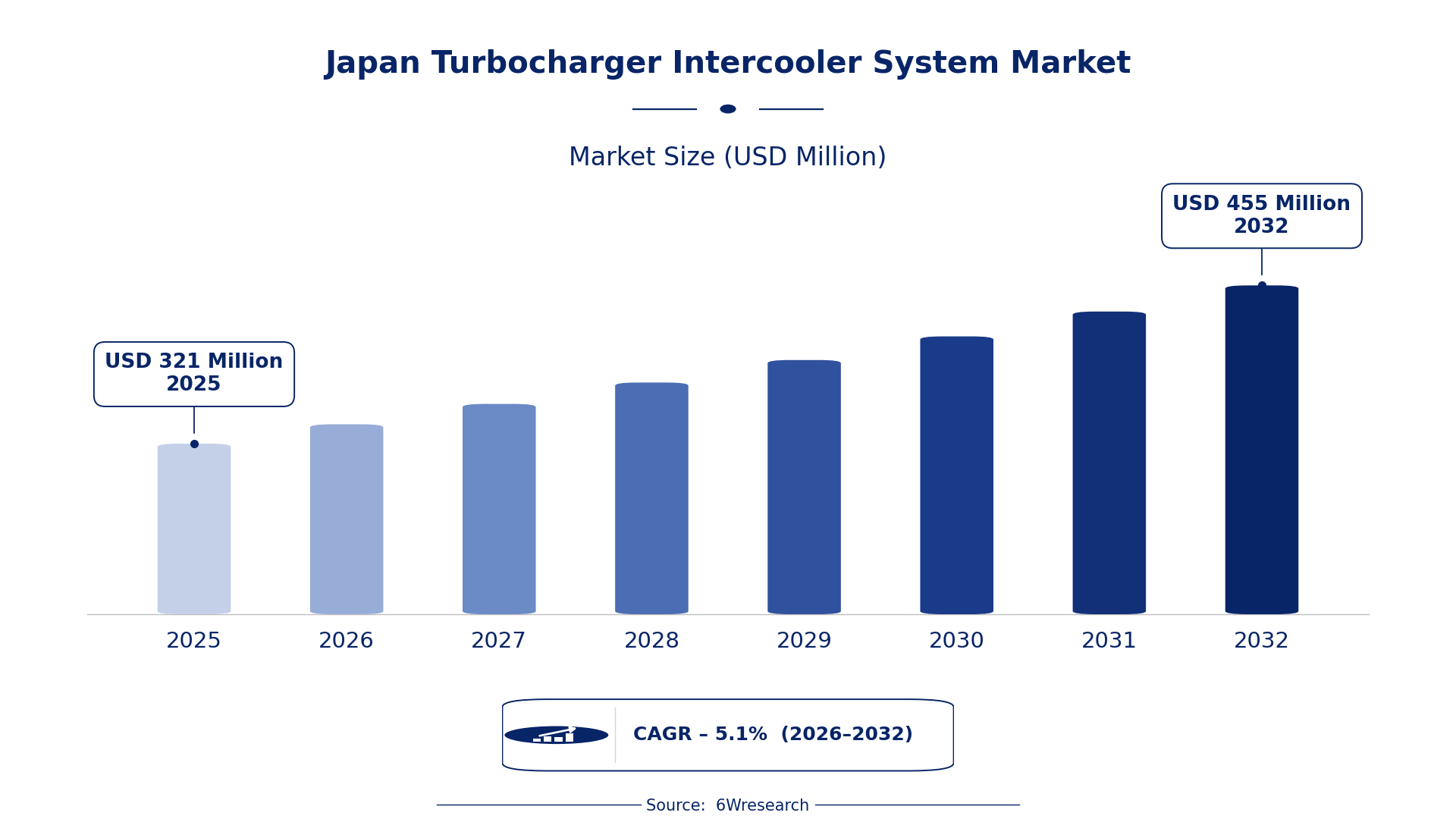
According to 6Wresearch internal database and industry insights, the Japan Turbocharger Intercooler System Market was valued at USD 321 Million in 2025 and is projected to reach USD 455 Million by 2032, growing at a CAGR of approximately 5.1% during 2026–2032.
Japan Turbocharger Intercooler System Market Highlights
| Report Metric | Details |
| Report Name | Japan Turbocharger Intercooler System Market (2026-2032) |
| Market Size 2025 | USD 321 Million |
| Market Size 2032 | USD 455 Million |
| Absolute Growth 2025–2032 | USD 134 Million |
| CAGR 2026–2032 | 5.1% |
| Peak Annual Growth | 6.1% in 2028 |
| Forecast Period | 2026–2032 |
| Historical Data | 2022–2025 |
| Base Year | 2025 |
| Leading Intercooler Type, 2025 | Air-to-Air Intercooler (52% share) |
| Leading Cooling Medium, 2025 | Ambient Air (47% share) |
| Leading Mounting Position, 2025 | Front-Mounted (47% share) |
| Leading End User, 2025 | Performance Car OEMs (40% share) |
| Fastest-Growing Intercooler Type | Air-to-Water Intercooler (7.1% CAGR) |
| Fastest-Growing Cooling Medium | Coolant Liquid (6.4% CAGR) |
| Fastest-Growing Mounting Position | Integrated Turbo Systems (6.8% CAGR) |
| Fastest-Growing End User | Racing Vehicle Teams (6.5% CAGR) |
| Growing Sector | automotive performance |
| Key End Users | performance car OEMs, racing vehicle teams, sports car makers, heavy-duty truck manufacturers |
Japan Turbocharger Intercooler System Market Year-wise Growth Rate and Key Drivers (2022–2032)
This graph illustrates the annual growth rates of the market from 2022 to 2032, highlighting a steady upward trajectory and projected market expansion over the forecast period.
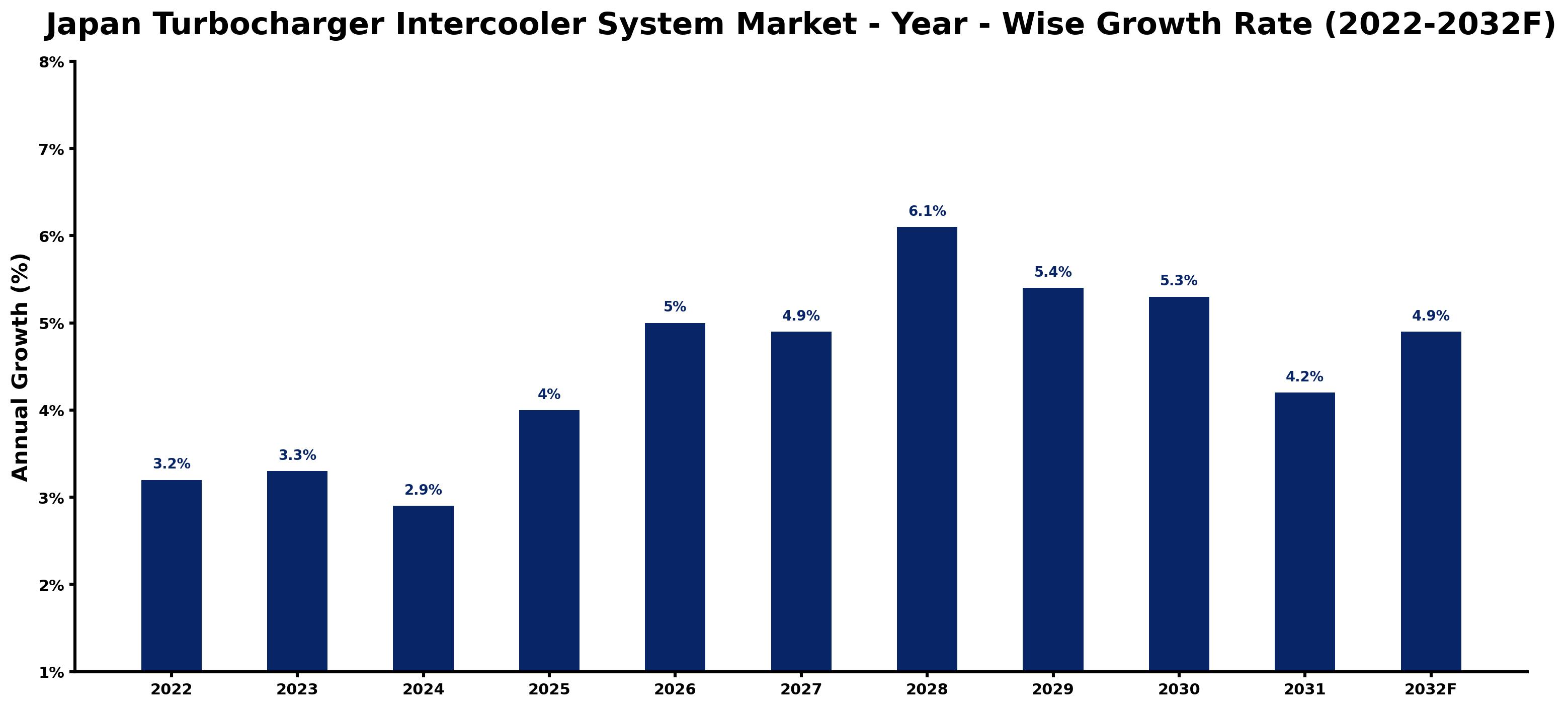
Below, each year's estimated growth is shown next to the factor that most influenced it.
| Year | Estimated Annual Growth (%) | Market Rationale |
| 2022 | 3.2 | The market experienced steady growth due to ongoing automotive production. |
| 2023 | 3.3 | Demand increased as performance car manufacturers expanded their offerings. |
| 2024 | 2.9 | Growth slowed slightly as manufacturers adjusted to changing market conditions. |
| 2025 | 4.0 | The market rebounded with a surge in turbocharged vehicle production. |
| 2026 | 5.0 | Demand is expected to rise as more consumers opt for performance upgrades. |
| 2027 | 4.9 | Growth will slow as the market begins to stabilise after rapid expansion. |
| 2028 | 6.1 | The market is projected to peak with heightened interest in high-performance vehicles. |
| 2029 | 5.4 | Growth is expected to decelerate as the market adjusts to peak demand levels. |
| 2030 | 5.3 | Demand will continue to slow as manufacturers focus on efficiency. |
| 2031 | 4.2 | Growth is projected to moderate as the market stabilises after previous peaks. |
| 2032 | 4.9 | The market will see renewed interest in turbocharged vehicles, driving growth. |
Note: Market size estimations and growth projections presented in this report are based on 6Wresearch's proprietary forecasting methodology, utilizing the latest available industry data, government publications, and primary research inputs.
Japan Turbocharger Intercooler System Market Synopsis
Turbocharger intercooler systems cool the air compressed by turbochargers, improving engine performance and efficiency in automotive applications. The Japan Turbocharger Intercooler System Market is growing due to the production of over 8 million vehicles in 2022, with demand driven by performance car manufacturers and racing vehicle teams. Advancements in automotive technology and a heightened focus on performance upgrades are propelling market growth, projecting steady demand through 2032.
Market Dynamics Impact Analysis (2026–2032)
| Factor | Type | Impact | Primary Segment Affected |
| Increasing production of turbocharged vehicles | Driver | High | Air-to-Air Intercooler |
| Growing interest in performance upgrades | Driver | High | Air-to-Water Intercooler |
| Demand for enhanced engine efficiency | Opportunity | High | Integrated Turbo Systems |
| Rising popularity of racing vehicles | Opportunity | Medium | Racing Vehicle Teams |
| High costs of advanced materials | Restraint | High | Bar and Plate Intercooler |
| Limited awareness of benefits among consumers | Restraint | Medium | Air-to-Water Intercooler |
| Competition from alternative technologies | Challenge | High | Performance Car OEMs |
| Supply chain disruptions affecting production | Challenge | Medium | Heavy-Duty Trucks |
Evaluation of Drivers in Japan Turbocharger Intercooler System Market (2026–2032)
These are the developments adding the most demand over the forecast period.
| Drivers | Primary Segment Affected | Why It Matters (Evidence) |
| Increase in turbocharged vehicle production | Air-to-Air Intercooler | Japan's automotive industry produced approximately 8 million vehicles in 2022, driving demand for intercoolers. |
| Performance upgrades in automotive applications | Air-to-Water Intercooler | Performance car manufacturers are increasingly adopting advanced intercooler systems to improve vehicle capabilities, with a 20% horsepower boost. |
| Technological advancements in engine efficiency | Integrated Turbo Systems | The average horsepower increase from intercoolers can reach 20%, motivating manufacturers to invest in these systems. |
| Growing motorsport activities in Japan | Racing Vehicle Teams | The Tokyo Auto Salon in 2023 showcased advanced automotive technologies, boosting interest in performance enhancements. |
| Regulatory incentives for eco-friendly technologies | Heavy-Duty Trucks | The Japanese government promotes eco-friendly vehicle technologies through subsidies, encouraging the adoption of efficient systems. |
Spending rises because the Tokyo region is a major hub for automotive manufacturing, producing around 8 million vehicles in 2022. This production drives demand for turbocharger intercooler systems, particularly from performance car manufacturers. The average horsepower increase from intercoolers can reach 20%, prompting manufacturers to invest in these technologies. The growing interest in motorsport has also stimulated demand for high-performance upgrades. The push for eco-friendly vehicle technologies has led to increased investments in efficient systems, contributing to overall market growth.
Evaluation of Restraints in Japan Turbocharger Intercooler System Market
These are the pressures that could keep growth below its potential.
| Market Restraint | Primary Segment Affected | Why It Matters (Evidence) |
| High costs of advanced materials | Bar and Plate Intercooler | The use of lightweight materials can raise production costs by approximately 15%, impacting pricing strategies. |
| Limited awareness of benefits among consumers | Air-to-Water Intercooler | Many consumers lack knowledge about the performance advantages of intercooler systems, hindering adoption by an estimated 30%. |
| Supply chain disruptions affecting production | Heavy-Duty Trucks | Recent global supply chain issues have delayed the availability of critical components for production, affecting timelines by 20%. |
| Regulatory compliance costs | Integrated Turbo Systems | Meeting stringent environmental regulations can increase operational costs for manufacturers by up to 10%. |
| Competition from alternative technologies | Performance Car OEMs | Emerging technologies may divert attention and resources away from traditional turbocharger systems, impacting market share. |
Japan Turbocharger Intercooler System Market Challenges
In 2022, Japan's automotive industry produced approximately 8 million vehicles, leading to fierce competition among over 50 performance car manufacturers. This rivalry compels suppliers to reduce prices, which can compromise the quality of turbocharger intercooler systems for buyers. Dependence on lightweight materials creates supply chain vulnerabilities, resulting in production delays for manufacturers. The average age of vehicles on Japanese roads is around 10 years, indicating a pressing need for upgrades that buyers often hesitate to finance, causing missed sales opportunities for suppliers. Rising costs linked to eco-friendly technologies further strain manufacturers, limiting their ability to innovate.
Trends in the Japan Turbocharger Intercooler System Market
The shifts below are changing how Japan Turbocharger Intercooler System Market products are bought and supplied.
- Shift from Air-to-Water to Air-to-Air Intercoolers: Japanese performance vehicles are increasingly adopting Air-to-Air intercoolers, which are projected to hold a 52% market share in 2025.
- Rising Adoption of Integrated Turbo Systems: Integrated Turbo Systems are becoming more popular in modern engine designs, with a projected CAGR of 6.8% from 2026 to 2032, reflecting advancements in automotive technology.
- Increased Focus on Racing Vehicle Performance: Racing Vehicle Teams are driving demand for high-performance intercoolers, with a CAGR of 6.5% anticipated from 2026 to 2032, highlighting the competitive nature of motorsport.
- Expansion of Eco-Friendly Vehicle Technologies: The Green Growth Strategy promotes eco-friendly vehicle technologies, leading to increased investments in turbocharger intercooler systems, with substantial funding allocated to innovation.
Investment Opportunities in the Japan Turbocharger Intercooler System Market
The following opportunities in the Japan Turbocharger Intercooler System Market pair current demand with a clear way in.
- Gap in high-performance vehicle upgrades: With a growing number of performance car manufacturers, there is an opportunity to supply advanced intercooler systems to improve vehicle performance, particularly in the Tokyo region.
- Demand from Racing Vehicle Teams: Racing Vehicle Teams require high-performance intercoolers, presenting an opportunity to invest in specialized products that cater to this competitive segment.
- Potential in Heavy-Duty Truck Market: Heavy-Duty Trucks are increasingly adopting turbocharger systems, creating an opportunity to supply intercooler solutions that improve power and efficiency.
- Investment in Integrated Turbo Systems: The Integrated Turbo Systems segment is projected to grow, offering opportunities for suppliers to develop innovative products that meet evolving automotive standards.
Government Initiatives in the Japan Turbocharger Intercooler System Market
The Water Supply Act (1957) sets standards for drinking-water quality and supply, impacting manufacturers by ensuring compliance with environmental regulations. The Sewerage Act (1958) governs sewerage systems and wastewater treatment, indirectly affecting automotive production through regulatory frameworks. These laws require manufacturers to invest in compliance measures, influencing operational costs.
Performance car manufacturers benefit from the Battery Industry Strategy (METI, August 2022), which aims to boost domestic battery manufacturing capacity by 2030. This initiative supports the development of electric and hybrid vehicles, encouraging the adoption of turbocharger intercooler systems in eco-friendly designs. The strategy is expected to allocate significant funding to support innovation in the automotive sector.
Future Insight of the Japan Turbocharger Intercooler System Market
Turbocharger intercooler systems will evolve by 2032, driven by advancements in automotive technology and stricter efficiency standards. The Japanese government's support for eco-friendly vehicle initiatives will encourage manufacturers to adopt more effective cooling solutions. Automotive innovation programmes will likely lead to breakthroughs in turbocharger efficiency, improving overall vehicle performance. As demand for turbocharged vehicles grows, with projections indicating a steady market expansion, suppliers must adapt their products to meet the evolving needs of performance enthusiasts.
Market Segmentation Analysis
Japan Turbocharger Intercooler System Market report covers a detailed analysis of the following market segments:
By Intercooler Type – Air-to-Air Intercooler Leads, Air-to-Water Intercooler Expected to Grow Fastest
According to Saurav Kr Singh, Senior Research Analyst at 6Wresearch, Air-to-Air Intercooler took 52% of intercooler type revenue in 2025, more than any other category. Air-to-Air intercoolers dominate the market due to their efficiency in cooling compressed air for turbocharged engines. Their prevalence among performance car manufacturers, particularly in the Tokyo region, highlights their importance in the automotive industry. Air-to-Water Intercooler is set to record the highest CAGR in this split, 7.1% over 2026–2032. The rise of Air-to-Water intercoolers is fuelled by their superior cooling capabilities, especially in high-performance applications. As automotive technology progresses, the demand for these systems is expected to surge, particularly among racing enthusiasts. Suppliers should prioritise the development of high-efficiency Air-to-Water intercoolers to align with the increasing demand in the performance sector.
By Cooling Medium – Ambient Air Leads, Coolant Liquid Expected to Grow Fastest
Ambient Air held 47% of the Japan Turbocharger Intercooler System Market by cooling medium in 2025. Ambient air serves as the primary cooling medium in various intercooler types, making it the most widely adopted choice in Japan's automotive sector. Its extensive use in performance vehicles, particularly in the Tokyo region, reinforces its leading market position. Coolant Liquid is projected to grow fastest, at a CAGR of 6.4% during 2026–2032. Coolant liquid is gaining traction due to its effectiveness in specific applications, especially where enhanced cooling is crucial. This trend is driven by the increasing performance demands of modern turbocharged engines, which require more efficient cooling solutions. Suppliers should explore coolant liquid options to meet the growing need for effective cooling in high-performance applications.
By Mounting Position – Front-Mounted Leads, Integrated Turbo Systems Expected to Grow Fastest
In 2025, Front-Mounted led the mounting position split with a 47% share. Front-mounted intercoolers are the standard choice for performance vehicles, providing optimal airflow and cooling efficiency. This mounting position is prevalent among many performance car OEMs in Japan, solidifying its market leadership. Over 2026–2032, Integrated Turbo Systems are expected to post the fastest growth, at a CAGR of 6.8%. Integrated turbo systems are becoming increasingly popular as they offer space-saving advantages and improved performance in modern engine designs. This trend is likely to continue as manufacturers seek to optimise engine layouts. Suppliers should consider developing integrated solutions to cater to the growing preference for compact and efficient engine designs.
By End User – Performance Car OEMs Lead, Racing Vehicle Teams Expected to Grow Fastest
The largest end user category in 2025 was Performance Car OEMs, at 40% of revenue. Performance car OEMs represent the largest user group of intercooler systems, utilising them extensively to enhance vehicle performance. With a strong presence of over 50 active manufacturers in Japan, this segment demonstrates a solid demand for advanced intercooler technologies. The quickest growth will come from Racing Vehicle Teams, forecast to expand at a CAGR of 6.5% between 2026 and 2032. Racing vehicle teams are experiencing the fastest growth, as they require sophisticated intercooling solutions to maintain a competitive edge. The emphasis on performance in racing applications is a key factor propelling this rapid expansion. Suppliers must tailor their offerings to the specific requirements of racing teams to take advantage of the increasing demand for high-performance intercooler systems.
Key Attractiveness of the Report
- 10 Years of Market Numbers
- Historical Data Starting from 2022 to 2025
- Base Year 2025
- Forecast Data until 2032
- Key Performance Indicators Impacting the Market
- Major Upcoming Developments and Projects
Key Highlights of the Report:
- Japan Turbocharger Intercooler System Market Outlook
- Market Size of Japan Turbocharger Intercooler System Market, 2025
- Forecast of Japan Turbocharger Intercooler System Market, 2032
- Historical Data and Forecast of Japan Turbocharger Intercooler System Revenues & Volume for the Period 2022-2032F
- Japan Turbocharger Intercooler System Market Trend Evolution
- Japan Turbocharger Intercooler System Market Drivers and Challenges
- Japan Turbocharger Intercooler System Price Trends
- Japan Turbocharger Intercooler System Porter's Five Forces
- Japan Turbocharger Intercooler System Industry Life Cycle
- Historical Data and Forecast of Japan Turbocharger Intercooler System Market Revenues & Volume By Intercooler Type for the Period 2022-2032F
- Historical Data and Forecast of Japan Turbocharger Intercooler System Market Revenues & Volume By Air-to-Air Intercooler for the Period 2022-2032F
- Historical Data and Forecast of Japan Turbocharger Intercooler System Market Revenues & Volume By Air-to-Water Intercooler for the Period 2022-2032F
- Historical Data and Forecast of Japan Turbocharger Intercooler System Market Revenues & Volume By Dual Pass Intercooler for the Period 2022-2032F
- Historical Data and Forecast of Japan Turbocharger Intercooler System Market Revenues & Volume By Bar and Plate Intercooler for the Period 2022-2032F
- Historical Data and Forecast of Japan Turbocharger Intercooler System Market Revenues & Volume By Cooling Medium for the Period 2022-2032F
- Historical Data and Forecast of Japan Turbocharger Intercooler System Market Revenues & Volume By Ambient Air for the Period 2022-2032F
- Historical Data and Forecast of Japan Turbocharger Intercooler System Market Revenues & Volume By Coolant Liquid for the Period 2022-2032F
- Historical Data and Forecast of Japan Turbocharger Intercooler System Market Revenues & Volume By Air + Water for the Period 2022-2032F
- Historical Data and Forecast of Japan Turbocharger Intercooler System Market Revenues & Volume By High Efficiency Alloy for the Period 2022-2032F
- Historical Data and Forecast of Japan Turbocharger Intercooler System Market Revenues & Volume By Mounting Position for the Period 2022-2032F
- Historical Data and Forecast of Japan Turbocharger Intercooler System Market Revenues & Volume By Front-Mounted for the Period 2022-2032F
- Historical Data and Forecast of Japan Turbocharger Intercooler System Market Revenues & Volume By Top-Mounted for the Period 2022-2032F
- Historical Data and Forecast of Japan Turbocharger Intercooler System Market Revenues & Volume By Integrated Turbo Systems for the Period 2022-2032F
- Historical Data and Forecast of Japan Turbocharger Intercooler System Market Revenues & Volume By Heavy-Duty Trucks for the Period 2022-2032F
- Historical Data and Forecast of Japan Turbocharger Intercooler System Market Revenues & Volume By End User for the Period 2022-2032F
- Historical Data and Forecast of Japan Turbocharger Intercooler System Market Revenues & Volume By Performance Car OEMs for the Period 2022-2032F
- Historical Data and Forecast of Japan Turbocharger Intercooler System Market Revenues & Volume By Sports Car Makers for the Period 2022-2032F
- Historical Data and Forecast of Japan Turbocharger Intercooler System Market Revenues & Volume By Racing Vehicle Teams for the Period 2022-2032F
- Historical Data and Forecast of Japan Turbocharger Intercooler System Market Revenues & Volume By Truck OEMs for the Period 2022-2032F
- Japan Turbocharger Intercooler System Import Export Trade Statistics
- Market Opportunity Assessment By Intercooler Type
- Market Opportunity Assessment By Cooling Medium
- Market Opportunity Assessment By Mounting Position
- Market Opportunity Assessment By End User
- Japan Turbocharger Intercooler System Top Companies Market Share
- Japan Turbocharger Intercooler System Competitive Benchmarking By Technical and Operational Parameters
- Japan Turbocharger Intercooler System Company Profiles
- Japan Turbocharger Intercooler System Key Strategic Recommendations
Market Covered
The study includes the following segmentation.
By Intercooler Type
- Air-to-Air Intercooler
- Air-to-Water Intercooler
- Dual Pass Intercooler
- Bar and Plate Intercooler
By Cooling Medium
- Ambient Air
- Coolant Liquid
- Air + Water
- High Efficiency Alloy
By Mounting Position
- Front-Mounted
- Top-Mounted
- Integrated Turbo Systems
- Heavy-Duty Trucks
By End User
- Performance Car OEMs
- Sports Car Makers
- Racing Vehicle Teams
- Truck OEMs































