Japan Turbojet Engine Market Size & Growth Rate
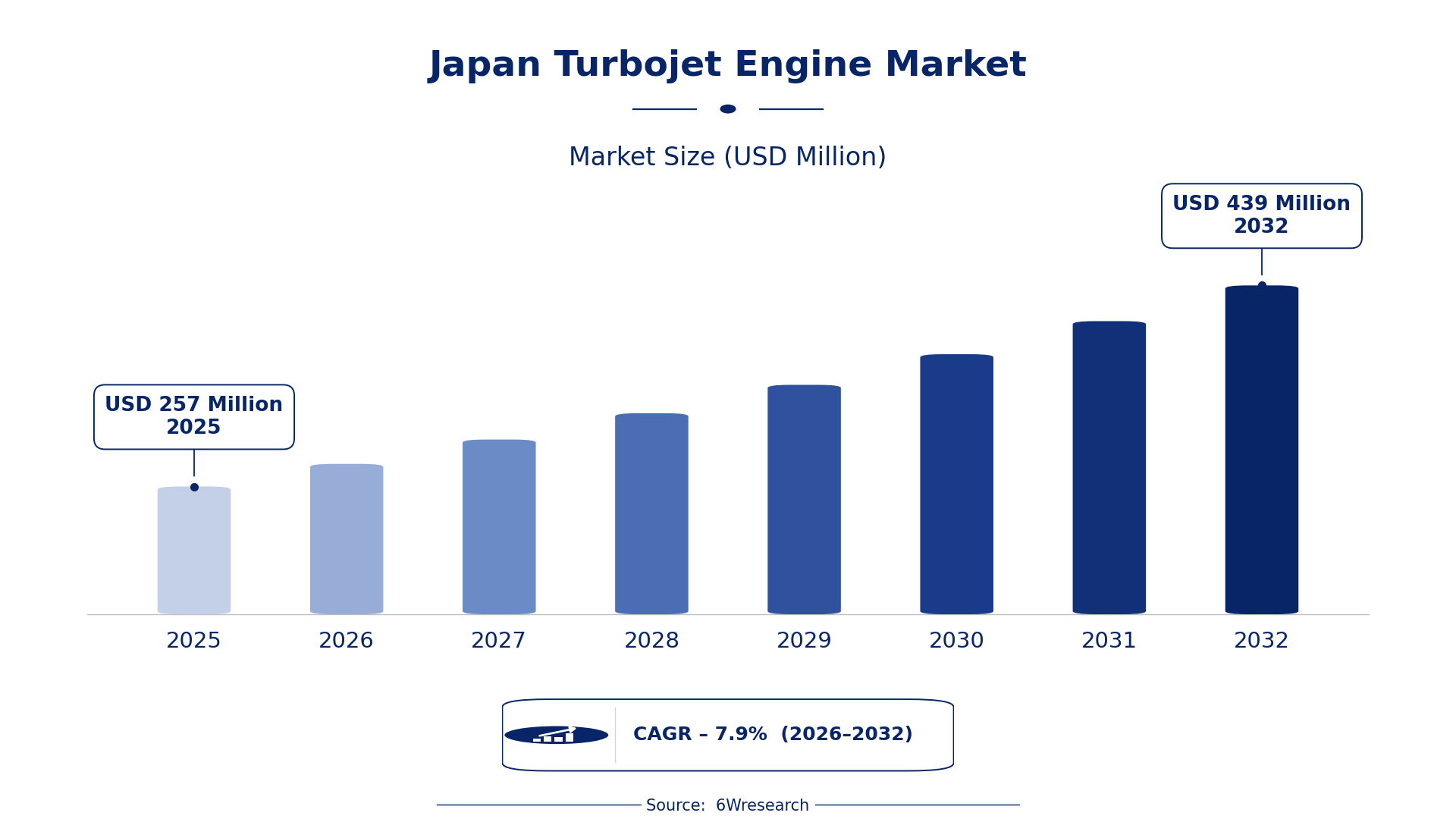
According to 6Wresearch internal database and industry insights, the Japan Turbojet Engine Market was valued at USD 257 Million in 2025 and is projected to reach USD 439 Million by 2032, growing at a CAGR of approximately 7.9% during 2026–2032.
Japan Turbojet Engine Market Highlights
| Report Metric | Details |
| Report Name | Japan Turbojet Engine Market (2026-2032) |
| Market Size 2025 | USD 257 Million |
| Market Size 2032 | USD 439 Million |
| Absolute Growth 2025–2032 | USD 182 Million |
| CAGR 2026–2032 | 7.9% |
| Peak Annual Growth | 8.7% in 2032 |
| Forecast Period | 2026–2032 |
| Historical Data | 2022–2025 |
| Base Year | 2025 |
| Leading Turbojet Engine Type, 2025 | Afterburning Turbojets (51% share) |
| Leading Engine Type, 2025 | Jet Fighter Engines (49% share) |
| Leading Afterburner Options, 2025 | With Afterburners (45% share) |
| Leading Distribution Channel, 2025 | Military Contracts (44% share) |
| Leading End User Industry, 2025 | Air Forces (40% share) |
| Fastest-Growing Turbojet Engine Type | Non-afterburning Turbojets (10.9% CAGR) |
| Fastest-Growing Engine Type | Training Aircraft (11.2% CAGR) |
| Fastest-Growing Afterburner Options | No Afterburner (10.1% CAGR) |
| Fastest-Growing Distribution Channel | Aero Engine OEMs (10.4% CAGR) |
| Fastest-Growing End User Industry | Pilot Training Schools (10.2% CAGR) |
| Growing Sector | Military aviation |
| Key End Users | Air Forces, Pilot Training Schools, Aero Engine OEMs, Engine Overhaul Shops |
Japan Turbojet Engine Market Year-wise Growth Rate and Key Drivers (2022–2032)
This graph illustrates the annual growth rates of the market from 2022 to 2032, highlighting a steady upward trajectory and projected market expansion over the forecast period.
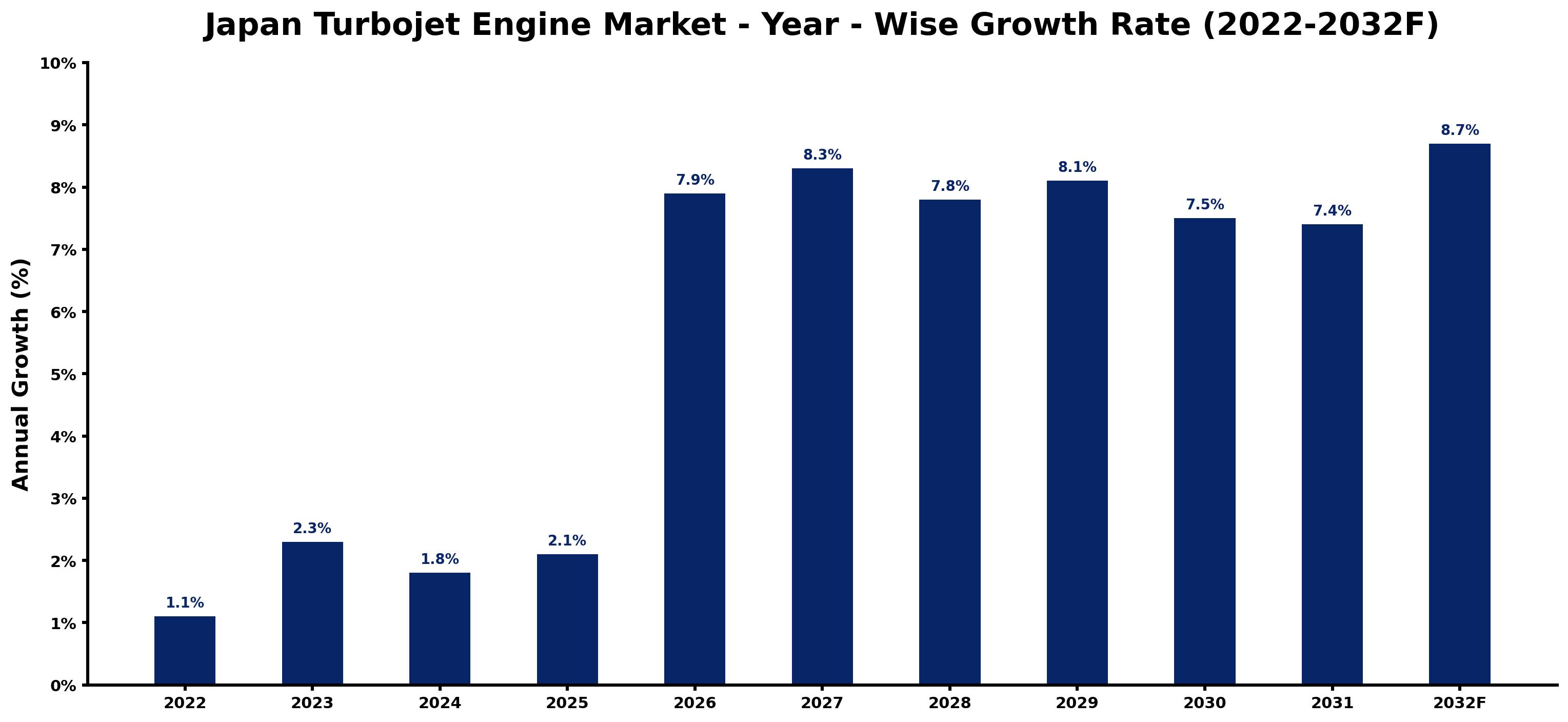
Year by year, the estimates below pair each growth rate with the development that shaped it.
| Year | Estimated Annual Growth (%) | Market Rationale |
| 2022 | 1.1 | The market showed steady growth due to ongoing military aviation projects. |
| 2023 | 2.3 | Demand increased as the defense budget allocated more funds for modernization. |
| 2024 | 1.8 | Growth slowed as some military contracts were delayed or re-evaluated. |
| 2025 | 2.1 | Demand rose again as new pilot training schools opened across the country. |
| 2026 | 7.9 | Investment in aerospace technology is expected to surge, boosting production capabilities. |
| 2027 | 8.3 | The market will continue to grow as military contracts expand with new projects. |
| 2028 | 7.8 | Growth is projected to slow slightly as some projects face regulatory scrutiny. |
| 2029 | 8.1 | Demand is expected to increase as pilot training schools expand their programs. |
| 2030 | 7.5 | Growth will slow due to a temporary dip in military spending plans. |
| 2031 | 7.4 | The market will continue to grow as new technologies are adopted in aviation. |
| 2032 | 8.7 | Demand is projected to peak as military modernization initiatives reach their full potential. |
Note: Market size estimations and growth projections presented in this report are based on 6Wresearch's proprietary forecasting methodology, utilizing the latest available industry data, government publications, and primary research inputs.
Japan Turbojet Engine Market Synopsis
Turbojet engines are integral to military and commercial aviation, utilising a gas turbine to produce thrust. The Japan Turbojet Engine Market is growing due to rising defence budgets and an emphasis on advanced aviation technologies. The allocation of $50 billion for military modernisation in 2023 is a pivotal factor, along with the establishment of new pilot training schools. This growth is supported by the aerospace engineering capabilities in the Tokyo metropolitan area and ongoing demand from air forces and pilot training sectors.
Market Dynamics Impact Analysis (2026–2032)
| Factor | Type | Impact | Primary Segment Affected |
| Increased defense spending | Driver | High | Jet Fighter Engines |
| Expansion of pilot training schools | Driver | High | Training Aircraft |
| Growing demand for military modernization | Opportunity | High | Military Contracts |
| Investment in aerospace technology | Opportunity | Medium | Aero Engine OEMs |
| Regulatory scrutiny on military projects | Restraint | High | Jet Fighter Engines |
| Limited domestic production capacity | Restraint | Medium | Training Aircraft |
| Delays in military contracts | Challenge | High | Military Contracts |
| High costs of advanced technologies | Challenge | Medium | Aero Engine OEMs |
Evaluation of Drivers in Japan Turbojet Engine Market (2026–2032)
The table below links each growth driver to the segment it affects and the evidence for it.
| Drivers | Primary Segment Affected | Why It Matters (Evidence) |
| Increased funding for military projects | Jet Fighter Engines | Japan's defense budget for 2023 allocated $50 billion, leading to more purchases of jet fighter engines. |
| Expansion of pilot training facilities | Training Aircraft | The establishment of over 200 pilot training schools nationwide increases demand for training aircraft. |
| Investment in advanced aviation technologies | Military Contracts | The Ministry of Economy, Trade and Industry supports advanced technologies, encouraging contracts for new military engines. |
| Growing interest in aerospace innovation | Aero Engine OEMs | The Japan Aerospace Research Institute conducts research, driving demand for new engines. |
| Collaborations with international aerospace agencies | Jet Fighter Engines | The Japan Aerospace Exploration Agency collaborates internationally, improving technology and production capabilities. |
Buyers are adding capacity as investment in military aviation rises, with Japan's defense budget reaching $50 billion in 2023, driving demand for jet fighter engines. Research conducted by the Japan Aerospace Research Institute stimulates interest in advanced aviation technologies.
Evaluation of Restraints in Japan Turbojet Engine Market
These are the pressures that could keep growth below its potential.
| Market Restraint | Primary Segment Affected | Why It Matters (Evidence) |
| Regulatory scrutiny on military contracts | Jet Fighter Engines | Delays in approvals due to regulatory scrutiny hinder timely procurement of jet fighter engines. |
| Limited domestic production capacity | Training Aircraft | Insufficient local manufacturing capabilities restrict the supply of training aircraft. |
| High costs of advanced technologies | Military Contracts | The rising costs associated with advanced military technologies deter some buyers from making purchases. |
| Delays in project timelines | Aero Engine OEMs | Unforeseen delays in military projects can disrupt the supply chain for aero engine manufacturers. |
| Dependence on government contracts | Jet Fighter Engines | Heavy reliance on government contracts makes the market vulnerable to budget cuts. |
Japan Turbojet Engine Market Challenges
Japan produced only 50 military aircraft engines last year, highlighting a cost issue linked to inadequate investment in modern manufacturing technologies, which delays military readiness for the air force. A shortage of skilled workers complicates production, as over 80,000 aerospace employees struggle to adapt to new technologies, potentially extending project timelines for manufacturers. Buyers face rising costs due to intensified competition among domestic suppliers, compelling pilot training schools to allocate more budget for engine procurement. Limited competitive pressure from international markets restricts innovation, reducing options for military contracts and increasing reliance on outdated technologies.
Trends in the Japan Turbojet Engine Market
Several trends are reshaping the Japan Turbojet Engine Market; the most important are set out below.
- Shift towards Advanced Pilot Training: The establishment of over 200 pilot training schools is transforming the training approach. With an increasing focus on modern aviation techniques, demand for advanced training aircraft has surged, reflecting a 10% increase in enrolment.
- Growth in Military Modernization Initiatives: Japan's defence budget allocation of $50 billion in 2023 is driving military modernisation. This investment is leading to increased procurement of jet fighter engines and advanced technologies.
- Increased Collaboration in Aerospace Research: The Japan Aerospace Exploration Agency is forming partnerships with international agencies. This collaboration is promoting innovation in jet engine technology, with a focus on sustainable practices.
- Focus on Energy Efficiency Standards: The Act on the Rational Use of Energy mandates improvements in energy efficiency for large users. This regulation is prompting manufacturers to adopt more efficient turbojet engines.
Investment Opportunities in the Japan Turbojet Engine Market
The following opportunities in the Japan Turbojet Engine Market pair current demand with a clear way in.
- Supply of Advanced Turbojet Engines: The growing demand for advanced turbojet engines presents an opportunity, with the defence budget reaching $50 billion. Suppliers can target military contracts to meet this demand.
- Investment in Pilot Training Aircraft: Pilot training schools are expanding, creating a need for new training aircraft. Suppliers can enter this market through partnerships with educational institutions.
- Development of Turbojet Repower Kits: The market for turbojet repower kits is emerging as vintage aircraft upgrades gain popularity. Suppliers can capitalise on this trend by targeting specialty aviation shops.
- Expansion of Military Contracts: With military modernisation initiatives underway, the demand for military contracts is set to rise. Suppliers should focus on establishing relationships with the Ministry of Defence.
Government Initiatives in the Japan Turbojet Engine Market
The Industrial Safety and Health Act (1972) mandates employer responsibilities for hazardous materials and machinery, ensuring safety standards in turbojet engine production. Compliance with these regulations is necessary for manufacturers to maintain operational licences and avoid penalties.
The Japan Defence Agency oversees military aviation projects, funding various initiatives aimed at improving Japan's defence capabilities. In 2023, $50 billion was allocated for military modernisation, directly impacting turbojet engine procurement.
Future Insight of the Japan Turbojet Engine Market
The investment pipeline for advanced aviation technologies will grow significantly by 2032, creating substantial demand for turbojet engines. The Japan Aerospace Exploration Agency's collaboration with international space agencies will drive research initiatives that open new opportunities for suppliers. As specialised aviation shops in the Tokyo region expand, they will improve maintenance efficiency, providing better service for buyers. The Ministry of Defence's support for innovative projects will motivate suppliers to develop cutting-edge solutions, ultimately benefiting the entire aerospace sector.
Market Segmentation Analysis
Japan Turbojet Engine Market report covers a detailed analysis of the following market segments:
By Turbojet Engine Type – Afterburning Turbojets Lead, Non-afterburning Turbojets Expected to Grow Fastest
According to Saurav Kr Singh, Senior Research Analyst at 6Wresearch, in 2025, Afterburning Turbojets led the turbojet engine type split with a 51% share. Afterburning turbojets lead the market due to their essential function in military aviation, providing the necessary thrust for operational effectiveness. The Japanese Air Self-Defense Force's reliance on these engines highlights their significance in maintaining air superiority. Non-afterburning Turbojets are set to record the highest CAGR in this split, 10.9% over 2026–2032. Non-afterburning turbojets are rapidly gaining traction as they are increasingly favoured in commercial and training aircraft, reflecting a trend towards operational efficiency. The presence of over 200 pilot training schools in Japan adopting these engines is a key factor in their growth. Suppliers should prioritise the development of non-afterburning turbojets to align with the increasing demand from the commercial aviation sector.
By Engine Type – Jet Fighter Engines Lead, Training Aircraft Expected to Grow Fastest
The largest engine type category in 2025 was Jet Fighter Engines, at 49% of revenue. Jet fighter engines hold the largest share due to their essential role in maintaining Japan's military readiness and national security. The Japan Defense Agency prioritises these engines, reflecting their significance in defence operations. Over 2026–2032, Training Aircraft is expected to post the fastest growth, at a CAGR of 11.2%. Training aircraft engines are growing rapidly, driven by the increasing number of pilot training schools that are vital for developing skilled aviators. With over 200 institutions in Japan, the demand for these engines is projected to rise significantly. Suppliers should tailor their offerings to address the specific requirements of pilot training schools.
By Afterburner Options – With Afterburners Lead, No Afterburner Expected to Grow Fastest
With Afterburners held 45% of the Japan Turbojet Engine Market by afterburner options in 2025. Engines with afterburners are prevalent in military applications, providing the necessary thrust for advanced jet fighters used by Japan's air forces. This capability is vital for maintaining air superiority in defence operations. The quickest growth will come from No Afterburner, forecast to expand at a CAGR of 10.1% between 2026 and 2032. Engines without afterburners are rapidly gaining traction, particularly in commercial and training environments, where efficiency is paramount. Their adoption in pilot training schools is indicative of a broader trend towards more economical aviation solutions. Suppliers must adapt their strategies to include more no afterburner options to align with market preferences.
By Distribution Channel – Military Contracts Lead, Aero Engine OEMs Expected to Grow Fastest
Military Contracts took 44% of distribution channel revenue in 2025, more than any other category. Military contracts are the primary source of demand for turbojet engines, driven by substantial allocations in Japan's defence budget, which reached $50 billion in 2023. This funding is essential for maintaining and upgrading military capabilities. Aero Engine OEMs are projected to grow fastest, at a CAGR of 10.4% during 2026–2032. Aero engine OEMs are experiencing the fastest growth as they serve as key suppliers for new aircraft manufacturing, reflecting the ongoing expansion of the aerospace sector. The Tokyo metropolitan area is a hub for aerospace engineering, supporting this trend. Suppliers should strengthen partnerships with aero engine OEMs to capture emerging opportunities in the market.
By End User Industry – Air Forces Lead, Pilot Training Schools Expected to Grow Fastest
With 40% of end user industry revenue in 2025, Air Forces was the largest category. Air forces represent the largest segment of turbojet engine consumption, as they are crucial for Japan's defence capabilities. The extensive fleet maintained by the Japan Air Self-Defense Force highlights the importance of this end user. Pilot Training Schools are set to record the highest CAGR in this split, 10.2% over 2026–2032. Pilot training schools are witnessing the fastest growth, propelled by the rising demand for skilled pilots in the aviation sector. With more than 200 training institutions nationwide, the need for engines in this area is expected to surge. Manufacturers should concentrate on creating engines that cater specifically to the needs of pilot training schools to seize this growth opportunity.
Key Attractiveness of the Report
- 10 Years of Market Numbers
- Historical Data Starting from 2022 to 2025
- Base Year 2025
- Forecast Data until 2032
- Key Performance Indicators Impacting the Market
- Major Upcoming Developments and Projects
Key Highlights of the Report:
- Japan Turbojet Engine Market Outlook
- Market Size of Japan Turbojet Engine Market, 2025
- Forecast of Japan Turbojet Engine Market, 2032
- Historical Data and Forecast of Japan Turbojet Engine Revenues & Volume for the Period 2022-2032F
- Japan Turbojet Engine Market Trend Evolution
- Japan Turbojet Engine Market Drivers and Challenges
- Japan Turbojet Engine Price Trends
- Japan Turbojet Engine Porter's Five Forces
- Japan Turbojet Engine Industry Life Cycle
- Historical Data and Forecast of Japan Turbojet Engine Market Revenues & Volume By Turbojet Engine Type for the Period 2022-2032F
- Historical Data and Forecast of Japan Turbojet Engine Market Revenues & Volume By Afterburning Turbojets for the Period 2022-2032F
- Historical Data and Forecast of Japan Turbojet Engine Market Revenues & Volume By Non-afterburning Turbojets for the Period 2022-2032F
- Historical Data and Forecast of Japan Turbojet Engine Market Revenues & Volume By Turbojet Repower Kits for the Period 2022-2032F
- Historical Data and Forecast of Japan Turbojet Engine Market Revenues & Volume By Vintage Turbojets for the Period 2022-2032F
- Historical Data and Forecast of Japan Turbojet Engine Market Revenues & Volume By Engine Type for the Period 2022-2032F
- Historical Data and Forecast of Japan Turbojet Engine Market Revenues & Volume By Jet Fighter Engines for the Period 2022-2032F
- Historical Data and Forecast of Japan Turbojet Engine Market Revenues & Volume By Training Aircraft for the Period 2022-2032F
- Historical Data and Forecast of Japan Turbojet Engine Market Revenues & Volume By Industrial Use for the Period 2022-2032F
- Historical Data and Forecast of Japan Turbojet Engine Market Revenues & Volume By Classic Aircraft for the Period 2022-2032F
- Historical Data and Forecast of Japan Turbojet Engine Market Revenues & Volume By Afterburner Options for the Period 2022-2032F
- Historical Data and Forecast of Japan Turbojet Engine Market Revenues & Volume By With Afterburners for the Period 2022-2032F
- Historical Data and Forecast of Japan Turbojet Engine Market Revenues & Volume By No Afterburner for the Period 2022-2032F
- Historical Data and Forecast of Japan Turbojet Engine Market Revenues & Volume By Jet-Repowered Units for the Period 2022-2032F
- Historical Data and Forecast of Japan Turbojet Engine Market Revenues & Volume By Original Spec for the Period 2022-2032F
- Historical Data and Forecast of Japan Turbojet Engine Market Revenues & Volume By Distribution Channel for the Period 2022-2032F
- Historical Data and Forecast of Japan Turbojet Engine Market Revenues & Volume By Military Contracts for the Period 2022-2032F
- Historical Data and Forecast of Japan Turbojet Engine Market Revenues & Volume By Aero Engine OEMs for the Period 2022-2032F
- Historical Data and Forecast of Japan Turbojet Engine Market Revenues & Volume By Engine Overhaul Shops for the Period 2022-2032F
- Historical Data and Forecast of Japan Turbojet Engine Market Revenues & Volume By Specialty Aviation Shops for the Period 2022-2032F
- Historical Data and Forecast of Japan Turbojet Engine Market Revenues & Volume By End User Industry for the Period 2022-2032F
- Historical Data and Forecast of Japan Turbojet Engine Market Revenues & Volume By Air Forces for the Period 2022-2032F
- Historical Data and Forecast of Japan Turbojet Engine Market Revenues & Volume By Pilot Training Schools for the Period 2022-2032F
- Historical Data and Forecast of Japan Turbojet Engine Market Revenues & Volume By Test & Experimental Use for the Period 2022-2032F
- Historical Data and Forecast of Japan Turbojet Engine Market Revenues & Volume By Collector Restorations for the Period 2022-2032F
- Japan Turbojet Engine Import Export Trade Statistics
- Market Opportunity Assessment By Turbojet Engine Type
- Market Opportunity Assessment By Engine Type
- Market Opportunity Assessment By Afterburner Options
- Market Opportunity Assessment By Distribution Channel
- Market Opportunity Assessment By End User Industry
- Japan Turbojet Engine Top Companies Market Share
- Japan Turbojet Engine Competitive Benchmarking By Technical and Operational Parameters
- Japan Turbojet Engine Company Profiles
- Japan Turbojet Engine Key Strategic Recommendations
Market Covered
This report examines the market across the segments below.
By Turbojet Engine Type
- Afterburning Turbojets
- Non-afterburning Turbojets
- Turbojet Repower Kits
- Vintage Turbojets
By Engine Type
- Jet Fighter Engines
- Training Aircraft
- Industrial Use
- Classic Aircraft
By Afterburner Options
- With Afterburners
- No Afterburner
- Jet-Repowered Units
- Original Spec
By Distribution Channel
- Military Contracts
- Aero Engine OEMs
- Engine Overhaul Shops
- Specialty Aviation Shops
By End User Industry
- Air Forces
- Pilot Training Schools
- Test & Experimental Use
- Collector Restorations































