Japan Turboprop Drive System Market Size & Growth Rate
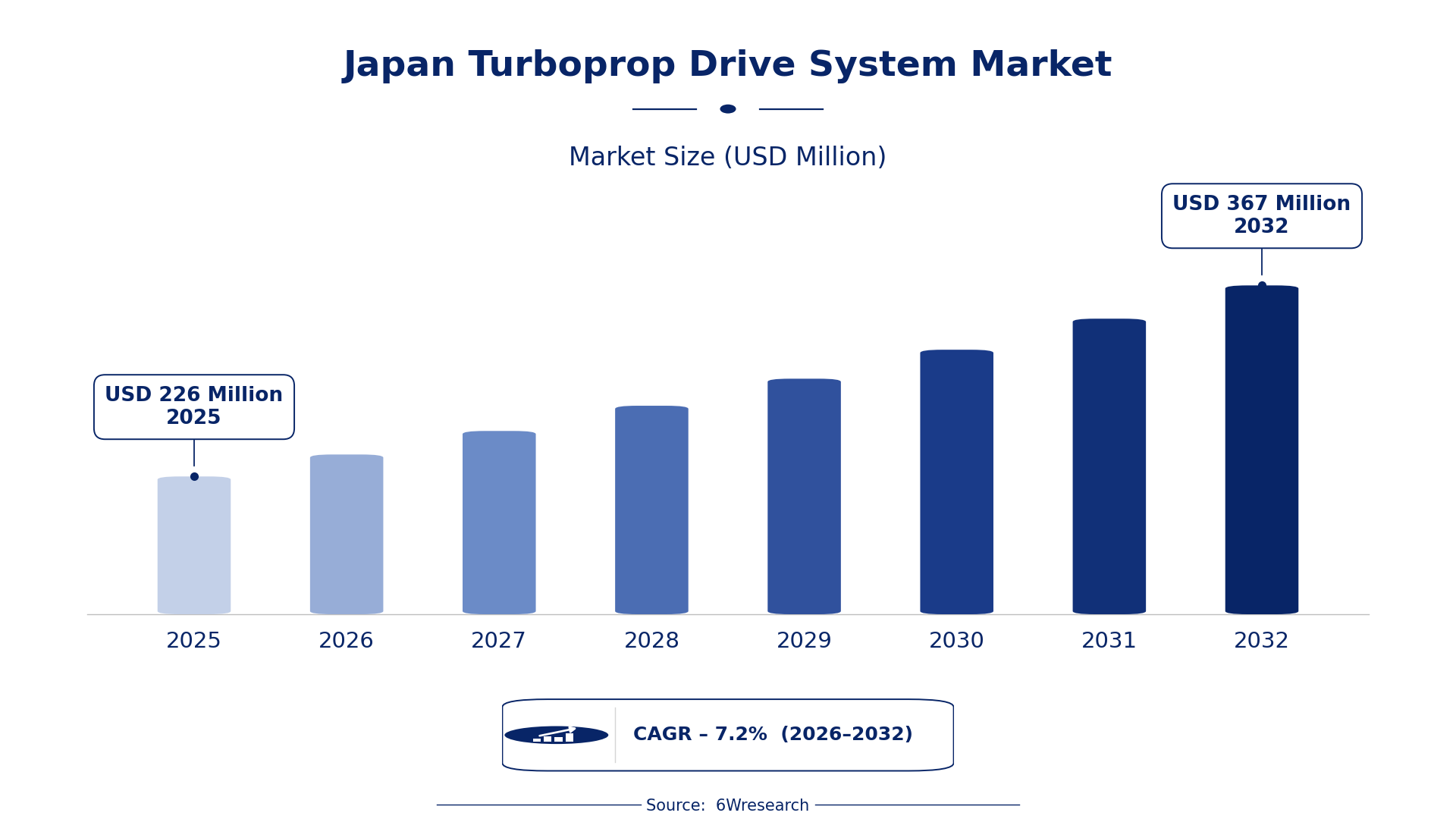
According to 6Wresearch internal database and industry insights, the Japan Turboprop Drive System Market was valued at USD 226 Million in 2025 and is projected to reach USD 367 Million by 2032, growing at a CAGR of approximately 7.2% during 2026–2032.
Japan Turboprop Drive System Market Highlights
| Report Metric | Details |
| Report Name | Japan Turboprop Drive System Market (2026-2032) |
| Market Size 2025 | USD 226 Million |
| Market Size 2032 | USD 367 Million |
| Absolute Growth 2025–2032 | USD 141 Million |
| CAGR 2026–2032 | 7.2% |
| Peak Annual Growth | 9.3% in 2029 |
| Forecast Period | 2026–2032 |
| Historical Data | 2022–2025 |
| Base Year | 2025 |
| Leading Turboprop Drive System, 2025 | Propeller Reduction Gears (40% share) |
| Leading Component Type, 2025 | Gearbox Assemblies (44% share) |
| Leading Transmission Type, 2025 | Straight / Bevel Gears (35% share) |
| Leading Distribution Channel, 2025 | OEM Suppliers (40% share) |
| Leading End User Industry, 2025 | Regional Airliners (46% share) |
| Fastest-Growing Turboprop Drive System | Gearbox Overhaul Kits (9.6% CAGR) |
| Fastest-Growing Component Type | Rebuild Assemblies (9.8% CAGR) |
| Fastest-Growing Transmission Type | Hydraulics / Elec. (10.1% CAGR) |
| Fastest-Growing Distribution Channel | MRO Providers (8.6% CAGR) |
| Fastest-Growing End User Industry | Cargo Aircraft (8.8% CAGR) |
| Growing Sector | Aviation |
| Key End Users | Regional Airliners, Cargo Aircraft, Military Trainers |
Japan Turboprop Drive System Market Year-wise Growth Rate and Key Drivers (2022–2032)
This graph illustrates the annual growth rates of the market from 2022 to 2032, highlighting a steady upward trajectory and projected market expansion over the forecast period.
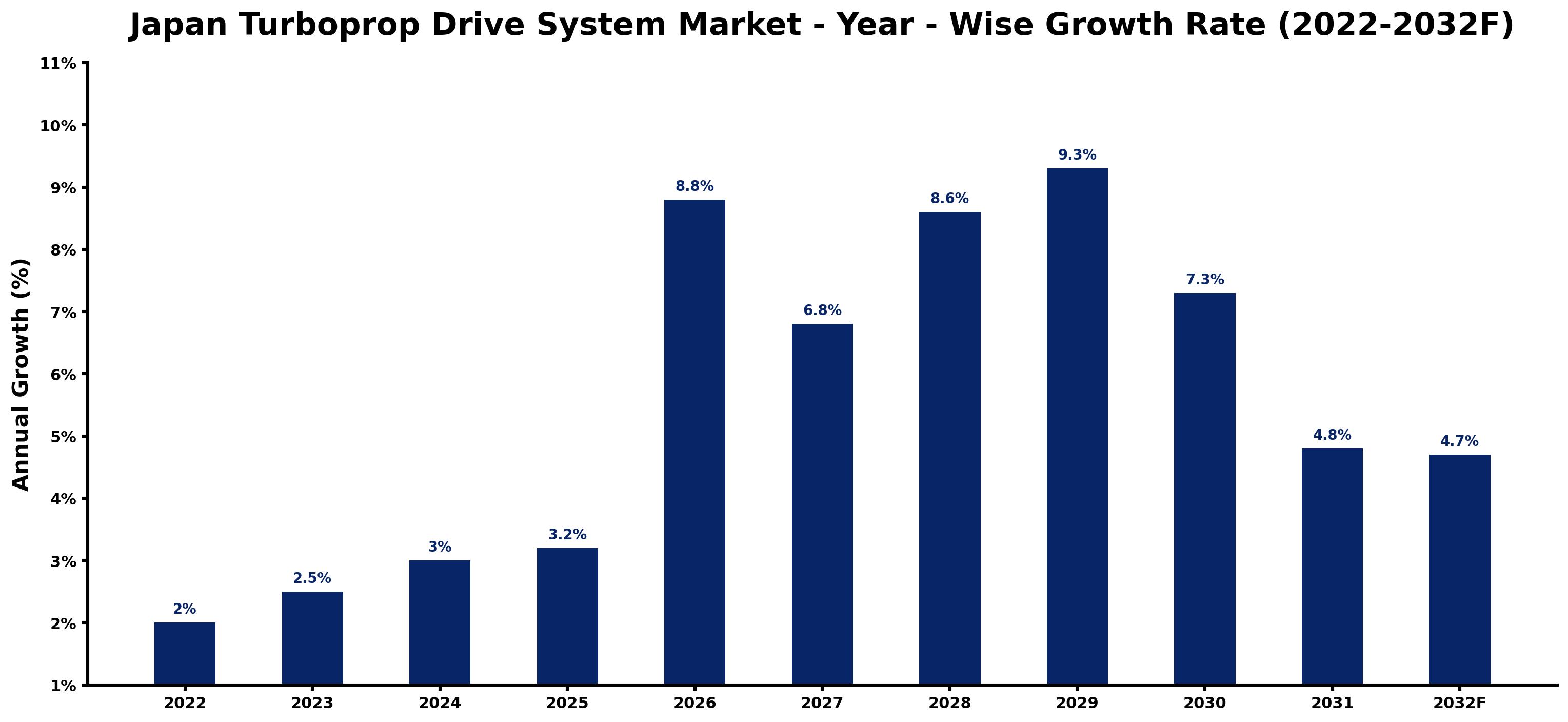
The following figures match every annual growth estimate with the main market development of that year, giving the reasoning behind each rise or slowdown.
| Year | Estimated Annual Growth (%) | Market Rationale |
| 2022 | 2.0 | The aviation industry showed steady activity with existing turboprop systems in use. |
| 2023 | 2.5 | Increased regional connectivity spurred demand for turboprop aircraft and components. |
| 2024 | 3.0 | Growth continued as regional airliners expanded their fleets to meet rising passenger numbers. |
| 2025 | 3.2 | The market experienced heightened demand due to improvements in aviation safety standards. |
| 2026 | 8.8 | A surge in domestic aircraft manufacturing initiatives is expected to drive demand. |
| 2027 | 6.8 | Demand growth slows as the market adjusts to new supply chain conditions. |
| 2028 | 8.6 | Continued investments in regional air travel boost demand for turboprop systems. |
| 2029 | 9.3 | The peak growth year sees a rise in orders for new turboprop aircraft. |
| 2030 | 7.3 | Growth moderates as market stabilisation occurs following peak demand levels. |
| 2031 | 4.8 | A slower growth rate reflects a maturing market with established players. |
| 2032 | 4.7 | The market continues to grow, driven by ongoing regional connectivity initiatives. |
Note: Market size estimations and growth projections presented in this report are based on 6Wresearch's proprietary forecasting methodology, utilizing the latest available industry data, government publications, and primary research inputs.
Japan Turboprop Drive System Market Synopsis
A turboprop drive system is a propulsion solution that employs a turbine engine to drive a propeller, essential for powering regional airliners, cargo aircraft, and military trainers. The Japan Turboprop Drive System Market is expanding due to increased regional air traffic, with turboprop aircraft accounting for approximately 30% of this sector. The aviation industry is supported by government initiatives aimed at improving domestic manufacturing capabilities and promoting innovation in aerospace technology, including funding programs from the Tokyo Metropolitan Government.
Market Dynamics Impact Analysis (2026–2032)
| Factor | Type | Impact | Primary Segment Affected |
| Rising regional air traffic is driving demand for turboprop aircraft and their components. | Driver | High | Propeller Reduction Gears |
| Government initiatives to enhance domestic aircraft manufacturing capabilities create new opportunities. | Opportunity | High | Propeller Reduction Gears |
| Maintenance and repair complexities can hinder the growth of the turboprop market. | Restraint | High | Gearbox Overhaul Kits |
| The need for skilled labour in the aviation sector presents a challenge for suppliers. | Challenge | High | Propeller Reduction Gears |
| Increasing demand for cargo aircraft fuels the growth of turboprop systems. | Driver | Medium | Cargo Aircraft |
| The Tokyo region's hub status for maintenance operations offers significant growth potential. | Opportunity | Medium | MRO Providers |
| Regulatory compliance can increase operational costs for manufacturers. | Restraint | Medium | Accessory Gearboxes |
| Technological advancements in competing propulsion systems may pose risks. | Challenge | Medium | Driveshafts |
Evaluation of Drivers in Japan Turboprop Drive System Market (2026–2032)
The following drivers explain most of the expected growth.
| Drivers | Primary Segment Affected | Why It Matters (Evidence) |
| Growing regional air traffic increases the demand for turboprop aircraft. | Propeller Reduction Gears | In 2022, turboprop aircraft accounted for about 30% of Japan's regional air traffic, prompting airlines to expand their fleets. |
| Government initiatives to boost domestic manufacturing capabilities are increasing supply. | Gearbox Assemblies | In 2023, a government initiative aimed to improve domestic aircraft manufacturing capabilities, leading to increased production. |
| The need for efficient cargo transport drives demand for turboprop systems. | Cargo Aircraft | Japan has over 100 regional airliners operating turboprop aircraft, essential for freight transport. |
| Maintenance and repair operations in Tokyo support the turboprop market. | MRO Providers | The Tokyo region is a hub for turboprop maintenance and repair operations, ensuring ongoing demand. |
| Military training requirements increase the need for turboprop systems. | Military Trainers | Military trainers are essential for pilot training, driving demand for reliable turboprop systems. |
What keeps demand rising is the increasing regional air traffic, with turboprop aircraft making up about 30% of this sector. The Tokyo region serves as a hub for maintenance and repair operations, ensuring ongoing demand for turboprop systems. The need for efficient cargo transport drives demand, as over 100 regional airliners operate turboprop aircraft. Training requirements for military pilots also contribute to demand, as military trainers are essential for aviation education in Japan.
Evaluation of Restraints in Japan Turboprop Drive System Market
The table below lists the restraints and the evidence behind each.
| Market Restraint | Primary Segment Affected | Why It Matters (Evidence) |
| Maintenance and repair complexities can hinder the growth of the turboprop market. | Gearbox Overhaul Kits | The need for regular maintenance can lead to increased operational costs for airlines, raising expenses by approximately 15%. |
| Regulatory compliance can increase operational costs for manufacturers. | Accessory Gearboxes | Compliance with aviation safety standards requires investment in quality assurance, estimated at 10% of production costs. |
| A shortage of skilled labour in the aviation sector presents a challenge for suppliers. | Propeller Reduction Gears | A lack of qualified technicians can delay production and maintenance schedules, potentially extending timelines by several months. |
| Technological advancements in competing propulsion systems may pose risks. | Driveshafts | Emerging technologies could divert investment away from traditional turboprop systems, impacting market share by up to 20%. |
| Market saturation in certain regions can limit growth opportunities. | Propeller Reduction Gears | Established players dominate the market, making it difficult for new entrants to capture more than 5% market share. |
Japan Turboprop Drive System Market Challenges
Producers in the aviation sector encounter a skills shortage, as the workforce of approximately 200,000 lacks the necessary training for advanced turboprop manufacturing. This gap exists due to insufficient specialised training programmes, causing production delays that can extend timelines by up to six months. Many producers rely on outdated technology, which reduces efficiency and can delay project completion by three months. Increased competition from foreign manufacturers forces local producers to lower prices, squeezing profit margins and limiting their ability to invest in new technologies.
Trends in the Japan Turboprop Drive System Market
The following changes are redrawing the Japan Turboprop Drive System Market.
- Shift from Traditional to Advanced Manufacturing Techniques: In 2023, the adoption of advanced manufacturing techniques began to reshape the turboprop sector. The Tokyo Metropolitan Government supports aerospace innovation through funding programs, improving production efficiency and quality.
- Transition from Domestic to International Markets: As of 2022, Japanese turboprop manufacturers are increasingly targeting international markets. This shift is driven by the need to diversify revenue streams and mitigate risks associated with domestic demand fluctuations.
- Emergence of Eco-Friendly Turboprop Technologies: The aviation sector is prioritising eco-friendly technologies, with initiatives launched in 2023 to develop sustainable turboprop systems. This trend aligns with global decarbonisation goals and attracts environmentally conscious buyers.
- Growing Focus on Maintenance and Repair Services: The demand for MRO services has surged since 2022, reflecting the need for efficient maintenance of turboprop systems. The Tokyo region's hub status for maintenance operations underscores this trend.
Investment Opportunities in the Japan Turboprop Drive System Market
The following areas offer the clearest openings for investors and suppliers in the Japan Turboprop Drive System Market.
- Regional Airliners Seeking Efficient Solutions: Regional airliners are increasingly looking for efficient turboprop systems, with over 100 operating in Japan. This presents an opportunity for suppliers to provide advanced propulsion technologies.
- Investment in MRO Capabilities: With the Tokyo region as a maintenance hub, investment in MRO capabilities is essential. In 2023, funding programs support the expansion of maintenance facilities.
- Cargo Aircraft Demand Surges: The demand for cargo aircraft is rising, driven by increased freight transport needs. Suppliers can capitalise on this growth by offering tailored turboprop solutions.
- Aerospace Innovation Funding Opportunities: The Tokyo Metropolitan Government has launched funding programs to support aerospace innovation. This presents a timely opportunity for investors to enter the market.
Government Initiatives in the Japan Turboprop Drive System Market
The Building Energy Efficiency Act, amended in 2022, requires all new aviation facilities to meet energy efficiency standards from April 2025. This measure strengthens the regulatory framework for manufacturers, ensuring compliance with modern energy standards and promoting sustainability in the aviation sector.
The Japan Aerospace Exploration Agency oversees standards for aviation components, ensuring that manufacturers adhere to stringent quality requirements. This agency certifies components, which is essential for buyers seeking reliable turboprop systems.
Future Insight of the Japan Turboprop Drive System Market
A government initiative for regional aerospace manufacturing will support the establishment of advanced production facilities by 2032. This will allow suppliers to adopt new technologies that improve production efficiency. As regional air traffic rises, turboprop aircraft demand is expected to increase, with projections indicating a 15% growth in operational fleets. These advancements will create new opportunities for buyers and suppliers, driving innovation in the market.
Market Segmentation Analysis
Japan Turboprop Drive System Market report covers a detailed analysis of the following market segments:
By Turboprop Drive System – Propeller Reduction Gears Lead, Gearbox Overhaul Kits Expected to Grow Fastest
According to Saurav Kr Singh, Senior Research Analyst at 6Wresearch, Propeller Reduction Gears took 40% of turboprop drive system revenue in 2025, more than any other category. Propeller reduction gears play a critical role in optimising the engine speed to match the propeller speed, making them indispensable for over 100 regional airliners in Japan. The concentration of maintenance and repair operations in the Tokyo region further cements their dominant market position. Gearbox Overhaul Kits are set to record the highest CAGR in this split, 9.6% over 2026–2032. The increasing demand for gearbox overhaul kits is driven by the growing need for maintenance of existing turboprop systems, particularly as Japan's aviation market continues to expand. Additionally, government initiatives aimed at boosting domestic aircraft manufacturing capabilities are also contributing to this segment's growth. Suppliers should prioritise the production of gearbox overhaul kits to meet the rising maintenance demands.
By Component Type – Gearbox Assemblies Lead, Rebuild Assemblies Expected to Grow Fastest
With 44% of component type revenue in 2025, Gearbox Assemblies was the largest category. Gearbox assemblies are essential for the overall functionality of turboprop drive systems, making them a primary choice for manufacturers. Their importance is underscored by the aviation industry's reliance on high-quality components to ensure safety and performance. Rebuild Assemblies are projected to grow fastest, at a CAGR of 9.8% during 2026–2032. Rebuild assemblies are experiencing rapid growth as refurbishment of existing systems becomes more common, reflecting a trend towards sustainability in the aviation sector. This is particularly relevant as operators seek cost-effective solutions to maintain their fleets. Buyers may benefit from focusing on rebuild assemblies to maximise the lifespan of their existing systems.
By Transmission Type – Straight / Bevel Gears Lead, Hydraulics / Elec. Expected to Grow Fastest
In 2025, Straight / Bevel Gears led the transmission type split with a 35% share. Straight and bevel gears are fundamental for providing the necessary mechanical advantage in turboprop drive systems, making them a preferred choice among manufacturers. Their extensive use in the aviation sector reinforces their leading market share. Over 2026–2032, Hydraulics / Elec. is expected to post the fastest growth, at a CAGR of 10.1%. Hydraulics and electric systems are becoming increasingly relevant in specific applications, driven by technological advancements and evolving operational requirements. This growth indicates a shift in the industry's focus towards more diverse transmission solutions. Suppliers should consider incorporating hydraulics and electric systems into their product lines to capture emerging opportunities.
By Distribution Channel – OEM Suppliers Lead, MRO Providers Expected to Grow Fastest
The largest distribution channel category in 2025 was OEM Suppliers, at 40% of revenue. OEM suppliers are the main source of original equipment for new aircraft, establishing their dominant role in the market. Their critical involvement in the supply chain ensures that new turboprop systems meet the latest standards and technologies. The quickest growth will come from MRO Providers, forecast to expand at a CAGR of 8.6% between 2026 and 2032. MRO providers are experiencing increased demand due to the rising need for maintenance and repair of existing aircraft systems, indicating a shift towards sustaining current fleets. This trend highlights the importance of MRO services in the aviation sector. Buyers should collaborate with MRO providers to ensure timely maintenance and support for their aircraft.
By End User Industry – Regional Airliners Lead, Cargo Aircraft Expected to Grow Fastest
Regional Airliners held 46% of the Japan Turboprop Drive System Market by end user industry in 2025. Regional airliners are the primary users of turboprop systems, accounting for around 30% of Japan's regional air traffic. Their dependence on turboprop technology for operational efficiency solidifies their leading market position. Cargo Aircraft is set to record the highest CAGR in this split, 8.8% over 2026–2032. Cargo aircraft are rapidly increasing their adoption of turboprop systems, spurred by the need for efficient freight transport solutions. This trend aligns with broader logistics developments and enhances their market share. Suppliers should tailor their products to meet the specific requirements of cargo aircraft operators.
Key Attractiveness of the Report
- 10 Years of Market Numbers
- Historical Data Starting from 2022 to 2025
- Base Year 2025
- Forecast Data until 2032
- Key Performance Indicators Impacting the Market
- Major Upcoming Developments and Projects
Key Highlights of the Report:
- Japan Turboprop Drive System Market Outlook
- Market Size of Japan Turboprop Drive System Market, 2025
- Forecast of Japan Turboprop Drive System Market, 2032
- Historical Data and Forecast of Japan Turboprop Drive System Revenues & Volume for the Period 2022-2032F
- Japan Turboprop Drive System Market Trend Evolution
- Japan Turboprop Drive System Market Drivers and Challenges
- Japan Turboprop Drive System Price Trends
- Japan Turboprop Drive System Porter's Five Forces
- Japan Turboprop Drive System Industry Life Cycle
- Historical Data and Forecast of Japan Turboprop Drive System Market Revenues & Volume By Turboprop Drive System for the Period 2022-2032F
- Historical Data and Forecast of Japan Turboprop Drive System Market Revenues & Volume By Propeller Reduction Gears for the Period 2022-2032F
- Historical Data and Forecast of Japan Turboprop Drive System Market Revenues & Volume By Propeller Shafts for the Period 2022-2032F
- Historical Data and Forecast of Japan Turboprop Drive System Market Revenues & Volume By Gearbox Overhaul Kits for the Period 2022-2032F
- Historical Data and Forecast of Japan Turboprop Drive System Market Revenues & Volume By Accessory Gearboxes for the Period 2022-2032F
- Historical Data and Forecast of Japan Turboprop Drive System Market Revenues & Volume By Component Type for the Period 2022-2032F
- Historical Data and Forecast of Japan Turboprop Drive System Market Revenues & Volume By Gearbox Assemblies for the Period 2022-2032F
- Historical Data and Forecast of Japan Turboprop Drive System Market Revenues & Volume By Driveshafts for the Period 2022-2032F
- Historical Data and Forecast of Japan Turboprop Drive System Market Revenues & Volume By Rebuild Assemblies for the Period 2022-2032F
- Historical Data and Forecast of Japan Turboprop Drive System Market Revenues & Volume By Auxiliary Drives for the Period 2022-2032F
- Historical Data and Forecast of Japan Turboprop Drive System Market Revenues & Volume By Transmission Type for the Period 2022-2032F
- Historical Data and Forecast of Japan Turboprop Drive System Market Revenues & Volume By Straight / Bevel Gears for the Period 2022-2032F
- Historical Data and Forecast of Japan Turboprop Drive System Market Revenues & Volume By Steel / Composite for the Period 2022-2032F
- Historical Data and Forecast of Japan Turboprop Drive System Market Revenues & Volume By Full Overhaul for the Period 2022-2032F
- Historical Data and Forecast of Japan Turboprop Drive System Market Revenues & Volume By Hydraulics / Elec. for the Period 2022-2032F
- Historical Data and Forecast of Japan Turboprop Drive System Market Revenues & Volume By Distribution Channel for the Period 2022-2032F
- Historical Data and Forecast of Japan Turboprop Drive System Market Revenues & Volume By OEM Suppliers for the Period 2022-2032F
- Historical Data and Forecast of Japan Turboprop Drive System Market Revenues & Volume By MRO Providers for the Period 2022-2032F
- Historical Data and Forecast of Japan Turboprop Drive System Market Revenues & Volume By Component Shops for the Period 2022-2032F
- Historical Data and Forecast of Japan Turboprop Drive System Market Revenues & Volume By Aviation Distributors for the Period 2022-2032F
- Historical Data and Forecast of Japan Turboprop Drive System Market Revenues & Volume By End User Industry for the Period 2022-2032F
- Historical Data and Forecast of Japan Turboprop Drive System Market Revenues & Volume By Regional Airliners for the Period 2022-2032F
- Historical Data and Forecast of Japan Turboprop Drive System Market Revenues & Volume By Cargo Aircraft for the Period 2022-2032F
- Historical Data and Forecast of Japan Turboprop Drive System Market Revenues & Volume By Turboprop Fleets for the Period 2022-2032F
- Historical Data and Forecast of Japan Turboprop Drive System Market Revenues & Volume By Military Trainers for the Period 2022-2032F
- Japan Turboprop Drive System Import Export Trade Statistics
- Market Opportunity Assessment By Turboprop Drive System
- Market Opportunity Assessment By Component Type
- Market Opportunity Assessment By Transmission Type
- Market Opportunity Assessment By Distribution Channel
- Market Opportunity Assessment By End User Industry
- Japan Turboprop Drive System Top Companies Market Share
- Japan Turboprop Drive System Competitive Benchmarking By Technical and Operational Parameters
- Japan Turboprop Drive System Company Profiles
- Japan Turboprop Drive System Key Strategic Recommendations
Market Covered
Coverage by segment is as follows.
By Turboprop Drive System
- Propeller Reduction Gears
- Propeller Shafts
- Gearbox Overhaul Kits
- Accessory Gearboxes
By Component Type
- Gearbox Assemblies
- Driveshafts
- Rebuild Assemblies
- Auxiliary Drives
By Transmission Type
- Straight / Bevel Gears
- Steel / Composite
- Full Overhaul
- Hydraulics / Elec.
By Distribution Channel
- OEM Suppliers
- MRO Providers
- Component Shops
- Aviation Distributors
By End User Industry
- Regional Airliners
- Cargo Aircraft
- Turboprop Fleets
- Military Trainers































