Japan Turboprop Reduction Gearbox Market Size & Growth Rate
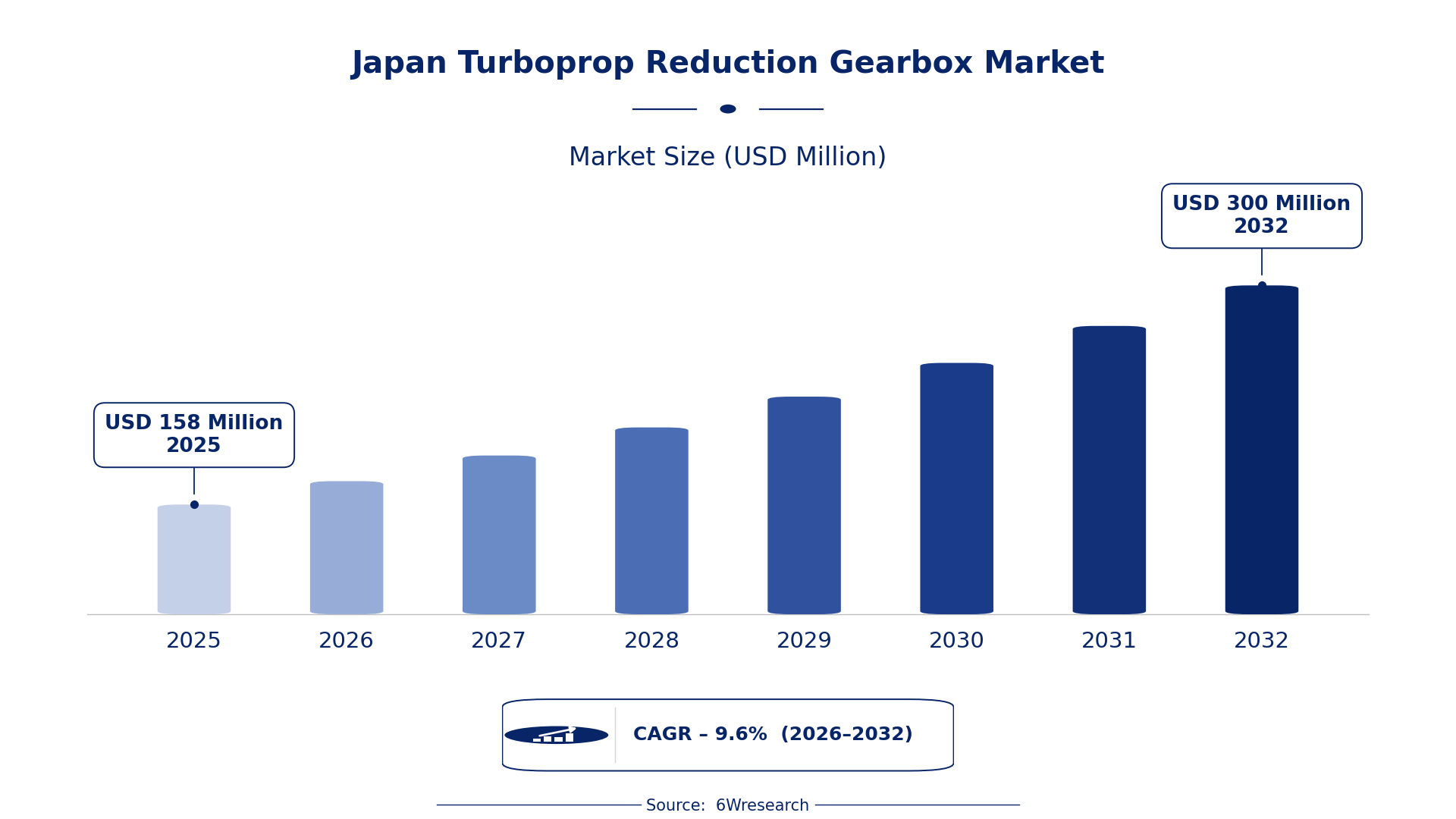
According to 6Wresearch internal database and industry insights, the Japan Turboprop Reduction Gearbox Market was valued at USD 158 Million in 2025 and is projected to reach USD 300 Million by 2032, growing at a CAGR of approximately 9.6% during 2026–2032.
Japan Turboprop Reduction Gearbox Market Highlights
| Report Metric | Details |
| Report Name | Japan Turboprop Reduction Gearbox Market (2026-2032) |
| Market Size 2025 | USD 158 Million |
| Market Size 2032 | USD 300 Million |
| Absolute Growth 2025–2032 | USD 142 Million |
| CAGR 2026–2032 | 9.6% |
| Peak Annual Growth | 11.2% in 2032 |
| Forecast Period | 2026–2032 |
| Historical Data | 2022–2025 |
| Base Year | 2025 |
| Leading Turboprop Reduction Gearbox, 2025 | Conventional Gearboxes (49% share) |
| Leading Gearbox Type, 2025 | Straight Bevel (50% share) |
| Leading Gear Design, 2025 | Steel Gears (45% share) |
| Leading Distribution Channel, 2025 | OEM Engine Suppliers (45% share) |
| Leading End User Industry, 2025 | Regional Carriers (47% share) |
| Fastest-Growing Turboprop Reduction Gearbox | Composite Gearboxes (12.6% CAGR) |
| Fastest-Growing Gearbox Type | Hybrid Gears (13.9% CAGR) |
| Fastest-Growing Gear Design | Steel/Composite (12.8% CAGR) |
| Fastest-Growing Distribution Channel | Tier-1 Suppliers (12.2% CAGR) |
| Fastest-Growing End User Industry | Military Training (12.5% CAGR) |
| Growing Sector | Aviation |
| Key End Users | Regional Carriers, Military Training, Charter Operators |
Japan Turboprop Reduction Gearbox Market Year-wise Growth Rate and Key Drivers (2022–2032)
This graph illustrates the annual growth rates of the market from 2022 to 2032, highlighting a steady upward trajectory and projected market expansion over the forecast period.
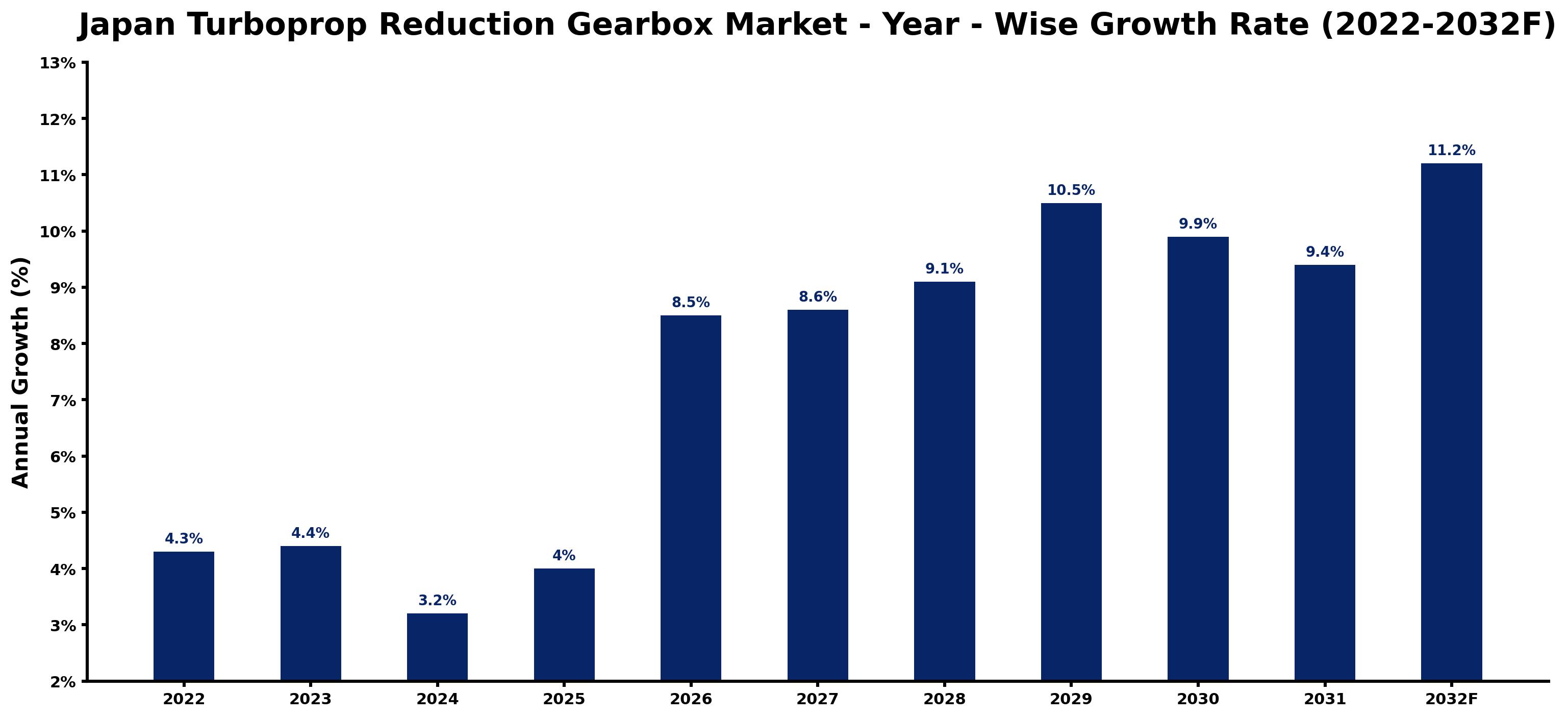
The table below sets out the estimated growth rate for each year and the main factor behind it.
| Year | Estimated Annual Growth (%) | Market Rationale |
| 2022 | 4.3 | The market exhibited steady growth due to a strong domestic aviation sector. |
| 2023 | 4.4 | Growth accelerated as military budgets for training aircraft increased. |
| 2024 | 3.2 | A slight slowdown occurred as demand stabilised after the previous year's surge. |
| 2025 | 4.0 | Demand rose again, driven by ongoing maintenance needs for aging aircraft fleets. |
| 2026 | 8.5 | The market is expected to gain momentum as new aircraft manufacturing targets are set. |
| 2027 | 8.6 | Growth is projected to continue with rising investments in aerospace R&D initiatives. |
| 2028 | 9.1 | The market is anticipated to expand further as domestic passenger numbers increase. |
| 2029 | 10.5 | Demand is likely to rise sharply as military training programmes expand. |
| 2030 | 9.9 | A slowdown is expected as the market adjusts to previous rapid growth rates. |
| 2031 | 9.4 | Growth is projected to moderate as the market stabilises after peak demand. |
| 2032 | 11.2 | Demand is expected to peak as advanced gearbox technologies are adopted. |
Note: Market size estimations and growth projections presented in this report are based on 6Wresearch's proprietary forecasting methodology, utilizing the latest available industry data, government publications, and primary research inputs.
Japan Turboprop Reduction Gearbox Market Synopsis
Turboprop reduction gearboxes are mechanical devices that reduce engine rotational speeds for propellers, primarily made from high-strength steel and composites. The Japan Turboprop Reduction Gearbox Market is growing, driven by the domestic aviation industry, which served approximately 50 million passengers in 2022, alongside substantial military training aircraft budgets. The government's target to increase domestic aircraft manufacturing by 20% by 2025 further supports this trend, creating opportunities for both local and international suppliers.
Market Dynamics Impact Analysis (2026–2032)
| Factor | Type | Impact | Primary Segment Affected |
| Increasing domestic passenger traffic | Driver | High | Conventional Gearboxes |
| Growing military training budgets | Driver | High | Military Training |
| Rising demand for lightweight materials | Opportunity | Medium | Composite Gearboxes |
| Investment in advanced gearbox technologies | Opportunity | High | Conventional Gearboxes |
| Aging aircraft fleets necessitating overhauls | Restraint | High | Overhauled Assemblies |
| Regulatory compliance with JIS standards | Restraint | Medium | Conventional Gearboxes |
| High costs associated with R&D for new technologies | Challenge | High | Experimental Gearboxes |
| Limited availability of skilled workforce | Challenge | Medium | Conventional Gearboxes |
Evaluation of Drivers in Japan Turboprop Reduction Gearbox Market (2026–2032)
The factors lifting demand, and the evidence behind each, are summarised below.
| Drivers | Primary Segment Affected | Why It Matters (Evidence) |
| Increased domestic passenger traffic | Conventional Gearboxes | Japan's aviation market served approximately 50 million passengers in 2022, driving demand for efficient turboprop aircraft. |
| Growing military training budgets | Military Training | The Ministry of Defense allocates substantial funds for military training aircraft, increasing gearbox demand. |
| Investment in advanced gearbox technologies | Composite Gearboxes | The Japan Aerospace Exploration Agency supports R&D, improving the performance of composite gearboxes. |
| Aging turboprop aircraft fleets | Overhauled Assemblies | The average age of turboprop aircraft in Japan is around 15 years, necessitating regular gearbox maintenance. |
| Regulatory compliance with JIS standards | Conventional Gearboxes | Compliance with JIS standards ensures quality assurance in gearbox manufacturing, influencing buyer decisions. |
The strongest pull on demand comes from increased domestic passenger traffic, with Japan's aviation market serving approximately 50 million passengers in 2022, leading to more purchases of turboprop aircraft. Military training budgets are also rising, as significant resources are allocated for turboprop models. With the average age of turboprop aircraft around 15 years, there is a consistent need for overhauled assemblies to maintain operational efficiency. Compliance with JIS standards drives demand as buyers seek quality assurance in their purchases.
Evaluation of Restraints in Japan Turboprop Reduction Gearbox Market
The main factors holding the market back are set out below.
| Market Restraint | Primary Segment Affected | Why It Matters (Evidence) |
| High costs associated with R&D for new technologies | Experimental Gearboxes | Developing new gearbox technologies requires considerable investment, limiting available funds for other projects. |
| Regulatory compliance with JIS standards | Conventional Gearboxes | Adhering to stringent JIS standards raises production costs, impacting pricing strategies for manufacturers. |
| Aging aircraft fleets necessitating overhauls | Overhauled Assemblies | Regular maintenance of older aircraft creates demand but also limits new purchases. |
| Limited availability of skilled workforce | Conventional Gearboxes | A shortage of skilled workers in aerospace engineering can delay production and increase operational costs. |
| Market saturation in conventional gearbox designs | Conventional Gearboxes | The prevalence of established designs limits opportunities for new entrants and innovation. |
Japan Turboprop Reduction Gearbox Market Challenges
Producers face elevated supply chain expenses due to dependency on imported components, raising production costs by up to 15% for turboprop gearboxes. Stringent JIS standards require substantial investment in quality assurance, causing production delays of approximately three months for manufacturers. Intense competition from foreign suppliers offering lower prices pressures local producers, potentially shrinking profit margins by 10%. Volatile material costs for high-strength steel and composites create budgeting challenges for manufacturers, resulting in unpredictable pricing for buyers who rely on stable supply costs.
Trends in the Japan Turboprop Reduction Gearbox Market
These developments are changing demand patterns in the Japan Turboprop Reduction Gearbox Market.
- Shift from Conventional to Composite Gearboxes: Since 2026, the market has seen a shift towards composite gearboxes, due to their lightweight and durable properties. The Japan Aerospace Industry Association reports a 12.6% CAGR for composite gearboxes, indicating a growing preference among regional carriers.
- Increased Focus on R&D for Advanced Technologies: In 2023, Japan hosted an aerospace technology conference focusing on turboprop advancements, highlighting the industry's commitment to innovation. This event attracted over 1,500 participants, showcasing the growing investment in advanced gearbox technologies.
- Rise in Military Training Programmes: The Ministry of Defense's increased budgets for military training aircraft, including turboprop models, has led to a rise in demand. In 2022, military training expenditures rose by 15%, reflecting the sector's expansion.
- Expansion of Aerospace Innovation Funding: The Tokyo Metropolitan Government has implemented funding programs to promote aerospace innovation, allocating JPY 10 billion for new projects. This initiative aims to support local manufacturers in developing advanced gearbox technologies.
Investment Opportunities in the Japan Turboprop Reduction Gearbox Market
Investors looking at the Japan Turboprop Reduction Gearbox Market should consider the following areas.
- Joint Ventures with Local Manufacturers: With the government's target to increase domestic aircraft manufacturing by 20% by 2025, there is an opportunity for joint ventures with local manufacturers. This collaboration can facilitate market entry for foreign suppliers.
- Investment in Composite Gearbox Production: The rising demand for lightweight materials presents an opportunity to invest in composite gearbox production. Regional carriers are increasingly seeking these solutions to improve aircraft efficiency.
- Focus on Overhaul Services for Aging Fleets: As the average age of turboprop aircraft reaches 15 years, there is a growing need for overhaul services. MRO providers can capitalise on this trend by offering comprehensive maintenance solutions.
- Development of Custom Gear Ratios: The demand for specific applications creates an opportunity to develop custom gear ratios. Engaging with military training programmes can provide access to niche markets.
Government Initiatives in the Japan Turboprop Reduction Gearbox Market
The GX Basic Policy, adopted in 2023, aims to mobilise around JPY 150 trillion for public-private decarbonisation investment over the next decade. This policy supports the turboprop reduction gearbox sector by encouraging innovation and investment in sustainable technologies. Additionally, the Industrial Standardization Act, amended in 2019, governs JIS product standards, ensuring that manufacturers adhere to quality benchmarks that improve the reliability of turboprop gearboxes, thereby benefiting buyers who seek dependable products.
The Consumer Affairs Agency administers the Act against Unjustifiable Premiums and Misleading Representations, which prohibits misleading advertising of goods, including turboprop gearboxes. This regulation protects buyers by ensuring they receive accurate information about products. The Ministry of Land, Infrastructure, Transport and Tourism oversees aviation safety standards, approving designs and manufacturing processes that meet stringent safety requirements, thus assuring buyers of the quality and safety of turboprop gearboxes.
Future Insight of the Japan Turboprop Reduction Gearbox Market
Buyers in the aviation sector will experience improved gearbox technologies as government-backed R&D initiatives focus on advanced designs. By 2032, the goal to boost domestic aircraft manufacturing by 20% will open new avenues for local suppliers. Funding programs in the Tokyo region will stimulate innovations in gearbox production methods. Updated guidelines from the Japan Aerospace Industry Association will raise quality standards, giving local manufacturers a competitive edge.
Market Segmentation Analysis
Japan Turboprop Reduction Gearbox Market report covers a detailed analysis of the following market segments:
By Turboprop Reduction Gearbox – Conventional Gearboxes Lead, Composite Gearboxes Expected to Grow Fastest
According to Saurav Kr Singh, Senior Research Analyst at 6Wresearch, Conventional Gearboxes took 49% of turboprop reduction gearbox revenue in 2025, more than any other category. Conventional gearboxes dominate the market as they are extensively used in regional aircraft, which are vital for Japan's aviation sector. The robust presence of over 300 registered aircraft operators ensures a consistent demand for these gearboxes across the industry. The quickest growth will come from Composite Gearboxes, forecast to expand at a CAGR of 12.6% between 2026 and 2032. The surge in composite gearboxes is attributed to their lightweight and durable nature, making them increasingly appealing for modern aircraft applications. This aligns with the government's objective to boost domestic aircraft manufacturing by 20% by 2025, propelling the demand for advanced materials. Suppliers should focus on developing lightweight materials to stay competitive in the evolving market.
By Gearbox Type – Straight Bevel Leads, Hybrid Gears Expected to Grow Fastest
The largest gearbox type category in 2025 was Straight Bevel, at 50% of revenue. Straight bevel gears are widely preferred for turboprop applications due to their reliable performance and compatibility with various aircraft systems. Their established market presence guarantees a steady demand from numerous aircraft operators throughout Japan. Over 2026–2032, Hybrid Gears are expected to post the fastest growth, at a CAGR of 13.9%. Hybrid gears are gaining traction as they cater to specialised applications requiring advanced gearbox solutions, thus driving their rapid growth. As the aerospace industry continues to innovate, the demand for hybrid gears is expected to increase significantly. Buyers may benefit from considering hybrid gear options to enhance performance in targeted applications.
By Gear Design – Steel Gears Lead, Steel/Composite Expected to Grow Fastest
Steel Gears held 45% of the Japan Turboprop Reduction Gearbox Market by gear design in 2025. Steel gears are highly regarded in the market for their strength and durability, making them a dependable choice for turboprop applications. Their proven reliability has led to a strong installed base among aircraft operators in Japan. Steel/Composite is set to record the highest CAGR in this split, 12.8% over 2026–2032. The rising interest in steel/composite gears stems from their ability to combine the strengths of both materials, offering improved performance characteristics. As aircraft designs progress, this segment is poised for accelerated growth. Suppliers should invest in research to create advanced gear designs that effectively leverage both steel and composite materials.
By Distribution Channel – OEM Engine Suppliers Lead, Tier-1 Suppliers Expected to Grow Fastest
In 2025, OEM Engine Suppliers led the distribution channel split with a 45% share. OEM engine suppliers serve as the primary source for new gearboxes, granting manufacturers access to cutting-edge technology and standards. Their established connections with aircraft producers solidify their leading position in the market. Tier-1 Suppliers are projected to grow fastest, at a CAGR of 12.2% during 2026–2032. Tier-1 suppliers are experiencing rapid growth as they provide essential components for assembly, addressing the increasing demand for turboprop aircraft. Their strategic role in the supply chain positions them favourably for future expansion. Suppliers should explore partnerships with Tier-1 suppliers to enhance their market presence.
By End User Industry – Regional Carriers Lead, Military Training Expected to Grow Fastest
Regional Carriers accounted for 47% of the market by end user industry in 2025. Regional carriers are the largest user group for turboprop aircraft, employing them extensively for domestic routes. Their operational requirements drive consistent demand for dependable gearbox solutions within the aviation market. The quickest growth will come from Military Training, forecast to expand at a CAGR of 12.5% between 2026 and 2032. Military training applications are experiencing notable growth due to increased budgets allocated for training aircraft by the Ministry of Defense. This emphasis on military readiness is expected to sustain high demand in this segment. Suppliers should tailor their offerings to address the specific needs of military training programmes.
Key Attractiveness of the Report
- 10 Years of Market Numbers
- Historical Data Starting from 2022 to 2025
- Base Year 2025
- Forecast Data until 2032
- Key Performance Indicators Impacting the Market
- Major Upcoming Developments and Projects
Key Highlights of the Report:
- Japan Turboprop Reduction Gearbox Market Outlook
- Market Size of Japan Turboprop Reduction Gearbox Market, 2025
- Forecast of Japan Turboprop Reduction Gearbox Market, 2032
- Historical Data and Forecast of Japan Turboprop Reduction Gearbox Revenues & Volume for the Period 2022-2032F
- Japan Turboprop Reduction Gearbox Market Trend Evolution
- Japan Turboprop Reduction Gearbox Market Drivers and Challenges
- Japan Turboprop Reduction Gearbox Price Trends
- Japan Turboprop Reduction Gearbox Porter's Five Forces
- Japan Turboprop Reduction Gearbox Industry Life Cycle
- Historical Data and Forecast of Japan Turboprop Reduction Gearbox Market Revenues & Volume By Turboprop Reduction Gearbox for the Period 2022-2032F
- Historical Data and Forecast of Japan Turboprop Reduction Gearbox Market Revenues & Volume By Conventional Gearboxes for the Period 2022-2032F
- Historical Data and Forecast of Japan Turboprop Reduction Gearbox Market Revenues & Volume By Composite Gearboxes for the Period 2022-2032F
- Historical Data and Forecast of Japan Turboprop Reduction Gearbox Market Revenues & Volume By Overhauled Assemblies for the Period 2022-2032F
- Historical Data and Forecast of Japan Turboprop Reduction Gearbox Market Revenues & Volume By Experimental Gearboxes for the Period 2022-2032F
- Historical Data and Forecast of Japan Turboprop Reduction Gearbox Market Revenues & Volume By Gearbox Type for the Period 2022-2032F
- Historical Data and Forecast of Japan Turboprop Reduction Gearbox Market Revenues & Volume By Straight Bevel for the Period 2022-2032F
- Historical Data and Forecast of Japan Turboprop Reduction Gearbox Market Revenues & Volume By Hybrid Gears for the Period 2022-2032F
- Historical Data and Forecast of Japan Turboprop Reduction Gearbox Market Revenues & Volume By Refurbished Units for the Period 2022-2032F
- Historical Data and Forecast of Japan Turboprop Reduction Gearbox Market Revenues & Volume By Prototype Designs for the Period 2022-2032F
- Historical Data and Forecast of Japan Turboprop Reduction Gearbox Market Revenues & Volume By Gear Design for the Period 2022-2032F
- Historical Data and Forecast of Japan Turboprop Reduction Gearbox Market Revenues & Volume By Steel Gears for the Period 2022-2032F
- Historical Data and Forecast of Japan Turboprop Reduction Gearbox Market Revenues & Volume By Steel/Composite for the Period 2022-2032F
- Historical Data and Forecast of Japan Turboprop Reduction Gearbox Market Revenues & Volume By Performance Upgrades for the Period 2022-2032F
- Historical Data and Forecast of Japan Turboprop Reduction Gearbox Market Revenues & Volume By Custom Gear Ratios for the Period 2022-2032F
- Historical Data and Forecast of Japan Turboprop Reduction Gearbox Market Revenues & Volume By Distribution Channel for the Period 2022-2032F
- Historical Data and Forecast of Japan Turboprop Reduction Gearbox Market Revenues & Volume By OEM Engine Suppliers for the Period 2022-2032F
- Historical Data and Forecast of Japan Turboprop Reduction Gearbox Market Revenues & Volume By Tier-1 Suppliers for the Period 2022-2032F
- Historical Data and Forecast of Japan Turboprop Reduction Gearbox Market Revenues & Volume By MRO Providers for the Period 2022-2032F
- Historical Data and Forecast of Japan Turboprop Reduction Gearbox Market Revenues & Volume By R&D Suppliers for the Period 2022-2032F
- Historical Data and Forecast of Japan Turboprop Reduction Gearbox Market Revenues & Volume By End User Industry for the Period 2022-2032F
- Historical Data and Forecast of Japan Turboprop Reduction Gearbox Market Revenues & Volume By Regional Carriers for the Period 2022-2032F
- Historical Data and Forecast of Japan Turboprop Reduction Gearbox Market Revenues & Volume By Military Training for the Period 2022-2032F
- Historical Data and Forecast of Japan Turboprop Reduction Gearbox Market Revenues & Volume By Charter Operators for the Period 2022-2032F
- Historical Data and Forecast of Japan Turboprop Reduction Gearbox Market Revenues & Volume By Test Programs for the Period 2022-2032F
- Japan Turboprop Reduction Gearbox Import Export Trade Statistics
- Market Opportunity Assessment By Turboprop Reduction Gearbox
- Market Opportunity Assessment By Gearbox Type
- Market Opportunity Assessment By Gear Design
- Market Opportunity Assessment By Distribution Channel
- Market Opportunity Assessment By End User Industry
- Japan Turboprop Reduction Gearbox Top Companies Market Share
- Japan Turboprop Reduction Gearbox Competitive Benchmarking By Technical and Operational Parameters
- Japan Turboprop Reduction Gearbox Company Profiles
- Japan Turboprop Reduction Gearbox Key Strategic Recommendations
Market Covered
The report covers the following segments.
By Turboprop Reduction Gearbox
- Conventional Gearboxes
- Composite Gearboxes
- Overhauled Assemblies
- Experimental Gearboxes
By Gearbox Type
- Straight Bevel
- Hybrid Gears
- Refurbished Units
- Prototype Designs
By Gear Design
- Steel Gears
- Steel/Composite
- Performance Upgrades
- Custom Gear Ratios
By Distribution Channel
- OEM Engine Suppliers
- Tier-1 Suppliers
- MRO Providers
- R&D Suppliers
By End User Industry
- Regional Carriers
- Military Training
- Charter Operators
- Test Programs































