Japan Turboshaft Engine Market Size & Growth Rate
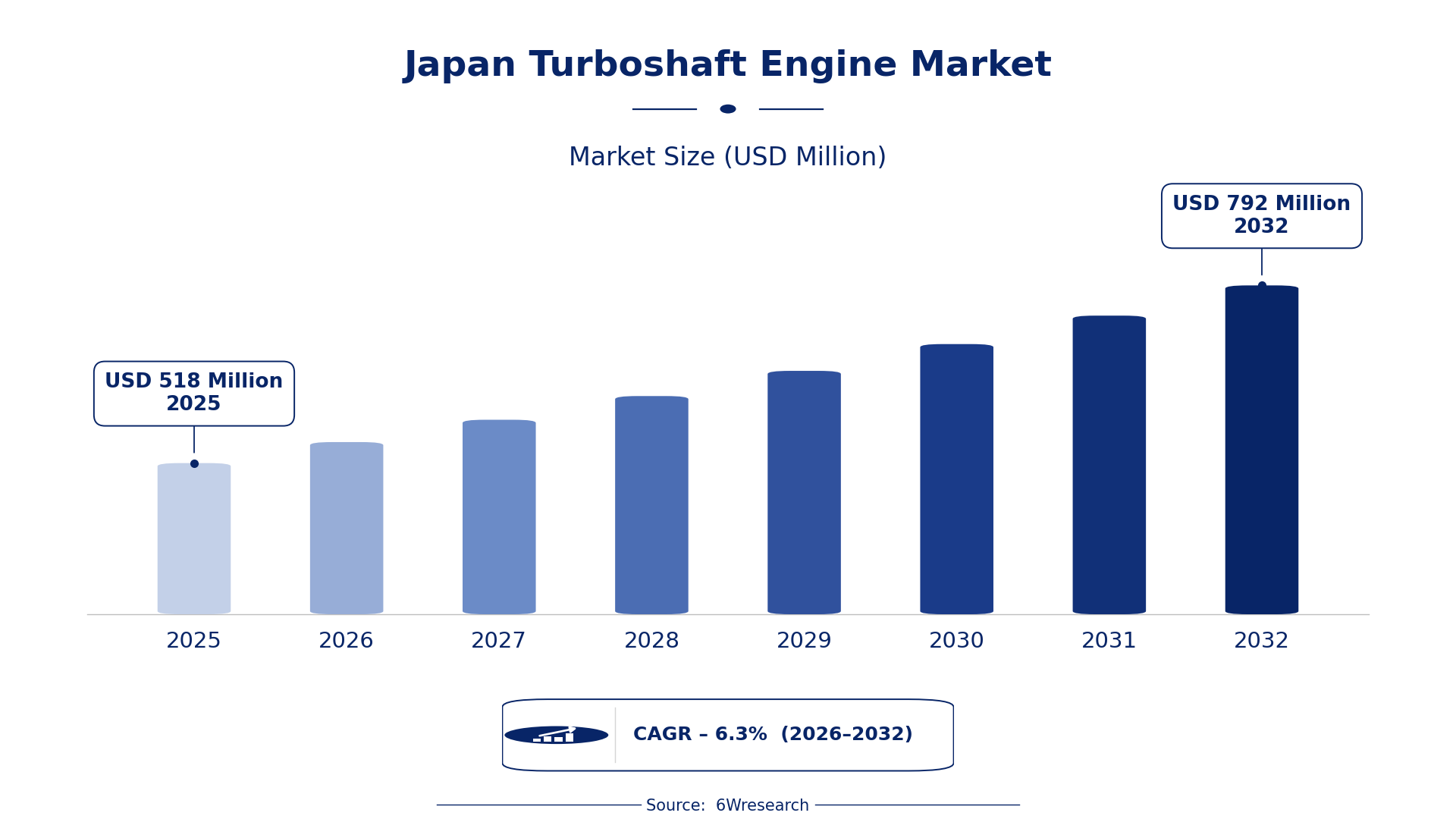
According to 6Wresearch internal database and industry insights, the Japan Turboshaft Engine Market was valued at USD 518 Million in 2025 and is projected to reach USD 792 Million by 2032, growing at a CAGR of approximately 6.3% during 2026–2032.
Japan Turboshaft Engine Market Highlights
| Report Metric | Details |
| Report Name | Japan Turboshaft Engine Market (2026-2032) |
| Market Size 2025 | USD 518 Million |
| Market Size 2032 | USD 792 Million |
| Absolute Growth 2025–2032 | USD 274 Million |
| CAGR 2026–2032 | 6.3% |
| Peak Annual Growth | 7.7% in 2032 |
| Forecast Period | 2026–2032 |
| Historical Data | 2022–2025 |
| Base Year | 2025 |
| Leading Turboshaft Engine Type, 2025 | Helicopter Primary Engines (42% share) |
| Leading Engine Type, 2025 | >2 (31% share) |
| Leading HP Class, 2025 | Military/CSAR (44% share) |
| Leading Distribution Channel, 2025 | Engine OEMs (37% share) |
| Leading End User Industry, 2025 | Rotary-Wing Aircraft (51% share) |
| Fastest-Growing Turboshaft Engine Type | Turboshaft Repower Kits (8.9% CAGR) |
| Fastest-Growing Engine Type | Upgrade Engines (9.2% CAGR) |
| Fastest-Growing HP Class | Civil/Multi-Role (8.5% CAGR) |
| Fastest-Growing Distribution Channel | Aero Engine Suppliers (8.0% CAGR) |
| Fastest-Growing End User Industry | Civil & Helo Fleets (8.3% CAGR) |
| Growing Sector | Aerospace |
| Key End Users | Military, Civil Aviation, Helicopter Operators, Aerospace Manufacturers |
Japan Turboshaft Engine Market Year-wise Growth Rate and Key Drivers (2022–2032)
This graph illustrates the annual growth rates of the market from 2022 to 2032, highlighting a steady upward trajectory and projected market expansion over the forecast period.
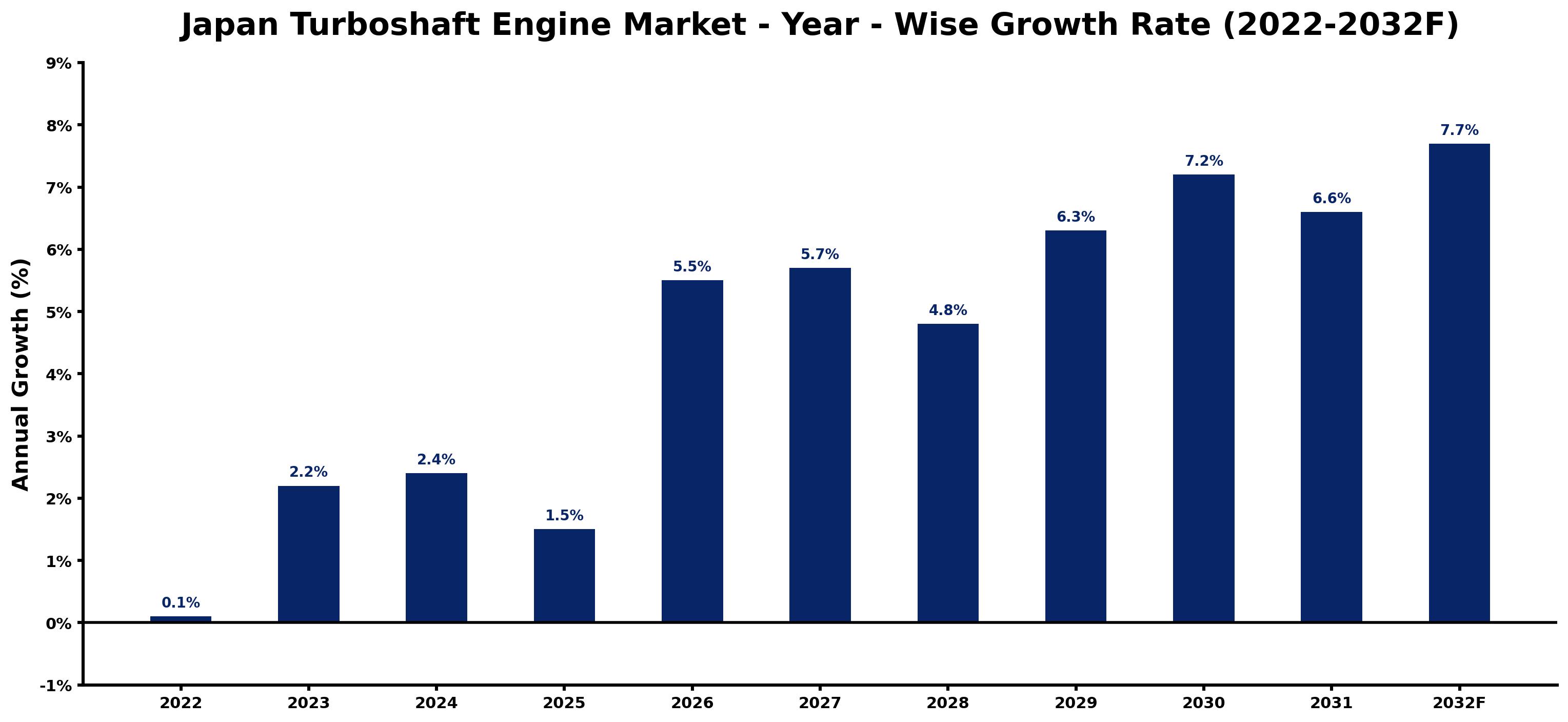
Each row of the following table gives one year's estimated growth and the event or demand shift that explains it.
| Year | Estimated Annual Growth (%) | Market Rationale |
| 2022 | 0.1 | The market showed minimal growth due to limited investment in new technologies. |
| 2023 | 2.2 | Increased demand from military applications contributed to faster growth compared to the previous year. |
| 2024 | 2.4 | The growth continued as modernization efforts gained traction within the defense sector. |
| 2025 | 1.5 | Growth slowed as some helicopter programs faced delays in implementation and funding. |
| 2026 | 5.5 | Investment in advanced engine technologies is anticipated to drive demand further. |
| 2027 | 5.7 | Continued modernization of the helicopter fleet will further boost market growth. |
| 2028 | 4.8 | Growth is projected to slow as the market stabilizes after rapid expansion. |
| 2029 | 6.3 | The introduction of new helicopter models is likely to accelerate demand again. |
| 2030 | 7.2 | Increased focus on urban air mobility initiatives will support market expansion. |
| 2031 | 6.6 | Growth is projected to decelerate slightly as the market matures and stabilizes. |
| 2032 | 7.7 | The market is expected to peak as modernization programs reach completion. |
Note: Market size estimations and growth projections presented in this report are based on 6Wresearch's proprietary forecasting methodology, utilizing the latest available industry data, government publications, and primary research inputs.
Japan Turboshaft Engine Market Synopsis
Turboshaft engines are gas turbine engines that generate shaft power, primarily used in helicopters and some fixed-wing aircraft. These engines are manufactured with advanced materials to ensure reliability and performance. The Japan Turboshaft Engine Market is expanding due to increased military spending, particularly in helicopter modernization, and a strong domestic aerospace sector. The Ministry of Defense's budget of ¥150 billion for modernization programs in 2023 highlights the demand from military buyers, while initiatives in urban air mobility further stimulate interest from civilian sectors.
Market Dynamics Impact Analysis (2026–2032)
| Factor | Type | Impact | Primary Segment Affected |
| Increased military spending on helicopter modernization programs | Driver | High | Helicopter Primary Engines |
| Growing urban air mobility initiatives | Driver | High | Light Turboshafts |
| Rising demand for auxiliary power units in various applications | Opportunity | High | Auxiliary Power Units |
| Expansion of MRO facilities to support turboshaft engines | Opportunity | Medium | Maintenance Overhaul Shops |
| High import dependency for specialized applications | Restraint | High | Turboshaft Repower Kits |
| Limited domestic production capacity for advanced models | Restraint | Medium | Upgrade Engines |
| Challenges in integrating advanced technologies into existing platforms | Challenge | High | Military/CSAR |
| Competition from imported engines affecting local manufacturers | Challenge | Medium | Civil/Multi-Role |
Evaluation of Drivers in Japan Turboshaft Engine Market (2026–2032)
The table below links each growth driver to the segment it affects and the evidence for it.
| Drivers | Primary Segment Affected | Why It Matters (Evidence) |
| Increased defense budgets for modernization | Helicopter Primary Engines | The allocation of ¥150 billion for helicopter upgrades drives demand for turboshaft engines. |
| Investment in urban air mobility technologies | Light Turboshafts | The Tokyo Metropolitan Government's program for urban air mobility is increasing the need for advanced helicopter engines. |
| Growing demand for auxiliary power units in helicopters | Auxiliary Power Units | The need for reliable power sources in rotary-wing aircraft increases purchases of auxiliary power units. |
| Expansion of maintenance and repair facilities | Maintenance Overhaul Shops | The establishment of several MRO facilities in Japan supports the growing turboshaft engine market. |
| Rising interest in repowering older aircraft | Turboshaft Repower Kits | The demand for upgrading existing helicopters encourages purchases of repower kits. |
Purchasing is picking up as military budgets increase, particularly with the allocation of ¥150 billion for helicopter modernization in 2023. This funding drives demand for turboshaft engines, especially for military applications. Urban air mobility efforts by local governments are also stimulating interest in advanced helicopter technologies. The establishment of new maintenance and repair facilities supports the growing need for auxiliary power units in rotary-wing aircraft. The trend towards repowering older aircraft is encouraging buyers to invest in turboshaft repower kits, further boosting market activity.
Evaluation of Restraints in Japan Turboshaft Engine Market
These are the pressures that could keep growth below its potential.
| Market Restraint | Primary Segment Affected | Why It Matters (Evidence) |
| Dependence on imports for specialized turboshaft engines | Turboshaft Repower Kits | Japan imported approximately 200 turboshaft engines in 2022, highlighting reliance on foreign sources. |
| Limited domestic production capacity for advanced models | Upgrade Engines | The need for advanced engine technologies outpaces local manufacturing capabilities, affecting supply. |
| Challenges in integrating new technologies into existing aircraft | Military/CSAR | Existing military helicopters face difficulties in adopting advanced turboshaft engines, delaying upgrades. |
| Competition from imported engines in the civilian market | Civil/Multi-Role | Local manufacturers face pressure from imported models, impacting their market share. |
| Regulatory hurdles for new engine certifications | Light Turboshafts | Compliance with stringent aviation safety standards can delay product launches. |
Japan Turboshaft Engine Market Challenges
Japan imported approximately 200 turboshaft engines in 2022, highlighting a challenge for local buyers who depend on timely access to advanced technology for their operations. Domestic producers encounter fierce competition from international manufacturers offering lower-priced alternatives, which can erode profit margins and compromise quality for buyers. Strict adherence to JIS Q 9100 requires substantial investment in quality management for producers, diverting funds from critical innovation and raising costs. High operational expenses in the Tokyo region, where aerospace manufacturing is concentrated, can inflate prices for buyers, straining their budgets.
Trends in the Japan Turboshaft Engine Market
Four trends stand out in the Japan Turboshaft Engine Market.
- Shift towards Urban Air Mobility Initiatives: In 2023, the Tokyo Metropolitan Government initiated a program to promote urban air mobility using helicopters, creating new applications for turboshaft engines. This shift is likely to increase demand for advanced rotary-wing technologies.
- Emergence of Advanced Maintenance Facilities: New maintenance, repair, and overhaul facilities are being established in Japan, reshaping support for turboshaft engines. This trend is set to improve service capabilities and expand the overall market size.
- Growing Demand for Auxiliary Power Units: The rising need for auxiliary power units in helicopters is becoming clear as more rotary-wing aircraft require reliable onboard power. This trend is supported by the increasing number of helicopters in operation, estimated at over 1,500.
- Transition from Traditional to Advanced Turboshaft Engines: Research on advanced engine technologies by the Japan Aerospace Exploration Agency is leading to a shift from traditional to more efficient turboshaft engines in the coming years.
Investment Opportunities in the Japan Turboshaft Engine Market
The openings below show where demand in the Japan Turboshaft Engine Market is visible and how suppliers can enter.
- Military Buyers Seeking Modernization Solutions: The Japan Self-Defense Forces require advanced turboshaft engines for their modernization programs, creating opportunities for suppliers to engage in partnerships with local manufacturers.
- Joint Ventures for Advanced Engine Development: Investment in joint ventures for developing advanced turboshaft engines is a key opportunity, particularly in regions like Nagoya, known for aerospace manufacturing.
- Expansion of Urban Air Mobility Solutions: The Tokyo region's focus on urban air mobility presents a timely opportunity for suppliers of turboshaft engines to enter this emerging market.
- Investment in MRO Facilities: The growing number of helicopters in operation necessitates investment in maintenance, repair, and overhaul facilities, particularly in regions with high helicopter activity.
Government Initiatives in the Japan Turboshaft Engine Market
The GX Promotion Act (2023) strengthens the legal framework for decarbonisation efforts in the aerospace sector, building upon earlier regulations. This act encourages investment in advanced technologies and promotes sustainable practices among manufacturers, ensuring compliance with evolving environmental standards. The GX Basic Policy aims for JPY 150 trillion of public-private decarbonisation investment over 10 years, targeting advancements in the industry.
The Japan Civil Aviation Bureau oversees aviation safety and standards, ensuring that buyers of turboshaft engines adhere to strict regulatory requirements. This agency's oversight is vital in maintaining safety and reliability in aviation operations, impacting how buyers approach engine procurement. The agency's efforts have led to numerous approvals for new engine models, enhancing the market's overall safety profile.
Future Insight of the Japan Turboshaft Engine Market
The Tokyo Metropolitan Government's urban air mobility program will facilitate the integration of helicopters into city transport systems. By 2032, research from the Japan Aerospace Exploration Agency will yield advanced turboshaft engine technologies, improving performance and reducing emissions. The Ministry of Defense's budget for helicopter modernization will drive innovation and increase production capabilities. Comprehensive training programs for helicopter pilots will develop a skilled workforce, enabling suppliers to better meet market needs.
Market Segmentation Analysis
Japan Turboshaft Engine Market report covers a detailed analysis of the following market segments:
By Turboshaft Engine Type – Helicopter Primary Engines Lead, Turboshaft Repower Kits Expected to Grow Fastest
According to Saurav Kr Singh, Senior Research Analyst at 6Wresearch, the largest turboshaft engine type category in 2025 was Helicopter Primary Engines, at 42% of revenue. Helicopter Primary Engines hold the largest share as they are vital for the operation of Japan's extensive fleet of over 1,500 rotary-wing aircraft. The military and civilian sectors heavily rely on these engines, ensuring sustained demand and a strong installed base. The quickest growth will come from Turboshaft Repower Kits, forecast to expand at a CAGR of 8.9% between 2026 and 2032. Turboshaft Repower Kits are rapidly gaining traction as operators aim to modernise older engines, spurred by the ¥150 billion budget allocated by the Ministry of Defense for helicopter upgrades in 2023. This trend will likely reinforce the dominance of Helicopter Primary Engines. Suppliers must prioritise the development of advanced repower solutions to capitalise on the increasing demand for engine upgrades.
By Engine Type – >2 Leads, Upgrade Engines Expected to Grow Fastest
>2 accounted for 31% of the market by engine type in 2025. The segment of engines above 2 is prevalent in military applications where performance and reliability are paramount. This segment benefits from a robust installed base of operational engines supporting various missions across Japan. Upgrade Engines are projected to grow fastest, at a CAGR of 9.2% during 2026–2032. Upgrade Engines are experiencing notable growth as operators aim to enhance performance and prolong the lifespan of current engines. This trend highlights a broader emphasis on efficiency and capability improvements within the aviation sector. Manufacturers should focus on developing advanced upgrade technologies to cater to the increasing demand for enhanced engine performance.
By HP Class – Military/CSAR Leads, Civil/Multi-Role Expected to Grow Fastest
Military/CSAR took 44% of hp class revenue in 2025, more than any other category. Military/CSAR engines lead the market due to their critical role in supporting military operations and search and rescue missions. The ongoing need for reliable and powerful engines in these applications ensures a strong market presence. Over 2026–2032, Civil/Multi-Role is expected to post the fastest growth, at a CAGR of 8.5%. Civil/Multi-Role engines are experiencing rapid growth as they are increasingly adopted for various civilian applications, reflecting a shift towards versatile aircraft usage. This segment's expansion highlights the potential for broader market opportunities. Suppliers should explore partnerships with civil aviation stakeholders to tap into the growing demand for multi-role engines.
By Distribution Channel – Engine OEMs Lead, Aero Engine Suppliers Expected to Grow Fastest
With 37% of distribution channel revenue in 2025, Engine OEMs was the largest category. Engine OEMs serve as the primary source of turboshaft engines, supplying essential products directly to customers in military and civilian sectors. Their established relationships with manufacturers ensure a consistent supply chain and maintain market leadership. Aero Engine Suppliers are set to record the highest CAGR in this split, 8.0% over 2026–2032. Aero Engine Suppliers are witnessing rapid growth as they provide aftermarket parts and services, addressing the rising demand for maintenance and upgrades. This trend signifies a shift towards a more service-oriented market approach. Distributors need to enhance their service offerings to meet the growing requirements for aftermarket support and parts.
By End User Industry – Rotary-Wing Aircraft Leads, Civil & Helo Fleets Expected to Grow Fastest
In 2025, Rotary-Wing Aircraft led the end user industry split with a 51% share. Rotary-Wing Aircraft are the main application for turboshaft engines, with a significant user base in both military and civilian sectors. This strong demand is driven by the operational requirements of various aviation missions throughout Japan. The quickest growth will come from Civil & Helo Fleets, forecast to expand at a CAGR of 8.3% between 2026 and 2032. Civil & Helo Fleets are expanding quickly as the need for urban air mobility and helicopter services rises. This growth indicates a broader trend towards utilising helicopters for diverse applications, thereby increasing market potential. Suppliers should align their strategies with the increasing interest in civil aviation to seize new market opportunities.
Key Attractiveness of the Report
- 10 Years of Market Numbers
- Historical Data Starting from 2022 to 2025
- Base Year 2025
- Forecast Data until 2032
- Key Performance Indicators Impacting the Market
- Major Upcoming Developments and Projects
Key Highlights of the Report:
- Japan Turboshaft Engine Market Outlook
- Market Size of Japan Turboshaft Engine Market, 2025
- Forecast of Japan Turboshaft Engine Market, 2032
- Historical Data and Forecast of Japan Turboshaft Engine Revenues & Volume for the Period 2022-2032F
- Japan Turboshaft Engine Market Trend Evolution
- Japan Turboshaft Engine Market Drivers and Challenges
- Japan Turboshaft Engine Price Trends
- Japan Turboshaft Engine Porter's Five Forces
- Japan Turboshaft Engine Industry Life Cycle
- Historical Data and Forecast of Japan Turboshaft Engine Market Revenues & Volume By Turboshaft Engine Type for the Period 2022-2032F
- Historical Data and Forecast of Japan Turboshaft Engine Market Revenues & Volume By Helicopter Primary Engines for the Period 2022-2032F
- Historical Data and Forecast of Japan Turboshaft Engine Market Revenues & Volume By Light Turboshafts for the Period 2022-2032F
- Historical Data and Forecast of Japan Turboshaft Engine Market Revenues & Volume By Auxiliary Power Units for the Period 2022-2032F
- Historical Data and Forecast of Japan Turboshaft Engine Market Revenues & Volume By Turboshaft Repower Kits for the Period 2022-2032F
- Historical Data and Forecast of Japan Turboshaft Engine Market Revenues & Volume By Engine Type for the Period 2022-2032F
- Historical Data and Forecast of Japan Turboshaft Engine Market Revenues & Volume By >2,500 HP for the Period 2022-2032F
- Historical Data and Forecast of Japan Turboshaft Engine Market Revenues & Volume By <1,500 HP for the Period 2022-2032F
- Historical Data and Forecast of Japan Turboshaft Engine Market Revenues & Volume By APU Units for the Period 2022-2032F
- Historical Data and Forecast of Japan Turboshaft Engine Market Revenues & Volume By Upgrade Engines for the Period 2022-2032F
- Historical Data and Forecast of Japan Turboshaft Engine Market Revenues & Volume By HP Class for the Period 2022-2032F
- Historical Data and Forecast of Japan Turboshaft Engine Market Revenues & Volume By Military/CSAR for the Period 2022-2032F
- Historical Data and Forecast of Japan Turboshaft Engine Market Revenues & Volume By Civil/Multi-Role for the Period 2022-2032F
- Historical Data and Forecast of Japan Turboshaft Engine Market Revenues & Volume By <500 HP for the Period 2022-2032F
- Historical Data and Forecast of Japan Turboshaft Engine Market Revenues & Volume By Custom Horsepower for the Period 2022-2032F
- Historical Data and Forecast of Japan Turboshaft Engine Market Revenues & Volume By Distribution Channel for the Period 2022-2032F
- Historical Data and Forecast of Japan Turboshaft Engine Market Revenues & Volume By Engine OEMs for the Period 2022-2032F
- Historical Data and Forecast of Japan Turboshaft Engine Market Revenues & Volume By Aero Engine Suppliers for the Period 2022-2032F
- Historical Data and Forecast of Japan Turboshaft Engine Market Revenues & Volume By Aircraft MRO Suppliers for the Period 2022-2032F
- Historical Data and Forecast of Japan Turboshaft Engine Market Revenues & Volume By Maintenance Overhaul Shops for the Period 2022-2032F
- Historical Data and Forecast of Japan Turboshaft Engine Market Revenues & Volume By End User Industry for the Period 2022-2032F
- Historical Data and Forecast of Japan Turboshaft Engine Market Revenues & Volume By Rotary-Wing Aircraft for the Period 2022-2032F
- Historical Data and Forecast of Japan Turboshaft Engine Market Revenues & Volume By Civil & Helo Fleets for the Period 2022-2032F
- Historical Data and Forecast of Japan Turboshaft Engine Market Revenues & Volume By Fixed-Wing Aircraft for the Period 2022-2032F
- Historical Data and Forecast of Japan Turboshaft Engine Market Revenues & Volume By Special Ops Helos for the Period 2022-2032F
- Japan Turboshaft Engine Import Export Trade Statistics
- Market Opportunity Assessment By Turboshaft Engine Type
- Market Opportunity Assessment By Engine Type
- Market Opportunity Assessment By HP Class
- Market Opportunity Assessment By Distribution Channel
- Market Opportunity Assessment By End User Industry
- Japan Turboshaft Engine Top Companies Market Share
- Japan Turboshaft Engine Competitive Benchmarking By Technical and Operational Parameters
- Japan Turboshaft Engine Company Profiles
- Japan Turboshaft Engine Key Strategic Recommendations
Market Covered
The following segment groups are covered in the report.
By Turboshaft Engine Type
- Helicopter Primary Engines
- Light Turboshafts
- Auxiliary Power Units
- Turboshaft Repower Kits
By Engine Type
- >2
- 500 HP
- <1
- APU Units
- Upgrade Engines
By HP Class
- Military/CSAR
- Civil/Multi-Role
- <500 HP
- Custom Horsepower
By Distribution Channel
- Engine OEMs
- Aero Engine Suppliers
- Aircraft MRO Suppliers
- Maintenance Overhaul Shops
By End User Industry
- Rotary-Wing Aircraft
- Civil & Helo Fleets
- Fixed-Wing Aircraft
- Special Ops Helos































