Japan Two-Wheeler Sharing Market Size & Growth Rate
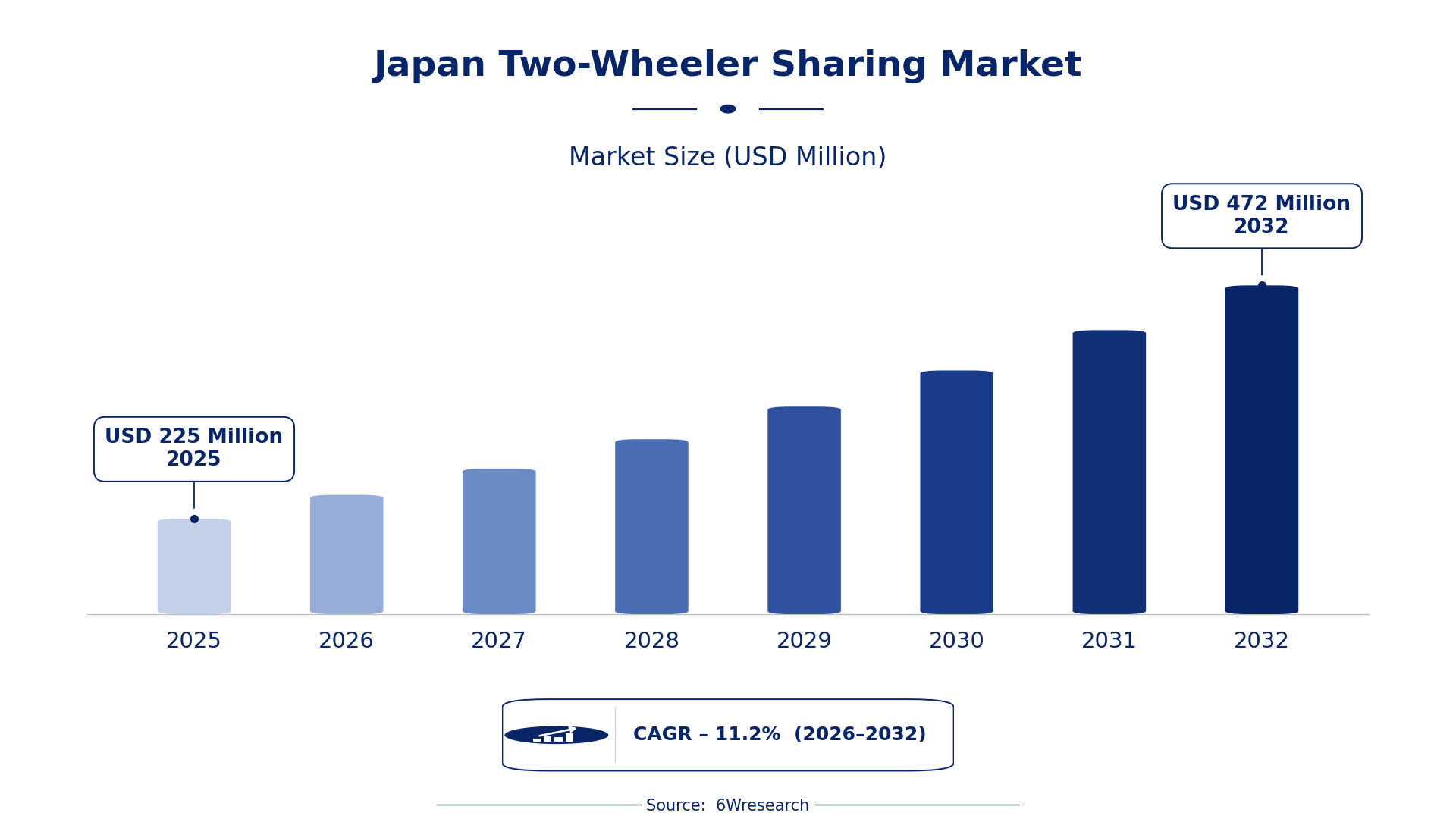
According to 6Wresearch internal database and industry insights, the Japan Two-Wheeler Sharing Market was valued at USD 225 Million in 2025 and is projected to reach USD 472 Million by 2032, growing at a CAGR of approximately 11.2% during 2026–2032.
Japan Two-Wheeler Sharing Market Highlights
| Report Metric | Details |
| Report Name | Japan Two-Wheeler Sharing Market (2026-2032) |
| Market Size 2025 | USD 225 Million |
| Market Size 2032 | USD 472 Million |
| Absolute Growth 2025–2032 | USD 247 Million |
| CAGR 2026–2032 | 11.2% |
| Peak Annual Growth | 12.2% in 2031 |
| Forecast Period | 2026–2032 |
| Historical Data | 2022–2025 |
| Base Year | 2025 |
| Leading Sharing Type, 2025 | Dockless Scooters (48% share) |
| Leading Power Source, 2025 | Electric (55% share) |
| Leading Distribution Channel, 2025 | Mobile App Platforms (45% share) |
| Leading End User Industry, 2025 | Commuters (49% share) |
| Fastest-Growing Sharing Type | Kick-Scooters (15.6% CAGR) |
| Fastest-Growing Power Source | Commuter E-Bikes (13.9% CAGR) |
| Fastest-Growing Distribution Channel | B2B Sharing Platforms (14.3% CAGR) |
| Fastest-Growing End User Industry | Students/Urban Users (14.6% CAGR) |
| Growing Sector | urban mobility solutions |
| Key End Users | commuters, students, corporate clients |
Japan Two-Wheeler Sharing Market Year-wise Growth Rate and Key Drivers (2022–2032)
This graph illustrates the annual growth rates of the market from 2022 to 2032, highlighting a steady upward trajectory and projected market expansion over the forecast period.
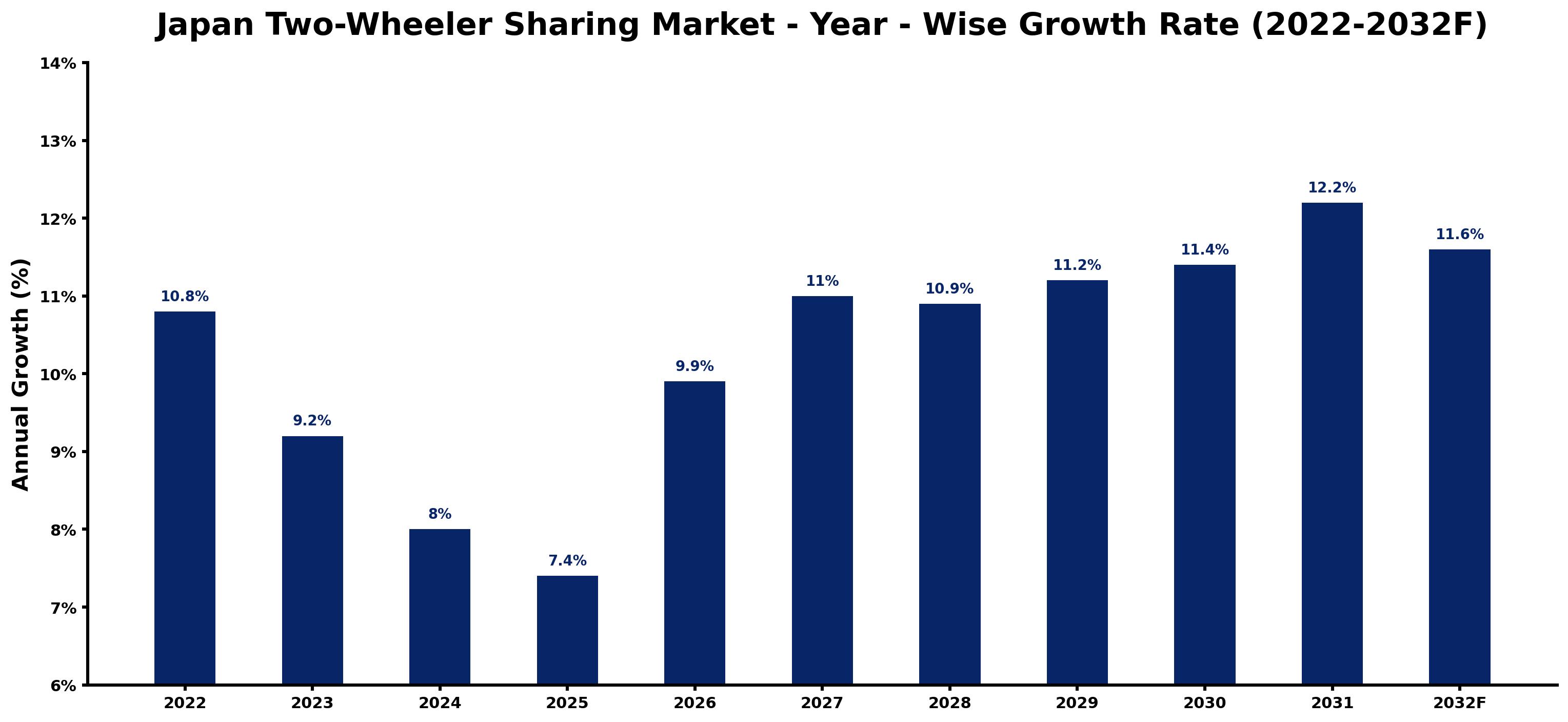
The yearly estimates that follow link every growth rate to its principal driver, so readers can see why the pace changed in each period.
| Year | Estimated Annual Growth (%) | Market Rationale |
| 2022 | 10.8 | The market experienced strong demand from urban commuters and students seeking efficient transport options. |
| 2023 | 9.2 | Growth slowed as the market adjusted to increased competition and user expectations in urban areas. |
| 2024 | 8.0 | The demand continued to grow, but at a slower pace due to market saturation and rising alternatives. |
| 2025 | 7.4 | The market saw a further slowdown as new entrants increased competition and user choices expanded. |
| 2026 | 9.9 | Demand is expected to rise as urban mobility solutions gain more traction among commuters and students. |
| 2027 | 11.0 | Growth is projected to accelerate with increased investment in infrastructure and user engagement strategies. |
| 2028 | 10.9 | The market will continue to grow, but at a slightly reduced rate due to maturity and market adjustments. |
| 2029 | 11.2 | Demand is set to rise as more users adopt two-wheeler sharing services for short-distance travel. |
| 2030 | 11.4 | Growth is expected to remain strong as urban areas expand sharing options and improve accessibility. |
| 2031 | 12.2 | The market will peak as new technologies improve user experience and operational efficiencies. |
| 2032 | 11.6 | Growth will slow as the market stabilises and matures, reflecting a more competitive environment. |
Note: Market size estimations and growth projections presented in this report are based on 6Wresearch's proprietary forecasting methodology, utilizing the latest available industry data, government publications, and primary research inputs.
Japan Two-Wheeler Sharing Market Synopsis
Two-wheeler sharing in Japan primarily involves electric scooters and e-bikes for short-distance travel, accessed via mobile applications. In 2023, Tokyo accounted for 40% of the market's usage, driven by urban commuters, students, and corporate clients seeking efficient transport solutions. The sector is expanding due to rising demand for sustainable urban mobility, supported by government programs and increasing adoption of electric vehicles, with registered users reaching 1 million.
Market Dynamics Impact Analysis (2026–2032)
| Factor | Type | Impact | Primary Segment Affected |
| Urban commuters are increasingly opting for two-wheeler sharing services to avoid congestion. | Driver | High | Commuters |
| The rise in mobile app downloads facilitates easier access to two-wheeler sharing. | Driver | High | Mobile App Platforms |
| The growing need for sustainable transport solutions creates opportunities for electric scooter providers. | Opportunity | High | Electric |
| Corporate clients are seeking efficient transport options for employees, driving demand for sharing platforms. | Opportunity | High | B2B Sharing Platforms |
| High competition among providers may lead to price wars, affecting profitability. | Restraint | Medium | Fleet Operators |
| Limited infrastructure in some urban areas restricts service expansion and user access. | Restraint | Medium | City Mobility Agencies |
| Regulatory hurdles can delay the introduction of new services in certain regions. | Challenge | High | City Mobility Agencies |
| The need for constant technological upgrades can strain operational budgets. | Challenge | Medium | Fleet Operators |
Evaluation of Drivers in Japan Two-Wheeler Sharing Market (2026–2032)
The factors lifting demand, and the evidence behind each, are summarised below.
| Drivers | Primary Segment Affected | Why It Matters (Evidence) |
| Increasing urbanisation leads to higher demand for short-distance travel solutions. | Commuters | In 2023, the average trip duration was approximately 15 minutes, prompting more users to seek quick transport options. |
| The popularity of electric scooters is rising due to their eco-friendliness and convenience. | Electric | Electric scooters are the most popular vehicle type in urban areas, accounting for over 40% of two-wheeler sharing usage. |
| Mobile applications are improving user engagement and accessibility to sharing services. | Mobile App Platforms | Mobile app downloads for sharing services exceeded 2 million in 2023, indicating a growing user base and interest. |
| Government support for sustainable transport initiatives boosts market growth. | City Mobility Agencies | Government programs promote two-wheeler sharing as part of urban planning, encouraging user adoption and infrastructure development. |
| Corporate interest in employee mobility solutions is driving demand for sharing services. | B2B Sharing Platforms | B2B sharing platforms are targeting a 20% market share by 2025, reflecting corporate demand for efficient transport solutions. |
Purchasing is picking up as urbanisation increases, with the average trip duration around 15 minutes. The rising popularity of electric scooters stems from their eco-friendliness, making them the preferred choice in urban areas. In 2023, mobile app downloads for sharing services exceeded 2 million, indicating a growing user base. Corporate interest in employee mobility solutions is driving demand, with B2B sharing platforms targeting a 20% market share by 2025.
Evaluation of Restraints in Japan Two-Wheeler Sharing Market
The key brakes on demand, and where they bite hardest, are shown below.
| Market Restraint | Primary Segment Affected | Why It Matters (Evidence) |
| High competition may lead to price wars among sharing service providers. | Fleet Operators | As more players enter the market, maintaining profitability becomes challenging due to aggressive pricing strategies. |
| Limited infrastructure in some urban areas restricts service expansion and user access. | City Mobility Agencies | Inadequate docking stations and charging facilities hinder the growth of two-wheeler sharing services, affecting user convenience. |
| Regulatory hurdles can delay the introduction of new services in certain regions. | City Mobility Agencies | Stringent regulations can slow down the approval process for new sharing platforms, impacting market entry. |
| The need for constant technological upgrades can strain operational budgets. | Fleet Operators | Investing in new technologies is essential for competitiveness but can increase operational costs, affecting profitability. |
| User retention can be challenging due to the availability of alternative transport options. | Commuters | With various transport modes available, keeping users engaged with sharing services is difficult, impacting market growth. |
Japan Two-Wheeler Sharing Market Challenges
Increased regulatory scrutiny from the Ministry of Land, Infrastructure, Transport and Tourism can raise compliance costs for fleet operators, delaying service rollouts and frustrating users. Buyers face challenges with vehicle availability due to the mandated 95% operational rate, which can lead to lost revenue opportunities and dissatisfaction among commuters. The average ride cost of around 300 yen may deter students from using the service, limiting the overall user base. Technology integration issues persist; despite over 2 million mobile app downloads, inadequate infrastructure can hinder user experience and slow adoption rates for two-wheeler sharing services.
Trends in the Japan Two-Wheeler Sharing Market
Buyers and suppliers in the Japan Two-Wheeler Sharing Market are adjusting to the following trends.
- Shift from Traditional to Electric Scooters: The trend towards electric scooters began in 2023, with over 500 docking stations in Tokyo facilitating this shift. This change appeals to urban commuters seeking eco-friendly transport options, resulting in a 30% increase in e-bike adoption.
- Transition from Station-Based to Dockless Systems: Since 2023, dockless systems have gained popularity, particularly among students in urban areas. This shift allows for greater flexibility and convenience, with users enjoying the freedom to park scooters anywhere, improving user experience.
- Emergence of Corporate Mobility Solutions: In 2023, corporate clients increasingly adopted two-wheeler sharing for employee transport. This trend is clear as B2B sharing platforms target a 20% market share by 2025, indicating a growing demand for efficient transport solutions.
- Growing Popularity of Monthly Plans: Monthly plans have gained traction since 2023, particularly among regular commuters seeking cost-effective travel. This trend reflects the need for affordable transport options, with many users opting for subscription services.
Investment Opportunities in the Japan Two-Wheeler Sharing Market
Where to invest in the Japan Two-Wheeler Sharing Market: the main openings are set out below.
- Gap in Sustainable Transport Solutions: With 40% of two-wheeler sharing usage in Tokyo, there is strong demand for sustainable transport solutions. Investing in electric scooter fleets can attract urban commuters looking for eco-friendly options and strengthen market presence.
- Timing for Corporate Mobility Solutions: The corporate sector is increasingly focused on sustainable transport, with a 25% increase in e-vehicles for staff programs in 2023. Targeting B2B clients with tailored sharing solutions can lead to substantial growth and market capture.
- Need for Enhanced User Experience: The average age of users is 25-35 years old, indicating a young demographic eager for innovative solutions. Developing user-friendly mobile applications can improve engagement and retention in this competitive market.
- Entry into Urban Areas with Limited Services: Tokyo's over 500 docking stations highlight the potential for expansion into underserved urban areas. Partnering with local agencies can facilitate entry and growth in these regions, enhancing service availability.
Government Initiatives in the Japan Two-Wheeler Sharing Market
The Electrical Appliance and Material Safety Act (1961) mandates safety regulations for electric scooters, ensuring user protection. The Battery Industry Strategy, launched in August 2022, aims to boost domestic battery manufacturing capacity to 150 GWh by 2030, supporting the electric vehicle sector and improving infrastructure.
City mobility agencies play a crucial role in implementing government initiatives. The Digital Agency, established in September 2021, oversees digital transformation, ensuring that sharing platforms comply with common system standards. These measures improve operational efficiency and user experience.
Future Insight of the Japan Two-Wheeler Sharing Market
Investment in two-wheeler sharing will increase as government support for sustainable urban transport initiatives expands, driving demand for electric scooters and e-bikes. By 2032, registered users are expected to exceed 1 million, creating a larger customer base for suppliers. Improved technology will streamline access to sharing services, enhancing user experience and operational efficiency. The Tokyo Metropolitan Government's green transport initiative will promote shared mobility solutions, aligning with urban planning goals and fostering a more integrated transport framework.
Market Segmentation Analysis
Japan Two-Wheeler Sharing Market report covers a detailed analysis of the following market segments:
By Sharing Type – Dockless Scooters Lead, Kick-Scooters Expected to Grow Fastest
According to Saurav Kr Singh, Senior Research Analyst at 6Wresearch, Dockless Scooters took 48% of sharing type revenue in 2025, more than any other category. Dockless scooters hold the largest share due to their convenience and widespread use for short trips in urban settings. With over 500 docking stations in Tokyo, they effectively meet the mobility needs of urban commuters and leisure users alike. Kick-Scooters are set to record the highest CAGR in this split, 15.6% over 2026–2032. Kick-scooters are experiencing rapid growth among students and urban users, primarily due to their ease of access and user-friendly design. The increase in mobile app downloads, surpassing 2 million in 2023, further fuels this segment's expansion. Suppliers must prioritise user-friendly features in their offerings to capture the growing interest in kick-scooters.
By Power Source – Electric Leads, Commuter E-Bikes Expected to Grow Fastest
Electric held 55% of the Japan Two-Wheeler Sharing Market by power source in 2025. Electric power sources lead the market as they are the primary option for most two-wheeler sharing services. The push for sustainable urban transport initiatives by the government further solidifies their dominance. The quickest growth will come from Commuter E-Bikes, forecast to expand at a CAGR of 13.9% between 2026 and 2032. Commuter e-bikes are rapidly gaining popularity for longer commutes in urban settings, evidenced by a 30% increase in adoption among commuters in 2023. This trend indicates a shift towards more efficient transportation solutions. Buyers may benefit from a wider range of e-bike options as demand continues to grow.
By Distribution Channel – Mobile App Platforms Lead, B2B Sharing Platforms Expected to Grow Fastest
With 45% of distribution channel revenue in 2025, Mobile App Platforms was the largest category. Mobile app platforms are essential for accessing two-wheeler sharing services, making them the leading distribution channel. Their role in facilitating user engagement is critical, especially with a user base of 1 million in Japan. B2B Sharing Platforms are projected to grow fastest, at a CAGR of 14.3% during 2026–2032. B2B sharing platforms are emerging quickly, targeting corporate clients who seek efficient transportation solutions. This segment is projected to capture 20% of the market share by 2025, indicating strong growth potential. Suppliers should consider expanding their offerings to include B2B solutions to tap into this growing market.
By End User Industry – Commuters Lead, Students/Urban Users Expected to Grow Fastest
The largest end user industry category in 2025 was Commuters, at 49% of revenue. Commuters constitute the largest user group for two-wheeler sharing services, utilising these vehicles for daily commutes in urban environments. Their reliance on efficient transport options is evident in Tokyo, which accounts for 40% of the market's usage. Over 2026–2032, Students/Urban Users are expected to post the fastest growth, at a CAGR of 14.6%. Students and urban users are experiencing the highest growth rate, drawn to shared mobility for its convenience and cost-effectiveness. The increase in student discounts offered by sharing platforms is a key factor in this trend. This indicates that suppliers must focus on appealing to the student demographic to maximise market penetration.
Key Attractiveness of the Report
- 10 Years of Market Numbers
- Historical Data Starting from 2022 to 2025
- Base Year 2025
- Forecast Data until 2032
- Key Performance Indicators Impacting the Market
- Major Upcoming Developments and Projects
Key Highlights of the Report:
- Japan Two-Wheeler Sharing Market Outlook
- Market Size of Japan Two-Wheeler Sharing Market, 2025
- Forecast of Japan Two-Wheeler Sharing Market, 2032
- Historical Data and Forecast of Japan Two-Wheeler Sharing Revenues & Volume for the Period 2022-2032F
- Japan Two-Wheeler Sharing Market Trend Evolution
- Japan Two-Wheeler Sharing Market Drivers and Challenges
- Japan Two-Wheeler Sharing Price Trends
- Japan Two-Wheeler Sharing Porter's Five Forces
- Japan Two-Wheeler Sharing Industry Life Cycle
- Historical Data and Forecast of Japan Two-Wheeler Sharing Market Revenues & Volume By Sharing Type for the Period 2022-2032F
- Historical Data and Forecast of Japan Two-Wheeler Sharing Market Revenues & Volume By Dockless Scooters for the Period 2022-2032F
- Historical Data and Forecast of Japan Two-Wheeler Sharing Market Revenues & Volume By Kick-Scooters for the Period 2022-2032F
- Historical Data and Forecast of Japan Two-Wheeler Sharing Market Revenues & Volume By Monthly Plans for the Period 2022-2032F
- Historical Data and Forecast of Japan Two-Wheeler Sharing Market Revenues & Volume By e-Vehicles for Staff for the Period 2022-2032F
- Historical Data and Forecast of Japan Two-Wheeler Sharing Market Revenues & Volume By Power Source for the Period 2022-2032F
- Historical Data and Forecast of Japan Two-Wheeler Sharing Market Revenues & Volume By Electric for the Period 2022-2032F
- Historical Data and Forecast of Japan Two-Wheeler Sharing Market Revenues & Volume By Commuter E-Bikes for the Period 2022-2032F
- Historical Data and Forecast of Japan Two-Wheeler Sharing Market Revenues & Volume By Electric for the Period 2022-2032F
- Historical Data and Forecast of Japan Two-Wheeler Sharing Market Revenues & Volume By Electric for the Period 2022-2032F
- Historical Data and Forecast of Japan Two-Wheeler Sharing Market Revenues & Volume By Distribution Channel for the Period 2022-2032F
- Historical Data and Forecast of Japan Two-Wheeler Sharing Market Revenues & Volume By Mobile App Platforms for the Period 2022-2032F
- Historical Data and Forecast of Japan Two-Wheeler Sharing Market Revenues & Volume By City Mobility Agencies for the Period 2022-2032F
- Historical Data and Forecast of Japan Two-Wheeler Sharing Market Revenues & Volume By Fleet Operators for the Period 2022-2032F
- Historical Data and Forecast of Japan Two-Wheeler Sharing Market Revenues & Volume By B2B Sharing Platforms for the Period 2022-2032F
- Historical Data and Forecast of Japan Two-Wheeler Sharing Market Revenues & Volume By End User Industry for the Period 2022-2032F
- Historical Data and Forecast of Japan Two-Wheeler Sharing Market Revenues & Volume By Commuters for the Period 2022-2032F
- Historical Data and Forecast of Japan Two-Wheeler Sharing Market Revenues & Volume By Students/Urban Users for the Period 2022-2032F
- Historical Data and Forecast of Japan Two-Wheeler Sharing Market Revenues & Volume By Short Trip Users for the Period 2022-2032F
- Historical Data and Forecast of Japan Two-Wheeler Sharing Market Revenues & Volume By Corporate Clients for the Period 2022-2032F
- Japan Two-Wheeler Sharing Import Export Trade Statistics
- Market Opportunity Assessment By Sharing Type
- Market Opportunity Assessment By Power Source
- Market Opportunity Assessment By Distribution Channel
- Market Opportunity Assessment By End User Industry
- Japan Two-Wheeler Sharing Top Companies Market Share
- Japan Two-Wheeler Sharing Competitive Benchmarking By Technical and Operational Parameters
- Japan Two-Wheeler Sharing Company Profiles
- Japan Two-Wheeler Sharing Key Strategic Recommendations
Market Covered
This report examines the market across the segments below.
By Sharing Type
- Dockless Scooters
- Kick-Scooters
- Monthly Plans
- e-Vehicles for Staff
By Power Source
- Electric
- Commuter E-Bikes
By Distribution Channel
- Mobile App Platforms
- City Mobility Agencies
- Fleet Operators
- B2B Sharing Platforms
By End User Industry
- Commuters
- Students/Urban Users
- Short Trip Users
- Corporate Clients































