Japan Two-Wheeler Suspension Market Size & Growth Rate
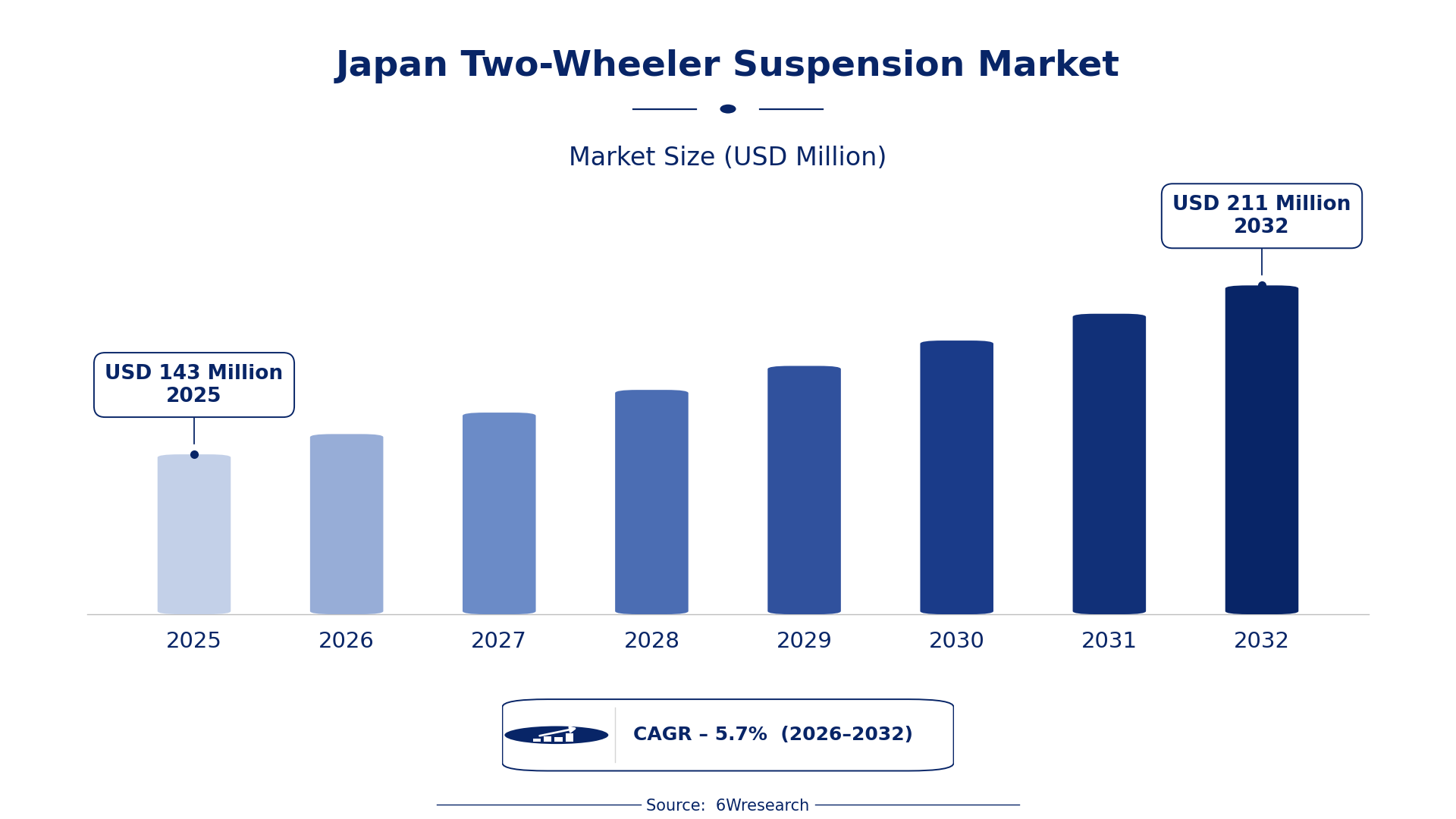
According to 6Wresearch internal database and industry insights, the Japan Two-Wheeler Suspension Market was valued at USD 143 Million in 2025 and is projected to reach USD 211 Million by 2032, growing at a CAGR of approximately 5.7% during 2026–2032.
Japan Two-Wheeler Suspension Market Highlights
| Report Metric | Details |
| Report Name | Japan Two-Wheeler Suspension Market (2026-2032) |
| Market Size 2025 | USD 143 Million |
| Market Size 2032 | USD 211 Million |
| Absolute Growth 2025–2032 | USD 68 Million |
| CAGR 2026–2032 | 5.7% |
| Peak Annual Growth | 6.5% in 2028 |
| Forecast Period | 2026–2032 |
| Historical Data | 2022–2025 |
| Base Year | 2025 |
| Leading Two‑Wheeler Suspension, 2025 | Front Forks (44% share) |
| Leading Component Type, 2025 | Telescopic Forks (33% share) |
| Leading Suspension Tech, 2025 | USD / Conventional (37% share) |
| Leading Distribution Channel, 2025 | OEM Supply Chains (46% share) |
| Leading End User Industry, 2025 | Off-Road & Road Bikes (51% share) |
| Fastest-Growing Two‑Wheeler Suspension | Rear Shocks (7.5% CAGR) |
| Fastest-Growing Component Type | Mono / Twin Shocks (8.2% CAGR) |
| Fastest-Growing Suspension Tech | Gas / Oil Filled (7.7% CAGR) |
| Fastest-Growing Distribution Channel | Specialized Dealers (7.2% CAGR) |
| Fastest-Growing End User Industry | Commuter / Touring (8.1% CAGR) |
| Growing Sector | Performance Riders |
| Key End Users | Motorcycle manufacturers, performance riders, specialized dealers, commuters |
Japan Two-Wheeler Suspension Market Year-wise Growth Rate and Key Drivers (2022–2032)
This graph illustrates the annual growth rates of the market from 2022 to 2032, highlighting a steady upward trajectory and projected market expansion over the forecast period.
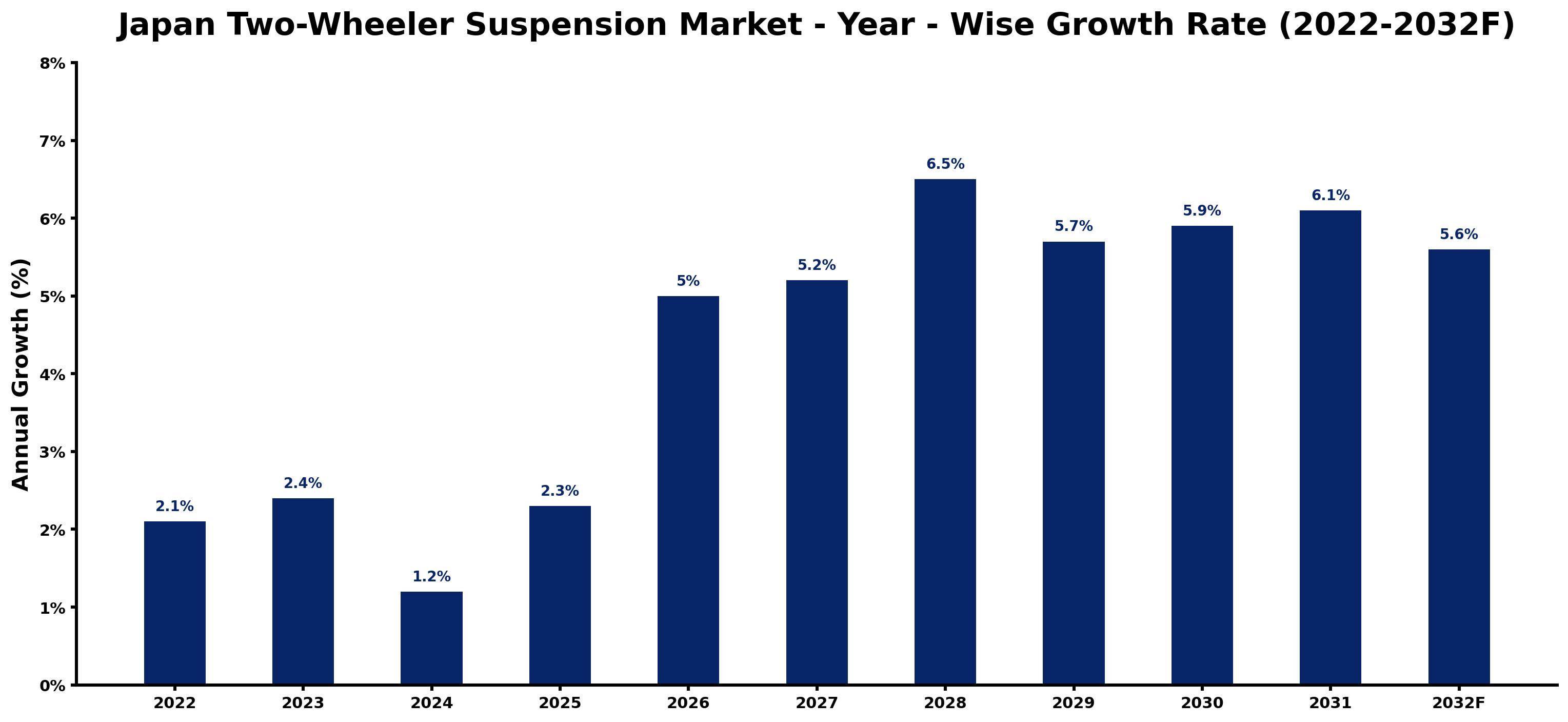
Below, each year's estimated growth is shown next to the factor that most influenced it.
| Year | Estimated Annual Growth (%) | Market Rationale |
| 2022 | 2.1 | The market experienced steady growth, reflecting consistent demand from domestic users. |
| 2023 | 2.4 | Growth accelerated due to increased motorcycle sales, particularly in urban areas. |
| 2024 | 1.2 | A slowdown occurred as economic factors influenced consumer spending on motorcycles. |
| 2025 | 2.3 | Demand rose again, driven by interest in performance upgrades among riders. |
| 2026 | 5.0 | Growth is expected to rise as investments in electric motorcycle infrastructure expand. |
| 2027 | 5.2 | Demand will continue to rise due to the popularity of off-road biking activities. |
| 2028 | 6.5 | The market is projected to peak with heightened interest in advanced suspension technologies. |
| 2029 | 5.7 | Growth is expected to slow slightly as market saturation begins to affect new sales. |
| 2030 | 5.9 | Demand will increase again as new models with improved features are introduced. |
| 2031 | 6.1 | Continued interest in performance and safety features will drive steady growth. |
| 2032 | 5.6 | A slight slowdown is projected as the market stabilises after rapid growth. |
Note: Market size estimations and growth projections presented in this report are based on 6Wresearch's proprietary forecasting methodology, utilizing the latest available industry data, government publications, and primary research inputs.
Japan Two-Wheeler Suspension Market Synopsis
Two-wheeler suspension systems are essential mechanical devices that absorb shocks and provide stability for motorcycles and scooters. In Japan, the motorcycle manufacturing industry remains active, with a population of approximately 6 million units. The Japan Two-Wheeler Suspension Market is growing due to rising demand from domestic users and the increasing popularity of performance upgrades, particularly in regions like Kansai. Government initiatives to promote electric motorcycles are driving investments in new technologies and infrastructure, stimulating market growth.
Market Dynamics Impact Analysis (2026–2032)
| Factor | Type | Impact | Primary Segment Affected |
| Increased demand for performance upgrades among riders | Driver | High | Suspension Kits |
| Growth in the electric motorcycle segment | Driver | High | Rear Shocks |
| Expansion of specialized dealers in urban areas | Opportunity | Medium | OEM Supply Chains |
| Rising interest in off-road biking experiences | Opportunity | Medium | Off-Road & Road Bikes |
| High costs associated with advanced suspension technologies | Restraint | High | Telescopic Forks |
| Limited availability of high-performance components | Restraint | Medium | Adjustable Dampers |
| Competition from alternative transport modes | Challenge | High | Commuter / Touring |
| Fluctuating raw material prices affecting production | Challenge | Medium | Gas / Oil Filled |
Evaluation of Drivers in Japan Two-Wheeler Suspension Market (2026–2032)
Below are the drivers that matter most for revenue growth, with supporting evidence.
| Drivers | Primary Segment Affected | Why It Matters (Evidence) |
| Increasing motorcycle population | Rear Shocks | Japan's motorcycle population is approximately 6 million units, leading to higher demand for suspension systems. |
| Rising interest in performance upgrades | Suspension Kits | Suspension kits are popular in the Kansai region, where sales have increased by 20% in the last year. |
| Government initiatives promoting electric motorcycles | Telescopic Forks | In 2023, a government program was launched to promote electric motorcycles, increasing demand for related components. |
| Growth in specialized dealers | OEM Supply Chains | The number of specialized dealers has increased by 15% in the last five years, improving market access. |
| Popularity of motorcycle events | Off-Road & Road Bikes | The annual motorcycle event in Osaka attracts over 100,000 visitors, stimulating interest in two-wheeler products. |
Most of the extra volume comes from the increasing motorcycle population, which is approximately 6 million units in Japan. This growth leads to heightened demand for rear shocks, particularly as riders seek improved comfort and safety. The rising interest in performance upgrades has made suspension kits popular among performance riders. The expansion of specialized dealers, which has increased by 15% over the last five years, improves access to OEM supply chains, driving overall market growth. The annual motorcycle event in Osaka stimulates interest in advanced suspension technologies, attracting a large audience.
Evaluation of Restraints in Japan Two-Wheeler Suspension Market
Below are the constraints most often cited by buyers and suppliers, with the segment each affects.
| Market Restraint | Primary Segment Affected | Why It Matters (Evidence) |
| High costs associated with advanced suspension technologies | Telescopic Forks | The average price for a quality rear shock is around ¥30,000, limiting affordability for some buyers. |
| Limited availability of high-performance components | Adjustable Dampers | The demand for adjustable dampers is growing, but supply constraints hinder availability in the market. |
| Competition from alternative transport modes | Commuter / Touring | As urban mobility shifts towards public transport, motorcycle sales face competition, impacting overall demand. |
| Fluctuating raw material prices affecting production | Gas / Oil Filled | Rising raw material costs can lead to increased production expenses, affecting pricing strategies for manufacturers. |
| Regulatory compliance costs for new technologies | Suspension Kits | Compliance with safety regulations, such as the JIS B 1301 standard, adds to production costs for suspension kits. |
Japan Two-Wheeler Suspension Market Challenges
A shortage of qualified technicians in the two-wheeler suspension market hampers production efficiency, leading to delays of up to two months for producers. Strict compliance with the JIS B 1301 standard complicates design processes, resulting in increased manufacturing costs that can raise prices for buyers by around 10%. The slow adoption of advanced technologies in suspension systems limits performance improvements, reducing satisfaction among buyers who seek better handling and comfort. Difficulties in sourcing high-quality materials can extend delivery times by three months for producers, ultimately affecting product availability for buyers.
Trends in the Japan Two-Wheeler Suspension Market
Several trends are reshaping the Japan Two-Wheeler Suspension Market; the most important are set out below.
- Shift towards Electric Motorcycles: In 2023, a government program was initiated to promote electric motorcycles, reflecting a change in consumer preferences. This initiative is projected to contribute to a 15% increase in sales over the next few years.
- Transition from Standard to Adjustable Dampers: The growing enthusiasm for performance riding has resulted in a shift from standard to adjustable dampers. This trend is particularly pronounced among enthusiasts, with a reported 20% rise in sales of adjustable dampers in 2023.
- Emergence of Specialized Dealers: The growth of specialized dealers has revolutionised the distribution of two-wheeler suspension systems. With a 15% increase in the number of specialized dealers, buyers now enjoy improved access to high-performance components.
- Prioritisation of Safety Features: Safety features are increasingly emphasised in motorcycle design, with manufacturers concentrating on advanced suspension systems. This trend is evident in new models, where 70% of new motorcycles now incorporate gas/oil filled suspensions.
Investment Opportunities in the Japan Two-Wheeler Suspension Market
The following areas offer the clearest openings for investors and suppliers in the Japan Two-Wheeler Suspension Market.
- Supply of Suspension Kits: Suspension kits are in high demand, especially among performance riders in the Kansai region, where sales have surged by 20%. Investing in high-quality suspension kits could capture this expanding market segment.
- Expansion of Specialized Dealers: The rise in specialized dealers offers an opportunity to supply high-performance components. Targeting urban areas, where demand is increasing, can enhance market penetration for suppliers.
- Investment in Electric Motorcycle Components: With the government's push for electric motorcycles, there is a notable opportunity to supply components designed for electric models. Focusing on manufacturers in the Tokyo region can facilitate entry into this emerging market.
- Partnerships with OEMs: Establishing partnerships with OEMs can provide access to established supply chains. This strategy is particularly advantageous for suppliers of telescopic forks, as OEM supply chains accounted for 46% of the market in 2025.
Government Initiatives in the Japan Two-Wheeler Suspension Market
The Hydrogen Society Promotion Act, enacted in 2024, supports low-carbon hydrogen and ammonia supply chains, which adds to existing regulations like the Waste Management and Public Cleansing Act of 1970. This law mandates proper waste disposal, impacting manufacturers by requiring compliance with environmental standards in their production processes.
The Ministry of Land, Infrastructure, Transport and Tourism oversees motorcycle safety regulations, approving new safety standards and funding initiatives aimed at improving rider safety. This includes funding for research into advanced suspension technologies that improve motorcycle stability.
Future Insight of the Japan Two-Wheeler Suspension Market
Investment in electric motorcycle infrastructure will drive demand for advanced suspension systems, benefiting suppliers who adapt swiftly. The introduction of smart technologies in suspension will improve safety and handling, attracting a broader range of buyers. The motorcycle population in Japan, currently around 6 million units, is expected to transition towards electric models, necessitating customised suspension solutions. The annual motorcycle event in Osaka is anticipated to draw over 120,000 visitors, creating opportunities for suppliers to showcase their latest innovations.
Market Segmentation Analysis
Japan Two-Wheeler Suspension Market report covers a detailed analysis of the following market segments:
By Two‑Wheeler Suspension – Front Forks Lead, Rear Shocks Expected to Grow Fastest
According to Saurav Kr Singh, Senior Research Analyst at 6Wresearch, the largest two‑wheeler suspension category in 2025 was Front Forks, at 44% of revenue. Front forks are essential for stability and control, making them a vital component in the majority of motorcycles. Their significance is highlighted by the large motorcycle population in Japan, which stands at approximately 6 million units. Rear Shocks are projected to grow fastest, at a CAGR of 7.5% during 2026–2032. Rear shocks are gaining traction due to the increasing demand for rider comfort and safety, particularly among the average rider demographic of 45 years. This segment's growth is expected to continue as riders increasingly seek enhanced experiences and advanced shock technologies. Suppliers must focus on high-quality front forks while also innovating in rear shock technologies to meet emerging demands.
By Component Type – Telescopic Forks Lead, Mono / Twin Shocks Expected to Grow Fastest
In 2025, Telescopic Forks led the component type split with a 33% share. Telescopic forks are the most common design for front suspension systems, widely used across various motorcycle models. Their popularity is reinforced by the Tokyo region, which accounts for 30% of motorcycle sales in Japan, highlighting their extensive adoption. Over 2026–2032, Mono / Twin Shocks are expected to post the fastest growth, at a CAGR of 8.2%. Mono and twin shocks are becoming more popular as they provide a standard solution for rear suspension, appealing to both manufacturers and consumers. This growth is supported by a 15% increase in specialized dealers over the past five years, enhancing product availability. Manufacturers should ensure a steady supply of telescopic forks while investing in mono and twin shocks to meet rising demand.
By Suspension Tech – USD / Conventional Leads, Gas / Oil Filled Expected to Grow Fastest
USD / Conventional held 37% of the Japan Two-Wheeler Suspension Market by suspension tech in 2025. USD and conventional suspension designs are prevalent across various motorcycle types, catering to diverse rider preferences and bike specifications. Their established presence ensures they capture a substantial share of the suspension technology market. Gas / Oil Filled is set to record the highest CAGR in this split, 7.7% over 2026–2032. Gas and oil filled suspensions are increasingly common in modern motorcycles, due to their effectiveness in enhancing ride comfort. As more manufacturers adopt this technology, its growth rate is expected to accelerate, solidifying its market position. Suppliers need to advance gas and oil filled technologies to remain competitive and align with the preferences of motorcycle manufacturers.
By Distribution Channel – OEM Supply Chains Lead, Specialized Dealers Expected to Grow Fastest
OEM Supply Chains accounted for 46% of the market by distribution channel in 2025. OEM supply chains serve as the primary source for manufacturers, ensuring a reliable flow of essential components to production lines. This established relationship is crucial for maintaining product quality and consistency across the market. The quickest growth will come from Specialized Dealers, forecast to expand at a CAGR of 7.2% between 2026 and 2032. Specialized dealers are experiencing rapid growth as they play a significant role in aftermarket sales, catering to the increasing number of motorcycle enthusiasts. Their rise indicates a shift towards personalised service and tailored solutions for riders. Suppliers should strengthen partnerships with specialized dealers to enhance distribution and reach a broader customer base.
By End User Industry – Off-Road & Road Bikes Lead, Commuter / Touring Expected to Grow Fastest
Off-Road & Road Bikes took 51% of end user industry revenue in 2025, more than any other category. Off-road and road bikes represent a major market segment, appealing to a wide range of riders and applications. This broad appeal is reflected in Japan's large motorcycle population, supporting sustained demand for suspension systems. Commuter / Touring is projected to grow fastest, at a CAGR of 8.1% during 2026–2032. The commuter and touring segment is witnessing notable growth as more riders seek practical solutions for daily travel and long-distance journeys. This trend is bolstered by the increasing popularity of motorcycles as a cost-effective transportation option. Manufacturers should prioritise the development of suspension systems tailored for commuter and touring motorcycles to capitalise on this growing user base.
Key Attractiveness of the Report
- 10 Years of Market Numbers
- Historical Data Starting from 2022 to 2025
- Base Year 2025
- Forecast Data until 2032
- Key Performance Indicators Impacting the Market
- Major Upcoming Developments and Projects
Key Highlights of the Report:
- Japan Two-Wheeler Suspension Market Outlook
- Market Size of Japan Two-Wheeler Suspension Market, 2025
- Forecast of Japan Two-Wheeler Suspension Market, 2032
- Historical Data and Forecast of Japan Two-Wheeler Suspension Revenues & Volume for the Period 2022-2032F
- Japan Two-Wheeler Suspension Market Trend Evolution
- Japan Two-Wheeler Suspension Market Drivers and Challenges
- Japan Two-Wheeler Suspension Price Trends
- Japan Two-Wheeler Suspension Porter's Five Forces
- Japan Two-Wheeler Suspension Industry Life Cycle
- Historical Data and Forecast of Japan Two-Wheeler Suspension Market Revenues & Volume By Two Wheeler Suspension for the Period 2022-2032F
- Historical Data and Forecast of Japan Two-Wheeler Suspension Market Revenues & Volume By Front Forks for the Period 2022-2032F
- Historical Data and Forecast of Japan Two-Wheeler Suspension Market Revenues & Volume By Rear Shocks for the Period 2022-2032F
- Historical Data and Forecast of Japan Two-Wheeler Suspension Market Revenues & Volume By Steering Dampers for the Period 2022-2032F
- Historical Data and Forecast of Japan Two-Wheeler Suspension Market Revenues & Volume By Suspension Kits for the Period 2022-2032F
- Historical Data and Forecast of Japan Two-Wheeler Suspension Market Revenues & Volume By Component Type for the Period 2022-2032F
- Historical Data and Forecast of Japan Two-Wheeler Suspension Market Revenues & Volume By Telescopic Forks for the Period 2022-2032F
- Historical Data and Forecast of Japan Two-Wheeler Suspension Market Revenues & Volume By Mono / Twin Shocks for the Period 2022-2032F
- Historical Data and Forecast of Japan Two-Wheeler Suspension Market Revenues & Volume By Adjustable Dampers for the Period 2022-2032F
- Historical Data and Forecast of Japan Two-Wheeler Suspension Market Revenues & Volume By Suspension Upgrades for the Period 2022-2032F
- Historical Data and Forecast of Japan Two-Wheeler Suspension Market Revenues & Volume By Suspension Tech for the Period 2022-2032F
- Historical Data and Forecast of Japan Two-Wheeler Suspension Market Revenues & Volume By USD / Conventional for the Period 2022-2032F
- Historical Data and Forecast of Japan Two-Wheeler Suspension Market Revenues & Volume By Gas / Oil Filled for the Period 2022-2032F
- Historical Data and Forecast of Japan Two-Wheeler Suspension Market Revenues & Volume By Hydraulic for the Period 2022-2032F
- Historical Data and Forecast of Japan Two-Wheeler Suspension Market Revenues & Volume By Cartridge Rebuildable for the Period 2022-2032F
- Historical Data and Forecast of Japan Two-Wheeler Suspension Market Revenues & Volume By Distribution Channel for the Period 2022-2032F
- Historical Data and Forecast of Japan Two-Wheeler Suspension Market Revenues & Volume By OEM Supply Chains for the Period 2022-2032F
- Historical Data and Forecast of Japan Two-Wheeler Suspension Market Revenues & Volume By Specialized Dealers for the Period 2022-2032F
- Historical Data and Forecast of Japan Two-Wheeler Suspension Market Revenues & Volume By Performance Stores for the Period 2022-2032F
- Historical Data and Forecast of Japan Two-Wheeler Suspension Market Revenues & Volume By Aftermarket Sellers for the Period 2022-2032F
- Historical Data and Forecast of Japan Two-Wheeler Suspension Market Revenues & Volume By End User Industry for the Period 2022-2032F
- Historical Data and Forecast of Japan Two-Wheeler Suspension Market Revenues & Volume By Off-Road & Road Bikes for the Period 2022-2032F
- Historical Data and Forecast of Japan Two-Wheeler Suspension Market Revenues & Volume By Commuter / Touring for the Period 2022-2032F
- Historical Data and Forecast of Japan Two-Wheeler Suspension Market Revenues & Volume By Performance Riders for the Period 2022-2032F
- Historical Data and Forecast of Japan Two-Wheeler Suspension Market Revenues & Volume By Enthusiasts for the Period 2022-2032F
- Japan Two-Wheeler Suspension Import Export Trade Statistics
- Market Opportunity Assessment By Two Wheeler Suspension
- Market Opportunity Assessment By Component Type
- Market Opportunity Assessment By Suspension Tech
- Market Opportunity Assessment By Distribution Channel
- Market Opportunity Assessment By End User Industry
- Japan Two-Wheeler Suspension Top Companies Market Share
- Japan Two-Wheeler Suspension Competitive Benchmarking By Technical and Operational Parameters
- Japan Two-Wheeler Suspension Company Profiles
- Japan Two-Wheeler Suspension Key Strategic Recommendations
Market Covered
The following segment groups are covered in the report.
By Two‑Wheeler Suspension
- Front Forks
- Rear Shocks
- Steering Dampers
- Suspension Kits
By Component Type
- Telescopic Forks
- Mono / Twin Shocks
- Adjustable Dampers
- Suspension Upgrades
By Suspension Tech
- USD / Conventional
- Gas / Oil Filled
- Hydraulic
- Cartridge Rebuildable
By Distribution Channel
- OEM Supply Chains
- Specialized Dealers
- Performance Stores
- Aftermarket Sellers
By End User Industry
- Off-Road & Road Bikes
- Commuter / Touring
- Performance Riders
- Enthusiasts































