Japan UAV Autopilot Market Size & Growth Rate
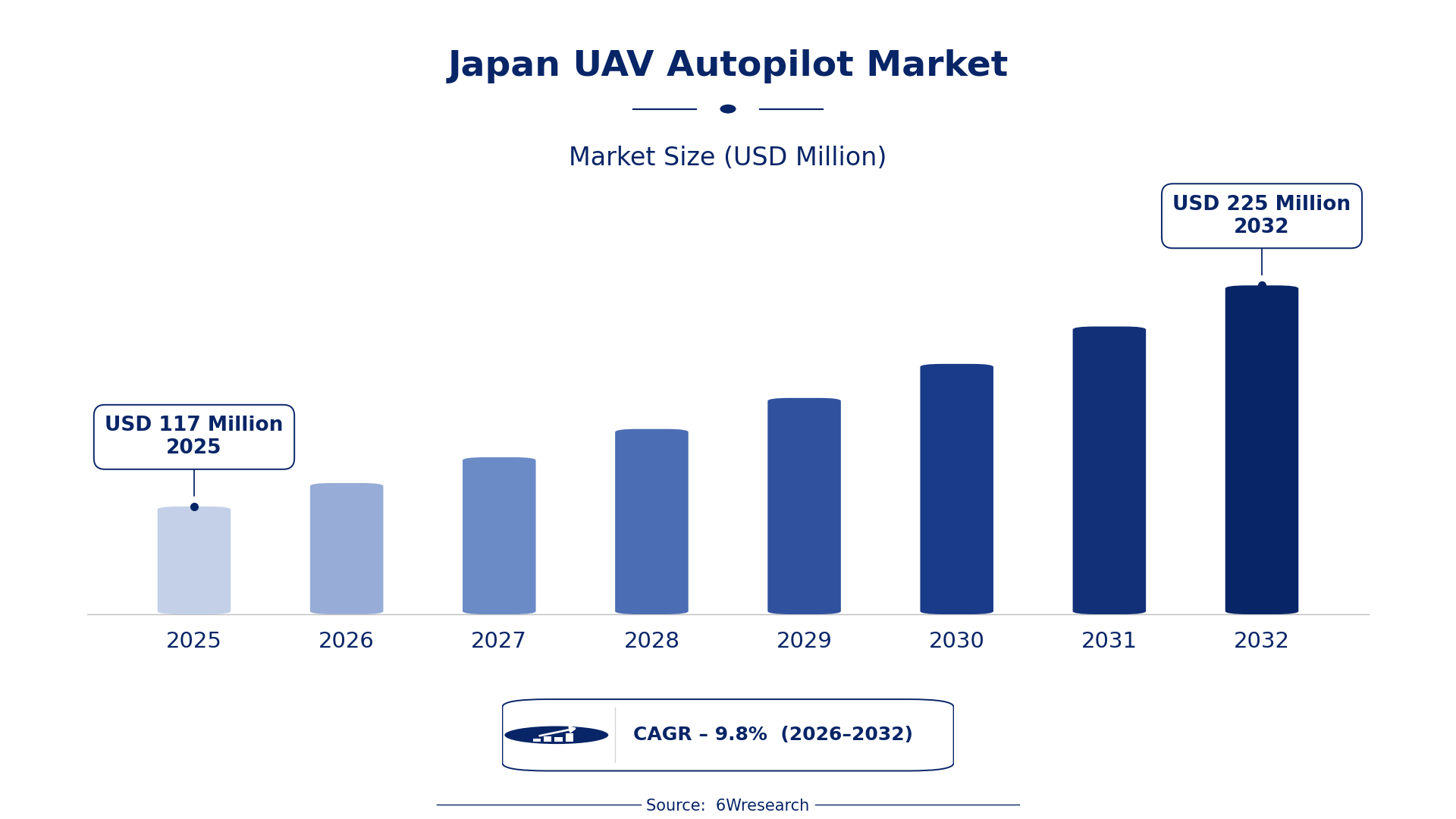
According to 6Wresearch internal database and industry insights, the Japan UAV Autopilot Market was valued at USD 117 Million in 2025 and is projected to reach USD 225 Million by 2032, growing at a CAGR of approximately 9.8% during 2026–2032.
Japan UAV Autopilot Market Highlights
| Report Metric | Details |
| Report Name | Japan UAV Autopilot Market (2026-2032) |
| Market Size 2025 | USD 117 Million |
| Market Size 2032 | USD 225 Million |
| Absolute Growth 2025–2032 | USD 108 Million |
| CAGR 2026–2032 | 9.8% |
| Peak Annual Growth | 10.8% in 2027 |
| Forecast Period | 2026–2032 |
| Historical Data | 2022–2025 |
| Base Year | 2025 |
| Leading Autopilot Type, 2025 | Fixed-Wing Autopilots (39% share) |
| Leading UAV Class, 2025 | Surveillance UAVs (39% share) |
| Leading Navigation Support, 2025 | GPS + Inertial (36% share) |
| Leading End User, 2025 | ISR UAV Makers (49% share) |
| Fastest-Growing Autopilot Type | Rotary-Wing Autopilots (14.4% CAGR) |
| Fastest-Growing UAV Class | Drones / VTOLs (13.1% CAGR) |
| Fastest-Growing Navigation Support | GNSS-Based (12.9% CAGR) |
| Fastest-Growing End User | Defense Integrators (12.8% CAGR) |
| Growing Sector | Defense Integrators |
| Key End Users | ISR UAV Makers, Defense Integrators, UAV OEMs, Tactical Forces |
Japan UAV Autopilot Market Year-wise Growth Rate and Key Drivers (2022–2032)
This graph illustrates the annual growth rates of the market from 2022 to 2032, highlighting a steady upward trajectory and projected market expansion over the forecast period.
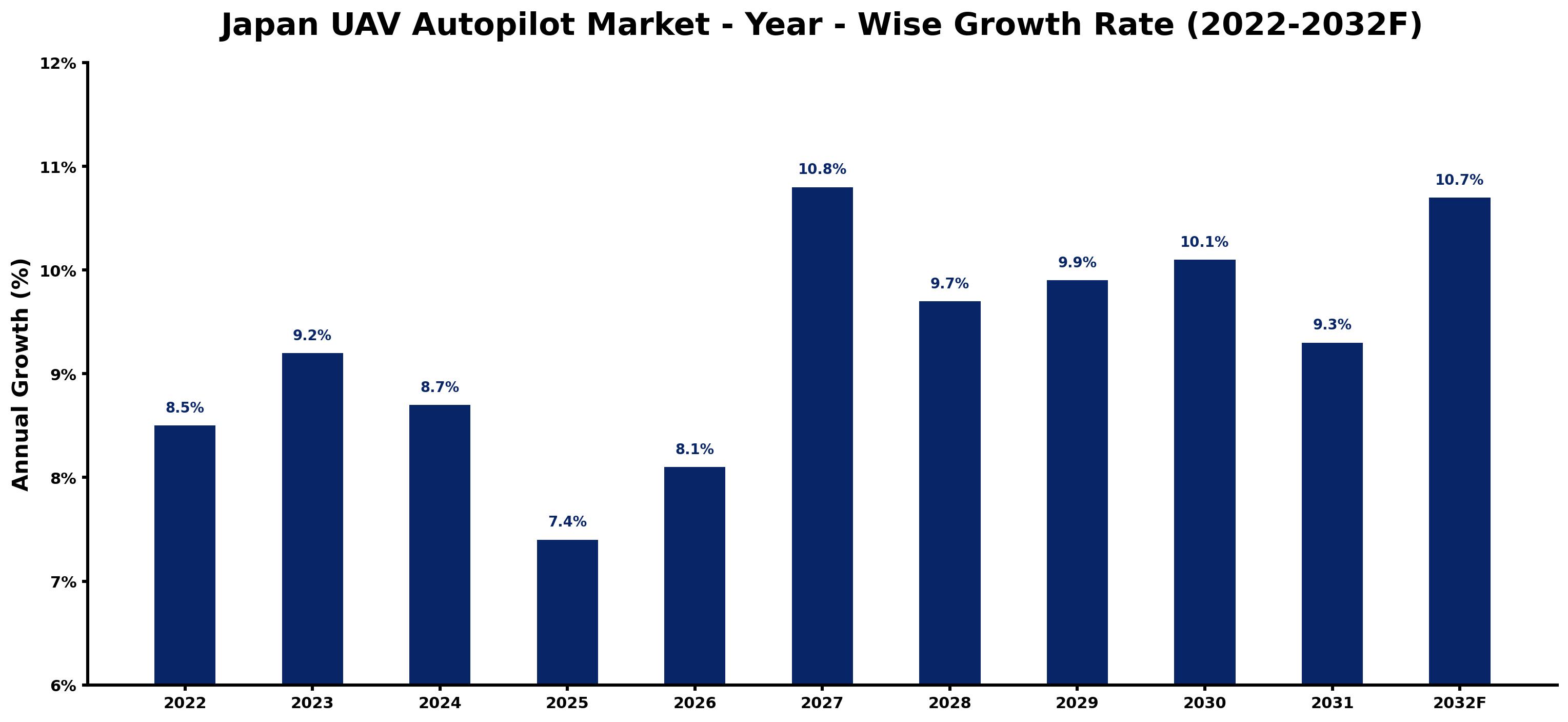
Each row of the following table gives one year's estimated growth and the event or demand shift that explains it.
| Year | Estimated Annual Growth (%) | Market Rationale |
| 2022 | 8.5 | The market experienced steady growth due to increasing interest in UAV technology. |
| 2023 | 9.2 | Demand surged as the Ministry of Defense allocated funding for UAV systems. |
| 2024 | 8.7 | Growth slowed as the market adjusted to previous high investment levels. |
| 2025 | 7.4 | Continued investment in UAV technology led to further market expansion, albeit at a slower pace. |
| 2026 | 8.1 | The market is expected to recover with renewed interest in UAV applications across sectors. |
| 2027 | 10.8 | A peak in growth is projected as advanced UAV technologies gain traction. |
| 2028 | 9.7 | Growth is expected to slow again as market saturation begins to affect new orders. |
| 2029 | 9.9 | Demand is projected to rebound as new applications for UAVs emerge in various industries. |
| 2030 | 10.1 | Increased focus on autonomous systems will drive further growth in the UAV sector. |
| 2031 | 9.3 | A slight slowdown is expected as the market stabilises after rapid expansion. |
| 2032 | 10.7 | Growth is projected to accelerate again as investment in UAV technology reaches new heights. |
Note: Market size estimations and growth projections presented in this report are based on 6Wresearch's proprietary forecasting methodology, utilizing the latest available industry data, government publications, and primary research inputs.
Japan UAV Autopilot Market Synopsis
UAV autopilots are advanced control systems that automate flight operations in unmanned aerial vehicles, utilising software algorithms and hardware components. The Japan UAV Autopilot Market is expanding due to rising demand from the defense sector and increased investment in UAV technology, particularly in surveillance and reconnaissance applications. The market is driven by the ¥1.2 trillion budget for defense modernization and advancements in autonomous systems, indicating a strong future for UAV technology in Japan.
Market Dynamics Impact Analysis (2026–2032)
| Factor | Type | Impact | Primary Segment Affected |
| Increasing defense budgets drive demand for UAV systems. | Driver | High | Surveillance UAVs |
| Growing civilian applications for UAVs create new market opportunities. | Driver | High | Drones / VTOLs |
| Investment in autonomous UAV technologies presents significant growth potential. | Opportunity | High | Hybrid Autopilot Systems |
| Rising interest in UAVs for disaster response creates demand for innovative solutions. | Opportunity | Medium | Small Tactical UAVs |
| Regulatory challenges can hinder UAV deployment and operations. | Restraint | High | ISR UAV Makers |
| High development costs can restrict market entry for new players. | Restraint | Medium | UAV OEMs |
| Competition from international UAV manufacturers pressures local producers. | Challenge | High | Defense Integrators |
| Technological advancements require continuous investment to remain competitive. | Challenge | Medium | Tactical Forces |
Evaluation of Drivers in Japan UAV Autopilot Market (2026–2032)
These are the developments adding the most demand over the forecast period.
| Drivers | Primary Segment Affected | Why It Matters (Evidence) |
| Increased defense spending on UAV systems. | Surveillance UAVs | The Ministry of Defense allocated ¥1.2 trillion for modernization, boosting UAV orders. |
| Rising civilian applications for UAVs. | Drones / VTOLs | The growing interest in UAV technology leads to more purchases across agriculture and logistics sectors. |
| Investment in autonomous systems improves UAV capabilities. | Hybrid Autopilot Systems | Japan's focus on autonomous technologies drives demand for advanced UAV solutions. |
| Technological advancements improve UAV performance. | Small Tactical UAVs | Innovations in UAV design lead to increased operational efficiency and demand. |
| Growing interest in UAVs for disaster response. | ISR UAV Makers | Increased UAV deployment for recovery efforts is reported by the Japan Defense Agency. |
Civilian applications are growing as interest in UAV technology rises, prompting purchases in sectors such as agriculture and logistics. Investment in autonomous systems improves capabilities, aligning with Japan's focus on technological progress. Recent advancements in UAV design lead to greater operational efficiency for users, further driving demand.
Evaluation of Restraints in Japan UAV Autopilot Market
Several factors work against faster growth; the main ones are summarised below.
| Market Restraint | Primary Segment Affected | Why It Matters (Evidence) |
| Regulatory challenges hinder UAV deployment. | ISR UAV Makers | Compliance with strict regulations can delay UAV operations and limit market access. |
| High development costs restrict market entry. | UAV OEMs | Investment requirements can deter new entrants from competing effectively. |
| Limited availability of skilled workforce affects production capacity. | Defense Integrators | A shortage of qualified personnel can slow down UAV development and integration. |
| Market saturation limits growth opportunities. | Surveillance UAVs | As more players enter the market, competition intensifies, affecting profit margins. |
| Technological obsolescence requires ongoing investment. | Drones / VTOLs | Rapid advancements necessitate continuous upgrades, straining financial resources. |
Japan UAV Autopilot Market Challenges
Producers face intense competition from global UAV autopilot manufacturers, which pressures prices and reduces profit margins. Buyers experience unpredictable pricing as currency fluctuations can increase costs by up to 10%, affecting budgets for UAV projects. Importers deal with extended delivery times, as compliance with regulations from the Ministry of Land, Infrastructure, Transport and Tourism can delay shipments by up to three months. Regulatory costs challenge producers, since adherence to standards like JIS Q 9100 can raise production expenses by around 15%, impacting their ability to compete effectively.
Trends in the Japan UAV Autopilot Market
The following changes are redrawing the Japan UAV Autopilot Market.
- Shift Towards Autonomous UAV Operations: In 2023, Japan launched a program to enhance domestic UAV capabilities, focusing on autonomous systems. This initiative is expected to drive demand for advanced autopilot technologies, with an investment of ¥150 trillion over ten years.
- Transition from Military to Civilian UAV Applications: Since 2022, there has been a notable shift towards civilian applications for UAVs, particularly in disaster response. Tokyo has seen a 20% increase in UAV usage for emergency services, reflecting changing operational priorities.
- Emergence of Advanced Navigation Systems: The adoption of GNSS-based navigation systems has increased since 2022, with a 12.9% growth rate projected. This trend is evident in the development of UAVs designed for precision tasks, improving operational capabilities.
- Prioritisation of UAV Research and Development: The Japan Aerospace Exploration Agency (JAXA) has intensified UAV R&D efforts since 2023, focusing on advanced technologies. This commitment is supported by a ¥1.2 trillion budget, facilitating advancements in UAV capabilities.
Investment Opportunities in the Japan UAV Autopilot Market
Where to invest in the Japan UAV Autopilot Market: the main openings are set out below.
- Investment Gap in Autonomous UAV Technologies: With a projected market size of USD 225 million by 2032, there is an opportunity to invest in autonomous UAV technologies. Defense integrators are looking for effective solutions to enhance operational efficiency.
- Growing Demand for UAVs in Disaster Response: The Japan Defense Agency reported increased UAV deployment for disaster recovery efforts, highlighting a need for advanced UAV systems. Investing in specialised UAVs for this sector can yield substantial returns.
- Expansion of UAV Applications in Civilian Sectors: Tokyo and Kanagawa prefectures are key areas for UAV technology innovation, presenting opportunities for suppliers. Focusing on UAVs for agriculture and logistics can cater to the increasing demand in these regions.
- Development of Advanced Navigation Solutions: As GNSS-based navigation systems gain traction, there is a need for suppliers to provide effective solutions. Collaborating with UAV OEMs can facilitate entry into this expanding market.
Government Initiatives in the Japan UAV Autopilot Market
The GX Promotion Act (2023) establishes a framework for promoting green technologies, including UAV systems. This law complements previous regulations by incentivising advancements in UAV technology while ensuring compliance with safety standards, benefiting UAV autopilot producers and users.
The New Energy and Industrial Technology Development Organization (NEDO) supports UAV research through funding and development programs. With a budget of ¥1.2 trillion, NEDO focuses on improving domestic UAV capabilities, facilitating innovation in the sector.
Future Insight of the Japan UAV Autopilot Market
Japan's commitment to a 46% reduction in greenhouse-gas emissions by 2030 will drive demand for advanced UAV technologies, prompting suppliers to innovate. The ¥1.2 trillion budget for defense modernization will enhance UAV capabilities, providing buyers with improved operational tools. The 2023 program focused on autonomous systems will open avenues for suppliers to introduce cutting-edge solutions. Collaboration with organisations like the Japan Aerospace Exploration Agency will further propel UAV advancements, benefiting both buyers and suppliers.
Market Segmentation Analysis
Japan UAV Autopilot Market report covers a detailed analysis of the following market segments:
By Autopilot Type – Fixed-Wing Autopilots Lead, Rotary-Wing Autopilots Expected to Grow Fastest
According to Saurav Kr Singh, Senior Research Analyst at 6Wresearch, the largest autopilot type category in 2025 was Fixed-Wing Autopilots, at 39% of revenue. Fixed-Wing Autopilots command the largest share due to their essential role in long-range missions that require stability and reliability. The Japanese Ministry of Defense extensively employs these systems for various surveillance operations, highlighting their critical importance in the market. Rotary-Wing Autopilots are projected to grow fastest, at a CAGR of 14.4% during 2026–2032. Rotary-Wing Autopilots are experiencing rapid growth because they are vital for drones that require vertical takeoff and landing, serving both military and civilian purposes. Their increasing deployment in urban environments is driving swift adoption. This trend indicates that suppliers must prioritise the development of rotary-wing systems to capitalise on growing market opportunities.
By UAV Class – Surveillance UAVs Lead, Drones / VTOLs Expected to Grow Fastest
With 39% of uav class revenue in 2025, Surveillance UAVs was the largest category. Surveillance UAVs dominate the market as they are crucial for monitoring and reconnaissance missions, which are vital for national security. The Self-Defense Forces of Japan heavily rely on these UAVs for effective intelligence gathering and surveillance operations. Drones / VTOLs are set to record the highest CAGR in this split, 13.1% over 2026–2032. Drones / VTOLs are the fastest-growing segment, propelled by their versatility in various civilian and military applications, including emergency response and logistics. The rising interest in UAV technology across multiple sectors is significantly boosting their rapid expansion. Suppliers should consider expanding their offerings in the drone and VTOL segment to meet the increasing demand from diverse user groups.
By Navigation Support – GPS + Inertial Leads, GNSS-Based Expected to Grow Fastest
GPS + Inertial held 36% of the Japan UAV Autopilot Market by navigation support in 2025. GPS + Inertial systems are the leading navigation method for UAVs, providing reliable positioning and stability during flight operations. Their extensive use in military applications, particularly for surveillance missions, underscores their critical role in the UAV market. The quickest growth will come from GNSS-Based, forecast to expand at a CAGR of 12.9% between 2026 and 2032. GNSS-Based navigation is growing rapidly due to its ability to deliver precise positioning, which is increasingly required in advanced UAV operations. The demand for improved accuracy in navigation systems is propelling this segment's swift growth. Suppliers must invest in enhancing GNSS technology to keep pace with the demand for more precise navigation solutions in UAV applications.
By End User – ISR UAV Makers Lead, Defense Integrators Expected to Grow Fastest
In 2025, ISR UAV Makers led the end user split with a 49% share. ISR UAV Makers lead the market as they are the primary producers of intelligence, surveillance, and reconnaissance UAVs, which are essential for defence operations. The significant budget allocation by the Ministry of Defense for UAV systems underscores the importance of ISR capabilities in national security. Over 2026–2032, Defense Integrators are expected to post the fastest growth, at a CAGR of 12.8%. Defense Integrators represent the fastest-growing user group, as they integrate UAV systems into defence operations to improve operational efficiency. The increasing emphasis on modernising defence capabilities is a key factor driving this segment's rapid growth. This growth suggests that suppliers should strengthen partnerships with defense integrators to align their offerings with evolving operational requirements.
Key Attractiveness of the Report
- 10 Years of Market Numbers
- Historical Data Starting from 2022 to 2025
- Base Year 2025
- Forecast Data until 2032
- Key Performance Indicators Impacting the Market
- Major Upcoming Developments and Projects
Key Highlights of the Report:
- Japan UAV Autopilot Market Outlook
- Market Size of Japan UAV Autopilot Market, 2025
- Forecast of Japan UAV Autopilot Market, 2032
- Historical Data and Forecast of Japan UAV Autopilot Revenues & Volume for the Period 2022-2032F
- Japan UAV Autopilot Market Trend Evolution
- Japan UAV Autopilot Market Drivers and Challenges
- Japan UAV Autopilot Price Trends
- Japan UAV Autopilot Porter's Five Forces
- Japan UAV Autopilot Industry Life Cycle
- Historical Data and Forecast of Japan UAV Autopilot Market Revenues & Volume By Autopilot Type for the Period 2022-2032F
- Historical Data and Forecast of Japan UAV Autopilot Market Revenues & Volume By Fixed-Wing Autopilots for the Period 2022-2032F
- Historical Data and Forecast of Japan UAV Autopilot Market Revenues & Volume By Rotary-Wing Autopilots for the Period 2022-2032F
- Historical Data and Forecast of Japan UAV Autopilot Market Revenues & Volume By Hybrid Autopilot Systems for the Period 2022-2032F
- Historical Data and Forecast of Japan UAV Autopilot Market Revenues & Volume By Miniature Autopilots for the Period 2022-2032F
- Historical Data and Forecast of Japan UAV Autopilot Market Revenues & Volume By UAV Class for the Period 2022-2032F
- Historical Data and Forecast of Japan UAV Autopilot Market Revenues & Volume By Surveillance UAVs for the Period 2022-2032F
- Historical Data and Forecast of Japan UAV Autopilot Market Revenues & Volume By Drones / VTOLs for the Period 2022-2032F
- Historical Data and Forecast of Japan UAV Autopilot Market Revenues & Volume By Multi-Mission UAVs for the Period 2022-2032F
- Historical Data and Forecast of Japan UAV Autopilot Market Revenues & Volume By Small Tactical UAVs for the Period 2022-2032F
- Historical Data and Forecast of Japan UAV Autopilot Market Revenues & Volume By Navigation Support for the Period 2022-2032F
- Historical Data and Forecast of Japan UAV Autopilot Market Revenues & Volume By GPS + Inertial for the Period 2022-2032F
- Historical Data and Forecast of Japan UAV Autopilot Market Revenues & Volume By GNSS-Based for the Period 2022-2032F
- Historical Data and Forecast of Japan UAV Autopilot Market Revenues & Volume By Vision + Inertial Fusion for the Period 2022-2032F
- Historical Data and Forecast of Japan UAV Autopilot Market Revenues & Volume By IMU Based for the Period 2022-2032F
- Historical Data and Forecast of Japan UAV Autopilot Market Revenues & Volume By End User for the Period 2022-2032F
- Historical Data and Forecast of Japan UAV Autopilot Market Revenues & Volume By ISR UAV Makers for the Period 2022-2032F
- Historical Data and Forecast of Japan UAV Autopilot Market Revenues & Volume By Defense Integrators for the Period 2022-2032F
- Historical Data and Forecast of Japan UAV Autopilot Market Revenues & Volume By UAV OEMs for the Period 2022-2032F
- Historical Data and Forecast of Japan UAV Autopilot Market Revenues & Volume By Tactical Forces for the Period 2022-2032F
- Japan UAV Autopilot Import Export Trade Statistics
- Market Opportunity Assessment By Autopilot Type
- Market Opportunity Assessment By UAV Class
- Market Opportunity Assessment By Navigation Support
- Market Opportunity Assessment By End User
- Japan UAV Autopilot Top Companies Market Share
- Japan UAV Autopilot Competitive Benchmarking By Technical and Operational Parameters
- Japan UAV Autopilot Company Profiles
- Japan UAV Autopilot Key Strategic Recommendations
Market Covered
The following segment groups are covered in the report.
By Autopilot Type
- Fixed-Wing Autopilots
- Rotary-Wing Autopilots
- Hybrid Autopilot Systems
- Miniature Autopilots
By UAV Class
- Surveillance UAVs
- Drones / VTOLs
- Multi-Mission UAVs
- Small Tactical UAVs
By Navigation Support
- GPS + Inertial
- GNSS-Based
- Vision + Inertial Fusion
- IMU Based
By End User
- ISR UAV Makers
- Defense Integrators
- UAV OEMs
- Tactical Forces































