Japan UAV Avionics Market Size & Growth Rate
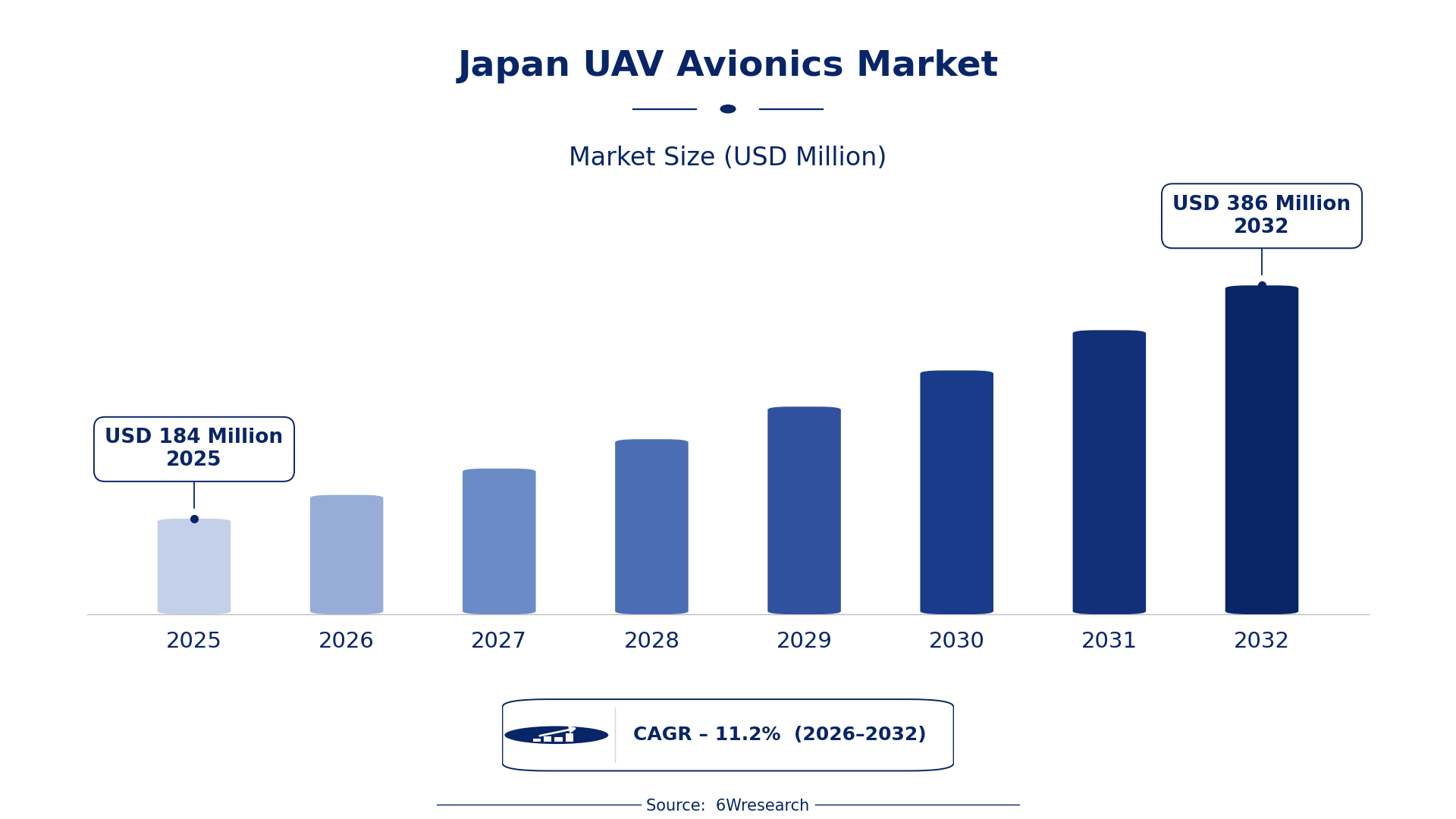
According to 6Wresearch internal database and industry insights, the Japan UAV Avionics Market was valued at USD 184 Million in 2025 and is projected to reach USD 386 Million by 2032, growing at a CAGR of approximately 11.2% during 2026–2032.
Japan UAV Avionics Market Highlights
| Report Metric | Details |
| Report Name | Japan UAV Avionics Market (2026-2032) |
| Market Size 2025 | USD 184 Million |
| Market Size 2032 | USD 386 Million |
| Absolute Growth 2025–2032 | USD 202 Million |
| CAGR 2026–2032 | 11.2% |
| Peak Annual Growth | 12.1% in 2030 |
| Forecast Period | 2026–2032 |
| Historical Data | 2022–2025 |
| Base Year | 2025 |
| Leading Avionics Type, 2025 | Communication Systems (43% share) |
| Leading UAV Type, 2025 | Medium-Large UAVs (40% share) |
| Leading Functionality, 2025 | Data Link & Control (44% share) |
| Leading End User, 2025 | Military Users (50% share) |
| Fastest-Growing Avionics Type | Navigation Systems (15.3% CAGR) |
| Fastest-Growing UAV Type | ISR UAVs (15.6% CAGR) |
| Fastest-Growing End User | UAV OEMs (14.1% CAGR) |
| Growing Sector | Military Applications |
| Key End Users | Military Users, UAV OEMs, Agricultural Producers, Research Institutions |
Japan UAV Avionics Market Year-wise Growth Rate and Key Drivers (2022–2032)
This graph illustrates the annual growth rates of the market from 2022 to 2032, highlighting a steady upward trajectory and projected market expansion over the forecast period.
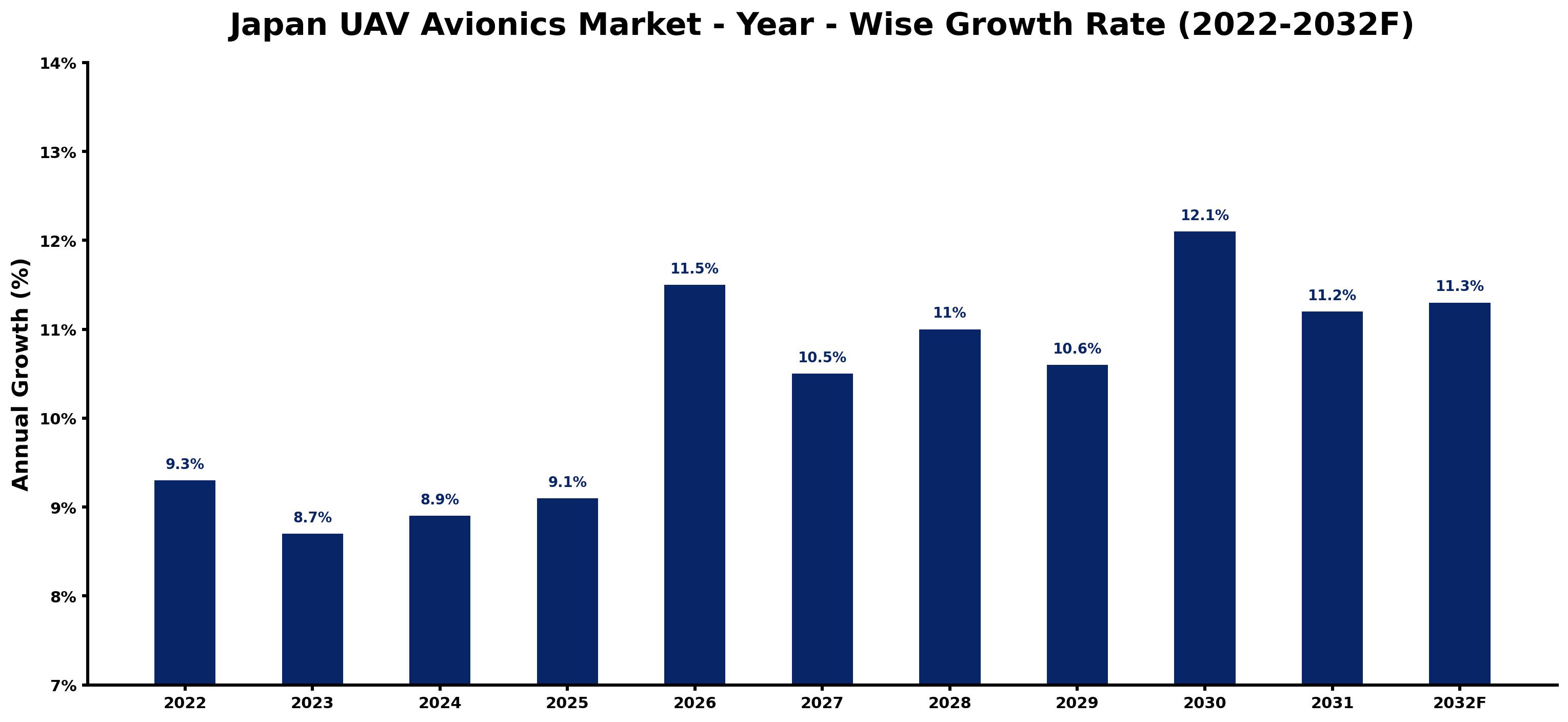
Annual growth estimates for each year appear below with the principal reason behind them, explaining the shifts that set the pace of the market.
| Year | Estimated Annual Growth (%) | Market Rationale |
| 2022 | 9.3 | The market showed strong demand from military users and UAV manufacturers. |
| 2023 | 8.7 | Growth slowed as military applications expanded but faced supply chain challenges. |
| 2024 | 8.9 | Increased agricultural UAV applications drove faster growth compared to the previous year. |
| 2025 | 9.1 | Demand from military users and the introduction of new technologies boosted growth. |
| 2026 | 11.5 | The rise in UAV usage for disaster response is expected to lead to increased demand. |
| 2027 | 10.5 | Growth is projected to slow slightly as the market adjusts to new technology implementations. |
| 2028 | 11.0 | Investment in UAV technology will spur higher demand from various sectors. |
| 2029 | 10.6 | The market is expected to experience a slowdown as competition intensifies among manufacturers. |
| 2030 | 12.1 | The introduction of advanced UAV models will drive the peak growth rate this year. |
| 2031 | 11.2 | A slowdown in growth is anticipated as the market stabilises after rapid expansion. |
| 2032 | 11.3 | Growth is projected to accelerate again due to rising demand for UAVs in agriculture and surveillance. |
Note: Market size estimations and growth projections presented in this report are based on 6Wresearch's proprietary forecasting methodology, utilizing the latest available industry data, government publications, and primary research inputs.
Japan UAV Avionics Market Synopsis
UAV avionics are critical electronic systems in unmanned aerial vehicles, encompassing navigation, communication, and control systems. The Japan UAV Avionics Market is expanding due to increasing military applications and agricultural monitoring, with the UAV market projected to reach 1.2 million units by 2025. Demand is driven by investments in UAV technology, a growing domestic manufacturing base, and initiatives from the Japan Aerospace Exploration Agency and the Ministry of Land, Infrastructure, Transport and Tourism.
Market Dynamics Impact Analysis (2026–2032)
| Factor | Type | Impact | Primary Segment Affected |
| Increased military spending on UAVs | Driver | High | Military Users |
| Growing agricultural applications for UAVs | Driver | High | UAV OEMs |
| Rising demand for UAVs in disaster response | Opportunity | High | Military Users |
| Expansion of UAV technology in commercial sectors | Opportunity | High | UAV OEMs |
| Supply chain disruptions affecting component availability | Restraint | High | All UAV Types |
| High costs associated with advanced avionics development | Restraint | Medium | Avionics Integrators |
| Intense competition among UAV manufacturers | Challenge | High | UAV OEMs |
| Regulatory hurdles for UAV operations | Challenge | Medium | Military Users |
Evaluation of Drivers in Japan UAV Avionics Market (2026–2032)
The following drivers explain most of the expected growth.
| Drivers | Primary Segment Affected | Why It Matters (Evidence) |
| Increased military spending on UAVs | Military Users | The Self-Defense Forces are increasing UAV usage by 30% annually, resulting in higher procurement of avionics. |
| Growing agricultural applications for UAVs | UAV OEMs | Japan's population of 126 million presents a large potential market for UAV applications, driving demand for advanced systems. |
| Technological advancements in UAV avionics | All UAV Types | The adoption of ISO 9001 standards by manufacturers improves product reliability, increasing buyer confidence. |
| Government funding for UAV development | Military Users | The Ministry of Defense allocated ¥500 million for UAV development in 2023, boosting market growth. |
| Rising demand for UAVs in disaster response | UAV OEMs | The Ministry of Land, Infrastructure, Transport and Tourism promotes UAV technology for disaster response, expanding applications. |
Several shifts outside the market lift sales. Increased military spending on UAVs has led to a surge in procurement of avionics, particularly from military users. The growing agricultural sector is driving demand for UAV applications, supported by a large population that requires efficient monitoring solutions. Technological advancements are improving product reliability, boosting buyer confidence. Rising interest in UAVs for disaster response is expanding their applications across various sectors.
Evaluation of Restraints in Japan UAV Avionics Market
These restraints slow adoption and weigh on supplier margins.
| Market Restraint | Primary Segment Affected | Why It Matters (Evidence) |
| Supply chain disruptions affecting component availability | All UAV Types | Japan has over 100 registered UAV manufacturers, leading to competition for limited components. |
| High costs associated with advanced avionics development | Avionics Integrators | Investment in research and development is essential, but costs can deter smaller firms. |
| Regulatory hurdles for UAV operations | Military Users | Compliance with strict regulations can complicate UAV deployment and increase costs. |
| Limited public acceptance of UAVs in urban areas | UAV OEMs | Concerns about privacy and safety can hinder the adoption of UAV technology. |
| Technological obsolescence in rapidly evolving markets | All UAV Types | Continuous innovation is necessary, but it requires substantial investment to keep up. |
Japan UAV Avionics Market Challenges
A shortage of skilled engineers hampers UAV development in Japan, as educational institutions struggle to produce graduates, delaying projects for manufacturers by six months. Stringent regulations for UAV operations create compliance costs exceeding ¥100 million annually for producers, impacting their financial resources. The presence of over 100 registered manufacturers intensifies competition, resulting in price wars that can jeopardise smaller firms' survival. Rising component costs from global supply chain disruptions inflate production expenses, forcing buyers to reassess procurement strategies and potentially extending project timelines.
Trends in the Japan UAV Avionics Market
Below are the shifts with the largest effect on the Japan UAV Avionics Market.
- Shift from Military to Civilian Applications: Tokyo is experiencing a shift as UAVs are increasingly used for agricultural monitoring, with an expected growth in applications by 25% by 2025.
- Transition to Autonomous UAV Operations: The introduction of autonomous flight capabilities in UAVs is gaining traction, with the Japan Aerospace Exploration Agency leading research efforts in this area.
- Military Users Prioritising Advanced Surveillance: Military Users are focusing on ISR UAVs, with a projected increase in demand of 15% annually as surveillance needs grow.
- Emergence of UAV Technology Standards: The Japan UAV Association is promoting standards and best practices, which are expected to improve interoperability by 2025.
Investment Opportunities in the Japan UAV Avionics Market
Several openings in the Japan UAV Avionics Market merit attention from investors.
- Military Users Seeking Advanced Systems: Military Users are increasingly looking for advanced UAV systems, with a projected growth of 30% in procurement by 2025, creating opportunities for suppliers.
- Agricultural Sector Adopting UAV Technology: The agricultural sector is now prioritising UAV technology for monitoring crops, with demand expected to increase significantly by 2025, inviting new investments.
- Urban Areas Needing UAV Solutions: Urban areas are exploring UAV solutions for logistics, with Tokyo leading initiatives to integrate UAVs into delivery systems, presenting entry points for suppliers.
- Research Institutions Focusing on UAV Innovation: Research institutions are investing in UAV innovation, with funding expected to reach ¥300 million by 2025, providing collaboration opportunities for technology firms.
Government Initiatives in the Japan UAV Avionics Market
The Semiconductor and Digital Industry Strategy, established by METI in June 2021, aims to secure domestic semiconductor manufacturing, which is critical for UAV avionics. The Economic Security Promotion Act of 2022 supports supply-chain resilience for critical products, ensuring a stable supply of essential components for UAV production.
The Japan Aerospace Exploration Agency (JAXA) funds UAV research, supporting the development of advanced avionics systems. The Digital Agency oversees government digital transformation efforts and approves standards for UAV technology integration.
Future Insight of the Japan UAV Avionics Market
New UAV research facilities funded by the Ministry of Defense will drive innovation in the sector. By 2032, the integration of advanced communication systems will enhance data transmission capabilities for users. The Ministry of Land, Infrastructure, Transport and Tourism's initiatives will expand UAV applications in disaster response, increasing operational versatility. With the UAV market projected to reach 1.2 million units by 2025, suppliers must adapt to growing demand from both agricultural and military sectors.
Market Segmentation Analysis
Japan UAV Avionics Market report covers a detailed analysis of the following market segments:
By Avionics Type – Communication Systems Lead, Navigation Systems Expected to Grow Fastest
According to Saurav Kr Singh, Senior Research Analyst at 6Wresearch, Communication Systems accounted for 43% of the market by avionics type in 2025. Communication systems hold the largest share as they are vital for ensuring reliable data transmission and control during UAV operations. The Japanese Self-Defense Forces rely heavily on these systems to maintain effective operational capabilities. Navigation Systems are projected to grow fastest, at a CAGR of 15.3% during 2026–2032. Navigation systems are experiencing rapid growth due to their critical role in achieving flight path accuracy, particularly for military missions. The increasing demand for precise navigation in complex operational scenarios is propelling this segment's expansion. Suppliers should focus on enhancing communication and navigation technologies to meet the growing demands of the UAV market.
By UAV Type – Medium-Large UAVs Lead, ISR UAVs Expected to Grow Fastest
With 40% of uav type revenue in 2025, Medium-Large UAVs was the largest category. Medium-large UAVs dominate the market because they require advanced avionics to effectively execute complex missions. Their significant application in military surveillance and commercial sectors underscores their crucial role within the UAV industry. ISR UAVs are set to record the highest CAGR in this split, 15.6% over 2026–2032. ISR UAVs are the fastest-growing segment, driven by the rising need for intelligence, surveillance, and reconnaissance in defence operations. The Japanese Ministry of Defense's focus on improving UAV capabilities for ISR functions is a key factor in this growth. Buyers should invest in ISR capabilities to align with the evolving military requirements.
By Functionality – Data Link & Control Leads and Records the Fastest Growth
Data Link & Control held 44% of the Japan UAV Avionics Market by functionality in 2025. Data link and control functionalities lead the market as they are essential for remote operation and data exchange in UAVs. This is especially important for military applications where effective communication is critical. The same category is also set to grow fastest, at a CAGR of 13.3% during 2026–2032. The data link and control segment is also the fastest-growing due to the increasing demand for reliable communication channels in UAV operations. As military and commercial applications expand, the necessity for robust data link systems will continue to rise. Suppliers must prioritise advancements in data link technologies to address the needs of the expanding UAV market.
By End User – Military Users Lead, UAV OEMs Expected to Grow Fastest
The largest end user category in 2025 was Military Users, at 50% of revenue. Military users represent the largest segment due to their significant demand for advanced UAV capabilities in surveillance and reconnaissance. The Japanese Self-Defense Forces are increasingly integrating UAVs into their operations, reinforcing this segment's importance. Over 2026–2032, UAV OEMs are expected to post the fastest growth, at a CAGR of 14.1%. UAV OEMs are the fastest-growing end user group as they are the primary manufacturers of UAVs that require advanced avionics for their products. The expansion of UAV applications across various sectors is driving demand from these manufacturers. Suppliers should strengthen partnerships with UAV OEMs to capitalise on the growing market opportunities.
Key Attractiveness of the Report
- 10 Years of Market Numbers
- Historical Data Starting from 2022 to 2025
- Base Year 2025
- Forecast Data until 2032
- Key Performance Indicators Impacting the Market
- Major Upcoming Developments and Projects
Key Highlights of the Report:
- Japan UAV Avionics Market Outlook
- Market Size of Japan UAV Avionics Market, 2025
- Forecast of Japan UAV Avionics Market, 2032
- Historical Data and Forecast of Japan UAV Avionics Revenues & Volume for the Period 2022-2032F
- Japan UAV Avionics Market Trend Evolution
- Japan UAV Avionics Market Drivers and Challenges
- Japan UAV Avionics Price Trends
- Japan UAV Avionics Porter's Five Forces
- Japan UAV Avionics Industry Life Cycle
- Historical Data and Forecast of Japan UAV Avionics Market Revenues & Volume By Avionics Type for the Period 2022-2032F
- Historical Data and Forecast of Japan UAV Avionics Market Revenues & Volume By Navigation Systems for the Period 2022-2032F
- Historical Data and Forecast of Japan UAV Avionics Market Revenues & Volume By Communication Systems for the Period 2022-2032F
- Historical Data and Forecast of Japan UAV Avionics Market Revenues & Volume By Flight Control Computers for the Period 2022-2032F
- Historical Data and Forecast of Japan UAV Avionics Market Revenues & Volume By Payload Interface Modules for the Period 2022-2032F
- Historical Data and Forecast of Japan UAV Avionics Market Revenues & Volume By UAV Type for the Period 2022-2032F
- Historical Data and Forecast of Japan UAV Avionics Market Revenues & Volume By Fixed & Rotary UAVs for the Period 2022-2032F
- Historical Data and Forecast of Japan UAV Avionics Market Revenues & Volume By Medium-Large UAVs for the Period 2022-2032F
- Historical Data and Forecast of Japan UAV Avionics Market Revenues & Volume By All UAV Types for the Period 2022-2032F
- Historical Data and Forecast of Japan UAV Avionics Market Revenues & Volume By ISR UAVs for the Period 2022-2032F
- Historical Data and Forecast of Japan UAV Avionics Market Revenues & Volume By Functionality for the Period 2022-2032F
- Historical Data and Forecast of Japan UAV Avionics Market Revenues & Volume By Autonomous Flight for the Period 2022-2032F
- Historical Data and Forecast of Japan UAV Avionics Market Revenues & Volume By Data Link & Control for the Period 2022-2032F
- Historical Data and Forecast of Japan UAV Avionics Market Revenues & Volume By Real-Time Stabilization for the Period 2022-2032F
- Historical Data and Forecast of Japan UAV Avionics Market Revenues & Volume By Sensor Coordination for the Period 2022-2032F
- Historical Data and Forecast of Japan UAV Avionics Market Revenues & Volume By End User for the Period 2022-2032F
- Historical Data and Forecast of Japan UAV Avionics Market Revenues & Volume By UAV OEMs for the Period 2022-2032F
- Historical Data and Forecast of Japan UAV Avionics Market Revenues & Volume By Military Users for the Period 2022-2032F
- Historical Data and Forecast of Japan UAV Avionics Market Revenues & Volume By Avionics Integrators for the Period 2022-2032F
- Historical Data and Forecast of Japan UAV Avionics Market Revenues & Volume By Defense Contractors for the Period 2022-2032F
- Japan UAV Avionics Import Export Trade Statistics
- Market Opportunity Assessment By Avionics Type
- Market Opportunity Assessment By UAV Type
- Market Opportunity Assessment By Functionality
- Market Opportunity Assessment By End User
- Japan UAV Avionics Top Companies Market Share
- Japan UAV Avionics Competitive Benchmarking By Technical and Operational Parameters
- Japan UAV Avionics Company Profiles
- Japan UAV Avionics Key Strategic Recommendations
Market Covered
The study includes the following segmentation.
By Avionics Type
- Navigation Systems
- Communication Systems
- Flight Control Computers
- Payload Interface Modules
By UAV Type
- Fixed & Rotary UAVs
- Medium-Large UAVs
- All UAV Types
- ISR UAVs
By Functionality
- Autonomous Flight
- Data Link & Control
- Real-Time Stabilization
- Sensor Coordination
By End User
- UAV OEMs
- Military Users
- Avionics Integrators
- Defense Contractors































