Japan UAV Electric Thruster Market Size & Growth Rate
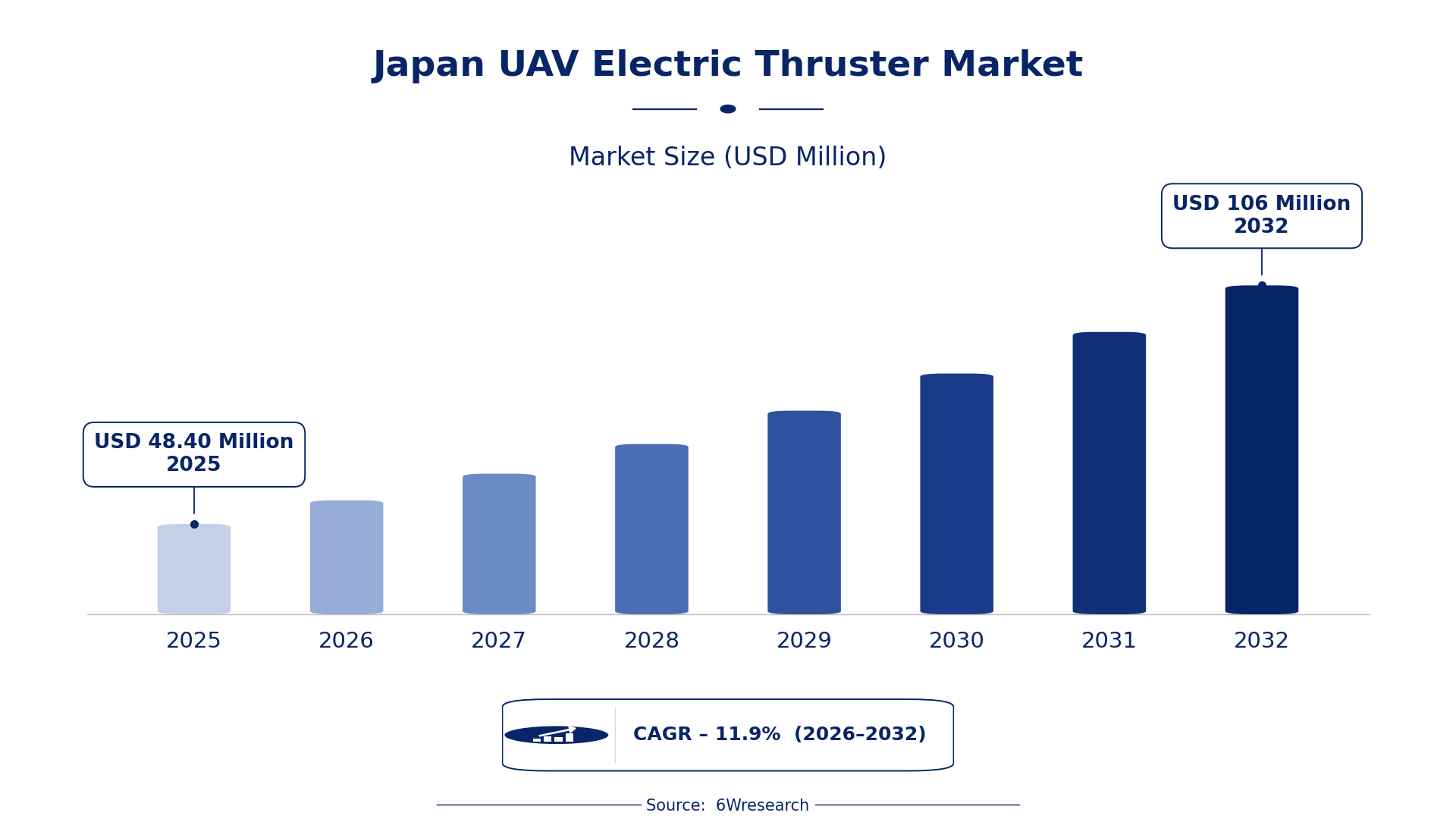
According to 6Wresearch internal database and industry insights, the Japan UAV Electric Thruster Market was valued at USD 48.40 Million in 2025 and is projected to reach USD 106 Million by 2032, growing at a CAGR of approximately 11.9% during 2026–2032.
Japan UAV Electric Thruster Market Highlights
| Report Metric | Details |
| Report Name | Japan UAV Electric Thruster Market (2026-2032) |
| Market Size 2025 | USD 48.40 Million |
| Market Size 2032 | USD 106 Million |
| Absolute Growth 2025–2032 | USD 57.60 Million |
| CAGR 2026–2032 | 11.9% |
| Peak Annual Growth | 14.3% in 2026 |
| Forecast Period | 2026–2032 |
| Historical Data | 2022–2025 |
| Base Year | 2025 |
| Leading Thruster Type, 2025 | Hall Effect Thrusters (47% share) |
| Leading Power Source, 2025 | Battery / Solar Power (39% share) |
| Leading UAV Size Suitability, 2025 | Long-Endurance UAVs (39% share) |
| Leading End User, 2025 | Defense Labs (39% share) |
| Fastest-Growing Thruster Type | Ion Thrusters (15.9% CAGR) |
| Fastest-Growing UAV Size Suitability | Experimental UAVs (14.7% CAGR) |
| Fastest-Growing End User | Aerospace Startups (14.6% CAGR) |
| Growing Sector | Defense and Research |
| Key End Users | Defense Labs, Research Institutions, Surveillance Forces, Aerospace Startups |
Japan UAV Electric Thruster Market Year-wise Growth Rate and Key Drivers (2022–2032)
This graph illustrates the annual growth rates of the market from 2022 to 2032, highlighting a steady upward trajectory and projected market expansion over the forecast period.
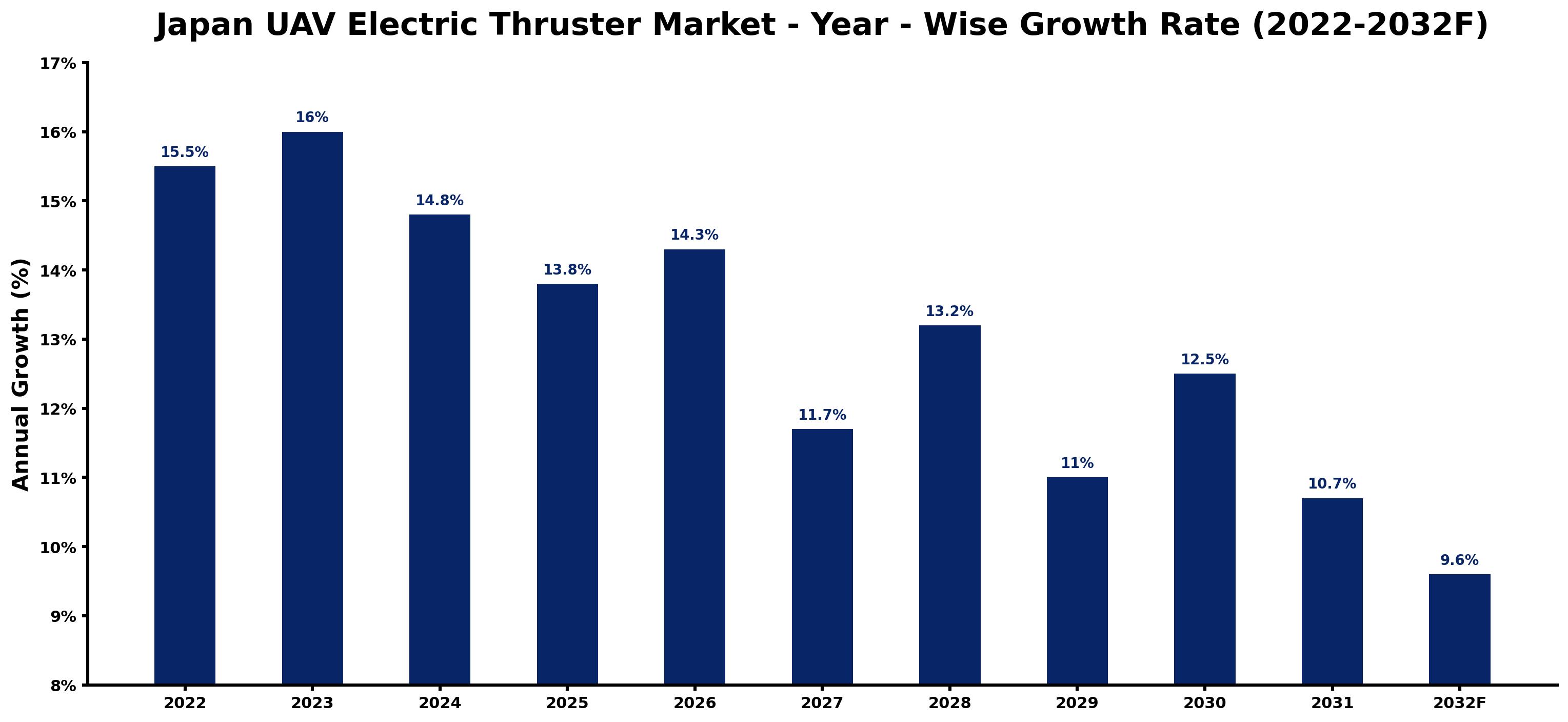
Below, each year's estimated growth is shown next to the factor that most influenced it.
| Year | Estimated Annual Growth (%) | Market Rationale |
| 2022 | 15.5 | Demand from defense labs increased UAV testing during this year. |
| 2023 | 16.0 | The UAV market experienced accelerated growth due to heightened defense spending. |
| 2024 | 14.8 | Growth moderated as the market adjusted to previous high levels of investment. |
| 2025 | 13.8 | The market continued to grow as research institutions expanded UAV projects. |
| 2026 | 14.3 | Demand is expected to surge again, driven by advancements in electric propulsion technologies. |
| 2027 | 11.7 | Growth will slow as the market stabilises after rapid expansions in previous years. |
| 2028 | 13.2 | Increased investment in UAV technologies is projected to revitalise the market's growth. |
| 2029 | 11.0 | Market growth is anticipated to decelerate as competition intensifies among suppliers. |
| 2030 | 12.5 | Demand will rise again with new applications emerging in urban surveillance. |
| 2031 | 10.7 | Growth is expected to moderate as the market matures and competition increases. |
| 2032 | 9.6 | The market is projected to grow steadily as technology adoption continues. |
Note: Market size estimations and growth projections presented in this report are based on 6Wresearch's proprietary forecasting methodology, utilizing the latest available industry data, government publications, and primary research inputs.
Japan UAV Electric Thruster Market Synopsis
UAV Electric Thrusters are propulsion systems for unmanned aerial vehicles, utilising electric energy for thrust generation. The Japan UAV Electric Thruster Market is experiencing growth due to increased investment in defense and research initiatives. The Ministry of Defense allocated ¥10 billion for UAV technology development in 2023, while the Japan Aerospace Exploration Agency is actively involved in propulsion research.
Market Dynamics Impact Analysis (2026–2032)
| Factor | Type | Impact | Primary Segment Affected |
| Increased defense spending drives demand for UAVs and their propulsion systems. | Driver | High | Hall Effect Thrusters |
| Growing research initiatives from institutions enhance the need for advanced UAV technologies. | Driver | High | Hall Effect Thrusters |
| The rising number of UAV-related projects indicates a growing market opportunity. | Opportunity | High | Research Institutions |
| Urban surveillance applications create demand for more UAVs equipped with electric thrusters. | Opportunity | Medium | Surveillance Forces |
| High development costs may limit entry for new players in the UAV market. | Restraint | High | Hall Effect Thrusters |
| Technological challenges in electric propulsion systems can hinder performance improvements. | Restraint | Medium | Electric Propulsion |
| Limited access to advanced materials can slow down production capabilities. | Challenge | High | Hall Effect Thrusters |
| Intense competition among suppliers may affect pricing strategies and margins. | Challenge | Medium | Hall Effect Thrusters |
Evaluation of Drivers in Japan UAV Electric Thruster Market (2026–2032)
The table below links each growth driver to the segment it affects and the evidence for it.
| Drivers | Primary Segment Affected | Why It Matters (Evidence) |
| Increased defense budgets boost procurement of UAV systems. | Defense Labs | The Ministry of Defense allocated ¥10 billion for UAV technology development in 2023. |
| Expansion of research initiatives leads to more UAV projects. | Research Institutions | Reports indicate a 40% increase in UAV-related projects in 2023. |
| Technological advancements in electric propulsion improve UAV capabilities. | Electric Propulsion | The Japan Aerospace Exploration Agency is focusing on propulsion research. |
| Growing urban surveillance needs drive UAV adoption. | Surveillance Forces | Micro UAVs are increasingly used for surveillance in urban environments. |
| Rising interest in experimental UAVs encourages innovation in propulsion. | Experimental UAVs | Defense Labs are increasing UAV testing by 30% annually since 2022. |
Much of the new demand traces back to heightened defense budgets, with substantial allocations for UAV technology development. Research Institutions reported a notable increase in UAV-related projects, leading to more procurement of advanced UAV systems. Technological advancements in electric propulsion systems are improving UAV capabilities significantly. Urban surveillance needs are driving the adoption of UAVs, while increased testing activities are further boosting demand.
Evaluation of Restraints in Japan UAV Electric Thruster Market
The following restraints limit how fast demand can grow.
| Market Restraint | Primary Segment Affected | Why It Matters (Evidence) |
| High development costs may limit market entry for new players. | Hall Effect Thrusters | The initial investment required for advanced UAV technologies can be substantial. |
| Technological challenges in electric propulsion systems can hinder performance improvements. | Electric Propulsion | Issues with efficiency and reliability can slow down market growth. |
| Limited access to advanced materials can slow down production capabilities. | Hall Effect Thrusters | Material shortages can affect the availability of high-performance components. |
| Regulatory hurdles may delay product approvals and market entry. | Hall Effect Thrusters | Compliance with safety standards can extend the time to market. |
| Intense competition among suppliers may affect pricing strategies and margins. | Hall Effect Thrusters | Price wars can lead to reduced profitability for manufacturers. |
Japan UAV Electric Thruster Market Challenges
Japan's UAV market faces fierce competition, as local producers contend with pressure from foreign entrants, resulting in price wars that can erode profit margins for domestic manufacturers. Supply chain issues arise from reliance on imported components, causing production delays for manufacturers, with lead times extending by up to three months. Skills shortages persist as the UAV sector expands, with research institutions noting a 40% rise in projects but lacking qualified engineers, hindering innovation and development. Buyers encounter elevated costs due to limited local options, forcing them to pay a premium for imported systems, impacting budgets by up to 20%.
Trends in the Japan UAV Electric Thruster Market
Several trends are reshaping the Japan UAV Electric Thruster Market; the most important are set out below.
- Shift Towards Urban Surveillance: Tokyo is seeing a shift towards increased use of UAVs for urban surveillance, with Micro UAVs gaining popularity for monitoring activities. The total installed base of UAVs in Japan is estimated at 200,000 units as of 2023.
- Transition from Conventional to Electric Propulsion: The year 2023 marked a transition as UAV manufacturers began adopting electric propulsion systems over traditional methods. This shift is supported by advancements in electric thruster technologies, driven by initiatives from the Japan Aerospace Exploration Agency.
- Emergence of Experimental UAVs: Experimental UAVs are gaining traction as research institutions push for solutions in UAV technology. The focus on experimental applications is reflected in increased funding and support for research initiatives.
- Growing Demand for Long-Endurance UAVs: The demand for Long-Endurance UAVs has increased, particularly for defence applications. Defence labs are leading this trend, holding a 39% market share in 2025, as they seek extended operational capabilities.
Investment Opportunities in the Japan UAV Electric Thruster Market
The opportunities below stand out in the Japan UAV Electric Thruster Market for new entrants and existing suppliers.
- Research Institutions Seeking Advanced UAV Technologies: Research institutions in Japan are actively seeking advanced UAV technologies, with a reported increase in projects in 2023. This presents an opportunity for suppliers to invest in propulsion systems.
- Defense Labs Investing in UAV Development: Defence labs are increasing their UAV testing by 30% annually, indicating strong demand for advanced propulsion systems. Suppliers can enter this market through partnerships with local defence contractors.
- Urban Surveillance Needs Driving UAV Demand: With urban surveillance becoming a priority, the demand for UAVs equipped with electric thrusters is rising. Suppliers can target this sector by collaborating with local government agencies.
- Aerospace Startups Focusing on Innovative Solutions: Aerospace startups are emerging as key players in the UAV market, concentrating on solutions that improve operational capabilities. The growing number of startups presents opportunities for investment and collaboration.
Government Initiatives in the Japan UAV Electric Thruster Market
The Economic Security Promotion Act, enacted in 2022, supports supply-chain resilience for critical products, including UAV technologies. This act complements the Electrical Appliance and Material Safety Act of 1961, which ensures that UAV electric thrusters meet safety standards for electrical appliances and materials in Japan.
Buyers in the UAV sector benefit from the Battery Industry Strategy initiated by METI in August 2022, which aims to boost domestic battery manufacturing capacity. This strategy, alongside the Act on the Rational Use of Energy from 1979, obliges large energy users to improve energy efficiency, promoting sustainable practices in UAV production.
Future Insight of the Japan UAV Electric Thruster Market
Domestic research institutions will lead advancements in UAV electric thrusters by 2032, improving performance and efficiency. Increased funding from the Ministry of Defence will strengthen domestic capabilities, with an allocation of ¥10 billion for UAV technology development. As the installed base of UAVs reaches 1.2 million units by 2025, suppliers will expand their offerings, resulting in more competitive pricing. Enhanced standards from the JIS B 0001 will facilitate the integration of advanced technologies, benefiting both buyers and suppliers.
Market Segmentation Analysis
Japan UAV Electric Thruster Market report covers a detailed analysis of the following market segments:
By Thruster Type – Hall Effect Thrusters Lead, Ion Thrusters Expected to Grow Fastest
According to Saurav Kr Singh, Senior Research Analyst at 6Wresearch, Hall Effect Thrusters held 47% of the Japan UAV Electric Thruster Market by thruster type in 2025. Hall Effect Thrusters dominate the market as they are widely used in various UAV applications, particularly in defence and surveillance. Their proven reliability and efficiency make them a preferred choice for many operational needs. Over 2026–2032, Ion Thrusters are expected to post the fastest growth, at a CAGR of 15.9%. Ion Thrusters are experiencing rapid growth due to their capability for precise control, essential for advanced UAV functionalities. The rising demand for high-performance UAVs in both research and defence sectors is propelling this sub-segment forward. Suppliers must focus on enhancing Ion Thruster capabilities to align with the increasing demand for precision in UAV operations.
By Power Source – Battery / Solar Power Leads and Records the Fastest Growth
Battery / Solar Power accounted for 39% of the market by power source in 2025. Battery / Solar Power serves as the primary power source for UAVs, ensuring operational efficiency and sustainability. This segment is reinforced by the growing emphasis on eco-friendly technologies in UAV development. Battery / Solar Power is also forecast to expand faster than any other category, at a CAGR of 13.0% over 2026–2032. Battery / Solar Power is also the fastest-growing segment due to advancements in energy storage and solar technology. As UAV applications expand, the need for reliable and sustainable power sources continues to drive this growth. Suppliers must invest in research and development to improve battery and solar technologies to keep pace with increasing UAV demands.
By UAV Size Suitability – Long-Endurance UAVs Lead, Experimental UAVs Expected to Grow Fastest
In 2025, Long-Endurance UAVs led the uav size suitability split with a 39% share. Long-Endurance UAVs are vital for extended missions, making them essential for surveillance and reconnaissance tasks. Their ability to sustain operations over long periods has made them the preferred option for defence and research organisations. The quickest growth will come from Experimental UAVs, forecast to expand at a CAGR of 14.7% between 2026 and 2032. Experimental UAVs are rapidly gaining traction as they are critical for testing new technologies and concepts in the UAV industry. The push for innovation in UAV capabilities is significantly accelerating this sub-segment's growth. Buyers should invest in Experimental UAVs to leverage technological advancements and improve operational effectiveness.
By End User – Defense Labs Lead, Aerospace Startups Expected to Grow Fastest
The largest end user category in 2025 was Defense Labs, at 39% of revenue. Defense Labs are the primary users of UAV technology for defence applications, generating substantial market demand. Their ongoing projects and testing activities play a crucial role in advancing UAV capabilities. Aerospace Startups are projected to grow fastest, at a CAGR of 14.6% during 2026–2032. Aerospace Startups are emerging as a fast-growing user group, focusing on innovative UAV solutions for niche markets. This trend indicates a broader movement towards diversification in UAV applications. Suppliers should engage with Aerospace Startups to uncover new opportunities and drive innovation in UAV technologies.
Key Attractiveness of the Report
- 10 Years of Market Numbers
- Historical Data Starting from 2022 to 2025
- Base Year 2025
- Forecast Data until 2032
- Key Performance Indicators Impacting the Market
- Major Upcoming Developments and Projects
Key Highlights of the Report:
- Japan UAV Electric Thruster Market Outlook
- Market Size of Japan UAV Electric Thruster Market, 2025
- Forecast of Japan UAV Electric Thruster Market, 2032
- Historical Data and Forecast of Japan UAV Electric Thruster Revenues & Volume for the Period 2022-2032F
- Japan UAV Electric Thruster Market Trend Evolution
- Japan UAV Electric Thruster Market Drivers and Challenges
- Japan UAV Electric Thruster Price Trends
- Japan UAV Electric Thruster Porter's Five Forces
- Japan UAV Electric Thruster Industry Life Cycle
- Historical Data and Forecast of Japan UAV Electric Thruster Market Revenues & Volume By Thruster Type for the Period 2022-2032F
- Historical Data and Forecast of Japan UAV Electric Thruster Market Revenues & Volume By Ion Thrusters for the Period 2022-2032F
- Historical Data and Forecast of Japan UAV Electric Thruster Market Revenues & Volume By Plasma Thrusters for the Period 2022-2032F
- Historical Data and Forecast of Japan UAV Electric Thruster Market Revenues & Volume By Hall Effect Thrusters for the Period 2022-2032F
- Historical Data and Forecast of Japan UAV Electric Thruster Market Revenues & Volume By Electrothermal Thrusters for the Period 2022-2032F
- Historical Data and Forecast of Japan UAV Electric Thruster Market Revenues & Volume By Power Source for the Period 2022-2032F
- Historical Data and Forecast of Japan UAV Electric Thruster Market Revenues & Volume By Battery / Solar Power for the Period 2022-2032F
- Historical Data and Forecast of Japan UAV Electric Thruster Market Revenues & Volume By High Voltage Systems for the Period 2022-2032F
- Historical Data and Forecast of Japan UAV Electric Thruster Market Revenues & Volume By Electric Propulsion for the Period 2022-2032F
- Historical Data and Forecast of Japan UAV Electric Thruster Market Revenues & Volume By Electric-Resistive for the Period 2022-2032F
- Historical Data and Forecast of Japan UAV Electric Thruster Market Revenues & Volume By UAV Size Suitability for the Period 2022-2032F
- Historical Data and Forecast of Japan UAV Electric Thruster Market Revenues & Volume By Micro UAVs for the Period 2022-2032F
- Historical Data and Forecast of Japan UAV Electric Thruster Market Revenues & Volume By Experimental UAVs for the Period 2022-2032F
- Historical Data and Forecast of Japan UAV Electric Thruster Market Revenues & Volume By Long-Endurance UAVs for the Period 2022-2032F
- Historical Data and Forecast of Japan UAV Electric Thruster Market Revenues & Volume By Small Tactical Drones for the Period 2022-2032F
- Historical Data and Forecast of Japan UAV Electric Thruster Market Revenues & Volume By End User for the Period 2022-2032F
- Historical Data and Forecast of Japan UAV Electric Thruster Market Revenues & Volume By Research Institutions for the Period 2022-2032F
- Historical Data and Forecast of Japan UAV Electric Thruster Market Revenues & Volume By Defense Labs for the Period 2022-2032F
- Historical Data and Forecast of Japan UAV Electric Thruster Market Revenues & Volume By Aerospace Startups for the Period 2022-2032F
- Historical Data and Forecast of Japan UAV Electric Thruster Market Revenues & Volume By Surveillance Forces for the Period 2022-2032F
- Japan UAV Electric Thruster Import Export Trade Statistics
- Market Opportunity Assessment By Thruster Type
- Market Opportunity Assessment By Power Source
- Market Opportunity Assessment By UAV Size Suitability
- Market Opportunity Assessment By End User
- Japan UAV Electric Thruster Top Companies Market Share
- Japan UAV Electric Thruster Competitive Benchmarking By Technical and Operational Parameters
- Japan UAV Electric Thruster Company Profiles
- Japan UAV Electric Thruster Key Strategic Recommendations
Market Covered
The following segment groups are covered in the report.
By Thruster Type
- Ion Thrusters
- Plasma Thrusters
- Hall Effect Thrusters
- Electrothermal Thrusters
By Power Source
- Battery / Solar Power
- High Voltage Systems
- Electric Propulsion
- Electric-Resistive
By UAV Size Suitability
- Micro UAVs
- Experimental UAVs
- Long-Endurance UAVs
- Small Tactical Drones
By End User
- Research Institutions
- Defense Labs
- Aerospace Startups
- Surveillance Forces































