Japan UAV ISR System Market Size & Growth Rate
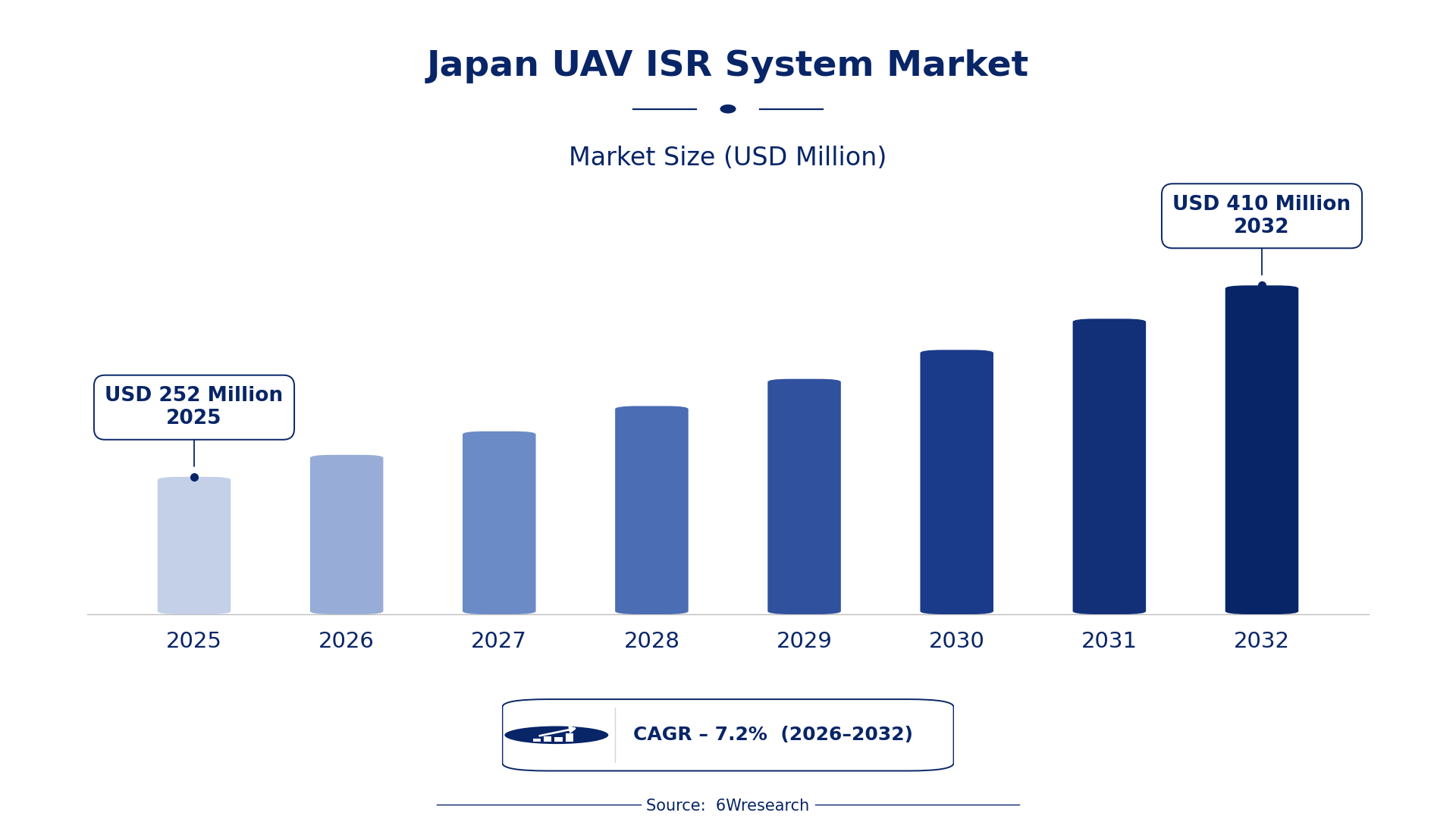
According to 6Wresearch internal database and industry insights, the Japan UAV ISR System Market was valued at USD 252 Million in 2025 and is projected to reach USD 410 Million by 2032, growing at a CAGR of approximately 7.2% during 2026–2032.
Japan UAV ISR System Market Highlights
| Report Metric | Details |
| Report Name | Japan UAV ISR System Market (2026-2032) |
| Market Size 2025 | USD 252 Million |
| Market Size 2032 | USD 410 Million |
| Absolute Growth 2025–2032 | USD 158 Million |
| CAGR 2026–2032 | 7.2% |
| Peak Annual Growth | 8.4% in 2028 |
| Forecast Period | 2026–2032 |
| Historical Data | 2022–2025 |
| Base Year | 2025 |
| Leading ISR Type, 2025 | SIGINT (39% share) |
| Leading Platform Type, 2025 | HALE/MALE UAVs (38% share) |
| Leading Sensor Payload, 2025 | Combined Payloads (36% share) |
| Leading End User, 2025 | Armed Forces (51% share) |
| Fastest-Growing ISR Type | Multi-INT ISR Systems (9.9% CAGR) |
| Fastest-Growing Platform Type | Rotary UAVs (10.1% CAGR) |
| Fastest-Growing End User | Airborne Surveillance (9.0% CAGR) |
| Growing Sector | defense technology |
| Key End Users | armed forces, defense contractors, government agencies |
Japan UAV ISR System Market Year-wise Growth Rate and Key Drivers (2022–2032)
This graph illustrates the annual growth rates of the market from 2022 to 2032, highlighting a steady upward trajectory and projected market expansion over the forecast period.
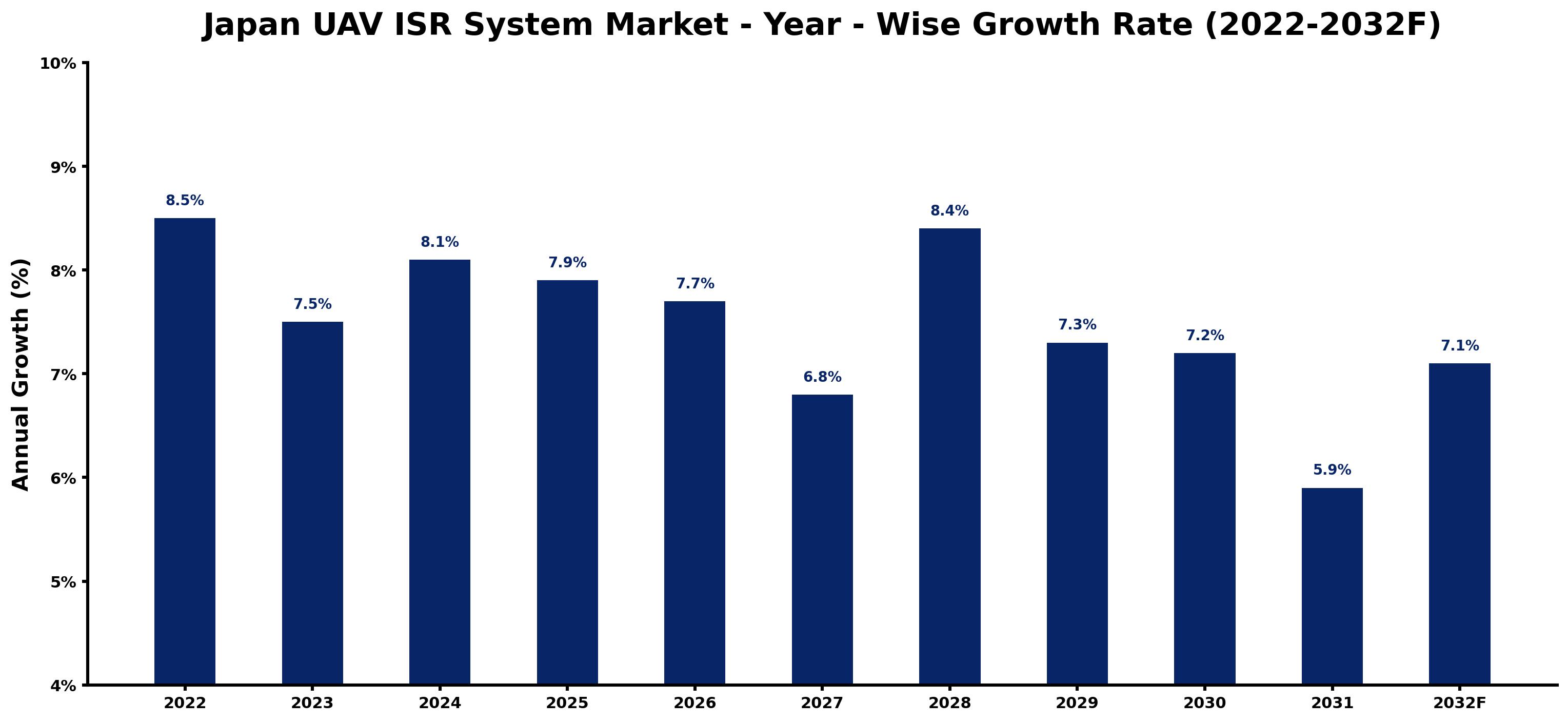
Annual growth estimates for each year appear below with the principal reason behind them, explaining the shifts that set the pace of the market.
| Year | Estimated Annual Growth (%) | Market Rationale |
| 2022 | 8.5 | The demand for UAV ISR systems remained strong due to ongoing military operations. |
| 2023 | 7.5 | Growth slowed as the defense budget faced tighter allocations amid economic pressures. |
| 2024 | 8.1 | Increased focus on enhancing ISR capabilities drove a rise in UAV procurement. |
| 2025 | 7.9 | Market growth slowed slightly as manufacturers adjusted to new standards and requirements. |
| 2026 | 7.7 | Demand remains steady as the government pushes for advanced ISR technologies. |
| 2027 | 6.8 | Growth decelerated as the market adjusted to evolving defense strategies. |
| 2028 | 8.4 | A surge in military investment revitalised the UAV ISR sector, boosting demand. |
| 2029 | 7.3 | Demand growth slowed as supply chain challenges impacted production rates. |
| 2030 | 7.2 | Market expansion continued but at a reduced pace due to market saturation. |
| 2031 | 5.9 | A slowdown occurred as the focus shifted to integrating AI into existing systems. |
| 2032 | 7.1 | Demand is expected to rise again as new technologies enhance operational capabilities. |
Note: Market size estimations and growth projections presented in this report are based on 6Wresearch's proprietary forecasting methodology, utilizing the latest available industry data, government publications, and primary research inputs.
Japan UAV ISR System Market Synopsis
UAV ISR Systems combine unmanned aerial vehicles with intelligence, surveillance, and reconnaissance capabilities, primarily for military use. The Japan UAV ISR System Market is expanding as defense budgets rise, with the 2023 budget estimated at around 6.8 trillion yen. The government aims to improve UAV capabilities by 2025, while collaborations with international defense organisations are driving technological advancements, generating new demand from armed forces and defense contractors.
Market Dynamics Impact Analysis (2026–2032)
| Factor | Type | Impact | Primary Segment Affected |
| Increased defense spending | Driver | High | Armed Forces |
| Focus on advanced ISR capabilities | Driver | High | Multi-INT ISR Systems |
| Growing demand for domestic UAV production | Opportunity | High | HALE/MALE UAVs |
| Expansion of international partnerships | Opportunity | Medium | EO/IR ISR |
| Supply chain disruptions | Restraint | High | Fixed-Wing UAVs |
| Rising production costs | Restraint | Medium | Rotary UAVs |
| Compliance with stringent standards | Challenge | High | Combined Payloads |
| Capacity constraints in manufacturing | Challenge | Medium | Radar ISR Systems |
Evaluation of Drivers in Japan UAV ISR System Market (2026–2032)
The main growth drivers and the segments they affect most are set out below.
| Drivers | Primary Segment Affected | Why It Matters (Evidence) |
| Increased defense budget allocations | Armed Forces | Japan's defense budget for 2023 is approximately 6.8 trillion yen, resulting in higher procurement of UAV ISR systems. |
| Emphasis on advanced ISR capabilities | Multi-INT ISR Systems | The Economic Security Promotion Act supports the need for advanced ISR capabilities, driving demand for sophisticated systems. |
| Domestic UAV production initiatives | HALE/MALE UAVs | The government aims to increase domestic UAV production by 30% by 2025, boosting local manufacturing. |
| Partnerships with international defense organizations | EO/IR ISR | Collaborations facilitate technology transfer, resulting in better ISR systems and increased purchases. |
| Integration of AI technologies | Combined Payloads | The Self-Defense Forces plan to integrate AI into UAV ISR systems by 2026, improving operational effectiveness. |
Buyers are adding capacity as the Japan Self-Defense Forces operate over 100 UAVs for ISR missions, reflecting a strong commitment to military surveillance. The Tokyo region is a key area for defense technology development, attracting investments in UAV ISR systems. The focus on integrating AI into these systems by 2026 is expected to further increase demand among military users, as they seek to improve operational effectiveness. Collaborations with international defense organizations are driving innovation in UAV technologies, resulting in increased procurement from military buyers.
Evaluation of Restraints in Japan UAV ISR System Market
The following restraints limit how fast demand can grow.
| Market Restraint | Primary Segment Affected | Why It Matters (Evidence) |
| Supply chain disruptions affecting production timelines | Fixed-Wing UAVs | Supply chain issues have delayed the delivery of critical components, impacting production schedules. |
| Rising costs of materials and manufacturing | Rotary UAVs | Increased prices for raw materials have raised production costs, limiting affordability for buyers. |
| Compliance with stringent manufacturing standards | Combined Payloads | Adhering to ISO 9001 standards increases operational costs and complexity for manufacturers. |
| Limited skilled workforce in UAV technology | HALE/MALE UAVs | A shortage of qualified personnel restricts production capacity and innovation in UAV systems. |
| Market saturation in certain UAV segments | EO/IR ISR | An oversupply of basic ISR systems has led to price competition, affecting profitability. |
Japan UAV ISR System Market Challenges
Japan's defense budget for 2023 is approximately 6.8 trillion yen, limiting available funds for UAV ISR systems and delaying procurement for military buyers. The Self-Defense Forces operate over 100 UAVs, requiring regular upgrades that increase maintenance costs and pressure operational budgets. Strict regulations, such as ISO 9001 standards, complicate manufacturing processes for suppliers, resulting in extended production timelines. A lack of domestic expertise in advanced technologies like AI hinders innovation, ultimately affecting the effectiveness of Japan's defense capabilities.
Trends in the Japan UAV ISR System Market
Buyers and suppliers in the Japan UAV ISR System Market are adjusting to the following trends.
- Shift in Military Focus to Advanced ISR: The armed forces are prioritising advanced ISR capabilities, as highlighted by the National Defense Program Guidelines. This shift is evident in the 30% increase in domestic UAV production targeted by 2025.
- Increase in AI Integration in UAV Systems: The integration of AI technologies into UAV ISR systems is gaining momentum, with the Self-Defense Forces planning to implement AI by 2026. This initiative is expected to significantly improve operational effectiveness.
- Growth of Domestic UAV Manufacturing: Japan is strengthening its domestic UAV manufacturing capabilities, particularly in the Tokyo region, where substantial investments are being made. The government aims for a 30% increase in production by 2025.
- Expansion of International Defense Collaborations: Partnerships with international defense organisations are growing, enabling technology transfer and innovation. This trend is reflected in ongoing projects aimed at enhancing UAV ISR capabilities.
Investment Opportunities in the Japan UAV ISR System Market
Where to invest in the Japan UAV ISR System Market: the main openings are set out below.
- Armed Forces seeking advanced ISR solutions: The armed forces are in search of advanced ISR solutions, with the government allocating 10 billion yen for UAV technology advancements in 2024. This creates opportunities for suppliers to meet rising demand.
- Supply of AI-enhanced UAV systems: The integration of AI into UAV systems offers a substantial opportunity, as the Self-Defense Forces plan to implement these technologies by 2026. Suppliers can invest in AI capabilities to address this demand.
- Investment in domestic UAV production: With a goal to increase domestic UAV production by 30% by 2025, there is a clear opportunity for manufacturers to expand operations. Collaborating with local partners can facilitate market entry.
- Development of multi-intelligence ISR systems: The market for multi-intelligence ISR systems is growing, driven by the demand for enhanced capabilities. Suppliers can focus on developing these systems to meet the armed forces' needs.
Government Initiatives in the Japan UAV ISR System Market
The Semiconductor and Digital Industry Strategy, established by METI in June 2021, strengthens domestic semiconductor manufacturing capabilities. This initiative complements the Economic Security Promotion Act of 2022, which supports supply-chain resilience for critical products, ensuring reliable components for UAV ISR systems.
The Japan Ministry of Defense has approved funding for UAV technology advancements, allocating 10 billion yen for 2024. This funding supports various projects aimed at improving UAV capabilities and ensuring compliance with international standards.
Future Insight of the Japan UAV ISR System Market
By 2032, a government initiative to increase domestic UAV production by 30% will compel suppliers to enhance their manufacturing processes. The integration of AI into UAV ISR systems by 2026 will boost reconnaissance efficiency and effectiveness. The Ministry of Defense's commitment to advancing ISR capabilities will promote collaboration among defence entities. Strengthened partnerships with international defence organisations will further encourage technological advancements and operational improvements.
Market Segmentation Analysis
Japan UAV ISR System Market report covers a detailed analysis of the following market segments:
By ISR Type – SIGINT Leads, Multi-INT ISR Systems Expected to Grow Fastest
According to Saurav Kr Singh, Senior Research Analyst at 6Wresearch, SIGINT held 39% of the Japan UAV ISR System Market by isr type in 2025. The SIGINT segment leads due to its critical function in military operations, particularly for the Japan Self-Defense Forces focused on signal intelligence. This sub-segment benefits from the established use of UAVs in military applications, ensuring consistent demand. Multi-INT ISR Systems are set to record the highest CAGR in this split, 9.9% over 2026–2032. The Multi-INT ISR Systems segment is growing rapidly as military strategies increasingly require the integration of diverse intelligence sources. The Ministry of Defense's programme to enhance UAV capabilities by 2025 highlights the rising necessity for these comprehensive systems. Suppliers should prioritise the development of Multi-INT capabilities to meet the evolving requirements of the Japanese military.
By Platform Type – HALE/MALE UAVs Lead, Rotary UAVs Expected to Grow Fastest
HALE/MALE UAVs accounted for 38% of the market by platform type in 2025. HALE/MALE UAVs dominate the market as they are essential for high-altitude, long-endurance missions, crucial for Japan's defence strategies. The Japan Self-Defense Forces operate a considerable number of these platforms for surveillance and reconnaissance, ensuring their leading position. The quickest growth will come from Rotary UAVs, forecast to expand at a CAGR of 10.1% between 2026 and 2032. Rotary UAVs are experiencing the fastest growth due to their versatility in operational roles, aligning with the Japanese government's focus on advanced UAV capabilities. The ongoing development in key regions like Tokyo and Aichi supports this upward trend. Buyers should consider investing in rotary UAVs to leverage their operational flexibility across various mission scenarios.
By Sensor Payload – Combined Payloads Lead and Record the Fastest Growth
The largest sensor payload category in 2025 was Combined Payloads, at 36% of revenue. Combined Payloads hold the largest share as they significantly enhance the operational flexibility and effectiveness of UAV ISR systems. This capability is vital for the Japan Self-Defense Forces, which depend on versatile sensor configurations for comprehensive intelligence gathering. The same category are also set to grow fastest, at a CAGR of 9.3% during 2026–2032. The Combined Payloads segment is also the fastest-growing, as the integration of multiple sensors is increasingly recognised as essential for advanced ISR operations. The anticipated advancements in UAV technology further accelerate this growth trajectory. Suppliers must focus on developing advanced combined payload solutions to meet the rising demand for sophisticated ISR capabilities.
By End User – Armed Forces Lead, Airborne Surveillance Expected to Grow Fastest
In 2025, Armed Forces led the end user split with a 51% share. The Armed Forces represent the largest end user of UAV ISR systems, driven by their need for comprehensive surveillance and reconnaissance capabilities. The substantial defence budget allocated for 2023 underscores the commitment to enhancing military capabilities and sustaining this segment's lead. Over 2026–2032, Airborne Surveillance is expected to post the fastest growth, at a CAGR of 9.0%. Airborne Surveillance is the fastest-growing end user segment, reflecting the urgent need for ongoing surveillance missions across various operational contexts. The government's emphasis on improving ISR capabilities by 2025 propels this growth. Suppliers should align their offerings with the specific needs of airborne surveillance to capture opportunities in this expanding segment.
Key Attractiveness of the Report
- 10 Years of Market Numbers
- Historical Data Starting from 2022 to 2025
- Base Year 2025
- Forecast Data until 2032
- Key Performance Indicators Impacting the Market
- Major Upcoming Developments and Projects
Key Highlights of the Report:
- Japan UAV ISR System Market Outlook
- Market Size of Japan UAV ISR System Market, 2025
- Forecast of Japan UAV ISR System Market, 2032
- Historical Data and Forecast of Japan UAV ISR System Revenues & Volume for the Period 2022-2032F
- Japan UAV ISR System Market Trend Evolution
- Japan UAV ISR System Market Drivers and Challenges
- Japan UAV ISR System Price Trends
- Japan UAV ISR System Porter's Five Forces
- Japan UAV ISR System Industry Life Cycle
- Historical Data and Forecast of Japan UAV ISR System Market Revenues & Volume By ISR Type for the Period 2022-2032F
- Historical Data and Forecast of Japan UAV ISR System Market Revenues & Volume By SIGINT for the Period 2022-2032F
- Historical Data and Forecast of Japan UAV ISR System Market Revenues & Volume By EO/IR ISR for the Period 2022-2032F
- Historical Data and Forecast of Japan UAV ISR System Market Revenues & Volume By Radar ISR Systems for the Period 2022-2032F
- Historical Data and Forecast of Japan UAV ISR System Market Revenues & Volume By Multi-INT ISR Systems for the Period 2022-2032F
- Historical Data and Forecast of Japan UAV ISR System Market Revenues & Volume By Platform Type for the Period 2022-2032F
- Historical Data and Forecast of Japan UAV ISR System Market Revenues & Volume By Fixed-Wing UAVs for the Period 2022-2032F
- Historical Data and Forecast of Japan UAV ISR System Market Revenues & Volume By Rotary UAVs for the Period 2022-2032F
- Historical Data and Forecast of Japan UAV ISR System Market Revenues & Volume By HALE/MALE UAVs for the Period 2022-2032F
- Historical Data and Forecast of Japan UAV ISR System Market Revenues & Volume By All-Class UAVs for the Period 2022-2032F
- Historical Data and Forecast of Japan UAV ISR System Market Revenues & Volume By Sensor Payload for the Period 2022-2032F
- Historical Data and Forecast of Japan UAV ISR System Market Revenues & Volume By RF Sensors for the Period 2022-2032F
- Historical Data and Forecast of Japan UAV ISR System Market Revenues & Volume By Visual + Thermal Cameras for the Period 2022-2032F
- Historical Data and Forecast of Japan UAV ISR System Market Revenues & Volume By SAR and GMTI for the Period 2022-2032F
- Historical Data and Forecast of Japan UAV ISR System Market Revenues & Volume By Combined Payloads for the Period 2022-2032F
- Historical Data and Forecast of Japan UAV ISR System Market Revenues & Volume By End User for the Period 2022-2032F
- Historical Data and Forecast of Japan UAV ISR System Market Revenues & Volume By Defense Intelligence for the Period 2022-2032F
- Historical Data and Forecast of Japan UAV ISR System Market Revenues & Volume By Armed Forces for the Period 2022-2032F
- Historical Data and Forecast of Japan UAV ISR System Market Revenues & Volume By Airborne Surveillance for the Period 2022-2032F
- Historical Data and Forecast of Japan UAV ISR System Market Revenues & Volume By Defense Contractors for the Period 2022-2032F
- Japan UAV ISR System Import Export Trade Statistics
- Market Opportunity Assessment By ISR Type
- Market Opportunity Assessment By Platform Type
- Market Opportunity Assessment By Sensor Payload
- Market Opportunity Assessment By End User
- Japan UAV ISR System Top Companies Market Share
- Japan UAV ISR System Competitive Benchmarking By Technical and Operational Parameters
- Japan UAV ISR System Company Profiles
- Japan UAV ISR System Key Strategic Recommendations
Market Covered
Coverage by segment is as follows.
By ISR Type
- SIGINT
- EO/IR ISR
- Radar ISR Systems
- Multi-INT ISR Systems
By Platform Type
- Fixed-Wing UAVs
- Rotary UAVs
- HALE/MALE UAVs
- All-Class UAVs
By Sensor Payload
- RF Sensors
- Visual + Thermal Cameras
- SAR and GMTI
- Combined Payloads
By End User
- Defense Intelligence
- Armed Forces
- Airborne Surveillance
- Defense Contractors































