Japan UAV Manufacturing Market Size & Growth Rate
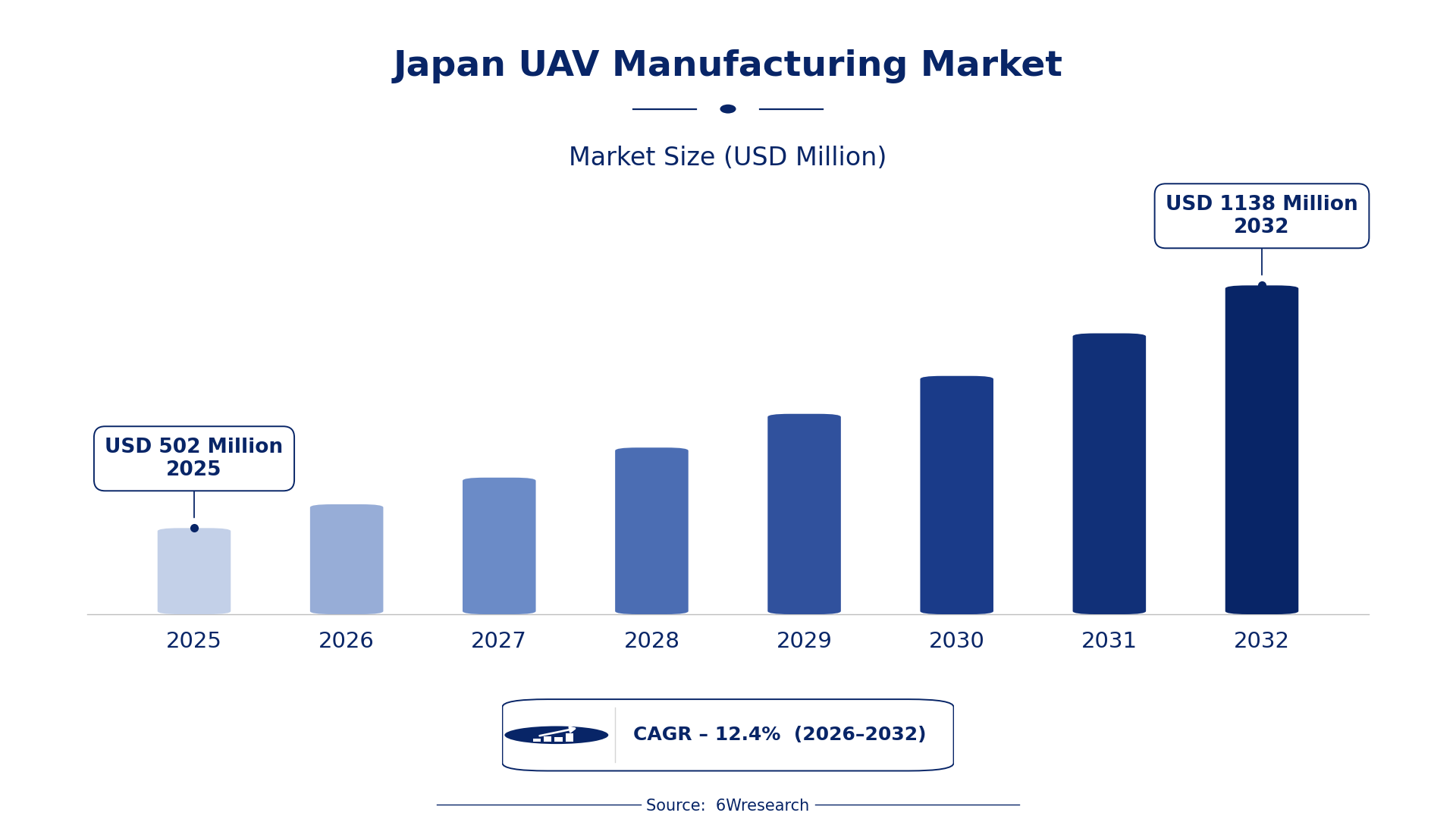
According to 6Wresearch internal database and industry insights, the Japan UAV Manufacturing Market was valued at USD 502 Million in 2025 and is projected to reach USD 1,138 Million by 2032, growing at a CAGR of approximately 12.4% during 2026–2032.
Japan UAV Manufacturing Market Highlights
| Report Metric | Details |
| Report Name | Japan UAV Manufacturing Market (2026-2032) |
| Market Size 2025 | USD 502 Million |
| Market Size 2032 | USD 1,138 Million |
| Absolute Growth 2025–2032 | USD 636 Million |
| CAGR 2026–2032 | 12.4% |
| Peak Annual Growth | 13.2% in 2028 |
| Forecast Period | 2026–2032 |
| Historical Data | 2022–2025 |
| Base Year | 2025 |
| Leading UAV Type, 2025 | Fixed-Wing UAVs (51% share) |
| Leading Manufacturing Process, 2025 | CNC & Assembly Lines (50% share) |
| Leading Structure Material, 2025 | Composite Materials (36% share) |
| Leading End User, 2025 | UAV OEMs (38% share) |
| Fastest-Growing UAV Type | Rotary-Wing UAVs (17.9% CAGR) |
| Fastest-Growing Manufacturing Process | Modular Assembly (18.1% CAGR) |
| Fastest-Growing Structure Material | Aluminum & Carbon Fiber (17.8% CAGR) |
| Fastest-Growing End User | Defense Integrators (15.6% CAGR) |
| Growing Sector | defense applications |
| Key End Users | UAV OEMs, defense integrators, agricultural producers, research and development labs |
Japan UAV Manufacturing Market Year-wise Growth Rate and Key Drivers (2022–2032)
This graph illustrates the annual growth rates of the market from 2022 to 2032, highlighting a steady upward trajectory and projected market expansion over the forecast period.
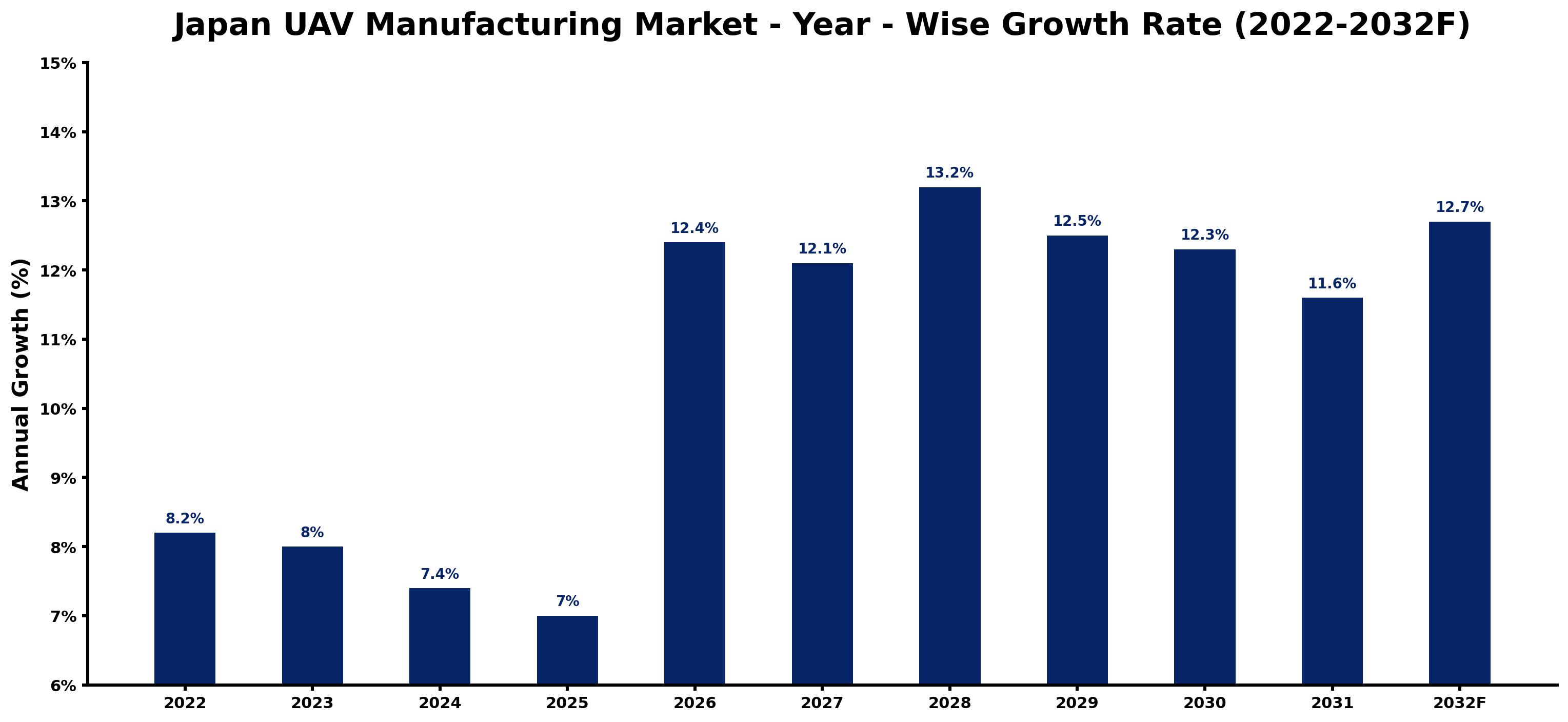
Each row of the following table gives one year's estimated growth and the event or demand shift that explains it.
| Year | Estimated Annual Growth (%) | Market Rationale |
| 2022 | 8.2 | The market experienced steady growth, driven by increasing demand from defense applications. |
| 2023 | 8.0 | Growth slowed as manufacturers adjusted to supply chain challenges and rising material costs. |
| 2024 | 7.4 | Demand continued to rise, albeit at a slower pace, reflecting ongoing investments in UAV technology. |
| 2025 | 7.0 | The market maintained a moderate growth rate, supported by ongoing UAV development initiatives. |
| 2026 | 12.4 | Growth is expected to accelerate as investments in UAV manufacturing surge, driven by technological advancements. |
| 2027 | 12.1 | Demand will remain strong, with manufacturers adapting to evolving market needs and buyer preferences. |
| 2028 | 13.2 | The market is projected to peak with strong demand from defense integrators and increased R&D activities. |
| 2029 | 12.5 | Growth is expected to slow slightly as the market begins to stabilise after the peak demand phase. |
| 2030 | 12.3 | The market will continue to grow, supported by ongoing innovation and expanding applications. |
| 2031 | 11.6 | Demand growth will moderate as the market matures, focusing on efficiency and sustainability. |
| 2032 | 12.7 | The market is expected to see renewed growth from emerging applications and increased investment. |
Note: Market size estimations and growth projections presented in this report are based on 6Wresearch's proprietary forecasting methodology, utilizing the latest available industry data, government publications, and primary research inputs.
Japan UAV Manufacturing Market Synopsis
UAV manufacturing in Japan involves the production of unmanned aerial vehicles using advanced technologies such as CNC machining and modular assembly. The industry is evolving with a focus on composite materials for improved performance. The Japan UAV Manufacturing Market is expanding due to strong demand from defense integrators, agricultural monitoring, and research and development activities. With ¥20 billion allocated for UAV development in 2023, the market is set for growth, aiming to reach 1,000 units by 2025.
Market Dynamics Impact Analysis (2026–2032)
| Factor | Type | Impact | Primary Segment Affected |
| Increased defense spending | Driver | High | UAV OEMs |
| Growing agricultural applications | Driver | High | Rotary-Wing UAVs |
| Rising demand for disaster response capabilities | Opportunity | Medium | Fixed-Wing UAVs |
| Expansion of UAV startups in Chubu region | Opportunity | Medium | Hybrid UAVs |
| High production costs for advanced materials | Restraint | High | Composite Materials |
| Regulatory compliance challenges in UAV operations | Restraint | High | UAV OEMs |
| Limited skilled workforce for advanced manufacturing | Challenge | Medium | CNC & Assembly Lines |
| Dependence on imported components for production | Challenge | Medium | Additive Manufacturing |
Evaluation of Drivers in Japan UAV Manufacturing Market (2026–2032)
Key forces behind demand, with the segment each one moves most, are listed below.
| Drivers | Primary Segment Affected | Why It Matters (Evidence) |
| Increased defense budgets | UAV OEMs | The Ministry of Defense allocated ¥20 billion for UAV development in 2023, boosting procurement. |
| Adoption of UAVs in precision agriculture | Rotary-Wing UAVs | The average population density in urban areas drives UAV demand for logistics and agricultural monitoring. |
| Technological advancements in UAV design | CNC & Assembly Lines | Investments in CNC machining improve production efficiency, attracting more manufacturers. |
| Research and development initiatives | VTOL UAVs | Tokyo is a major hub for UAV R&D activities, encouraging innovation and new applications. |
| Growing interest in environmental monitoring | Hybrid UAVs | The government initiated a UAV pilot program for environmental monitoring in 2023, expanding usage. |
This funding boosts procurement from UAV manufacturers, driving demand for advanced manufacturing processes like CNC machining. Urban population density fuels demand for logistics solutions and precision agriculture. Innovations in UAV design attract manufacturers, particularly in Tokyo, which serves as a hub for UAV R&D activities.
Evaluation of Restraints in Japan UAV Manufacturing Market
These restraints slow adoption and weigh on supplier margins.
| Market Restraint | Primary Segment Affected | Why It Matters (Evidence) |
| High production costs for advanced materials | Composite Materials | The use of high-quality composite materials increases manufacturing costs, limiting production capabilities. |
| Regulatory compliance challenges in UAV operations | UAV OEMs | Strict regulations from the Japan Civil Aviation Bureau complicate UAV operations and approvals. |
| Limited skilled workforce for advanced manufacturing | CNC & Assembly Lines | A shortage of skilled workers hinders the efficiency of CNC machining processes. |
| Dependence on imported components for production | Additive Manufacturing | Reliance on imported parts increases vulnerability to supply chain disruptions. |
| Market saturation in certain UAV segments | Fixed-Wing UAVs | Increased competition has led to market saturation, limiting growth potential for existing players. |
Japan UAV Manufacturing Market Challenges
Local producers face stringent regulations from the Japan Civil Aviation Bureau, leading to product launch delays of up to six months, which hampers timely UAV deliveries for defence and agricultural buyers. Buyers experience increased costs due to a lack of competition, with prices soaring to ¥2 million per unit, putting financial pressure on projects. Domestic manufacturers contend with intense rivalry from foreign firms, compelling them to lower prices, which may compromise quality for local buyers. Technology integration challenges arise as the government mandates UAV deployment for disaster response by 2025, requiring producers to invest heavily to meet new compliance standards.
Trends in the Japan UAV Manufacturing Market
Several trends are reshaping the Japan UAV Manufacturing Market; the most important are set out below.
- Shift towards Modular UAV Designs: Japan is increasingly adopting modular UAV designs to improve customization and efficiency. This trend began in 2023, with the Tohoku region leading in modular assembly facilities, allowing for rapid adaptation to various applications.
- Transition from Traditional to Additive Manufacturing: Since 2022, the UAV manufacturing sector has shifted towards additive manufacturing techniques. This change is evident in Tokyo, where 3D-printed components are becoming common, reducing weight and production time significantly.
- Emergence of UAVs in Environmental Monitoring: The government initiated a UAV pilot program for environmental monitoring in 2023, reflecting a growing trend. This initiative aims to deploy UAVs for disaster response by 2025, improving operational capabilities.
- Increasing Collaboration among UAV Startups: The Chubu region has seen a rise in UAV startups since 2021, fostering innovation and collaboration. This trend is supported by local government initiatives, creating a vibrant UAV ecosystem.
Investment Opportunities in the Japan UAV Manufacturing Market
Below are the investment opportunities with the strongest case in the Japan UAV Manufacturing Market.
- Expansion of UAV Facilities in Tohoku: Tohoku is expanding UAV manufacturing facilities, with a projected growth of 20% in 2025. Investment in CNC and assembly lines is essential for meeting rising demand from UAV manufacturers.
- Growing Demand from Agricultural Sector: The agricultural sector is increasingly adopting UAVs for monitoring and precision farming, with a growth rate of 15% expected by 2025. Collaborating with agricultural cooperatives can facilitate market entry.
- Investment in UAV R&D: Now is the time to invest in UAV research and development, as Tokyo is a major hub for innovation. Establishing partnerships with R&D labs can improve product offerings and market reach.
- Government Support for Disaster Response: The government aims to deploy UAVs for disaster response by 2025, creating opportunities for manufacturers. Engaging with local authorities can streamline the approval process for new UAV technologies.
Government Initiatives in the Japan UAV Manufacturing Market
The Economic Security Promotion Act of 2022 supports supply-chain resilience for critical products, including UAVs. This law mandates that manufacturers ensure a stable supply of essential materials, improving the reliability of UAV production. Additionally, the PRTR Law requires businesses to report chemical substances used in UAV manufacturing, ensuring environmental compliance and safety standards.
Buyers, particularly UAV manufacturers, benefit from the Japan Civil Aviation Bureau's regulations that streamline UAV operations. The bureau oversees the approval of UAV designs and operational guidelines, ensuring safety and compliance. This regulatory framework builds confidence among buyers, encouraging investments in UAV technology and applications.
Future Insight of the Japan UAV Manufacturing Market
The upcoming UAV pilot programme for environmental monitoring will enhance data collection capabilities for government agencies and researchers. By 2032, the integration of UAVs in logistics will optimise operations in densely populated urban areas. Initiatives from the Japan Aerospace Exploration Agency will drive advancements in UAV technology, benefiting both suppliers and buyers. The market is projected to reach 1,000 UAVs by 2025, signalling a robust shift towards increased innovation and collaboration among industry participants.
Market Segmentation Analysis
Japan UAV Manufacturing Market report covers a detailed analysis of the following market segments:
By UAV Type – Fixed-Wing UAVs Lead, Rotary-Wing UAVs Expected to Grow Fastest
According to Saurav Kr Singh, Senior Research Analyst at 6Wresearch, in 2025, Fixed-Wing UAVs led the uav type split with a 51% share. Fixed-Wing UAVs command the largest share due to their effectiveness in surveillance and reconnaissance, which are vital for national security and monitoring. Their established presence in defence initiatives reinforces their status as the preferred option among users. Over 2026–2032, Rotary-Wing UAVs are expected to post the fastest growth, at a CAGR of 17.9%. Rotary-Wing UAVs are rapidly growing in popularity, largely because of their increasing use in precision agriculture for crop monitoring and management. The heightened focus on agricultural productivity is driving this segment's swift expansion. Suppliers should prioritise advancements in rotary-wing UAVs to capitalise on the burgeoning agricultural sector.
By Manufacturing Process – CNC & Assembly Lines Lead, Modular Assembly Expected to Grow Fastest
With 50% of manufacturing process revenue in 2025, CNC & Assembly Lines was the largest category. CNC & Assembly Lines lead the market due to their importance in ensuring precision during UAV production, which is vital for operational efficiency. Their extensive use in various manufacturing facilities across Japan reinforces their dominant position. The quickest growth will come from Modular Assembly, forecast to expand at a CAGR of 18.1% between 2026 and 2032. Modular Assembly is witnessing rapid growth as it supports efficient production and allows for tailored UAV designs, catering to diverse customer needs. This flexibility is essential for manufacturers looking to adapt to evolving market demands. Suppliers should focus on enhancing modular assembly capabilities to meet the increasing demand for customised UAV solutions.
By Structure Material – Composite Materials Lead, Aluminum & Carbon Fiber Expected to Grow Fastest
The largest structure material category in 2025 was Composite Materials, at 36% of revenue. Composite Materials command the largest share as they are vital for improving the performance and durability of UAVs, making them a preferred choice among manufacturers. Their widespread application in numerous UAV models highlights their critical role in the industry. Aluminum & Carbon Fiber is set to record the highest CAGR in this split, 17.8% over 2026–2032. Aluminum & Carbon Fiber are experiencing significant growth because they offer strength while keeping weight low, which is essential for optimising UAV performance. This trend is crucial as manufacturers aim to enhance their product efficiency. Suppliers need to consider expanding their offerings to include more aluminium and carbon fibre materials to meet market needs.
By End User – UAV OEMs Lead, Defense Integrators Expected to Grow Fastest
UAV OEMs accounted for 38% of the market by end user in 2025. UAV OEMs represent the largest segment as they are the primary manufacturers of UAVs, directly influencing the market's growth through their production capabilities. Their established relationships with defence and commercial sectors reinforce their leading position. Defense Integrators are projected to grow fastest, at a CAGR of 15.6% during 2026–2032. Defense Integrators are the fastest-growing segment, driven by the increasing integration of UAVs into advanced defence systems. The heightened focus on national security and modern warfare strategies is fuelling this growth. Suppliers should strengthen partnerships with defence integrators to capitalise on the increasing demand for integrated UAV solutions.
Key Attractiveness of the Report
- 10 Years of Market Numbers
- Historical Data Starting from 2022 to 2025
- Base Year 2025
- Forecast Data until 2032
- Key Performance Indicators Impacting the Market
- Major Upcoming Developments and Projects
Key Highlights of the Report:
- Japan UAV Manufacturing Market Outlook
- Market Size of Japan UAV Manufacturing Market, 2025
- Forecast of Japan UAV Manufacturing Market, 2032
- Historical Data and Forecast of Japan UAV Manufacturing Revenues & Volume for the Period 2022-2032F
- Japan UAV Manufacturing Market Trend Evolution
- Japan UAV Manufacturing Market Drivers and Challenges
- Japan UAV Manufacturing Price Trends
- Japan UAV Manufacturing Porter's Five Forces
- Japan UAV Manufacturing Industry Life Cycle
- Historical Data and Forecast of Japan UAV Manufacturing Market Revenues & Volume By UAV Type for the Period 2022-2032F
- Historical Data and Forecast of Japan UAV Manufacturing Market Revenues & Volume By Fixed-Wing UAVs for the Period 2022-2032F
- Historical Data and Forecast of Japan UAV Manufacturing Market Revenues & Volume By Rotary-Wing UAVs for the Period 2022-2032F
- Historical Data and Forecast of Japan UAV Manufacturing Market Revenues & Volume By VTOL UAVs for the Period 2022-2032F
- Historical Data and Forecast of Japan UAV Manufacturing Market Revenues & Volume By Hybrid UAVs for the Period 2022-2032F
- Historical Data and Forecast of Japan UAV Manufacturing Market Revenues & Volume By Manufacturing Process for the Period 2022-2032F
- Historical Data and Forecast of Japan UAV Manufacturing Market Revenues & Volume By CNC & Assembly Lines for the Period 2022-2032F
- Historical Data and Forecast of Japan UAV Manufacturing Market Revenues & Volume By Modular Assembly for the Period 2022-2032F
- Historical Data and Forecast of Japan UAV Manufacturing Market Revenues & Volume By Additive Manufacturing for the Period 2022-2032F
- Historical Data and Forecast of Japan UAV Manufacturing Market Revenues & Volume By 3D-Printed Components for the Period 2022-2032F
- Historical Data and Forecast of Japan UAV Manufacturing Market Revenues & Volume By Structure Material for the Period 2022-2032F
- Historical Data and Forecast of Japan UAV Manufacturing Market Revenues & Volume By Composite Materials for the Period 2022-2032F
- Historical Data and Forecast of Japan UAV Manufacturing Market Revenues & Volume By Aluminum & Carbon Fiber for the Period 2022-2032F
- Historical Data and Forecast of Japan UAV Manufacturing Market Revenues & Volume By Lightweight Alloys for the Period 2022-2032F
- Historical Data and Forecast of Japan UAV Manufacturing Market Revenues & Volume By Multi-Material Designs for the Period 2022-2032F
- Historical Data and Forecast of Japan UAV Manufacturing Market Revenues & Volume By End User for the Period 2022-2032F
- Historical Data and Forecast of Japan UAV Manufacturing Market Revenues & Volume By UAV OEMs for the Period 2022-2032F
- Historical Data and Forecast of Japan UAV Manufacturing Market Revenues & Volume By Defense Integrators for the Period 2022-2032F
- Historical Data and Forecast of Japan UAV Manufacturing Market Revenues & Volume By R&D Labs for the Period 2022-2032F
- Historical Data and Forecast of Japan UAV Manufacturing Market Revenues & Volume By Startups for the Period 2022-2032F
- Japan UAV Manufacturing Import Export Trade Statistics
- Market Opportunity Assessment By UAV Type
- Market Opportunity Assessment By Manufacturing Process
- Market Opportunity Assessment By Structure Material
- Market Opportunity Assessment By End User
- Japan UAV Manufacturing Top Companies Market Share
- Japan UAV Manufacturing Competitive Benchmarking By Technical and Operational Parameters
- Japan UAV Manufacturing Company Profiles
- Japan UAV Manufacturing Key Strategic Recommendations
Market Covered
Segments analysed in this report are listed below.
By UAV Type
- Fixed-Wing UAVs
- Rotary-Wing UAVs
- VTOL UAVs
- Hybrid UAVs
By Manufacturing Process
- CNC & Assembly Lines
- Modular Assembly
- Additive Manufacturing
- 3D-Printed Components
By Structure Material
- Composite Materials
- Aluminum & Carbon Fiber
- Lightweight Alloys
- Multi-Material Designs
By End User
- UAV OEMs
- Defense Integrators
- R&D Labs
- Startups































