Japan UAV Microturbine Market Size & Growth Rate
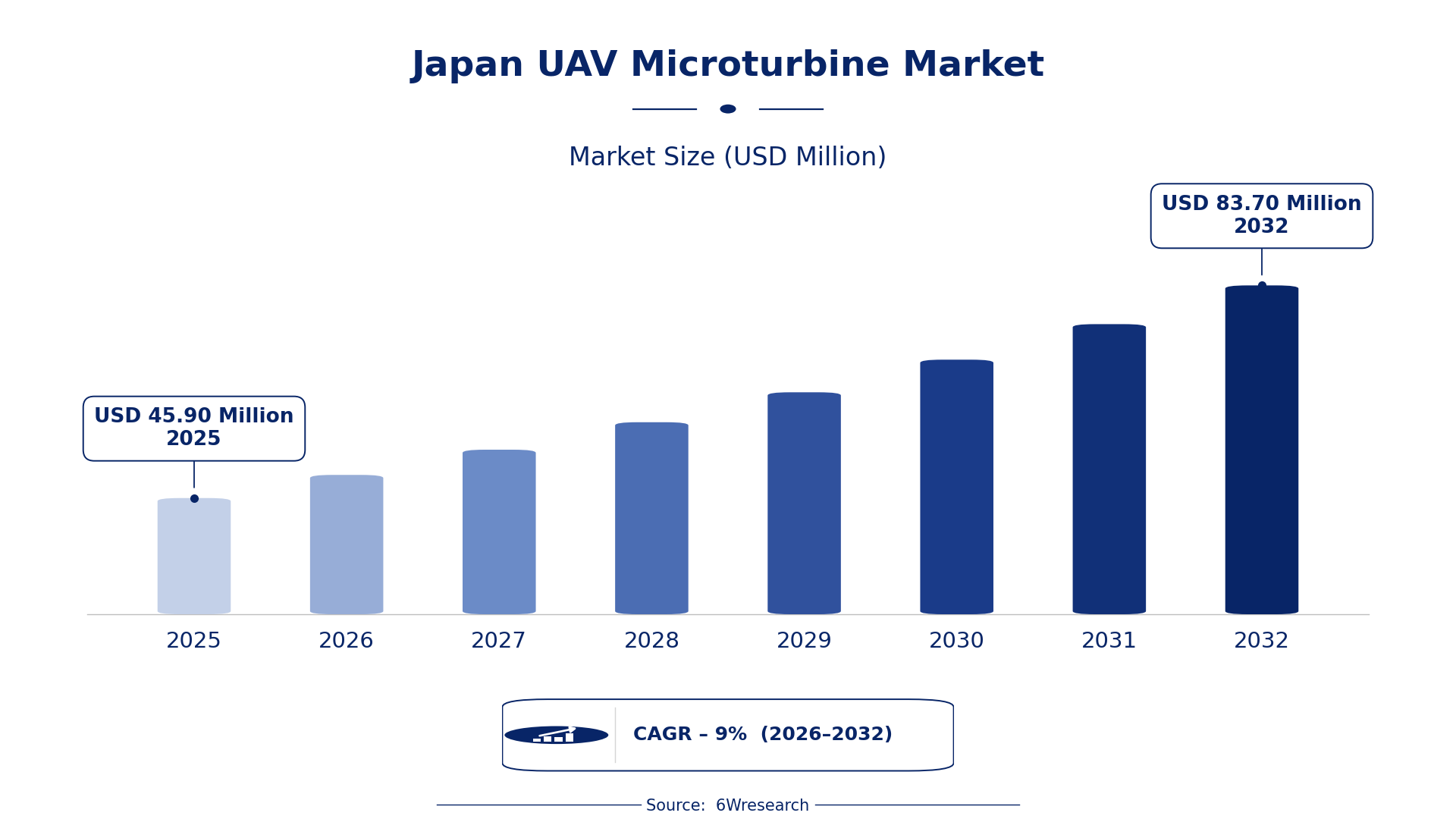
According to 6Wresearch internal database and industry insights, the Japan UAV Microturbine Market was valued at USD 45.90 Million in 2025 and is projected to reach USD 83.70 Million by 2032, growing at a CAGR of approximately 9% during 2026–2032.
Japan UAV Microturbine Market Highlights
| Report Metric | Details |
| Report Name | Japan UAV Microturbine Market (2026-2032) |
| Market Size 2025 | USD 45.90 Million |
| Market Size 2032 | USD 83.70 Million |
| Absolute Growth 2025–2032 | USD 37.80 Million |
| CAGR 2026–2032 | 9% |
| Peak Annual Growth | 9.5% in 2029 |
| Forecast Period | 2026–2032 |
| Historical Data | 2022–2025 |
| Base Year | 2025 |
| Leading Microturbine Type, 2025 | Air-Cooled Microturbine (36% share) |
| Leading Cooling Method, 2025 | Ambient Air (36% share) |
| Leading Application, 2025 | Recon UAVs (42% share) |
| Leading End User, 2025 | Defense OEMs (50% share) |
| Fastest-Growing Microturbine Type | Oil-Cooled Microturbine (13.0% CAGR) |
| Fastest-Growing Cooling Method | Lubricant Circulation (12.5% CAGR) |
| Fastest-Growing Application | MALE UAVs (12.0% CAGR) |
| Fastest-Growing End User | Jet Drone Makers (11.5% CAGR) |
| Growing Sector | Defense |
| Key End Users | Defense OEMs, Government Contractors, UAV Integrators, Jet Drone Makers |
Japan UAV Microturbine Market Year-wise Growth Rate and Key Drivers (2022–2032)
This graph illustrates the annual growth rates of the market from 2022 to 2032, highlighting a steady upward trajectory and projected market expansion over the forecast period.
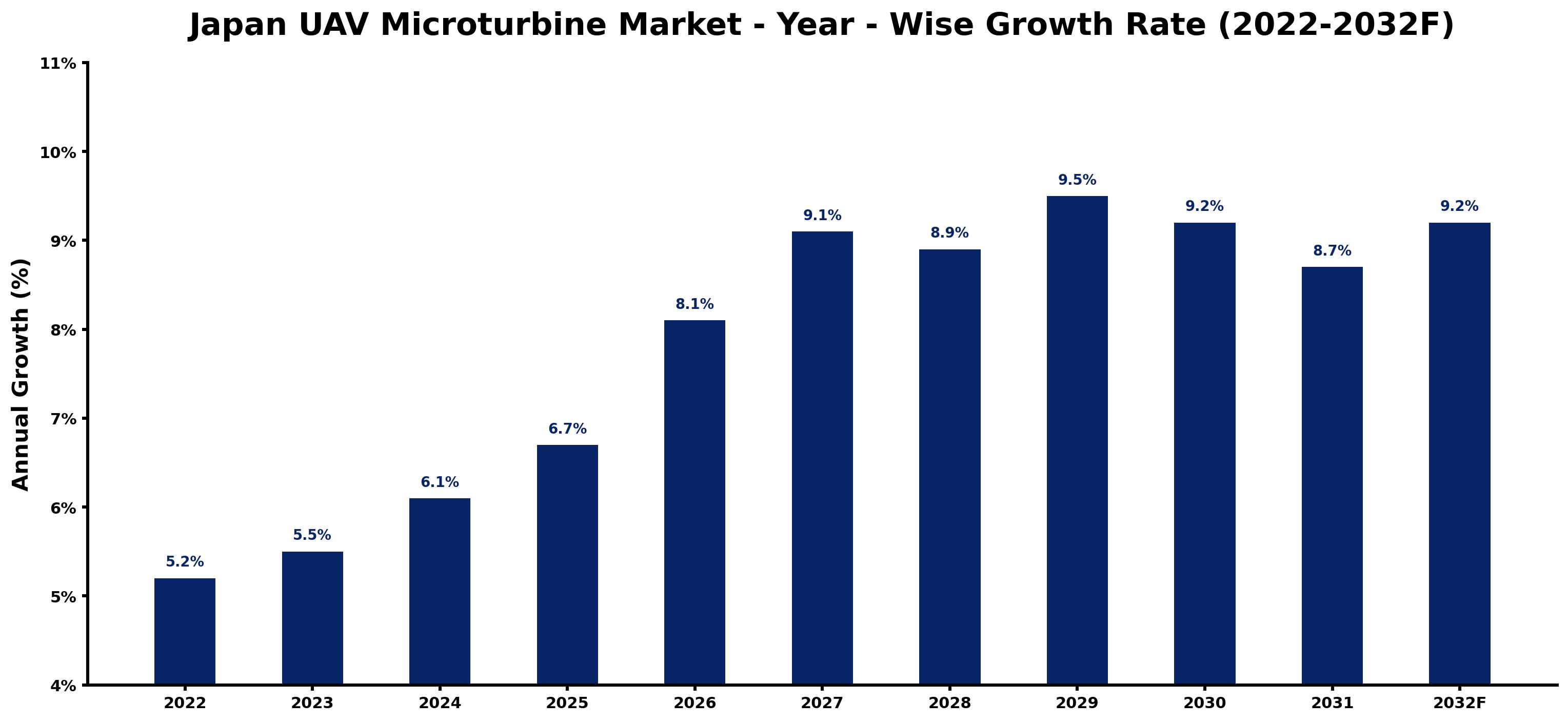
The yearly estimates that follow link every growth rate to its principal driver, so readers can see why the pace changed in each period.
| Year | Estimated Annual Growth (%) | Market Rationale |
| 2022 | 5.2 | The market experienced steady growth as defense spending increased. |
| 2023 | 5.5 | Demand rose due to heightened focus on UAV capabilities and technology advancements. |
| 2024 | 6.1 | Investment in advanced UAV systems continued to drive market expansion. |
| 2025 | 6.7 | The peak growth rate was achieved as the defense budget reached 5 trillion JPY. |
| 2026 | 8.1 | Growth accelerated with the introduction of new UAV standards and initiatives. |
| 2027 | 9.1 | Demand surged as the government allocated 200 billion JPY for drone technology advancements. |
| 2028 | 8.9 | Growth slowed slightly as the market adjusted to previous high levels. |
| 2029 | 9.5 | The market peaked again with advancements in UAV technology and capabilities. |
| 2030 | 9.2 | A slight slowdown occurred as the market stabilised after rapid growth. |
| 2031 | 8.7 | Growth continued to decelerate as the market matured and competition increased. |
| 2032 | 9.2 | Demand is projected to rise again as new UAV projects come online. |
Note: Market size estimations and growth projections presented in this report are based on 6Wresearch's proprietary forecasting methodology, utilizing the latest available industry data, government publications, and primary research inputs.
Japan UAV Microturbine Market Synopsis
UAV microturbines are small gas turbines designed for unmanned aerial vehicles, primarily for propulsion and power generation. They are essential in reconnaissance, surveillance, and tactical operations within military applications. The Japan UAV Microturbine Market is expanding due to increased defense spending, with the government allocating approximately 5 trillion JPY for UAV technology in 2023. Active domestic demand is driven by defense contracts and technological advancements, particularly in Tokyo, a major hub for UAV development and manufacturing.
Market Dynamics Impact Analysis (2026–2032)
| Factor | Type | Impact | Primary Segment Affected |
| Increased defense spending | Driver | High | Air-Cooled Microturbine |
| Technological advancements in UAV capabilities | Driver | High | Air-Cooled Microturbine |
| Growing demand for advanced UAV systems | Opportunity | High | Recon UAVs |
| Expansion of UAV manufacturing facilities | Opportunity | Medium | Defense OEMs |
| Regulatory compliance costs | Restraint | High | Air-Cooled Microturbine |
| Limited availability of skilled workforce | Restraint | Medium | Air-Cooled Microturbine |
| High initial investment for R&D | Challenge | High | Air-Cooled Microturbine |
| Intense competition among manufacturers | Challenge | Medium | Air-Cooled Microturbine |
Evaluation of Drivers in Japan UAV Microturbine Market (2026–2032)
Demand rests on the following drivers, each shown with the segment it touches most.
| Drivers | Primary Segment Affected | Why It Matters (Evidence) |
| Increased defense budget allocation for UAV technology | Air-Cooled Microturbine | Japan's defense budget for UAV technology is approximately 5 trillion JPY for 2023, leading to higher procurement of UAV microturbines. |
| Technological advancements in UAV systems | Recon UAVs | The program for advanced UAV systems by 2025 is driving demand for more efficient microturbines. |
| Growing domestic UAV production | Defense OEMs | The Tokyo Metropolitan area hosts numerous UAV technology firms, boosting local production and increasing demand for microturbines. |
| Rising need for surveillance capabilities | Surveillance | The Self-Defense Forces operate over 100 UAVs primarily for reconnaissance, increasing demand for UAV microturbines. |
| Support from research initiatives | UAV Integrators | The Japan Aerospace Exploration Agency funds UAV R&D, promoting the market for microturbines. |
What keeps demand rising is the substantial increase in Japan's defense budget, which is approximately 5 trillion JPY for 2023, prompting higher procurement of UAV microturbines. The Tokyo Metropolitan area hosts numerous UAV technology firms, boosting local production and increasing demand from military contractors. The operation of over 100 UAVs primarily for reconnaissance drives the need for microturbines. Research support for UAV R&D further promotes market growth, ensuring continuous innovation in microturbine technology.
Evaluation of Restraints in Japan UAV Microturbine Market
Below are the constraints most often cited by buyers and suppliers, with the segment each affects.
| Market Restraint | Primary Segment Affected | Why It Matters (Evidence) |
| High compliance costs due to regulatory standards | Air-Cooled Microturbine | Producers must adhere to JIS standards for UAV components, increasing operational costs. |
| Limited skilled workforce for UAV manufacturing | Air-Cooled Microturbine | The shortage of qualified personnel affects production efficiency and innovation, slowing down project timelines. |
| Rising costs of advanced materials | Integrated Microturbine | The use of advanced materials for lightweight performance increases production costs, impacting pricing strategies. |
| Market saturation in certain UAV segments | Recon UAVs | With over 100 UAVs in operation, the market is becoming increasingly competitive, limiting growth potential. |
| Dependency on government contracts | Defense OEMs | Many manufacturers rely heavily on government contracts, risking stability during budget cuts. |
Japan UAV Microturbine Market Challenges
Buyers incur high technology costs, as Japan's defense budget for UAV technology is approximately 5 trillion JPY for 2023, which limits available funding for other projects. Regulatory hurdles arise from the Ministry of Economy, Trade and Industry's stringent oversight, leading to compliance delays that can extend project timelines for manufacturers by up to six months. Supply chain issues occur due to reliance on specific components, resulting in production delays that can cost producers as much as 200 billion JPY in 2023. Rising prices for advanced materials, driven by global demand, force buyers to adjust budgets, complicating procurement strategies across the UAV sector.
Trends in the Japan UAV Microturbine Market
The following changes are redrawing the Japan UAV Microturbine Market.
- Shift towards Advanced UAV Systems: Japan is transitioning towards advanced UAV systems, with a programme initiated by the Ministry of Defense by 2025. This shift aims to improve operational capabilities and includes a budget allocation of 200 billion JPY for drone technology advancements.
- Emergence of Integrated Microturbines: The integrated microturbine type is gaining traction as UAV designs become more compact. This trend is clear in Tokyo, where local manufacturers are focusing on developing integrated systems to meet operational demands.
- Focus on Surveillance Capabilities: The demand for surveillance UAVs is increasing, particularly within the Self-Defense Forces. This trend is reflected in the operation of over 100 UAVs for reconnaissance, highlighting the importance of UAV microturbines.
- Growth in UAV Manufacturing Facilities: The establishment of new UAV manufacturing facilities is on the rise, particularly in Tokyo. This trend is supported by government initiatives aimed at boosting local production capabilities.
Investment Opportunities in the Japan UAV Microturbine Market
Several openings in the Japan UAV Microturbine Market merit attention from investors.
- Gap in Advanced UAV Technology: With Japan's defense budget reaching 5 trillion JPY, there is an opportunity to supply advanced UAV microturbines. Defense OEMs are actively seeking solutions to improve UAV performance.
- Investment in UAV Research and Development: The Japan Aerospace Exploration Agency's support for UAV R&D presents an opportunity to invest in microturbine technologies. Collaborating with local firms can facilitate market entry and innovation.
- Expansion of UAV Applications: The growing use of UAVs in tactical operations creates a demand for specialised microturbines. Government contractors are increasingly looking for reliable propulsion systems to meet operational needs.
- Development of Compact UAV Designs: The trend towards compact UAV designs opens opportunities for integrated microturbines. UAV integrators are seeking suppliers that can provide lightweight and efficient propulsion solutions.
Government Initiatives in the Japan UAV Microturbine Market
The Fire Service Act of 1948 regulates the handling of hazardous materials, ensuring safety standards in UAV production facilities. This law impacts UAV microturbine manufacturers by enforcing compliance with safety protocols. The Waste Management and Public Cleansing Act of 1970 mandates proper disposal of industrial waste, affecting operational practices for UAV manufacturers.
The Ministry of Economy, Trade and Industry oversees UAV technology regulations, ensuring compliance with national standards. The agency funds initiatives aimed at improving UAV capabilities, including a recent allocation of 200 billion JPY for drone technology advancements.
Future Insight of the Japan UAV Microturbine Market
The advanced UAV systems programme scheduled for 2025 will improve operational capabilities for producers and buyers. By 2032, established JIS standards will enhance production efficiency and ensure quality across the industry. Government funding for drone technology advancements is projected to increase, promoting research and development initiatives. The Tokyo Metropolitan area's role as a UAV development hub will continue to attract new firms, encouraging collaboration and driving technological progress.
Market Segmentation Analysis
Japan UAV Microturbine Market report covers a detailed analysis of the following market segments:
By Microturbine Type – Air-Cooled Microturbine Leads, Oil-Cooled Microturbine Expected to Grow Fastest
According to Saurav Kr Singh, Senior Research Analyst at 6Wresearch, Air-Cooled Microturbine held 36% of the Japan UAV Microturbine Market by microturbine type in 2025. Air-Cooled Microturbines dominate the market due to their efficiency in cooling UAV systems, which is essential for optimal performance. Their extensive use in Japan's Self-Defense Forces' UAVs illustrates their critical role in military applications. Oil-Cooled Microturbine is set to record the highest CAGR in this split, 13.0% over 2026–2032. The Oil-Cooled Microturbine segment is expanding rapidly because it provides superior thermal management, which is vital for high-performance UAVs. The Ministry of Defense's initiative for advanced UAV systems by 2025 significantly contributes to this growth. Suppliers should focus on developing oil-cooled technologies to meet the increasing demand from military and commercial UAV sectors.
By Cooling Method – Ambient Air Leads, Lubricant Circulation Expected to Grow Fastest
With 36% of cooling method revenue in 2025, Ambient Air was the largest category. Ambient Air is the leading cooling method for UAV microturbines, primarily due to its simplicity and effectiveness in maintaining optimal operating temperatures. This method is widely utilised across various UAV models, ensuring reliable performance in diverse conditions. Lubricant Circulation is projected to grow fastest, at a CAGR of 12.5% during 2026–2032. Lubricant Circulation is the fastest-growing cooling method, crucial for sustaining turbine performance under demanding operational conditions. The push for advanced UAV systems necessitates enhanced cooling solutions, driving rapid expansion in this segment. Buyers should seek suppliers that offer advanced lubricant circulation solutions to improve the reliability of their UAV systems.
By Application – Recon UAVs Lead, MALE UAVs Expected to Grow Fastest
In 2025, Recon UAVs led the application split with a 42% share. Recon UAVs hold the largest share as they are primarily used for reconnaissance missions, which are vital for national security and defense operations. The emphasis of Japan's Self-Defense Forces on enhancing reconnaissance capabilities underscores the importance of this application. Over 2026–2032, MALE UAVs are expected to post the fastest growth, at a CAGR of 12.0%. MALE UAVs represent the fastest-growing application segment, driven by their effectiveness in medium-altitude long-endurance missions. The increasing focus on versatile UAV capabilities in military operations is a key factor supporting this rapid growth. Suppliers should align their offerings with the rising demand for MALE UAV capabilities to seize emerging market opportunities.
By End User – Defense OEMs Lead, Jet Drone Makers Expected to Grow Fastest
Defense OEMs accounted for 50% of the market by end user in 2025. Defense OEMs are the largest end user group for UAV microturbines, being the primary manufacturers of UAV systems for military applications. Their significant procurement volume highlights the strategic importance of UAV technology within Japan's defense initiatives. The quickest growth will come from Jet Drone Makers, forecast to expand at a CAGR of 11.5% between 2026 and 2032. Jet Drone Makers are the fastest-growing end user segment, as they increasingly engage in developing advanced UAV technologies. The heightened focus on enhancing UAV capabilities in the defense sector is a notable growth driver for this group. Suppliers must collaborate with jet drone makers to ensure their technologies meet the evolving requirements of the UAV market.
Key Attractiveness of the Report
- 10 Years of Market Numbers
- Historical Data Starting from 2022 to 2025
- Base Year 2025
- Forecast Data until 2032
- Key Performance Indicators Impacting the Market
- Major Upcoming Developments and Projects
Key Highlights of the Report:
- Japan UAV Microturbine Market Outlook
- Market Size of Japan UAV Microturbine Market, 2025
- Forecast of Japan UAV Microturbine Market, 2032
- Historical Data and Forecast of Japan UAV Microturbine Revenues & Volume for the Period 2022-2032F
- Japan UAV Microturbine Market Trend Evolution
- Japan UAV Microturbine Market Drivers and Challenges
- Japan UAV Microturbine Price Trends
- Japan UAV Microturbine Porter's Five Forces
- Japan UAV Microturbine Industry Life Cycle
- Historical Data and Forecast of Japan UAV Microturbine Market Revenues & Volume By Microturbine Type for the Period 2022-2032F
- Historical Data and Forecast of Japan UAV Microturbine Market Revenues & Volume By Air-Cooled Microturbine for the Period 2022-2032F
- Historical Data and Forecast of Japan UAV Microturbine Market Revenues & Volume By Oil-Cooled Microturbine for the Period 2022-2032F
- Historical Data and Forecast of Japan UAV Microturbine Market Revenues & Volume By Hybrid-Cooled Turbine for the Period 2022-2032F
- Historical Data and Forecast of Japan UAV Microturbine Market Revenues & Volume By Integrated Microturbine for the Period 2022-2032F
- Historical Data and Forecast of Japan UAV Microturbine Market Revenues & Volume By Cooling Method for the Period 2022-2032F
- Historical Data and Forecast of Japan UAV Microturbine Market Revenues & Volume By Ambient Air for the Period 2022-2032F
- Historical Data and Forecast of Japan UAV Microturbine Market Revenues & Volume By Lubricant Circulation for the Period 2022-2032F
- Historical Data and Forecast of Japan UAV Microturbine Market Revenues & Volume By Mixed Cooling for the Period 2022-2032F
- Historical Data and Forecast of Japan UAV Microturbine Market Revenues & Volume By Onboard ECU Systems for the Period 2022-2032F
- Historical Data and Forecast of Japan UAV Microturbine Market Revenues & Volume By Application for the Period 2022-2032F
- Historical Data and Forecast of Japan UAV Microturbine Market Revenues & Volume By Recon UAVs for the Period 2022-2032F
- Historical Data and Forecast of Japan UAV Microturbine Market Revenues & Volume By MALE UAVs for the Period 2022-2032F
- Historical Data and Forecast of Japan UAV Microturbine Market Revenues & Volume By Surveillance for the Period 2022-2032F
- Historical Data and Forecast of Japan UAV Microturbine Market Revenues & Volume By Tactical Drone for the Period 2022-2032F
- Historical Data and Forecast of Japan UAV Microturbine Market Revenues & Volume By End User for the Period 2022-2032F
- Historical Data and Forecast of Japan UAV Microturbine Market Revenues & Volume By Defense OEMs for the Period 2022-2032F
- Historical Data and Forecast of Japan UAV Microturbine Market Revenues & Volume By Jet Drone Makers for the Period 2022-2032F
- Historical Data and Forecast of Japan UAV Microturbine Market Revenues & Volume By Government Contractors for the Period 2022-2032F
- Historical Data and Forecast of Japan UAV Microturbine Market Revenues & Volume By UAV Integrators for the Period 2022-2032F
- Japan UAV Microturbine Import Export Trade Statistics
- Market Opportunity Assessment By Microturbine Type
- Market Opportunity Assessment By Cooling Method
- Market Opportunity Assessment By Application
- Market Opportunity Assessment By End User
- Japan UAV Microturbine Top Companies Market Share
- Japan UAV Microturbine Competitive Benchmarking By Technical and Operational Parameters
- Japan UAV Microturbine Company Profiles
- Japan UAV Microturbine Key Strategic Recommendations
Market Covered
The study includes the following segmentation.
By Microturbine Type
- Air-Cooled Microturbine
- Oil-Cooled Microturbine
- Hybrid-Cooled Turbine
- Integrated Microturbine
By Cooling Method
- Ambient Air
- Lubricant Circulation
- Mixed Cooling
- Onboard ECU Systems
By Application
- Recon UAVs
- MALE UAVs
- Surveillance
- Tactical Drone
By End User
- Defense OEMs
- Jet Drone Makers
- Government Contractors
- UAV Integrators































