Japan UAV Operating Systems Market Size & Growth Rate
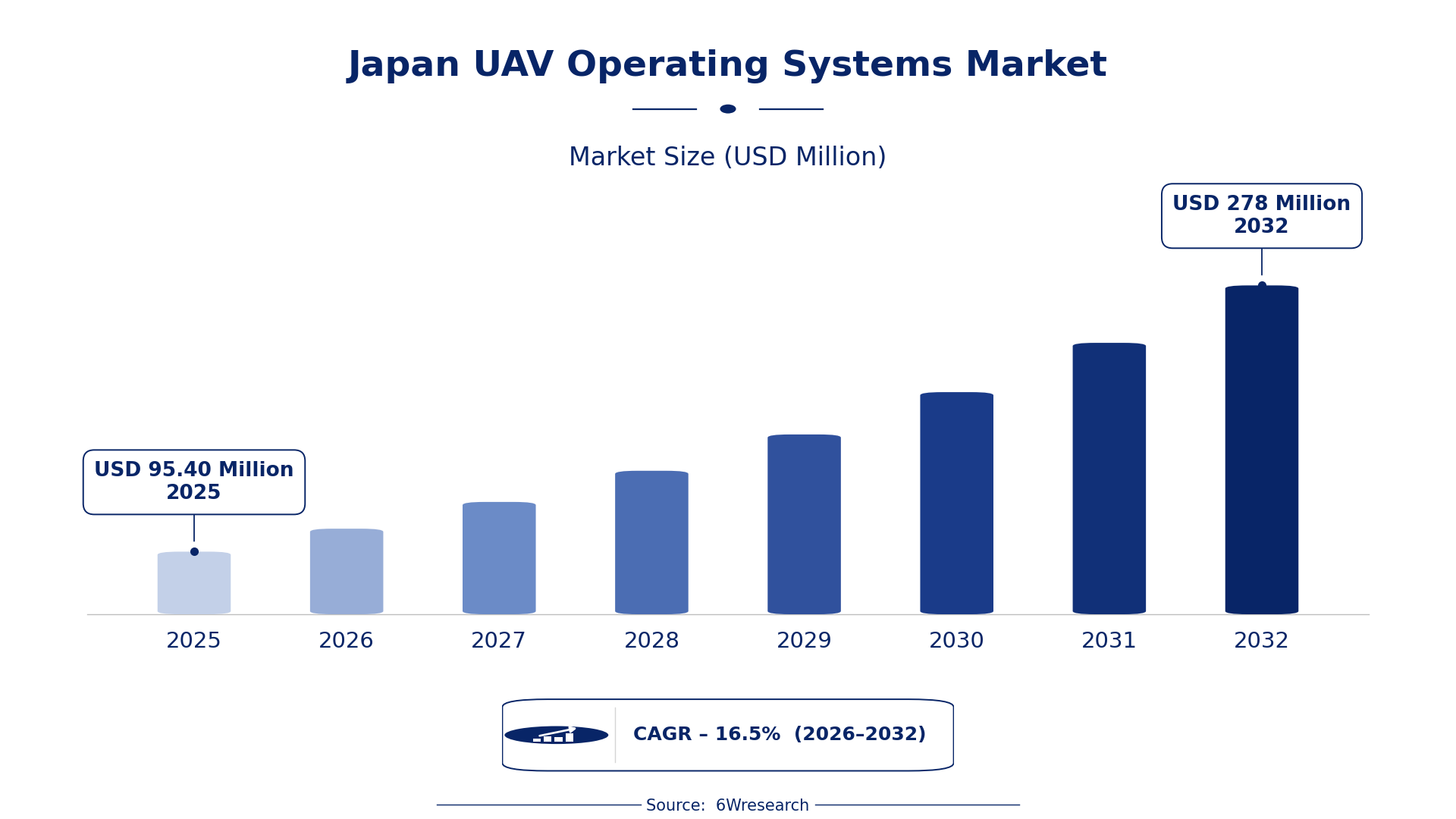
According to 6Wresearch internal database and industry insights, the Japan UAV Operating Systems Market was valued at USD 95.40 Million in 2025 and is projected to reach USD 278 Million by 2032, growing at a CAGR of approximately 16.5% during 2026–2032.
Japan UAV Operating Systems Market Highlights
| Report Metric | Details |
| Report Name | Japan UAV Operating Systems Market (2026-2032) |
| Market Size 2025 | USD 95.40 Million |
| Market Size 2032 | USD 278 Million |
| Absolute Growth 2025–2032 | USD 182.60 Million |
| CAGR 2026–2032 | 16.5% |
| Peak Annual Growth | 20.4% in 2030 |
| Forecast Period | 2026–2032 |
| Historical Data | 2022–2025 |
| Base Year | 2025 |
| Leading OS Type, 2025 | RTOS (Real-Time OS) (44% share) |
| Leading Architecture, 2025 | Microcontroller-Based (36% share) |
| Leading UAV Class, 2025 | Micro/Nano UAVs (35% share) |
| Leading End User, 2025 | Embedded System Designers (42% share) |
| Fastest-Growing OS Type | Linux-Based UAV OS (22.9% CAGR) |
| Fastest-Growing Architecture | Open Source (21.3% CAGR) |
| Fastest-Growing UAV Class | Large Tactical UAVs (22.2% CAGR) |
| Fastest-Growing End User | Avionics Developers (21.1% CAGR) |
| Growing Sector | Avionics Developers |
| Key End Users | Embedded System Designers, Avionics Developers, Defense OEMs, Aerospace Integrators |
Japan UAV Operating Systems Market Year-wise Growth Rate and Key Drivers (2022–2032)
This graph illustrates the annual growth rates of the market from 2022 to 2032, highlighting a steady upward trajectory and projected market expansion over the forecast period.
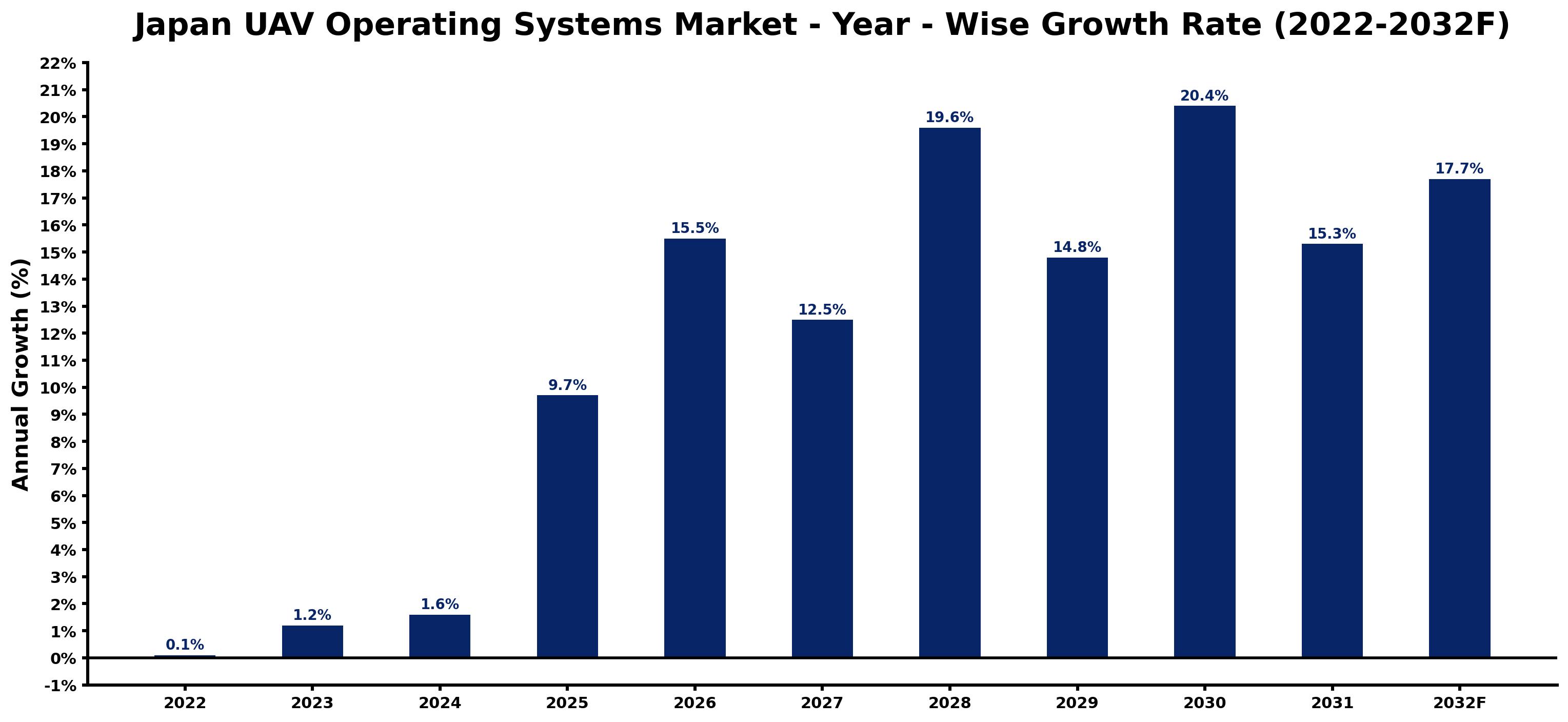
For each year, the table pairs the estimated growth rate with the leading influence on demand, showing how the drivers changed across the period.
| Year | Estimated Annual Growth (%) | Market Rationale |
| 2022 | 0.1 | The market showed minimal growth due to limited adoption of UAV technologies. |
| 2023 | 1.2 | Increased interest in UAV applications led to faster growth compared to the previous year. |
| 2024 | 1.6 | Demand for UAV operating systems continued to rise as more sectors explored UAV capabilities. |
| 2025 | 9.7 | The introduction of new UAV projects spurred growth in the market. |
| 2026 | 15.5 | Rising investments in defense technology will contribute to a stronger growth rate. |
| 2027 | 12.5 | Growth is expected to slow as the market adjusts to previous high rates of expansion. |
| 2028 | 19.6 | Technological advancements and new applications will drive faster growth once again. |
| 2029 | 14.8 | Growth is projected to slow as the market matures and competition intensifies. |
| 2030 | 20.4 | Major investments in UAV technology will result in peak growth for the market. |
| 2031 | 15.3 | Growth is expected to slow slightly as the market stabilises after rapid expansion. |
| 2032 | 17.7 | Continued investments and technological advancements are projected to sustain growth. |
Note: Market size estimations and growth projections presented in this report are based on 6Wresearch's proprietary forecasting methodology, utilizing the latest available industry data, government publications, and primary research inputs.
Japan UAV Operating Systems Market Synopsis
UAV Operating Systems are software platforms designed to control unmanned aerial vehicles, essential for flight control, mission planning, and data processing. The Japan UAV Operating Systems Market is projected to reach 1.5 billion USD by 2025, driven by substantial investments in domestic defense and aerospace sectors. The Tokyo region's status as a research hub further stimulates demand, while international collaborations broaden the market's potential. Ongoing advancements in UAV technology also contribute to the increasing adoption of these systems across various applications.
Market Dynamics Impact Analysis (2026–2032)
| Factor | Type | Impact | Primary Segment Affected |
| Growing demand from the defense sector for advanced UAV capabilities | Driver | High | Military UAVs |
| Increased investment in UAV technology development | Driver | High | RTOS (Real-Time OS) |
| Expansion of UAV applications in commercial sectors | Opportunity | High | Micro/Nano UAVs |
| Emerging collaborations between domestic and international UAV manufacturers | Opportunity | Medium | Linux-Based UAV OS |
| Regulatory challenges affecting UAV operations and development | Restraint | High | Mission-Critical OS |
| Limited awareness among potential end-users about UAV benefits | Restraint | Medium | Microcontroller-Based |
| High costs associated with advanced UAV technology development | Challenge | High | Large Tactical UAVs |
| Competition from foreign UAV manufacturers impacting local players | Challenge | Medium | Proprietary OS |
Evaluation of Drivers in Japan UAV Operating Systems Market (2026–2032)
Below are the drivers that matter most for revenue growth, with supporting evidence.
| Drivers | Primary Segment Affected | Why It Matters (Evidence) |
| Increased defense spending on UAV technology | Military UAVs | Japan's Ministry of Defense has allocated 200 million JPY for UAV advancements, boosting procurement. |
| Growing interest in commercial UAV applications | Micro/Nano UAVs | Research initiatives in the Tokyo region have led to increased investment in commercial UAV technologies. |
| Advancements in UAV operating systems | RTOS (Real-Time OS) | New developments in real-time processing capabilities are driving demand for advanced UAV systems. |
| Collaboration with international partners on UAV projects | Linux-Based UAV OS | International partnerships are facilitating knowledge exchange and technology transfer, boosting local production. |
| Rising demand for surveillance and reconnaissance capabilities | Large Tactical UAVs | The need for enhanced surveillance in defense operations is increasing purchases of tactical UAV systems. |
Purchasing is picking up as defense budgets rise, with substantial funds allocated for UAV technology development. Growing interest in commercial applications has led to higher investments in UAV technologies. Collaborations with international partners are facilitating technology transfer, further boosting local production.
Evaluation of Restraints in Japan UAV Operating Systems Market
The table below lists the restraints and the evidence behind each.
| Market Restraint | Primary Segment Affected | Why It Matters (Evidence) |
| Regulatory complexities surrounding UAV operations | Mission-Critical OS | The Ministry of Land, Infrastructure, Transport and Tourism has strict regulations that complicate UAV deployment. |
| Limited awareness of UAV benefits among potential users | Microcontroller-Based | Many industries remain unaware of how UAVs can improve operational efficiency and data collection. |
| High development costs for advanced UAV systems | Large Tactical UAVs | The financial burden of developing sophisticated UAV technologies can deter investment from smaller firms. |
| Intense competition from foreign UAV manufacturers | Proprietary OS | Local manufacturers face challenges from established foreign companies offering competitive products. |
| Slow adoption rates in certain sectors | Linux-Based UAV OS | Some industries are hesitant to integrate UAV technologies due to perceived risks and uncertainties. |
Japan UAV Operating Systems Market Challenges
Recent pilot projects in Tokyo reveal the regulatory hurdles UAV operators face, as compliance with local laws can delay project timelines by up to six months for buyers. Intense competition among over 100 registered manufacturers results in price wars, which may erode profit margins for producers and limit their investment in research and development. Supply chain disruptions, especially in sourcing components, can extend lead times by 20% for suppliers, affecting their ability to meet buyer demand. Evolving standards set by JIS Q 1001 can impose additional compliance costs, estimated at 15 million JPY annually for manufacturers.
Trends in the Japan UAV Operating Systems Market
The shifts below are changing how Japan UAV Operating Systems Market products are bought and supplied.
- Shift in Focus from Military to Commercial UAV Applications: Embedded System Designers are targeting commercial UAV markets, with a 30% growth in applications. The Tokyo Metropolitan Government's UAV pilot projects for urban planning illustrate this trend.
- Rise of Open Source UAV Operating Systems: Open Source systems are gaining traction, with a projected 21.3% CAGR. This shift is driven by the need for flexibility and community support in UAV development.
- Transition to Micro/Nano UAVs for Surveillance: Micro/Nano UAVs are becoming the preferred choice for surveillance, holding a 35% market share. This change is supported by advancements in miniaturisation and sensor technology.
- Expansion of UAV Pilot Projects in Urban Planning: The Tokyo Metropolitan Government has initiated multiple UAV pilot projects, with a budget of 100 million JPY. These projects aim to integrate UAVs into urban infrastructure.
Investment Opportunities in the Japan UAV Operating Systems Market
The openings below show where demand in the Japan UAV Operating Systems Market is visible and how suppliers can enter.
- Investment in UAV Research Facilities in Tokyo: The Tokyo region is seeing a 200 million JPY investment in UAV research facilities. This presents opportunities for collaboration with local universities and research institutions.
- Growing Demand for UAVs in Disaster Management: Japan's increasing frequency of natural disasters highlights a 50% rise in UAV applications for disaster response. Investing in UAV technologies for emergency services can yield substantial returns.
- Entry into the UAV Market through Joint Ventures: The current market conditions encourage partnerships with local firms. Engaging in joint ventures can facilitate access to Japan's UAV market, projected to reach 1.5 billion USD by 2025.
- Development of Custom UAV Solutions for Specific Industries: The demand for tailored UAV solutions is rising, particularly in agriculture and logistics, with a 30% increase in applications. Focusing on these sectors can improve market penetration.
Government Initiatives in the Japan UAV Operating Systems Market
The Economic Security Promotion Act (2022) supports supply-chain resilience for critical products, including UAV technologies. This law builds on the Industrial Standardization Act (1949), which established essential product standards, ensuring safety and reliability in UAV operations.
The New Energy and Industrial Technology Development Organization (NEDO) supports UAV technology through funding initiatives. In 2023, NEDO allocated 500 million JPY for UAV research projects, promoting innovation and collaboration in the sector.
Future Insight of the Japan UAV Operating Systems Market
New urban planning initiatives using UAV technology will emerge by 2032, stemming from pilot projects in Tokyo. The integration of advanced real-time operating systems will improve flight control capabilities, allowing for more precise mission planning. Increased collaboration with the Japan Aerospace Exploration Agency will accelerate innovation in UAV applications. With Japan's UAV market projected to reach 1.5 billion USD by 2025, buyers will benefit from improved product offerings, while suppliers must align with evolving industry standards.
Market Segmentation Analysis
Japan UAV Operating Systems Market report covers a detailed analysis of the following market segments:
By OS Type – RTOS (Real-Time OS) Leads, Linux-Based UAV OS Expected to Grow Fastest
According to Saurav Kr Singh, Senior Research Analyst at 6Wresearch, RTOS (Real-Time OS) accounted for 44% of the market by os type in 2025. RTOS holds the largest share because it is crucial for real-time processing in UAV operations, ensuring mission success across various applications. The Japanese Ministry of Defense heavily utilises RTOS for its UAV technology advancements, underscoring its significance in defence operations. Linux-Based UAV OS is projected to grow fastest, at a CAGR of 22.9% during 2026–2032. The Linux-Based UAV OS segment is growing rapidly due to its flexibility and robust community support, making it appealing for developers. This trend is reflected in the increasing number of UAV projects initiated in the Tokyo region, which further accelerates its adoption. Suppliers should prioritise the development of Linux-based solutions to cater to the rising demand from developers.
By Architecture – Microcontroller-Based Leads, Open Source Expected to Grow Fastest
Microcontroller-Based held 36% of the Japan UAV Operating Systems Market by architecture in 2025. Microcontroller-Based architecture dominates the market as it is commonly used in smaller UAVs, providing efficient control and performance. This is particularly relevant for the numerous registered UAV manufacturers in Japan, who often opt for this architecture. The quickest growth will come from Open Source, forecast to expand at a CAGR of 21.3% between 2026 and 2032. Open Source architecture is growing quickly as it allows for collaborative development and rapid prototyping, appealing to developers looking for cost-effective solutions. This growth is supported by the active UAV research community in Japan. Buyers may benefit from exploring open-source options to reduce costs and accelerate development timelines.
By UAV Class – Micro/Nano UAVs Lead, Large Tactical UAVs Expected to Grow Fastest
In 2025, Micro/Nano UAVs led the uav class split with a 35% share. Micro/Nano UAVs dominate the market as they are increasingly deployed for surveillance and reconnaissance tasks, vital for various sectors in Japan. The substantial number of registered UAVs indicates a strong demand for these smaller models, particularly in urban settings. Over 2026–2032, Large Tactical UAVs are expected to post the fastest growth, at a CAGR of 22.2%. Large Tactical UAVs are the fastest-growing segment, as they are increasingly utilised for military and strategic operations, aligning with Japan's commitment to enhancing its defence capabilities. The Defence Agency's budget allocation for UAV advancements reinforces this growth trajectory. Suppliers should expand their offerings in large tactical UAVs to leverage the increasing demand from military applications.
By End User – Embedded System Designers Lead, Avionics Developers Expected to Grow Fastest
The largest end user category in 2025 was Embedded System Designers, at 42% of revenue. Embedded System Designers constitute the largest user group, as they are integral to developing UAV operating systems tailored for specific applications. Their essential role in the UAV ecosystem ensures a consistent demand for these systems across defence and commercial sectors. Avionics Developers are set to record the highest CAGR in this split, 21.1% over 2026–2032. Avionics Developers are witnessing the fastest growth as they integrate UAV systems into aircraft, driven by the need for enhanced aerial capabilities. The ongoing UAV pilot projects in Tokyo illustrate the growing relevance of UAV technology in aviation, further boosting this segment. Suppliers should focus on targeting avionics developers to align with the increasing integration of UAV systems in various aircraft.
Key Attractiveness of the Report
- 10 Years of Market Numbers
- Historical Data Starting from 2022 to 2025
- Base Year 2025
- Forecast Data until 2032
- Key Performance Indicators Impacting the Market
- Major Upcoming Developments and Projects
Key Highlights of the Report:
- Japan UAV Operating Systems Market Outlook
- Market Size of Japan UAV Operating Systems Market, 2025
- Forecast of Japan UAV Operating Systems Market, 2032
- Historical Data and Forecast of Japan UAV Operating Systems Revenues & Volume for the Period 2022-2032F
- Japan UAV Operating Systems Market Trend Evolution
- Japan UAV Operating Systems Market Drivers and Challenges
- Japan UAV Operating Systems Price Trends
- Japan UAV Operating Systems Porter's Five Forces
- Japan UAV Operating Systems Industry Life Cycle
- Historical Data and Forecast of Japan UAV Operating Systems Market Revenues & Volume By OS Type for the Period 2022-2032F
- Historical Data and Forecast of Japan UAV Operating Systems Market Revenues & Volume By RTOS (Real-Time OS) for the Period 2022-2032F
- Historical Data and Forecast of Japan UAV Operating Systems Market Revenues & Volume By Linux-Based UAV OS for the Period 2022-2032F
- Historical Data and Forecast of Japan UAV Operating Systems Market Revenues & Volume By Proprietary OS for the Period 2022-2032F
- Historical Data and Forecast of Japan UAV Operating Systems Market Revenues & Volume By Mission-Critical OS for the Period 2022-2032F
- Historical Data and Forecast of Japan UAV Operating Systems Market Revenues & Volume By Architecture for the Period 2022-2032F
- Historical Data and Forecast of Japan UAV Operating Systems Market Revenues & Volume By Microcontroller-Based for the Period 2022-2032F
- Historical Data and Forecast of Japan UAV Operating Systems Market Revenues & Volume By Open Source for the Period 2022-2032F
- Historical Data and Forecast of Japan UAV Operating Systems Market Revenues & Volume By Custom Kernel for the Period 2022-2032F
- Historical Data and Forecast of Japan UAV Operating Systems Market Revenues & Volume By Secure Architecture for the Period 2022-2032F
- Historical Data and Forecast of Japan UAV Operating Systems Market Revenues & Volume By UAV Class for the Period 2022-2032F
- Historical Data and Forecast of Japan UAV Operating Systems Market Revenues & Volume By Micro/Nano UAVs for the Period 2022-2032F
- Historical Data and Forecast of Japan UAV Operating Systems Market Revenues & Volume By Large Tactical UAVs for the Period 2022-2032F
- Historical Data and Forecast of Japan UAV Operating Systems Market Revenues & Volume By Military UAVs for the Period 2022-2032F
- Historical Data and Forecast of Japan UAV Operating Systems Market Revenues & Volume By HALE/MALE UAVs for the Period 2022-2032F
- Historical Data and Forecast of Japan UAV Operating Systems Market Revenues & Volume By End User for the Period 2022-2032F
- Historical Data and Forecast of Japan UAV Operating Systems Market Revenues & Volume By Embedded System Designers for the Period 2022-2032F
- Historical Data and Forecast of Japan UAV Operating Systems Market Revenues & Volume By Avionics Developers for the Period 2022-2032F
- Historical Data and Forecast of Japan UAV Operating Systems Market Revenues & Volume By Defense OEMs for the Period 2022-2032F
- Historical Data and Forecast of Japan UAV Operating Systems Market Revenues & Volume By Aerospace Integrators for the Period 2022-2032F
- Japan UAV Operating Systems Import Export Trade Statistics
- Market Opportunity Assessment By OS Type
- Market Opportunity Assessment By Architecture
- Market Opportunity Assessment By UAV Class
- Market Opportunity Assessment By End User
- Japan UAV Operating Systems Top Companies Market Share
- Japan UAV Operating Systems Competitive Benchmarking By Technical and Operational Parameters
- Japan UAV Operating Systems Company Profiles
- Japan UAV Operating Systems Key Strategic Recommendations
Market Covered
Segments analysed in this report are listed below.
By OS Type
- RTOS (Real-Time OS)
- Linux-Based UAV OS
- Proprietary OS
- Mission-Critical OS
By Architecture
- Microcontroller-Based
- Open Source
- Custom Kernel
- Secure Architecture
By UAV Class
- Micro/Nano UAVs
- Large Tactical UAVs
- Military UAVs
- HALE/MALE UAVs
By End User
- Embedded System Designers
- Avionics Developers
- Defense OEMs
- Aerospace Integrators































