Japan UAV Sensor Protection Radome Market Size & Growth Rate
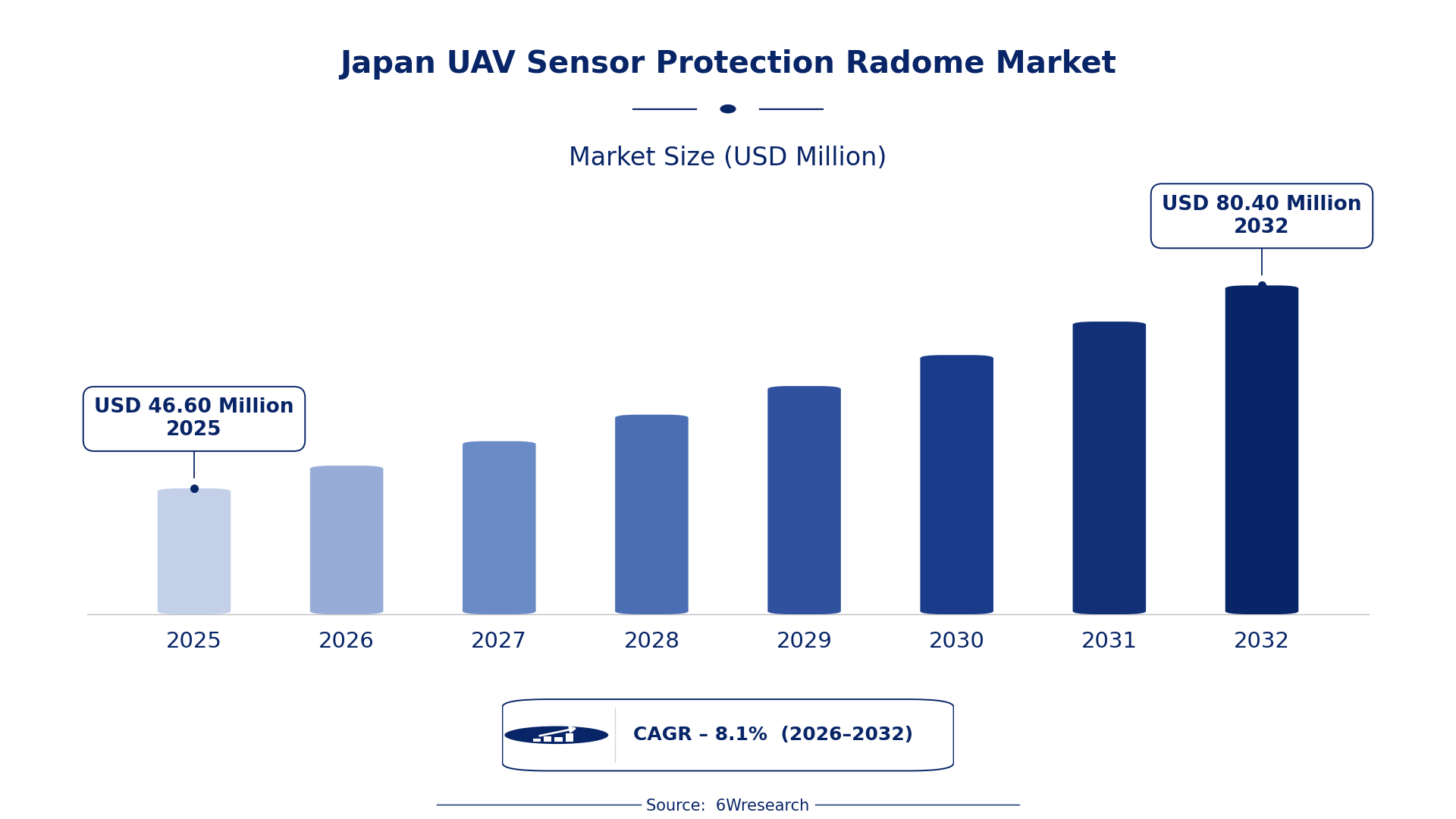
According to 6Wresearch internal database and industry insights, the Japan UAV Sensor Protection Radome Market was valued at USD 46.60 Million in 2025 and is projected to reach USD 80.40 Million by 2032, growing at a CAGR of approximately 8.1% during 2026–2032.
Japan UAV Sensor Protection Radome Market Highlights
| Report Metric | Details |
| Report Name | Japan UAV Sensor Protection Radome Market (2026-2032) |
| Market Size 2025 | USD 46.60 Million |
| Market Size 2032 | USD 80.40 Million |
| Absolute Growth 2025–2032 | USD 33.80 Million |
| CAGR 2026–2032 | 8.1% |
| Peak Annual Growth | 9.1% in 2032 |
| Forecast Period | 2026–2032 |
| Historical Data | 2022–2025 |
| Base Year | 2025 |
| Leading Radome Type, 2025 | RF-Transparent Radomes (40% share) |
| Leading Material Used, 2025 | PTFE & Quartz (50% share) |
| Leading Sensor Compatibility, 2025 | Radar / Comms (42% share) |
| Leading End User, 2025 | UAV OEMs (49% share) |
| Fastest-Growing Radome Type | Impact-Resistant Radomes (11.4% CAGR) |
| Fastest-Growing Material Used | Composite Laminates (11.6% CAGR) |
| Fastest-Growing Sensor Compatibility | Lidar / Optical Sensors (11.5% CAGR) |
| Fastest-Growing End User | ISR UAV Manufacturers (10.5% CAGR) |
| Growing Sector | UAV manufacturing |
| Key End Users | UAV OEMs, ISR UAV Manufacturers, Tactical Drone Builders |
Japan UAV Sensor Protection Radome Market Year-wise Growth Rate and Key Drivers (2022–2032)
This graph illustrates the annual growth rates of the market from 2022 to 2032, highlighting a steady upward trajectory and projected market expansion over the forecast period.
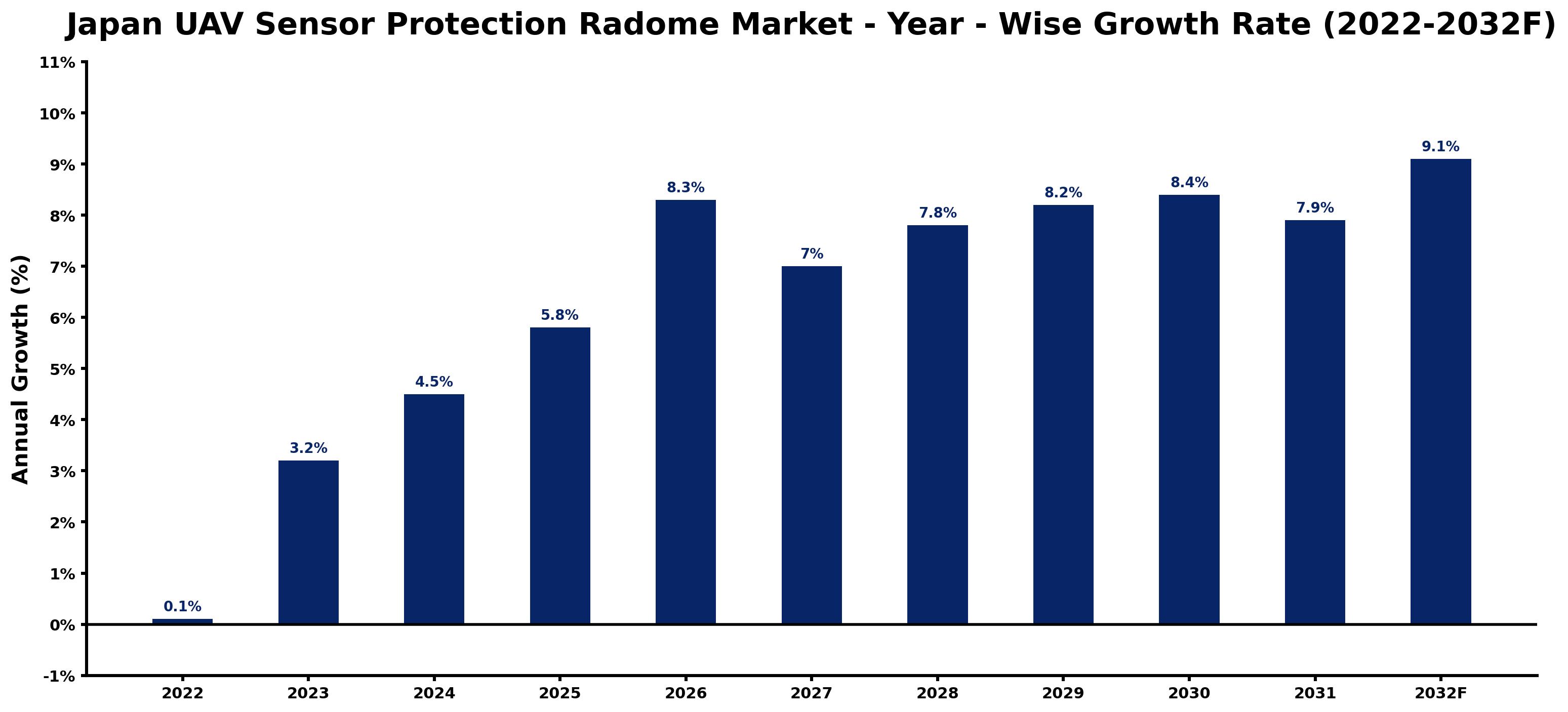
The following figures match every annual growth estimate with the main market development of that year, giving the reasoning behind each rise or slowdown.
| Year | Estimated Annual Growth (%) | Market Rationale |
| 2022 | 0.1 | The market exhibited slight growth due to recovery efforts in UAV technology adoption. |
| 2023 | 3.2 | Growth accelerated as UAV technology gained traction among domestic users and manufacturers. |
| 2024 | 4.5 | Demand increased further, driven by advancements in UAV capabilities and applications. |
| 2025 | 5.8 | The market peaked historically as military applications surged, boosting UAV operational efficiency. |
| 2026 | 8.3 | Growth continued robustly as investments in UAV technology expanded across various sectors. |
| 2027 | 7.0 | The growth rate slowed slightly as market saturation began to affect new purchases. |
| 2028 | 7.8 | Demand picked up again, supported by rising interest in UAVs for surveillance and mapping. |
| 2029 | 8.2 | The market maintained momentum as new UAV models entered the production phase. |
| 2030 | 8.4 | Growth remained strong, driven by ongoing technological advancements in UAV systems. |
| 2031 | 7.9 | A slight slowdown occurred as the market stabilised, reflecting mature demand patterns. |
| 2032 | 9.1 | The market is set to peak as military and civilian applications for UAVs expand significantly. |
Note: Market size estimations and growth projections presented in this report are based on 6Wresearch's proprietary forecasting methodology, utilizing the latest available industry data, government publications, and primary research inputs.
Japan UAV Sensor Protection Radome Market Synopsis
UAV Sensor Protection Radomes serve as protective covers for UAV sensors, made from materials such as PTFE and quartz to ensure durability and functionality. The Japan UAV Sensor Protection Radome Market is expanding due to rising demand from UAV manufacturers and military applications. Advancements in UAV technology and a focus on domestic production capabilities are driving this growth, with projections indicating the market will reach USD 46.60 million by 2025.
Market Dynamics Impact Analysis (2026–2032)
| Factor | Type | Impact | Primary Segment Affected |
| Increasing military applications drive demand for impact-resistant radomes. | Driver | High | Impact-Resistant Radomes |
| The UAV market's expansion fuels the need for RF-transparent materials. | Driver | High | RF-Transparent Radomes |
| Growing investments in UAV technology create opportunities for manufacturers. | Opportunity | High | UAV OEMs |
| The Tokyo region's UAV pilot program opens new avenues for innovation. | Opportunity | Medium | ISR UAV Manufacturers |
| High production costs limit the growth of UAV manufacturers. | Restraint | High | UAV OEMs |
| Limited availability of advanced materials constrains production capabilities. | Restraint | Medium | Composite Laminates |
| Supply chain disruptions affect timely delivery of UAV components. | Challenge | High | UAV OEMs |
| Technological complexities in radome design pose challenges for manufacturers. | Challenge | Medium | Impact-Resistant Radomes |
Evaluation of Drivers in Japan UAV Sensor Protection Radome Market (2026–2032)
The following drivers explain most of the expected growth.
| Drivers | Primary Segment Affected | Why It Matters (Evidence) |
| Rising military demand for UAVs enhances the need for impact-resistant radomes. | Impact-Resistant Radomes | The annual budget for defense UAV projects is estimated at 300 billion yen, increasing purchases of durable radomes. |
| The growth of UAV units drives the demand for RF-transparent materials. | RF-Transparent Radomes | Japan's UAV market is projected to reach 1.5 million units by 2025, leading to higher radome purchases. |
| Technological advancements in UAVs necessitate improved sensor protection. | PTFE & Quartz | The Ministry of Defense's UAV technology enhancement program initiated in 2023 increases demand for advanced radomes. |
| Increased surveillance applications boost demand for thermal cameras in UAVs. | Thermal Cameras | The demand for thermal cameras in UAVs is increasing, with a growth rate of 15% annually, driving radome sales. |
| The need for multi-sensor arrays in UAVs drives material innovation. | Multi-Sensor Arrays | The installed base of UAVs in Japan is around 200,000 units as of 2023, increasing the need for advanced radomes. |
Much of the new demand traces back to the projected growth of Japan's UAV market, which is expected to reach 1.5 million units by 2025. This surge drives manufacturers to invest in RF-transparent materials essential for sensor functionality. The increasing need for thermal cameras in UAVs, growing at 15% annually, propels the need for durable radomes. As the installed base of UAVs approaches 200,000 units, manufacturers are compelled to innovate and improve their offerings to meet evolving market needs.
Evaluation of Restraints in Japan UAV Sensor Protection Radome Market
The main factors holding the market back are set out below.
| Market Restraint | Primary Segment Affected | Why It Matters (Evidence) |
| High production costs limit the affordability of UAV radomes. | UAV OEMs | Japan's national weighted-average minimum wage rose to JPY 1,055 per hour in October 2024, increasing operational costs. |
| Limited availability of advanced materials constrains production capabilities. | Composite Laminates | The reliance on specific materials like PTFE and quartz creates supply chain vulnerabilities. |
| Supply chain disruptions affect timely delivery of UAV components. | Impact-Resistant Radomes | Ongoing global supply chain issues delay the procurement of essential materials. |
| Technological complexities in radome design pose challenges for manufacturers. | RF-Transparent Radomes | The need for advanced manufacturing techniques increases development time and costs. |
| Market saturation limits new customer acquisition for UAV manufacturers. | UAV OEMs | The installed base of UAVs is substantial, making it harder to attract new buyers. |
Japan UAV Sensor Protection Radome Market Challenges
Regulatory hurdles in UAV operations lead to delays for manufacturers, extending project approval timelines by as much as six months. Limited access to advanced technology hampers innovation, resulting in a 20% slowdown in product development for suppliers. Intense competition among over 100 registered manufacturers drives prices down, which reduces profit margins and limits producers' ability to invest in quality improvements. Rising production costs, influenced by Japan's minimum wage increase to JPY 1,055 per hour, force buyers to reassess budgets, impacting procurement strategies across the industry.
Trends in the Japan UAV Sensor Protection Radome Market
Below are the shifts with the largest effect on the Japan UAV Sensor Protection Radome Market.
- Shift from Traditional to Advanced UAV Technologies: UAV OEMs are increasingly adopting advanced technologies to improve operational capabilities. The Tokyo Metropolitan Government launched a UAV pilot program in 2023, aiming to integrate new solutions into existing frameworks.
- Transition to Custom Radomes: Manufacturers are moving towards custom radome designs to meet specific UAV requirements. The demand for modular radomes is growing, with projections indicating a significant uptick in tailored solutions.
- Lidar / Optical Sensors Gaining Prominence: Lidar / Optical Sensors are becoming essential for navigation and mapping in UAVs. This segment is projected to grow at a CAGR of 11.5%, reflecting the increasing complexity of UAV missions.
- Increased Focus on Environmental Resilience: There is a growing emphasis on developing radomes that withstand harsh environmental conditions. Impact-resistant radomes are critical for military UAV applications, ensuring durability in challenging environments.
Investment Opportunities in the Japan UAV Sensor Protection Radome Market
Investors looking at the Japan UAV Sensor Protection Radome Market should consider the following areas.
- Tokyo Region as a Hub for UAV Innovation: The Tokyo region is a major hub for UAV technology development, with over 100 registered manufacturers. This concentration creates opportunities for partnerships and innovation in radome production.
- Growing Demand from ISR UAV Manufacturers: ISR UAV Manufacturers are increasingly seeking advanced radome solutions. The annual budget for defense UAV projects is estimated at 300 billion yen, indicating a strong investment opportunity.
- Gap in Advanced Material Supply: With the projected increase in UAV production, there is a gap in the supply of advanced materials. Manufacturers can invest in local sourcing to meet this demand effectively.
- Increased Military Spending on UAVs: Japan's government aims to increase UAV manufacturing by 20% by 2025. This target opens avenues for suppliers to meet the rising demand for UAV components.
Government Initiatives in the Japan UAV Sensor Protection Radome Market
The Industrial Standardization Act, established in 1949 and amended in 2019, governs the Japanese Industrial Standards (JIS) applicable to UAV sensor components. This law ensures that manufacturers adhere to quality and safety standards, which is important for the reliability of UAV operations. The Semiconductor and Digital Industry Strategy initiated by METI in June 2021 aims to secure domestic semiconductor manufacturing, which is essential for UAV technology.
Approximately JPY 150 trillion has been allocated for public-private decarbonisation investment over ten years under the GX Basic Policy adopted in 2023. The Ministry of Economy, Trade and Industry oversees this initiative, promoting innovation in UAV technologies and supporting manufacturers in improving their production capabilities.
Future Insight of the Japan UAV Sensor Protection Radome Market
A new UAV technology enhancement program initiated by the Ministry of Defense will introduce advanced testing methodologies and improve operational standards. By 2032, the annual budget for defence UAV projects will reach 300 billion yen, providing substantial funding for innovation. The Ministry of Economy, Trade and Industry's support for UAV innovation programs will lead to advancements in manufacturing techniques. As the government aims for a 20% increase in UAV manufacturing by 2025, suppliers will need to scale operations to meet growing market demands.
Market Segmentation Analysis
Japan UAV Sensor Protection Radome Market report covers a detailed analysis of the following market segments:
By Radome Type – RF-Transparent Radomes Lead, Impact-Resistant Radomes Expected to Grow Fastest
According to Saurav Kr Singh, Senior Research Analyst at 6Wresearch, RF-Transparent Radomes accounted for 40% of the market by radome type in 2025. RF-Transparent Radomes lead the market because they are essential for ensuring the proper functionality of UAV sensors. Their critical role is evident in the Tokyo region, a hub for UAV technology development, where these radomes are widely used. Impact-Resistant Radomes are projected to grow fastest, at a CAGR of 11.4% during 2026–2032. Impact-Resistant Radomes are experiencing rapid growth as they are vital for durability in challenging military environments. The substantial annual budget of 300 billion yen allocated for defense UAV projects significantly boosts demand for these radomes. Suppliers should focus on enhancing the durability of radomes to meet the needs of military applications.
By Material Used – PTFE & Quartz Leads, Composite Laminates Expected to Grow Fastest
PTFE & Quartz took 50% of material used revenue in 2025, more than any other category. PTFE & Quartz materials dominate the market as they are commonly used for their RF transparency properties. Their extensive application in UAV radomes ensures optimal sensor performance across various UAV models. Over 2026–2032, Composite Laminates are expected to post the fastest growth, at a CAGR of 11.6%. Composite Laminates are growing rapidly due to their strength and lightweight characteristics, making them ideal for UAV applications. The projected increase in UAV manufacturing by 20% by 2025 will further boost this segment's demand. Buyers may benefit from exploring composite options for improved performance and weight efficiency.
By Sensor Compatibility – Radar / Comms Lead, Lidar / Optical Sensors Expected to Grow Fastest
With 42% of sensor compatibility revenue in 2025, Radar / Comms was the largest category. Radar / Comms sensors lead the market as they are critical for UAV operations, ensuring effective communication and navigation. This segment's importance is underscored by the installed base of around 200,000 UAVs in Japan that rely on these systems. The quickest growth will come from Lidar / Optical Sensors, forecast to expand at a CAGR of 11.5% between 2026 and 2032. Lidar / Optical Sensors are seeing the fastest growth because they are necessary for advanced navigation and mapping functions. The ongoing development of UAV technology in the Tokyo region supports this increasing demand. Suppliers should consider expanding their offerings to include advanced sensor compatibility features.
By End User – UAV OEMs Lead, ISR UAV Manufacturers Expected to Grow Fastest
In 2025, UAV OEMs led the end user split with a 49% share. UAV OEMs represent the largest share as they are the main users of radomes, integrating them into various UAV models. This is supported by the existence of over 100 registered UAV manufacturers in Japan who depend on these components for their products. ISR UAV Manufacturers are set to record the highest CAGR in this split, 10.5% over 2026–2032. ISR UAV Manufacturers are growing quickly due to increased demand for advanced surveillance and reconnaissance capabilities. The Ministry of Defense's initiatives to enhance UAV technology are a major factor driving this segment's expansion. Suppliers must tailor their products to meet the specific needs of ISR UAV Manufacturers to capitalise on emerging market opportunities.
Key Attractiveness of the Report
- 10 Years of Market Numbers
- Historical Data Starting from 2022 to 2025
- Base Year 2025
- Forecast Data until 2032
- Key Performance Indicators Impacting the Market
- Major Upcoming Developments and Projects
Key Highlights of the Report:
- Japan UAV Sensor Protection Radome Market Outlook
- Market Size of Japan UAV Sensor Protection Radome Market, 2025
- Forecast of Japan UAV Sensor Protection Radome Market, 2032
- Historical Data and Forecast of Japan UAV Sensor Protection Radome Revenues & Volume for the Period 2022-2032F
- Japan UAV Sensor Protection Radome Market Trend Evolution
- Japan UAV Sensor Protection Radome Market Drivers and Challenges
- Japan UAV Sensor Protection Radome Price Trends
- Japan UAV Sensor Protection Radome Porter's Five Forces
- Japan UAV Sensor Protection Radome Industry Life Cycle
- Historical Data and Forecast of Japan UAV Sensor Protection Radome Market Revenues & Volume By Radome Type for the Period 2022-2032F
- Historical Data and Forecast of Japan UAV Sensor Protection Radome Market Revenues & Volume By RF-Transparent Radomes for the Period 2022-2032F
- Historical Data and Forecast of Japan UAV Sensor Protection Radome Market Revenues & Volume By Impact-Resistant Radomes for the Period 2022-2032F
- Historical Data and Forecast of Japan UAV Sensor Protection Radome Market Revenues & Volume By Infrared Transparent Domes for the Period 2022-2032F
- Historical Data and Forecast of Japan UAV Sensor Protection Radome Market Revenues & Volume By Modular Radomes for the Period 2022-2032F
- Historical Data and Forecast of Japan UAV Sensor Protection Radome Market Revenues & Volume By Material Used for the Period 2022-2032F
- Historical Data and Forecast of Japan UAV Sensor Protection Radome Market Revenues & Volume By PTFE & Quartz for the Period 2022-2032F
- Historical Data and Forecast of Japan UAV Sensor Protection Radome Market Revenues & Volume By Composite Laminates for the Period 2022-2032F
- Historical Data and Forecast of Japan UAV Sensor Protection Radome Market Revenues & Volume By Sapphire Glass for the Period 2022-2032F
- Historical Data and Forecast of Japan UAV Sensor Protection Radome Market Revenues & Volume By Polycarbonate for the Period 2022-2032F
- Historical Data and Forecast of Japan UAV Sensor Protection Radome Market Revenues & Volume By Sensor Compatibility for the Period 2022-2032F
- Historical Data and Forecast of Japan UAV Sensor Protection Radome Market Revenues & Volume By Radar / Comms for the Period 2022-2032F
- Historical Data and Forecast of Japan UAV Sensor Protection Radome Market Revenues & Volume By Lidar / Optical Sensors for the Period 2022-2032F
- Historical Data and Forecast of Japan UAV Sensor Protection Radome Market Revenues & Volume By Thermal Cameras for the Period 2022-2032F
- Historical Data and Forecast of Japan UAV Sensor Protection Radome Market Revenues & Volume By Multi-Sensor Arrays for the Period 2022-2032F
- Historical Data and Forecast of Japan UAV Sensor Protection Radome Market Revenues & Volume By End User for the Period 2022-2032F
- Historical Data and Forecast of Japan UAV Sensor Protection Radome Market Revenues & Volume By UAV OEMs for the Period 2022-2032F
- Historical Data and Forecast of Japan UAV Sensor Protection Radome Market Revenues & Volume By ISR UAV Manufacturers for the Period 2022-2032F
- Historical Data and Forecast of Japan UAV Sensor Protection Radome Market Revenues & Volume By Tactical Drone Builders for the Period 2022-2032F
- Historical Data and Forecast of Japan UAV Sensor Protection Radome Market Revenues & Volume By Payload Integrators for the Period 2022-2032F
- Japan UAV Sensor Protection Radome Import Export Trade Statistics
- Market Opportunity Assessment By Radome Type
- Market Opportunity Assessment By Material Used
- Market Opportunity Assessment By Sensor Compatibility
- Market Opportunity Assessment By End User
- Japan UAV Sensor Protection Radome Top Companies Market Share
- Japan UAV Sensor Protection Radome Competitive Benchmarking By Technical and Operational Parameters
- Japan UAV Sensor Protection Radome Company Profiles
- Japan UAV Sensor Protection Radome Key Strategic Recommendations
Market Covered
Segments analysed in this report are listed below.
By Radome Type
- RF-Transparent Radomes
- Impact-Resistant Radomes
- Infrared Transparent Domes
- Modular Radomes
By Material Used
- PTFE & Quartz
- Composite Laminates
- Sapphire Glass
- Polycarbonate
By Sensor Compatibility
- Radar / Comms
- Lidar / Optical Sensors
- Thermal Cameras
- Multi-Sensor Arrays
By End User
- UAV OEMs
- ISR UAV Manufacturers
- Tactical Drone Builders
- Payload Integrators































