Japan Ultra-Lightweight Materials Market Size & Growth Rate
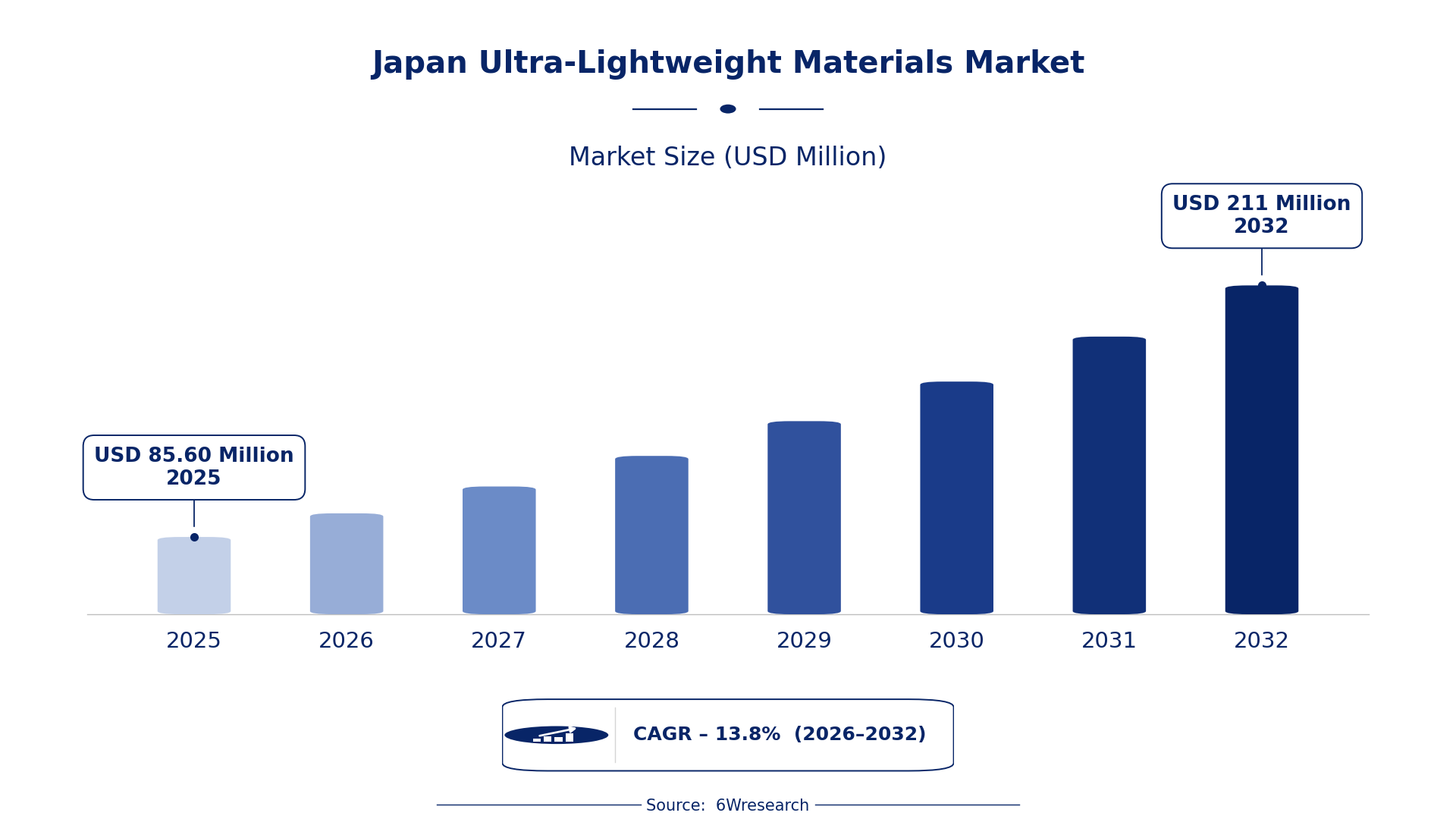
According to 6Wresearch internal database and industry insights, the Japan Ultra-Lightweight Materials Market was valued at USD 85.60 Million in 2025 and is projected to reach USD 211 Million by 2032, growing at a CAGR of approximately 13.8% during 2026–2032.
Japan Ultra-Lightweight Materials Market Highlights
| Report Metric | Details |
| Report Name | Japan Ultra-Lightweight Materials Market (2026-2032) |
| Market Size 2025 | USD 85.60 Million |
| Market Size 2032 | USD 211 Million |
| Absolute Growth 2025–2032 | USD 125.40 Million |
| CAGR 2026–2032 | 13.8% |
| Peak Annual Growth | 16.4% in 2032 |
| Forecast Period | 2026–2032 |
| Historical Data | 2022–2025 |
| Base Year | 2025 |
| Leading Material Type, 2025 | Carbon Fiber (46% share) |
| Leading Application Sector, 2025 | Automotive (40% share) |
| Leading Form Type, 2025 | Composite Sheets (45% share) |
| Leading End User, 2025 | Car Manufacturers (46% share) |
| Fastest-Growing Material Type | Thermoplastics (19.7% CAGR) |
| Fastest-Growing Application Sector | Consumer Electronics (18.2% CAGR) |
| Fastest-Growing Form Type | Molded Components (16.5% CAGR) |
| Fastest-Growing End User | Device Assemblers (17.8% CAGR) |
| Growing Sector | Consumer Electronics |
| Key End Users | Automotive, Aerospace, Consumer Electronics, Rail / Marine |
Japan Ultra-Lightweight Materials Market Year-wise Growth Rate and Key Drivers (2022–2032)
This graph illustrates the annual growth rates of the market from 2022 to 2032, highlighting a steady upward trajectory and projected market expansion over the forecast period.
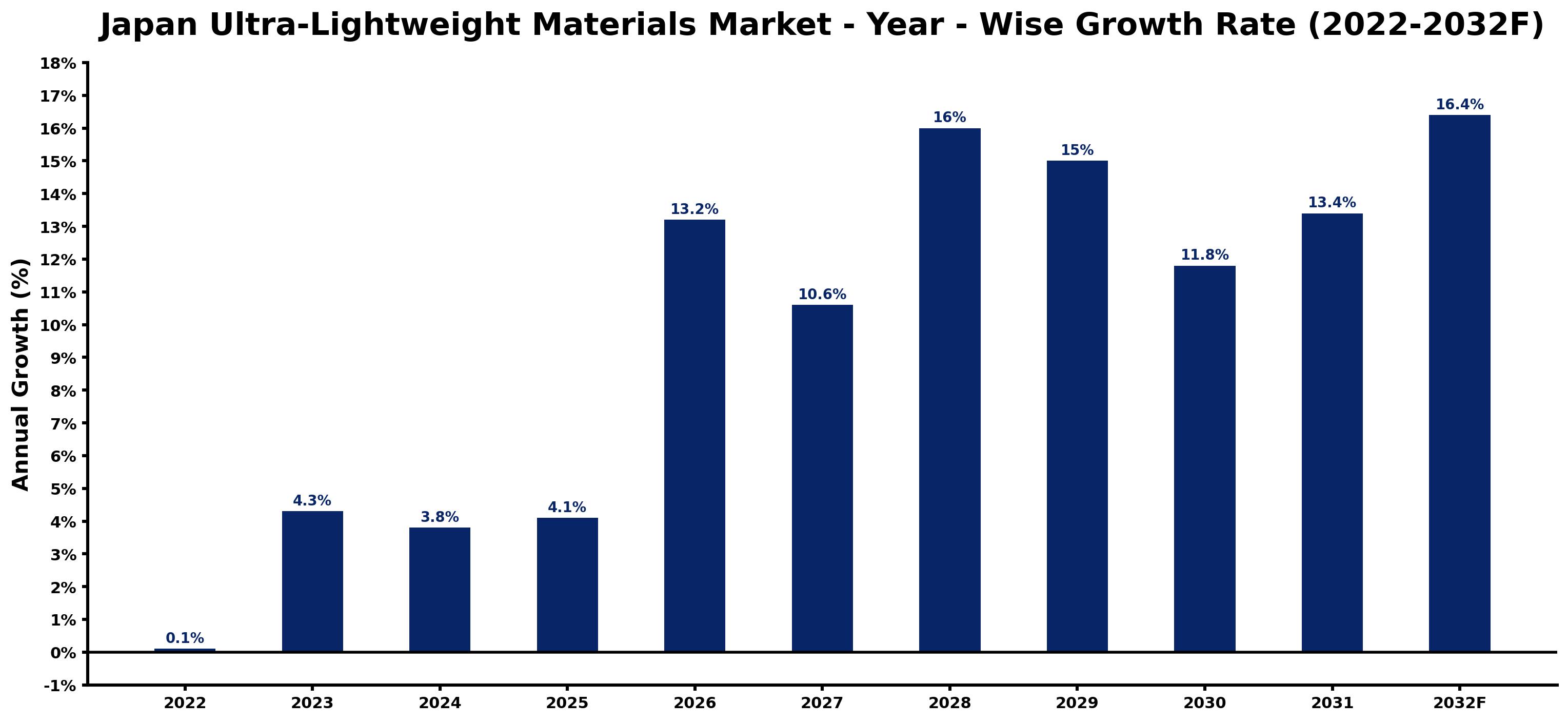
For each year, the table pairs the estimated growth rate with the leading influence on demand, showing how the drivers changed across the period.
| Year | Estimated Annual Growth (%) | Market Rationale |
| 2022 | 0.1 | The market showed minimal growth as manufacturers adjusted to changing material demands. |
| 2023 | 4.3 | Growth accelerated due to increased production in the automotive sector and rising lightweight material adoption. |
| 2024 | 3.8 | Growth slowed slightly as manufacturers faced challenges in sourcing advanced composites. |
| 2025 | 4.1 | Demand increased as the automotive industry aimed for weight reduction in vehicle production. |
| 2026 | 13.2 | Growth is expected to surge as investment in lightweight technologies expands across various sectors. |
| 2027 | 10.6 | Growth is projected to slow again as market adjustments to supply chain issues take effect. |
| 2028 | 16.0 | Demand is anticipated to rise sharply as innovations in lightweight materials gain traction in aerospace. |
| 2029 | 15.0 | Growth is expected to moderate as manufacturers consolidate gains and focus on quality improvements. |
| 2030 | 11.8 | Growth will slow as market saturation in certain applications begins to emerge. |
| 2031 | 13.4 | Demand is projected to increase as new applications for lightweight materials are explored in consumer electronics. |
| 2032 | 16.4 | Growth will peak as the automotive sector pushes for advanced lightweight solutions to meet emissions targets. |
Note: Market size estimations and growth projections presented in this report are based on 6Wresearch's proprietary forecasting methodology, utilizing the latest available industry data, government publications, and primary research inputs.
Japan Ultra-Lightweight Materials Market Synopsis
Ultra-lightweight materials are advanced composites that provide high strength-to-weight ratios, primarily used in aerospace, automotive, and consumer electronics. The Japan Ultra-Lightweight Materials Market is growing due to the automotive sector's production of over 8 million vehicles in 2022, along with a strong focus on technological advancements. Investment in lightweight technologies is projected to reach approximately JPY 150 trillion over the next decade, stimulating further demand across various industries.
Market Dynamics Impact Analysis (2026–2032)
| Factor | Type | Impact | Primary Segment Affected |
| Increased automotive production and focus on fuel efficiency drive demand for lightweight materials. | Driver | High | Automotive |
| Technological advancements in material science enable the development of innovative lightweight solutions. | Driver | High | Aerospace |
| Growing demand for electric vehicles creates opportunities for lightweight material applications. | Opportunity | High | Magnesium Alloys |
| The emphasis on reducing greenhouse gas emissions opens new markets for lightweight materials. | Opportunity | High | Carbon Fiber |
| Supply chain disruptions hinder the availability of advanced composites for manufacturers. | Restraint | Medium | Thermoplastics |
| High production costs for advanced materials limit widespread adoption in certain sectors. | Restraint | Medium | Composite Sheets |
| Competition from alternative materials poses challenges for market penetration. | Challenge | High | Lightweight Steel |
| Technological integration in manufacturing processes can delay product development timelines. | Challenge | Medium | Molded Components |
Evaluation of Drivers in Japan Ultra-Lightweight Materials Market (2026–2032)
These are the developments adding the most demand over the forecast period.
| Drivers | Primary Segment Affected | Why It Matters (Evidence) |
| Increased vehicle production | Automotive | The automotive industry produced over 8 million vehicles in 2022, leading to higher demand for lightweight materials. |
| Technological innovations | Aerospace | Carbon fiber composites are used in over 70% of new aircraft designs, improving fuel efficiency. |
| Investment in electric vehicle production | Magnesium Alloys | The automotive sector aims to reduce vehicle weight by 20% by 2025, increasing demand for magnesium alloys. |
| Government initiatives for decarbonisation | Carbon Fiber | Japan targets a 46% cut in greenhouse-gas emissions by 2030, promoting lightweight materials. |
| Rising consumer electronics demand | Thermoplastics | The growing use of thermoplastics in devices is driven by innovation and design trends. |
Buyers are adding capacity as the automotive sector produced over 8 million vehicles in 2022, leading to higher demand for lightweight materials. Innovations in aerospace are driving the adoption of carbon fiber composites, which are featured in over 70% of new aircraft designs. Investment in electric vehicle production is increasing the demand for magnesium alloys, with a target to reduce vehicle weight by 20% by 2025. The expanding consumer electronics market is also contributing to the increased use of thermoplastics, driven by ongoing innovation and design trends. These developments are increasing the demand for ultra-lightweight materials across various industries.
Evaluation of Restraints in Japan Ultra-Lightweight Materials Market
The main factors holding the market back are set out below.
| Market Restraint | Primary Segment Affected | Why It Matters (Evidence) |
| Supply chain disruptions | Thermoplastics | Supply chain issues have limited the availability of advanced composites, impacting production timelines significantly. |
| High production costs | Composite Sheets | The cost of producing advanced lightweight materials remains high, limiting adoption in some sectors. |
| Limited awareness of benefits | Aerospace | Some manufacturers lack awareness of the advantages of lightweight materials, hindering market growth. |
| Regulatory compliance costs | Automotive | Compliance with stringent regulations increases costs for manufacturers, affecting pricing and adoption. |
| Competition from alternative materials | Lightweight Steel | Alternative materials are gaining traction, posing challenges to market penetration for ultra-lightweight materials. |
Japan Ultra-Lightweight Materials Market Challenges
Over 8 million vehicles produced in Japan in 2022 highlight a skills shortage in lightweight material technologies, which limits innovation for automotive manufacturers. Suppliers face supply chain disruptions due to reliance on imported raw materials, causing delays for aerospace companies that require timely access to components. Stringent JIS standards complicate operations, forcing producers to invest in quality assurance that can prolong production timelines. Buyers in the consumer electronics sector experience rising costs as demand for thermoplastics outstrips local supply capabilities, leading to inflated prices for end products.
Trends in the Japan Ultra-Lightweight Materials Market
Below are the shifts with the largest effect on the Japan Ultra-Lightweight Materials Market.
- Shift from Traditional to Advanced Composites: Since 2023, the automotive sector has increasingly shifted towards advanced composites for vehicle production, reflecting a focus on weight reduction and fuel efficiency. This trend aligns with the industry's aim to reduce vehicle weight by 20% by 2025.
- Emergence of Lightweight Materials in Consumer Electronics: The consumer electronics sector has begun prioritising lightweight materials, particularly thermoplastics, since 2022. This shift is seen in the growing demand for lightweight and durable device casings, reflecting innovation in design trends.
- Transition to Sustainable Manufacturing Practices: The push for sustainability in manufacturing has gained momentum since 2023, with companies adopting lightweight materials to meet environmental targets. The GX Basic Policy aims for JPY 150 trillion of decarbonisation investment over the next decade.
- Growing Adoption of Carbon Fiber in Aerospace: The aerospace industry has increasingly adopted carbon fiber composites since 2022, with over 70% of new aircraft designs incorporating these materials. This trend underscores the industry's commitment to improving fuel efficiency.
Investment Opportunities in the Japan Ultra-Lightweight Materials Market
Investors looking at the Japan Ultra-Lightweight Materials Market should consider the following areas.
- Car Manufacturers Seeking Lightweight Solutions: Car manufacturers are increasingly looking for lightweight materials to improve vehicle performance and fuel efficiency. The automotive sector's target to reduce vehicle weight by 20% by 2025 presents a notable opportunity for suppliers of advanced composites.
- Tokyo's Innovation Hubs: Tokyo is emerging as a key region for lightweight material innovation, focusing on developing advanced composites. Investment in local production facilities can help suppliers meet the growing demand in this urban market.
- Supply of Advanced Composites: The gap in supply for advanced composites in the automotive sector is widening, with demand outpacing local production capabilities. Suppliers can enter this market by establishing partnerships with local manufacturers to enhance capacity.
- Growing Demand for Thermoplastics: With the consumer electronics market expanding, there is a pressing need for lightweight thermoplastics. Suppliers can capitalise on this demand by investing in production capabilities to meet the needs of device assemblers.
Government Initiatives in the Japan Ultra-Lightweight Materials Market
The PRTR Law, enacted in 1999, mandates businesses to report releases and transfers of designated chemical substances, ensuring that producers of lightweight materials adhere to environmental standards. The Chemical Substances Control Law, established in 1973, requires evaluation and control of chemical substances used in manufacturing, impacting the production processes of lightweight materials.
The GX Promotion Act, introduced in 2023, serves as the legal foundation for Japan's decarbonisation strategy, aiming for a notable reduction in greenhouse gas emissions. The Ministry of Economy, Trade and Industry (METI) supports initiatives that promote lightweight material technologies, providing funding and resources to enhance manufacturing capabilities.
Future Insight of the Japan Ultra-Lightweight Materials Market
The adoption of advanced manufacturing technologies will reshape lightweight material production by 2032, optimising processes and reducing lead times. A new programme from the Ministry of Economy, Trade and Industry will encourage innovation in material technologies, boosting competitiveness for suppliers. Japan's ambitious target to cut greenhouse gas emissions by 46% by 2030 will elevate demand for sustainable lightweight solutions across multiple industries. As the automotive sector aims for a 20% reduction in vehicle weight by 2025, buyers will benefit from improved fuel efficiency and lower emissions.
Market Segmentation Analysis
Japan Ultra-Lightweight Materials Market report covers a detailed analysis of the following market segments:
By Material Type – Carbon Fiber Leads, Thermoplastics Expected to Grow Fastest
According to Saurav Kr Singh, Senior Research Analyst at 6Wresearch, Carbon Fiber held 46% of the Japan Ultra-Lightweight Materials Market by material type in 2025. Carbon fiber holds the largest share due to its extensive use in aerospace and automotive applications, where its high strength-to-weight ratio is crucial. For instance, carbon fiber composites are utilised in over 70% of new aircraft designs in Japan, highlighting its importance in these sectors. The quickest growth will come from Thermoplastics, forecast to expand at a CAGR of 19.7% between 2026 and 2032. Thermoplastics are rapidly growing in popularity, particularly in consumer electronics, where their lightweight and durable characteristics are highly sought after. This trend is evident as manufacturers increasingly focus on product performance and aesthetic appeal to stay competitive. Suppliers should prioritise the development of advanced thermoplastic materials to meet the rising demand in consumer electronics.
By Application Sector – Automotive Leads, Consumer Electronics Expected to Grow Fastest
In 2025, Automotive led the application sector split with a 40% share. The automotive sector leads the market, being essential for vehicle production that prioritises fuel efficiency and performance. With Japan producing over 8 million vehicles in 2022, the substantial demand for lightweight materials in this sector is clear. Consumer Electronics is set to record the highest CAGR in this split, 18.2% over 2026–2032. The consumer electronics sector is the fastest-growing application area, as lightweight materials are increasingly employed for robust device casings and components. This growth is driven by ongoing innovation and design trends that favour lightweight solutions. Buyers in the consumer electronics sector must stay updated on material advancements to ensure their products remain competitive.
By Form Type – Composite Sheets Lead, Molded Components Expected to Grow Fastest
With 45% of form type revenue in 2025, Composite Sheets was the largest category. Composite sheets dominate the market due to their strength and lightweight properties, making them suitable for a wide range of applications across various industries. Their versatility has established them as a preferred choice in both automotive and aerospace sectors. Molded Components are projected to grow fastest, at a CAGR of 16.5% during 2026–2032. Molded components are experiencing the fastest growth, particularly in consumer electronics, where they are produced for lightweight and durable applications. This increase is propelled by the rising demand for innovative designs in electronic devices. Suppliers should invest in moulding technologies to capitalise on the growing demand for lightweight components in consumer electronics.
By End User – Car Manufacturers Lead, Device Assemblers Expected to Grow Fastest
Car Manufacturers accounted for 46% of the market by end user in 2025. Car manufacturers are the primary end users of ultra-lightweight materials, significantly impacting the production of lightweight vehicles. Their objective to reduce vehicle weight by 20% by 2025 underscores the vital role of these materials in achieving fuel efficiency. Over 2026–2032, Device Assemblers are expected to post the fastest growth, at a CAGR of 17.8%. Device assemblers represent the fastest-growing end user segment, as they are crucial for producing lightweight electronic devices that meet consumer preferences. The surge in portable electronics is a key factor driving this growth. Suppliers should focus on targeting device assemblers to align with the increasing trend towards lightweight electronic products.
Key Attractiveness of the Report
- 10 Years of Market Numbers
- Historical Data Starting from 2022 to 2025
- Base Year 2025
- Forecast Data until 2032
- Key Performance Indicators Impacting the Market
- Major Upcoming Developments and Projects
Key Highlights of the Report:
- Japan Ultra-Lightweight Materials Market Outlook
- Market Size of Japan Ultra-Lightweight Materials Market, 2025
- Forecast of Japan Ultra-Lightweight Materials Market, 2032
- Historical Data and Forecast of Japan Ultra-Lightweight Materials Revenues & Volume for the Period 2022-2032F
- Japan Ultra-Lightweight Materials Market Trend Evolution
- Japan Ultra-Lightweight Materials Market Drivers and Challenges
- Japan Ultra-Lightweight Materials Price Trends
- Japan Ultra-Lightweight Materials Porter's Five Forces
- Japan Ultra-Lightweight Materials Industry Life Cycle
- Historical Data and Forecast of Japan Ultra-Lightweight Materials Market Revenues & Volume By Material Type for the Period 2022-2032F
- Historical Data and Forecast of Japan Ultra-Lightweight Materials Market Revenues & Volume By Carbon Fiber for the Period 2022-2032F
- Historical Data and Forecast of Japan Ultra-Lightweight Materials Market Revenues & Volume By Magnesium Alloys for the Period 2022-2032F
- Historical Data and Forecast of Japan Ultra-Lightweight Materials Market Revenues & Volume By Thermoplastics for the Period 2022-2032F
- Historical Data and Forecast of Japan Ultra-Lightweight Materials Market Revenues & Volume By Lightweight Steel for the Period 2022-2032F
- Historical Data and Forecast of Japan Ultra-Lightweight Materials Market Revenues & Volume By Application Sector for the Period 2022-2032F
- Historical Data and Forecast of Japan Ultra-Lightweight Materials Market Revenues & Volume By Aerospace for the Period 2022-2032F
- Historical Data and Forecast of Japan Ultra-Lightweight Materials Market Revenues & Volume By Automotive for the Period 2022-2032F
- Historical Data and Forecast of Japan Ultra-Lightweight Materials Market Revenues & Volume By Consumer Electronics for the Period 2022-2032F
- Historical Data and Forecast of Japan Ultra-Lightweight Materials Market Revenues & Volume By Rail / Marine for the Period 2022-2032F
- Historical Data and Forecast of Japan Ultra-Lightweight Materials Market Revenues & Volume By Form Type for the Period 2022-2032F
- Historical Data and Forecast of Japan Ultra-Lightweight Materials Market Revenues & Volume By Composite Sheets for the Period 2022-2032F
- Historical Data and Forecast of Japan Ultra-Lightweight Materials Market Revenues & Volume By Structural Frames for the Period 2022-2032F
- Historical Data and Forecast of Japan Ultra-Lightweight Materials Market Revenues & Volume By Molded Components for the Period 2022-2032F
- Historical Data and Forecast of Japan Ultra-Lightweight Materials Market Revenues & Volume By Plates / Beams for the Period 2022-2032F
- Historical Data and Forecast of Japan Ultra-Lightweight Materials Market Revenues & Volume By End User for the Period 2022-2032F
- Historical Data and Forecast of Japan Ultra-Lightweight Materials Market Revenues & Volume By Aircraft OEMs for the Period 2022-2032F
- Historical Data and Forecast of Japan Ultra-Lightweight Materials Market Revenues & Volume By Car Manufacturers for the Period 2022-2032F
- Historical Data and Forecast of Japan Ultra-Lightweight Materials Market Revenues & Volume By Device Assemblers for the Period 2022-2032F
- Historical Data and Forecast of Japan Ultra-Lightweight Materials Market Revenues & Volume By Industrial Builders for the Period 2022-2032F
- Japan Ultra-Lightweight Materials Import Export Trade Statistics
- Market Opportunity Assessment By Material Type
- Market Opportunity Assessment By Application Sector
- Market Opportunity Assessment By Form Type
- Market Opportunity Assessment By End User
- Japan Ultra-Lightweight Materials Top Companies Market Share
- Japan Ultra-Lightweight Materials Competitive Benchmarking By Technical and Operational Parameters
- Japan Ultra-Lightweight Materials Company Profiles
- Japan Ultra-Lightweight Materials Key Strategic Recommendations
Market Covered
Coverage by segment is as follows.
By Material Type
- Carbon Fiber
- Magnesium Alloys
- Thermoplastics
- Lightweight Steel
By Application Sector
- Aerospace
- Automotive
- Consumer Electronics
- Rail / Marine
By Form Type
- Composite Sheets
- Structural Frames
- Molded Components
- Plates / Beams
By End User
- Aircraft OEMs
- Car Manufacturers
- Device Assemblers
- Industrial Builders































