Japan Ultra-Supercritical Boiler Market Size & Growth Rate
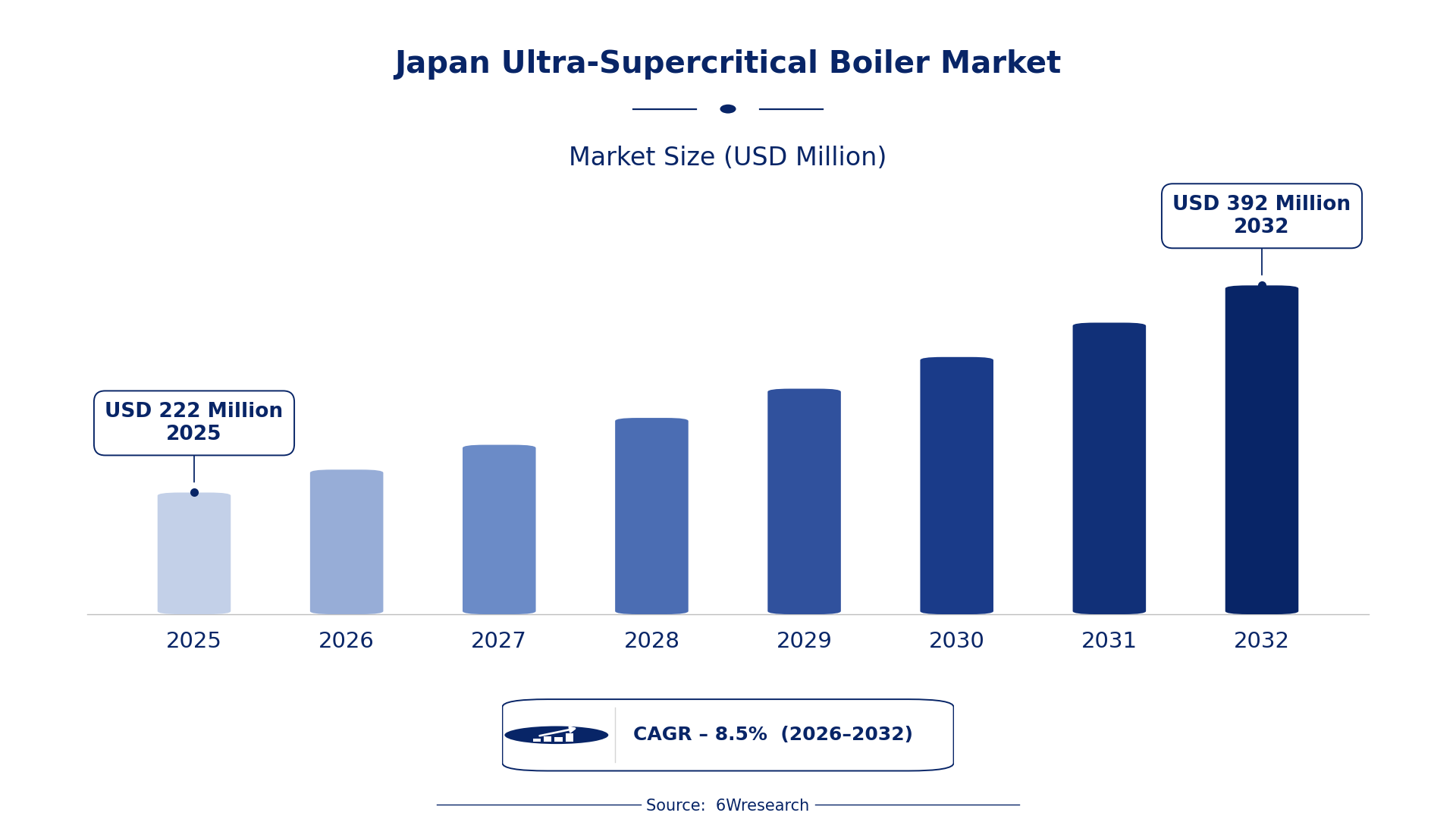
According to 6Wresearch internal database and industry insights, the Japan Ultra-Supercritical Boiler Market was valued at USD 222 Million in 2025 and is projected to reach USD 392 Million by 2032, growing at a CAGR of approximately 8.5% during 2026–2032.
Japan Ultra-Supercritical Boiler Market Highlights
| Report Metric | Details |
| Report Name | Japan Ultra-Supercritical Boiler Market (2026-2032) |
| Market Size 2025 | USD 222 Million |
| Market Size 2032 | USD 392 Million |
| Absolute Growth 2025–2032 | USD 170 Million |
| CAGR 2026–2032 | 8.5% |
| Peak Annual Growth | 9.0% in 2030 |
| Forecast Period | 2026–2032 |
| Historical Data | 2022–2025 |
| Base Year | 2025 |
| Leading Boiler Type, 2025 | Once-Through Boilers (42% share) |
| Leading Operating Pressure, 2025 | >300 bar (50% share) |
| Leading Application Type, 2025 | Thermal Power Plants (43% share) |
| Leading End User, 2025 | Energy Utilities (48% share) |
| Fastest-Growing Boiler Type | Drum-Type Boilers (11.6% CAGR) |
| Fastest-Growing Operating Pressure | Ultra-High Temp (11.2% CAGR) |
| Fastest-Growing Application Type | Industrial Steam (11.8% CAGR) |
| Fastest-Growing End User | Manufacturing Plants (10.8% CAGR) |
| Growing Sector | Energy Utilities |
| Key End Users | Energy Utilities, Government Projects, Thermal Power Plants |
Japan Ultra-Supercritical Boiler Market Year-wise Growth Rate and Key Drivers (2022–2032)
This graph illustrates the annual growth rates of the market from 2022 to 2032, highlighting a steady upward trajectory and projected market expansion over the forecast period.
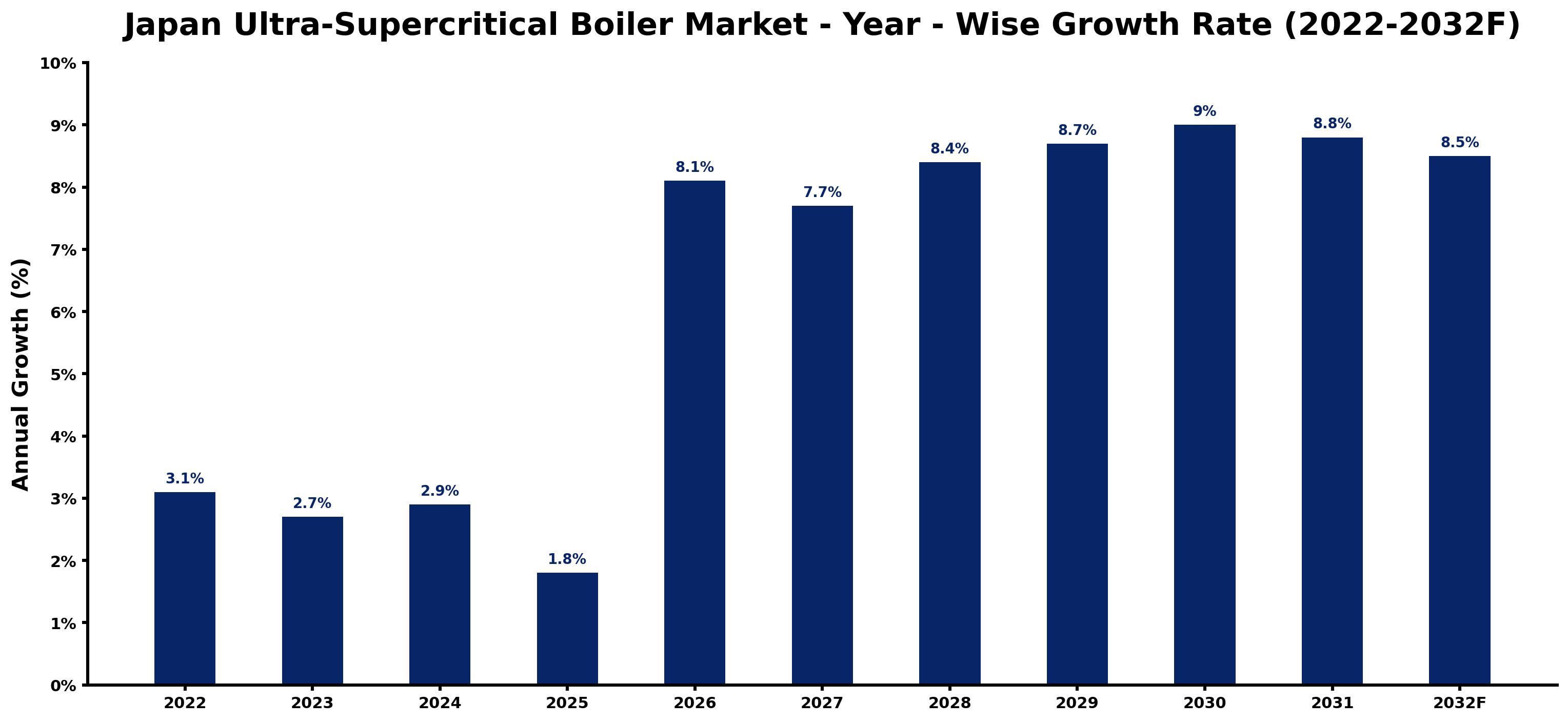
Below, each year's estimated growth is shown next to the factor that most influenced it.
| Year | Estimated Annual Growth (%) | Market Rationale |
| 2022 | 3.1 | The market exhibited strong demand due to ongoing energy efficiency initiatives. |
| 2023 | 2.7 | Growth slowed as energy utilities adjusted to new regulations and technologies. |
| 2024 | 2.9 | Increased investments in ultra-supercritical technology drove faster growth. |
| 2025 | 1.8 | Demand was constrained by market saturation in existing power plants. |
| 2026 | 8.1 | Growth accelerated as energy utilities adopted more ultra-supercritical boilers. |
| 2027 | 7.7 | A slight slowdown occurred as the market is expected to stabilise. |
| 2028 | 8.4 | Demand surged with new projects focusing on high-efficiency technologies. |
| 2029 | 8.7 | Growth is projected to continue as energy utilities expand their ultra-supercritical capacity. |
| 2030 | 9.0 | The peak growth rate is expected amid heightened investment in sustainability. |
| 2031 | 8.8 | A slowdown is anticipated as the market adjusts to previous high levels. |
| 2032 | 8.5 | Growth is projected to stabilise as the market matures and technology adoption continues. |
Note: Market size estimations and growth projections presented in this report are based on 6Wresearch's proprietary forecasting methodology, utilizing the latest available industry data, government publications, and primary research inputs.
Japan Ultra-Supercritical Boiler Market Synopsis
In Japan, over 70 thermal power plants utilise this technology, driven by energy utilities focused on reducing emissions. The Japan Ultra-Supercritical Boiler Market is expanding due to government projects aimed at energy efficiency and sustainability, with a target of a 46% reduction in greenhouse gas emissions by 2030. Investment in renewable energy projects, including a ¥50 billion allocation, fuels demand, creating opportunities for suppliers in this sector.
Market Dynamics Impact Analysis (2026–2032)
| Factor | Type | Impact | Primary Segment Affected |
| Increasing adoption of ultra-supercritical technology | Driver | High | Thermal Power Plants |
| Government initiatives promoting energy efficiency | Driver | High | Energy Utilities |
| Growing investments in renewable energy projects | Opportunity | High | Energy Utilities |
| Transition to high-efficiency technologies | Opportunity | High | Thermal Power Plants |
| High initial investment costs for ultra-supercritical boilers | Restraint | Medium | Once-Through Boilers |
| Limited availability of high-strength materials | Restraint | Medium | Ultra-High Temp |
| Supply chain disruptions affecting material procurement | Challenge | High | Drum-Type Boilers |
| Technological complexity in boiler manufacturing | Challenge | High | Pulverized Coal Boilers |
Evaluation of Drivers in Japan Ultra-Supercritical Boiler Market (2026–2032)
Key forces behind demand, with the segment each one moves most, are listed below.
| Drivers | Primary Segment Affected | Why It Matters (Evidence) |
| High efficiency of ultra-supercritical boilers | Once-Through Boilers | The average efficiency exceeds 45%, encouraging energy utilities to invest in these systems for better performance. |
| Government support for energy efficiency | Energy Utilities | Standards promote utilities to upgrade to ultra-supercritical technology, improving operational performance. |
| Demand for reduced emissions in power generation | Thermal Power Plants | Japan's energy policy encourages the transition to ultra-supercritical boilers to meet emission reduction targets. |
| Investment in renewable energy projects | Energy Utilities | In 2023, ¥50 billion was allocated for renewable energy, boosting demand for advanced boiler technologies. |
| Technological advancements in boiler design | Ultra-High Temp | Innovations in materials and design enable higher efficiency and reliability in ultra-supercritical systems. |
Spending rises because energy utilities are transitioning to ultra-supercritical boilers, motivated by the need for higher efficiency, with an average efficiency exceeding 45%. In 2023, ¥50 billion was allocated for renewable energy projects, boosting demand for advanced technologies. Innovations in boiler design improve performance, encouraging investment in ultra-supercritical systems. These factors propel the market forward, as energy utilities seek to meet stringent emission reduction targets through enhanced operational capabilities.
Evaluation of Restraints in Japan Ultra-Supercritical Boiler Market
Below are the constraints most often cited by buyers and suppliers, with the segment each affects.
| Market Restraint | Primary Segment Affected | Why It Matters (Evidence) |
| High initial investment costs for ultra-supercritical boilers | Once-Through Boilers | The upfront costs deter some energy utilities from upgrading their systems, limiting market growth. |
| Limited availability of high-strength materials | Ultra-High Temp | The scarcity of materials necessary for ultra-supercritical operation hampers production capabilities. |
| Supply chain disruptions affecting material procurement | Drum-Type Boilers | Recent global supply chain issues have delayed the availability of critical components for boiler manufacturing. |
| Technological complexity in boiler manufacturing | Pulverized Coal Boilers | The advanced technology required for ultra-supercritical boilers increases production challenges and costs. |
| Regulatory hurdles for new installations | Thermal Power Plants | Stringent regulations can prolong approval processes, delaying project timelines for energy utilities. |
Japan Ultra-Supercritical Boiler Market Challenges
In 2023, producers face escalating costs as retrofitting existing plants with ultra-supercritical technology can exceed ¥10 billion per facility. Buyers encounter delays due to skills shortages in advanced boiler manufacturing, which can extend production timelines by up to 15%. Compliance with the JIS B 8601 standard requires continuous investments in safety and performance, straining budgets for buyers in the energy sector. Supply chain disruptions related to high-strength materials can lead to project delays of six months, impacting delivery schedules for producers and hindering electricity generation.
Trends in the Japan Ultra-Supercritical Boiler Market
These developments are changing demand patterns in the Japan Ultra-Supercritical Boiler Market.
- Shift towards Ultra-Supercritical Technology: The Japanese energy sector is increasingly adopting ultra-supercritical technology, as seen in over 70 thermal power plants. This shift is motivated by the need for improved efficiency and reduced emissions, aligning with Japan's target to cut greenhouse gas emissions by 46% by 2030.
- Transition from Traditional to Advanced Boilers: Energy utilities are moving away from traditional boiler systems to advanced ultra-supercritical boilers. This change is reflected in the allocation of ¥50 billion for renewable energy projects in 2023, highlighting the focus on sustainability.
- New Energy Efficiency Standards: The introduction of new energy efficiency standards is reshaping the boiler market. These standards mandate higher performance, pushing utilities to invest in ultra-supercritical technology to comply with regulatory expectations.
- Increased Focus on Renewable Energy Integration: Energy utilities are prioritising the integration of renewable energy sources with ultra-supercritical technology. This trend is supported by government funding, with ¥50 billion allocated for renewable energy projects, driving innovation and investment.
Investment Opportunities in the Japan Ultra-Supercritical Boiler Market
The openings below show where demand in the Japan Ultra-Supercritical Boiler Market is visible and how suppliers can enter.
- Timing for Renewable Energy Investments: With the government allocating ¥50 billion for renewable energy projects, suppliers have a prime opportunity to invest in ultra-supercritical technology. Energy utilities are actively seeking partnerships to enhance their capabilities in this sector.
- Expansion of Thermal Power Plants: The ongoing expansion of thermal power plants in regions like Fukushima presents an opportunity for suppliers of ultra-supercritical boilers. This growth is driven by the need for higher efficiency and lower emissions.
- Supply of Advanced Boiler Technologies: The demand for ultra-supercritical boilers is rising as energy utilities transition to high-efficiency systems. Suppliers can enter this market by establishing joint ventures with local manufacturers to meet increasing demand.
- Entry through Certification and Compliance: The adoption of the JIS B 8601 standard for boiler safety and performance creates an entry point for suppliers. Compliance with these standards will be essential for market participation and gaining buyer trust.
Government Initiatives in the Japan Ultra-Supercritical Boiler Market
The Waste Management and Public Cleansing Act (1970) regulates the treatment of industrial waste, ensuring that producers of ultra-supercritical boilers adhere to strict environmental standards. This law, alongside the Economic Security Promotion Act (2022), supports supply-chain resilience for critical materials needed in boiler manufacturing. These regulations drive producers to invest in sustainable practices and technologies, ultimately benefiting the environment.
Energy utilities benefit from the GX Basic Policy adopted in 2023, which aims for JPY 150 trillion in public-private decarbonisation investment over ten years. This policy encourages energy utilities to adopt ultra-supercritical technology, as it aligns with government goals for emissions reduction and energy efficiency, facilitating funding for necessary upgrades and projects.
Future Insight of the Japan Ultra-Supercritical Boiler Market
A policy-driven shift towards ultra-supercritical technology will reshape the market by 2032, prompting suppliers to enhance manufacturing capabilities. The government's substantial allocation for renewable energy projects will stimulate innovation in boiler technologies. Stricter energy efficiency standards will drive the adoption of advanced practices across the sector. Buyers will benefit from improved thermal efficiencies, with average efficiencies exceeding 45%, resulting in lower operational costs and reduced emissions.
Market Segmentation Analysis
Japan Ultra-Supercritical Boiler Market report covers a detailed analysis of the following market segments:
By Boiler Type – Once-Through Boilers Lead, Drum-Type Boilers Expected to Grow Fastest
According to Saurav Kr Singh, Senior Research Analyst at 6Wresearch, the largest boiler type category in 2025 was Once-Through Boilers, at 42% of revenue. Once-Through Boilers dominate the market as they are directly utilised in power generation, offering high efficiency that aligns with Japan's energy policies. Their implementation in over 70 thermal power plants illustrates their essential role in improving thermal performance and reducing emissions. Over 2026–2032, Drum-Type Boilers are expected to post the fastest growth, at a CAGR of 11.6%. Drum-Type Boilers are experiencing growth as older facilities are retrofitted to enhance efficiency, particularly due to government initiatives promoting energy standards. This trend is likely to accelerate as energy utilities aim to modernise their operations and meet regulatory requirements. Suppliers must enhance the efficiency of Drum-Type Boilers to satisfy the increasing demand in retrofitting projects.
By Operating Pressure – >300 bar Leads, Ultra-High Temp Expected to Grow Fastest
In 2025, >300 bar led the operating pressure split with a 50% share. >300 bar boilers are critical for ultra-supercritical operation, providing the high pressures necessary for improved thermal efficiency. Their widespread application in Japan's thermal power plants highlights their importance in the energy sector's performance. The quickest growth will come from Ultra-High Temp, forecast to expand at a CAGR of 11.2% between 2026 and 2032. Ultra-High Temp systems are gaining traction as they are vital for maximising efficiency in energy generation. The government's dedication to advancing energy technologies further fuels the growth of this segment. Buyers should focus on investing in Ultra-High Temp systems to enhance efficiency and maintain competitiveness.
By Application Type – Thermal Power Plants Lead, Industrial Steam Expected to Grow Fastest
Thermal Power Plants accounted for 43% of the market by application type in 2025. Thermal Power Plants serve as the primary application for ultra-supercritical boilers, directly facilitating electricity generation. This segment's significance is reinforced by Japan's commitment to reducing greenhouse gas emissions through advanced technology adoption. Industrial Steam is set to record the highest CAGR in this split, 11.8% over 2026–2032. Industrial Steam applications are on the rise as manufacturers seek to optimise steam generation processes, aligning with national energy efficiency goals. The integration of ultra-supercritical technology in these applications is becoming increasingly prevalent. Suppliers should target the industrial sector to capitalise on the growing demand for efficient steam generation solutions.
By End User – Energy Utilities Lead, Manufacturing Plants Expected to Grow Fastest
With 48% of end user revenue in 2025, Energy Utilities was the largest category. Energy Utilities are the leading end-users of ultra-supercritical boilers, extensively employing them to efficiently meet electricity demands. Their considerable investments in this technology reflect a commitment to sustainability and emissions reduction. Manufacturing Plants are projected to grow fastest, at a CAGR of 10.8% during 2026–2032. Manufacturing Plants are increasingly adopting ultra-supercritical technology for steam generation, motivated by the need for greater efficiency in production processes. This trend is bolstered by energy policies that promote high-efficiency technologies. Suppliers should customise their offerings to meet the specific needs of manufacturing plants seeking improved steam generation capabilities.
Key Attractiveness of the Report
- 10 Years of Market Numbers
- Historical Data Starting from 2022 to 2025
- Base Year 2025
- Forecast Data until 2032
- Key Performance Indicators Impacting the Market
- Major Upcoming Developments and Projects
Key Highlights of the Report:
- Japan Ultra-Supercritical Boiler Market Outlook
- Market Size of Japan Ultra-Supercritical Boiler Market, 2025
- Forecast of Japan Ultra-Supercritical Boiler Market, 2032
- Historical Data and Forecast of Japan Ultra-Supercritical Boiler Revenues & Volume for the Period 2022-2032F
- Japan Ultra-Supercritical Boiler Market Trend Evolution
- Japan Ultra-Supercritical Boiler Market Drivers and Challenges
- Japan Ultra-Supercritical Boiler Price Trends
- Japan Ultra-Supercritical Boiler Porter's Five Forces
- Japan Ultra-Supercritical Boiler Industry Life Cycle
- Historical Data and Forecast of Japan Ultra-Supercritical Boiler Market Revenues & Volume By Boiler Type for the Period 2022-2032F
- Historical Data and Forecast of Japan Ultra-Supercritical Boiler Market Revenues & Volume By Once-Through Boilers for the Period 2022-2032F
- Historical Data and Forecast of Japan Ultra-Supercritical Boiler Market Revenues & Volume By Drum-Type Boilers for the Period 2022-2032F
- Historical Data and Forecast of Japan Ultra-Supercritical Boiler Market Revenues & Volume By Modular Boilers for the Period 2022-2032F
- Historical Data and Forecast of Japan Ultra-Supercritical Boiler Market Revenues & Volume By Pulverized Coal Boilers for the Period 2022-2032F
- Historical Data and Forecast of Japan Ultra-Supercritical Boiler Market Revenues & Volume By Operating Pressure for the Period 2022-2032F
- Historical Data and Forecast of Japan Ultra-Supercritical Boiler Market Revenues & Volume By >300 bar for the Period 2022-2032F
- Historical Data and Forecast of Japan Ultra-Supercritical Boiler Market Revenues & Volume By Ultra-High Temp for the Period 2022-2032F
- Historical Data and Forecast of Japan Ultra-Supercritical Boiler Market Revenues & Volume By Flexible Output for the Period 2022-2032F
- Historical Data and Forecast of Japan Ultra-Supercritical Boiler Market Revenues & Volume By Coal-Based for the Period 2022-2032F
- Historical Data and Forecast of Japan Ultra-Supercritical Boiler Market Revenues & Volume By Application Type for the Period 2022-2032F
- Historical Data and Forecast of Japan Ultra-Supercritical Boiler Market Revenues & Volume By Thermal Power Plants for the Period 2022-2032F
- Historical Data and Forecast of Japan Ultra-Supercritical Boiler Market Revenues & Volume By Industrial Steam for the Period 2022-2032F
- Historical Data and Forecast of Japan Ultra-Supercritical Boiler Market Revenues & Volume By District Heating for the Period 2022-2032F
- Historical Data and Forecast of Japan Ultra-Supercritical Boiler Market Revenues & Volume By Power Generation for the Period 2022-2032F
- Historical Data and Forecast of Japan Ultra-Supercritical Boiler Market Revenues & Volume By End User for the Period 2022-2032F
- Historical Data and Forecast of Japan Ultra-Supercritical Boiler Market Revenues & Volume By Energy Utilities for the Period 2022-2032F
- Historical Data and Forecast of Japan Ultra-Supercritical Boiler Market Revenues & Volume By Manufacturing Plants for the Period 2022-2032F
- Historical Data and Forecast of Japan Ultra-Supercritical Boiler Market Revenues & Volume By Municipal Services for the Period 2022-2032F
- Historical Data and Forecast of Japan Ultra-Supercritical Boiler Market Revenues & Volume By Government Projects for the Period 2022-2032F
- Japan Ultra-Supercritical Boiler Import Export Trade Statistics
- Market Opportunity Assessment By Boiler Type
- Market Opportunity Assessment By Operating Pressure
- Market Opportunity Assessment By Application Type
- Market Opportunity Assessment By End User
- Japan Ultra-Supercritical Boiler Top Companies Market Share
- Japan Ultra-Supercritical Boiler Competitive Benchmarking By Technical and Operational Parameters
- Japan Ultra-Supercritical Boiler Company Profiles
- Japan Ultra-Supercritical Boiler Key Strategic Recommendations
Market Covered
Segments analysed in this report are listed below.
By Boiler Type
- Once-Through Boilers
- Drum-Type Boilers
- Modular Boilers
- Pulverized Coal Boilers
By Operating Pressure
- >300 bar
- Ultra-High Temp
- Flexible Output
- Coal-Based
By Application Type
- Thermal Power Plants
- Industrial Steam
- District Heating
- Power Generation
By End User
- Energy Utilities
- Manufacturing Plants
- Municipal Services
- Government Projects































