Japan Ultrasound AI Software Market Size & Growth Rate
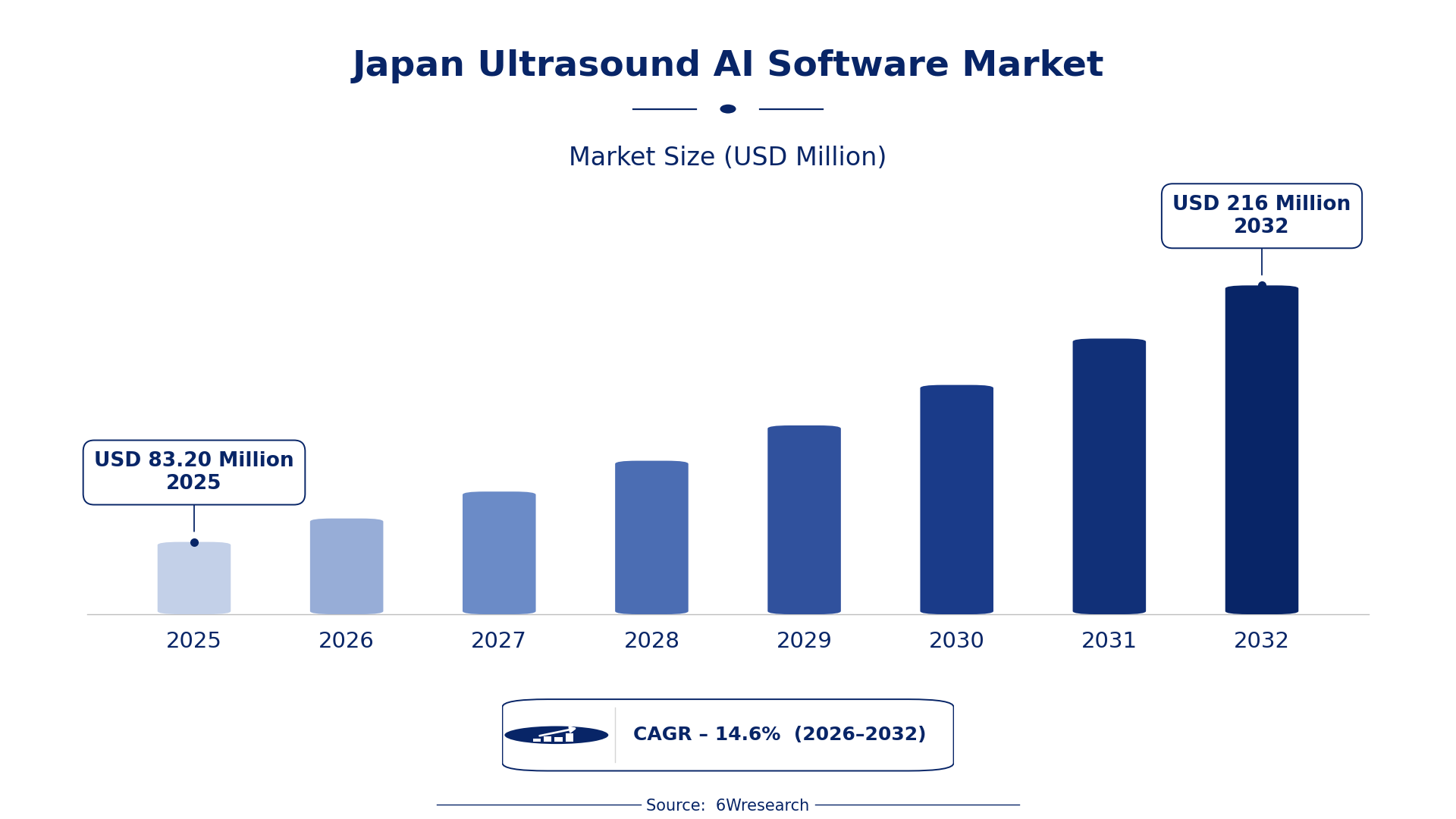
According to 6Wresearch internal database and industry insights, the Japan Ultrasound AI Software Market was valued at USD 83.20 Million in 2025 and is projected to reach USD 216 Million by 2032, growing at a CAGR of approximately 14.6% during 2026–2032.
Japan Ultrasound AI Software Market Highlights
| Report Metric | Details |
| Report Name | Japan Ultrasound AI Software Market (2026-2032) |
| Market Size 2025 | USD 83.20 Million |
| Market Size 2032 | USD 216 Million |
| Absolute Growth 2025–2032 | USD 132.80 Million |
| CAGR 2026–2032 | 14.6% |
| Peak Annual Growth | 15.7% in 2026 |
| Forecast Period | 2026–2032 |
| Historical Data | 2022–2025 |
| Base Year | 2025 |
| Leading Software Type, 2025 | Real-Time Detection (40% share) |
| Leading Use Case, 2025 | Tumor Identification (34% share) |
| Leading Integration Platform, 2025 | Ultrasound Machines (45% share) |
| Leading End User, 2025 | Radiology Centers (37% share) |
| Fastest-Growing Software Type | Image Segmentation (19.7% CAGR) |
| Fastest-Growing Use Case | Cardiac Imaging (18.8% CAGR) |
| Fastest-Growing Integration Platform | PACS / RIS (20.8% CAGR) |
| Fastest-Growing End User | Hospitals (18.1% CAGR) |
| Growing Sector | Healthcare technology |
| Key End Users | Hospitals, Radiology Centers, Clinics, Healthcare IT Firms |
Japan Ultrasound AI Software Market Year-wise Growth Rate and Key Drivers (2022–2032)
This graph illustrates the annual growth rates of the market from 2022 to 2032, highlighting a steady upward trajectory and projected market expansion over the forecast period.
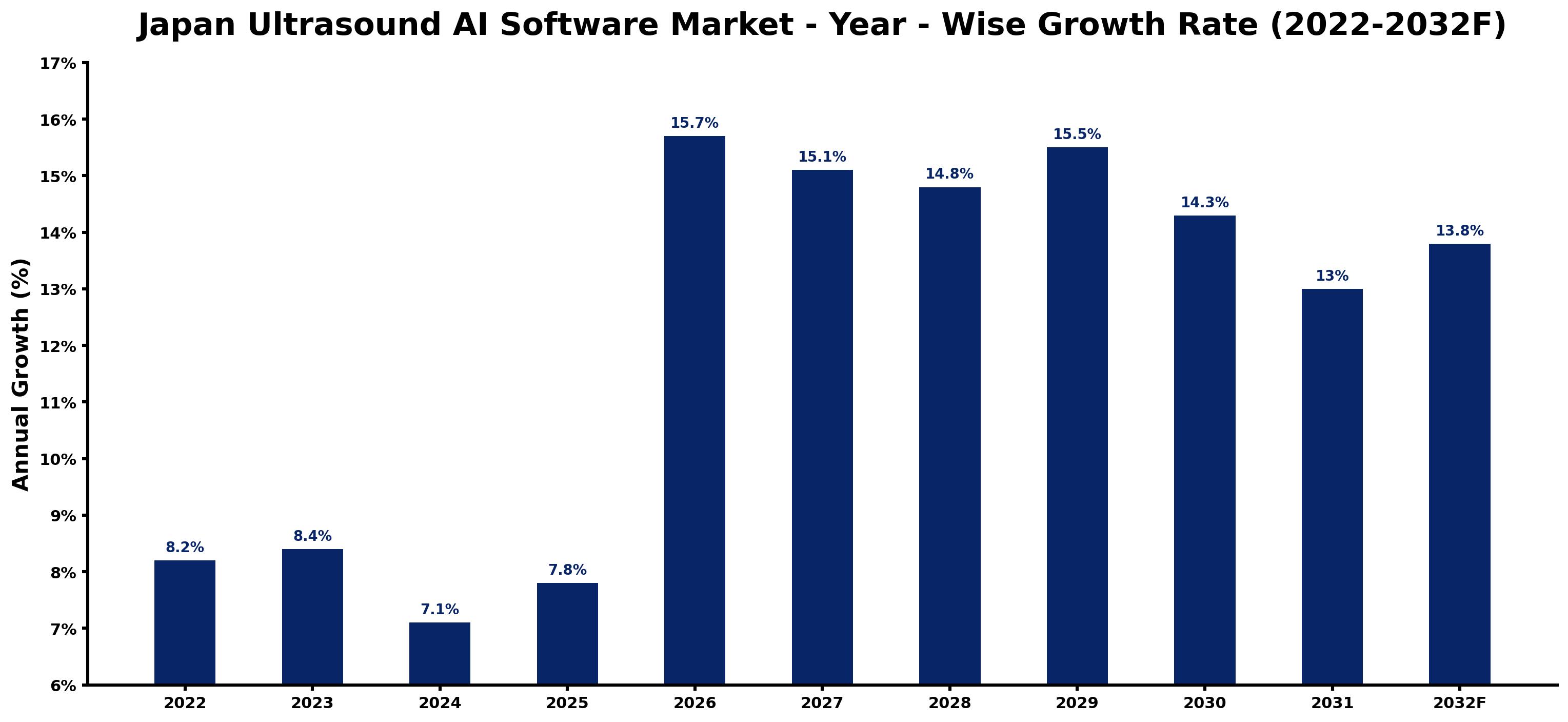
The following figures match every annual growth estimate with the main market development of that year, giving the reasoning behind each rise or slowdown.
| Year | Estimated Annual Growth (%) | Market Rationale |
| 2022 | 8.2 | The market exhibited steady growth, driven by rising healthcare demand. |
| 2023 | 8.4 | Growth accelerated due to increased adoption of AI technologies in diagnostics. |
| 2024 | 7.1 | A slowdown occurred as healthcare budgets faced tighter constraints. |
| 2025 | 7.8 | Growth resumed as hospitals expanded their ultrasound capabilities. |
| 2026 | 15.7 | The market surged, propelled by advancements in AI integration. |
| 2027 | 15.1 | Growth is expected to slow as the market stabilises after rapid expansion. |
| 2028 | 14.8 | A further slowdown is projected as the market adjusts to new standards. |
| 2029 | 15.5 | Growth is anticipated to accelerate again, driven by improved diagnostic accuracy. |
| 2030 | 14.3 | The market is expected to experience a slowdown as saturation begins in key areas. |
| 2031 | 13.0 | Growth will continue to slow as competition intensifies among providers. |
| 2032 | 13.8 | An uptick in growth is anticipated as new technologies emerge. |
Note: Market size estimations and growth projections presented in this report are based on 6Wresearch's proprietary forecasting methodology, utilizing the latest available industry data, government publications, and primary research inputs.
Japan Ultrasound AI Software Market Synopsis
Ultrasound AI software employs advanced algorithms to improve imaging capabilities and automate analysis in ultrasound diagnostics. In Japan, over 8,000 hospitals utilise ultrasound technology, driven by rising healthcare expenditure, which constitutes around 10% of GDP. The Japan Ultrasound AI Software Market is growing due to increasing demand from healthcare providers and ongoing advancements in medical technology, particularly in radiology and cardiology.
Market Dynamics Impact Analysis (2026–2032)
| Factor | Type | Impact | Primary Segment Affected |
| Increased adoption of AI technologies in hospitals | Driver | High | Ultrasound Machines |
| Growing demand for accurate diagnostics in radiology | Driver | High | Tumor Identification |
| Rising healthcare expenditure creating demand for advanced technologies | Opportunity | High | Cardiac Imaging |
| Expansion of healthcare IT infrastructure supporting AI integration | Opportunity | Medium | PACS / RIS |
| Budget constraints limiting hospital investments in new technologies | Restraint | High | Ultrasound Machines |
| Regulatory hurdles delaying AI software approvals | Restraint | Medium | Image Segmentation |
| High costs of implementing AI solutions in healthcare | Challenge | High | Workflow Optimization |
| Limited capacity for training staff on new technologies | Challenge | Medium | Real-Time Detection |
Evaluation of Drivers in Japan Ultrasound AI Software Market (2026–2032)
These are the developments adding the most demand over the forecast period.
| Drivers | Primary Segment Affected | Why It Matters (Evidence) |
| Rising healthcare expenditure | Ultrasound Machines | Japan's healthcare expenditure is around 10% of GDP, leading hospitals to invest in advanced ultrasound technologies. |
| Increased demand for diagnostic accuracy | Tumor Identification | Over 60% of radiology centers in Japan have implemented AI technologies to improve diagnostic precision. |
| Advancements in AI technology | Cardiac Imaging | The integration of AI in cardiac imaging improves assessment, driving demand among healthcare providers. |
| Government initiatives supporting AI in healthcare | PACS / RIS | The AI Promotion Act promotes AI adoption, encouraging hospitals to upgrade their imaging capabilities. |
| Growing number of ultrasound machines | Image Segmentation | With over 30,000 ultrasound machines in Japan, the need for advanced imaging software is increasing. |
Several shifts outside the market lift sales. The rising healthcare expenditure, which is around 10% of GDP, drives hospitals to invest in advanced ultrasound technologies. More than 60% of radiology centers have adopted AI technologies to improve diagnostic accuracy, leading to increased demand for software that identifies tumors. With over 30,000 ultrasound machines in Japan, the need for advanced imaging software continues to grow.
Evaluation of Restraints in Japan Ultrasound AI Software Market
The key brakes on demand, and where they bite hardest, are shown below.
| Market Restraint | Primary Segment Affected | Why It Matters (Evidence) |
| Budget constraints limiting hospital investments | Ultrasound Machines | Healthcare budgets are under pressure, reducing the ability of hospitals to invest in new technologies. |
| Regulatory hurdles delaying software approvals | Image Segmentation | The complexity of regulatory processes can slow down the introduction of new AI software. |
| High implementation costs for AI solutions | Workflow Optimization | The costs associated with implementing AI in healthcare can be prohibitive for smaller facilities. |
| Limited training capacity for staff | Real-Time Detection | Healthcare facilities often struggle to train staff adequately on new technologies. |
| Intense competition among providers | Tumor Identification | As more companies enter the market, differentiation becomes challenging for existing providers. |
Japan Ultrasound AI Software Market Challenges
Intense competition compels producers to lower prices, which restricts their capacity to invest in advancements for ultrasound AI software. Distributors face challenges in rapidly adopting new technologies, causing delays that hinder over 8,000 hospitals from accessing essential imaging solutions. Rising development costs, influenced by Japan's minimum wage increase to JPY 1,055 per hour, strain budgets for buyers, forcing them to delay crucial upgrades. Integration issues with existing systems create inefficiencies, resulting in increased operational costs for hospitals across Japan.
Trends in the Japan Ultrasound AI Software Market
The shifts below are changing how Japan Ultrasound AI Software Market products are bought and supplied.
- Radiology Centers Adopting AI Solutions: Radiology centers are increasingly adopting AI software to improve diagnostic accuracy, with over 60% implementing such technologies by 2023. This trend reflects the growing emphasis on precision in medical imaging.
- Shift Towards Integrated Healthcare IT Systems: The integration of AI with EMR systems is gaining traction, as hospitals seek to streamline operations. By 2023, many facilities have begun this integration to improve patient care and data management.
- Increased Focus on Cardiac Imaging: Cardiac imaging is becoming a priority as advancements in AI improve assessment capabilities. This shift is seen in hospitals expanding their imaging departments to include AI-driven solutions.
- Growth in AI-Driven Ultrasound Applications: The number of AI-driven ultrasound applications is increasing annually in Japan, with a notable rise in demand for real-time detection capabilities. This trend is reshaping diagnostic practices across healthcare facilities.
Investment Opportunities in the Japan Ultrasound AI Software Market
The following areas offer the clearest openings for investors and suppliers in the Japan Ultrasound AI Software Market.
- Partnerships for AI Integration: Now is an opportune time to form partnerships with healthcare IT firms to supply AI solutions, as the market shows a growing need for advanced imaging technologies. The Tokyo region is a hub for such collaborations.
- Supply of Advanced Imaging Software: With a gap in AI software for ultrasound, suppliers can focus on developing solutions tailored for radiology centers. The increasing adoption of AI technologies presents a timely opportunity.
- Investment in Training Programs: Investing in training programs for healthcare staff on AI technologies is important, especially as over 60% of radiology centers adopt these tools. This investment will improve operational efficiency.
- Expansion of AI Applications in Healthcare: The timing is ideal for expanding AI applications in healthcare, particularly in ultrasound diagnostics. The annual budget for healthcare IT advancements in Japan is approximately $10 billion.
Government Initiatives in the Japan Ultrasound AI Software Market
The AI Promotion Act, enacted in 2025, provides a national framework for AI research and development, offering clearer guidelines for AI implementation in healthcare. This act encourages hospitals to adopt AI technologies more readily, aligning with the government's push for digital transformation and improving the integration of ultrasound AI software.
The Digital Agency, with an annual budget of approximately $10 billion for healthcare IT advancements, supports the integration of AI in medical imaging, facilitating approvals and funding for projects that enhance ultrasound diagnostics.
Future Insight of the Japan Ultrasound AI Software Market
Emerging digital health initiatives will enable improved integration of AI in ultrasound diagnostics. By 2032, the number of AI-driven ultrasound applications is projected to increase significantly, enhancing diagnostic capabilities. Development of JIS standards for AI in healthcare will ensure quality and safety, benefiting both buyers and suppliers. Increased collaboration between technology developers and healthcare providers will drive innovation, leading to more effective ultrasound solutions.
Market Segmentation Analysis
Japan Ultrasound AI Software Market report covers a detailed analysis of the following market segments:
By Software Type – Real-Time Detection Leads, Image Segmentation Expected to Grow Fastest
According to Saurav Kr Singh, Senior Research Analyst at 6Wresearch, Real-Time Detection took 40% of software type revenue in 2025, more than any other category. Real-Time Detection captures the largest share as it enables immediate analysis of ultrasound images, which is crucial for timely decision-making in medical environments. This is particularly vital in emergency departments where rapid interventions can greatly influence patient outcomes. Over 2026–2032, Image Segmentation is expected to post the fastest growth, at a CAGR of 19.7%. Image Segmentation is experiencing rapid growth due to its accuracy in identifying anatomical structures, which is essential for precise diagnostics in intricate cases. The rising number of ultrasound applications focusing on segmentation further drives this trend. Suppliers should focus on enhancing real-time functionalities while also investing in segmentation features to meet market demands.
By Use Case – Tumor Identification Leads, Cardiac Imaging Expected to Grow Fastest
In 2025, Tumor Identification led the use case split with a 34% share. Tumor Identification leads the market as it is essential for detecting tumors during ultrasound examinations, a primary concern for healthcare providers. The increasing focus on early detection in oncology fuels the demand for this application. Cardiac Imaging is set to record the highest CAGR in this split, 18.8% over 2026–2032. Cardiac Imaging is growing swiftly as the incidence of cardiovascular diseases rises, necessitating improved assessment tools in ultrasound. This expansion is supported by the integration of advanced features tailored for cardiac diagnostics. Buyers should prioritise software that enhances tumor detection and cardiac imaging capabilities to improve patient care.
By Integration Platform – Ultrasound Machines Lead, PACS / RIS Expected to Grow Fastest
The largest integration platform category in 2025 was Ultrasound Machines, at 45% of revenue. Ultrasound Machines hold the largest share since this software is directly integrated into these devices, enhancing their diagnostic functionalities. The substantial installed base of over 30,000 ultrasound machines in Japan solidifies this leading position. PACS / RIS is projected to grow fastest, at a CAGR of 20.8% during 2026–2032. PACS / RIS is rapidly growing as healthcare facilities seek efficient solutions for image storage and retrieval, complementing ultrasound applications. The increasing adoption of advanced technologies in radiology centres accelerates this segment's growth. Suppliers must ensure compatibility with ultrasound machines while also considering integration with PACS and RIS for comprehensive solutions.
By End User – Radiology Centers Lead, Hospitals Expected to Grow Fastest
Radiology Centers held 37% of the Japan Ultrasound AI Software Market by end user in 2025. Radiology Centers are the primary users of ultrasound software, utilising it extensively for diagnostics and improving patient outcomes. The high concentration of these centres in Japan ensures a strong demand for such solutions. The quickest growth will come from Hospitals, forecast to expand at a CAGR of 18.1% between 2026 and 2032. Hospitals are witnessing the fastest growth in adoption as they increasingly implement ultrasound software for patient care and imaging. Continuous advancements in medical technology motivate hospitals to actively seek these solutions. Suppliers should focus on radiology centres while also expanding outreach to hospitals to capture the growing demand in both segments.
Key Attractiveness of the Report
- 10 Years of Market Numbers
- Historical Data Starting from 2022 to 2025
- Base Year 2025
- Forecast Data until 2032
- Key Performance Indicators Impacting the Market
- Major Upcoming Developments and Projects
Key Highlights of the Report:
- Japan Ultrasound AI Software Market Outlook
- Market Size of Japan Ultrasound AI Software Market, 2025
- Forecast of Japan Ultrasound AI Software Market, 2032
- Historical Data and Forecast of Japan Ultrasound AI Software Revenues & Volume for the Period 2022-2032F
- Japan Ultrasound AI Software Market Trend Evolution
- Japan Ultrasound AI Software Market Drivers and Challenges
- Japan Ultrasound AI Software Price Trends
- Japan Ultrasound AI Software Porter's Five Forces
- Japan Ultrasound AI Software Industry Life Cycle
- Historical Data and Forecast of Japan Ultrasound AI Software Market Revenues & Volume By Software Type for the Period 2022-2032F
- Historical Data and Forecast of Japan Ultrasound AI Software Market Revenues & Volume By Real-Time Detection for the Period 2022-2032F
- Historical Data and Forecast of Japan Ultrasound AI Software Market Revenues & Volume By Image Segmentation for the Period 2022-2032F
- Historical Data and Forecast of Japan Ultrasound AI Software Market Revenues & Volume By Predictive Analytics for the Period 2022-2032F
- Historical Data and Forecast of Japan Ultrasound AI Software Market Revenues & Volume By Workflow Optimization for the Period 2022-2032F
- Historical Data and Forecast of Japan Ultrasound AI Software Market Revenues & Volume By Use Case for the Period 2022-2032F
- Historical Data and Forecast of Japan Ultrasound AI Software Market Revenues & Volume By Tumor Identification for the Period 2022-2032F
- Historical Data and Forecast of Japan Ultrasound AI Software Market Revenues & Volume By Cardiac Imaging for the Period 2022-2032F
- Historical Data and Forecast of Japan Ultrasound AI Software Market Revenues & Volume By Risk Stratification for the Period 2022-2032F
- Historical Data and Forecast of Japan Ultrasound AI Software Market Revenues & Volume By Scan Time Reduction for the Period 2022-2032F
- Historical Data and Forecast of Japan Ultrasound AI Software Market Revenues & Volume By Integration Platform for the Period 2022-2032F
- Historical Data and Forecast of Japan Ultrasound AI Software Market Revenues & Volume By Ultrasound Machines for the Period 2022-2032F
- Historical Data and Forecast of Japan Ultrasound AI Software Market Revenues & Volume By PACS / RIS for the Period 2022-2032F
- Historical Data and Forecast of Japan Ultrasound AI Software Market Revenues & Volume By Cloud API for the Period 2022-2032F
- Historical Data and Forecast of Japan Ultrasound AI Software Market Revenues & Volume By EMR Systems for the Period 2022-2032F
- Historical Data and Forecast of Japan Ultrasound AI Software Market Revenues & Volume By End User for the Period 2022-2032F
- Historical Data and Forecast of Japan Ultrasound AI Software Market Revenues & Volume By Radiology Centers for the Period 2022-2032F
- Historical Data and Forecast of Japan Ultrasound AI Software Market Revenues & Volume By Hospitals for the Period 2022-2032F
- Historical Data and Forecast of Japan Ultrasound AI Software Market Revenues & Volume By Healthcare IT Firms for the Period 2022-2032F
- Historical Data and Forecast of Japan Ultrasound AI Software Market Revenues & Volume By Clinics for the Period 2022-2032F
- Japan Ultrasound AI Software Import Export Trade Statistics
- Market Opportunity Assessment By Software Type
- Market Opportunity Assessment By Use Case
- Market Opportunity Assessment By Integration Platform
- Market Opportunity Assessment By End User
- Japan Ultrasound AI Software Top Companies Market Share
- Japan Ultrasound AI Software Competitive Benchmarking By Technical and Operational Parameters
- Japan Ultrasound AI Software Company Profiles
- Japan Ultrasound AI Software Key Strategic Recommendations
Market Covered
The study includes the following segmentation.
By Software Type
- Real-Time Detection
- Image Segmentation
- Predictive Analytics
- Workflow Optimization
By Use Case
- Tumor Identification
- Cardiac Imaging
- Risk Stratification
- Scan Time Reduction
By Integration Platform
- Ultrasound Machines
- PACS / RIS
- Cloud API
- EMR Systems
By End User
- Radiology Centers
- Hospitals
- Healthcare IT Firms
- Clinics































