Japan Ultrasound Interpretation AI Market Size & Growth Rate
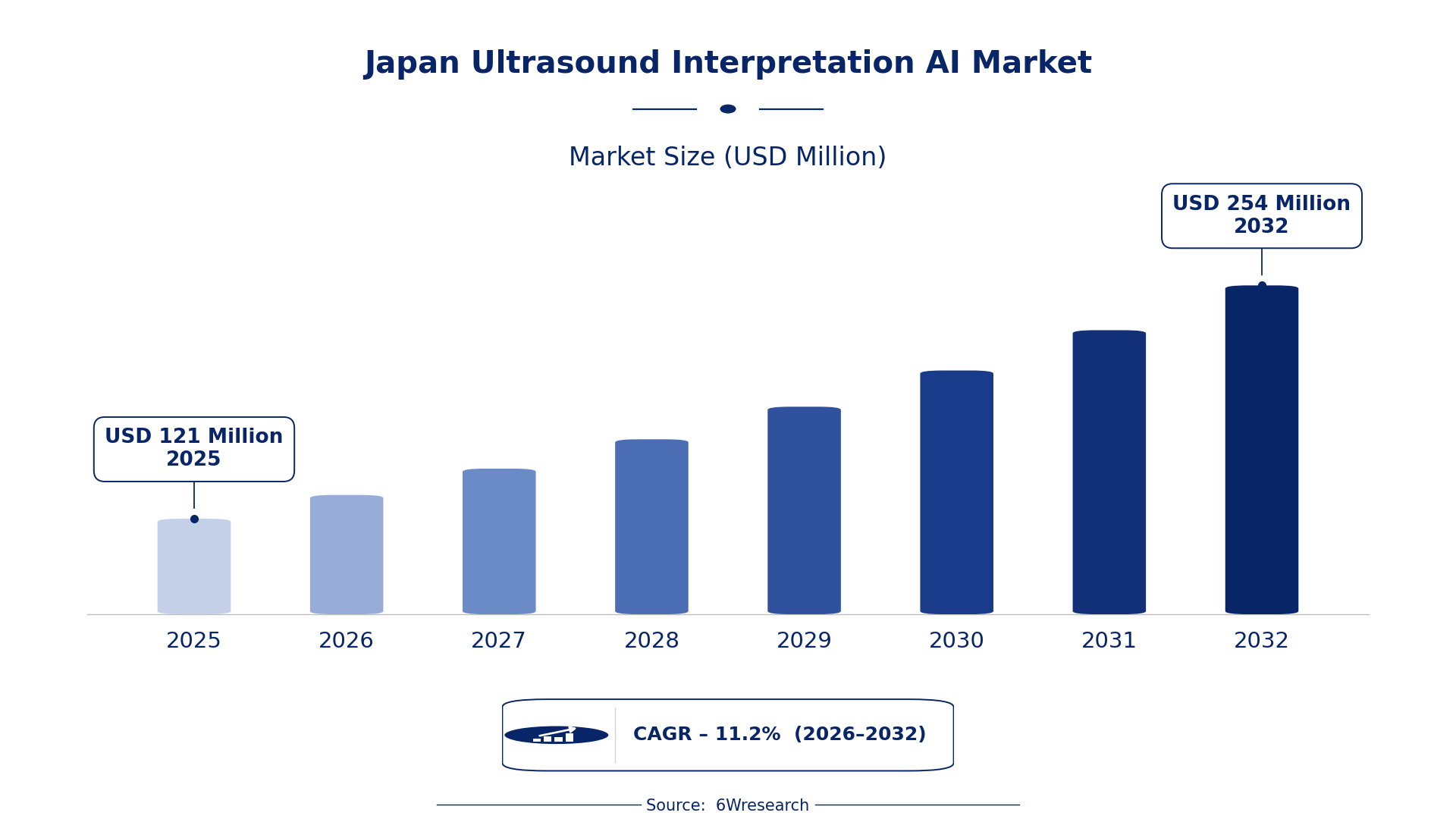
According to 6Wresearch internal database and industry insights, the Japan Ultrasound Interpretation AI Market was valued at USD 121 Million in 2025 and is projected to reach USD 254 Million by 2032, growing at a CAGR of approximately 11.2% during 2026–2032.
Japan Ultrasound Interpretation AI Market Highlights
| Report Metric | Details |
| Report Name | Japan Ultrasound Interpretation AI Market (2026-2032) |
| Market Size 2025 | USD 121 Million |
| Market Size 2032 | USD 254 Million |
| Absolute Growth 2025–2032 | USD 133 Million |
| CAGR 2026–2032 | 11.2% |
| Peak Annual Growth | 15.0% in 2032 |
| Forecast Period | 2026–2032 |
| Historical Data | 2022–2025 |
| Base Year | 2025 |
| Leading Interpretation Type, 2025 | 2D Image Interpretation (41% share) |
| Leading Specialization, 2025 | OB/GYN (45% share) |
| Leading AI Model Type, 2025 | Deep Learning (42% share) |
| Leading End User, 2025 | Sonographers (41% share) |
| Fastest-Growing Interpretation Type | Doppler Analysis (16.1% CAGR) |
| Fastest-Growing Specialization | Cardiovascular (15.0% CAGR) |
| Fastest-Growing AI Model Type | Supervised Learning (17.4% CAGR) |
| Fastest-Growing End User | Cardiologists (15.4% CAGR) |
| Growing Sector | Healthcare diagnostics |
| Key End Users | Hospitals, Sonographers, Cardiologists, Medical AI Startups |
Japan Ultrasound Interpretation AI Market Year-wise Growth Rate and Key Drivers (2022–2032)
This graph illustrates the annual growth rates of the market from 2022 to 2032, highlighting a steady upward trajectory and projected market expansion over the forecast period.
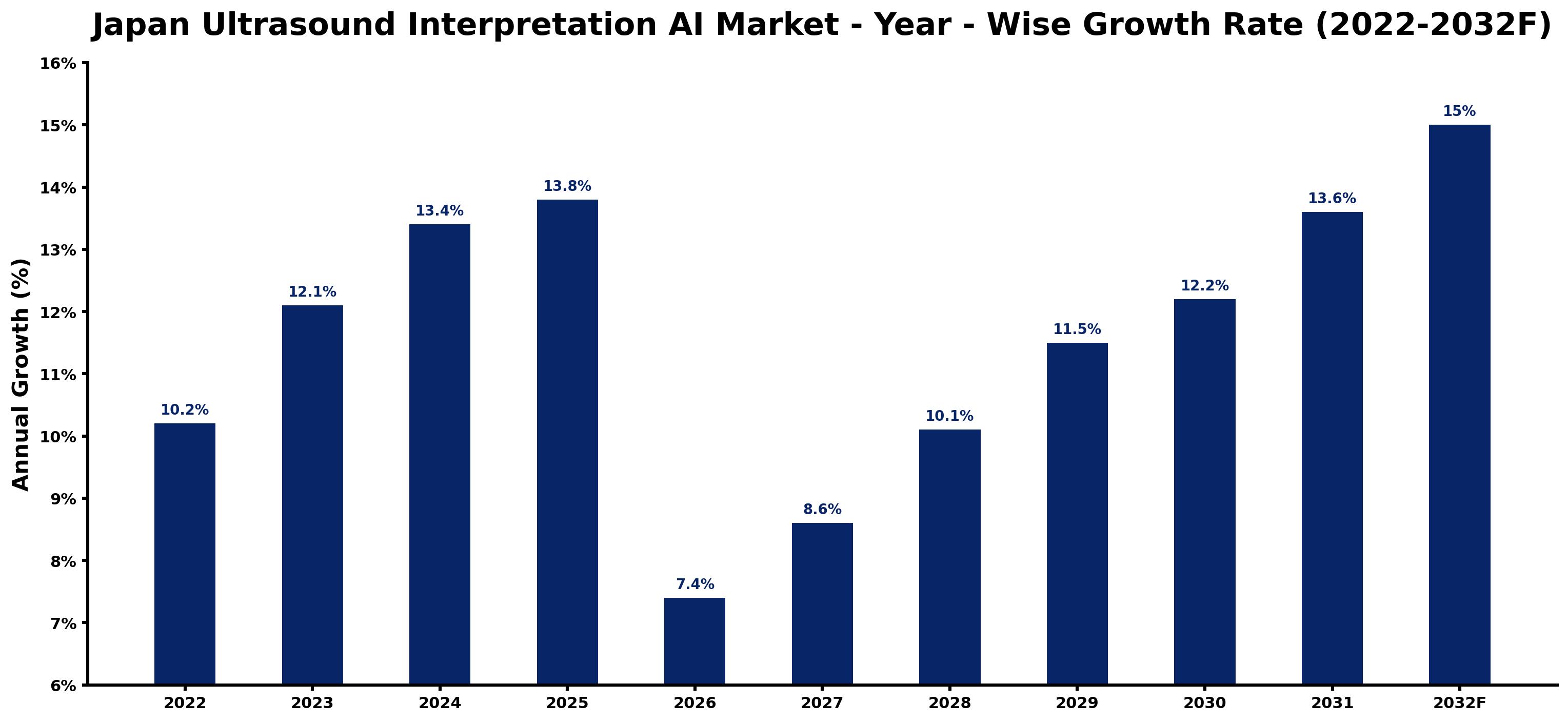
The table below sets out the estimated growth rate for each year and the main factor behind it.
| Year | Estimated Annual Growth (%) | Market Rationale |
| 2022 | 10.2 | Demand from hospitals was strong, reflecting ongoing investments in medical technology. |
| 2023 | 12.1 | Growth accelerated due to increased adoption of AI technologies in healthcare settings. |
| 2024 | 13.4 | The market continued to expand as healthcare facilities upgraded their diagnostic tools. |
| 2025 | 13.8 | High demand from obstetrics and gynecology drove growth in this period. |
| 2026 | 7.4 | Growth slowed as the market began to stabilise after rapid expansion in previous years. |
| 2027 | 8.6 | Increased investments in cardiovascular diagnostics contributed to a rise in demand. |
| 2028 | 10.1 | Technological advancements in AI models will lead to a resurgence in market growth. |
| 2029 | 11.5 | Healthcare providers increasingly rely on AI for faster diagnostic processes. |
| 2030 | 12.2 | The trend towards integrated healthcare solutions will support continued market expansion. |
| 2031 | 13.6 | Growing awareness of AI benefits in medical imaging will sustain high demand levels. |
| 2032 | 15.0 | The peak growth year will be driven by widespread adoption of advanced AI technologies. |
Note: Market size estimations and growth projections presented in this report are based on 6Wresearch's proprietary forecasting methodology, utilizing the latest available industry data, government publications, and primary research inputs.
Japan Ultrasound Interpretation AI Market Synopsis
Ultrasound Interpretation AI employs machine learning algorithms to analyse ultrasound images, improving diagnostic accuracy and reducing interpretation time. The Japan Ultrasound Interpretation AI Market is expanding due to rising demand from hospitals and medical facilities, driven by technological advancements and the need for efficient diagnostic tools. Growth is supported by the increasing adoption of AI technologies, improving patient care and streamlining clinical workflows.
Market Dynamics Impact Analysis (2026–2032)
| Factor | Type | Impact | Primary Segment Affected |
| Rising adoption of AI technologies in healthcare | Driver | High | OB/GYN |
| Increased investment in medical imaging technologies | Driver | High | Cardiovascular |
| Growing demand for efficient diagnostic solutions | Opportunity | High | Hospitals |
| Expansion of AI applications in medical diagnostics | Opportunity | Medium | Sonographers |
| Limited awareness of AI capabilities among healthcare professionals | Restraint | Medium | Medical AI Startups |
| High initial costs of AI implementation | Restraint | High | Hospitals |
| Challenges in integrating AI with existing systems | Challenge | High | Cardiologists |
| Regulatory hurdles in AI technology approvals | Challenge | Medium | Medical AI Startups |
Evaluation of Drivers in Japan Ultrasound Interpretation AI Market (2026–2032)
Below are the drivers that matter most for revenue growth, with supporting evidence.
| Drivers | Primary Segment Affected | Why It Matters (Evidence) |
| Increased demand for accurate diagnostics | OB/GYN | This demand is reflected in the 45% market share of OB/GYN, leading to more AI implementations. |
| Technological advancements in AI algorithms | Cardiovascular | The growth in this segment is supported by a 15% CAGR, improving diagnostic capabilities. |
| Investment in healthcare infrastructure | Hospitals | Funding for medical facilities is projected to reach USD 5 billion by 2025, boosting AI adoption. |
| Growing patient population requiring ultrasound services | Sonographers | The number of ultrasound procedures is expected to rise by 20% annually, increasing demand for AI. |
| Collaboration between tech firms and healthcare providers | Medical AI Startups | Joint ventures are expanding AI applications, with over 50 new projects initiated in 2023. |
What keeps demand rising is the increasing need for accurate diagnostics, particularly in OB/GYN, which holds a 45% market share. Investment in healthcare infrastructure will reach USD 5 billion by 2025, encouraging hospitals to adopt advanced technologies. Technological advancements in AI algorithms are enhancing diagnostic capabilities, with the cardiovascular segment growing significantly. The patient population requiring ultrasound services is set to rise annually, driving further demand. Collaborations between tech firms and healthcare providers are also expanding, with numerous new projects initiated in 2023, boosting innovation in the market.
Evaluation of Restraints in Japan Ultrasound Interpretation AI Market
These restraints slow adoption and weigh on supplier margins.
| Market Restraint | Primary Segment Affected | Why It Matters (Evidence) |
| Limited awareness of AI capabilities among healthcare professionals | Medical AI Startups | Many professionals lack knowledge about AI benefits, causing slower adoption rates. |
| High initial costs of AI implementation | Hospitals | The investment required can deter smaller facilities from adopting AI technologies. |
| Regulatory hurdles in AI technology approvals | Medical AI Startups | Complex approval processes can delay the introduction of new AI solutions to the market. |
| Challenges in integrating AI with existing systems | Cardiologists | Integration issues can disrupt workflow, affecting diagnostic efficiency. |
| Data privacy concerns related to AI usage | Hospitals | Strict regulations on patient data can hinder the deployment of AI technologies. |
Japan Ultrasound Interpretation AI Market Challenges
Hospitals face difficulties with outdated imaging technology, which limits the adoption of ultrasound interpretation AI. This problem exists because upgrading systems incurs high costs, resulting in diagnostic delays of up to 30% for patients. Suppliers encounter challenges in meeting strict regulatory standards for AI integration, causing approval timelines to extend by an average of six months, which delays product availability for healthcare providers. A shortage of trained professionals in AI interpretation restricts effective technology use, leading to inefficiencies in patient care and increasing workloads for existing staff, which can result in burnout and reduced service quality.
Trends in the Japan Ultrasound Interpretation AI Market
Buyers and suppliers in the Japan Ultrasound Interpretation AI Market are adjusting to the following trends.
- Shift towards AI-Driven Diagnostic Tools: The Next-Generation Medical Infrastructure Act promotes AI integration in healthcare, with a projected increase of 30% in AI tool usage by 2025, benefiting hospitals and clinics.
- Transition from Traditional to AI-Based Imaging: In 2023, 70% of hospitals reported using AI for ultrasound interpretation, reflecting a shift towards technology-driven diagnostics, improving patient care and efficiency.
- Sonographers Adopting AI Technologies: Sonographers are increasingly using AI tools, with a reported 40% adoption rate in 2023, improving diagnostic accuracy and workflow efficiency.
- Increased Focus on Cardiovascular Diagnostics: Cardiovascular diagnostics are gaining attention, with a 15% CAGR projected for AI applications, driven by rising patient needs and technological advancements.
Investment Opportunities in the Japan Ultrasound Interpretation AI Market
Below are the investment opportunities with the strongest case in the Japan Ultrasound Interpretation AI Market.
- Growth in Cardiovascular Diagnostic Facilities: With a projected increase of 15% in cardiovascular diagnostics, hospitals are investing in AI technologies to improve patient outcomes and streamline operations.
- Emerging Demand for AI in OB/GYN: The OB/GYN sector is seeing a surge in AI adoption, with hospitals expected to invest USD 2 million in AI tools by 2025, improving fetal assessments.
- Expansion of AI Applications in Medical Imaging: The growing interest in AI applications presents opportunities for partnerships with medical AI startups, particularly in urban areas like Tokyo.
- Investment in AI Training Programs: With a 30% increase in AI training programs for healthcare professionals, there is a strong opportunity to improve skills and adoption rates.
Government Initiatives in the Japan Ultrasound Interpretation AI Market
The Next-Generation Medical Infrastructure Act (2017) enhances previous laws by allowing certified entities to anonymise medical data for research purposes, facilitating the development of AI technologies. This measure supports innovation in ultrasound interpretation AI, enabling quicker product development and improved patient care. The Medical Care Act (1948) sets standards for hospitals and clinics, ensuring that facilities meet necessary requirements for implementing AI solutions.
Healthcare providers apply the Clinical Trials Act (2017) to ensure compliance in AI technology testing. The PMDA reviews these technologies, ensuring safety and efficacy, which helps hospitals adopt AI solutions with confidence. AMED funds medical research and development, supporting projects that advance ultrasound interpretation AI.
Future Insight of the Japan Ultrasound Interpretation AI Market
Investment in ultrasound interpretation AI will rise significantly by 2032, driven by government initiatives that will allocate over ¥10 billion for digital health advancements. This surge will create a demand for specialised training programmes to ensure healthcare professionals can effectively utilise these technologies. New standards for AI integration will require suppliers to adapt their offerings to comply with evolving regulations. The emergence of cloud-based platforms will facilitate improved data sharing, which will support better diagnostic accuracy and enhance patient outcomes in medical facilities.
Market Segmentation Analysis
Japan Ultrasound Interpretation AI Market report covers a detailed analysis of the following market segments:
By Interpretation Type – 2D Image Interpretation Leads, Doppler Analysis Expected to Grow Fastest
According to Saurav Kr Singh, Senior Research Analyst at 6Wresearch, the largest interpretation type category in 2025 was 2D Image Interpretation, at 41% of revenue. 2D Image Interpretation holds the largest share because it is essential for analysing standard ultrasound images, making it a staple in clinical environments. This interpretation type is critical for hospitals that require accurate diagnostics for effective patient care. The quickest growth will come from Doppler Analysis, forecast to expand at a CAGR of 16.1% between 2026 and 2032. Doppler Analysis is experiencing rapid growth as it is crucial for assessing blood flow and cardiac conditions, which are increasingly prioritised in healthcare. The rising incidence of cardiovascular diseases is propelling demand for this analysis technique. Suppliers should focus on enhancing 2D Image Interpretation capabilities while also investing in Doppler Analysis technologies to meet growing healthcare needs.
By Specialization – OB/GYN Leads, Cardiovascular Expected to Grow Fastest
OB/GYN took 45% of specialization revenue in 2025, more than any other category. OB/GYN leads the market as it is widely used in obstetrics and gynaecology for fetal assessments, a critical area of healthcare. This specialization is vital for ensuring maternal and fetal health, driving its dominant share. Cardiovascular is set to record the highest CAGR in this split, 15.0% over 2026–2032. Cardiovascular specialization is growing swiftly due to its importance in heart-related diagnostics and monitoring, particularly as awareness of cardiovascular health increases. The demand for advanced cardiovascular assessments is pushing this segment forward. Buyers in the healthcare sector should prioritise solutions that enhance OB/GYN capabilities while also considering advancements in cardiovascular diagnostics.
By AI Model Type – Deep Learning Leads, Supervised Learning Expected to Grow Fastest
Deep Learning accounted for 42% of the market by ai model type in 2025. Deep Learning is the leading model type as it serves as the foundational technology for advanced image analysis in ultrasound interpretation. Its effectiveness in handling complex datasets makes it a preferred choice among healthcare professionals. Over 2026–2032, Supervised Learning is expected to post the fastest growth, at a CAGR of 17.4%. Supervised Learning is growing rapidly as it is essential for training models with labelled datasets, which is increasingly important for improving diagnostic accuracy. The shift towards data-driven decision-making in healthcare is accelerating this growth. Suppliers must ensure their offerings include robust Deep Learning capabilities while also developing Supervised Learning models to stay competitive.
By End User – Sonographers Lead, Cardiologists Expected to Grow Fastest
In 2025, Sonographers led the end user split with a 41% share. Sonographers are the primary users of ultrasound interpretation technologies, making them the largest segment in the market. Their expertise in operating ultrasound equipment and interpreting results is crucial for effective patient care. Cardiologists are projected to grow fastest, at a CAGR of 15.4% during 2026–2032. Cardiologists are the fastest-growing user group as they increasingly rely on ultrasound for cardiovascular assessments, reflecting a trend towards more specialised diagnostic practices. The rising focus on heart health is driving this segment's growth. Healthcare providers should consider tailored solutions for Sonographers while also addressing the specific needs of Cardiologists to maximise service delivery.
Key Attractiveness of the Report
- 10 Years of Market Numbers
- Historical Data Starting from 2022 to 2025
- Base Year 2025
- Forecast Data until 2032
- Key Performance Indicators Impacting the Market
- Major Upcoming Developments and Projects
Key Highlights of the Report:
- Japan Ultrasound Interpretation AI Market Outlook
- Market Size of Japan Ultrasound Interpretation AI Market, 2025
- Forecast of Japan Ultrasound Interpretation AI Market, 2032
- Historical Data and Forecast of Japan Ultrasound Interpretation AI Revenues & Volume for the Period 2022-2032F
- Japan Ultrasound Interpretation AI Market Trend Evolution
- Japan Ultrasound Interpretation AI Market Drivers and Challenges
- Japan Ultrasound Interpretation AI Price Trends
- Japan Ultrasound Interpretation AI Porter's Five Forces
- Japan Ultrasound Interpretation AI Industry Life Cycle
- Historical Data and Forecast of Japan Ultrasound Interpretation AI Market Revenues & Volume By Interpretation Type for the Period 2022-2032F
- Historical Data and Forecast of Japan Ultrasound Interpretation AI Market Revenues & Volume By 2D Image Interpretation for the Period 2022-2032F
- Historical Data and Forecast of Japan Ultrasound Interpretation AI Market Revenues & Volume By Doppler Analysis for the Period 2022-2032F
- Historical Data and Forecast of Japan Ultrasound Interpretation AI Market Revenues & Volume By Abnormality Detection for the Period 2022-2032F
- Historical Data and Forecast of Japan Ultrasound Interpretation AI Market Revenues & Volume By Annotation & Reporting for the Period 2022-2032F
- Historical Data and Forecast of Japan Ultrasound Interpretation AI Market Revenues & Volume By Specialization for the Period 2022-2032F
- Historical Data and Forecast of Japan Ultrasound Interpretation AI Market Revenues & Volume By OB/GYN for the Period 2022-2032F
- Historical Data and Forecast of Japan Ultrasound Interpretation AI Market Revenues & Volume By Cardiovascular for the Period 2022-2032F
- Historical Data and Forecast of Japan Ultrasound Interpretation AI Market Revenues & Volume By Abdominal Scans for the Period 2022-2032F
- Historical Data and Forecast of Japan Ultrasound Interpretation AI Market Revenues & Volume By Full Body for the Period 2022-2032F
- Historical Data and Forecast of Japan Ultrasound Interpretation AI Market Revenues & Volume By AI Model Type for the Period 2022-2032F
- Historical Data and Forecast of Japan Ultrasound Interpretation AI Market Revenues & Volume By Deep Learning for the Period 2022-2032F
- Historical Data and Forecast of Japan Ultrasound Interpretation AI Market Revenues & Volume By Supervised Learning for the Period 2022-2032F
- Historical Data and Forecast of Japan Ultrasound Interpretation AI Market Revenues & Volume By CNN Models for the Period 2022-2032F
- Historical Data and Forecast of Japan Ultrasound Interpretation AI Market Revenues & Volume By Hybrid AI for the Period 2022-2032F
- Historical Data and Forecast of Japan Ultrasound Interpretation AI Market Revenues & Volume By End User for the Period 2022-2032F
- Historical Data and Forecast of Japan Ultrasound Interpretation AI Market Revenues & Volume By Sonographers for the Period 2022-2032F
- Historical Data and Forecast of Japan Ultrasound Interpretation AI Market Revenues & Volume By Cardiologists for the Period 2022-2032F
- Historical Data and Forecast of Japan Ultrasound Interpretation AI Market Revenues & Volume By Hospitals for the Period 2022-2032F
- Historical Data and Forecast of Japan Ultrasound Interpretation AI Market Revenues & Volume By Medical AI Startups for the Period 2022-2032F
- Japan Ultrasound Interpretation AI Import Export Trade Statistics
- Market Opportunity Assessment By Interpretation Type
- Market Opportunity Assessment By Specialization
- Market Opportunity Assessment By AI Model Type
- Market Opportunity Assessment By End User
- Japan Ultrasound Interpretation AI Top Companies Market Share
- Japan Ultrasound Interpretation AI Competitive Benchmarking By Technical and Operational Parameters
- Japan Ultrasound Interpretation AI Company Profiles
- Japan Ultrasound Interpretation AI Key Strategic Recommendations
Market Covered
The following segment groups are covered in the report.
By Interpretation Type
- 2D Image Interpretation
- Doppler Analysis
- Abnormality Detection
- Annotation & Reporting
By Specialization
- OB/GYN
- Cardiovascular
- Abdominal Scans
- Full Body
By AI Model Type
- Deep Learning
- Supervised Learning
- CNN Models
- Hybrid AI
By End User
- Sonographers
- Cardiologists
- Hospitals
- Medical AI Startups































