Japan Underground Waste Collection Systems Market Size & Growth Rate
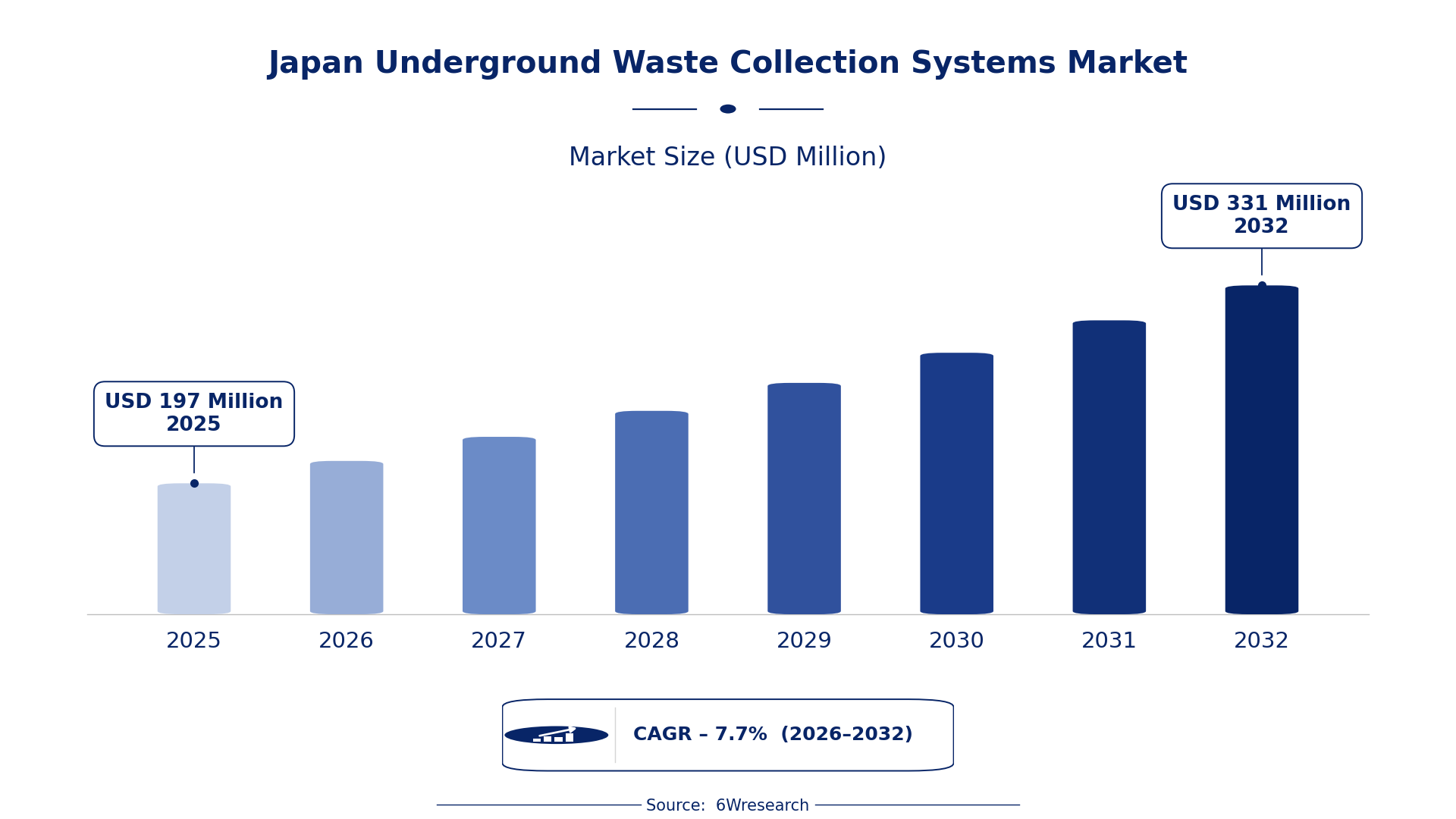
According to 6Wresearch internal database and industry insights, the Japan Underground Waste Collection Systems Market was valued at USD 197 Million in 2025 and is projected to reach USD 331 Million by 2032, growing at a CAGR of approximately 7.7% during 2026–2032.
Japan Underground Waste Collection Systems Market Highlights
| Report Metric | Details |
| Report Name | Japan Underground Waste Collection Systems Market (2026-2032) |
| Market Size 2025 | USD 197 Million |
| Market Size 2032 | USD 331 Million |
| Absolute Growth 2025–2032 | USD 134 Million |
| CAGR 2026–2032 | 7.7% |
| Peak Annual Growth | 8.8% in 2031 |
| Forecast Period | 2026–2032 |
| Historical Data | 2022–2025 |
| Base Year | 2025 |
| Leading System Type, 2025 | Pneumatic Collection (47% share) |
| Leading Waste Type, 2025 | Household Waste (47% share) |
| Leading Installation Site, 2025 | Urban Areas (44% share) |
| Leading End User, 2025 | City Municipalities (41% share) |
| Fastest-Growing System Type | Gravity-Based Systems (11.2% CAGR) |
| Fastest-Growing Waste Type | Organic/Plastic (11.3% CAGR) |
| Fastest-Growing Installation Site | Residential Projects (9.9% CAGR) |
| Fastest-Growing End User | Smart Cities (10.1% CAGR) |
| Growing Sector | Urban waste management |
| Key End Users | City Municipalities, Real Estate Developers, Facility Managers, Urban Planners |
Japan Underground Waste Collection Systems Market Year-wise Growth Rate and Key Drivers (2022–2032)
This graph illustrates the annual growth rates of the market from 2022 to 2032, highlighting a steady upward trajectory and projected market expansion over the forecast period.
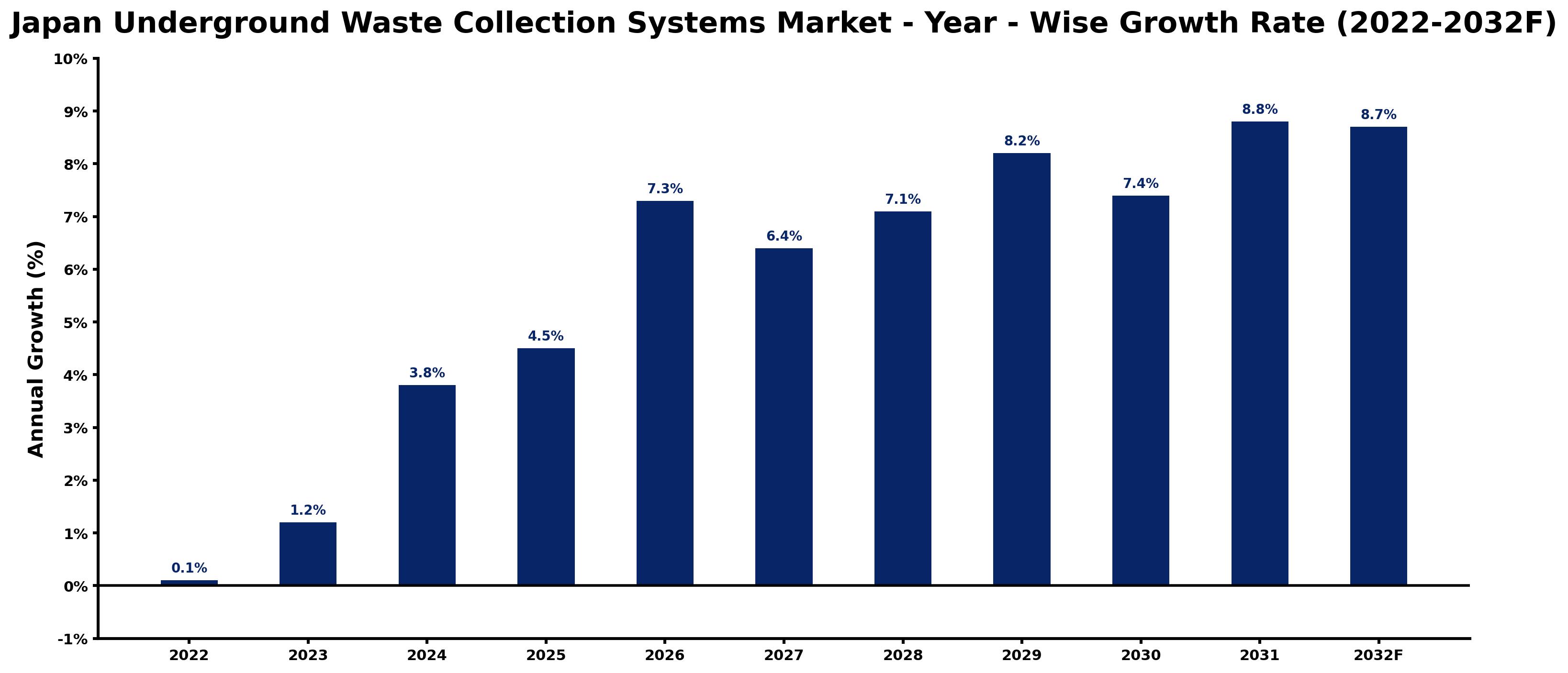
The yearly estimates that follow link every growth rate to its principal driver, so readers can see why the pace changed in each period.
| Year | Estimated Annual Growth (%) | Market Rationale |
| 2022 | 0.1 | The market showed minimal growth due to initial installations and limited awareness. |
| 2023 | 1.2 | Demand increased as municipalities began implementing more underground systems. |
| 2024 | 3.8 | Growth accelerated with the launch of new waste management initiatives. |
| 2025 | 4.5 | The market peaked historically as urban areas expanded their waste systems. |
| 2026 | 7.3 | Demand rose due to increased investments in urban waste management infrastructure. |
| 2027 | 6.4 | Growth slowed as the market began to stabilise after rapid expansion. |
| 2028 | 7.1 | Demand picked up again as more residential projects integrated underground systems. |
| 2029 | 8.2 | The market continued to grow as efficiency improvements were realised. |
| 2030 | 7.4 | Growth moderated as the market adjusted to established systems and standards. |
| 2031 | 8.8 | The market peaked again with new projects initiated across urban areas. |
| 2032 | 8.7 | Growth slowed slightly as the market approached maturity with established systems. |
Note: Market size estimations and growth projections presented in this report are based on 6Wresearch's proprietary forecasting methodology, utilizing the latest available industry data, government publications, and primary research inputs.
Japan Underground Waste Collection Systems Market Synopsis
Underground waste collection systems are advanced solutions designed for efficient waste disposal in urban settings, constructed from durable materials like steel and concrete. The Japan Underground Waste Collection Systems Market is expanding as municipalities and real estate developers invest in these systems to improve waste management efficiency. The Tokyo Metropolitan Government's 2023 waste management plan and the integration of systems in new residential projects are driving demand, while the high population density in cities like Tokyo contributes to increased waste generation.
Market Dynamics Impact Analysis (2026–2032)
| Factor | Type | Impact | Primary Segment Affected |
| Growing urban population driving demand for efficient waste disposal solutions. | Driver | High | Pneumatic Collection |
| Increased investments in smart city initiatives enhancing waste management systems. | Driver | High | Gravity-Based Systems |
| Expansion of urban areas necessitating improved waste management infrastructure. | Opportunity | High | Urban Areas |
| Rising consumer awareness about sustainable waste management practices. | Opportunity | Medium | Residential Projects |
| High initial installation costs may deter some municipalities from adopting systems. | Restraint | High | Pneumatic Collection |
| Limited awareness of benefits among smaller municipalities restricts market growth. | Restraint | Medium | Gravity-Based Systems |
| Compliance with stringent waste management regulations can increase operational costs. | Challenge | High | City Municipalities |
| Capacity constraints in existing infrastructure may limit expansion opportunities. | Challenge | Medium | Urban Areas |
Evaluation of Drivers in Japan Underground Waste Collection Systems Market (2026–2032)
The following drivers explain most of the expected growth.
| Drivers | Primary Segment Affected | Why It Matters (Evidence) |
| Urban population growth increases waste generation, driving demand for underground systems. | Pneumatic Collection | Tokyo's population of approximately 14 million creates substantial waste management needs. |
| Government initiatives support the adoption of advanced waste management systems. | Gravity-Based Systems | The Tokyo Metropolitan Government promotes underground waste systems under its 2023 waste management plan. |
| Rising investments in residential projects incorporate underground waste systems. | Residential Projects | In 2023, 50% of new residential projects in urban areas included plans for these systems. |
| Technological advancements improve the efficiency of waste collection systems. | Hybrid Underground Bins | Osaka has implemented hybrid underground bins in 15 new residential projects since 2022. |
| Increased recycling rates drive demand for efficient waste management solutions. | Household Waste | The city of Kobe reported a 15% increase in recycling rates due to improved waste collection. |
The strongest pull on demand comes from urban population growth, particularly in Tokyo, which generates around 1.0 kg of household waste per person daily. Investments in residential projects are rising, with 50% of new developments incorporating these systems. Technological advancements, including hybrid underground bins, improve collection efficiency, as seen in recent projects in Osaka. Cities like Kobe are experiencing improved recycling rates, driving demand for efficient waste management solutions.
Evaluation of Restraints in Japan Underground Waste Collection Systems Market
Several factors work against faster growth; the main ones are summarised below.
| Market Restraint | Primary Segment Affected | Why It Matters (Evidence) |
| High initial costs associated with installation can deter municipalities from adopting systems. | Pneumatic Collection | The average installation cost for underground systems can be substantial, limiting uptake. |
| Limited awareness of the benefits of underground systems among smaller municipalities restricts growth. | Gravity-Based Systems | Many smaller urban areas lack information on the advantages of these systems. |
| Compliance with stringent waste management regulations can increase operational costs for municipalities. | City Municipalities | The Waste Management and Public Cleansing Law imposes strict compliance requirements. |
| Existing infrastructure capacity may limit the expansion of underground waste systems in urban areas. | Urban Areas | Many cities face challenges in upgrading their waste management infrastructure. |
| Market fragmentation due to various waste management practices complicates standardisation. | Residential Projects | Diverse practices across municipalities hinder the implementation of uniform systems. |
Japan Underground Waste Collection Systems Market Challenges
High demand for underground collection systems in urban settings creates supply chain pressures, delaying project timelines for municipalities by up to six months. Regulatory complexities hinder the swift implementation of these systems, with 60% of urban municipalities experiencing compliance challenges that can extend timelines significantly. A lack of qualified engineers in waste management leads to increased labour costs for producers, rising by around 15%. Technological constraints in existing infrastructure limit the adoption of advanced solutions, resulting in collection inefficiencies that can decrease operational effectiveness by as much as 30% for local authorities.
Trends in the Japan Underground Waste Collection Systems Market
Four trends stand out in the Japan Underground Waste Collection Systems Market.
- Shift towards Smart City Initiatives in Tokyo: Tokyo is increasingly integrating underground waste collection systems into its smart city initiatives, improving urban waste management efficiency. In 2023, the Tokyo Metropolitan Government allocated ¥5 billion for infrastructure improvements, signalling a commitment to modernising waste systems.
- Growing Adoption of Hybrid Underground Bins: Osaka has seen a rise in the use of hybrid underground bins, with 15 new residential projects incorporating these systems since 2022. This trend reflects a shift towards more efficient waste collection methods, improving overall urban waste management.
- Increased Recycling Rates in Kobe: Kobe has reported a 15% increase in recycling rates due to the implementation of improved waste collection systems. This trend highlights the effectiveness of advanced waste management solutions in promoting recycling and sustainability.
- Expansion of Underground Systems in Yokohama: Yokohama has integrated underground waste systems in 10 commercial complexes since 2021, showcasing a growing trend towards efficient waste disposal methods in urban commercial settings. This reflects the city's commitment to improving waste management.
Investment Opportunities in the Japan Underground Waste Collection Systems Market
The following areas offer the clearest openings for investors and suppliers in the Japan Underground Waste Collection Systems Market.
- Investment Gap in Waste Management Infrastructure: With the government allocating ¥5 billion for waste management improvements, there is an opportunity for investment in advanced waste collection systems. City municipalities are actively seeking solutions to enhance their infrastructure.
- Urban Areas as Key Installation Sites: Urban areas are prime locations for underground waste systems, with a 44% share in 2025. Collaborating with local municipalities can facilitate entry into this growing market segment.
- Partnerships for Residential Projects: Now is an opportune time to invest in residential projects, with 50% of new developments incorporating underground systems. Forming joint ventures with real estate developers can enhance market access.
- Rising Demand for Sustainable Solutions: The increasing focus on sustainability creates opportunities for innovative waste management solutions. Engaging with city municipalities can help suppliers meet the growing demand for efficient waste systems.
Government Initiatives in the Japan Underground Waste Collection Systems Market
The Waste Management and Public Cleansing Act regulates waste treatment and disposal, ensuring compliance with environmental standards. The 2023 amendments introduced by the Ministry of the Environment reinforce these regulations, adding stricter guidelines for underground waste collection systems, which must now meet enhanced performance criteria.
City municipalities benefit from the Ministry of the Environment's funding for waste management infrastructure improvements. In 2023, the ministry allocated ¥5 billion to support projects that improve urban waste collection efficiency, enabling municipalities to upgrade their systems and improve service delivery.
Future Insight of the Japan Underground Waste Collection Systems Market
The investment pipeline for underground collection systems will expand, driven by government initiatives and urban demand for efficient solutions. By 2032, municipalities will increasingly adopt standards like JIS Z 8901, enhancing system reliability. Smart technologies will streamline operations, leading to quicker waste processing and improved efficiency. The integration of underground systems in new residential developments will become standard, with cities reporting a 30% increase in collection efficiency as these systems gain traction.
Market Segmentation Analysis
Japan Underground Waste Collection Systems Market report covers a detailed analysis of the following market segments:
By System Type – Pneumatic Collection Leads, Gravity-Based Systems Expected to Grow Fastest
According to Saurav Kr Singh, Senior Research Analyst at 6Wresearch, Pneumatic Collection accounted for 47% of the market by system type in 2025. Pneumatic collection systems hold the largest share due to their effectiveness in urban settings, particularly in Tokyo where over 200 systems are operational. Their ability to transport waste efficiently without disrupting surface activities appeals to municipalities and residents alike. Gravity-Based Systems are set to record the highest CAGR in this split, 11.2% over 2026–2032. Gravity-based systems are rapidly gaining traction as municipalities seek affordable solutions for various waste types, with many new residential projects adopting these systems. Their straightforward design and minimal maintenance make them increasingly popular among urban planners aiming to improve waste management. Suppliers should prioritise the development of gravity-based systems to meet the rising demand in urban environments.
By Waste Type – Household Waste Leads, Organic/Plastic Expected to Grow Fastest
In 2025, Household Waste led the waste type split with a 47% share. Household waste is the leading segment as it constitutes a large portion of urban waste collection, driven by Japan's high population density and an average daily waste generation of around 1.0 kg per person. This consistent source ensures that systems tailored for households remain in high demand. Organic/Plastic is projected to grow fastest, at a CAGR of 11.3% during 2026–2032. The organic and plastic waste segment is experiencing rapid growth due to heightened awareness and regulations regarding recycling, with municipalities actively promoting specialised collection. This trend aligns with a broader movement towards sustainability and efficient waste management practices. Buyers should focus on systems that effectively manage organic and plastic waste to comply with environmental standards.
By Installation Site – Urban Areas Lead, Residential Projects Expected to Grow Fastest
The largest installation site category in 2025 was Urban Areas, at 44% of revenue. Urban areas hold the largest share as they are the primary installation sites for underground waste systems, necessitated by high population density and the urgency for effective waste management solutions. The Tokyo Metropolitan Government's initiatives further highlight the critical role of these locations in achieving efficient waste collection. The quickest growth will come from Residential Projects, forecast to expand at a CAGR of 9.9% between 2026 and 2032. Residential projects are experiencing rapid growth as new developments increasingly incorporate underground waste systems to improve waste management efficiency. This trend is supported by government incentives aimed at promoting sustainable urban living and enhancing community waste practices. Suppliers should focus on partnerships with residential developers to leverage this growing segment.
By End User – City Municipalities Lead, Smart Cities Expected to Grow Fastest
With 41% of end user revenue in 2025, City Municipalities was the largest category. City municipalities are the main users of underground waste collection systems, as they are responsible for public waste management services in densely populated areas. Their commitment to improving waste collection efficiency aligns with national standards and initiatives. Over 2026–2032, Smart Cities are expected to post the fastest growth, at a CAGR of 10.1%. Smart cities are rapidly adopting these systems as part of their infrastructure, aligning with modern urban planning and sustainability goals. This trend is expected to accelerate as cities strive for smarter waste management solutions. Suppliers should focus on partnerships with smart city initiatives to expand their market reach.
Key Attractiveness of the Report
- 10 Years of Market Numbers
- Historical Data Starting from 2022 to 2025
- Base Year 2025
- Forecast Data until 2032
- Key Performance Indicators Impacting the Market
- Major Upcoming Developments and Projects
Key Highlights of the Report:
- Japan Underground Waste Collection Systems Market Outlook
- Market Size of Japan Underground Waste Collection Systems Market, 2025
- Forecast of Japan Underground Waste Collection Systems Market, 2032
- Historical Data and Forecast of Japan Underground Waste Collection Systems Revenues & Volume for the Period 2022-2032F
- Japan Underground Waste Collection Systems Market Trend Evolution
- Japan Underground Waste Collection Systems Market Drivers and Challenges
- Japan Underground Waste Collection Systems Price Trends
- Japan Underground Waste Collection Systems Porter's Five Forces
- Japan Underground Waste Collection Systems Industry Life Cycle
- Historical Data and Forecast of Japan Underground Waste Collection Systems Market Revenues & Volume By System Type for the Period 2022-2032F
- Historical Data and Forecast of Japan Underground Waste Collection Systems Market Revenues & Volume By Pneumatic Collection for the Period 2022-2032F
- Historical Data and Forecast of Japan Underground Waste Collection Systems Market Revenues & Volume By Gravity-Based Systems for the Period 2022-2032F
- Historical Data and Forecast of Japan Underground Waste Collection Systems Market Revenues & Volume By Hybrid Underground Bins for the Period 2022-2032F
- Historical Data and Forecast of Japan Underground Waste Collection Systems Market Revenues & Volume By Industrial Systems for the Period 2022-2032F
- Historical Data and Forecast of Japan Underground Waste Collection Systems Market Revenues & Volume By Waste Type for the Period 2022-2032F
- Historical Data and Forecast of Japan Underground Waste Collection Systems Market Revenues & Volume By Household Waste for the Period 2022-2032F
- Historical Data and Forecast of Japan Underground Waste Collection Systems Market Revenues & Volume By Mixed Waste for the Period 2022-2032F
- Historical Data and Forecast of Japan Underground Waste Collection Systems Market Revenues & Volume By Organic/Plastic for the Period 2022-2032F
- Historical Data and Forecast of Japan Underground Waste Collection Systems Market Revenues & Volume By Bulk Waste for the Period 2022-2032F
- Historical Data and Forecast of Japan Underground Waste Collection Systems Market Revenues & Volume By Installation Site for the Period 2022-2032F
- Historical Data and Forecast of Japan Underground Waste Collection Systems Market Revenues & Volume By Urban Areas for the Period 2022-2032F
- Historical Data and Forecast of Japan Underground Waste Collection Systems Market Revenues & Volume By Commercial Complexes for the Period 2022-2032F
- Historical Data and Forecast of Japan Underground Waste Collection Systems Market Revenues & Volume By Residential Projects for the Period 2022-2032F
- Historical Data and Forecast of Japan Underground Waste Collection Systems Market Revenues & Volume By Manufacturing Zones for the Period 2022-2032F
- Historical Data and Forecast of Japan Underground Waste Collection Systems Market Revenues & Volume By End User for the Period 2022-2032F
- Historical Data and Forecast of Japan Underground Waste Collection Systems Market Revenues & Volume By Smart Cities for the Period 2022-2032F
- Historical Data and Forecast of Japan Underground Waste Collection Systems Market Revenues & Volume By City Municipalities for the Period 2022-2032F
- Historical Data and Forecast of Japan Underground Waste Collection Systems Market Revenues & Volume By Real Estate Builders for the Period 2022-2032F
- Historical Data and Forecast of Japan Underground Waste Collection Systems Market Revenues & Volume By Facility Managers for the Period 2022-2032F
- Japan Underground Waste Collection Systems Import Export Trade Statistics
- Market Opportunity Assessment By System Type
- Market Opportunity Assessment By Waste Type
- Market Opportunity Assessment By Installation Site
- Market Opportunity Assessment By End User
- Japan Underground Waste Collection Systems Top Companies Market Share
- Japan Underground Waste Collection Systems Competitive Benchmarking By Technical and Operational Parameters
- Japan Underground Waste Collection Systems Company Profiles
- Japan Underground Waste Collection Systems Key Strategic Recommendations
Market Covered
The report covers the following segments.
By System Type
- Pneumatic Collection
- Gravity-Based Systems
- Hybrid Underground Bins
- Industrial Systems
By Waste Type
- Household Waste
- Mixed Waste
- Organic/Plastic
- Bulk Waste
By Installation Site
- Urban Areas
- Commercial Complexes
- Residential Projects
- Manufacturing Zones
By End User
- Smart Cities
- City Municipalities
- Real Estate Builders
- Facility Managers































