Japan Underhood Module Market Size & Growth Rate
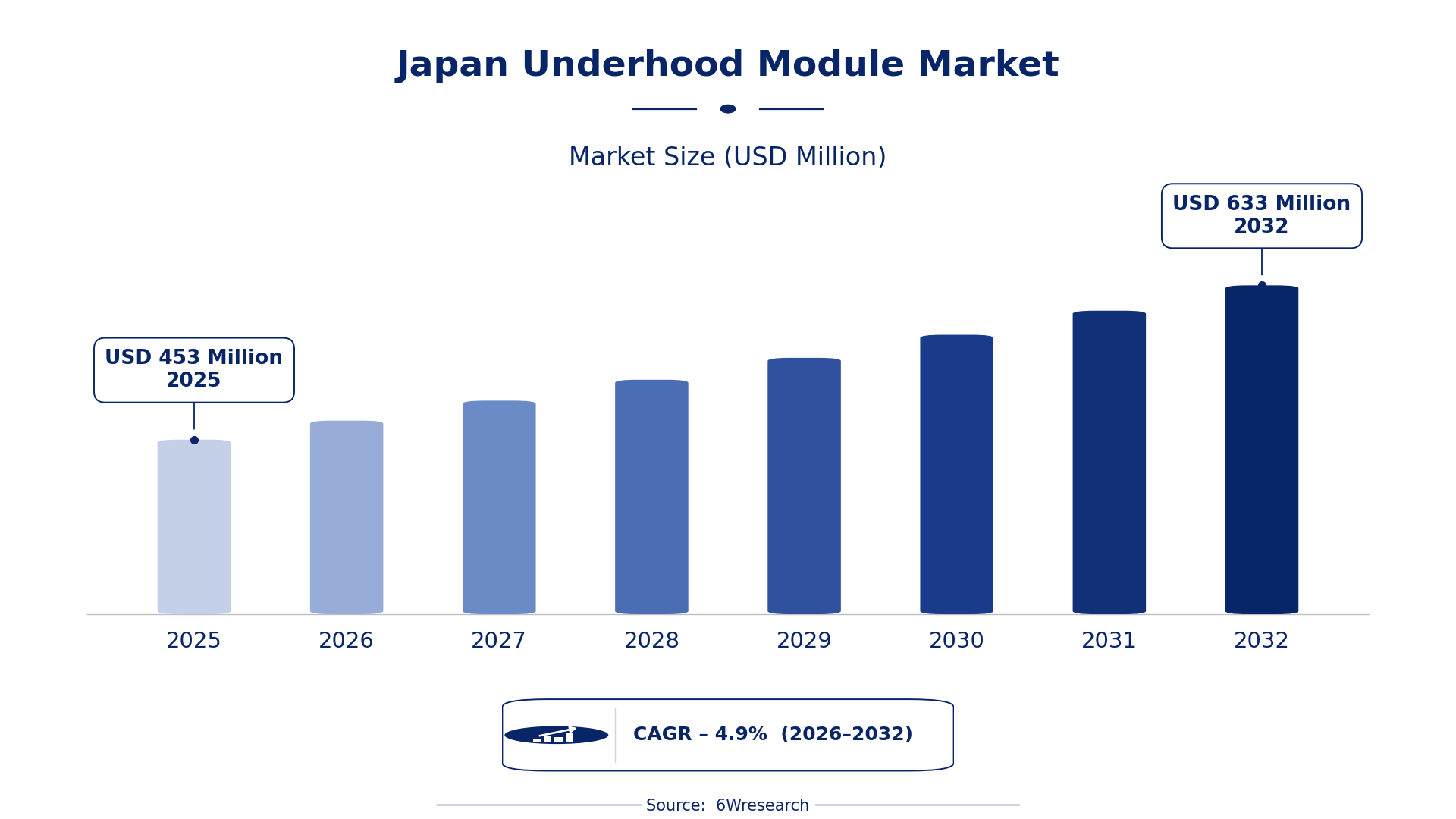
According to 6Wresearch internal database and industry insights, the Japan Underhood Module Market was valued at USD 453 Million in 2025 and is projected to reach USD 633 Million by 2032, growing at a CAGR of approximately 4.9% during 2026–2032.
Japan Underhood Module Market Highlights
| Report Metric | Details |
| Report Name | Japan Underhood Module Market (2026-2032) |
| Market Size 2025 | USD 453 Million |
| Market Size 2032 | USD 633 Million |
| Absolute Growth 2025–2032 | USD 180 Million |
| CAGR 2026–2032 | 4.9% |
| Peak Annual Growth | 5.9% in 2032 |
| Forecast Period | 2026–2032 |
| Historical Data | 2022–2025 |
| Base Year | 2025 |
| Leading Module Type, 2025 | Powertrain Modules (33% share) |
| Leading Integration Area, 2025 | Engine Bay (44% share) |
| Leading Vehicle Type, 2025 | Passenger Vehicles (39% share) |
| Leading End User, 2025 | OEMs (39% share) |
| Fastest-Growing Module Type | Battery Support Modules (6.9% CAGR) |
| Fastest-Growing Integration Area | EV Underhood (6.3% CAGR) |
| Fastest-Growing Vehicle Type | Electric Vehicles (7.3% CAGR) |
| Fastest-Growing End User | EV Manufacturers (6.6% CAGR) |
| Growing Sector | EV Manufacturers |
| Key End Users | OEMs, Tier 1 Suppliers, Luxury Car Makers, EV Manufacturers |
Japan Underhood Module Market Year-wise Growth Rate and Key Drivers (2022–2032)
This graph illustrates the annual growth rates of the market from 2022 to 2032, highlighting a steady upward trajectory and projected market expansion over the forecast period.
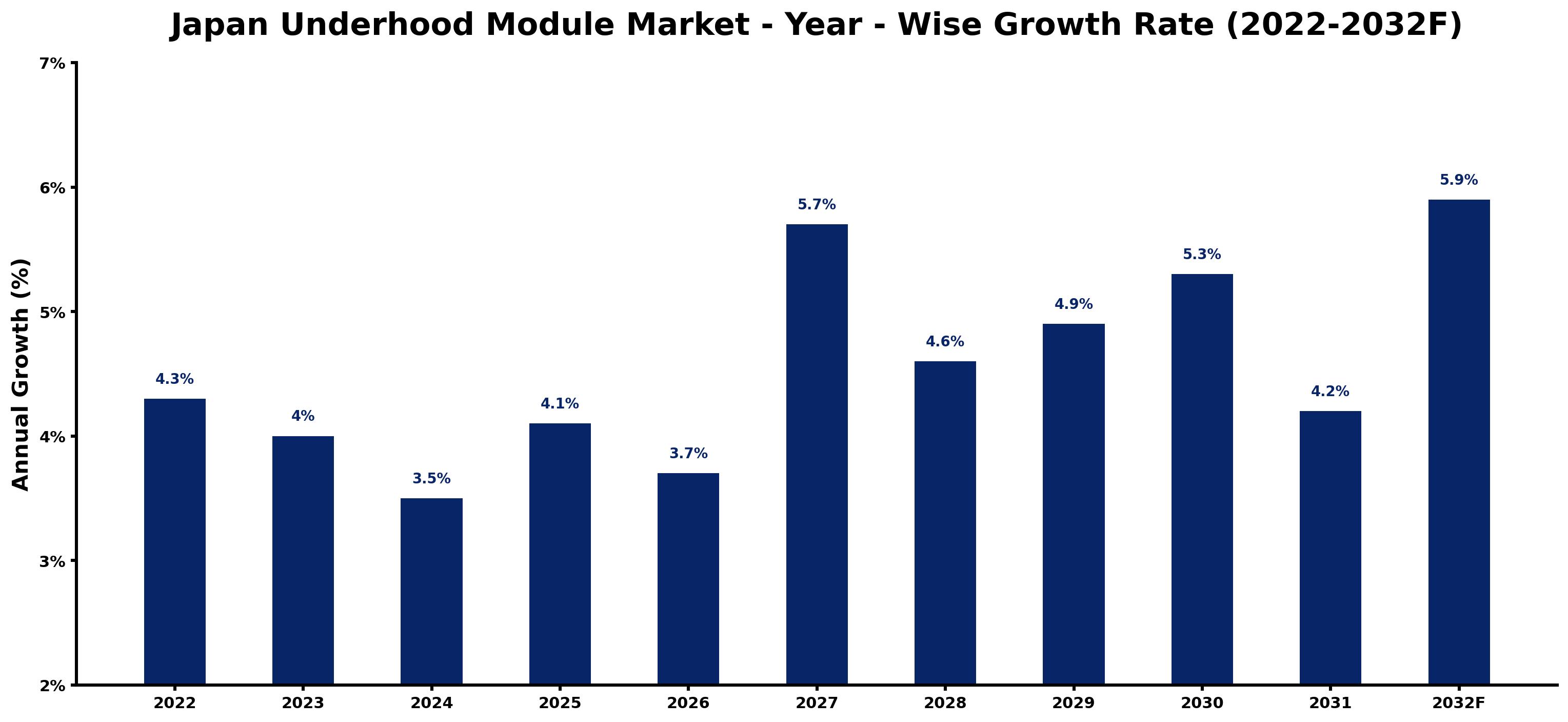
Annual growth estimates for each year appear below with the principal reason behind them, explaining the shifts that set the pace of the market.
| Year | Estimated Annual Growth (%) | Market Rationale |
| 2022 | 4.3 | The market experienced strong demand due to high vehicle production levels. |
| 2023 | 4.0 | Growth slowed slightly as the market adjusted to previous highs in production. |
| 2024 | 3.5 | Demand continued to decrease as the market stabilised after earlier fluctuations. |
| 2025 | 4.1 | Growth accelerated again as production ramped up for electric vehicles. |
| 2026 | 3.7 | Manufacturers are likely to face supply chain challenges, impacting growth. |
| 2027 | 5.7 | Increased demand for electric vehicles will spur growth in underhood modules. |
| 2028 | 4.6 | Growth is projected to slow as the market adjusts to new production capacities. |
| 2029 | 4.9 | Demand will rise again as automotive innovation continues to drive purchases. |
| 2030 | 5.3 | The market is expected to expand with further investments in electric vehicle technology. |
| 2031 | 4.2 | Growth will slow slightly as the market matures and competition intensifies. |
| 2032 | 5.9 | The market is projected to peak with a surge in electric vehicle production and sales. |
Note: Market size estimations and growth projections presented in this report are based on 6Wresearch's proprietary forecasting methodology, utilizing the latest available industry data, government publications, and primary research inputs.
Japan Underhood Module Market Synopsis
Underhood Modules are composite assemblies that integrate critical components like powertrain and cooling systems in vehicles. They support engine components and manage thermal systems effectively. The Japan Underhood Module Market is growing, driven by vehicle production, particularly electric vehicles, with 25% of new sales being electric as of 2023. The automotive sector employs over 5 million people, reflecting strong demand for automotive components, supported by government initiatives aimed at technological advancements.
Market Dynamics Impact Analysis (2026–2032)
| Factor | Type | Impact | Primary Segment Affected |
| High vehicle production rates drive demand for underhood modules. | Driver | High | Powertrain Modules |
| The shift towards electric vehicles increases the need for battery support modules. | Driver | High | Battery Support Modules |
| Growing electric vehicle market creates opportunities for new suppliers. | Opportunity | High | Electric Vehicles |
| Investment in EV infrastructure offers potential for module manufacturers. | Opportunity | Medium | EV Underhood |
| Strict regulations on emissions can limit production flexibility. | Restraint | High | Cooling Modules |
| High competition among suppliers may drive down prices. | Restraint | Medium | Powertrain Modules |
| High costs of compliance with safety standards can burden manufacturers. | Challenge | High | Battery Support Modules |
| Supply chain disruptions can delay production timelines. | Challenge | Medium | OEMs |
Evaluation of Drivers in Japan Underhood Module Market (2026–2032)
Demand rests on the following drivers, each shown with the segment it touches most.
| Drivers | Primary Segment Affected | Why It Matters (Evidence) |
| Increased vehicle production in Japan drives demand for underhood modules. | Powertrain Modules | Japan produced 8.3 million vehicles in 2022, leading to module demand. |
| The rise of electric vehicles necessitates advanced battery support modules. | Battery Support Modules | As of 2023, 25% of new vehicles sold in Japan are electric, increasing module requirements. |
| Technological advancements in automotive design encourage new module innovations. | Cooling Modules | The automotive industry contributes approximately 4% to Japan's GDP. |
| Government support for automotive innovation programs boosts demand for underhood modules. | EV Underhood | The Ministry of Economy, Trade and Industry promotes initiatives to advance automotive technology. |
| The integration of advanced materials improves module performance and durability. | Powertrain Modules | The average lifespan of underhood modules is around 10 years, promoting quality investments. |
Much of the new demand traces back to Japan's strong vehicle production, which reached 8.3 million units in 2022. This high output has led to increased requirements for underhood modules, particularly powertrain and battery support types. As electric vehicles accounted for 25% of new sales in 2023, manufacturers are investing in advanced technologies to meet this demand. The average lifespan of underhood modules is around 10 years, prompting OEMs to seek durable solutions to improve vehicle performance.
Evaluation of Restraints in Japan Underhood Module Market
The main factors holding the market back are set out below.
| Market Restraint | Primary Segment Affected | Why It Matters (Evidence) |
| Compliance with strict emissions regulations increases production costs. | Cooling Modules | Japan has strict regulations for vehicle emissions and safety standards, raising operational expenses. |
| Intense competition among suppliers may lead to price wars. | Powertrain Modules | The automotive parts market in Japan is valued at approximately 10 trillion yen, attracting numerous players. |
| High costs associated with advanced material sourcing can limit profitability. | Battery Support Modules | Investment in quality materials is essential but can impact overall costs. |
| Supply chain disruptions can hinder timely module availability. | OEMs | Disruptions in the highly integrated automotive supply chain in Japan can significantly impact production timelines. |
| Technological advancements require continuous investment, straining budgets. | EV Underhood | The need for innovation in electric vehicle components demands ongoing financial commitment. |
Japan Underhood Module Market Challenges
Many buyers encounter fierce competition in the Tokyo region, where 8.3 million vehicles were produced in 2022. This high output pressures buyers to compromise on quality, risking customer dissatisfaction. Suppliers experience skills shortages as the automotive sector employs over 5 million people, yet specialised training in advanced engineering remains insufficient. Rising raw material costs strain suppliers' profit margins, causing delays in deliveries to manufacturers. Strict emissions and safety regulations disrupt supply chains, resulting in production holdups for vehicle producers.
Trends in the Japan Underhood Module Market
Buyers and suppliers in the Japan Underhood Module Market are adjusting to the following trends.
- Shift Towards Electric Vehicle Integration: The automotive industry is increasingly focusing on integrating electric vehicle technologies into underhood modules. As of 2023, 25% of new vehicle sales are electric, prompting manufacturers to innovate their designs.
- Transition from Traditional to Advanced Materials: The use of advanced materials in underhood modules is becoming more prevalent. The average lifespan of these modules is around 10 years, encouraging investments in durable materials.
- Emergence of Multi-Function Modules: Multi-function modules are gaining traction within the automotive sector, providing versatility in design. This trend aligns with the growing demand for efficiency in vehicle manufacturing.
- Prioritisation of Thermal Management Systems: Automakers are increasingly prioritising thermal management solutions in underhood modules. The focus on electric vehicles has led to innovations in cooling systems to improve performance.
Investment Opportunities in the Japan Underhood Module Market
The following opportunities in the Japan Underhood Module Market pair current demand with a clear way in.
- Valuable Market Gap for Advanced Cooling Solutions: With the automotive parts market valued at approximately 10 trillion yen, there is a gap for advanced cooling solutions in underhood modules. OEMs are looking for effective designs to improve efficiency.
- Investment in Electric Vehicle Module Development: As 25% of new vehicles sold in Japan are electric, there is a pressing need for battery support modules. Suppliers can enter this market by collaborating with EV manufacturers.
- Focus on Lightweight Materials: The shift towards electric vehicles creates an opportunity for lightweight materials in underhood modules. Suppliers should target OEMs in the Tokyo region, where innovation is a priority.
- Expansion of Integration Capabilities: The demand for multi-function modules is increasing, creating opportunities for suppliers to innovate. Engaging with automotive research institutions can facilitate development in this area.
Government Initiatives in the Japan Underhood Module Market
The Economic Security Promotion Act (2022) supports supply-chain resilience for critical products and materials, enhancing the framework established by the Electrical Appliance and Material Safety Act (1961). This measure ensures that producers comply with safety standards while maintaining operational efficiency.
The Ministry of Economy, Trade and Industry oversees initiatives that promote innovation in the automotive sector. They fund projects aimed at advancing the production of electric vehicles, benefiting OEMs and suppliers by improving technology and infrastructure.
Future Insight of the Japan Underhood Module Market
A policy-driven shift towards carbon neutrality by 2050 will reshape vehicle design, prompting suppliers to create underhood modules with advanced thermal management systems. By 2032, 25% of new vehicles sold will be electric, leading to increased demand for efficient vehicle designs. Investment in EV infrastructure will support this transition, encouraging manufacturers to innovate. Research institutions will play a key role in advancing technology, ensuring that the automotive supply chain adapts to new standards and practices.
Market Segmentation Analysis
Japan Underhood Module Market report covers a detailed analysis of the following market segments:
By Module Type – Powertrain Modules Lead, Battery Support Modules Expected to Grow Fastest
According to Saurav Kr Singh, Senior Research Analyst at 6Wresearch, in 2025, Powertrain Modules led the module type split with a 33% share. Powertrain Modules hold the largest share as they are essential for optimising engine performance and efficiency in vehicles. The significant production of 8.3 million vehicles in Japan in 2022 highlights the ongoing demand for these critical components. Battery Support Modules are projected to grow fastest, at a CAGR of 6.9% during 2026–2032. Battery Support Modules are experiencing rapid growth due to their necessity for the functionality of electric vehicles. With 25% of new vehicles sold in Japan being electric, the demand for these modules is anticipated to rise sharply, further widening the lead of powertrain modules. Suppliers should prioritise the development of advanced powertrain and battery support modules to cater to the rising automotive demands.
By Integration Area – Engine Bay Leads, EV Underhood Expected to Grow Fastest
The largest integration area category in 2025 was Engine Bay, at 44% of revenue. The Engine Bay is the primary area for module installation, making it a focal point for underhood module integration. This area supports essential components, ensuring optimal vehicle performance and safety. Over 2026–2032, EV Underhood is expected to post the fastest growth, at a CAGR of 6.3%. EV Underhood is the fastest-growing segment as it caters specifically to the unique requirements of electric vehicle designs. With the automotive market shifting towards electrification, this area will see increased investment and innovation. Manufacturers must prioritise the development of modules tailored for the engine bay and EV underhood to capture emerging market opportunities.
By Vehicle Type – Passenger Vehicles Lead, Electric Vehicles Expected to Grow Fastest
Passenger Vehicles held 39% of the Japan Underhood Module Market by vehicle type in 2025. Passenger Vehicles account for the largest application area for underhood modules, driven by Japan's robust vehicle production capabilities. The high vehicle ownership rate of 0.6 vehicles per person further supports the sustained demand in this segment. The quickest growth will come from Electric Vehicles, forecast to expand at a CAGR of 7.3% between 2026 and 2032. Electric Vehicles are witnessing the fastest growth, propelled by the expanding EV market and rising consumer interest in sustainable transport solutions. The projected increase in electric vehicle sales indicates a transformative shift in the automotive sector, solidifying the position of passenger vehicles. Suppliers should align their production strategies with the increasing focus on passenger and electric vehicles to maintain competitiveness.
By End User – OEMs Lead, EV Manufacturers Expected to Grow Fastest
With 39% of end user revenue in 2025, OEMs was the largest category. OEMs are the primary users of underhood modules, integrating these components into their vehicle designs to ensure quality and performance. This relationship is crucial for maintaining industry standards in the competitive automotive landscape. EV Manufacturers are set to record the highest CAGR in this split, 6.6% over 2026–2032. EV Manufacturers are rapidly scaling their production to meet the surging demand for electric vehicles. The government's support for eco-friendly technologies and infrastructure development is driving this growth, which will likely enhance the influence of OEMs in the market. Suppliers need to strengthen partnerships with OEMs and EV manufacturers to ensure their products align with the evolving market requirements.
Key Attractiveness of the Report
- 10 Years of Market Numbers
- Historical Data Starting from 2022 to 2025
- Base Year 2025
- Forecast Data until 2032
- Key Performance Indicators Impacting the Market
- Major Upcoming Developments and Projects
Key Highlights of the Report:
- Japan Underhood Module Market Outlook
- Market Size of Japan Underhood Module Market, 2025
- Forecast of Japan Underhood Module Market, 2032
- Historical Data and Forecast of Japan Underhood Module Revenues & Volume for the Period 2022-2032F
- Japan Underhood Module Market Trend Evolution
- Japan Underhood Module Market Drivers and Challenges
- Japan Underhood Module Price Trends
- Japan Underhood Module Porter's Five Forces
- Japan Underhood Module Industry Life Cycle
- Historical Data and Forecast of Japan Underhood Module Market Revenues & Volume By Module Type for the Period 2022-2032F
- Historical Data and Forecast of Japan Underhood Module Market Revenues & Volume By Powertrain Modules for the Period 2022-2032F
- Historical Data and Forecast of Japan Underhood Module Market Revenues & Volume By Cooling Modules for the Period 2022-2032F
- Historical Data and Forecast of Japan Underhood Module Market Revenues & Volume By Battery Support Modules for the Period 2022-2032F
- Historical Data and Forecast of Japan Underhood Module Market Revenues & Volume By Multi-Function Modules for the Period 2022-2032F
- Historical Data and Forecast of Japan Underhood Module Market Revenues & Volume By Integration Area for the Period 2022-2032F
- Historical Data and Forecast of Japan Underhood Module Market Revenues & Volume By Engine Bay for the Period 2022-2032F
- Historical Data and Forecast of Japan Underhood Module Market Revenues & Volume By Front-End for the Period 2022-2032F
- Historical Data and Forecast of Japan Underhood Module Market Revenues & Volume By EV Underhood for the Period 2022-2032F
- Historical Data and Forecast of Japan Underhood Module Market Revenues & Volume By HVAC, Fuse, Wiring for the Period 2022-2032F
- Historical Data and Forecast of Japan Underhood Module Market Revenues & Volume By Vehicle Type for the Period 2022-2032F
- Historical Data and Forecast of Japan Underhood Module Market Revenues & Volume By Passenger Vehicles for the Period 2022-2032F
- Historical Data and Forecast of Japan Underhood Module Market Revenues & Volume By Heavy Vehicles for the Period 2022-2032F
- Historical Data and Forecast of Japan Underhood Module Market Revenues & Volume By Electric Vehicles for the Period 2022-2032F
- Historical Data and Forecast of Japan Underhood Module Market Revenues & Volume By Premium Cars for the Period 2022-2032F
- Historical Data and Forecast of Japan Underhood Module Market Revenues & Volume By End User for the Period 2022-2032F
- Historical Data and Forecast of Japan Underhood Module Market Revenues & Volume By Tier 1 Suppliers for the Period 2022-2032F
- Historical Data and Forecast of Japan Underhood Module Market Revenues & Volume By OEMs for the Period 2022-2032F
- Historical Data and Forecast of Japan Underhood Module Market Revenues & Volume By EV Manufacturers for the Period 2022-2032F
- Historical Data and Forecast of Japan Underhood Module Market Revenues & Volume By Luxury Car Makers for the Period 2022-2032F
- Japan Underhood Module Import Export Trade Statistics
- Market Opportunity Assessment By Module Type
- Market Opportunity Assessment By Integration Area
- Market Opportunity Assessment By Vehicle Type
- Market Opportunity Assessment By End User
- Japan Underhood Module Top Companies Market Share
- Japan Underhood Module Competitive Benchmarking By Technical and Operational Parameters
- Japan Underhood Module Company Profiles
- Japan Underhood Module Key Strategic Recommendations
Market Covered
Segments analysed in this report are listed below.
By Module Type
- Powertrain Modules
- Cooling Modules
- Battery Support Modules
- Multi-Function Modules
By Integration Area
- Engine Bay
- Front-End
- EV Underhood
- HVAC
- Fuse
- Wiring
By Vehicle Type
- Passenger Vehicles
- Heavy Vehicles
- Electric Vehicles
- Premium Cars
By End User
- Tier 1 Suppliers
- OEMs
- EV Manufacturers
- Luxury Car Makers































