Japan Underwater Propulsion Technology Market Size & Growth Rate
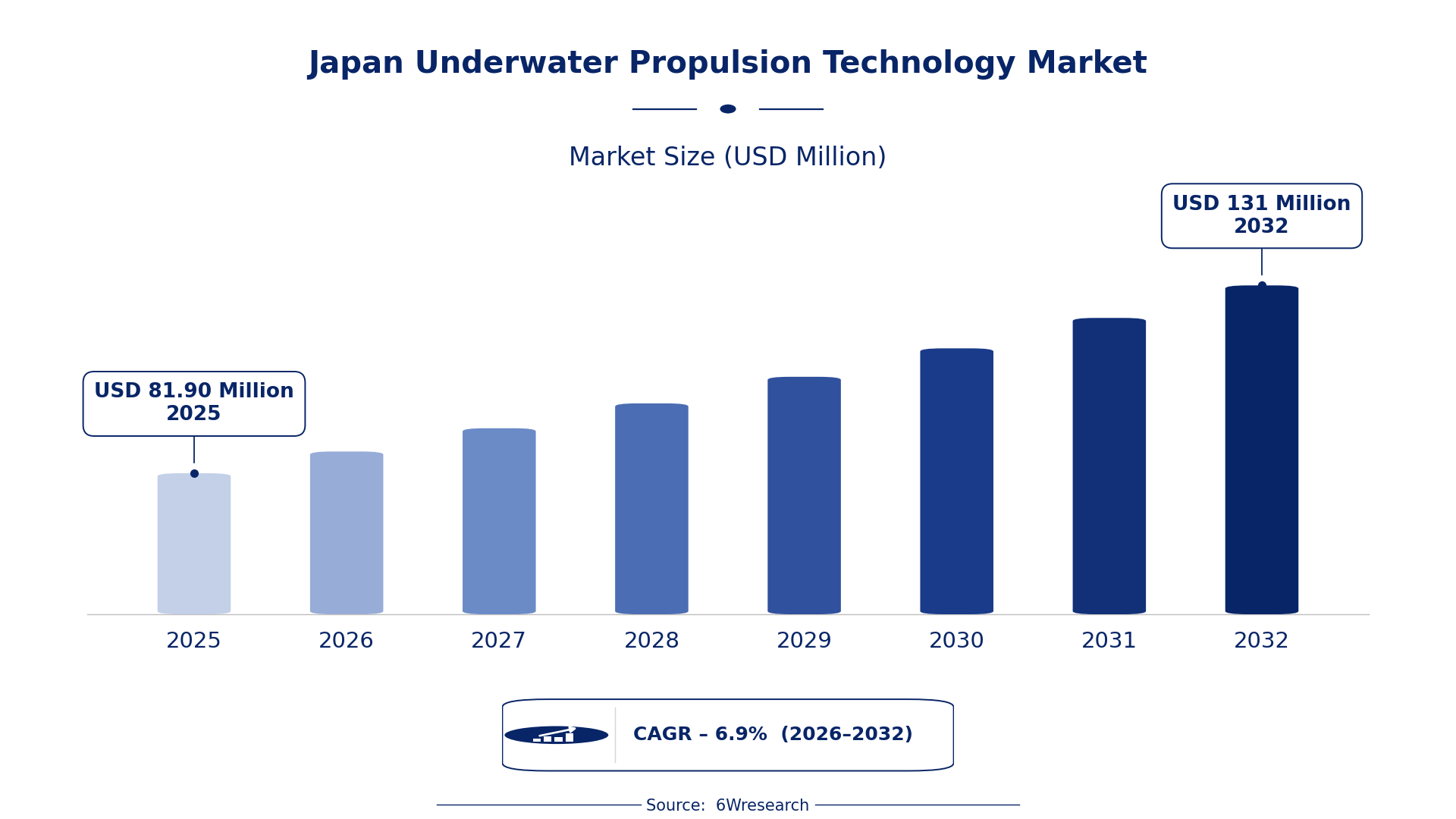
According to 6Wresearch internal database and industry insights, the Japan Underwater Propulsion Technology Market was valued at USD 81.90 Million in 2025 and is projected to reach USD 131 Million by 2032, growing at a CAGR of approximately 6.9% during 2026–2032.
Japan Underwater Propulsion Technology Market Highlights
| Report Metric | Details |
| Report Name | Japan Underwater Propulsion Technology Market (2026-2032) |
| Market Size 2025 | USD 81.90 Million |
| Market Size 2032 | USD 131 Million |
| Absolute Growth 2025–2032 | USD 49.10 Million |
| CAGR 2026–2032 | 6.9% |
| Peak Annual Growth | 7.8% in 2026 |
| Forecast Period | 2026–2032 |
| Historical Data | 2022–2025 |
| Base Year | 2025 |
| Leading Propulsion Type, 2025 | Thruster Systems (37% share) |
| Leading Power Source, 2025 | Electric (40% share) |
| Leading Application Sector, 2025 | Marine Robotics (37% share) |
| Leading End User, 2025 | Defense Navy (52% share) |
| Fastest-Growing Propulsion Type | Magnetohydrodynamic (10.0% CAGR) |
| Fastest-Growing Power Source | Battery-Powered (10.1% CAGR) |
| Fastest-Growing Application Sector | Submarines (9.2% CAGR) |
| Fastest-Growing End User | Naval Forces (8.7% CAGR) |
| Growing Sector | Submarines |
| Key End Users | Marine Robotics, Submarines, Deep Sea Vessels, Autonomous Drones |
Japan Underwater Propulsion Technology Market Year-wise Growth Rate and Key Drivers (2022–2032)
This graph illustrates the annual growth rates of the market from 2022 to 2032, highlighting a steady upward trajectory and projected market expansion over the forecast period.
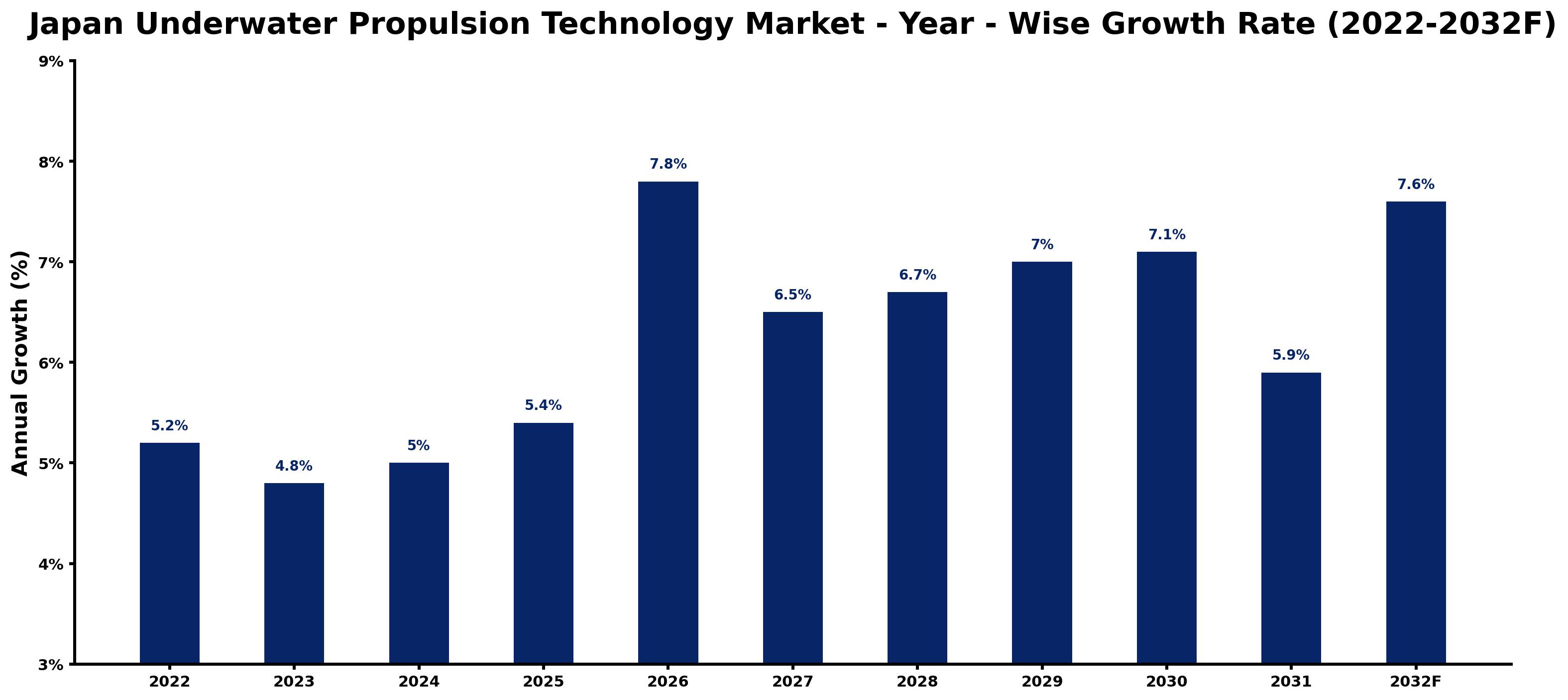
The table below sets out the estimated growth rate for each year and the main factor behind it.
| Year | Estimated Annual Growth (%) | Market Rationale |
| 2022 | 5.2 | The market showed steady growth due to ongoing naval investments and research activities. |
| 2023 | 4.8 | Growth slowed as some defense budgets were reallocated to other priorities. |
| 2024 | 5.0 | Increased focus on marine robotics spurred a faster growth rate this year. |
| 2025 | 5.4 | Demand rose further as Japan's defense budget for naval capabilities reached ¥1 trillion. |
| 2026 | 7.8 | The peak growth year reflects heightened investments in advanced propulsion technologies. |
| 2027 | 6.5 | A slight slowdown occurred as the market adjusted to previous high growth rates. |
| 2028 | 6.7 | Growth resumed as new marine technology initiatives gained traction in research. |
| 2029 | 7.0 | Increased demand for submarines led to a further rise in market growth. |
| 2030 | 7.1 | The market continued to expand with ongoing investments in marine research. |
| 2031 | 5.9 | Growth slowed as the market stabilised after several years of rapid expansion. |
| 2032 | 7.6 | Demand is expected to rise again with new technological advancements in propulsion. |
Note: Market size estimations and growth projections presented in this report are based on 6Wresearch's proprietary forecasting methodology, utilizing the latest available industry data, government publications, and primary research inputs.
Japan Underwater Propulsion Technology Market Synopsis
Underwater propulsion technology includes systems that enable movement underwater, such as thrusters and bio-inspired mechanisms. The primary applications are in military defense, marine research, and autonomous underwater vehicles. The Japan Underwater Propulsion Technology Market is growing due to investments in naval capabilities, with the defense budget reaching ¥1 trillion in 2023. The Tokyo Bay area is a hub for marine robotics research, driving demand for advanced propulsion solutions and technologies.
Market Dynamics Impact Analysis (2026–2032)
| Factor | Type | Impact | Primary Segment Affected |
| Increased defense spending on naval capabilities | Driver | High | Defense Navy |
| Growing demand for marine robotics applications | Driver | High | Marine Robotics |
| Emerging marine tech startups in Kanagawa and Osaka | Opportunity | Medium | Marine Robotics |
| Investment in advanced propulsion technologies for submarines | Opportunity | High | Submarines |
| High costs associated with advanced propulsion system development | Restraint | High | Thruster Systems |
| Limited applications for magnetohydrodynamic systems | Restraint | Medium | Magnetohydrodynamic |
| Competition from international underwater technology producers | Challenge | High | Marine Robotics |
| Technological challenges in developing bio-inspired systems | Challenge | Medium | Bio-Inspired Systems |
Evaluation of Drivers in Japan Underwater Propulsion Technology Market (2026–2032)
Demand rests on the following drivers, each shown with the segment it touches most.
| Drivers | Primary Segment Affected | Why It Matters (Evidence) |
| Increased defense budget allocations | Defense Navy | Japan's defense budget reached ¥1 trillion in 2023, leading to higher demand for advanced propulsion systems. |
| Expansion of marine robotics applications | Marine Robotics | Marine robotics applications are projected to grow significantly, driving demand for propulsion technologies. |
| Rising number of operational submarines | Submarines | With over 200 operational submarines, Japan's naval forces require advanced propulsion systems for enhanced capabilities. |
| Investment in research for bio-inspired propulsion systems | Bio-Inspired Systems | Research in bio-inspired propulsion systems is increasing, resulting in a demand for these technologies. |
| Development of battery-powered systems for marine drones | Battery-Powered | Battery-powered systems are prevalent in over 70% of marine drones, driving demand for efficient propulsion solutions. |
What keeps demand rising is the increased defense budget allocations, with Japan's defense budget reaching ¥1 trillion in 2023, which drives purchases of advanced propulsion technologies. The expansion of marine robotics applications in environmental monitoring is expected to increase demand for propulsion solutions. Japan's naval forces operate over 200 submarines, necessitating advanced propulsion systems for improved operational capabilities. Battery-powered systems dominate over 70% of marine drones, creating a strong demand for efficient propulsion solutions.
Evaluation of Restraints in Japan Underwater Propulsion Technology Market
The table below lists the restraints and the evidence behind each.
| Market Restraint | Primary Segment Affected | Why It Matters (Evidence) |
| High material costs for marine tech startups | Marine Tech Startups | Material costs can inflate project budgets by up to 30%, limiting competitiveness in the market. |
| Compliance delays with ISO 9001 standards | Defense Navy | Stringent compliance can extend project timelines by an average of six months, impacting operational readiness. |
| Intense competition among suppliers | Naval Forces | The defense budget for naval capabilities reached ¥1 trillion in 2023, driving prices up and squeezing margins. |
| Supply chain disruptions in advanced materials | Submarines | Disruptions can lead to production halts, affecting delivery schedules for propulsion systems. |
| Limited funding for emerging technologies | Bio-Inspired Systems | Funding constraints can hinder the development of new propulsion solutions. |
Japan Underwater Propulsion Technology Market Challenges
Marine tech startups in Kanagawa face high material costs, inflating project budgets by 30% and limiting their ability to secure contracts. Buyers in the military sector encounter delays due to stringent compliance with ISO 9001 standards, extending project timelines by six months and impacting operational readiness. Competition intensifies as Japan's defence budget for naval capabilities reached ¥1 trillion in 2023, driving prices up and squeezing margins for smaller producers. Supply chain disruptions in sourcing advanced materials can lead to production halts, delaying delivery schedules for underwater propulsion systems.
Trends in the Japan Underwater Propulsion Technology Market
Buyers and suppliers in the Japan Underwater Propulsion Technology Market are adjusting to the following trends.
- Advancement in Bio-Inspired Propulsion Systems: The Tokyo Institute of Technology is leading research in bio-inspired propulsion systems, improving efficiency in underwater movement. This advancement is projected to attract investment and innovation in the sector.
- Surge in Marine Robotics Applications: Marine robotics applications are set to expand significantly, with the Tokyo Bay area spearheading research efforts. This surge is likely to increase demand for propulsion technologies.
- Growing Emphasis on Environmental Monitoring: Research institutions are focusing more on environmental monitoring, resulting in a rise in demand for advanced underwater propulsion systems. This trend aligns with ongoing initiatives in marine technology.
- Rise of Battery-Powered Systems: Battery-powered systems are increasingly adopted in marine drones, with over 70% currently in use. This trend reflects the shift towards more efficient and sustainable underwater technologies.
Investment Opportunities in the Japan Underwater Propulsion Technology Market
Investors looking at the Japan Underwater Propulsion Technology Market should consider the following areas.
- Supply of Advanced Propulsion Technologies: There is a growing opportunity to supply advanced propulsion technologies, with the defence budget reaching ¥1 trillion. Collaborating with the Japan Maritime Self-Defense Force can facilitate market entry.
- Investment in Marine Robotics Solutions: Now is an ideal time to invest in marine robotics solutions, as applications are expected to grow. The Tokyo Bay area offers a vibrant environment for innovation and collaboration.
- Focus on Bio-Inspired Technologies: The demand for bio-inspired propulsion systems is on the rise, particularly in research institutions. Partnering with the Tokyo Institute of Technology can enhance development efforts.
- Expansion of Battery-Powered Solutions: With over 70% of marine drones utilising battery-powered systems, there is a strong market for efficient solutions. Engaging with marine tech startups in Kanagawa can provide entry points.
Government Initiatives in the Japan Underwater Propulsion Technology Market
The Economic Security Promotion Act (2022) supports supply-chain resilience for critical products, improving production capabilities for underwater propulsion technologies. This law complements existing regulations, ensuring that producers meet quality standards and maintain supply chain integrity.
The Japan Agency for Marine-Earth Science and Technology allocated ¥500 million for underwater research initiatives in 2023, promoting innovation in marine technology. This funding supports collaboration between research institutions and industry, driving advancements in underwater propulsion systems.
Future Insight of the Japan Underwater Propulsion Technology Market
Bio-inspired propulsion systems will reshape demand by 2032, driven by advancements in energy efficiency and environmental standards. The Japan Agency for Marine-Earth Science and Technology will boost research initiatives, encouraging collaboration between academia and industry. Investment in advanced propulsion technologies will rise, promoting efficient underwater movement. Marine applications in environmental monitoring will expand, addressing the growing need for solutions to combat climate change.
Market Segmentation Analysis
Japan Underwater Propulsion Technology Market report covers a detailed analysis of the following market segments:
By Propulsion Type – Thruster Systems Lead, Magnetohydrodynamic Expected to Grow Fastest
According to Saurav Kr Singh, Senior Research Analyst at 6Wresearch, Thruster Systems took 37% of propulsion type revenue in 2025, more than any other category. Thruster systems hold the largest share due to their essential role in ensuring the manoeuvrability of underwater vehicles. The operational submarines in Japan's naval forces exemplify this reliance, highlighting the critical need for effective navigation during missions. Magnetohydrodynamic is set to record the highest CAGR in this split, 10.0% over 2026–2032. The magnetohydrodynamic segment is poised for rapid growth as research institutions delve into its specialised applications in marine technology. The Tokyo Institute of Technology's work on propulsion systems showcases the potential for advancements in this niche area. Suppliers should focus on enhancing thruster technology to align with the defence sector's operational requirements.
By Power Source – Electric Leads, Battery-Powered Expected to Grow Fastest
The largest power source category in 2025 was Electric, at 40% of revenue. Electric power sources lead the market as they are extensively employed in underwater vehicles, ensuring reliable performance across various conditions. This is particularly evident in Japan's substantial fleet of operational submarines, which rely heavily on electric systems. Battery-Powered is projected to grow fastest, at a CAGR of 10.1% during 2026–2032. Battery-powered systems are rapidly gaining traction due to their prevalence in portable underwater devices, which are increasingly utilised in marine research. With over 70% of marine drones operating on battery power, demand is expected to grow significantly. Buyers should consider battery-powered solutions for improved portability and efficiency in underwater applications.
By Application Sector – Marine Robotics Lead, Submarines Expected to Grow Fastest
With 37% of application sector revenue in 2025, Marine Robotics was the largest category. Marine robotics represents the leading application sector, driven by extensive use in research and exploration activities throughout Japan. The Tokyo Bay area serves as a prime example, showcasing a robust focus on marine robotics initiatives. The quickest growth will come from Submarines, forecast to expand at a CAGR of 9.2% between 2026 and 2032. Submarines are experiencing rapid growth, primarily due to their critical role in military operations and research. The Ministry of Defense's substantial budget allocation for naval capabilities underscores the importance of this application sector. Suppliers must adapt their offerings to meet the rising demand for advanced submarine technologies in the defence sector.
By End User – Defense Navy Leads, Naval Forces Expected to Grow Fastest
Defense Navy accounted for 52% of the market by end user in 2025. The defense navy is the dominant end user of advanced propulsion systems, reflecting its crucial role in national security and maritime operations. Japan's considerable investments in naval capabilities further emphasise the significance of this sector. Over 2026–2032, Naval Forces are expected to post the fastest growth, at a CAGR of 8.7%. Naval forces are witnessing rapid growth, bolstered by substantial investments in underwater capabilities. The Ministry of Defense's budget for underwater technology advancements highlights the increasing focus on enhancing naval operations. Suppliers should tailor their products to address the specific needs of naval forces to capitalise on the growing demand for underwater propulsion technologies.
Key Attractiveness of the Report
- 10 Years of Market Numbers
- Historical Data Starting from 2022 to 2025
- Base Year 2025
- Forecast Data until 2032
- Key Performance Indicators Impacting the Market
- Major Upcoming Developments and Projects
Key Highlights of the Report:
- Japan Underwater Propulsion Technology Market Outlook
- Market Size of Japan Underwater Propulsion Technology Market, 2025
- Forecast of Japan Underwater Propulsion Technology Market, 2032
- Historical Data and Forecast of Japan Underwater Propulsion Technology Revenues & Volume for the Period 2022-2032F
- Japan Underwater Propulsion Technology Market Trend Evolution
- Japan Underwater Propulsion Technology Market Drivers and Challenges
- Japan Underwater Propulsion Technology Price Trends
- Japan Underwater Propulsion Technology Porter's Five Forces
- Japan Underwater Propulsion Technology Industry Life Cycle
- Historical Data and Forecast of Japan Underwater Propulsion Technology Market Revenues & Volume By Propulsion Type for the Period 2022-2032F
- Historical Data and Forecast of Japan Underwater Propulsion Technology Market Revenues & Volume By Thruster Systems for the Period 2022-2032F
- Historical Data and Forecast of Japan Underwater Propulsion Technology Market Revenues & Volume By Magnetohydrodynamic for the Period 2022-2032F
- Historical Data and Forecast of Japan Underwater Propulsion Technology Market Revenues & Volume By Pump-Jet Propulsion for the Period 2022-2032F
- Historical Data and Forecast of Japan Underwater Propulsion Technology Market Revenues & Volume By Bio-Inspired Systems for the Period 2022-2032F
- Historical Data and Forecast of Japan Underwater Propulsion Technology Market Revenues & Volume By Power Source for the Period 2022-2032F
- Historical Data and Forecast of Japan Underwater Propulsion Technology Market Revenues & Volume By Electric for the Period 2022-2032F
- Historical Data and Forecast of Japan Underwater Propulsion Technology Market Revenues & Volume By Battery-Powered for the Period 2022-2032F
- Historical Data and Forecast of Japan Underwater Propulsion Technology Market Revenues & Volume By Hybrid Systems for the Period 2022-2032F
- Historical Data and Forecast of Japan Underwater Propulsion Technology Market Revenues & Volume By Solar/Electric for the Period 2022-2032F
- Historical Data and Forecast of Japan Underwater Propulsion Technology Market Revenues & Volume By Application Sector for the Period 2022-2032F
- Historical Data and Forecast of Japan Underwater Propulsion Technology Market Revenues & Volume By Marine Robotics for the Period 2022-2032F
- Historical Data and Forecast of Japan Underwater Propulsion Technology Market Revenues & Volume By Submarines for the Period 2022-2032F
- Historical Data and Forecast of Japan Underwater Propulsion Technology Market Revenues & Volume By Deep Sea Vessels for the Period 2022-2032F
- Historical Data and Forecast of Japan Underwater Propulsion Technology Market Revenues & Volume By Autonomous Drones for the Period 2022-2032F
- Historical Data and Forecast of Japan Underwater Propulsion Technology Market Revenues & Volume By End User for the Period 2022-2032F
- Historical Data and Forecast of Japan Underwater Propulsion Technology Market Revenues & Volume By Defense Navy for the Period 2022-2032F
- Historical Data and Forecast of Japan Underwater Propulsion Technology Market Revenues & Volume By Naval Forces for the Period 2022-2032F
- Historical Data and Forecast of Japan Underwater Propulsion Technology Market Revenues & Volume By Ocean Research Labs for the Period 2022-2032F
- Historical Data and Forecast of Japan Underwater Propulsion Technology Market Revenues & Volume By Marine Tech Startups for the Period 2022-2032F
- Japan Underwater Propulsion Technology Import Export Trade Statistics
- Market Opportunity Assessment By Propulsion Type
- Market Opportunity Assessment By Power Source
- Market Opportunity Assessment By Application Sector
- Market Opportunity Assessment By End User
- Japan Underwater Propulsion Technology Top Companies Market Share
- Japan Underwater Propulsion Technology Competitive Benchmarking By Technical and Operational Parameters
- Japan Underwater Propulsion Technology Company Profiles
- Japan Underwater Propulsion Technology Key Strategic Recommendations
Market Covered
Segments analysed in this report are listed below.
By Propulsion Type
- Thruster Systems
- Magnetohydrodynamic
- Pump-Jet Propulsion
- Bio-Inspired Systems
By Power Source
- Electric
- Battery-Powered
- Hybrid Systems
- Solar/Electric
By Application Sector
- Marine Robotics
- Submarines
- Deep Sea Vessels
- Autonomous Drones
By End User
- Defense Navy
- Naval Forces
- Ocean Research Labs
- Marine Tech Startups































