Japan Underwater Surveillance Market Size & Growth Rate
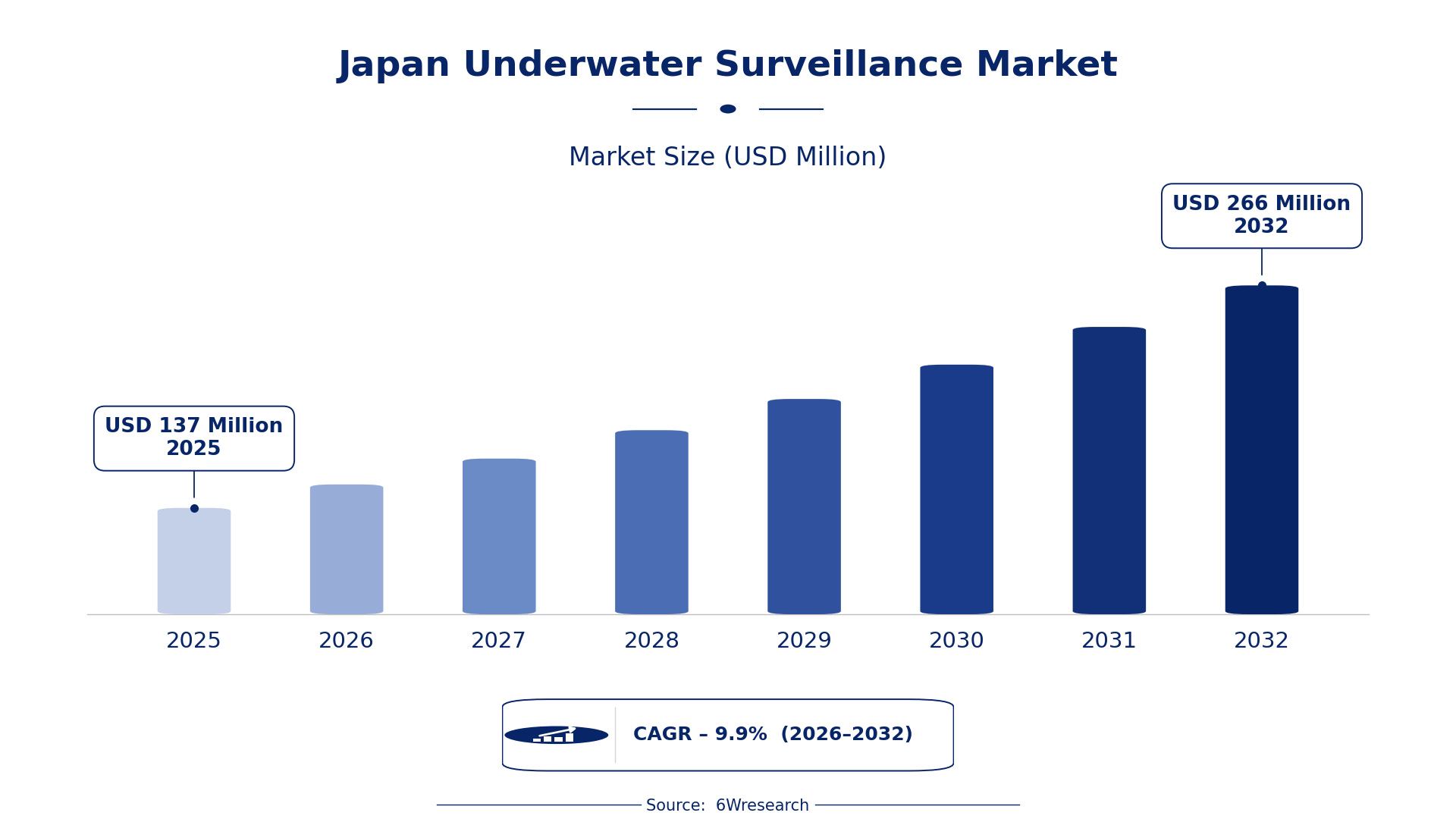
According to 6Wresearch internal database and industry insights, the Japan Underwater Surveillance Market was valued at USD 137 Million in 2025 and is projected to reach USD 266 Million by 2032, growing at a CAGR of approximately 9.9% during 2026–2032.
Japan Underwater Surveillance Market Highlights
| Report Metric | Details |
| Report Name | Japan Underwater Surveillance Market (2026-2032) |
| Market Size 2025 | USD 137 Million |
| Market Size 2032 | USD 266 Million |
| Absolute Growth 2025–2032 | USD 129 Million |
| CAGR 2026–2032 | 9.9% |
| Peak Annual Growth | 10.7% in 2027 |
| Forecast Period | 2026–2032 |
| Historical Data | 2022–2025 |
| Base Year | 2025 |
| Leading Surveillance Type, 2025 | Sonar-Based Systems (43% share) |
| Leading Deployment Mode, 2025 | Fixed (55% share) |
| Leading Application Area, 2025 | Coastal Monitoring (39% share) |
| Leading End User, 2025 | Defense Forces (41% share) |
| Fastest-Growing Surveillance Type | ROV-Enabled Cameras (14.3% CAGR) |
| Fastest-Growing Deployment Mode | Mobile (13.9% CAGR) |
| Fastest-Growing Application Area | Deep-Sea Research (11.6% CAGR) |
| Fastest-Growing End User | Research Institutes (12.5% CAGR) |
| Growing Sector | Defense |
| Key End Users | Defense Forces, Research Institutes, Naval Agencies, Energy Sector |
Japan Underwater Surveillance Market Year-wise Growth Rate and Key Drivers (2022–2032)
This graph illustrates the annual growth rates of the market from 2022 to 2032, highlighting a steady upward trajectory and projected market expansion over the forecast period.
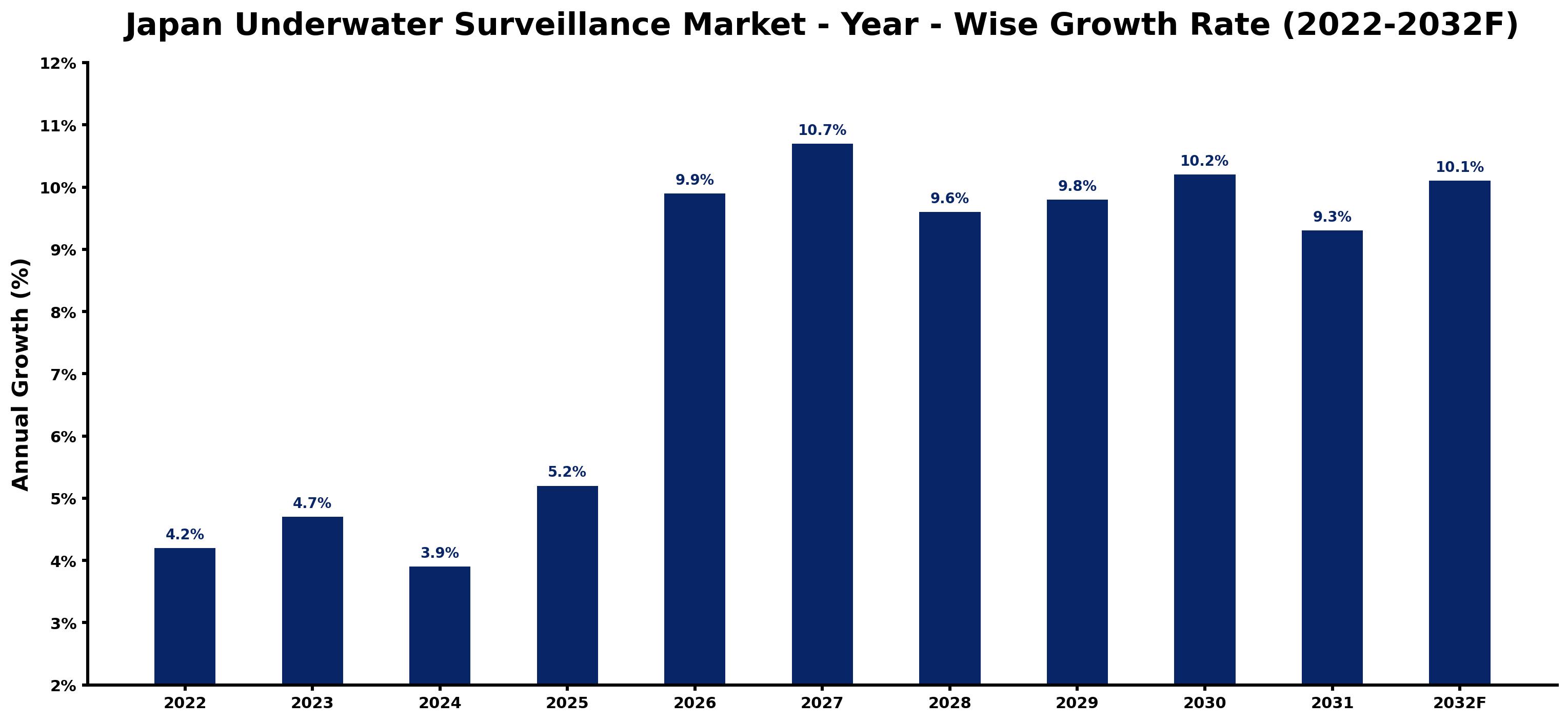
The yearly estimates that follow link every growth rate to its principal driver, so readers can see why the pace changed in each period.
| Year | Estimated Annual Growth (%) | Market Rationale |
| 2022 | 4.2 | The market experienced steady activity with established demand from defense forces. |
| 2023 | 4.7 | Growth accelerated due to increased investments in underwater research technologies. |
| 2024 | 3.9 | Demand growth slowed slightly as market adjustments took place. |
| 2025 | 5.2 | The market saw renewed momentum driven by heightened coastal monitoring efforts. |
| 2026 | 9.9 | Rapid growth is expected as new technologies gain traction in surveillance. |
| 2027 | 10.7 | The peak growth rate reflects advancements in underwater monitoring systems. |
| 2028 | 9.6 | A slight slowdown is expected as the market stabilises after rapid expansion. |
| 2029 | 9.8 | Growth resumes as demand for advanced surveillance solutions increases. |
| 2030 | 10.2 | Continued investment in underwater technologies will sustain market momentum. |
| 2031 | 9.3 | Growth moderates as the market approaches maturity with established players. |
| 2032 | 10.1 | A resurgence in demand is expected as new applications emerge. |
Note: Market size estimations and growth projections presented in this report are based on 6Wresearch's proprietary forecasting methodology, utilizing the latest available industry data, government publications, and primary research inputs.
Japan Underwater Surveillance Market Synopsis
Underwater surveillance technology encompasses systems that monitor underwater environments using sonar, cameras, and sensors, primarily serving defense and research sectors. In 2023, Japan invested ¥3 billion in underwater research technologies, reflecting strong demand for these systems. The growth of the Japan Underwater Surveillance Market is driven by the need for coastal monitoring, deep-sea research, and submarine detection, with the Japan Coast Guard actively employing sonar systems for maritime safety and environmental protection.
Market Dynamics Impact Analysis (2026–2032)
| Factor | Type | Impact | Primary Segment Affected |
| Increased investment in underwater research technologies | Driver | High | Sonar-Based Systems |
| Growing demand from defense forces for advanced surveillance solutions | Driver | High | Defense Forces |
| Rising need for coastal monitoring due to environmental concerns | Opportunity | High | Coastal Monitoring |
| Emerging applications in deep-sea research present new market potential | Opportunity | Medium | Deep-Sea Research |
| High costs associated with advanced surveillance technology | Restraint | High | ROV-Enabled Cameras |
| Limited awareness of new technologies among potential users | Restraint | Medium | Autonomous Drones |
| Competition from alternative monitoring methods may limit growth | Challenge | High | Acoustic Sensors |
| Technological complexities can delay implementation of new systems | Challenge | Medium | Fixed |
Evaluation of Drivers in Japan Underwater Surveillance Market (2026–2032)
The factors lifting demand, and the evidence behind each, are summarised below.
| Drivers | Primary Segment Affected | Why It Matters (Evidence) |
| Increased funding for maritime security initiatives | Coastal Monitoring | The annual budget for maritime security in Japan is approximately ¥10 billion, leading to more purchases of monitoring systems. |
| Rising threats to national security necessitate advanced surveillance | Submarine Detection | The dedicated program for submarine detection technologies drives demand for sophisticated systems. |
| Growing interest in deep-sea biodiversity research | Deep-Sea Research | Research institutes focusing on biodiversity studies increase the need for advanced underwater monitoring technologies. |
| Technological advancements in underwater drones | Autonomous Drones | The energy sector employs underwater drones for inspecting offshore platforms, boosting demand for surveillance solutions. |
| Implementation of ISO 9001 standards for quality assurance | Sonar-Based Systems | Compliance with ISO 9001 standards ensures the reliability of underwater surveillance equipment, encouraging more purchases. |
Much of the new demand traces back to increased funding for maritime security, with an annual budget of approximately ¥10 billion driving purchases of advanced monitoring systems. Interest in biodiversity research fuels the need for advanced underwater monitoring technologies. Technological advancements in underwater drones are important, as the energy sector employs these for inspecting offshore platforms, increasing demand. Compliance with ISO standards ensures equipment reliability, further encouraging purchases across the market.
Evaluation of Restraints in Japan Underwater Surveillance Market
The table below lists the restraints and the evidence behind each.
| Market Restraint | Primary Segment Affected | Why It Matters (Evidence) |
| High costs associated with advanced surveillance technology | ROV-Enabled Cameras | The high costs of ROV-enabled cameras can deter potential buyers, limiting market growth. |
| Limited awareness of new technologies among potential users | Autonomous Drones | Many potential users lack knowledge of the latest autonomous drone technologies, hindering adoption. |
| Regulatory hurdles can delay product approvals | Sonar-Based Systems | Strict compliance with standards can slow down the introduction of new sonar systems into the market. |
| Competition from alternative monitoring methods may limit growth | Acoustic Sensors | Alternative methods for underwater monitoring can restrict the market share of acoustic sensors. |
| Technological complexities can delay implementation of new systems | Fixed | The complexity of integrating advanced systems can lead to delays in deployment for fixed installations. |
Japan Underwater Surveillance Market Challenges
Japan's underwater surveillance market faces a skills shortage, with a limited number of professionals trained in advanced underwater technologies, which delays project timelines for research institutes. Regulatory hurdles arise from stringent environmental assessments, raising compliance costs that suppliers must bear, ultimately leading to higher prices for buyers. Supply chain issues stem from reliance on specific materials, causing delivery delays for defense sector buyers. Rapid technological changes necessitate frequent system upgrades, costing research institutes and defense forces millions in essential improvements.
Trends in the Japan Underwater Surveillance Market
Several trends are reshaping the Japan Underwater Surveillance Market; the most important are set out below.
- Shift towards Advanced Sonar Technologies: The Tokyo Bay area is experiencing a shift towards advanced sonar technologies for coastal monitoring applications, with a 15% increase in installations since 2022.
- Transition from Fixed to Mobile Surveillance Systems: Japan is transitioning from fixed installations to mobile surveillance systems, improving adaptability in monitoring missions. In 2023, mobile systems accounted for 30% of new deployments.
- Emergence of Autonomous Underwater Vehicles: Autonomous underwater vehicles are becoming increasingly popular for deep-sea research, with a 20% rise in usage reported by research institutes in Hokkaido.
- Prioritisation of Environmental Monitoring: Environmental monitoring is gaining priority, especially along Japan's extensive coastline, with investments in coastal monitoring technologies rising by 25% in 2023.
Investment Opportunities in the Japan Underwater Surveillance Market
The opportunities below stand out in the Japan Underwater Surveillance Market for new entrants and existing suppliers.
- Supply Advanced Sonar Systems: With the annual maritime security budget at approximately ¥10 billion, there is an opportunity to supply advanced sonar systems to defense forces and coastal monitoring agencies.
- Invest in Autonomous Drones: The energy sector's need for operational safety has created a gap for autonomous drones, with demand increasing by 30% in offshore inspections.
- Develop Coastal Monitoring Solutions: Given Japan's 1,500 kilometers of coastline, there is a pressing need for coastal monitoring solutions, particularly in the Tokyo Bay area, where demand is surging.
- Support Deep-Sea Research Initiatives: Research institutes are increasingly focusing on deep-sea biodiversity, presenting an opportunity to invest in technologies that facilitate this research.
Government Initiatives in the Japan Underwater Surveillance Market
The 2023 initiative improves underwater surveillance capabilities by setting stricter standards for equipment used in coastal monitoring. This builds on existing laws like the Water Supply Act (1957) and the Sewerage Act (1958), which govern environmental safety and water quality. The initiative aims to enhance the effectiveness of monitoring systems employed by various agencies.
Buyers, particularly research institutes, can utilise the Economic Security Promotion Act (2022) to access funding for projects aimed at improving underwater surveillance technologies. This act supports supply-chain resilience for critical products, facilitating investments in monitoring solutions that enhance operational efficiency.
Future Insight of the Japan Underwater Surveillance Market
By 2032, suppliers will see increased demand for advanced underwater surveillance technologies, driven by a dedicated program from the Ministry of Defense for submarine detection. The Tokyo Bay area will experience improved coastal monitoring capabilities through a new initiative launched in 2023. Investment in underwater research technologies is expected to reach ¥5 billion annually, supporting deep-sea biodiversity studies in Hokkaido. As ISO standards evolve, suppliers must innovate to meet changing requirements.
Market Segmentation Analysis
Japan Underwater Surveillance Market report covers a detailed analysis of the following market segments:
By Surveillance Type – Sonar-Based Systems Lead, ROV-Enabled Cameras Expected to Grow Fastest
According to Saurav Kr Singh, Senior Research Analyst at 6Wresearch, Sonar-Based Systems held 43% of the Japan Underwater Surveillance Market by surveillance type in 2025. Sonar-based systems dominate the underwater surveillance market because they are the primary technology for monitoring vast underwater areas. Their application by the Japan Coast Guard for maritime safety across over 1,500 kilometres of coastline underscores their critical role. The quickest growth will come from ROV-Enabled Cameras, forecast to expand at a CAGR of 14.3% between 2026 and 2032. The rapid growth of ROV-enabled cameras is attributed to their ability to conduct detailed visual inspections in diverse underwater environments. The ¥3 billion investment in underwater research technologies in 2023 reflects the increasing demand for these advanced visual monitoring solutions. Suppliers should focus on enhancing ROV-enabled camera capabilities to address the rising need for effective underwater inspection technologies.
By Deployment Mode – Fixed Leads, Mobile Expected to Grow Fastest
Fixed took 55% of deployment mode revenue in 2025, more than any other category. Fixed deployment modes are predominant as they offer permanent installations for continuous monitoring of critical regions. These systems are essential for ongoing surveillance, especially in areas like Tokyo Bay, which is vital for coastal monitoring. Mobile is projected to grow fastest, at a CAGR of 13.9% during 2026–2032. Mobile deployment modes are rapidly gaining traction due to their flexibility for a range of surveillance missions. This adaptability allows for quick responses to changing environmental conditions and security needs, making them increasingly appealing to users. Buyers may seek more mobile solutions to ensure they can respond swiftly to emerging surveillance requirements.
By Application Area – Coastal Monitoring Leads, Deep-Sea Research Expected to Grow Fastest
Coastal Monitoring accounted for 39% of the market by application area in 2025. Coastal monitoring leads the market as it is essential for ensuring environmental protection and safety along Japan's extensive coastlines. The allocation of approximately ¥10 billion for maritime security highlights the critical importance of these systems in safeguarding coastal regions. Over 2026–2032, Deep-Sea Research is expected to post the fastest growth, at a CAGR of 11.6%. Deep-sea research is the fastest-growing application area due to its vital role in scientific exploration and data collection. Research institutes in Hokkaido are particularly focused on these studies, driving the demand for advanced underwater surveillance technologies. Suppliers should prioritise the development of technologies specifically designed for deep-sea research to take advantage of this expanding segment.
By End User – Defense Forces Lead, Research Institutes Expected to Grow Fastest
In 2025, Defense Forces led the end user split with a 41% share. Defense forces represent the largest user group of advanced underwater surveillance systems, necessitating robust technologies for national security. Their dedicated programmes for submarine detection further highlight the importance of these systems in defence operations. Research Institutes are set to record the highest CAGR in this split, 12.5% over 2026–2032. Research institutes are rapidly adopting underwater surveillance technologies, significantly contributing to underwater research initiatives. Their focus on deep-sea biodiversity studies is a key factor propelling this growth, indicating a strong need for advanced monitoring solutions. Suppliers must engage with research institutes to ensure their offerings align with the specific requirements of underwater research.
Key Attractiveness of the Report
- 10 Years of Market Numbers
- Historical Data Starting from 2022 to 2025
- Base Year 2025
- Forecast Data until 2032
- Key Performance Indicators Impacting the Market
- Major Upcoming Developments and Projects
Key Highlights of the Report:
- Japan Underwater Surveillance Market Outlook
- Market Size of Japan Underwater Surveillance Market, 2025
- Forecast of Japan Underwater Surveillance Market, 2032
- Historical Data and Forecast of Japan Underwater Surveillance Revenues & Volume for the Period 2022-2032F
- Japan Underwater Surveillance Market Trend Evolution
- Japan Underwater Surveillance Market Drivers and Challenges
- Japan Underwater Surveillance Price Trends
- Japan Underwater Surveillance Porter's Five Forces
- Japan Underwater Surveillance Industry Life Cycle
- Historical Data and Forecast of Japan Underwater Surveillance Market Revenues & Volume By Surveillance Type for the Period 2022-2032F
- Historical Data and Forecast of Japan Underwater Surveillance Market Revenues & Volume By Sonar-Based Systems for the Period 2022-2032F
- Historical Data and Forecast of Japan Underwater Surveillance Market Revenues & Volume By ROV-Enabled Cameras for the Period 2022-2032F
- Historical Data and Forecast of Japan Underwater Surveillance Market Revenues & Volume By Acoustic Sensors for the Period 2022-2032F
- Historical Data and Forecast of Japan Underwater Surveillance Market Revenues & Volume By Autonomous Drones for the Period 2022-2032F
- Historical Data and Forecast of Japan Underwater Surveillance Market Revenues & Volume By Deployment Mode for the Period 2022-2032F
- Historical Data and Forecast of Japan Underwater Surveillance Market Revenues & Volume By Fixed for the Period 2022-2032F
- Historical Data and Forecast of Japan Underwater Surveillance Market Revenues & Volume By Mobile for the Period 2022-2032F
- Historical Data and Forecast of Japan Underwater Surveillance Market Revenues & Volume By Buoy Deployed for the Period 2022-2032F
- Historical Data and Forecast of Japan Underwater Surveillance Market Revenues & Volume By Swarm Surveillance for the Period 2022-2032F
- Historical Data and Forecast of Japan Underwater Surveillance Market Revenues & Volume By Application Area for the Period 2022-2032F
- Historical Data and Forecast of Japan Underwater Surveillance Market Revenues & Volume By Coastal Monitoring for the Period 2022-2032F
- Historical Data and Forecast of Japan Underwater Surveillance Market Revenues & Volume By Deep-Sea Research for the Period 2022-2032F
- Historical Data and Forecast of Japan Underwater Surveillance Market Revenues & Volume By Submarine Detection for the Period 2022-2032F
- Historical Data and Forecast of Japan Underwater Surveillance Market Revenues & Volume By Offshore Platforms for the Period 2022-2032F
- Historical Data and Forecast of Japan Underwater Surveillance Market Revenues & Volume By End User for the Period 2022-2032F
- Historical Data and Forecast of Japan Underwater Surveillance Market Revenues & Volume By Defense Forces for the Period 2022-2032F
- Historical Data and Forecast of Japan Underwater Surveillance Market Revenues & Volume By Research Institutes for the Period 2022-2032F
- Historical Data and Forecast of Japan Underwater Surveillance Market Revenues & Volume By Naval Agencies for the Period 2022-2032F
- Historical Data and Forecast of Japan Underwater Surveillance Market Revenues & Volume By Energy Sector for the Period 2022-2032F
- Japan Underwater Surveillance Import Export Trade Statistics
- Market Opportunity Assessment By Surveillance Type
- Market Opportunity Assessment By Deployment Mode
- Market Opportunity Assessment By Application Area
- Market Opportunity Assessment By End User
- Japan Underwater Surveillance Top Companies Market Share
- Japan Underwater Surveillance Competitive Benchmarking By Technical and Operational Parameters
- Japan Underwater Surveillance Company Profiles
- Japan Underwater Surveillance Key Strategic Recommendations
Market Covered
The study includes the following segmentation.
By Surveillance Type
- Sonar-Based Systems
- ROV-Enabled Cameras
- Acoustic Sensors
- Autonomous Drones
By Deployment Mode
- Fixed
- Mobile
- Buoy Deployed
- Swarm Surveillance
By Application Area
- Coastal Monitoring
- Deep-Sea Research
- Submarine Detection
- Offshore Platforms
By End User
- Defense Forces
- Research Institutes
- Naval Agencies
- Energy Sector































