Japan Underwriting AI Market Size & Growth Rate
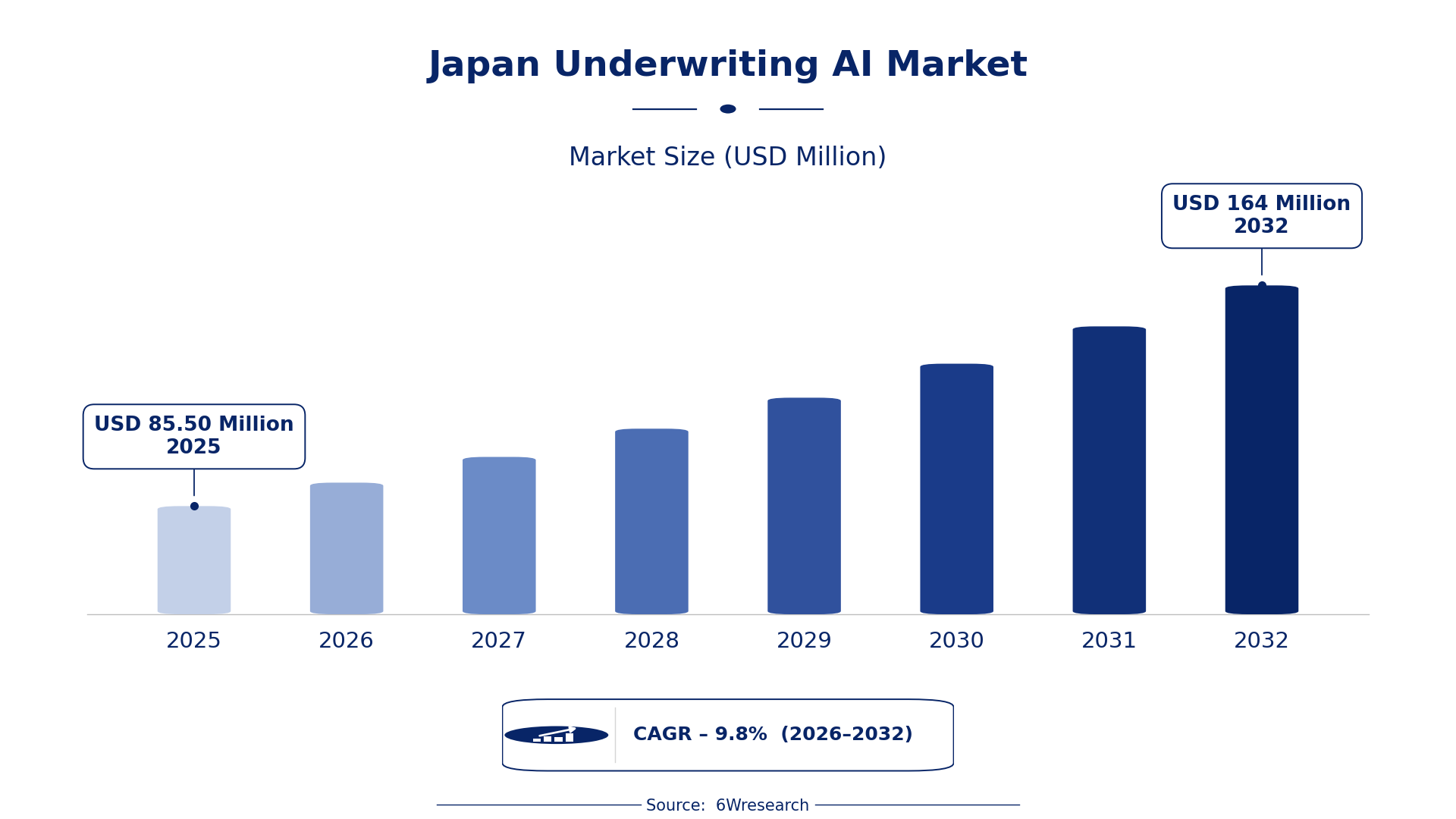
According to 6Wresearch internal database and industry insights, the Japan Underwriting AI Market was valued at USD 85.50 Million in 2025 and is projected to reach USD 164 Million by 2032, growing at a CAGR of approximately 9.8% during 2026–2032.
Japan Underwriting AI Market Highlights
| Report Metric | Details |
| Report Name | Japan Underwriting AI Market (2026-2032) |
| Market Size 2025 | USD 85.50 Million |
| Market Size 2032 | USD 164 Million |
| Absolute Growth 2025–2032 | USD 78.50 Million |
| CAGR 2026–2032 | 9.8% |
| Peak Annual Growth | 12.5% in 2030 |
| Forecast Period | 2026–2032 |
| Historical Data | 2022–2025 |
| Base Year | 2025 |
| Leading AI Type, 2025 | Predictive Modeling (44% share) |
| Leading Use Case, 2025 | Life Insurance (41% share) |
| Leading Deployment Mode, 2025 | Cloud-Based (48% share) |
| Leading End User, 2025 | Insurers (42% share) |
| Fastest-Growing AI Type | NLP Engine (13.6% CAGR) |
| Fastest-Growing Use Case | Policy Analysis (13.1% CAGR) |
| Fastest-Growing Deployment Mode | On-Premise (14.2% CAGR) |
| Fastest-Growing End User | Reinsurers (12.6% CAGR) |
| Growing Sector | life insurance |
| Key End Users | insurers, reinsurers, lending institutions |
Japan Underwriting AI Market Year-wise Growth Rate and Key Drivers (2022–2032)
This graph illustrates the annual growth rates of the market from 2022 to 2032, highlighting a steady upward trajectory and projected market expansion over the forecast period.
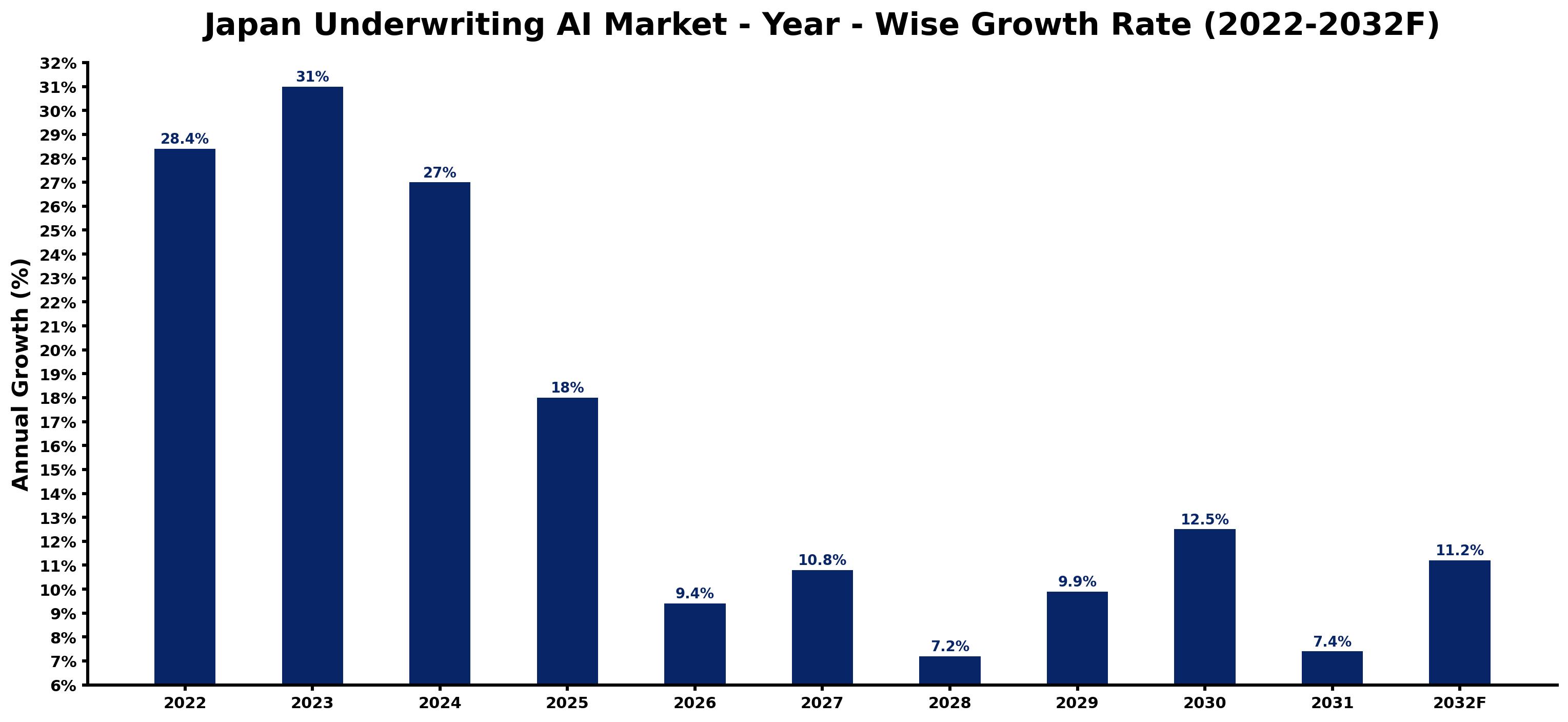
Below, each year's estimated growth is shown next to the factor that most influenced it.
| Year | Estimated Annual Growth (%) | Market Rationale |
| 2022 | 28.4 | The market exhibited strong demand from the life insurance sector, reflecting ongoing technological adoption. |
| 2023 | 31.0 | Growth accelerated due to increased investments in AI technologies across the insurance industry. |
| 2024 | 27.0 | Demand continued but at a slower rate as market adjustments took place. |
| 2025 | 18.0 | The market maintained growth, albeit at a reduced pace, as companies refined their AI strategies. |
| 2026 | 9.4 | Growth is expected to slow further as market maturity begins to set in, affecting expansion rates. |
| 2027 | 10.8 | A rebound is projected as insurers seek to improve underwriting efficiency through AI. |
| 2028 | 7.2 | Growth is anticipated to decelerate again as the market reaches a more stable phase. |
| 2029 | 9.9 | An uptick in growth is expected as companies adopt more advanced AI solutions. |
| 2030 | 12.5 | The market is projected to peak as technological advancements drive demand for underwriting AI. |
| 2031 | 7.4 | Growth is anticipated to slow as the market begins to stabilise after the peak year. |
| 2032 | 11.2 | A resurgence in growth is expected as new AI applications are integrated into underwriting processes. |
Note: Market size estimations and growth projections presented in this report are based on 6Wresearch's proprietary forecasting methodology, utilizing the latest available industry data, government publications, and primary research inputs.
Japan Underwriting AI Market Synopsis
Underwriting AI applies artificial intelligence technologies to streamline the insurance underwriting process through machine learning algorithms. The growing installed base of AI systems and government initiatives supporting digital transformation are key factors propelling market growth in Japan.
Market Dynamics Impact Analysis (2026–2032)
| Factor | Type | Impact | Primary Segment Affected |
| Increasing adoption of machine learning for risk assessment | Driver | High | Machine Learning |
| Demand for enhanced policy pricing accuracy | Driver | High | Predictive Modeling |
| Expansion of cloud-based solutions in insurance | Opportunity | High | Cloud-Based |
| Growing need for AI literacy among insurance professionals | Opportunity | Medium | Insurers |
| High costs associated with AI system implementation | Restraint | High | Predictive Modeling |
| Slow regulatory adaptation to new technologies | Restraint | Medium | Predictive Modeling |
| Limited integration capabilities with legacy systems | Challenge | High | API Integration |
| Shortage of skilled professionals in AI technologies | Challenge | Medium | Predictive Modeling |
Evaluation of Drivers in Japan Underwriting AI Market (2026–2032)
Below are the drivers that matter most for revenue growth, with supporting evidence.
| Drivers | Primary Segment Affected | Why It Matters (Evidence) |
| Increased efficiency in risk assessment processes | Machine Learning | Machine learning improves the accuracy of risk assessments, leading to more precise underwriting decisions, as seen in life insurance. |
| Growing demand for accurate policy pricing | Predictive Modeling | Predictive modeling tools improve pricing strategies, enabling insurers to better align premiums with risk profiles, particularly in life insurance. |
| Adoption of cloud-based solutions for flexibility | Cloud-Based | Cloud solutions offer scalability and cost-effectiveness, driving their popularity among insurers looking to modernise operations. |
| Improved customer service through NLP technologies | NLP Engine | NLP technologies enhance customer interaction, increasing satisfaction and retention rates in the insurance sector. |
| Integration of advanced risk scoring models | Risk Scoring | Advanced risk scoring models use AI to provide more accurate assessments, influencing underwriting decisions significantly. |
Volumes grow on the back of the increasing adoption of machine learning technologies that improve risk assessment accuracy. In Japan, the life insurance sector is valued at approximately 40 trillion JPY, driving demand for more efficient underwriting processes. The installed base of AI systems is expanding, with cloud-based solutions gaining traction due to their flexibility and cost-effectiveness.
Evaluation of Restraints in Japan Underwriting AI Market
These restraints slow adoption and weigh on supplier margins.
| Market Restraint | Primary Segment Affected | Why It Matters (Evidence) |
| High implementation costs for AI systems | Insurers | The initial investment in AI technology can be prohibitive for many insurers, limiting their ability to adopt new solutions. |
| Regulatory hurdles in adopting AI technologies | Predictive Modeling | Slow adaptation of regulations to accommodate AI innovations can delay implementation and affect competitive positioning. |
| Integration challenges with existing legacy systems | API Integration | Legacy systems often lack compatibility with new AI solutions, complicating integration efforts and slowing down adoption. |
| Shortage of skilled AI professionals | Predictive Modeling | The lack of qualified personnel to implement and manage AI technologies can hinder the growth of underwriting AI. |
| Concerns over data privacy and security | Predictive Modeling | Stringent data protection regulations can limit the use of AI in underwriting processes, affecting operational efficiency. |
Japan Underwriting AI Market Challenges
High operational costs for insurance firms arise from outdated technology, which slows data analysis and can lead to losses of up to 15% in policy pricing accuracy for producers. Insurers face intense competition that compels them to invest heavily in AI capabilities, delaying product launches by six months and reducing responsiveness to market changes for buyers. A shortage of skilled professionals in AI and underwriting technologies hinders innovation, resulting in training costs exceeding 20 million JPY annually for major firms. Compliance with regulations such as ISO 27001 incurs additional expenses, imposing a burden of 10 million JPY per year on producers and impacting their profitability.
Trends in the Japan Underwriting AI Market
The following changes are redrawing the Japan Underwriting AI Market.
- Shift from Traditional to AI-Driven Underwriting: In 2023, the insurance sector increasingly moved towards AI-driven underwriting processes, particularly in Tokyo, the hub for insurance technology innovation. This shift is evidenced by the growing installed base of AI systems in the industry.
- Transition from On-Premise to Cloud-Based Solutions: Cloud-based solutions are becoming more prevalent among insurers, driven by their cost-effectiveness and scalability. In 2023, approximately 48% of deployment modes in underwriting AI were cloud-based, indicating a notable trend towards digital transformation.
- Emergence of Advanced Risk Scoring Models: In 2023, risk scoring models began incorporating machine learning techniques, improving accuracy in assessing applicant risks. This trend is reshaping underwriting practices across the industry.
- Growing Importance of AI Literacy Initiatives: The Japanese government launched a digital transformation initiative in 2023 aimed at improving AI literacy in financial services. This initiative is important for preparing the workforce to effectively utilise AI technologies.
Investment Opportunities in the Japan Underwriting AI Market
The following areas offer the clearest openings for investors and suppliers in the Japan Underwriting AI Market.
- Tokyo as a Hub for AI Development: Tokyo's status as the primary hub for insurance technology innovation presents opportunities for investment in AI solutions. The market is valued at approximately 40 trillion JPY, indicating a notable gap for suppliers.
- Supply of Cloud-Based Underwriting Solutions: With cloud-based solutions gaining traction, suppliers can focus on providing scalable AI applications. The life insurance sector, which is the largest user of underwriting AI, offers a prime opportunity for partnerships.
- Investment in AI Training Programs: The ongoing need for AI literacy creates opportunities for educational initiatives. The Japan Insurers Association is promoting AI adoption, making it an ideal partner for training programs.
- Improving API Integration Services: As integration challenges persist, there is a growing demand for API integration services. Suppliers can target insurers looking to modernise their systems and improve operational efficiency.
Government Initiatives in the Japan Underwriting AI Market
The Digital Agency, established in September 2021, leads Japan's digital transformation efforts, particularly in financial services. This agency oversees the implementation of common system standards that facilitate the adoption of AI technologies in underwriting processes, ensuring compliance with regulations and improving operational efficiency for insurers.
In 2023, a program was initiated to improve AI literacy in financial sectors, with funding aimed at supporting educational initiatives. The Financial Services Agency oversees these efforts, ensuring that insurance professionals are equipped with the necessary skills to utilise AI technologies effectively.
Future Insight of the Japan Underwriting AI Market
The integration of advanced underwriting AI technologies will reshape demand for risk assessment by 2032, allowing buyers to benefit from improved policy pricing accuracy. The government's digital transformation initiative will enhance the adoption of cloud solutions, making them more affordable and scalable for firms. AI literacy programs will cultivate a skilled workforce, enabling suppliers to fulfil the growing demand for underwriting AI solutions. As the installed base of AI systems expands, firms will leverage these advancements to streamline claims processing, ultimately enhancing customer satisfaction in the insurance sector.
Market Segmentation Analysis
Japan Underwriting AI Market report covers a detailed analysis of the following market segments:
By AI Type – Predictive Modeling Leads, NLP Engine Expected to Grow Fastest
According to Saurav Kr Singh, Senior Research Analyst at 6Wresearch, with 44% of ai type revenue in 2025, Predictive Modeling was the largest category. Predictive modelling commands the largest share as it is crucial for assessing risk and determining pricing accuracy, particularly in the life insurance sector. Its extensive use in this domain illustrates the necessity for precise evaluations to maintain market competitiveness. NLP Engine is projected to grow fastest, at a CAGR of 13.6% during 2026–2032. The NLP engine is experiencing rapid growth due to its ability to significantly improve customer interactions, a key focus for modern insurance services. As firms increasingly prioritise customer experience, the adoption of NLP technologies is set to accelerate further. Suppliers should focus on developing advanced NLP solutions to meet the growing demand for enhanced customer service in the insurance sector.
By Use Case – Life Insurance Leads, Policy Analysis Expected to Grow Fastest
Life Insurance held 41% of the Japan Underwriting AI Market by use case in 2025. Life insurance dominates the market as it is the primary sector utilising underwriting technologies, supported by a robust valuation of approximately 40 trillion JPY. The high demand for life insurance products necessitates efficient underwriting processes to effectively meet consumer needs. The quickest growth will come from Policy Analysis, forecast to expand at a CAGR of 13.1% between 2026 and 2032. Policy analysis is the fastest-growing use case, vital for evaluating policy terms and conditions amid increasing complexity. This growth is driven by the need for accurate assessments to meet customer expectations and comply with regulatory standards. Buyers will benefit from improved policy analysis capabilities that enhance decision-making and elevate customer satisfaction in life insurance.
By Deployment Mode – Cloud-Based Leads, On-Premise Expected to Grow Fastest
In 2025, Cloud-Based led the deployment mode split with a 48% share. Cloud-based solutions lead the market due to their flexibility and scalability, making them the preferred option for insurers looking to modernise operations. Their cost-effectiveness aligns well with the financial strategies of insurance firms in Japan. On-Premise is set to record the highest CAGR in this split, 14.2% over 2026–2032. On-premise deployment is rapidly gaining traction as organisations seek greater control over their data and systems, despite higher maintenance costs. This trend indicates a shift towards customised solutions tailored to specific operational needs. Suppliers must offer robust on-premise solutions to address the demands of clients prioritising data control and customisation in their underwriting processes.
By End User – Insurers Lead, Reinsurers Expected to Grow Fastest
Insurers took 42% of end user revenue in 2025, more than any other category. Insurers are the main users of underwriting technologies, directly benefiting from enhanced risk assessment and decision-making capabilities. Their substantial investments in technology highlight the critical role of these solutions in improving operational efficiency. Over 2026–2032, Reinsurers are expected to post the fastest growth, at a CAGR of 12.6%. Reinsurers are experiencing the fastest growth as they increasingly adopt technologies for risk assessment, although their scale remains smaller compared to insurers. This trend reflects a growing recognition of the advantages these technologies offer in optimising operations. Suppliers should target reinsurers with tailored solutions that specifically address their unique risk assessment needs.
Key Attractiveness of the Report
- 10 Years of Market Numbers
- Historical Data Starting from 2022 to 2025
- Base Year 2025
- Forecast Data until 2032
- Key Performance Indicators Impacting the Market
- Major Upcoming Developments and Projects
Key Highlights of the Report:
- Japan Underwriting AI Market Outlook
- Market Size of Japan Underwriting AI Market, 2025
- Forecast of Japan Underwriting AI Market, 2032
- Historical Data and Forecast of Japan Underwriting AI Revenues & Volume for the Period 2022-2032F
- Japan Underwriting AI Market Trend Evolution
- Japan Underwriting AI Market Drivers and Challenges
- Japan Underwriting AI Price Trends
- Japan Underwriting AI Porter's Five Forces
- Japan Underwriting AI Industry Life Cycle
- Historical Data and Forecast of Japan Underwriting AI Market Revenues & Volume By AI Type for the Period 2022-2032F
- Historical Data and Forecast of Japan Underwriting AI Market Revenues & Volume By Predictive Modeling for the Period 2022-2032F
- Historical Data and Forecast of Japan Underwriting AI Market Revenues & Volume By NLP Engine for the Period 2022-2032F
- Historical Data and Forecast of Japan Underwriting AI Market Revenues & Volume By Machine Learning for the Period 2022-2032F
- Historical Data and Forecast of Japan Underwriting AI Market Revenues & Volume By Deep Learning for the Period 2022-2032F
- Historical Data and Forecast of Japan Underwriting AI Market Revenues & Volume By Use Case for the Period 2022-2032F
- Historical Data and Forecast of Japan Underwriting AI Market Revenues & Volume By Life Insurance for the Period 2022-2032F
- Historical Data and Forecast of Japan Underwriting AI Market Revenues & Volume By Policy Analysis for the Period 2022-2032F
- Historical Data and Forecast of Japan Underwriting AI Market Revenues & Volume By Risk Scoring for the Period 2022-2032F
- Historical Data and Forecast of Japan Underwriting AI Market Revenues & Volume By Claims Underwriting for the Period 2022-2032F
- Historical Data and Forecast of Japan Underwriting AI Market Revenues & Volume By Deployment Mode for the Period 2022-2032F
- Historical Data and Forecast of Japan Underwriting AI Market Revenues & Volume By Cloud-Based for the Period 2022-2032F
- Historical Data and Forecast of Japan Underwriting AI Market Revenues & Volume By On-Premise for the Period 2022-2032F
- Historical Data and Forecast of Japan Underwriting AI Market Revenues & Volume By SaaS for the Period 2022-2032F
- Historical Data and Forecast of Japan Underwriting AI Market Revenues & Volume By API Integration for the Period 2022-2032F
- Historical Data and Forecast of Japan Underwriting AI Market Revenues & Volume By End User for the Period 2022-2032F
- Historical Data and Forecast of Japan Underwriting AI Market Revenues & Volume By Insurers for the Period 2022-2032F
- Historical Data and Forecast of Japan Underwriting AI Market Revenues & Volume By Reinsurers for the Period 2022-2032F
- Historical Data and Forecast of Japan Underwriting AI Market Revenues & Volume By Lending Institutions for the Period 2022-2032F
- Historical Data and Forecast of Japan Underwriting AI Market Revenues & Volume By FinTech Companies for the Period 2022-2032F
- Japan Underwriting AI Import Export Trade Statistics
- Market Opportunity Assessment By AI Type
- Market Opportunity Assessment By Use Case
- Market Opportunity Assessment By Deployment Mode
- Market Opportunity Assessment By End User
- Japan Underwriting AI Top Companies Market Share
- Japan Underwriting AI Competitive Benchmarking By Technical and Operational Parameters
- Japan Underwriting AI Company Profiles
- Japan Underwriting AI Key Strategic Recommendations
Market Covered
The following segment groups are covered in the report.
By AI Type
- Predictive Modeling
- NLP Engine
- Machine Learning
- Deep Learning
By Use Case
- Life Insurance
- Policy Analysis
- Risk Scoring
- Claims Underwriting
By Deployment Mode
- Cloud-Based
- On-Premise
- SaaS
- API Integration
By End User
- Insurers
- Reinsurers
- Lending Institutions
- FinTech Companies































