Japan Unmanned Retail Store Market Size & Growth Rate
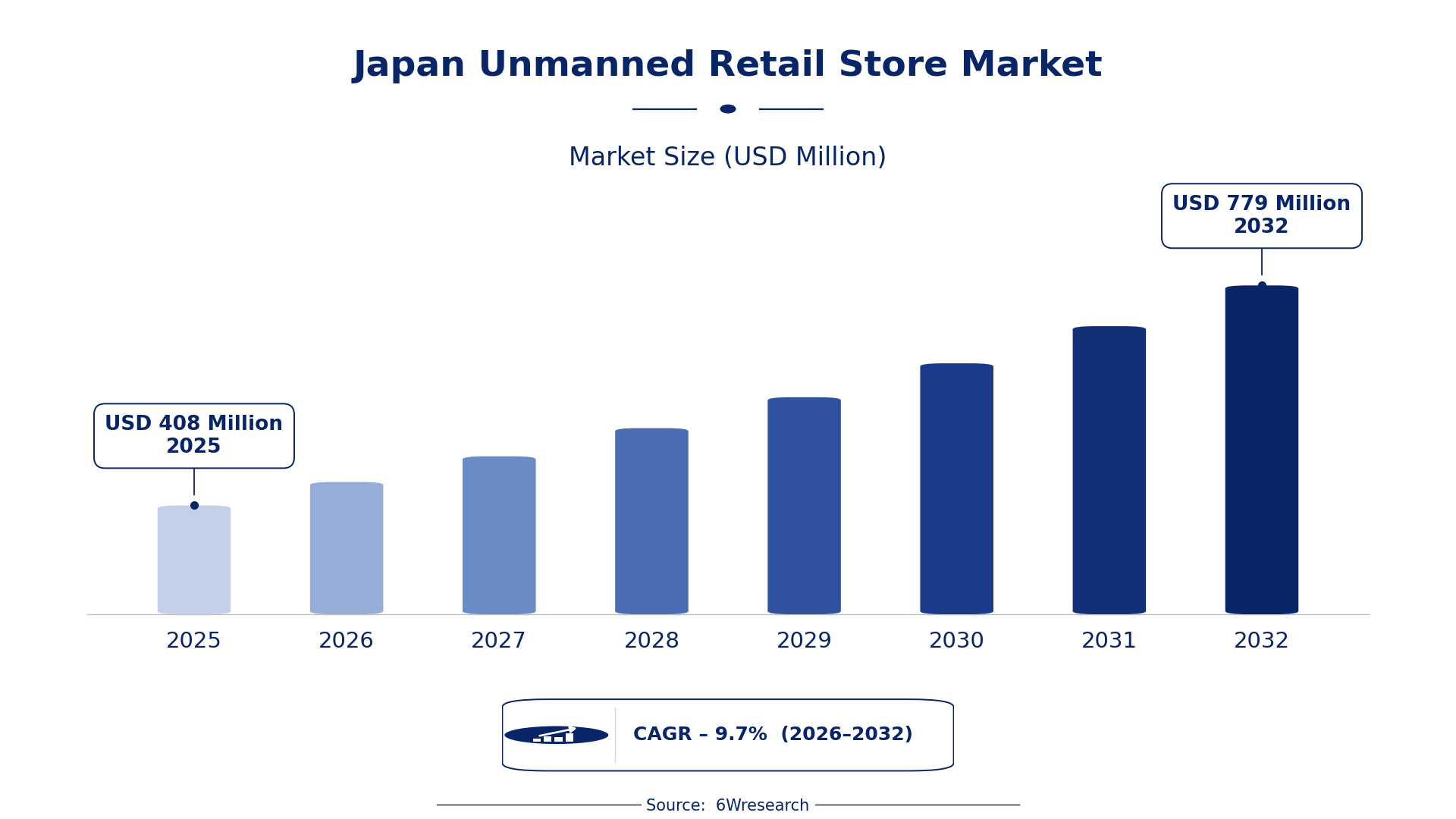
According to 6Wresearch internal database and industry insights, the Japan Unmanned Retail Store Market was valued at USD 408 Million in 2025 and is projected to reach USD 779 Million by 2032, growing at a CAGR of approximately 9.7% during 2026–2032.
Japan Unmanned Retail Store Market Highlights
| Report Metric | Details |
| Report Name | Japan Unmanned Retail Store Market (2026-2032) |
| Market Size 2025 | USD 408 Million |
| Market Size 2032 | USD 779 Million |
| Absolute Growth 2025–2032 | USD 371 Million |
| CAGR 2026–2032 | 9.7% |
| Peak Annual Growth | 10.6% in 2029 |
| Forecast Period | 2026–2032 |
| Historical Data | 2022–2025 |
| Base Year | 2025 |
| Leading Store Format, 2025 | Fully Automated Store (43% share) |
| Leading Technology Used, 2025 | RFID + Computer Vision (47% share) |
| Leading Product Category, 2025 | Snacks & Beverages (42% share) |
| Leading End User, 2025 | Urban Consumers (43% share) |
| Fastest-Growing Store Format | Smart Vending Units (13.7% CAGR) |
| Fastest-Growing Technology Used | Cloud Inventory (13.6% CAGR) |
| Fastest-Growing Product Category | Ready-to-Eat Meals (13.2% CAGR) |
| Fastest-Growing End User | Smart Cities (12.6% CAGR) |
| Growing Sector | Urban Retail |
| Key End Users | Urban Consumers, Office Campuses, Event Venues |
Japan Unmanned Retail Store Market Year-wise Growth Rate and Key Drivers (2022–2032)
This graph illustrates the annual growth rates of the market from 2022 to 2032, highlighting a steady upward trajectory and projected market expansion over the forecast period.
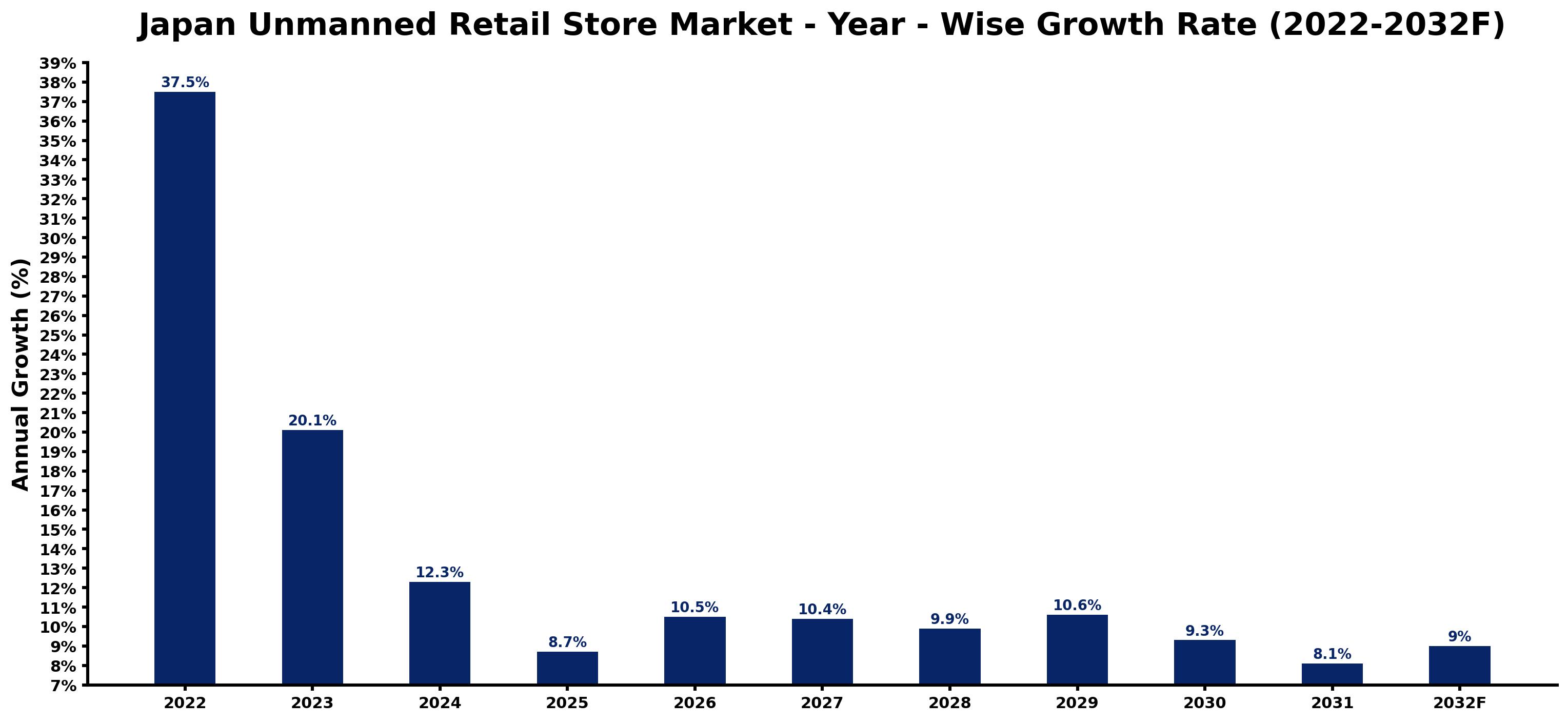
For each year, the table pairs the estimated growth rate with the leading influence on demand, showing how the drivers changed across the period.
| Year | Estimated Annual Growth (%) | Market Rationale |
| 2022 | 37.5 | The market experienced a surge due to heightened consumer interest in automated shopping solutions. |
| 2023 | 20.1 | Growth slowed as market saturation began to affect new store installations and consumer adoption. |
| 2024 | 12.3 | Continued interest in convenience led to further expansion, albeit at a reduced pace compared to previous years. |
| 2025 | 8.7 | The market maintained growth as urban consumers sought more efficient shopping experiences. |
| 2026 | 10.5 | Demand is expected to rise as technology advancements improve operations in unmanned stores. |
| 2027 | 10.4 | Growth is projected to slow slightly due to market maturity and increased competition among existing stores. |
| 2028 | 9.9 | The market is anticipated to continue growing, driven by ongoing urbanisation and smart city initiatives. |
| 2029 | 10.6 | A peak in growth is expected as new technologies and consumer preferences align with unmanned retail solutions. |
| 2030 | 9.3 | The market will experience a slowdown as consumer expectations evolve and competition intensifies. |
| 2031 | 8.1 | Growth is projected to decelerate as the market stabilises, with established players focusing on customer retention. |
| 2032 | 9.0 | An uptick in growth is anticipated as emerging technologies improve the shopping experience. |
Note: Market size estimations and growth projections presented in this report are based on 6Wresearch's proprietary forecasting methodology, utilizing the latest available industry data, government publications, and primary research inputs.
Japan Unmanned Retail Store Market Synopsis
Unmanned retail stores operate autonomously, utilising advanced technology such as AI and automation to provide convenient shopping experiences. They primarily serve urban consumers, office campuses, and event venues. The Japan Unmanned Retail Store Market is expanding due to increasing urbanisation, smart city initiatives, and the convenience demanded by consumers. With over 100 fully automated stores in major cities and a rise in smart vending units, the market is set to grow by 2032.
Market Dynamics Impact Analysis (2026–2032)
| Factor | Type | Impact | Primary Segment Affected |
| Urbanisation drives demand for convenient shopping solutions. | Driver | High | Fully Automated Store |
| Advancements in AI and automation technology enhance operational efficiency. | Driver | High | AI Kiosks |
| Growing consumer preference for convenience creates opportunities for new store formats. | Opportunity | High | Smart Vending Units |
| Increased investment in smart city initiatives boosts demand for unmanned retail solutions. | Opportunity | Medium | Pop-up Pods |
| High initial investment costs limit market entry for new players. | Restraint | High | Fully Automated Store |
| Regulatory compliance requirements can delay store openings and expansions. | Restraint | Medium | AI Kiosks |
| Technological integration challenges can hinder operational efficiency. | Challenge | High | Cloud Inventory |
| Intense competition among existing players may impact profitability. | Challenge | Medium | Smart Vending Units |
Evaluation of Drivers in Japan Unmanned Retail Store Market (2026–2032)
Demand rests on the following drivers, each shown with the segment it touches most.
| Drivers | Primary Segment Affected | Why It Matters (Evidence) |
| Rising urban population increases demand for convenient shopping options. | Fully Automated Store | Approximately 80 million urban consumers in Japan seek efficient shopping experiences. |
| Technological advancements in AI improve customer interaction and streamline operations. | AI Kiosks | AI kiosks are integrated into 30% of new retail projects in urban areas. |
| The growth of smart cities supports the installation of unmanned retail solutions. | Smart Vending Units | Tokyo and Osaka have over 500 smart vending units installed. |
| Consumer preference for ready-to-eat meals drives sales in unmanned stores. | Ready-to-Eat Meals | Ready-to-eat meals represent 40% of sales in unmanned retail stores. |
| Cloud inventory systems improve stock management and operational efficiency. | Cloud Inventory | 60% of automated stores have adopted cloud inventory systems. |
Buyers are adding capacity as urbanisation increases the demand for convenient shopping solutions. With approximately 80 million urban consumers in Japan, the need for efficient shopping experiences is paramount. Technological advancements in AI are improving customer interaction, with AI kiosks integrated into 30% of new retail projects. The growth of smart cities is supporting the installation of unmanned retail solutions. Ready-to-eat meals drive sales, accounting for 40% of total sales in unmanned stores, while 60% of automated stores have adopted cloud inventory systems to improve stock management.
Evaluation of Restraints in Japan Unmanned Retail Store Market
Several factors work against faster growth; the main ones are summarised below.
| Market Restraint | Primary Segment Affected | Why It Matters (Evidence) |
| High initial investment costs limit entry for new players. | Fully Automated Store | The capital required for setting up fully automated stores can deter potential investors. |
| Regulatory compliance can delay store openings and expansions. | AI Kiosks | Compliance with the JIS Z 8401 standard may prolong the deployment of new kiosks. |
| Integration of new technologies can lead to operational disruptions and increased costs. | Cloud Inventory | Technological integration challenges can hinder operational efficiency. |
| Market saturation limits growth potential for existing players. | Smart Vending Units | An oversupply of vending units in urban areas may lead to reduced profitability. |
| Changing consumer preferences can impact sales strategies. | Ready-to-Eat Meals | Evolving tastes may require constant adaptation of product offerings to maintain relevance. |
Japan Unmanned Retail Store Market Challenges
In 2023, automated stores faced technology failures that led to transaction delays, frustrating urban consumers and reducing foot traffic. Competition from traditional retail has intensified, compelling suppliers to lower prices, which diminishes profit margins. A shortage of skilled workers in automation hampers the development of new unmanned retail solutions, delaying expansion plans for producers. Rising operational costs, driven by Japan's minimum wage increase to JPY 1,055 per hour in October 2024, strain budgets for clinics and event venues that depend on unmanned systems.
Trends in the Japan Unmanned Retail Store Market
The trends below show where the Japan Unmanned Retail Store Market is heading.
- Shift from Traditional Retail to Unmanned Solutions: The transition to unmanned retail solutions has accelerated, particularly in urban areas like Tokyo, where over 100 fully automated stores operate, reflecting a growing consumer preference for convenience.
- Emergence of Smart Vending Units: Since 2023, smart vending units have gained popularity, particularly in Tokyo, with around 500 units installed, catering to the demand for quick access to snacks and beverages.
- Integration of AI in Retail: Beginning in 2026, AI technology is increasingly being integrated into retail environments, with 30% of new projects featuring AI kiosks, improving customer interaction and streamlining operations.
- Growth of Ready-to-Eat Meal Offerings: As of 2023, ready-to-eat meals constitute 40% of sales in unmanned stores, indicating a shift towards convenience-focused product offerings that cater to busy urban consumers.
Investment Opportunities in the Japan Unmanned Retail Store Market
The following opportunities in the Japan Unmanned Retail Store Market pair current demand with a clear way in.
- Partner with Local Technology Firms: Now is the time to invest in AI kiosks, as urban areas increasingly adopt these solutions, with 30% of new projects integrating AI technology to improve customer experiences.
- Supply Ready-to-Eat Meal Options: With ready-to-eat meals representing 40% of sales, suppliers should focus on this category, particularly in urban centres where demand is high and convenience is paramount.
- Invest in Smart Vending Unit Technology: The growing number of smart vending units, particularly in Tokyo, presents an opportunity for suppliers to innovate and provide advanced vending solutions, capitalising on the urban consumer trend.
- Engage in Smart City Initiatives: The government's allocation of 5 billion yen for smart city projects in 2023 creates opportunities for collaboration with local authorities to improve unmanned retail solutions.
Government Initiatives in the Japan Unmanned Retail Store Market
The New Robot Strategy, initiated in 2015, aims to expand the use of robotics in various sectors, including retail. This strategy encourages the development of unmanned retail stores by promoting technological advancements and providing funding for projects. The Food Sanitation Act amendment, fully applied in June 2021, mandates HACCP-based hygiene management for food businesses, ensuring that unmanned stores comply with stringent health standards, thereby building consumer trust.
To promote unmanned retail solutions, the Tokyo Metropolitan Government facilitates the installation of automated stores in popular tourist areas. This initiative is supported by the Japan Automated Retail Association, established in 2022, which aims to support industry growth and innovation. By providing resources and guidance, these agencies help streamline the approval process for new installations, encouraging more businesses to adopt unmanned formats.
Future Insight of the Japan Unmanned Retail Store Market
By 2032, the integration of advanced technology will reshape demand, with urban areas expected to see the establishment of 1,000 new automated stores. The adoption of cloud inventory systems will reach 60% among automated stores, streamlining operations for suppliers. Voice and face ID technologies will become standard in 25% of new installations, enhancing customer interaction. The government's allocation of 5 billion yen for smart city projects will further strengthen infrastructure, benefiting both buyers and suppliers.
Market Segmentation Analysis
Japan Unmanned Retail Store Market report covers a detailed analysis of the following market segments:
By Store Format – Fully Automated Store Leads, Smart Vending Units Expected to Grow Fastest
According to Saurav Kr Singh, Senior Research Analyst at 6Wresearch, in 2025, Fully Automated Store led the store format split with a 43% share. The fully automated store segment holds the largest share due to its ability to provide a completely autonomous shopping experience, appealing to urban consumers seeking convenience. With over 100 fully automated stores established in major cities, this format effectively meets the demands of a tech-savvy population. Over 2026–2032, Smart Vending Units are expected to post the fastest growth, at a CAGR of 13.7%. Smart vending units are experiencing rapid growth as they offer quick access to snacks and beverages, catering to the busy lifestyles of urban dwellers. The presence of approximately 500 smart vending units in Tokyo exemplifies this trend, indicating a shift towards on-the-go consumption. Suppliers should focus on enhancing the variety and efficiency of fully automated stores to capture the growing urban consumer base.
By Technology Used – RFID + Computer Vision Leads, Cloud Inventory Expected to Grow Fastest
RFID + Computer Vision accounted for 47% of the market by technology used in 2025. RFID combined with computer vision is the leading technology as it enables efficient inventory tracking and customer identification, essential for maintaining operational efficiency in unmanned stores. This technology is widely adopted across automated retail systems, ensuring seamless transactions and improved customer experiences. Cloud Inventory is projected to grow fastest, at a CAGR of 13.6% during 2026–2032. Cloud inventory technology is witnessing swift growth as it supports real-time inventory management, crucial for meeting the demands of fast-paced retail environments. The adoption rate of 60% among automated stores highlights its increasing importance in optimising stock levels and reducing waste. Buyers should invest in advanced inventory technologies to optimise their operations and improve customer satisfaction.
By Product Category – Snacks & Beverages Lead, Ready-to-Eat Meals Expected to Grow Fastest
With 42% of product category revenue in 2025, Snacks & Beverages was the largest category. Snacks and beverages dominate the product category as they are the primary products offered in unmanned stores, appealing to consumers looking for quick and convenient options. This category's popularity is reflected in its substantial sales volume within these retail formats, particularly in urban areas. Ready-to-Eat Meals are set to record the highest CAGR in this split, 13.2% over 2026–2032. Ready-to-eat meals are rapidly gaining traction due to their convenience for consumers seeking quick meal solutions. This category has seen a notable 30% increase in stock, indicating strong demand and a shift towards ready-made options in urban retail environments. Suppliers should expand their ready-to-eat meal offerings to capitalise on the growing consumer preference for convenience.
By End User – Urban Consumers Lead, Smart Cities Expected to Grow Fastest
Urban Consumers held 43% of the Japan Unmanned Retail Store Market by end user in 2025. Urban consumers represent the largest end user group, as they are the main target demographic for unmanned stores seeking convenience in their shopping experiences. With an estimated 80 million urban consumers in Japan, this segment drives market growth. The quickest growth will come from Smart Cities, forecast to expand at a CAGR of 12.6% between 2026 and 2032. Smart cities are emerging as the fastest-growing end user segment, integral to urban development strategies that promote technological advancements. The government's support for smart city initiatives further accelerates this trend. Suppliers must align their strategies with smart city initiatives to effectively tap into this expanding market.
Key Attractiveness of the Report
- 10 Years of Market Numbers
- Historical Data Starting from 2022 to 2025
- Base Year 2025
- Forecast Data until 2032
- Key Performance Indicators Impacting the Market
- Major Upcoming Developments and Projects
Key Highlights of the Report:
- Japan Unmanned Retail Store Market Outlook
- Market Size of Japan Unmanned Retail Store Market, 2025
- Forecast of Japan Unmanned Retail Store Market, 2032
- Historical Data and Forecast of Japan Unmanned Retail Store Revenues & Volume for the Period 2022-2032F
- Japan Unmanned Retail Store Market Trend Evolution
- Japan Unmanned Retail Store Market Drivers and Challenges
- Japan Unmanned Retail Store Price Trends
- Japan Unmanned Retail Store Porter's Five Forces
- Japan Unmanned Retail Store Industry Life Cycle
- Historical Data and Forecast of Japan Unmanned Retail Store Market Revenues & Volume By Store Format for the Period 2022-2032F
- Historical Data and Forecast of Japan Unmanned Retail Store Market Revenues & Volume By Fully Automated Store for the Period 2022-2032F
- Historical Data and Forecast of Japan Unmanned Retail Store Market Revenues & Volume By Smart Vending Units for the Period 2022-2032F
- Historical Data and Forecast of Japan Unmanned Retail Store Market Revenues & Volume By Pop-up Pods for the Period 2022-2032F
- Historical Data and Forecast of Japan Unmanned Retail Store Market Revenues & Volume By AI Kiosks for the Period 2022-2032F
- Historical Data and Forecast of Japan Unmanned Retail Store Market Revenues & Volume By Technology Used for the Period 2022-2032F
- Historical Data and Forecast of Japan Unmanned Retail Store Market Revenues & Volume By RFID + Computer Vision for the Period 2022-2032F
- Historical Data and Forecast of Japan Unmanned Retail Store Market Revenues & Volume By Mobile App Control for the Period 2022-2032F
- Historical Data and Forecast of Japan Unmanned Retail Store Market Revenues & Volume By Cloud Inventory for the Period 2022-2032F
- Historical Data and Forecast of Japan Unmanned Retail Store Market Revenues & Volume By Voice + Face ID for the Period 2022-2032F
- Historical Data and Forecast of Japan Unmanned Retail Store Market Revenues & Volume By Product Category for the Period 2022-2032F
- Historical Data and Forecast of Japan Unmanned Retail Store Market Revenues & Volume By Snacks & Beverages for the Period 2022-2032F
- Historical Data and Forecast of Japan Unmanned Retail Store Market Revenues & Volume By Ready-to-Eat Meals for the Period 2022-2032F
- Historical Data and Forecast of Japan Unmanned Retail Store Market Revenues & Volume By Essentials for the Period 2022-2032F
- Historical Data and Forecast of Japan Unmanned Retail Store Market Revenues & Volume By Groceries for the Period 2022-2032F
- Historical Data and Forecast of Japan Unmanned Retail Store Market Revenues & Volume By End User for the Period 2022-2032F
- Historical Data and Forecast of Japan Unmanned Retail Store Market Revenues & Volume By Urban Consumers for the Period 2022-2032F
- Historical Data and Forecast of Japan Unmanned Retail Store Market Revenues & Volume By Office Campuses for the Period 2022-2032F
- Historical Data and Forecast of Japan Unmanned Retail Store Market Revenues & Volume By Event Venues for the Period 2022-2032F
- Historical Data and Forecast of Japan Unmanned Retail Store Market Revenues & Volume By Smart Cities for the Period 2022-2032F
- Japan Unmanned Retail Store Import Export Trade Statistics
- Market Opportunity Assessment By Store Format
- Market Opportunity Assessment By Technology Used
- Market Opportunity Assessment By Product Category
- Market Opportunity Assessment By End User
- Japan Unmanned Retail Store Top Companies Market Share
- Japan Unmanned Retail Store Competitive Benchmarking By Technical and Operational Parameters
- Japan Unmanned Retail Store Company Profiles
- Japan Unmanned Retail Store Key Strategic Recommendations
Market Covered
The study includes the following segmentation.
By Store Format
- Fully Automated Store
- Smart Vending Units
- Pop-up Pods
- AI Kiosks
By Technology Used
- RFID + Computer Vision
- Mobile App Control
- Cloud Inventory
- Voice + Face ID
By Product Category
- Snacks & Beverages
- Ready-to-Eat Meals
- Essentials
- Groceries
By End User
- Urban Consumers
- Office Campuses
- Event Venues
- Smart Cities































