Japan Unmanned Weapons Platform Market Size & Growth Rate
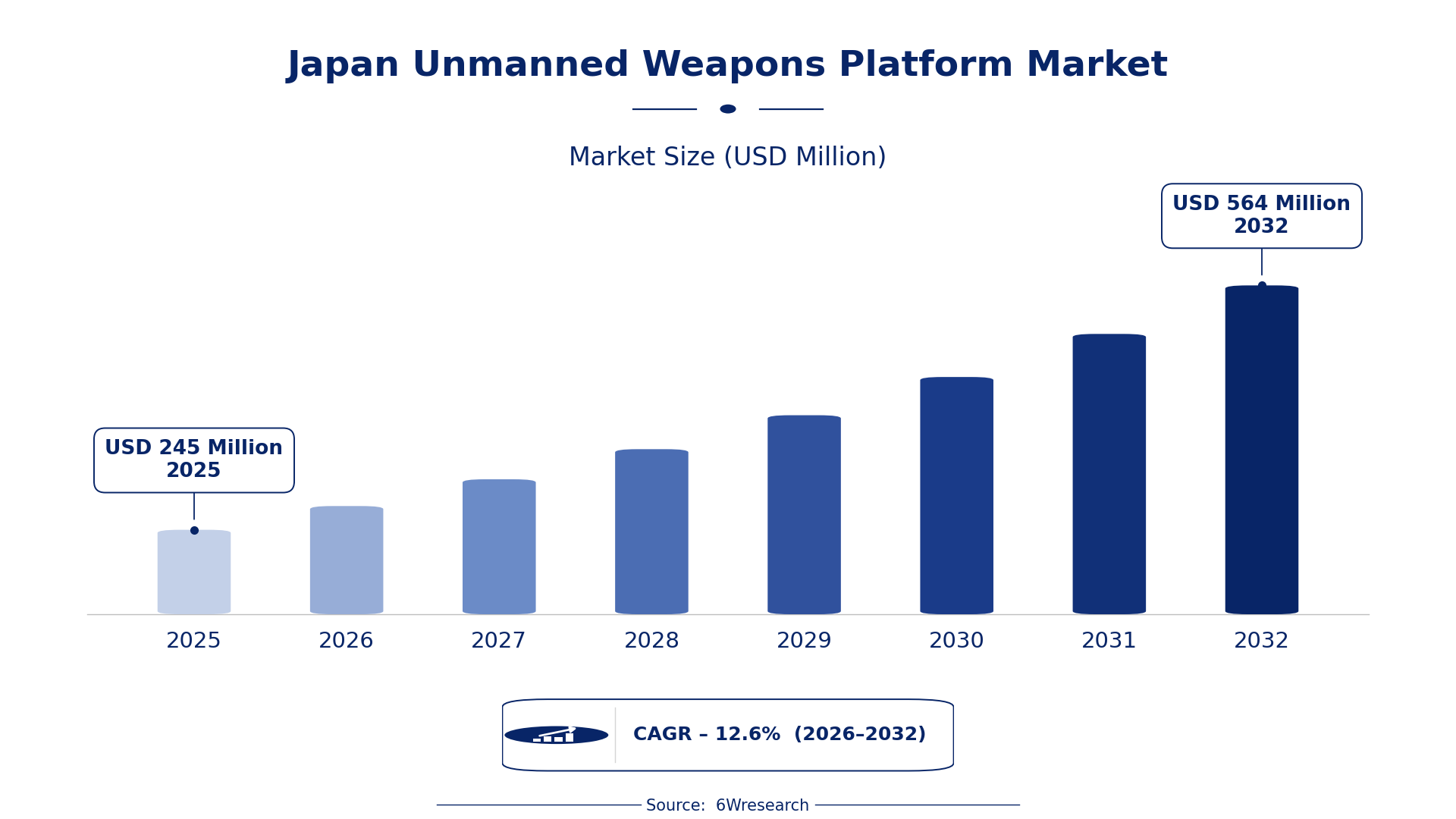
According to 6Wresearch internal database and industry insights, the Japan Unmanned Weapons Platform Market was valued at USD 245 Million in 2025 and is projected to reach USD 564 Million by 2032, growing at a CAGR of approximately 12.6% during 2026–2032.
Japan Unmanned Weapons Platform Market Highlights
| Report Metric | Details |
| Report Name | Japan Unmanned Weapons Platform Market (2026-2032) |
| Market Size 2025 | USD 245 Million |
| Market Size 2032 | USD 564 Million |
| Absolute Growth 2025–2032 | USD 319 Million |
| CAGR 2026–2032 | 12.6% |
| Peak Annual Growth | 13.8% in 2028 |
| Forecast Period | 2026–2032 |
| Historical Data | 2022–2025 |
| Base Year | 2025 |
| Leading Platform Type, 2025 | Ground-Based UGV (44% share) |
| Leading Weapon Integration, 2025 | Machine Gun/Turret (38% share) |
| Leading Mobility Type, 2025 | Tracked/Wheeled (35% share) |
| Leading End User, 2025 | Defense Contractors (45% share) |
| Fastest-Growing Platform Type | Aerial UAV Platforms (17.5% CAGR) |
| Fastest-Growing Weapon Integration | Missile/Firing Pods (17.6% CAGR) |
| Fastest-Growing Mobility Type | Fixed/Multi-Rotor (18.0% CAGR) |
| Fastest-Growing End User | Military Forces (16.1% CAGR) |
| Growing Sector | defense technology |
| Key End Users | Defense Contractors, Military Forces, Naval Defense, Tactical Units |
Japan Unmanned Weapons Platform Market Year-wise Growth Rate and Key Drivers (2022–2032)
This graph illustrates the annual growth rates of the market from 2022 to 2032, highlighting a steady upward trajectory and projected market expansion over the forecast period.
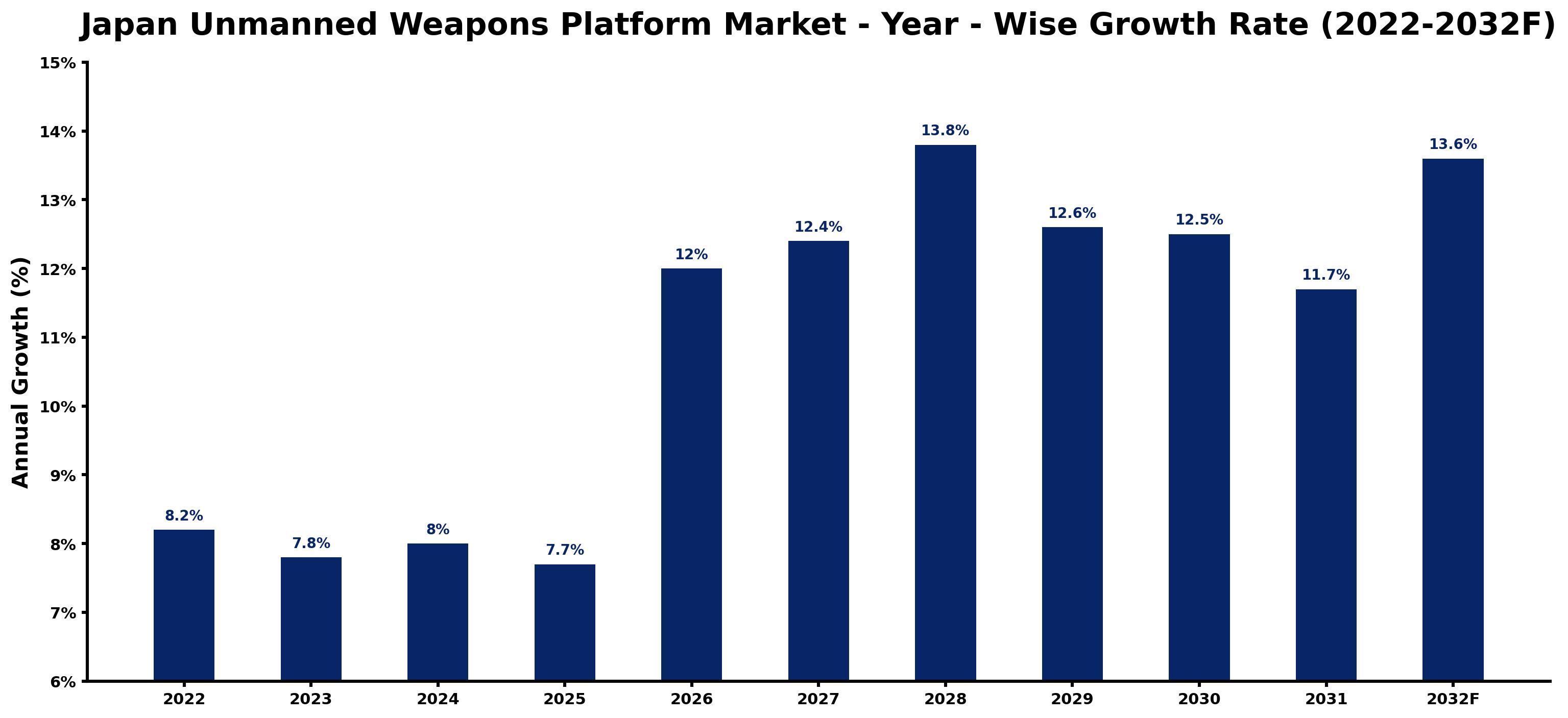
Year by year, the estimates below pair each growth rate with the development that shaped it.
| Year | Estimated Annual Growth (%) | Market Rationale |
| 2022 | 8.2 | Demand was driven by the integration of UAVs into the Japan Self-Defense Forces' operations. |
| 2023 | 7.8 | Growth slowed as military budgets were reallocated towards other defense priorities. |
| 2024 | 8.0 | Demand increased with the ongoing development of unmanned systems by the Ministry of Defense. |
| 2025 | 7.7 | Growth moderated as the JSDF focused on refining operational capabilities with existing platforms. |
| 2026 | 12.0 | Investment surged as the Ministry of Defense is expected to improve unmanned systems by 2025. |
| 2027 | 12.4 | Demand rose with the integration of advanced AI technologies in military applications. |
| 2028 | 13.8 | The market peaked as international collaborations intensified and technology sharing expanded. |
| 2029 | 12.6 | Growth slowed due to the maturation of existing technologies and platforms. |
| 2030 | 12.5 | Demand continued to rise as new operational requirements emerge for unmanned systems. |
| 2031 | 11.7 | Growth moderated as the market adjusts to technological advancements and user needs. |
| 2032 | 13.6 | Demand is projected to increase as new technologies are adopted in military operations. |
Note: Market size estimations and growth projections presented in this report are based on 6Wresearch's proprietary forecasting methodology, utilizing the latest available industry data, government publications, and primary research inputs.
Japan Unmanned Weapons Platform Market Synopsis
Unmanned Weapons Platforms are advanced military systems that operate autonomously, utilising robotics and AI for surveillance, reconnaissance, and combat operations. The Japan Unmanned Weapons Platform Market is expanding due to a defence budget of approximately ¥6 trillion for 2023 and the active integration of UAVs into military operations. The Ministry of Defence's emphasis on developing unmanned systems by 2025 and partnerships with international defence organisations for technology sharing are driving further demand.
Market Dynamics Impact Analysis (2026–2032)
| Factor | Type | Impact | Primary Segment Affected |
| Increasing defense budget allocation for unmanned systems | Driver | High | Aerial UAV Platforms |
| Growing emphasis on AI integration in military applications | Driver | High | Multi-Domain Platforms |
| Rising demand for advanced surveillance capabilities | Opportunity | High | Ground-Based UGV |
| Need for precision strike capabilities in combat scenarios | Opportunity | High | Missile/Firing Pods |
| Strict regulations governing defense technology development | Restraint | Medium | Naval Weapon Drones |
| High costs associated with R&D for advanced unmanned systems | Restraint | Medium | Aerial UAV Platforms |
| Limited domestic production capacity for advanced technologies | Challenge | High | Machine Gun/Turret |
| Compliance with international defense regulations and standards | Challenge | Medium | AI Targeting System |
Evaluation of Drivers in Japan Unmanned Weapons Platform Market (2026–2032)
The following drivers explain most of the expected growth.
| Drivers | Primary Segment Affected | Why It Matters (Evidence) |
| Increased defense budget allocation | Aerial UAV Platforms | Japan's defense budget of approximately ¥6 trillion for 2023 supports the procurement of UAVs for surveillance and combat. |
| Emphasis on AI integration | Multi-Domain Platforms | The 2023 Defense Strategy highlights AI's role in military applications, driving demand for unmanned systems. |
| Growing partnerships for technology sharing | Ground-Based UGV | International collaborations enable access to advanced unmanned technologies, boosting demand. |
| Focus on precision strike capabilities | Missile/Firing Pods | The JSDF's need for effective combat solutions increases demand for missile systems integrated into unmanned platforms. |
| R&D investments in dual-use technologies | Naval Weapon Drones | Japan's investment in R&D for unmanned systems improves capabilities for both military and civilian applications. |
Volumes grow on the back of Japan's defence budget of approximately ¥6 trillion for 2023, which supports the procurement of UAVs for surveillance and combat. The focus on AI integration in military applications drives demand for Multi-Domain Platforms. Collaborations with international defence organisations enable access to advanced technologies, increasing demand for Ground-Based UGVs. The JSDF's need for effective combat solutions boosts demand for Missile/Firing Pods. Investment in R&D for unmanned systems improves capabilities for military and civilian applications, leading to higher procurement levels.
Evaluation of Restraints in Japan Unmanned Weapons Platform Market
The main factors holding the market back are set out below.
| Market Restraint | Primary Segment Affected | Why It Matters (Evidence) |
| Strict regulations governing defense technology development | Naval Weapon Drones | Japan's defense industry is governed by strict regulations, limiting the pace of technological advancements. |
| High costs associated with R&D for advanced unmanned systems | Aerial UAV Platforms | Investment in advanced technologies can strain budgets, affecting procurement decisions by military forces. |
| Limited domestic production capacity for advanced technologies | Machine Gun/Turret | Japan's reliance on foreign technology can hinder timely availability of advanced unmanned systems. |
| Compliance with international defense regulations and standards | AI Targeting System | Adhering to complex regulations can delay the deployment of new technologies in military operations. |
| Potential delays in technology integration due to bureaucratic processes | Multi-Domain Platforms | The lengthy approval processes can slow down the introduction of new unmanned systems into the JSDF. |
Japan Unmanned Weapons Platform Market Challenges
Japan's rigorous engineering standards and high-quality materials drive up production costs, delaying project timelines for producers by approximately 20%. Strict regulations from the Defence Equipment Agency complicate the approval process, potentially extending technology integration timelines for importers by 18 months. Buyers face challenges with a limited pool of domestic suppliers for unmanned platforms, resulting in procurement costs that can exceed 20% over budget estimates. Rapid technological advancements require ongoing innovation from producers, risking obsolescence of existing systems within a two-year cycle, which undermines their market competitiveness.
Trends in the Japan Unmanned Weapons Platform Market
The following changes are redrawing the Japan Unmanned Weapons Platform Market.
- Shift from Traditional to Autonomous Systems: Since 2023, Japan has been transitioning towards autonomous systems in military operations, improving efficiency. The JSDF's focus on integrating UAVs into their operations is reflected in approximately 20% of the defence budget allocated to unmanned technologies.
- Emergence of AI-Driven Targeting Systems: In 2023, Japan's defence strategy prioritised AI integration, leading to the development of AI Targeting Systems. This shift is expected to improve targeting accuracy in combat scenarios, with an anticipated 30% increase in operational efficiency.
- Growth of Multi-Domain Operations: The JSDF is increasingly adopting Multi-Domain Platforms to enhance operational versatility. This trend is reflected in joint exercises with allied forces, showcasing a 25% rise in collaborative operations since 2023.
- Expansion of International Defense Collaborations: Since 2023, Japan has intensified partnerships with international defence organisations for technology sharing. This expansion is projected to increase the availability of advanced unmanned systems by 15% over the next few years.
Investment Opportunities in the Japan Unmanned Weapons Platform Market
The openings below show where demand in the Japan Unmanned Weapons Platform Market is visible and how suppliers can enter.
- Defense Contractors Seeking Advanced Solutions: Defense Contractors in Japan are increasingly looking for advanced unmanned systems to meet operational needs. With a defence budget of approximately ¥6 trillion for 2023, now is the time to invest in partnerships for technology development.
- Joint Ventures for Technology Development: Establishing joint ventures with local defence firms can facilitate access to the growing unmanned weapons platform market. The Tokyo Metropolitan area is a hub for defence technology development, making it an ideal location for collaboration.
- Focus on R&D for Dual-Use Technologies: The current emphasis on R&D for dual-use technologies presents opportunities for investment in unmanned systems. The Ministry of Defence's target to improve unmanned systems by 2025 creates a favourable environment for suppliers.
- Investment in Training Facilities for Military Forces: Military Forces are in need of advanced training facilities for unmanned systems. Investing in training infrastructure now can improve operational readiness, with a projected increase in demand by 2025.
Government Initiatives in the Japan Unmanned Weapons Platform Market
The Industrial Safety and Health Act of 1972 mandates safety standards for machinery and hazardous substances, ensuring that unmanned weapons platforms meet strict safety requirements. This law influences production processes and operational protocols. The National Defence Program Guidelines emphasise the development of unmanned platforms, reflecting the government's commitment to improving defence capabilities through advanced technologies.
Funding for unmanned systems R&D is projected to reach ¥100 billion by 2025, supporting the integration of advanced technologies into military operations. The Digital Agency, created in September 2021, oversees the digital transformation of government systems, ensuring that unmanned platforms comply with modern standards.
Future Insight of the Japan Unmanned Weapons Platform Market
The integration of AI technologies will redefine the capabilities of unmanned weapons platforms, enhancing their effectiveness in surveillance and combat. The Ministry of Defence's goal to develop unmanned systems by 2025 will drive increased investments in R&D, particularly focusing on dual-use technologies. Partnerships with international defence organisations will facilitate technology sharing, leading to improved system efficiencies. Adoption of ISO standards for safety and operation will boost reliability, giving buyers greater confidence in the platforms used by the Japan Self-Defense Forces.
Market Segmentation Analysis
Japan Unmanned Weapons Platform Market report covers a detailed analysis of the following market segments:
By Platform Type – Ground-Based UGV Leads, Aerial UAV Platforms Expected to Grow Fastest
According to Saurav Kr Singh, Senior Research Analyst at 6Wresearch, Ground-Based UGV took 44% of platform type revenue in 2025, more than any other category. Ground-Based UGVs hold the largest share as they are extensively utilised in land-based military operations, particularly by the Japan Self-Defense Forces. Their integration into existing military strategies has established a solid installed base, reinforcing their market position. The quickest growth will come from Aerial UAV Platforms, forecast to expand at a CAGR of 17.5% between 2026 and 2032. Aerial UAV Platforms are witnessing rapid growth due to their critical role in aerial surveillance and strikes, with the Japan Self-Defense Forces actively incorporating them into operations. This trend is expected to accelerate as the Ministry of Defense aims to enhance unmanned systems by 2025. Suppliers should prioritise the development of advanced aerial capabilities to satisfy the rising demand from military forces.
By Weapon Integration – Machine Gun/Turret Leads, Missile/Firing Pods Expected to Grow Fastest
The largest weapon integration category in 2025 was Machine Gun/Turret, at 38% of revenue. Machine Gun/Turret systems dominate the market as they are directly integrated for ground combat support, making them essential for defence operations. Their established use in various military scenarios significantly contributes to their market share. Over 2026–2032, Missile/Firing Pods are expected to post the fastest growth, at a CAGR of 17.6%. Missile/Firing Pods are experiencing rapid growth owing to their effectiveness in precision strikes, which aligns with the increasing focus on accuracy in contemporary combat situations. This growth is further supported by ongoing advancements in weapon integration technologies. Buyers will gain from improved weapon systems that enhance combat effectiveness and operational efficiency.
By Mobility Type – Tracked/Wheeled Leads, Fixed/Multi-Rotor Expected to Grow Fastest
Tracked/Wheeled accounted for 35% of the market by mobility type in 2025. Tracked/Wheeled platforms lead the market as they are widely used for mobility across various terrains, catering to the operational needs of defense contractors. Their versatility in different environments solidifies their position in the unmanned weapons platform market. Fixed/Multi-Rotor is projected to grow fastest, at a CAGR of 18.0% during 2026–2032. Fixed/Multi-Rotor platforms are rapidly gaining traction, driven by their employment in diverse aerial missions that require flexibility and adaptability. The increasing demand for such capabilities indicates a shift towards more versatile mobility solutions. Suppliers must invest in developing multi-rotor technologies to capture the growing interest from military forces.
By End User – Defense Contractors Lead, Military Forces Expected to Grow Fastest
With 45% of end user revenue in 2025, Defense Contractors was the largest category. Defense Contractors represent the largest share as they are the primary users of unmanned platforms, driving demand through their projects and collaborations. Their established relationships with the Japan Self-Defense Forces ensure a steady market for these technologies. Military Forces are set to record the highest CAGR in this split, 16.1% over 2026–2032. Military Forces are the fastest-growing end user segment, reflecting their increasing reliance on unmanned technologies for operational effectiveness. This trend is expected to continue as military strategies evolve to incorporate more advanced systems. Suppliers should prioritise partnerships with military forces to align their offerings with emerging operational requirements.
Key Attractiveness of the Report
- 10 Years of Market Numbers
- Historical Data Starting from 2022 to 2025
- Base Year 2025
- Forecast Data until 2032
- Key Performance Indicators Impacting the Market
- Major Upcoming Developments and Projects
Key Highlights of the Report:
- Japan Unmanned Weapons Platform Market Outlook
- Market Size of Japan Unmanned Weapons Platform Market, 2025
- Forecast of Japan Unmanned Weapons Platform Market, 2032
- Historical Data and Forecast of Japan Unmanned Weapons Platform Revenues & Volume for the Period 2022-2032F
- Japan Unmanned Weapons Platform Market Trend Evolution
- Japan Unmanned Weapons Platform Market Drivers and Challenges
- Japan Unmanned Weapons Platform Price Trends
- Japan Unmanned Weapons Platform Porter's Five Forces
- Japan Unmanned Weapons Platform Industry Life Cycle
- Historical Data and Forecast of Japan Unmanned Weapons Platform Market Revenues & Volume By Platform Type for the Period 2022-2032F
- Historical Data and Forecast of Japan Unmanned Weapons Platform Market Revenues & Volume By Ground-Based UGV for the Period 2022-2032F
- Historical Data and Forecast of Japan Unmanned Weapons Platform Market Revenues & Volume By Aerial UAV Platforms for the Period 2022-2032F
- Historical Data and Forecast of Japan Unmanned Weapons Platform Market Revenues & Volume By Naval Weapon Drones for the Period 2022-2032F
- Historical Data and Forecast of Japan Unmanned Weapons Platform Market Revenues & Volume By Multi-Domain Platforms for the Period 2022-2032F
- Historical Data and Forecast of Japan Unmanned Weapons Platform Market Revenues & Volume By Weapon Integration for the Period 2022-2032F
- Historical Data and Forecast of Japan Unmanned Weapons Platform Market Revenues & Volume By Machine Gun/Turret for the Period 2022-2032F
- Historical Data and Forecast of Japan Unmanned Weapons Platform Market Revenues & Volume By Missile/Firing Pods for the Period 2022-2032F
- Historical Data and Forecast of Japan Unmanned Weapons Platform Market Revenues & Volume By Torpedo Launch for the Period 2022-2032F
- Historical Data and Forecast of Japan Unmanned Weapons Platform Market Revenues & Volume By AI Targeting System for the Period 2022-2032F
- Historical Data and Forecast of Japan Unmanned Weapons Platform Market Revenues & Volume By Mobility Type for the Period 2022-2032F
- Historical Data and Forecast of Japan Unmanned Weapons Platform Market Revenues & Volume By Tracked/Wheeled for the Period 2022-2032F
- Historical Data and Forecast of Japan Unmanned Weapons Platform Market Revenues & Volume By Fixed/Multi-Rotor for the Period 2022-2032F
- Historical Data and Forecast of Japan Unmanned Weapons Platform Market Revenues & Volume By Surface Craft for the Period 2022-2032F
- Historical Data and Forecast of Japan Unmanned Weapons Platform Market Revenues & Volume By Cross-Terrain for the Period 2022-2032F
- Historical Data and Forecast of Japan Unmanned Weapons Platform Market Revenues & Volume By End User for the Period 2022-2032F
- Historical Data and Forecast of Japan Unmanned Weapons Platform Market Revenues & Volume By Defense Contractors for the Period 2022-2032F
- Historical Data and Forecast of Japan Unmanned Weapons Platform Market Revenues & Volume By Military Forces for the Period 2022-2032F
- Historical Data and Forecast of Japan Unmanned Weapons Platform Market Revenues & Volume By Naval Defense for the Period 2022-2032F
- Historical Data and Forecast of Japan Unmanned Weapons Platform Market Revenues & Volume By Tactical Units for the Period 2022-2032F
- Japan Unmanned Weapons Platform Import Export Trade Statistics
- Market Opportunity Assessment By Platform Type
- Market Opportunity Assessment By Weapon Integration
- Market Opportunity Assessment By Mobility Type
- Market Opportunity Assessment By End User
- Japan Unmanned Weapons Platform Top Companies Market Share
- Japan Unmanned Weapons Platform Competitive Benchmarking By Technical and Operational Parameters
- Japan Unmanned Weapons Platform Company Profiles
- Japan Unmanned Weapons Platform Key Strategic Recommendations
Market Covered
The report covers the following segments.
By Platform Type
- Ground-Based UGV
- Aerial UAV Platforms
- Naval Weapon Drones
- Multi-Domain Platforms
By Weapon Integration
- Machine Gun/Turret
- Missile/Firing Pods
- Torpedo Launch
- AI Targeting System
By Mobility Type
- Tracked/Wheeled
- Fixed/Multi-Rotor
- Surface Craft
- Cross-Terrain
By End User
- Defense Contractors
- Military Forces
- Naval Defense
- Tactical Units































