Japan Upholstery and Seat Cover Materials Market Size & Growth Rate
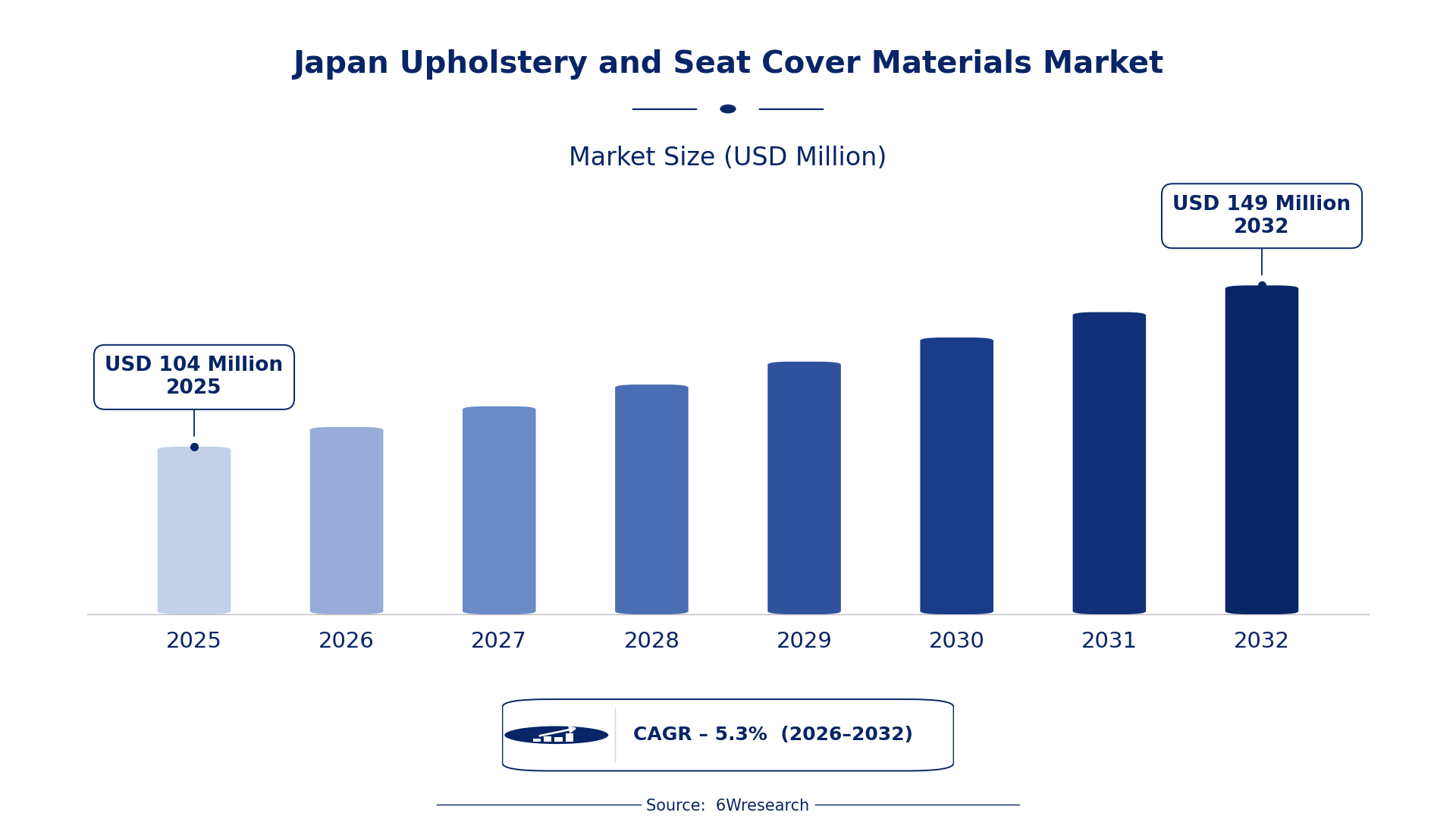
According to 6Wresearch internal database and industry insights, the Japan Upholstery and Seat Cover Materials Market was valued at USD 104 Million in 2025 and is projected to reach USD 149 Million by 2032, growing at a CAGR of approximately 5.3% during 2026–2032.
Japan Upholstery and Seat Cover Materials Market Highlights
| Report Metric | Details |
| Report Name | Japan Upholstery and Seat Cover Materials Market (2026-2032) |
| Market Size 2025 | USD 104 Million |
| Market Size 2032 | USD 149 Million |
| Absolute Growth 2025–2032 | USD 45 Million |
| CAGR 2026–2032 | 5.3% |
| Peak Annual Growth | 6.5% in 2028 |
| Forecast Period | 2026–2032 |
| Historical Data | 2022–2025 |
| Base Year | 2025 |
| Leading Material Type, 2025 | Leatherette (36% share) |
| Leading Fabric Finish, 2025 | PU Coated (39% share) |
| Leading Vehicle Type, 2025 | Luxury Cars (44% share) |
| Leading End User, 2025 | OEMs (44% share) |
| Fastest-Growing Material Type | Eco-Friendly Textiles (7.4% CAGR) |
| Fastest-Growing Fabric Finish | Recycled Polyester (7.2% CAGR) |
| Fastest-Growing Vehicle Type | EVs (7.3% CAGR) |
| Fastest-Growing End User | Sustainable Auto Co. (7.0% CAGR) |
| Growing Sector | automotive interiors |
| Key End Users | OEMs, Auto Interiors Firms, Seating Suppliers |
Japan Upholstery and Seat Cover Materials Market Year-wise Growth Rate and Key Drivers (2022–2032)
This graph illustrates the annual growth rates of the market from 2022 to 2032, highlighting a steady upward trajectory and projected market expansion over the forecast period.
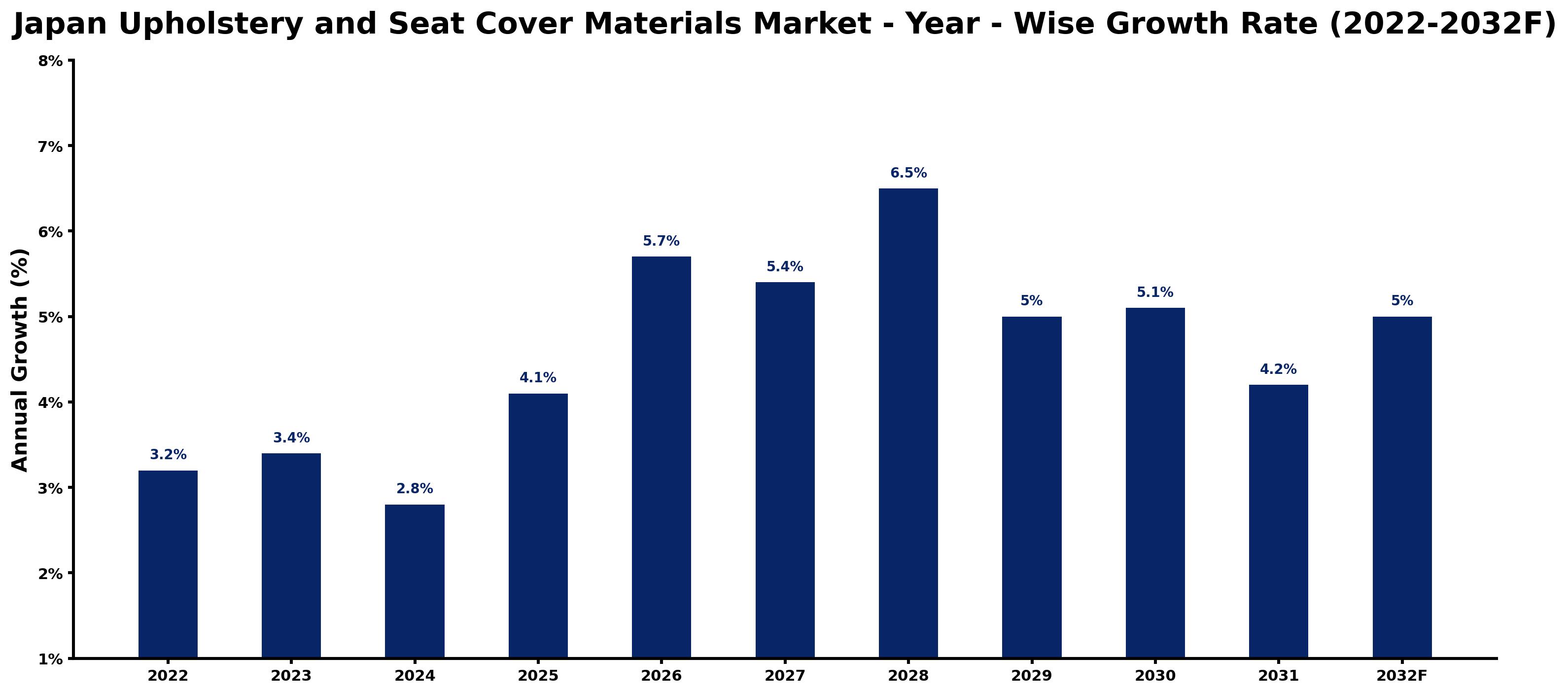
Year by year, the estimates below pair each growth rate with the development that shaped it.
| Year | Estimated Annual Growth (%) | Market Rationale |
| 2022 | 3.2 | The market experienced steady growth due to consistent demand from automotive manufacturers. |
| 2023 | 3.4 | Demand increased as domestic manufacturers ramped up production in response to evolving market needs. |
| 2024 | 2.8 | Growth slowed as manufacturers adjusted to changing material preferences and faced supply chain challenges. |
| 2025 | 4.1 | The market rebounded with stronger demand for eco-friendly materials in automotive applications. |
| 2026 | 5.7 | Growth is expected to accelerate as investments in sustainable material innovation gain traction. |
| 2027 | 5.4 | A slight slowdown is projected as manufacturers encounter challenges in sourcing sustainable materials. |
| 2028 | 6.5 | The market is expected to peak with heightened demand for premium upholstery in luxury vehicles. |
| 2029 | 5.0 | Growth will decelerate as the market stabilises after the peak year. |
| 2030 | 5.1 | Demand is projected to increase again as manufacturers adopt more sustainable practices. |
| 2031 | 4.2 | A slowdown is expected as the market adjusts to evolving consumer preferences. |
| 2032 | 5.0 | Growth will resume as investments in eco-friendly materials continue to rise. |
Note: Market size estimations and growth projections presented in this report are based on 6Wresearch's proprietary forecasting methodology, utilizing the latest available industry data, government publications, and primary research inputs.
Japan Upholstery and Seat Cover Materials Market Synopsis
Upholstery and seat cover materials are essential for automotive interiors, furniture upholstery, and commercial seating, primarily made from synthetic fibers, leatherette, and eco-friendly textiles. The Japan Upholstery and Seat Cover Materials Market is growing due to strong demand from domestic automotive manufacturers, with over 8 million vehicles produced in 2022. The rising adoption of eco-friendly textiles, which accounted for 15% of upholstery materials in 2023, is driving new demand as sustainability trends gain traction.
Market Dynamics Impact Analysis (2026–2032)
| Factor | Type | Impact | Primary Segment Affected |
| Rising demand for eco-friendly textiles | Driver | High | Eco-Friendly Textiles |
| Increased production of luxury vehicles | Driver | High | Luxury Cars |
| Growing interest in sustainable materials | Opportunity | High | Recycled Polyester |
| Expansion of automotive upholstery manufacturing in Tokyo | Opportunity | Medium | Leatherette |
| Challenges in sourcing sustainable materials | Restraint | High | Eco-Friendly Textiles |
| Competition from lower-cost alternatives | Restraint | Medium | Leatherette |
| High costs associated with sustainable material production | Challenge | High | Recycled Polyester |
| Fluctuations in raw material prices | Challenge | Medium | Synthetic Fabrics |
Evaluation of Drivers in Japan Upholstery and Seat Cover Materials Market (2026–2032)
The table below links each growth driver to the segment it affects and the evidence for it.
| Drivers | Primary Segment Affected | Why It Matters (Evidence) |
| Sustainability trends in automotive design | Eco-Friendly Textiles | Eco-friendly textiles accounted for 15% of upholstery materials in 2023, driving demand from manufacturers focused on sustainability. |
| Increased production of luxury vehicles | Luxury Cars | In 2022, luxury cars accounted for 44% of upholstery materials, boosting demand for high-quality upholstery options. |
| Rising consumer preference for premium materials | Leatherette | The average lifespan of automotive upholstery materials is around 10 years, prompting consumers to invest in durable options. |
| Government initiatives supporting sustainable practices | Recycled Polyester | Japan's GX Basic Policy targets JPY 150 trillion in decarbonisation investment, encouraging the use of sustainable materials. |
| Technological advancements in textile production | PU Coated | The JIS L 1096 standard governs textile testing, ensuring quality and performance in upholstery materials. |
Much of the new demand traces back to the Tokyo region, a hub for automotive upholstery manufacturing. In 2022, Japan produced over 8 million vehicles, creating a strong need for upholstery materials. The average lifespan of automotive upholstery materials is around 10 years, prompting manufacturers to seek durable options. Eco-friendly textiles accounted for 15% of upholstery materials in 2023, reflecting a shift towards sustainability. The ongoing push for sustainable practices is driving investment in new materials, further boosting demand.
Evaluation of Restraints in Japan Upholstery and Seat Cover Materials Market
The table below lists the restraints and the evidence behind each.
| Market Restraint | Primary Segment Affected | Why It Matters (Evidence) |
| Challenges in sourcing sustainable materials | Eco-Friendly Textiles | Increased demand for eco-friendly textiles has led to sourcing difficulties, impacting production timelines. |
| Competition from lower-cost alternatives | Leatherette | Leatherette faces competition from cheaper synthetic options, affecting market share and pricing strategies. |
| High costs associated with sustainable material production | Recycled Polyester | The production of recycled polyester remains costly, limiting its widespread adoption in the market. |
| Fluctuations in raw material prices | Synthetic Fabrics | Volatility in raw material prices can disrupt supply chains and impact production costs. |
| Limited consumer awareness of eco-friendly options | Eco-Friendly Textiles | Consumer knowledge regarding the benefits of eco-friendly textiles is still developing, hindering market growth. |
Japan Upholstery and Seat Cover Materials Market Challenges
In 2023, eco-friendly textiles accounted for only 15% of upholstery materials, forcing buyers to pay higher prices for sustainable options. Suppliers encounter sourcing delays due to stringent regulations like the JIS L 1096 standard, which complicates the procurement of compliant materials. Many producers still utilise traditional manufacturing methods, resulting in inefficiencies that waste resources and time, ultimately raising costs for manufacturers. A lack of skilled workers in advanced textile recycling techniques hampers plants' ability to innovate, delaying the introduction of new products for buyers and limiting market growth.
Trends in the Japan Upholstery and Seat Cover Materials Market
The shifts below are changing how Japan Upholstery and Seat Cover Materials Market products are bought and supplied.
- Shift towards Eco-Friendly Textiles: The trend towards eco-friendly textiles emerged in 2023, propelled by growing sustainability awareness among consumers. Eco-friendly textiles accounted for 15% of upholstery materials, reflecting an increasing preference for sustainable options in automotive interiors.
- Transition from Leatherette to Recycled Polyester: In recent years, manufacturers have started shifting from leatherette to recycled polyester for automotive interiors. This transition mirrors changing consumer preferences, with recycled polyester becoming more prevalent in EV interiors, aligning with sustainability trends.
- Emergence of Premium Upholstery in Luxury Cars: Luxury cars are now prioritising premium upholstery materials, with leatherette as the preferred choice. In 2025, luxury cars captured a 44% share of upholstery materials, demonstrating the demand for high-quality interiors.
- Growth of Sustainable Material Innovation: The Japanese government initiated a program in 2023 to support sustainable material innovation, targeting JPY 150 trillion in decarbonisation investment. This initiative is driving advancements in upholstery materials, benefiting manufacturers.
Investment Opportunities in the Japan Upholstery and Seat Cover Materials Market
Where to invest in the Japan Upholstery and Seat Cover Materials Market: the main openings are set out below.
- Tokyo as a Hub for Upholstery Innovation: The Tokyo region is emerging as a hub for upholstery innovation, focusing on sustainable materials. Manufacturers can collaborate with local firms to develop eco-friendly upholstery solutions, tapping into a growing market.
- Investment in Recycled Polyester Production: With eco-friendly textiles making up 15% of upholstery materials, there exists a supply gap. Investing in recycled polyester production can satisfy demand from OEMs seeking sustainable options.
- Collaboration with Sustainable Auto Firms: Partnering with Sustainable Auto Co. offers an opportunity to supply eco-friendly upholstery materials. This collaboration can strengthen market presence and align with consumer preferences for sustainable products.
- Entry into the Luxury Car Segment: The luxury car segment, which holds a 44% market share, presents opportunities for high-quality upholstery materials. Suppliers can penetrate this segment by forming joint ventures with local manufacturers.
Government Initiatives in the Japan Upholstery and Seat Cover Materials Market
The Green Growth Strategy Through Achieving Carbon Neutrality in 2050, updated in 2021, establishes a framework for sustainable practices in textile production. This policy encourages manufacturers to adopt eco-friendly materials and processes, aligning with national decarbonisation goals.
In 2023, the Ministry of the Environment launched a program to support sustainable material innovation, allocating JPY 150 trillion for public and private investment. This initiative aims to promote the use of eco-friendly textiles across various sectors, including automotive.
Future Insight of the Japan Upholstery and Seat Cover Materials Market
Japan's policy-driven shift towards sustainability will drive advancements in upholstery materials, focusing on reducing greenhouse-gas emissions. By 2032, recycled polyester is expected to see increased adoption in automotive interiors, supported by government initiatives for sustainable material innovation. Suppliers will respond by diversifying their textile offerings, aligning with consumer demand for eco-friendly products. As the automotive sector evolves, buyers will benefit from a broader selection of upholstery materials that meet environmental standards.
Market Segmentation Analysis
Japan Upholstery and Seat Cover Materials Market report covers a detailed analysis of the following market segments:
By Material Type – Leatherette Leads, Eco-Friendly Textiles Expected to Grow Fastest
According to Saurav Kr Singh, Senior Research Analyst at 6Wresearch, Leatherette took 36% of material type revenue in 2025, more than any other category. Leatherette holds the largest share due to its widespread use in automotive interiors, particularly in luxury vehicles where durability and aesthetics are paramount. For instance, the Tokyo region is a hub for automotive upholstery manufacturing, further solidifying its dominance. The quickest growth will come from Eco-Friendly Textiles, forecast to expand at a CAGR of 7.4% between 2026 and 2032. Eco-friendly textiles are experiencing rapid growth as manufacturers increasingly adopt sustainable practices in response to consumer demand for greener options. The Japanese government's 2023 programme to support sustainable material innovation is a key factor driving this trend. Suppliers should prioritise eco-friendly offerings to align with market shifts towards sustainability.
By Fabric Finish – PU Coated Leads, Recycled Polyester Expected to Grow Fastest
In 2025, PU Coated led the fabric finish split with a 39% share. PU coated materials command the largest share because they provide a protective layer that enhances durability, making them ideal for automotive applications. Their extensive use in vehicle interiors, particularly in the automotive sector, highlights their critical role for manufacturers. Recycled Polyester is projected to grow fastest, at a CAGR of 7.2% during 2026–2032. Recycled polyester is rapidly gaining traction as a sustainable option, driven by rising consumer demand for eco-friendly materials. The automotive industry's transition towards incorporating recycled textiles, especially in electric vehicles, underscores this growth trend. Suppliers need to focus on developing sustainable upholstery materials to align with market trends.
By Vehicle Type – Luxury Cars Lead, EVs Expected to Grow Fastest
With 44% of vehicle type revenue in 2025, Luxury Cars was the largest category. Luxury cars lead the market segment due to a strong demand for premium upholstery materials that enhance both comfort and aesthetics. The substantial investment in high-quality materials, such as leatherette, reflects the high expectations of consumers in this segment. Over 2026–2032, EVs are expected to post the fastest growth, at a CAGR of 7.3%. Electric vehicles are witnessing the fastest growth as manufacturers adapt to consumer preferences for sustainable and environmentally friendly materials. The increasing production of EVs indicates a notable shift towards greener options in the automotive upholstery market. Suppliers should prioritise the development of specialised materials tailored for the growing electric vehicle segment.
By End User – OEMs Lead, Sustainable Auto Co. Expected to Grow Fastest
The largest end user category in 2025 was OEMs, at 44% of revenue. OEMs are the leading end users of upholstery materials as they are the primary manufacturers of vehicles, requiring large quantities of high-quality materials for production. Their extensive purchasing power and established relationships with suppliers solidify their market position. Sustainable Auto Co. is set to record the highest CAGR in this split, 7.0% over 2026–2032. Sustainable Auto Co. is at the forefront of growth by prioritising eco-friendly materials in their vehicle interiors, aligning with consumer preferences for sustainability. This focus is driving their rapid expansion in the market. Suppliers should consider partnerships with eco-focused manufacturers to capture emerging market opportunities.
Key Attractiveness of the Report
- 10 Years of Market Numbers
- Historical Data Starting from 2022 to 2025
- Base Year 2025
- Forecast Data until 2032
- Key Performance Indicators Impacting the Market
- Major Upcoming Developments and Projects
Key Highlights of the Report:
- Japan Upholstery and Seat Cover Materials Market Outlook
- Market Size of Japan Upholstery and Seat Cover Materials Market, 2025
- Forecast of Japan Upholstery and Seat Cover Materials Market, 2032
- Historical Data and Forecast of Japan Upholstery and Seat Cover Materials Revenues & Volume for the Period 2022-2032F
- Japan Upholstery and Seat Cover Materials Market Trend Evolution
- Japan Upholstery and Seat Cover Materials Market Drivers and Challenges
- Japan Upholstery and Seat Cover Materials Price Trends
- Japan Upholstery and Seat Cover Materials Porter's Five Forces
- Japan Upholstery and Seat Cover Materials Industry Life Cycle
- Historical Data and Forecast of Japan Upholstery and Seat Cover Materials Market Revenues & Volume By Material Type for the Period 2022-2032F
- Historical Data and Forecast of Japan Upholstery and Seat Cover Materials Market Revenues & Volume By Leatherette for the Period 2022-2032F
- Historical Data and Forecast of Japan Upholstery and Seat Cover Materials Market Revenues & Volume By Synthetic Fabrics for the Period 2022-2032F
- Historical Data and Forecast of Japan Upholstery and Seat Cover Materials Market Revenues & Volume By Vinyl for the Period 2022-2032F
- Historical Data and Forecast of Japan Upholstery and Seat Cover Materials Market Revenues & Volume By Eco-Friendly Textiles for the Period 2022-2032F
- Historical Data and Forecast of Japan Upholstery and Seat Cover Materials Market Revenues & Volume By Fabric Finish for the Period 2022-2032F
- Historical Data and Forecast of Japan Upholstery and Seat Cover Materials Market Revenues & Volume By PU Coated for the Period 2022-2032F
- Historical Data and Forecast of Japan Upholstery and Seat Cover Materials Market Revenues & Volume By Woven/Knitted for the Period 2022-2032F
- Historical Data and Forecast of Japan Upholstery and Seat Cover Materials Market Revenues & Volume By Textured for the Period 2022-2032F
- Historical Data and Forecast of Japan Upholstery and Seat Cover Materials Market Revenues & Volume By Recycled Polyester for the Period 2022-2032F
- Historical Data and Forecast of Japan Upholstery and Seat Cover Materials Market Revenues & Volume By Vehicle Type for the Period 2022-2032F
- Historical Data and Forecast of Japan Upholstery and Seat Cover Materials Market Revenues & Volume By Luxury Cars for the Period 2022-2032F
- Historical Data and Forecast of Japan Upholstery and Seat Cover Materials Market Revenues & Volume By Mass-Market Cars for the Period 2022-2032F
- Historical Data and Forecast of Japan Upholstery and Seat Cover Materials Market Revenues & Volume By Buses/Trucks for the Period 2022-2032F
- Historical Data and Forecast of Japan Upholstery and Seat Cover Materials Market Revenues & Volume By EVs for the Period 2022-2032F
- Historical Data and Forecast of Japan Upholstery and Seat Cover Materials Market Revenues & Volume By End User for the Period 2022-2032F
- Historical Data and Forecast of Japan Upholstery and Seat Cover Materials Market Revenues & Volume By OEMs for the Period 2022-2032F
- Historical Data and Forecast of Japan Upholstery and Seat Cover Materials Market Revenues & Volume By Auto Interiors Firms for the Period 2022-2032F
- Historical Data and Forecast of Japan Upholstery and Seat Cover Materials Market Revenues & Volume By Seating Suppliers for the Period 2022-2032F
- Historical Data and Forecast of Japan Upholstery and Seat Cover Materials Market Revenues & Volume By Sustainable Auto Co. for the Period 2022-2032F
- Japan Upholstery and Seat Cover Materials Import Export Trade Statistics
- Market Opportunity Assessment By Material Type
- Market Opportunity Assessment By Fabric Finish
- Market Opportunity Assessment By Vehicle Type
- Market Opportunity Assessment By End User
- Japan Upholstery and Seat Cover Materials Top Companies Market Share
- Japan Upholstery and Seat Cover Materials Competitive Benchmarking By Technical and Operational Parameters
- Japan Upholstery and Seat Cover Materials Company Profiles
- Japan Upholstery and Seat Cover Materials Key Strategic Recommendations
Market Covered
The following segment groups are covered in the report.
By Material Type
- Leatherette
- Synthetic Fabrics
- Vinyl
- Eco-Friendly Textiles
By Fabric Finish
- PU Coated
- Woven/Knitted
- Textured
- Recycled Polyester
By Vehicle Type
- Luxury Cars
- Mass-Market Cars
- Buses/Trucks
- EVs
By End User
- OEMs
- Auto Interiors Firms
- Seating Suppliers
- Sustainable Auto Co.































