Japan Upholstery Soft Goods Market Size & Growth Rate
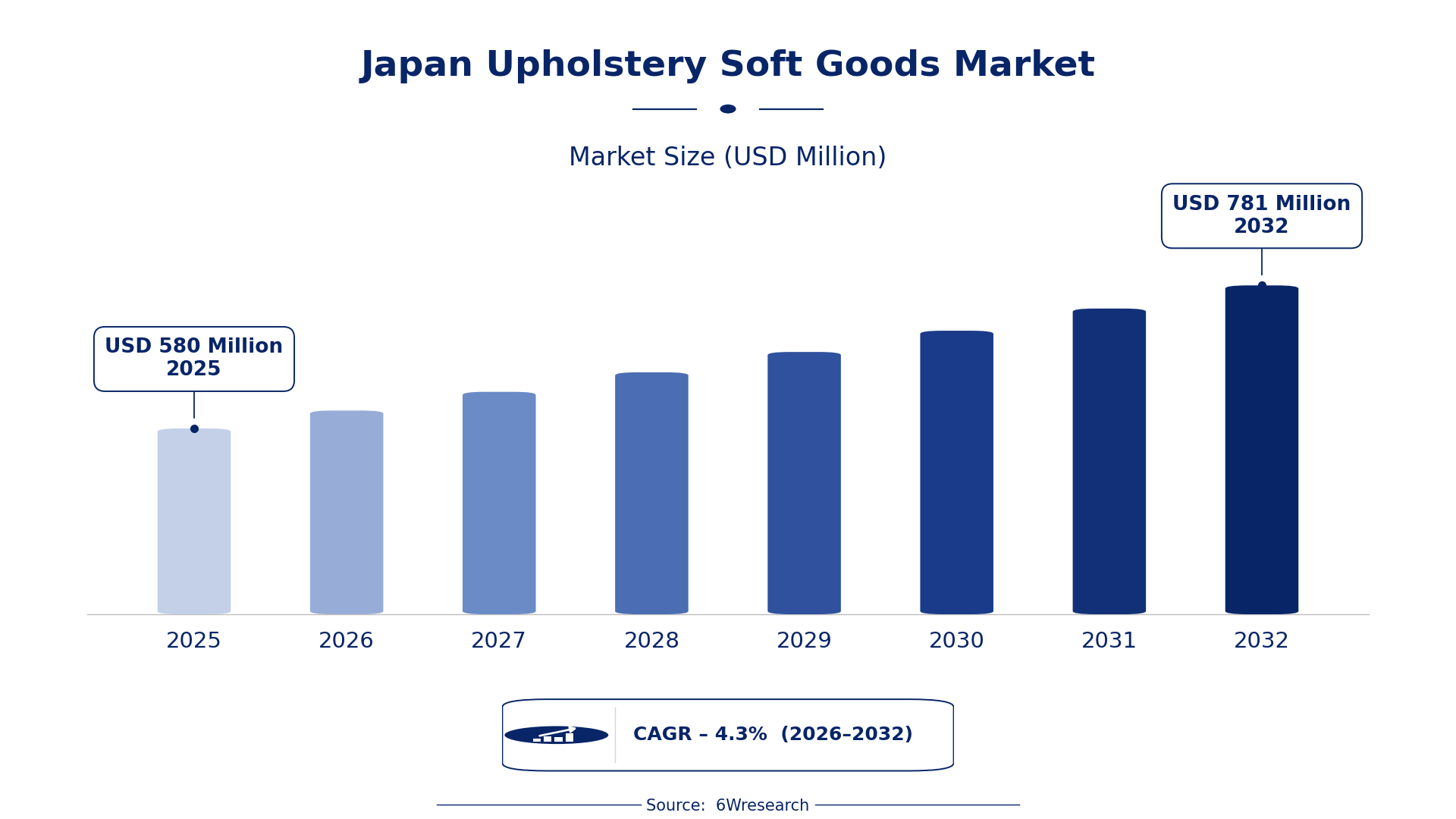
According to 6Wresearch internal database and industry insights, the Japan Upholstery Soft Goods Market was valued at USD 580 Million in 2025 and is projected to reach USD 781 Million by 2032, growing at a CAGR of approximately 4.3% during 2026–2032.
Japan Upholstery Soft Goods Market Highlights
| Report Metric | Details |
| Report Name | Japan Upholstery Soft Goods Market (2026-2032) |
| Market Size 2025 | USD 580 Million |
| Market Size 2032 | USD 781 Million |
| Absolute Growth 2025–2032 | USD 201 Million |
| CAGR 2026–2032 | 4.3% |
| Peak Annual Growth | 5.2% in 2028 |
| Forecast Period | 2026–2032 |
| Historical Data | 2022–2025 |
| Base Year | 2025 |
| Leading Product Type, 2025 | Sofa Upholstery (49% share) |
| Leading Material Used, 2025 | Velvet/Fabric (50% share) |
| Leading Use Sector, 2025 | Residential (42% share) |
| Leading Distribution Channel, 2025 | Home Decor Stores (47% share) |
| Fastest-Growing Product Type | Cushion Covers (6.1% CAGR) |
| Fastest-Growing Material Used | Cotton/Silk (6.5% CAGR) |
| Fastest-Growing Use Sector | Commercial (5.6% CAGR) |
| Fastest-Growing Distribution Channel | Online Marketplaces (5.8% CAGR) |
| Growing Sector | Residential |
| Key End Users | Interior contractors, home decor stores, commercial businesses, hospitality providers |
Japan Upholstery Soft Goods Market Year-wise Growth Rate and Key Drivers (2022–2032)
This graph illustrates the annual growth rates of the market from 2022 to 2032, highlighting a steady upward trajectory and projected market expansion over the forecast period.
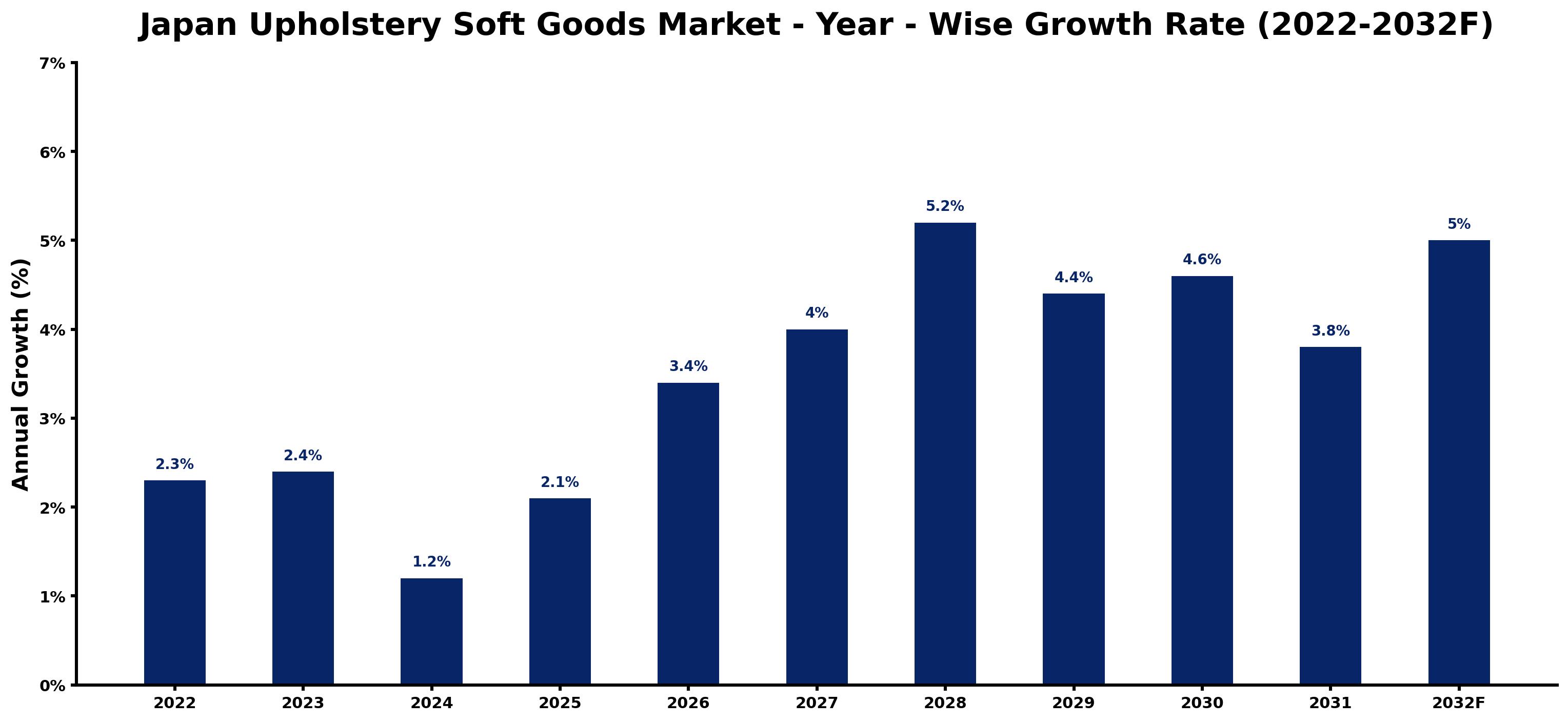
The table below sets out the estimated growth rate for each year and the main factor behind it.
| Year | Estimated Annual Growth (%) | Market Rationale |
| 2022 | 2.3 | The market showed steady growth due to consistent demand from residential users. |
| 2023 | 2.4 | Growth accelerated as consumers increased spending on home furnishings and decor. |
| 2024 | 1.2 | The market experienced a slowdown as inflation affected household budgets. |
| 2025 | 2.1 | Demand rose again as consumers sought to refresh their home environments. |
| 2026 | 3.4 | Growth is projected to rise due to increasing interest in sustainable upholstery materials. |
| 2027 | 4.0 | Continued investment in home decor will drive further market expansion. |
| 2028 | 5.2 | The peak growth will stem from a surge in commercial upholstery projects. |
| 2029 | 4.4 | Growth is anticipated to slow as supply chain issues impact availability. |
| 2030 | 4.6 | Demand will rise again as new residential projects are initiated. |
| 2031 | 3.8 | Growth is expected to moderate due to market saturation in certain segments. |
| 2032 | 5.0 | The market will rebound with increased consumer confidence and spending. |
Note: Market size estimations and growth projections presented in this report are based on 6Wresearch's proprietary forecasting methodology, utilizing the latest available industry data, government publications, and primary research inputs.
Japan Upholstery Soft Goods Market Synopsis
Upholstery soft goods are textiles used for covering furniture and interior items, made from various durable materials. The Japan Upholstery Soft Goods Market is growing due to rising household expenditure on home furnishings, averaging around ¥300,000 annually. The increasing focus on sustainable materials, supported by initiatives from the Tokyo Metropolitan Government, drives demand. A 15% rise in online sales reflects changing consumer habits, creating new opportunities for suppliers.
Market Dynamics Impact Analysis (2026–2032)
| Factor | Type | Impact | Primary Segment Affected |
| Rising household expenditure on home furnishings | Driver | High | Residential |
| Growing interest in sustainable materials | Driver | High | Commercial |
| Increased demand for eco-friendly upholstery | Opportunity | High | Cushion Covers |
| Expansion of online sales channels | Opportunity | High | Home Decor Stores |
| Supply chain disruptions affecting material availability | Restraint | High | Sofa Upholstery |
| High competition among local manufacturers | Restraint | Medium | Drapery Panels |
| Fluctuating material costs impacting pricing | Challenge | High | Bedding Accessories |
| Limited innovation in traditional upholstery designs | Challenge | Medium | Velvet/Fabric |
Evaluation of Drivers in Japan Upholstery Soft Goods Market (2026–2032)
Below are the drivers that matter most for revenue growth, with supporting evidence.
| Drivers | Primary Segment Affected | Why It Matters (Evidence) |
| Increased household expenditure on home furnishings | Residential | The average household spends around ¥300,000 annually, driving demand for upholstery goods. |
| Growing interest in sustainable materials | Commercial | The Tokyo Metropolitan Government's initiatives are promoting eco-friendly upholstery production, encouraging local manufacturers to innovate. |
| Rising online sales of upholstery goods | Home Decor Stores | Online sales increased by 15% last year, reflecting changing consumer purchasing habits. |
| Demand for luxury upholstery materials | Cushion Covers | Cotton and silk blends are preferred for luxury applications, boosting sales. |
| Increased investment in interior design | Drapery Panels | Interior contractors are expanding services, increasing demand for quality upholstery. |
Most of the extra volume comes from increased household expenditure on home furnishings, with average spending around ¥300,000 annually. Growing interest in sustainable materials is clear as local manufacturers respond to consumer preferences for eco-friendly options. The rise in online sales, which increased by 15% last year, reflects changing purchasing habits. There is notable demand for luxury upholstery materials, particularly cotton and silk blends, as consumers prioritise quality. Investment in interior design services by contractors is further driving demand for quality upholstery products, contributing to market growth.
Evaluation of Restraints in Japan Upholstery Soft Goods Market
Several factors work against faster growth; the main ones are summarised below.
| Market Restraint | Primary Segment Affected | Why It Matters (Evidence) |
| Supply chain disruptions affecting material availability | Sofa Upholstery | Disruptions have led to delays and increased costs, impacting production schedules. |
| High competition among local manufacturers | Drapery Panels | Intense competition pressures profit margins, making it difficult for smaller players. |
| Fluctuating material costs impacting pricing | Bedding Accessories | Volatile prices for raw materials affect the overall pricing strategy of products. |
| Limited innovation in traditional upholstery designs | Velvet/Fabric | A lack of new designs can lead to stagnant sales in a competitive market. |
| Consumer preference for imported goods over local products | Cushion Covers | Imported options often attract consumers due to perceived quality and variety. |
Japan Upholstery Soft Goods Market Challenges
Custom upholstery orders often face delays due to a shortage of skilled artisans, resulting from an ageing workforce and insufficient training programs, leading to extended wait times for homeowners. Outdated manufacturing technology burdens suppliers, inflating production costs by 20%, which directly impacts pricing for retailers and reduces profit margins. Local manufacturers struggle against fierce competition from imported upholstery soft goods, compelling them to lower prices, which can lead to compromised quality. Smaller suppliers find compliance with ISO 9001 standards overwhelming, causing product launch delays that hinder their responsiveness to market demands.
Trends in the Japan Upholstery Soft Goods Market
Buyers and suppliers in the Japan Upholstery Soft Goods Market are adjusting to the following trends.
- Shift towards Sustainable Materials: Home decor stores are increasingly prioritising sustainable upholstery options, driven by consumer demand for eco-friendly products. In 2023, the Tokyo Metropolitan Government launched a program to encourage eco-friendly upholstery production, reflecting this trend.
- Emergence of Online Sales Channels: Online marketplaces are becoming a preferred shopping channel for upholstery goods, with sales increasing by 15% last year. This shift is changing how consumers access and purchase upholstery products.
- Growing Preference for Luxury Materials: Consumers are increasingly opting for luxury upholstery materials, such as cotton and silk blends, which are gaining popularity for their aesthetic appeal and durability. This trend is reshaping product offerings in the market.
- Expansion of Interior Design Services: Interior contractors are expanding their services, leading to increased demand for quality upholstery products. This trend is reflected in the growing number of projects in urban areas, particularly in Tokyo.
Investment Opportunities in the Japan Upholstery Soft Goods Market
Below are the investment opportunities with the strongest case in the Japan Upholstery Soft Goods Market.
- Rising Demand for Eco-Friendly Upholstery: The growing focus on sustainable materials presents an opportunity for suppliers to invest in eco-friendly upholstery production. The Tokyo Metropolitan Government's initiatives support this shift, encouraging local manufacturers to innovate.
- Expansion of Online Marketplaces: With online sales of upholstery goods increasing by 15%, there is an opportunity for suppliers to enhance their online presence. Partnering with digital platforms can facilitate market entry and reach a broader audience.
- Investment in Luxury Upholstery Products: The demand for luxury upholstery materials is rising, creating opportunities for manufacturers to develop high-end products. Targeting affluent consumer segments in urban areas can yield substantial returns.
- Growth in Commercial Upholstery Projects: The expansion of commercial spaces in urban areas presents opportunities for upholstery suppliers. Collaborating with interior contractors can help tap into this growing market segment.
Government Initiatives in the Japan Upholstery Soft Goods Market
The 2023 program to promote eco-friendly upholstery production adds to existing laws supporting sustainable practices. This initiative encourages manufacturers to adopt environmentally friendly materials and processes, aligning with consumer demand for sustainability.
The Digital Agency, established in September 2021, oversees the approval of digital transformation initiatives in the upholstery sector. It facilitates the adoption of modern technologies, ensuring that manufacturers meet contemporary standards in production.
Future Insight of the Japan Upholstery Soft Goods Market
The investment pipeline for eco-friendly upholstery production will create substantial demand by 2032, benefiting both buyers and suppliers. Government initiatives will drive the adoption of sustainable materials, encouraging innovation in production methods. Online sales are projected to increase by 20% as consumer preferences shift towards convenience and variety. Major trade events will showcase advancements in upholstery technology, attracting interest from buyers eager for the latest trends and suppliers looking to stay competitive.
Market Segmentation Analysis
Japan Upholstery Soft Goods Market report covers a detailed analysis of the following market segments:
By Product Type – Sofa Upholstery Leads, Cushion Covers Expected to Grow Fastest
According to Saurav Kr Singh, Senior Research Analyst at 6Wresearch, the largest product type category in 2025 was Sofa Upholstery, at 49% of revenue. Sofa upholstery dominates the market as it is essential for covering furniture, particularly in residential settings where demand is high. For example, home decor stores in Tokyo prominently feature a variety of sofa upholstery options to cater to local consumers' preferences. The quickest growth will come from Cushion Covers, forecast to expand at a CAGR of 6.1% between 2026 and 2032. Cushion covers are rapidly gaining traction as they provide comfort and aesthetic appeal, with a notable increase in demand linked to changing consumer habits. The rise in online sales, which increased by 15% last year, highlights the growing interest in stylish cushion options. Suppliers should consider expanding their product lines to include more cushion cover options to meet rising consumer demand.
By Material Used – Velvet/Fabric Leads, Cotton/Silk Expected to Grow Fastest
Velvet/Fabric held 50% of the Japan Upholstery Soft Goods Market by material used in 2025. Velvet and fabric are the predominant materials in Japan's upholstery market, chosen for their appealing aesthetics and long-lasting nature. Their widespread use in residential settings highlights their importance in the local furniture landscape. Cotton/Silk is set to record the highest CAGR in this split, 6.5% over 2026–2032. Cotton and silk are rapidly gaining traction in luxury upholstery applications, as consumers increasingly prioritise high-end materials for their interior design needs. This shift is evident in the growing trend of incorporating these fabrics into upscale furniture offerings. Suppliers should consider expanding their product lines to include cotton and silk to meet the rising demand for luxury upholstery.
By Use Sector – Residential Leads, Commercial Expected to Grow Fastest
In 2025, Residential led the use sector split with a 42% share. The residential sector is the largest segment of the upholstery market, largely due to substantial household investment in home furnishings, averaging around ¥300,000 per year. This consistent expenditure demonstrates the critical role of upholstery in improving home aesthetics. Commercial is projected to grow fastest, at a CAGR of 5.6% during 2026–2032. The commercial sector is experiencing notable growth as businesses seek to enhance their environments with quality upholstery. This trend is driven by the increasing recognition of the impact that well-designed furnishings have on customer and employee experiences. Suppliers should target the commercial sector to leverage the growing interest in quality upholstery solutions among businesses.
By Distribution Channel – Home Decor Stores Lead, Online Marketplaces Expected to Grow Fastest
Home Decor Stores accounted for 47% of the market by distribution channel in 2025. Home decor stores serve as the primary retail channel for upholstery goods, offering consumers a diverse range of options in a physical shopping environment. Their established presence in urban centres like Tokyo ensures a steady influx of customers seeking upholstery solutions. Over 2026–2032, Online Marketplaces are expected to post the fastest growth, at a CAGR of 5.8%. Online marketplaces are rapidly becoming a preferred distribution channel, reflecting a shift in consumer behaviour towards convenience and accessibility. The 15% increase in online sales over the past year illustrates this growing trend in consumer shopping preferences. Suppliers must strengthen their online presence to effectively reach the expanding segment of consumers who prefer digital shopping.
Key Attractiveness of the Report
- 10 Years of Market Numbers
- Historical Data Starting from 2022 to 2025
- Base Year 2025
- Forecast Data until 2032
- Key Performance Indicators Impacting the Market
- Major Upcoming Developments and Projects
Key Highlights of the Report:
- Japan Upholstery Soft Goods Market Outlook
- Market Size of Japan Upholstery Soft Goods Market, 2025
- Forecast of Japan Upholstery Soft Goods Market, 2032
- Historical Data and Forecast of Japan Upholstery Soft Goods Revenues & Volume for the Period 2022-2032F
- Japan Upholstery Soft Goods Market Trend Evolution
- Japan Upholstery Soft Goods Market Drivers and Challenges
- Japan Upholstery Soft Goods Price Trends
- Japan Upholstery Soft Goods Porter's Five Forces
- Japan Upholstery Soft Goods Industry Life Cycle
- Historical Data and Forecast of Japan Upholstery Soft Goods Market Revenues & Volume By Product Type for the Period 2022-2032F
- Historical Data and Forecast of Japan Upholstery Soft Goods Market Revenues & Volume By Sofa Upholstery for the Period 2022-2032F
- Historical Data and Forecast of Japan Upholstery Soft Goods Market Revenues & Volume By Cushion Covers for the Period 2022-2032F
- Historical Data and Forecast of Japan Upholstery Soft Goods Market Revenues & Volume By Drapery Panels for the Period 2022-2032F
- Historical Data and Forecast of Japan Upholstery Soft Goods Market Revenues & Volume By Bedding Accessories for the Period 2022-2032F
- Historical Data and Forecast of Japan Upholstery Soft Goods Market Revenues & Volume By Material Used for the Period 2022-2032F
- Historical Data and Forecast of Japan Upholstery Soft Goods Market Revenues & Volume By Velvet/Fabric for the Period 2022-2032F
- Historical Data and Forecast of Japan Upholstery Soft Goods Market Revenues & Volume By Cotton/Silk for the Period 2022-2032F
- Historical Data and Forecast of Japan Upholstery Soft Goods Market Revenues & Volume By Linen/Polyester for the Period 2022-2032F
- Historical Data and Forecast of Japan Upholstery Soft Goods Market Revenues & Volume By Quilted/Textured for the Period 2022-2032F
- Historical Data and Forecast of Japan Upholstery Soft Goods Market Revenues & Volume By Use Sector for the Period 2022-2032F
- Historical Data and Forecast of Japan Upholstery Soft Goods Market Revenues & Volume By Residential for the Period 2022-2032F
- Historical Data and Forecast of Japan Upholstery Soft Goods Market Revenues & Volume By Commercial for the Period 2022-2032F
- Historical Data and Forecast of Japan Upholstery Soft Goods Market Revenues & Volume By Hotels for the Period 2022-2032F
- Historical Data and Forecast of Japan Upholstery Soft Goods Market Revenues & Volume By Hospitality for the Period 2022-2032F
- Historical Data and Forecast of Japan Upholstery Soft Goods Market Revenues & Volume By Distribution Channel for the Period 2022-2032F
- Historical Data and Forecast of Japan Upholstery Soft Goods Market Revenues & Volume By Home Decor Stores for the Period 2022-2032F
- Historical Data and Forecast of Japan Upholstery Soft Goods Market Revenues & Volume By Online Marketplaces for the Period 2022-2032F
- Historical Data and Forecast of Japan Upholstery Soft Goods Market Revenues & Volume By Interior Contractors for the Period 2022-2032F
- Historical Data and Forecast of Japan Upholstery Soft Goods Market Revenues & Volume By Specialty Retailers for the Period 2022-2032F
- Japan Upholstery Soft Goods Import Export Trade Statistics
- Market Opportunity Assessment By Product Type
- Market Opportunity Assessment By Material Used
- Market Opportunity Assessment By Use Sector
- Market Opportunity Assessment By Distribution Channel
- Japan Upholstery Soft Goods Top Companies Market Share
- Japan Upholstery Soft Goods Competitive Benchmarking By Technical and Operational Parameters
- Japan Upholstery Soft Goods Company Profiles
- Japan Upholstery Soft Goods Key Strategic Recommendations
Market Covered
The report covers the following segments.
By Product Type
- Sofa Upholstery
- Cushion Covers
- Drapery Panels
- Bedding Accessories
By Material Used
- Velvet/Fabric
- Cotton/Silk
- Linen/Polyester
- Quilted/Textured
By Use Sector
- Residential
- Commercial
- Hotels
- Hospitality
By Distribution Channel
- Home Decor Stores
- Online Marketplaces
- Interior Contractors
- Specialty Retailers































