Japan Upstream Production Analytics AI Market Size & Growth Rate
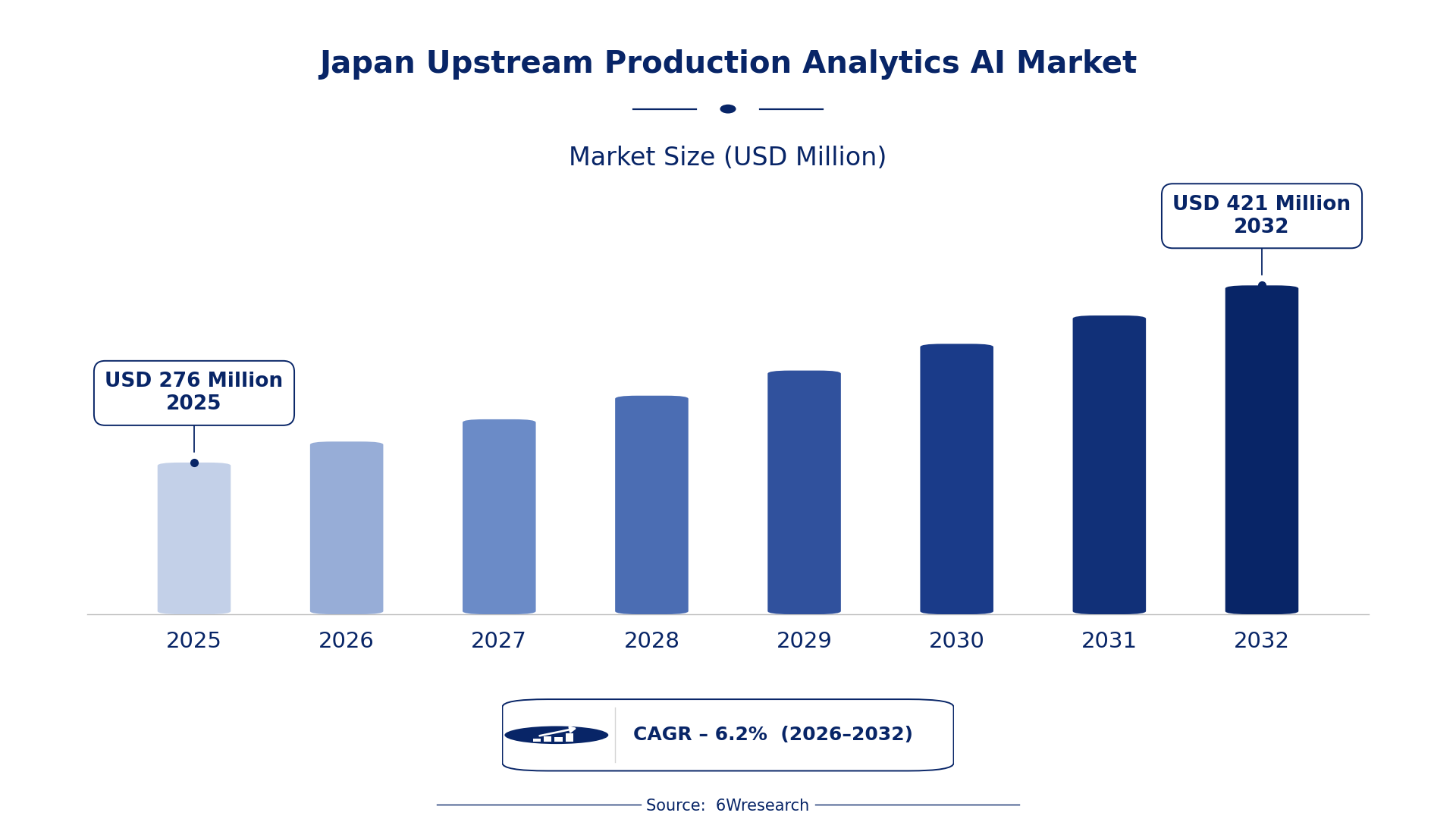
According to 6Wresearch internal database and industry insights, the Japan Upstream Production Analytics AI Market was valued at USD 276 Million in 2025 and is projected to reach USD 421 Million by 2032, growing at a CAGR of approximately 6.2% during 2026–2032.
Japan Upstream Production Analytics AI Market Highlights
| Report Metric | Details |
| Report Name | Japan Upstream Production Analytics AI Market (2026-2032) |
| Market Size 2025 | USD 276 Million |
| Market Size 2032 | USD 421 Million |
| Absolute Growth 2025–2032 | USD 145 Million |
| CAGR 2026–2032 | 6.2% |
| Peak Annual Growth | 7.0% in 2026 |
| Forecast Period | 2026–2032 |
| Historical Data | 2022–2025 |
| Base Year | 2025 |
| Leading AI Feature, 2025 | Predictive Analytics (49% share) |
| Leading Functionality, 2025 | Well Failure Forecast (46% share) |
| Leading Integration Level, 2025 | SCADA Systems (48% share) |
| Leading End User, 2025 | Oil Producers (40% share) |
| Fastest-Growing AI Feature | Production Optimization (8.4% CAGR) |
| Fastest-Growing Functionality | Reservoir Management (8.0% CAGR) |
| Fastest-Growing Integration Level | DCS (8.6% CAGR) |
| Fastest-Growing End User | Oilfield Operators (7.9% CAGR) |
| Growing Sector | Oilfield Operators |
| Key End Users | Oil Producers, Oilfield Operators, Energy Firms, EPC Contractors |
Japan Upstream Production Analytics AI Market Year-wise Growth Rate and Key Drivers (2022–2032)
This graph illustrates the annual growth rates of the market from 2022 to 2032, highlighting a steady upward trajectory and projected market expansion over the forecast period.
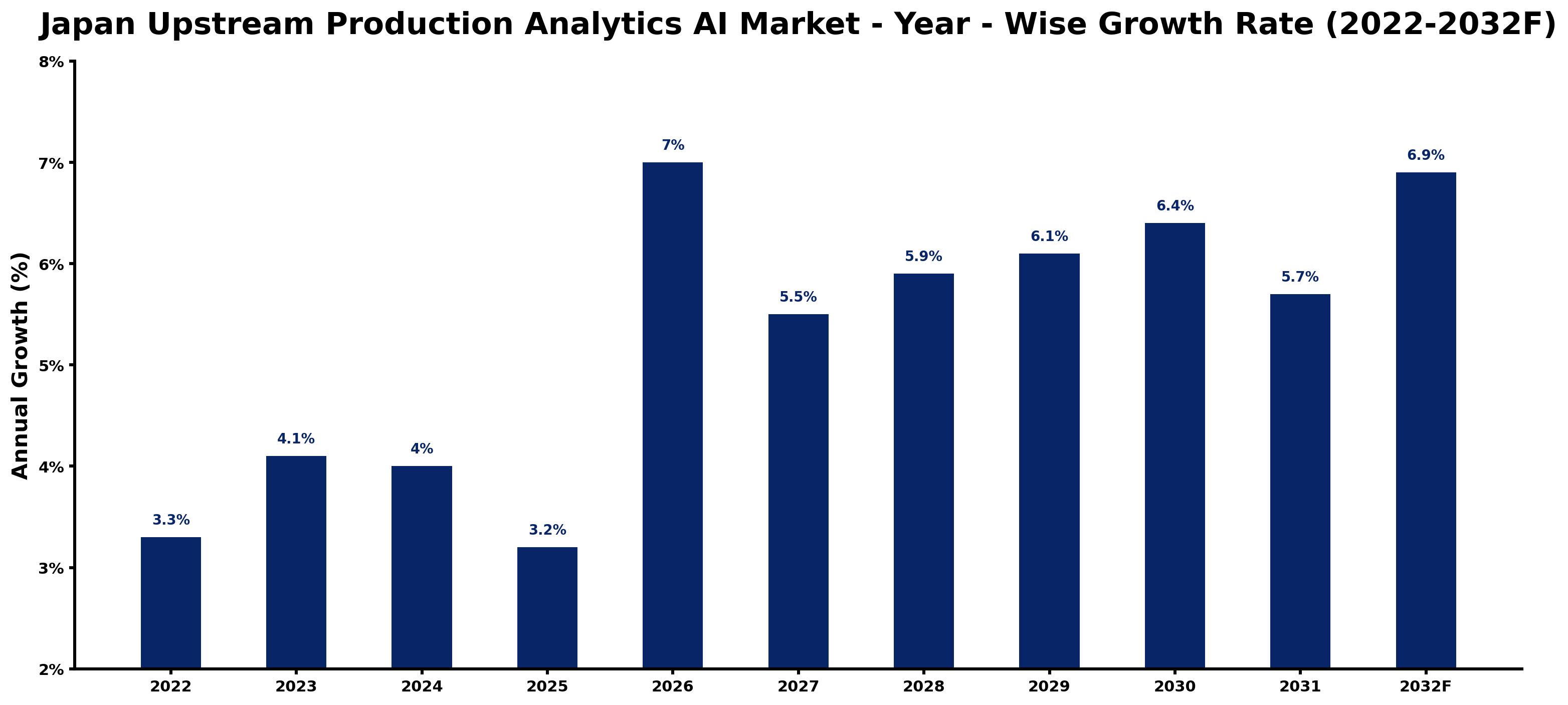
The following figures match every annual growth estimate with the main market development of that year, giving the reasoning behind each rise or slowdown.
| Year | Estimated Annual Growth (%) | Market Rationale |
| 2022 | 3.3 | The market showed steady growth as AI adoption began to gain traction. |
| 2023 | 4.1 | The increase in oil production efficiency drove faster growth compared to the previous year. |
| 2024 | 4.0 | Growth slowed as companies adjusted to new technologies and market conditions. |
| 2025 | 3.2 | Market growth continued to decelerate due to a focus on cost management in production. |
| 2026 | 7.0 | Demand is expected to surge as investments in AI technologies accelerate, marking a peak growth year. |
| 2027 | 5.5 | Growth is projected to slow as the market stabilises following the rapid expansion in the previous year. |
| 2028 | 5.9 | The market is expected to see renewed interest as companies upgrade their analytics capabilities. |
| 2029 | 6.1 | Growth will continue to rise as more firms adopt advanced AI solutions for production. |
| 2030 | 6.4 | The upward trend is projected to persist as the focus on real-time monitoring intensifies. |
| 2031 | 5.7 | Growth is expected to decelerate slightly as companies consolidate their investments in analytics. |
| 2032 | 6.9 | The market is projected to grow faster as new technologies emerge and gain traction. |
Note: Market size estimations and growth projections presented in this report are based on 6Wresearch's proprietary forecasting methodology, utilizing the latest available industry data, government publications, and primary research inputs.
Japan Upstream Production Analytics AI Market Synopsis
Upstream Production Analytics AI refers to advanced software solutions that improve decision-making in oil and gas production through data integration and machine learning. In Japan, the oil and gas sector is increasingly investing in AI technologies, with the Tokyo Metropolitan Area emerging as a hub for energy firms utilising these tools. The Japan Upstream Production Analytics AI Market is expanding due to rising domestic demand for production optimisation, real-time monitoring, and predictive analytics, driven by initiatives from the Ministry of Economy, Trade and Industry since 2021. This growth is supported by over 1,000 active oil wells and a workforce of around 100,000 people in the sector.
Market Dynamics Impact Analysis (2026–2032)
| Factor | Type | Impact | Primary Segment Affected |
| Growing investments in AI technologies for production optimization | Driver | High | Production Optimization |
| Increasing focus on real-time monitoring systems among oil producers | Driver | High | Real-Time Monitoring |
| Rising demand for predictive analytics to enhance operational efficiency | Opportunity | High | Predictive Analytics |
| Need for modernization of aging drilling rigs in the industry | Opportunity | High | Drilling Analytics |
| High operational costs associated with outdated equipment | Restraint | High | Well Failure Forecast |
| Limited integration of AI with existing legacy systems | Restraint | Medium | SCADA Systems |
| Aging workforce leading to skill shortages in AI technologies | Challenge | High | Oil Producers |
| High initial investment costs for AI implementation | Challenge | Medium | Energy Firms |
Evaluation of Drivers in Japan Upstream Production Analytics AI Market (2026–2032)
The following drivers explain most of the expected growth.
| Drivers | Primary Segment Affected | Why It Matters (Evidence) |
| Increased investment in AI technologies | Production Optimization | Japan's energy firms are investing heavily in AI technologies, with a focus on production optimisation and cost reduction. |
| Demand for real-time monitoring systems | Real-Time Monitoring | Over 60% of oil producers in Japan rely on real-time monitoring systems for immediate operational responses. |
| Focus on predictive analytics for equipment failure forecasting | Predictive Analytics | The need to forecast production trends drives demand for predictive analytics in the oil and gas sector, contributing to improved decision-making. |
| Modernization of aging drilling rigs | Drilling Analytics | The average age of drilling rigs in Japan exceeds 25 years, necessitating investments in modern technologies for enhanced performance. |
| Resource allocation optimization | Resource Allocation | Optimizing resource distribution across projects is essential for maximising production efficiency, particularly in competitive markets. |
Purchasing is picking up as Japan's energy firms invest heavily in AI technologies, focusing on production optimisation. In 2023, approximately 130,000 barrels per day were produced, driving demand for predictive analytics to forecast production trends. Real-time monitoring systems are critical for over 60% of oil producers, ensuring immediate responses to operational issues. The average age of drilling rigs exceeds 25 years, prompting investments in modernisation to improve operational capabilities. Cloud computing adoption in oil production has increased by 30% since 2020, facilitating data-driven decision-making processes.
Evaluation of Restraints in Japan Upstream Production Analytics AI Market
The following restraints limit how fast demand can grow.
| Market Restraint | Primary Segment Affected | Why It Matters (Evidence) |
| High operational costs due to outdated equipment | Well Failure Forecast | The average age of oil drilling rigs exceeds 25 years, resulting in increased maintenance costs. |
| Limited integration of AI with existing systems | SCADA Systems | Many facilities still rely on legacy systems, which hinders the adoption of advanced analytics. |
| Skill shortages in AI technologies | Oil Producers | An aging workforce in the oil sector creates difficulties in finding skilled personnel. |
| High initial investment costs for AI implementation | Energy Firms | The substantial upfront costs deter many firms from adopting advanced analytics. |
| Resistance to change among traditional operators | Production Optimization | Some operators hesitate to adopt new technologies, preferring established methods. |
Japan Upstream Production Analytics AI Market Challenges
A primary obstacle in the upstream production analytics AI market is limited competition, which restricts options for producers and stifles innovation. Skills shortages arise from the need for specialised expertise in AI, causing project delays that can extend timelines for firms by several months. Ageing technology is another issue; over 60% of oil producers rely on outdated systems, raising operational costs and reducing efficiency. High implementation costs deter buyers from adopting new AI solutions, potentially resulting in annual losses in production optimisation that could reach tens of millions.
Trends in the Japan Upstream Production Analytics AI Market
These developments are changing demand patterns in the Japan Upstream Production Analytics AI Market.
- Shift Towards Real-Time Monitoring: Oil producers in Japan are increasingly adopting real-time monitoring systems to improve operational efficiency, with over 60% currently utilising these technologies. This shift began in 2021 as firms sought to enhance responsiveness to operational challenges.
- Transition from Traditional to Predictive Analytics: The use of predictive analytics has grown significantly among oil producers, focusing on forecasting production trends and equipment failures. In 2023, approximately 130,000 barrels per day were produced, driving this transition.
- Emergence of AI-Driven Resource Allocation: Energy firms are prioritising AI-driven resource allocation strategies to optimise project distribution. This trend is evident in the Tokyo Metropolitan Area, where investments in AI technologies are increasing.
- Prioritisation of Modernisation in Drilling Operations: The average age of drilling rigs in Japan exceeds 25 years, prompting a shift towards modernisation. This trend is supported by rising investments in advanced drilling analytics.
Investment Opportunities in the Japan Upstream Production Analytics AI Market
Several openings in the Japan Upstream Production Analytics AI Market merit attention from investors.
- Investment Gap in AI Technologies: With Japan's energy firms investing heavily in AI technologies, a gap exists for suppliers in predictive analytics tools, particularly in the Tokyo Metropolitan Area, where demand is rising.
- Partnerships for AI Implementation: Energy firms are seeking partnerships to implement AI solutions effectively, especially in regions like Akita, where modernisation is critical for operational efficiency.
- Resource Allocation Solutions Needed: Oilfield operators require advanced resource allocation solutions to optimise project distribution, creating opportunities for suppliers in the analytics space.
- Modernisation of Drilling Equipment: The ageing drilling rigs in Japan present an opportunity for suppliers of advanced drilling analytics and technology, as firms seek to upgrade their operations.
Government Initiatives in the Japan Upstream Production Analytics AI Market
The Waste Management and Public Cleansing Act (1970) sets regulations for the management of industrial waste, impacting oil producers by enforcing strict protocols for waste treatment and disposal. The Hydrogen Society Promotion Act (2024) supports low-carbon hydrogen and ammonia supply chains, influencing energy firms to adopt cleaner technologies and practices, thereby improving sustainability in oil production.
The Digital Agency, established in September 2021, leads government digital transformation efforts, approving projects that improve data integration in the energy sector. The agency has allocated funding for initiatives aimed at boosting AI adoption in oil production, benefiting firms seeking to modernise their operations.
Future Insight of the Japan Upstream Production Analytics AI Market
Investment in AI technologies will see a notable increase, as government initiatives promote energy efficiency and carbon reduction. By 2032, cloud computing adoption in oil production is projected to rise, improving data integration capabilities for firms. Enhanced data analytics will facilitate more informed decision-making for producers. The implementation of the ISO 50001 standard will optimise energy management, creating a more efficient operational environment for both buyers and suppliers.
Market Segmentation Analysis
Japan Upstream Production Analytics AI Market report covers a detailed analysis of the following market segments:
By AI Feature – Predictive Analytics Leads, Production Optimization Expected to Grow Fastest
According to Saurav Kr Singh, Senior Research Analyst at 6Wresearch, the largest ai feature category in 2025 was Predictive Analytics, at 49% of revenue. Predictive Analytics holds the largest share as it is vital for forecasting production trends and equipment failures. For example, over 60% of oil producers in Japan rely on this feature to improve their operational efficiency. The quickest growth will come from Production Optimization, forecast to expand at a CAGR of 8.4% between 2026 and 2032. Production Optimization is experiencing rapid growth due to substantial investments in technologies aimed at enhancing production efficiency. The focus on minimising operational costs in oil extraction significantly contributes to this segment's expansion. Suppliers should focus on features that enhance predictive capabilities to align with the increasing demand.
By Functionality – Well Failure Forecast Leads, Reservoir Management Expected to Grow Fastest
With 46% of functionality revenue in 2025, Well Failure Forecast was the largest category. Well Failure Forecast is the leading functionality as it is crucial for preventing costly downtimes in oil production. This capability is particularly important given the average age of drilling rigs in Japan exceeds 25 years, necessitating effective maintenance strategies. Reservoir Management is projected to grow fastest, at a CAGR of 8.0% during 2026–2032. Reservoir Management is growing quickly as it plays a critical role in maximising resource extraction. The increasing emphasis on efficient resource utilisation in Japan's oil sector significantly fuels this segment's growth. Buyers will gain from solutions that improve reservoir management to optimise their production strategies.
By Integration Level – SCADA Systems Lead, DCS Expected to Grow Fastest
SCADA Systems accounted for 48% of the market by integration level in 2025. SCADA Systems dominate the integration level as they support data collection essential for operational insights in oil production. Their widespread use across Japan's oil wells highlights their importance in the analytics framework. DCS is set to record the highest CAGR in this split, 8.6% over 2026–2032. DCS is the fastest-growing integration level due to its increasing adoption for control processes that enhance operational efficiency. The shift towards more integrated control systems in production facilities accelerates this segment's growth. Suppliers must prioritise the development of DCS solutions to meet the rising demand for integrated control systems.
By End User – Oil Producers Lead, Oilfield Operators Expected to Grow Fastest
In 2025, Oil Producers led the end user split with a 40% share. Oil Producers represent the largest end user group as they are the primary users of analytics for optimising production processes. The presence of over 1,000 active oil wells in Japan highlights the significance of this segment. Over 2026–2032, Oilfield Operators are expected to post the fastest growth, at a CAGR of 7.9%. Oilfield Operators are the fastest-growing end user segment, utilising analytics to improve operational efficiency. The increasing complexity of operations in oilfields necessitates advanced analytical tools, driving growth in this area. Suppliers should tailor their offerings to meet the specific needs of oilfield operators to capitalise on this growth.
Key Attractiveness of the Report
- 10 Years of Market Numbers
- Historical Data Starting from 2022 to 2025
- Base Year 2025
- Forecast Data until 2032
- Key Performance Indicators Impacting the Market
- Major Upcoming Developments and Projects
Key Highlights of the Report:
- Japan Upstream Production Analytics AI Market Outlook
- Market Size of Japan Upstream Production Analytics AI Market, 2025
- Forecast of Japan Upstream Production Analytics AI Market, 2032
- Historical Data and Forecast of Japan Upstream Production Analytics AI Revenues & Volume for the Period 2022-2032F
- Japan Upstream Production Analytics AI Market Trend Evolution
- Japan Upstream Production Analytics AI Market Drivers and Challenges
- Japan Upstream Production Analytics AI Price Trends
- Japan Upstream Production Analytics AI Porter's Five Forces
- Japan Upstream Production Analytics AI Industry Life Cycle
- Historical Data and Forecast of Japan Upstream Production Analytics AI Market Revenues & Volume By AI Feature for the Period 2022-2032F
- Historical Data and Forecast of Japan Upstream Production Analytics AI Market Revenues & Volume By Predictive Analytics for the Period 2022-2032F
- Historical Data and Forecast of Japan Upstream Production Analytics AI Market Revenues & Volume By Production Optimization for the Period 2022-2032F
- Historical Data and Forecast of Japan Upstream Production Analytics AI Market Revenues & Volume By Real-Time Monitoring for the Period 2022-2032F
- Historical Data and Forecast of Japan Upstream Production Analytics AI Market Revenues & Volume By Decision Support AI for the Period 2022-2032F
- Historical Data and Forecast of Japan Upstream Production Analytics AI Market Revenues & Volume By Functionality for the Period 2022-2032F
- Historical Data and Forecast of Japan Upstream Production Analytics AI Market Revenues & Volume By Well Failure Forecast for the Period 2022-2032F
- Historical Data and Forecast of Japan Upstream Production Analytics AI Market Revenues & Volume By Reservoir Management for the Period 2022-2032F
- Historical Data and Forecast of Japan Upstream Production Analytics AI Market Revenues & Volume By Drilling Analytics for the Period 2022-2032F
- Historical Data and Forecast of Japan Upstream Production Analytics AI Market Revenues & Volume By Resource Allocation for the Period 2022-2032F
- Historical Data and Forecast of Japan Upstream Production Analytics AI Market Revenues & Volume By Integration Level for the Period 2022-2032F
- Historical Data and Forecast of Japan Upstream Production Analytics AI Market Revenues & Volume By SCADA Systems for the Period 2022-2032F
- Historical Data and Forecast of Japan Upstream Production Analytics AI Market Revenues & Volume By DCS for the Period 2022-2032F
- Historical Data and Forecast of Japan Upstream Production Analytics AI Market Revenues & Volume By Cloud/Edge for the Period 2022-2032F
- Historical Data and Forecast of Japan Upstream Production Analytics AI Market Revenues & Volume By AI Dashboard for the Period 2022-2032F
- Historical Data and Forecast of Japan Upstream Production Analytics AI Market Revenues & Volume By End User for the Period 2022-2032F
- Historical Data and Forecast of Japan Upstream Production Analytics AI Market Revenues & Volume By Oil Producers for the Period 2022-2032F
- Historical Data and Forecast of Japan Upstream Production Analytics AI Market Revenues & Volume By Oilfield Operators for the Period 2022-2032F
- Historical Data and Forecast of Japan Upstream Production Analytics AI Market Revenues & Volume By Energy Firms for the Period 2022-2032F
- Historical Data and Forecast of Japan Upstream Production Analytics AI Market Revenues & Volume By EPC Contractors for the Period 2022-2032F
- Japan Upstream Production Analytics AI Import Export Trade Statistics
- Market Opportunity Assessment By AI Feature
- Market Opportunity Assessment By Functionality
- Market Opportunity Assessment By Integration Level
- Market Opportunity Assessment By End User
- Japan Upstream Production Analytics AI Top Companies Market Share
- Japan Upstream Production Analytics AI Competitive Benchmarking By Technical and Operational Parameters
- Japan Upstream Production Analytics AI Company Profiles
- Japan Upstream Production Analytics AI Key Strategic Recommendations
Market Covered
The report covers the following segments.
By AI Feature
- Predictive Analytics
- Production Optimization
- Real-Time Monitoring
- Decision Support AI
By Functionality
- Well Failure Forecast
- Reservoir Management
- Drilling Analytics
- Resource Allocation
By Integration Level
- SCADA Systems
- DCS
- Cloud/Edge
- AI Dashboard
By End User
- Oil Producers
- Oilfield Operators
- Energy Firms
- EPC Contractors































