Japan Urban Agriculture Market Size & Growth Rate
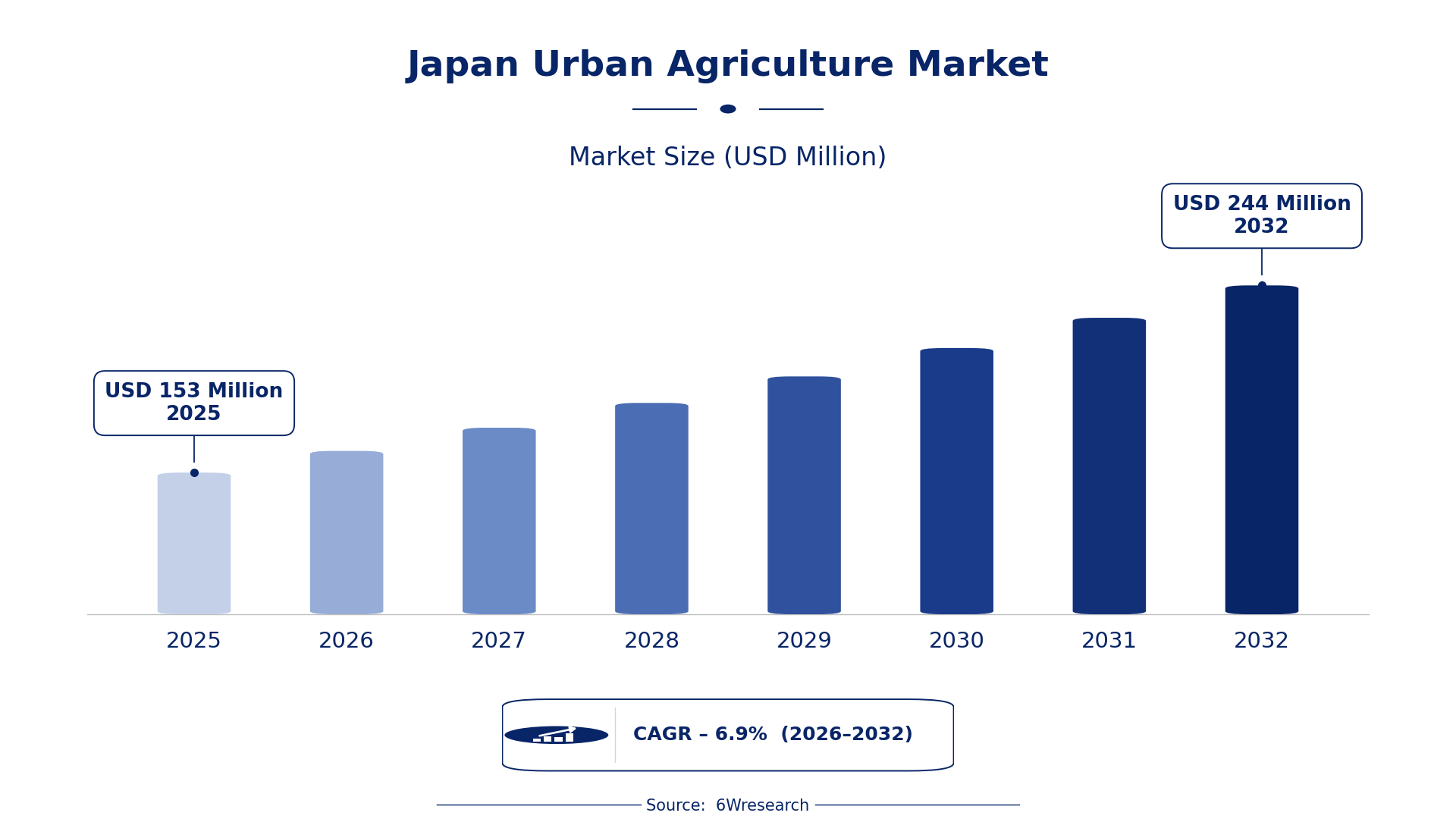
According to 6Wresearch internal database and industry insights, the Japan Urban Agriculture Market was valued at USD 153 Million in 2025 and is projected to reach USD 244 Million by 2032, growing at a CAGR of approximately 6.9% during 2026–2032.
Japan Urban Agriculture Market Highlights
| Report Metric | Details |
| Report Name | Japan Urban Agriculture Market (2026-2032) |
| Market Size 2025 | USD 153 Million |
| Market Size 2032 | USD 244 Million |
| Absolute Growth 2025–2032 | USD 91 Million |
| CAGR 2026–2032 | 6.9% |
| Peak Annual Growth | 7.7% in 2032 |
| Forecast Period | 2026–2032 |
| Historical Data | 2022–2025 |
| Base Year | 2025 |
| Leading Farming Type, 2025 | Indoor Vertical Farms (35% share) |
| Leading Growing Technique, 2025 | Hydroponics (46% share) |
| Leading Output Category, 2025 | Leafy Greens (50% share) |
| Leading End User, 2025 | Urban Farmers (43% share) |
| Fastest-Growing Growing Technique | IoT-Controlled (9.4% CAGR) |
| Fastest-Growing Output Category | Herbs & Microgreens (9.8% CAGR) |
| Fastest-Growing End User | Restaurants (9.0% CAGR) |
| Growing Sector | Urban Agriculture |
| Key End Users | Urban Farmers, Restaurants, NGOs & Cooperatives, Retailers |
Japan Urban Agriculture Market Year-wise Growth Rate and Key Drivers (2022–2032)
This graph illustrates the annual growth rates of the market from 2022 to 2032, highlighting a steady upward trajectory and projected market expansion over the forecast period.
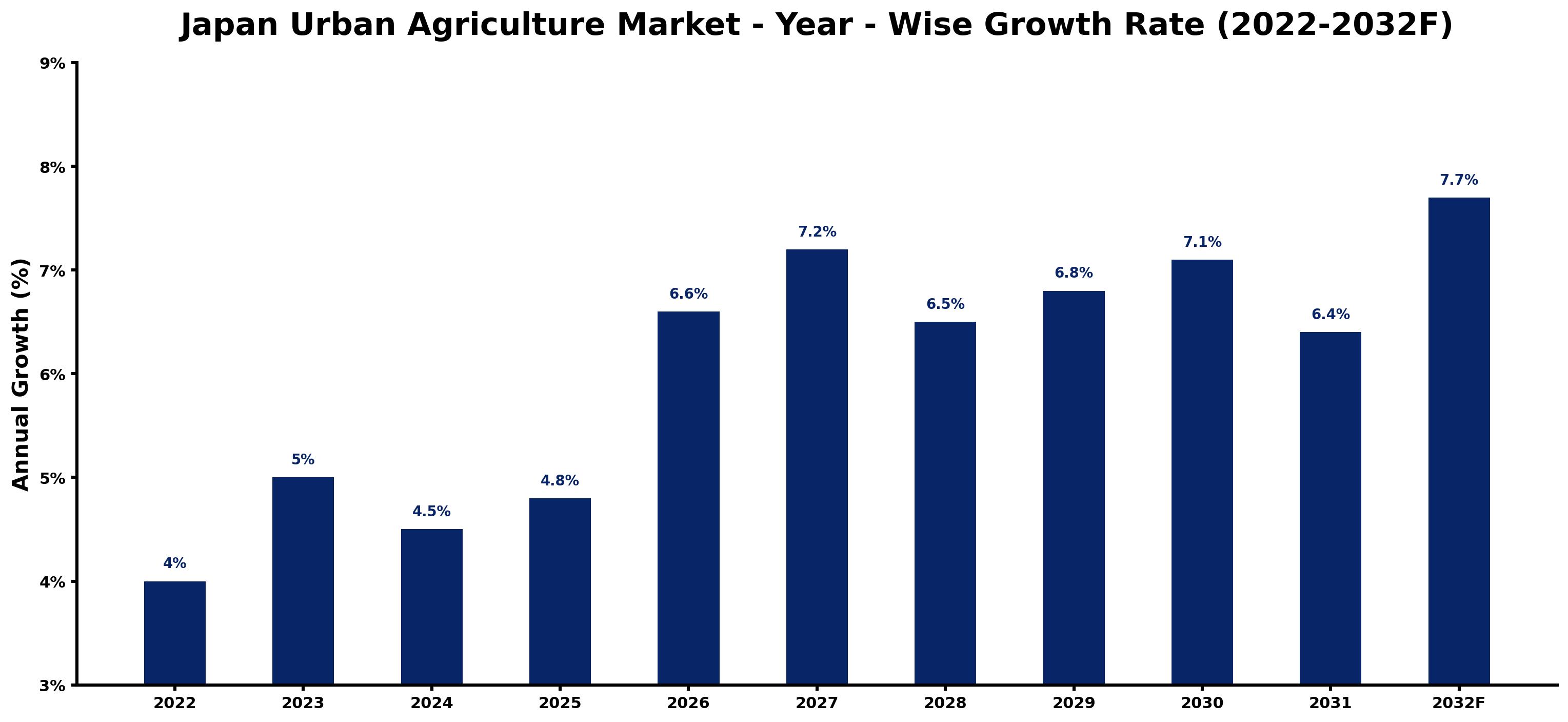
Annual growth estimates for each year appear below with the principal reason behind them, explaining the shifts that set the pace of the market.
| Year | Estimated Annual Growth (%) | Market Rationale |
| 2022 | 4.0 | The market experienced steady growth due to rising urbanisation and demand for local produce. |
| 2023 | 5.0 | Growth accelerated as urban farmers adopted new practices and technologies. |
| 2024 | 4.5 | The growth rate slowed as market saturation began to affect new installations. |
| 2025 | 4.8 | Demand increased again as urban farmers sought to expand their production capacity. |
| 2026 | 6.6 | The market is expected to see a surge in growth driven by increased consumer interest in local food. |
| 2027 | 7.2 | Urban agriculture is projected to gain momentum as more restaurants seek locally sourced ingredients. |
| 2028 | 6.5 | Growth is expected to slow slightly as competition intensifies among urban farmers. |
| 2029 | 6.8 | Demand is projected to rise again as urban farming initiatives expand in new regions. |
| 2030 | 7.1 | The market will continue to grow with more urban farmers adopting advanced technologies. |
| 2031 | 6.4 | Growth is expected to slow as the market matures and faces capacity constraints. |
| 2032 | 7.7 | The market will peak as urban agriculture becomes a staple in urban food systems. |
Note: Market size estimations and growth projections presented in this report are based on 6Wresearch's proprietary forecasting methodology, utilizing the latest available industry data, government publications, and primary research inputs.
Japan Urban Agriculture Market Synopsis
Urban agriculture in Japan encompasses methods such as rooftop farms, vertical farms, and community gardens, utilising technologies like hydroponics and IoT for efficient production. Demand is driven by urban farmers, restaurants, and NGOs, with vegetable production projected to reach 30,000 tons by 2025. This reflects a shift towards sustainable food systems, supported by government initiatives and increasing consumer preference for local produce.
Market Dynamics Impact Analysis (2026–2032)
| Factor | Type | Impact | Primary Segment Affected |
| Rising urbanisation and demand for fresh produce | Driver | High | Urban Farmers |
| Increasing adoption of IoT technologies in farming | Driver | High | IoT-Controlled |
| Growing interest in community engagement through gardens | Opportunity | High | Community Gardens |
| Expansion of urban farming initiatives in metropolitan areas | Opportunity | High | Rooftop Farms |
| High initial investment costs for urban farms | Restraint | Medium | Indoor Vertical Farms |
| Limited space for expansion in urban settings | Restraint | Medium | Rooftop Farms |
| Compliance with organic certification standards | Challenge | High | Hydroponics |
| Capacity constraints due to competition among urban farmers | Challenge | High | Urban Farmers |
Evaluation of Drivers in Japan Urban Agriculture Market (2026–2032)
Below are the drivers that matter most for revenue growth, with supporting evidence.
| Drivers | Primary Segment Affected | Why It Matters (Evidence) |
| Urbanisation increases demand for local produce | Urban Farmers | Japan's urban population is approximately 92% as of 2023, driving local food demand. |
| Technological advancements improve efficiency | IoT-Controlled | Urban farmers increasingly use IoT technology for crop management, improving yields. |
| Government initiatives support urban farming | Community Gardens | The Food Recycling Law encourages local food production and engagement by promoting sustainability. |
| Rising consumer preference for fresh, local ingredients | Restaurants | Restaurants are increasingly sourcing locally grown produce to meet consumer demand. |
| Sustainability trends drive investment in urban agriculture | Indoor Vertical Farms | The Sustainable Urban Agriculture Initiative launched in 2021 promotes local food security. |
Buyers are adding capacity as Japan's urban population reaches approximately 92% in 2023, creating a strong demand for local produce. Urban farmers are increasingly adopting IoT technology for crop management, with over 150 registered systems improving efficiency. Rising sustainability trends drive further investment in urban farming, while the growing interest in local produce among consumers boosts demand for fresh ingredients.
Evaluation of Restraints in Japan Urban Agriculture Market
Below are the constraints most often cited by buyers and suppliers, with the segment each affects.
| Market Restraint | Primary Segment Affected | Why It Matters (Evidence) |
| High initial investment costs for urban farms | Indoor Vertical Farms | The setup costs for advanced farming systems can deter new entrants, limiting market growth. |
| Limited space for expansion in urban settings | Rooftop Farms | Urban areas often have restricted space, making it challenging to scale operations. |
| Compliance with organic certification standards | Hydroponics | Meeting JAS standards for organic certification can be costly and time-consuming. |
| Competition among urban farmers leads to market saturation | Urban Farmers | As more farmers enter the market, profitability may decline due to increased competition. |
| Seasonal fluctuations affect production consistency | Community Gardens | Community gardens may struggle to maintain year-round production due to seasonal changes. |
Japan Urban Agriculture Market Challenges
High production costs burden urban agriculture in Japan, as advanced technologies and infrastructure require significant investment, limiting profitability for urban farmers. Limited access to fresh produce affects buyers, with inefficient distribution networks causing delays that can lead to food waste, particularly impacting restaurants and consumers. Regulatory hurdles arise from inconsistent local government policies, creating compliance challenges that can delay project approvals for producers. Competition from lower-priced imported vegetables pressures local farmers, as these imports can erode market share and reduce profit margins for domestic growers.
Trends in the Japan Urban Agriculture Market
The trends below show where the Japan Urban Agriculture Market is heading.
- Urban Farmers Adopting Hydroponics: A notable shift is occurring as urban farmers adopt hydroponics for efficient food production, with over 150 systems registered in Japan. This change allows for maximised space utilisation and reduced food miles.
- Growth of Community Gardens: Community gardens are gaining popularity, particularly in Osaka, where over 5,000 participants engage annually. This trend promotes local food production and strengthens community ties.
- Rise of Vertical Farms: The establishment of over 100 vertical farms in urban centres demonstrates a shift towards space-efficient agricultural practices. These farms are projected to significantly enhance local food supplies.
- Support from Government Initiatives: The Food Recycling Law exemplifies the shift towards supporting urban agriculture. In 2023, ¥1 billion was allocated for urban agriculture development, boosting local food systems.
Investment Opportunities in the Japan Urban Agriculture Market
Investors looking at the Japan Urban Agriculture Market should consider the following areas.
- Collaborate with Local NGOs: Now is an ideal time to invest in urban agriculture, with the Tokyo government allocating ¥1 billion for development. Partnering with local NGOs can boost community engagement and support.
- Expand Hydroponics Systems: With over 150 hydroponics systems in use, there is a growing gap in efficient urban farming solutions. Investing in advanced hydroponics technology can meet rising demand from urban farmers.
- Invest in Community Engagement: Community gardens are expanding, driven by local interest in food production. Investing in community garden initiatives can tap into this growing trend and improve local food security.
- Invest in Vertical Farming Technology: The vertical farming segment is projected to grow rapidly, with a 10% increase anticipated from 2026 to 2032. Supplying technology for vertical farms can meet this emerging demand.
Government Initiatives in the Japan Urban Agriculture Market
The Waste Management and Public Cleansing Act of 1970 regulates waste treatment, impacting urban agriculture producers by enforcing proper waste disposal practices. The Food Recycling Law of 2000 mandates food businesses to reduce waste, promoting sustainability in urban farming systems. These measures ensure that urban agriculture practices align with environmental standards and support local food production.
Urban farmers benefit from the Sustainable Urban Agriculture Initiative launched in 2021, which supports local food security. The Ministry of Agriculture, Forestry and Fisheries funds various urban agriculture projects, providing financial assistance to farmers implementing sustainable practices. This initiative aims to enhance local food systems and improve access to fresh produce.
Future Insight of the Japan Urban Agriculture Market
Government funding and initiatives will drive investment in urban agriculture, creating new opportunities for local food production. By 2032, vegetable production in urban areas is projected to reach 30,000 tons, bolstering food security for city residents. Technological advancements in IoT will improve crop management, allowing suppliers to optimise yields and reduce waste. The expansion of vertical farms will strengthen local food systems, ensuring fresh produce is consistently available to urban consumers.
Market Segmentation Analysis
Japan Urban Agriculture Market report covers a detailed analysis of the following market segments:
By Farming Type – Indoor Vertical Farms Lead and Record the Fastest Growth
According to Saurav Kr Singh, Senior Research Analyst at 6Wresearch, with 35% of farming type revenue in 2025, Indoor Vertical Farms was the largest category. Indoor vertical farms hold the largest share due to their efficiency in utilising limited urban space, particularly in cities like Tokyo. These farms provide a consistent supply of fresh produce, catering to the high demand from urban populations. The same category are also set to grow fastest, at a CAGR of 10.0% during 2026–2032. The growth of indoor vertical farms is propelled by their suitability for urban settings, with vegetable production projected to reach 30,000 tons by 2025. This trend ensures that their dominance will continue as urbanisation intensifies. Suppliers should prioritise advancements in indoor vertical farming technologies to address the increasing urban demand.
By Growing Technique – Hydroponics Lead, IoT-Controlled Expected to Grow Fastest
Hydroponics took 46% of growing technique revenue in 2025, more than any other category. Hydroponics is the leading technique because it allows for soil-less cultivation, which is crucial for efficient production in urban environments. With over 150 registered hydroponic systems in Japan, its widespread adoption reflects its effectiveness among urban farmers. IoT-Controlled is set to record the highest CAGR in this split, 9.4% over 2026–2032. The IoT-controlled segment is rapidly expanding as it significantly improves monitoring and management of urban farms, enhancing operational efficiency. As urban farmers increasingly implement IoT technology, this segment is expected to grow substantially, boosting productivity. Buyers should invest in IoT solutions to optimise their hydroponic operations and achieve higher yields.
By Output Category – Leafy Greens Lead, Herbs & Microgreens Expected to Grow Fastest
Leafy Greens held 50% of the Japan Urban Agriculture Market by output category in 2025. Leafy greens dominate the market as they are in high demand for fresh salads in urban areas, making them a staple in urban agriculture. This demand is particularly strong in metropolitan regions like Tokyo, where consumers prioritise fresh produce. Over 2026–2032, Herbs & Microgreens are expected to post the fastest growth, at a CAGR of 9.8%. Herbs and microgreens are rapidly gaining popularity, especially among restaurants that seek fresh ingredients for their dishes. This trend indicates a shift towards more diverse urban farming outputs, reflecting changing consumer preferences. Suppliers should diversify their offerings to include herbs and microgreens to cater to the evolving preferences of urban consumers.
By End User – Urban Farmers Lead, Restaurants Expected to Grow Fastest
Urban Farmers accounted for 43% of the market by end user in 2025. Urban farmers are the primary users of urban agriculture, driving market demand with their need for effective production methods. Their involvement in initiatives such as the Urban Farming Network reinforces their leading role in the sector. The quickest growth will come from Restaurants, forecast to expand at a CAGR of 9.0% between 2026 and 2032. Restaurants are the fastest-growing end user as they increasingly seek locally sourced produce to satisfy consumer preferences for fresh ingredients. This trend illustrates the strengthening relationship between urban agriculture and the food service sector, suggesting robust future growth. Suppliers should enhance collaborations with restaurants to improve distribution networks for locally produced goods.
Key Attractiveness of the Report
- 10 Years of Market Numbers
- Historical Data Starting from 2022 to 2025
- Base Year 2025
- Forecast Data until 2032
- Key Performance Indicators Impacting the Market
- Major Upcoming Developments and Projects
Key Highlights of the Report:
- Japan Urban Agriculture Market Outlook
- Market Size of Japan Urban Agriculture Market, 2025
- Forecast of Japan Urban Agriculture Market, 2032
- Historical Data and Forecast of Japan Urban Agriculture Revenues & Volume for the Period 2022-2032F
- Japan Urban Agriculture Market Trend Evolution
- Japan Urban Agriculture Market Drivers and Challenges
- Japan Urban Agriculture Price Trends
- Japan Urban Agriculture Porter's Five Forces
- Japan Urban Agriculture Industry Life Cycle
- Historical Data and Forecast of Japan Urban Agriculture Market Revenues & Volume By Farming Type for the Period 2022-2032F
- Historical Data and Forecast of Japan Urban Agriculture Market Revenues & Volume By Rooftop Farms for the Period 2022-2032F
- Historical Data and Forecast of Japan Urban Agriculture Market Revenues & Volume By Indoor Vertical Farms for the Period 2022-2032F
- Historical Data and Forecast of Japan Urban Agriculture Market Revenues & Volume By Community Gardens for the Period 2022-2032F
- Historical Data and Forecast of Japan Urban Agriculture Market Revenues & Volume By Greenhouses for the Period 2022-2032F
- Historical Data and Forecast of Japan Urban Agriculture Market Revenues & Volume By Growing Technique for the Period 2022-2032F
- Historical Data and Forecast of Japan Urban Agriculture Market Revenues & Volume By Hydroponics for the Period 2022-2032F
- Historical Data and Forecast of Japan Urban Agriculture Market Revenues & Volume By Aeroponics for the Period 2022-2032F
- Historical Data and Forecast of Japan Urban Agriculture Market Revenues & Volume By Organic Soil-Based for the Period 2022-2032F
- Historical Data and Forecast of Japan Urban Agriculture Market Revenues & Volume By IoT-Controlled for the Period 2022-2032F
- Historical Data and Forecast of Japan Urban Agriculture Market Revenues & Volume By Output Category for the Period 2022-2032F
- Historical Data and Forecast of Japan Urban Agriculture Market Revenues & Volume By Leafy Greens for the Period 2022-2032F
- Historical Data and Forecast of Japan Urban Agriculture Market Revenues & Volume By Herbs & Microgreens for the Period 2022-2032F
- Historical Data and Forecast of Japan Urban Agriculture Market Revenues & Volume By Vegetables for the Period 2022-2032F
- Historical Data and Forecast of Japan Urban Agriculture Market Revenues & Volume By Fruits & Flowers for the Period 2022-2032F
- Historical Data and Forecast of Japan Urban Agriculture Market Revenues & Volume By End User for the Period 2022-2032F
- Historical Data and Forecast of Japan Urban Agriculture Market Revenues & Volume By Urban Farmers for the Period 2022-2032F
- Historical Data and Forecast of Japan Urban Agriculture Market Revenues & Volume By Restaurants for the Period 2022-2032F
- Historical Data and Forecast of Japan Urban Agriculture Market Revenues & Volume By NGOs & Cooperatives for the Period 2022-2032F
- Historical Data and Forecast of Japan Urban Agriculture Market Revenues & Volume By Retailers for the Period 2022-2032F
- Japan Urban Agriculture Import Export Trade Statistics
- Market Opportunity Assessment By Farming Type
- Market Opportunity Assessment By Growing Technique
- Market Opportunity Assessment By Output Category
- Market Opportunity Assessment By End User
- Japan Urban Agriculture Top Companies Market Share
- Japan Urban Agriculture Competitive Benchmarking By Technical and Operational Parameters
- Japan Urban Agriculture Company Profiles
- Japan Urban Agriculture Key Strategic Recommendations
Market Covered
The following segment groups are covered in the report.
By Farming Type
- Rooftop Farms
- Indoor Vertical Farms
- Community Gardens
- Greenhouses
By Growing Technique
- Hydroponics
- Aeroponics
- Organic Soil-Based
- IoT-Controlled
By Output Category
- Leafy Greens
- Herbs & Microgreens
- Vegetables
- Fruits & Flowers
By End User
- Urban Farmers
- Restaurants
- NGOs & Cooperatives
- Retailers































