Japan Urban Air Mobility Service Market Size & Growth Rate
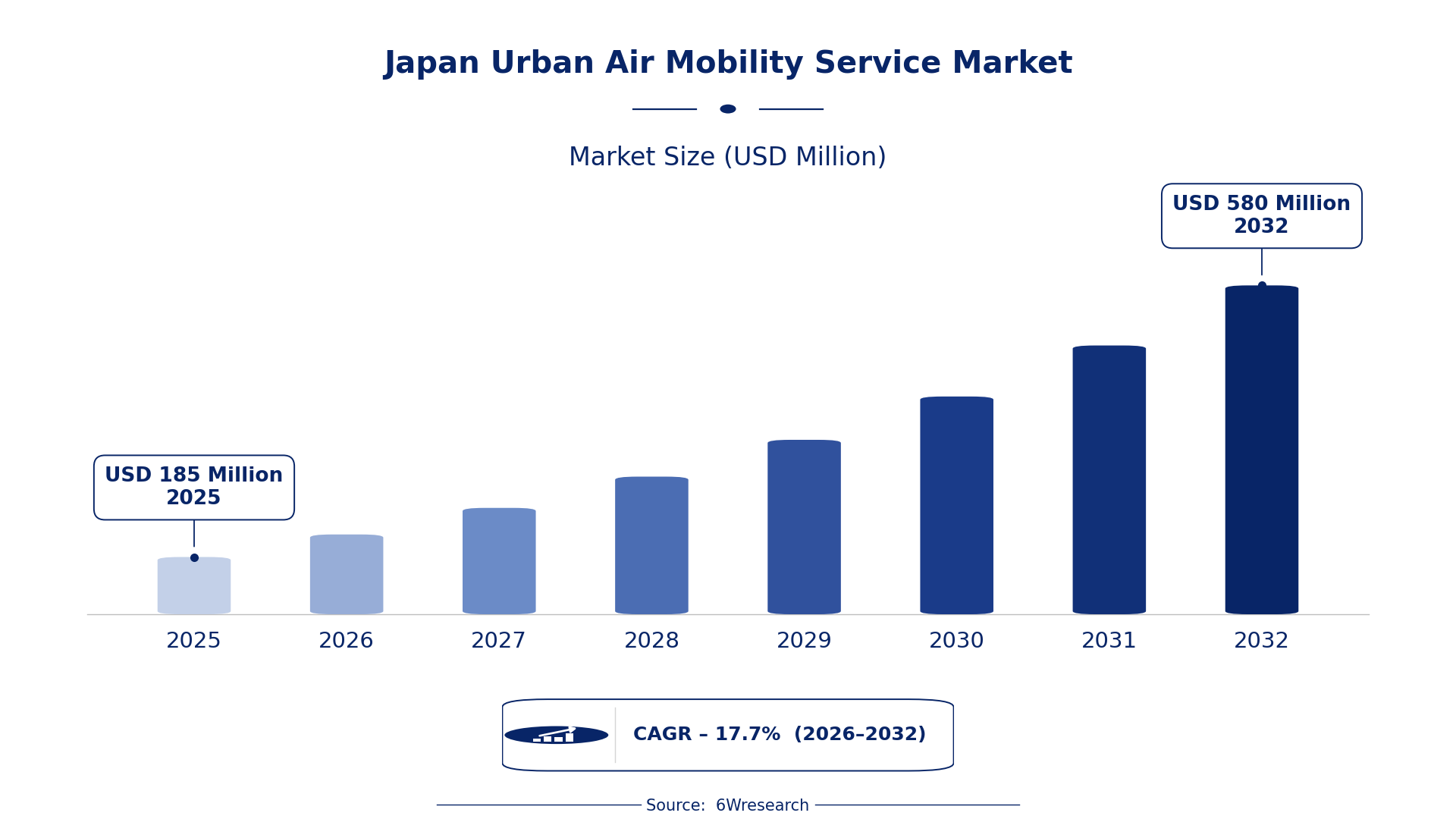
According to 6Wresearch internal database and industry insights, the Japan Urban Air Mobility Service Market was valued at USD 185 Million in 2025 and is projected to reach USD 580 Million by 2032, growing at a CAGR of approximately 17.7% during 2026–2032.
Japan Urban Air Mobility Service Market Highlights
| Report Metric | Details |
| Report Name | Japan Urban Air Mobility Service Market (2026-2032) |
| Market Size 2025 | USD 185 Million |
| Market Size 2032 | USD 580 Million |
| Absolute Growth 2025–2032 | USD 395 Million |
| CAGR 2026–2032 | 17.7% |
| Peak Annual Growth | 19.4% in 2032 |
| Forecast Period | 2026–2032 |
| Historical Data | 2022–2025 |
| Base Year | 2025 |
| Leading Service Type, 2025 | Air Taxi Services (45% share) |
| Leading Vehicle Type, 2025 | eVTOL Aircraft (36% share) |
| Leading Operational Range, 2025 | Intra-City (39% share) |
| Leading End User, 2025 | Urban Commuters (42% share) |
| Fastest-Growing Service Type | Cargo Delivery (23.9% CAGR) |
| Fastest-Growing Operational Range | Last-Mile Logistics (22.8% CAGR) |
| Fastest-Growing End User | Logistics Companies (22.6% CAGR) |
| Growing Sector | Urban Air Mobility Services |
| Key End Users | Urban Commuters, Logistics Companies, Hospitals, Law Enforcement |
Japan Urban Air Mobility Service Market Year-wise Growth Rate and Key Drivers (2022–2032)
This graph illustrates the annual growth rates of the market from 2022 to 2032, highlighting a steady upward trajectory and projected market expansion over the forecast period.
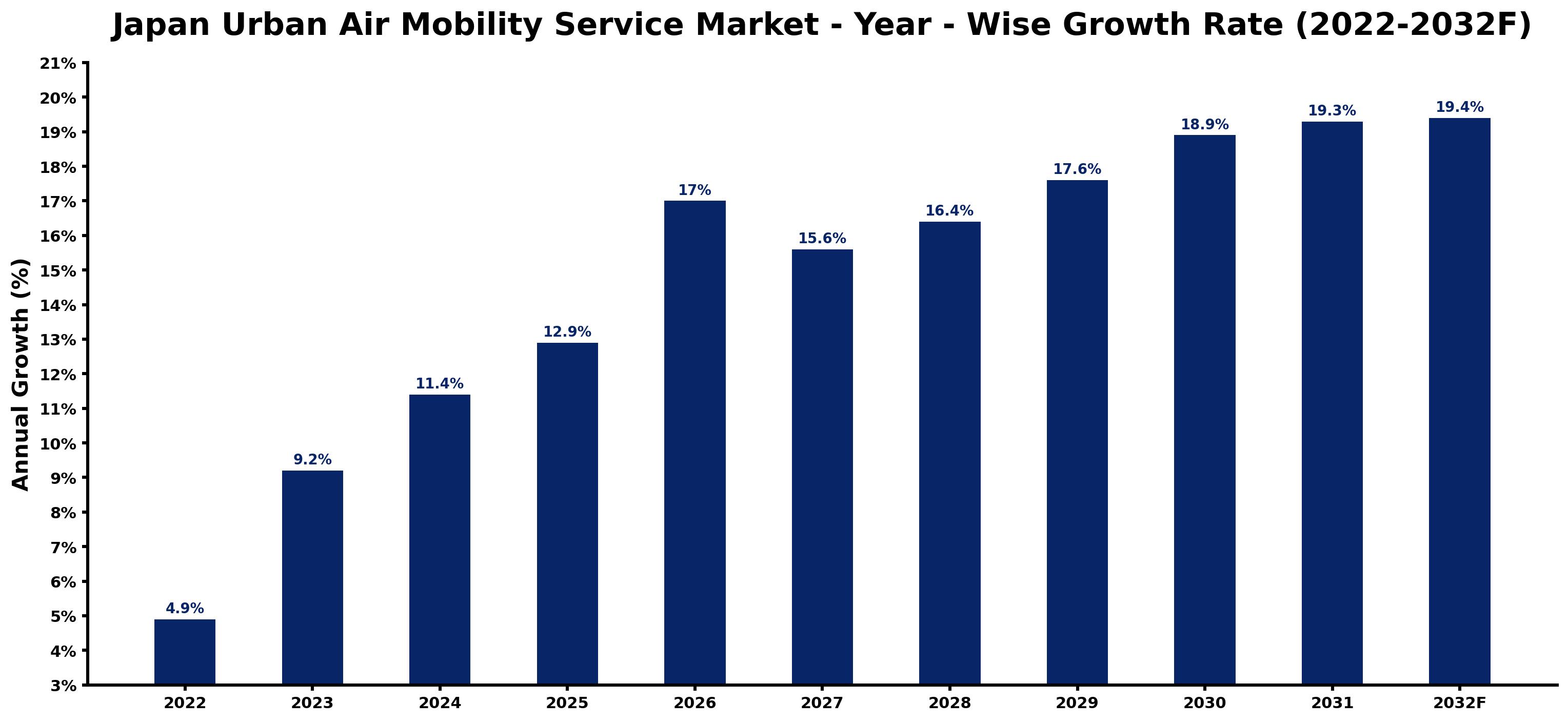
The yearly estimates that follow link every growth rate to its principal driver, so readers can see why the pace changed in each period.
| Year | Estimated Annual Growth (%) | Market Rationale |
| 2022 | 4.9 | The urban population demanded improved transport options, driving initial interest. |
| 2023 | 9.2 | Increased pilot projects in Tokyo accelerated the growth of urban air mobility services. |
| 2024 | 11.4 | Growing investment in eVTOL technology expanded service capabilities and options. |
| 2025 | 12.9 | The first operational air taxi service was set to launch, boosting market confidence. |
| 2026 | 17.0 | Government backing for infrastructure development spurred further investment in services. |
| 2027 | 15.6 | A slight slowdown occurred as market adjustments took place after rapid growth. |
| 2028 | 16.4 | Innovations in eVTOL technology reignited interest and demand for air mobility services. |
| 2029 | 17.6 | Further enhancements in service efficiency attracted more urban commuters to air taxis. |
| 2030 | 18.9 | Growing urban congestion increased the necessity for alternative transport solutions. |
| 2031 | 19.3 | Enhanced regulatory frameworks improved safety perceptions, encouraging wider adoption. |
| 2032 | 19.4 | The anticipated launch of multiple air taxi services will significantly increase market activity. |
Note: Market size estimations and growth projections presented in this report are based on 6Wresearch's proprietary forecasting methodology, utilizing the latest available industry data, government publications, and primary research inputs.
Japan Urban Air Mobility Service Market Synopsis
Urban Air Mobility Service utilises advanced aerial vehicles, particularly electric Vertical Take-Off and Landing (eVTOL) technology, for urban transport and logistics. Key applications include air taxi services, cargo delivery, and emergency transport. The Japan Urban Air Mobility Service Market is expanding, driven by Japan's large urban population of approximately 126 million and substantial government investment of 10 billion yen in eVTOL technology development. Ongoing trials in metropolitan areas like Tokyo and Osaka further stimulate demand, as urban commuters seek efficient transport solutions.
Market Dynamics Impact Analysis (2026–2032)
| Factor | Type | Impact | Primary Segment Affected |
| Growing urban population drives demand for efficient transport solutions. | Driver | High | Air Taxi Services |
| Government investment in eVTOL technology enhances service capabilities. | Driver | High | Cargo Delivery |
| Increasing urban congestion creates a pressing need for alternative transport. | Opportunity | High | Emergency Transport |
| Ongoing pilot projects in major cities present investment opportunities. | Opportunity | Medium | Air Taxi Services |
| Regulatory challenges may delay service launches and expansions. | Restraint | High | eVTOL Aircraft |
| High development costs for eVTOL technology can limit market entry. | Restraint | Medium | Cargo Delivery |
| Compliance with safety regulations increases operational costs. | Challenge | High | Emergency Transport |
| Limited infrastructure for urban air mobility may hinder service deployment. | Challenge | Medium | Air Taxi Services |
Evaluation of Drivers in Japan Urban Air Mobility Service Market (2026–2032)
The factors lifting demand, and the evidence behind each, are summarised below.
| Drivers | Primary Segment Affected | Why It Matters (Evidence) |
| Rising urban population | Air Taxi Services | Japan's urban population of approximately 126 million increases demand for efficient transport solutions. |
| Government investment in eVTOL technology | Cargo Delivery | The Japanese government allocated 10 billion yen to develop eVTOL technology, improving logistics capabilities. |
| Increasing urban congestion | Emergency Transport | Urban congestion necessitates rapid transport solutions, driving demand for emergency services. |
| Ongoing pilot projects | Air Taxi Services | Pilot projects in Tokyo and Osaka demonstrate feasibility, encouraging investment in air taxi services. |
| Technological advancements in eVTOL | eVTOL Aircraft | Innovations in eVTOL technology improve safety and efficiency, attracting more urban commuters. |
What keeps demand rising is the growing urban population of approximately 126 million, which increases the need for efficient transport solutions. Investment of 10 billion yen in eVTOL technology improves logistics capabilities, particularly for cargo delivery. Urban congestion necessitates rapid transport solutions, driving demand for emergency services. Pilot projects in Tokyo and Osaka demonstrate the feasibility of air taxi services, encouraging further investment. Technological advancements in eVTOL are attracting more urban commuters seeking alternatives to traditional transport methods.
Evaluation of Restraints in Japan Urban Air Mobility Service Market
The table below lists the restraints and the evidence behind each.
| Market Restraint | Primary Segment Affected | Why It Matters (Evidence) |
| Regulatory challenges may delay service launches and expansions. | eVTOL Aircraft | Compliance with regulations can slow down the introduction of new services, limiting market growth. |
| High development costs for eVTOL technology can limit market entry. | Cargo Delivery | The investment required for eVTOL development may deter new entrants into the market. |
| Compliance with safety regulations raises operational costs. | Emergency Transport | Meeting stringent safety standards raises operational costs for emergency transport services. |
| Limited infrastructure for urban air mobility may hinder service deployment. | Air Taxi Services | Insufficient infrastructure can restrict the operational capabilities of air taxi services. |
| Public acceptance of new transport modes may take time. | Air Taxi Services | Skepticism towards aerial transport can slow adoption rates among potential users. |
Japan Urban Air Mobility Service Market Challenges
In 2023, Japan's urban mobility sector faces supply chain disruptions, as reliance on foreign components delays eVTOL production and raises costs for producers by up to 15%. Regulatory hurdles arise from the Ministry of Land, Infrastructure, Transport and Tourism's stringent safety requirements, which can postpone service launches for up to two years, limiting buyers' access to new mobility options. High operational costs, stemming from advanced technology investments, can burden operators with expenses exceeding 20% of their revenue, constraining service expansion. Intense competition from traditional transport modes pressures producers to lower prices, impacting profitability.
Trends in the Japan Urban Air Mobility Service Market
Four trends stand out in the Japan Urban Air Mobility Service Market.
- Transition from Ground to Air Transport: Japan is moving from traditional ground transport to urban air mobility solutions, with pilot projects underway in Tokyo. This shift is expected to address urban congestion, with the first operational air taxi service anticipated in 2025.
- Launch of Public-Private Partnerships: A public-private partnership initiated in 2023 aims to develop urban air mobility infrastructure. This collaboration is set to invest significantly in necessary facilities, improving service availability and reliability.
- Focus on Emergency Transport: Emergency transport services are gaining prominence, with initiatives aimed at reducing response times for medical emergencies by 30% by 2025. This focus highlights the critical role of rapid transport in healthcare.
- Adoption of ISO 9001 Standards: The industry is increasingly adopting ISO 9001 standards for safety and quality in urban air mobility operations. This trend is vital for building consumer trust and ensuring operational excellence.
Investment Opportunities in the Japan Urban Air Mobility Service Market
The openings below show where demand in the Japan Urban Air Mobility Service Market is visible and how suppliers can enter.
- Urban Commuters seeking efficient transport: Urban commuters in Japan require efficient transport solutions, presenting opportunities for air taxi services. The anticipated launch of operational services in 2025 will cater to this growing demand.
- eVTOL Aircraft for cargo delivery: With the rise of e-commerce, logistics companies need efficient last-mile delivery solutions. Investing in eVTOL aircraft can streamline operations, particularly in urban areas.
- Partnerships for infrastructure development: Collaborating with local governments and agencies can facilitate the development of necessary infrastructure for urban air mobility. This approach can improve service deployment and operational efficiency.
- Tokyo as a hub for air mobility services: Tokyo is emerging as a key hub for urban air mobility services, supported by ongoing trials and government initiatives. Establishing operations in this metropolitan area can yield significant market opportunities.
Government Initiatives in the Japan Urban Air Mobility Service Market
The Battery Industry Strategy, introduced by METI in August 2022, aims to achieve 150 GWh of domestic battery manufacturing capacity by 2030. This measure supports the development of eVTOL technology, as efficient batteries are essential for urban air mobility services.
In 2023, a public-private partnership was initiated to develop urban air mobility infrastructure, with the Ministry of Land, Infrastructure, Transport and Tourism overseeing the initiative. This partnership aims to improve facilities and regulatory frameworks, promoting the growth of urban air mobility services.
Future Insight of the Japan Urban Air Mobility Service Market
By 2032, urban commuters will benefit from enhanced air mobility services driven by substantial government investment in eVTOL technology. Public-private partnerships will improve infrastructure, leading to more efficient operations and increased service availability. Adoption of ISO 9001 standards will ensure safety and quality, boosting consumer confidence. The first operational air taxi service is set to launch in 2025, contributing to a more integrated urban transport network.
Market Segmentation Analysis
Japan Urban Air Mobility Service Market report covers a detailed analysis of the following market segments:
By Service Type – Air Taxi Services Lead, Cargo Delivery Expected to Grow Fastest
According to Saurav Kr Singh, Senior Research Analyst at 6Wresearch, Air Taxi Services held 45% of the Japan Urban Air Mobility Service Market by service type in 2025. Air taxi services dominate the market as they provide urban commuters with efficient transport options in densely populated regions. The Tokyo metropolitan area, a hub for urban air mobility trials, exemplifies the strong demand for these services. Over 2026–2032, Cargo Delivery is expected to post the fastest growth, at a CAGR of 23.9%. Cargo delivery is experiencing rapid growth as logistics companies increasingly seek to optimise last-mile delivery solutions. The pilot projects currently underway in cities like Tokyo and Osaka highlight the segment's potential for substantial expansion. Suppliers must prioritise the development of cargo delivery services to capitalise on the increasing demand in this segment.
By Vehicle Type – eVTOL Aircraft Leads and Records the Fastest Growth
With 36% of vehicle type revenue in 2025, eVTOL Aircraft was the largest category. eVTOL aircraft hold the largest share as they are the primary vehicle type for urban air mobility services. Their design specifically caters to urban environments, making them the preferred choice for various applications. Its lead should widen, with a projected CAGR of 20.4% during 2026–2032, the highest in this split. The eVTOL aircraft segment is also the fastest-growing due to ongoing advancements in technology and increasing investments in infrastructure. As the first operational air taxi service is set to launch in 2025, demand for these vehicles will likely surge. Suppliers must invest in eVTOL technology to remain competitive in a rapidly advancing market.
By Operational Range – Intra-City Leads, Last-Mile Logistics Expected to Grow Fastest
Intra-City accounted for 39% of the market by operational range in 2025. Intra-city operations lead the market as they focus on urban commuting between city locations, aligning with the needs of a densely populated urban environment. This segment benefits from the high volume of commuters in cities like Tokyo. The quickest growth will come from Last-Mile Logistics, forecast to expand at a CAGR of 22.8% between 2026 and 2032. Last-mile logistics is the fastest-growing segment, driven by the need for efficient delivery solutions in urban areas. The emphasis on reducing delivery times aligns with the increasing demand for cargo delivery services. Buyers should consider last-mile logistics solutions to improve operational efficiency and meet customer expectations.
By End User – Urban Commuters Lead, Logistics Companies Expected to Grow Fastest
Urban Commuters took 42% of end user revenue in 2025, more than any other category. Urban commuters represent the primary end-user group, as air taxi services are specifically designed to cater to their transportation needs. With Japan's urban population around 126 million, there is a robust market for these services. Logistics Companies are projected to grow fastest, at a CAGR of 22.6% during 2026–2032. Logistics companies are the fastest-growing end-user segment, increasingly adopting urban air mobility for efficient cargo delivery solutions. The ongoing trials and pilot projects are paving the way for greater acceptance and utilisation in this sector. Suppliers should focus on tailoring their offerings to meet the specific needs of logistics companies to capture this growth opportunity.
Key Attractiveness of the Report
- 10 Years of Market Numbers
- Historical Data Starting from 2022 to 2025
- Base Year 2025
- Forecast Data until 2032
- Key Performance Indicators Impacting the Market
- Major Upcoming Developments and Projects
Key Highlights of the Report:
- Japan Urban Air Mobility Service Market Outlook
- Market Size of Japan Urban Air Mobility Service Market, 2025
- Forecast of Japan Urban Air Mobility Service Market, 2032
- Historical Data and Forecast of Japan Urban Air Mobility Service Revenues & Volume for the Period 2022-2032F
- Japan Urban Air Mobility Service Market Trend Evolution
- Japan Urban Air Mobility Service Market Drivers and Challenges
- Japan Urban Air Mobility Service Price Trends
- Japan Urban Air Mobility Service Porter's Five Forces
- Japan Urban Air Mobility Service Industry Life Cycle
- Historical Data and Forecast of Japan Urban Air Mobility Service Market Revenues & Volume By Service Type for the Period 2022-2032F
- Historical Data and Forecast of Japan Urban Air Mobility Service Market Revenues & Volume By Air Taxi Services for the Period 2022-2032F
- Historical Data and Forecast of Japan Urban Air Mobility Service Market Revenues & Volume By Cargo Delivery for the Period 2022-2032F
- Historical Data and Forecast of Japan Urban Air Mobility Service Market Revenues & Volume By Emergency Transport for the Period 2022-2032F
- Historical Data and Forecast of Japan Urban Air Mobility Service Market Revenues & Volume By Surveillance/Patrol for the Period 2022-2032F
- Historical Data and Forecast of Japan Urban Air Mobility Service Market Revenues & Volume By Vehicle Type for the Period 2022-2032F
- Historical Data and Forecast of Japan Urban Air Mobility Service Market Revenues & Volume By eVTOL Aircraft for the Period 2022-2032F
- Historical Data and Forecast of Japan Urban Air Mobility Service Market Revenues & Volume By Heavy-Lift UAV for the Period 2022-2032F
- Historical Data and Forecast of Japan Urban Air Mobility Service Market Revenues & Volume By Medical VTOL for the Period 2022-2032F
- Historical Data and Forecast of Japan Urban Air Mobility Service Market Revenues & Volume By Autonomous Drones for the Period 2022-2032F
- Historical Data and Forecast of Japan Urban Air Mobility Service Market Revenues & Volume By Operational Range for the Period 2022-2032F
- Historical Data and Forecast of Japan Urban Air Mobility Service Market Revenues & Volume By Intra-City for the Period 2022-2032F
- Historical Data and Forecast of Japan Urban Air Mobility Service Market Revenues & Volume By Last-Mile Logistics for the Period 2022-2032F
- Historical Data and Forecast of Japan Urban Air Mobility Service Market Revenues & Volume By Regional for the Period 2022-2032F
- Historical Data and Forecast of Japan Urban Air Mobility Service Market Revenues & Volume By Perimeter Coverage for the Period 2022-2032F
- Historical Data and Forecast of Japan Urban Air Mobility Service Market Revenues & Volume By End User for the Period 2022-2032F
- Historical Data and Forecast of Japan Urban Air Mobility Service Market Revenues & Volume By Urban Commuters for the Period 2022-2032F
- Historical Data and Forecast of Japan Urban Air Mobility Service Market Revenues & Volume By Logistics Companies for the Period 2022-2032F
- Historical Data and Forecast of Japan Urban Air Mobility Service Market Revenues & Volume By Hospitals for the Period 2022-2032F
- Historical Data and Forecast of Japan Urban Air Mobility Service Market Revenues & Volume By Law Enforcement for the Period 2022-2032F
- Japan Urban Air Mobility Service Import Export Trade Statistics
- Market Opportunity Assessment By Service Type
- Market Opportunity Assessment By Vehicle Type
- Market Opportunity Assessment By Operational Range
- Market Opportunity Assessment By End User
- Japan Urban Air Mobility Service Top Companies Market Share
- Japan Urban Air Mobility Service Competitive Benchmarking By Technical and Operational Parameters
- Japan Urban Air Mobility Service Company Profiles
- Japan Urban Air Mobility Service Key Strategic Recommendations
Market Covered
Segments analysed in this report are listed below.
By Service Type
- Air Taxi Services
- Cargo Delivery
- Emergency Transport
- Surveillance/Patrol
By Vehicle Type
- eVTOL Aircraft
- Heavy-Lift UAV
- Medical VTOL
- Autonomous Drones
By Operational Range
- Intra-City
- Last-Mile Logistics
- Regional
- Perimeter Coverage
By End User
- Urban Commuters
- Logistics Companies
- Hospitals
- Law Enforcement































