Japan Urban EV Charging Market Size & Growth Rate
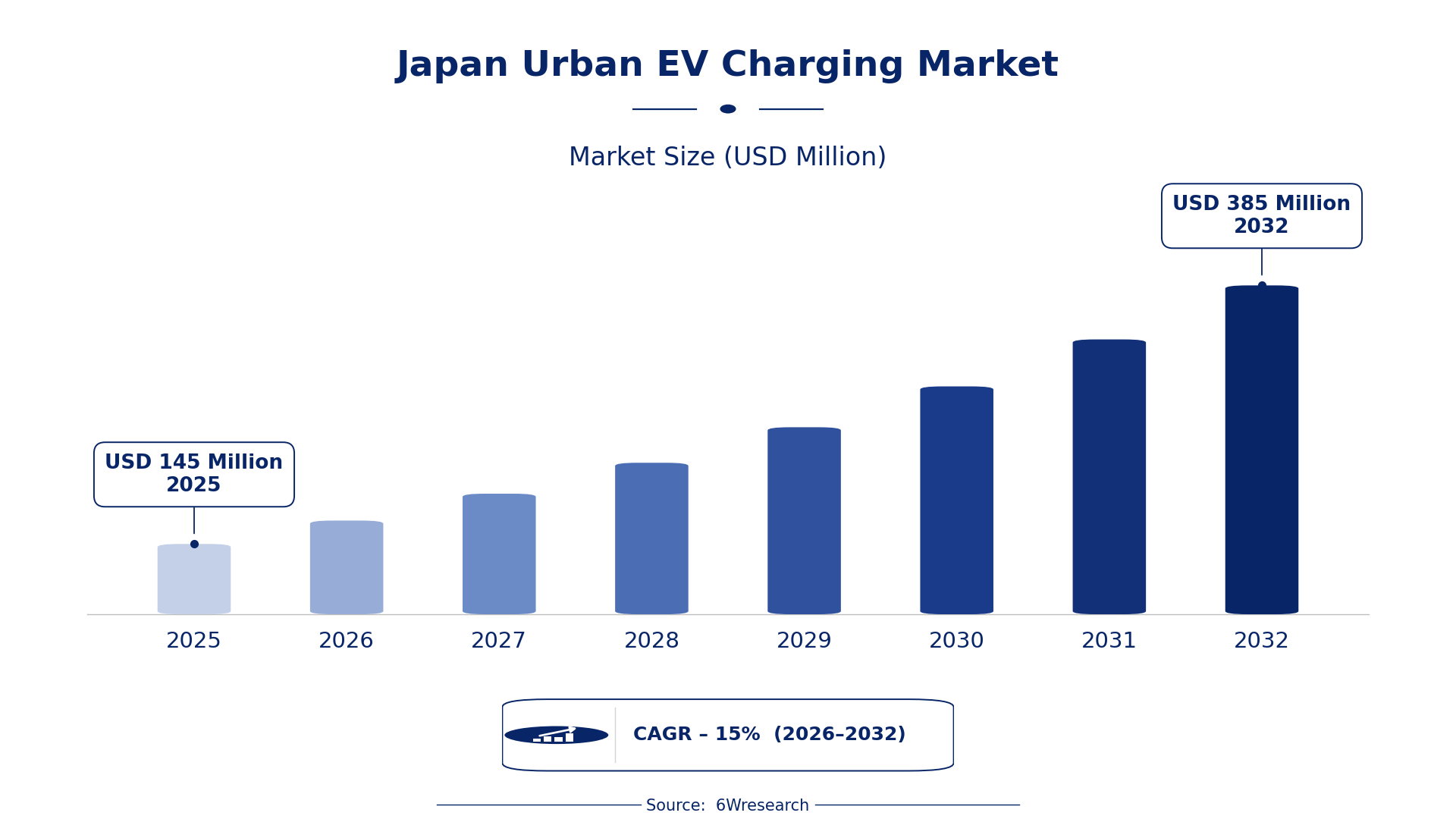
According to 6Wresearch internal database and industry insights, the Japan Urban EV Charging Market was valued at USD 145 Million in 2025 and is projected to reach USD 385 Million by 2032, growing at a CAGR of approximately 15% during 2026–2032.
Japan Urban EV Charging Market Highlights
| Report Metric | Details |
| Report Name | Japan Urban EV Charging Market (2026-2032) |
| Market Size 2025 | USD 145 Million |
| Market Size 2032 | USD 385 Million |
| Absolute Growth 2025–2032 | USD 240 Million |
| CAGR 2026–2032 | 15% |
| Peak Annual Growth | 15.7% in 2032 |
| Forecast Period | 2026–2032 |
| Historical Data | 2022–2025 |
| Base Year | 2025 |
| Leading Charging Type, 2025 | Fast Chargers (46% share) |
| Leading Installation Type, 2025 | Public Charging Hub (37% share) |
| Leading Vehicle Segment, 2025 | Passenger EVs (42% share) |
| Leading End User, 2025 | EV Drivers (48% share) |
| Fastest-Growing Charging Type | Smart Chargers (21.6% CAGR) |
| Fastest-Growing Installation Type | Residential Installations (20.8% CAGR) |
| Fastest-Growing Vehicle Segment | Light Electric Vehicles (20.0% CAGR) |
| Fastest-Growing End User | Delivery Aggregators (19.5% CAGR) |
| Growing Sector | Urban EV Charging |
| Key End Users | Municipalities, Delivery Aggregators, EV Drivers |
Japan Urban EV Charging Market Year-wise Growth Rate and Key Drivers (2022–2032)
This graph illustrates the annual growth rates of the market from 2022 to 2032, highlighting a steady upward trajectory and projected market expansion over the forecast period.
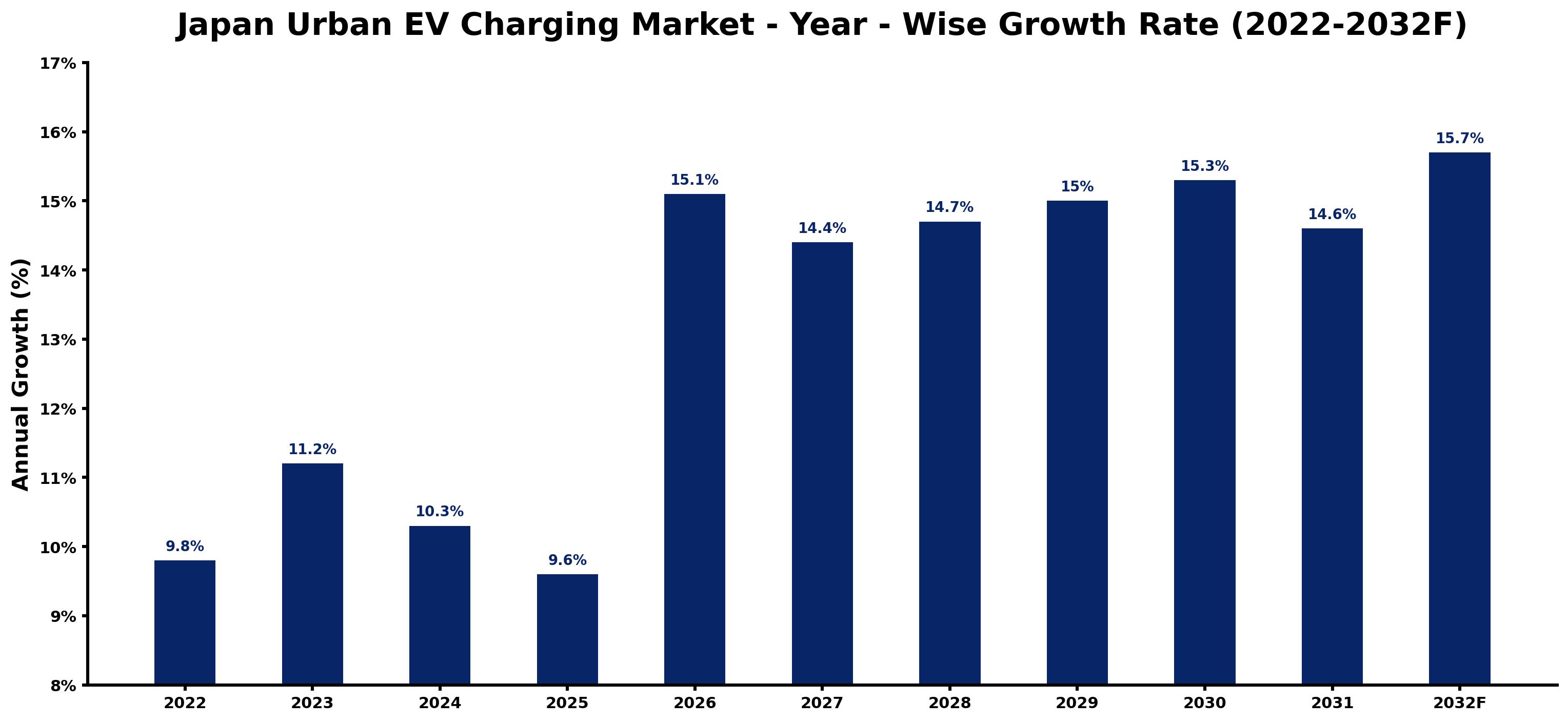
Each row of the following table gives one year's estimated growth and the event or demand shift that explains it.
| Year | Estimated Annual Growth (%) | Market Rationale |
| 2022 | 9.8 | Demand for urban EV charging grew as electric vehicle adoption increased across Japan. |
| 2023 | 11.2 | The expansion of public charging stations in urban areas accelerated market growth. |
| 2024 | 10.3 | Growth slowed as the market adjusted to increased competition among charging providers. |
| 2025 | 9.6 | Market growth continued to slow as urban infrastructure development faced challenges. |
| 2026 | 15.1 | The introduction of new smart charging technologies is anticipated to spur demand. |
| 2027 | 14.4 | Growth is projected to slow slightly as the market matures and competition intensifies. |
| 2028 | 14.7 | Increased investment in public charging hubs will boost market expansion once again. |
| 2029 | 15.0 | Demand is expected to surge as municipalities expand their electric vehicle fleets. |
| 2030 | 15.3 | The government's target of 1 million EVs on the road will stimulate further investment. |
| 2031 | 14.6 | Growth is projected to slow as market saturation begins to set in for urban charging solutions. |
| 2032 | 15.7 | The market is expected to peak as advanced charging solutions gain widespread adoption. |
Note: Market size estimations and growth projections presented in this report are based on 6Wresearch's proprietary forecasting methodology, utilizing the latest available industry data, government publications, and primary research inputs.
Japan Urban EV Charging Market Synopsis
Urban EV charging encompasses the infrastructure and technology enabling electric vehicle charging in urban settings. This includes fast and smart chargers, essential for supporting the growing number of electric vehicles. The Japan Urban EV Charging Market is expanding due to increasing demand from municipalities, delivery services, and individual EV drivers. Initiatives like the 'Green Mobility' program aim for 1 million EVs on the road by 2030, further propelling market growth.
Market Dynamics Impact Analysis (2026–2032)
| Factor | Type | Impact | Primary Segment Affected |
| Growing number of electric vehicles | Driver | High | Passenger EVs |
| Investment in public charging infrastructure | Driver | High | Public Charging Hub |
| Increasing demand for fleet electrification | Opportunity | High | Urban Fleets |
| Rise in residential installations | Opportunity | Medium | Residential Installations |
| Limited adoption of wireless charging technology | Restraint | Medium | Wireless Chargers |
| Challenges in urban infrastructure development | Restraint | High | Public Charging Hub |
| Competition among charging providers | Challenge | High | Fast Chargers |
| High installation costs for public charging hubs | Challenge | Medium | Public Charging Hub |
Evaluation of Drivers in Japan Urban EV Charging Market (2026–2032)
Below are the drivers that matter most for revenue growth, with supporting evidence.
| Drivers | Primary Segment Affected | Why It Matters (Evidence) |
| Increase in electric vehicle registrations | Passenger EVs | With over 30,000 public EV charging stations, more consumers are purchasing electric vehicles, driving demand for charging solutions. |
| Government support for EV infrastructure investment | Public Charging Hub | The Tokyo Metropolitan Government encourages municipalities to invest in charging hubs, enhancing urban infrastructure. |
| Growth in smart charging installations | Smart Chargers | Smart chargers accounted for 40% of new installations, enabling efficient energy management and increasing user convenience. |
| Rising demand from delivery services | Urban Fleets | Delivery aggregators are electrifying their fleets, creating a need for urban charging solutions. |
| Residential installations increasing by 25% | Residential Installations | As more individuals adopt electric vehicles, residential charging installations are becoming essential for EV ownership. |
A wider customer base explains much of the growth, as the number of electric vehicles in Japan continues to rise. The expansion of public charging stations is encouraging more consumers to purchase electric vehicles, significantly boosting demand for charging solutions. Smart chargers accounted for 40% of new installations, improving energy management and attracting more users. The electrification of delivery services is creating a surge in demand for urban charging infrastructure, while residential installations have increased by 25% recently, reflecting the growing trend of individual EV ownership.
Evaluation of Restraints in Japan Urban EV Charging Market
The following restraints limit how fast demand can grow.
| Market Restraint | Primary Segment Affected | Why It Matters (Evidence) |
| High costs of public charging hub installation | Public Charging Hub | The average cost of a public charging hub is approximately ¥10 million, deterring some municipalities from investing. |
| Limited adoption of battery swapping technology | Battery Swapping | Battery swapping stations remain niche, primarily located in urban centers, limiting widespread adoption. |
| Competition leading to price wars | Fast Chargers | Intense competition among charging providers can drive down prices, impacting profitability for suppliers. |
| Slow development of urban infrastructure | Public Charging Hub | Challenges in urban infrastructure development hinder the timely installation of new charging stations. |
| Regulatory hurdles for new installations | Smart Chargers | Compliance with JIS standards can delay the deployment of new smart charging solutions. |
Japan Urban EV Charging Market Challenges
A major obstacle in the urban EV charging market is the shortage of skilled technicians, which exists due to the rapid growth of the electric vehicle sector in Japan. This skills gap delays the installation and maintenance of charging stations, costing producers valuable time and resources. Supply chain disruptions hinder the availability of essential components, leading to project delays for distributors and increasing costs by approximately 15%. Rising installation costs, averaging ¥10 million per public charging hub, strain budgets for buyers, particularly municipalities investing in infrastructure. Increased competition among charging providers leads to price wars, forcing suppliers to lower prices and impacting their profit margins.
Trends in the Japan Urban EV Charging Market
The trends below show where the Japan Urban EV Charging Market is heading.
- Shift from Standard to Smart Charging: Since 2023, the adoption of smart charging solutions has increased, with 40% of new installations being smart chargers. This shift improves energy management and user convenience, benefiting urban EV drivers.
- Transition to Public Charging Hubs: The focus on public charging hubs has intensified, especially in Tokyo, where municipalities are investing heavily. This trend is supported by a growing number of electric vehicles, with over 30,000 charging stations available.
- Emergence of Light Electric Vehicles: Light electric vehicles are gaining traction in urban areas, with a projected growth rate of 15% annually. This trend is prompting the development of dedicated charging solutions to meet the increasing demand.
- Prioritisation of Fleet Electrification: Municipalities are increasingly electrifying their fleets, creating a surge in demand for urban charging infrastructure. This change aligns with the government's goal of reducing urban traffic emissions by 30% by 2030.
Investment Opportunities in the Japan Urban EV Charging Market
Several openings in the Japan Urban EV Charging Market merit attention from investors.
- Current Demand for Urban Charging Solutions: The market is ripe for supplying smart chargers, as municipalities seek to improve their EV infrastructure. Collaborating with local governments can facilitate market entry.
- Investment in Public Charging Infrastructure: The average cost of a public charging hub is approximately ¥10 million, indicating a gap for investment. Municipalities are actively seeking partners to develop these hubs.
- Residential Charging Solutions Needed: Residential installations have increased by 25% recently, presenting a chance to supply home charging units. Collaborating with local installers can streamline market entry.
- Growing Demand from Delivery Services: Delivery aggregators are electrifying their fleets, creating a need for urban charging solutions. Suppliers can enter this market through joint ventures with logistics companies.
Government Initiatives in the Japan Urban EV Charging Market
The Electrical Appliance and Material Safety Act regulates the safety of electrical appliances, including EV chargers, ensuring that producers meet safety standards. Compliance with these regulations is essential for manufacturers to operate in Japan's EV charging market, impacting their product development and marketing strategies.
In 2023, the government allocated ¥5 billion for EV infrastructure development under the 'Green Mobility' program, administered by the Ministry of the Environment. This funding supports the installation of charging stations, enabling municipalities to improve their EV infrastructure.
Future Insight of the Japan Urban EV Charging Market
Investment in charging infrastructure will surge, driven by government initiatives and private sector funding, generating substantial demand for solutions. By 2032, the installed base of smart chargers will reach 100,000 units, enhancing user experience. The adoption of the ISO 15118 standard will facilitate vehicle-to-grid communication, improving energy management. Municipalities will continue to develop charging hubs, ensuring convenient access for buyers, while the 'Sustainable Mobility' initiative aims to reduce urban traffic emissions by 30% by 2030.
Market Segmentation Analysis
Japan Urban EV Charging Market report covers a detailed analysis of the following market segments:
By Charging Type – Fast Chargers Lead, Smart Chargers Expected to Grow Fastest
According to Saurav Kr Singh, Senior Research Analyst at 6Wresearch, Fast Chargers accounted for 46% of the market by charging type in 2025. Fast chargers are essential for quick vehicle turnaround, making them indispensable for urban areas with high traffic. Their widespread use in locations such as public charging hubs in Tokyo illustrates their dominance in the market. Smart Chargers are projected to grow fastest, at a CAGR of 21.6% during 2026–2032. Smart chargers are gaining traction due to their ability to enable efficient energy management and user convenience, particularly in urban settings. The increasing installation rate, with smart chargers accounting for 40% of new installations, highlights their rapid adoption. Suppliers should focus on expanding smart charger offerings to meet rising urban demand.
By Installation Type – Public Charging Hub Leads, Residential Installations Expected to Grow Fastest
Public Charging Hub held 37% of the Japan Urban EV Charging Market by installation type in 2025. Public charging hubs are vital for urban infrastructure development, as they are essential for supporting the increasing number of electric vehicles in cities. Their establishment in regions like Tokyo exemplifies their critical role in promoting electric mobility. Over 2026–2032, Residential Installations are expected to post the fastest growth, at a CAGR of 20.8%. Residential installations are experiencing rapid growth, with a notable 25% increase in the last year, reflecting the rising need for charging solutions among individual EV owners. This trend suggests a shift towards more accessible and convenient charging options for homeowners in urban areas. Suppliers should prioritise the development of residential charging solutions to cater to the growing demand from urban homeowners.
By Vehicle Segment – Passenger EVs Lead, Light Electric Vehicles Expected to Grow Fastest
In 2025, Passenger EVs led the vehicle segment split with a 42% share. Passenger EVs represent the primary vehicle type for urban charging, driven by consumer preferences and supportive government initiatives aimed at increasing electric vehicle adoption. Their dominance is evident in the substantial share they command within Japan's electric vehicle market. The quickest growth will come from Light Electric Vehicles, forecast to expand at a CAGR of 20.0% between 2026 and 2032. Light electric vehicles are projected to grow at an annual rate of 15%, indicating a rising demand for specialised charging solutions tailored to this segment. This growth reflects a broader trend towards compact and efficient transportation options in urban environments. Suppliers must adapt their offerings to meet the increasing demand for charging solutions specifically designed for light electric vehicles.
By End User – EV Drivers Lead, Delivery Aggregators Expected to Grow Fastest
With 48% of end user revenue in 2025, EV Drivers was the largest category. EV drivers are the main users of charging infrastructure, directly influencing the demand for charging stations across urban areas. Their increasing numbers, driven by government initiatives, solidify their leading position in the market. Delivery Aggregators are set to record the highest CAGR in this split, 19.5% over 2026–2032. Delivery aggregators are driving demand for fleet electrification, necessitating more charging solutions to support their operations. This trend is indicative of a broader shift towards sustainable logistics in urban environments. Suppliers should target delivery aggregators as a key customer segment to capitalise on the electrification trend.
Key Attractiveness of the Report
- 10 Years of Market Numbers
- Historical Data Starting from 2022 to 2025
- Base Year 2025
- Forecast Data until 2032
- Key Performance Indicators Impacting the Market
- Major Upcoming Developments and Projects
Key Highlights of the Report:
- Japan Urban EV Charging Market Outlook
- Market Size of Japan Urban EV Charging Market, 2025
- Forecast of Japan Urban EV Charging Market, 2032
- Historical Data and Forecast of Japan Urban EV Charging Revenues & Volume for the Period 2022-2032F
- Japan Urban EV Charging Market Trend Evolution
- Japan Urban EV Charging Market Drivers and Challenges
- Japan Urban EV Charging Price Trends
- Japan Urban EV Charging Porter's Five Forces
- Japan Urban EV Charging Industry Life Cycle
- Historical Data and Forecast of Japan Urban EV Charging Market Revenues & Volume By Charging Type for the Period 2022-2032F
- Historical Data and Forecast of Japan Urban EV Charging Market Revenues & Volume By Fast Chargers for the Period 2022-2032F
- Historical Data and Forecast of Japan Urban EV Charging Market Revenues & Volume By Smart Chargers for the Period 2022-2032F
- Historical Data and Forecast of Japan Urban EV Charging Market Revenues & Volume By Wireless Chargers for the Period 2022-2032F
- Historical Data and Forecast of Japan Urban EV Charging Market Revenues & Volume By Battery Swapping for the Period 2022-2032F
- Historical Data and Forecast of Japan Urban EV Charging Market Revenues & Volume By Installation Type for the Period 2022-2032F
- Historical Data and Forecast of Japan Urban EV Charging Market Revenues & Volume By Public Charging Hub for the Period 2022-2032F
- Historical Data and Forecast of Japan Urban EV Charging Market Revenues & Volume By Residential Installations for the Period 2022-2032F
- Historical Data and Forecast of Japan Urban EV Charging Market Revenues & Volume By Road-Embedded for the Period 2022-2032F
- Historical Data and Forecast of Japan Urban EV Charging Market Revenues & Volume By Modular Units for the Period 2022-2032F
- Historical Data and Forecast of Japan Urban EV Charging Market Revenues & Volume By Vehicle Segment for the Period 2022-2032F
- Historical Data and Forecast of Japan Urban EV Charging Market Revenues & Volume By Passenger EVs for the Period 2022-2032F
- Historical Data and Forecast of Japan Urban EV Charging Market Revenues & Volume By Light Electric Vehicles for the Period 2022-2032F
- Historical Data and Forecast of Japan Urban EV Charging Market Revenues & Volume By Urban Fleets for the Period 2022-2032F
- Historical Data and Forecast of Japan Urban EV Charging Market Revenues & Volume By Two- & Three-Wheelers for the Period 2022-2032F
- Historical Data and Forecast of Japan Urban EV Charging Market Revenues & Volume By End User for the Period 2022-2032F
- Historical Data and Forecast of Japan Urban EV Charging Market Revenues & Volume By EV Drivers for the Period 2022-2032F
- Historical Data and Forecast of Japan Urban EV Charging Market Revenues & Volume By Apartment Owners for the Period 2022-2032F
- Historical Data and Forecast of Japan Urban EV Charging Market Revenues & Volume By Municipalities for the Period 2022-2032F
- Historical Data and Forecast of Japan Urban EV Charging Market Revenues & Volume By Delivery Aggregators for the Period 2022-2032F
- Japan Urban EV Charging Import Export Trade Statistics
- Market Opportunity Assessment By Charging Type
- Market Opportunity Assessment By Installation Type
- Market Opportunity Assessment By Vehicle Segment
- Market Opportunity Assessment By End User
- Japan Urban EV Charging Top Companies Market Share
- Japan Urban EV Charging Competitive Benchmarking By Technical and Operational Parameters
- Japan Urban EV Charging Company Profiles
- Japan Urban EV Charging Key Strategic Recommendations
Market Covered
Coverage by segment is as follows.
By Charging Type
- Fast Chargers
- Smart Chargers
- Wireless Chargers
- Battery Swapping
By Installation Type
- Public Charging Hub
- Residential Installations
- Road-Embedded
- Modular Units
By Vehicle Segment
- Passenger EVs
- Light Electric Vehicles
- Urban Fleets
- Two- & Three-Wheelers
By End User
- EV Drivers
- Apartment Owners
- Municipalities
- Delivery Aggregators































