Japan Urban Infrastructure Automation Market Size & Growth Rate
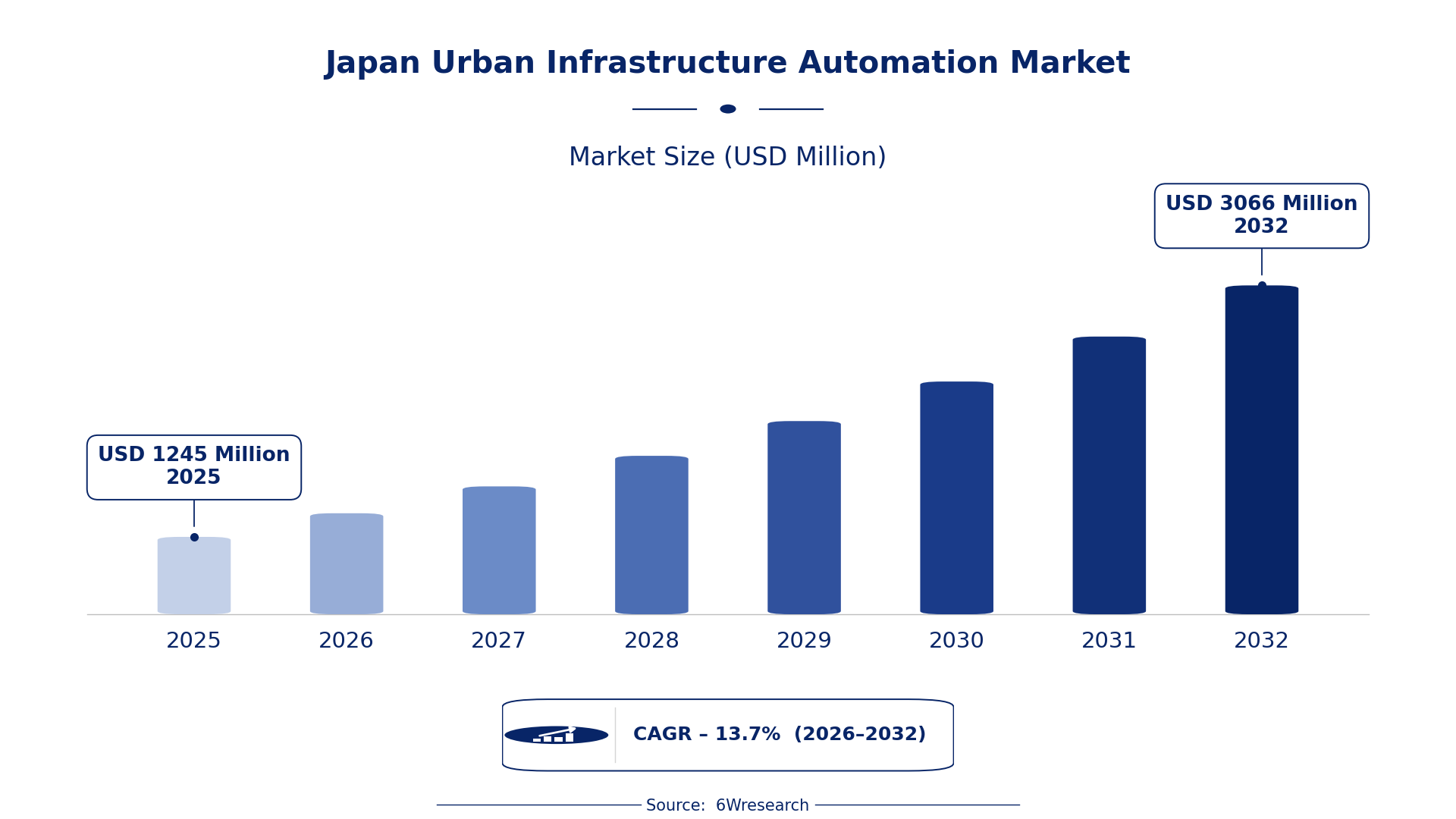
According to 6Wresearch internal database and industry insights, the Japan Urban Infrastructure Automation Market was valued at USD 1,245 Million in 2025 and is projected to reach USD 3,066 Million by 2032, growing at a CAGR of approximately 13.7% during 2026–2032.
Japan Urban Infrastructure Automation Market Highlights
| Report Metric | Details |
| Report Name | Japan Urban Infrastructure Automation Market (2026-2032) |
| Market Size 2025 | USD 1,245 Million |
| Market Size 2032 | USD 3,066 Million |
| Absolute Growth 2025–2032 | USD 1,821 Million |
| CAGR 2026–2032 | 13.7% |
| Peak Annual Growth | 14.8% in 2032 |
| Forecast Period | 2026–2032 |
| Historical Data | 2022–2025 |
| Base Year | 2025 |
| Leading Automation Type, 2025 | Traffic Management (41% share) |
| Leading Infrastructure Segment, 2025 | Smart Roads (40% share) |
| Leading Technology Used, 2025 | AI + IoT (46% share) |
| Leading End User, 2025 | City Governments (42% share) |
| Fastest-Growing Automation Type | Energy Automation (20.1% CAGR) |
| Fastest-Growing Technology Used | SCADA Systems (14.8% CAGR) |
| Fastest-Growing End User | Utility Providers (17.7% CAGR) |
| Growing Sector | Urban Infrastructure |
| Key End Users | City Governments, Utility Providers, Municipal Corporations |
Japan Urban Infrastructure Automation Market Year-wise Growth Rate and Key Drivers (2022–2032)
This graph illustrates the annual growth rates of the market from 2022 to 2032, highlighting a steady upward trajectory and projected market expansion over the forecast period.
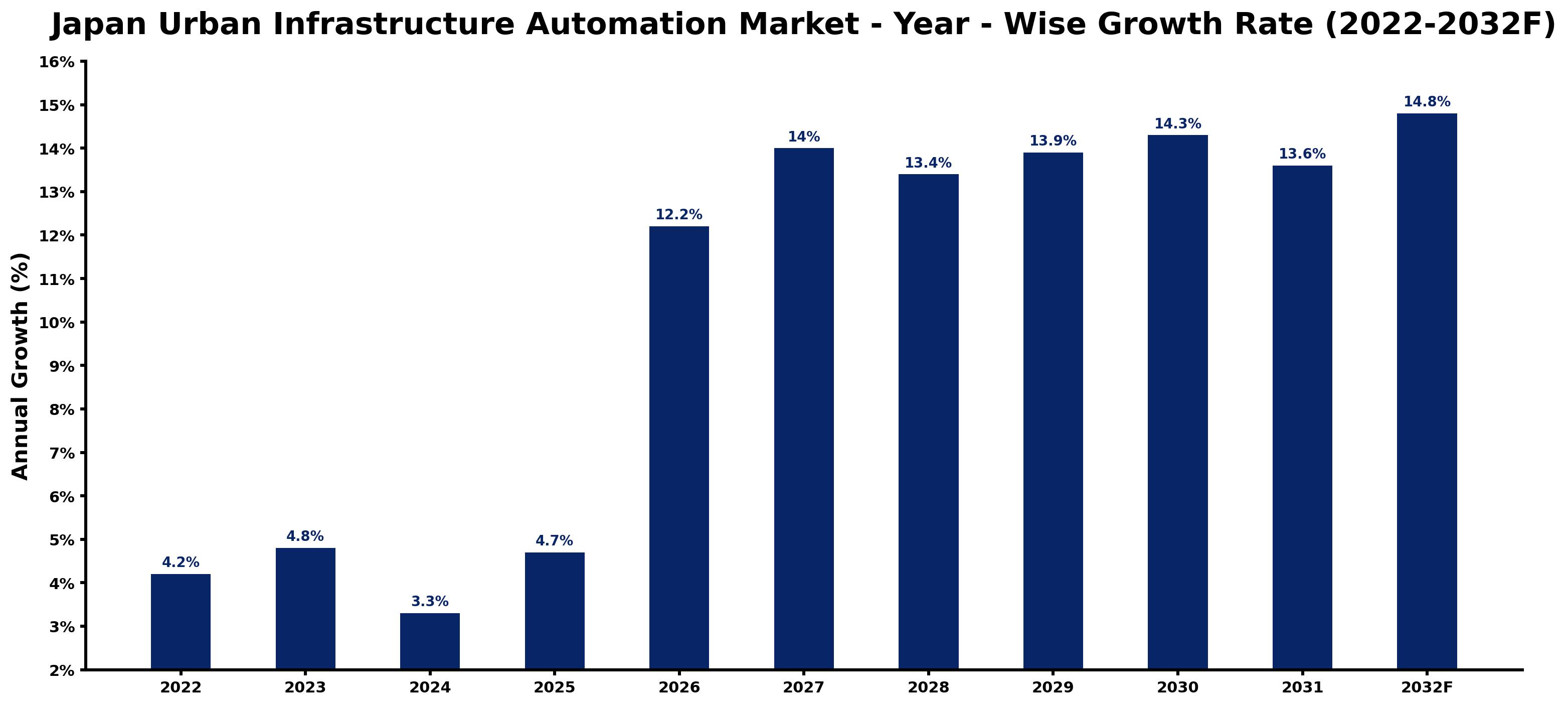
Annual growth estimates for each year appear below with the principal reason behind them, explaining the shifts that set the pace of the market.
| Year | Estimated Annual Growth (%) | Market Rationale |
| 2022 | 4.2 | The market showed steady growth, reflecting ongoing investments in urban infrastructure. |
| 2023 | 4.8 | Growth accelerated due to increased urbanisation and smart city initiatives in major regions. |
| 2024 | 3.3 | Growth slowed as some projects faced delays, but demand remained strong overall. |
| 2025 | 4.7 | The market rebounded with renewed investments in energy automation and traffic management. |
| 2026 | 12.2 | Growth is expected to surge as city governments expand automation projects to improve efficiency. |
| 2027 | 14.0 | Rising demand for smart technologies is projected to drive further increases in urban infrastructure investments. |
| 2028 | 13.4 | Growth is anticipated to moderate as some sectors adjust to new technologies and market conditions. |
| 2029 | 13.9 | Demand is expected to accelerate again with more public infrastructure projects being initiated. |
| 2030 | 14.3 | Continued investments in smart cities and energy automation will sustain high growth rates. |
| 2031 | 13.6 | Growth is projected to slow slightly as the market matures, but demand for automation remains strong. |
| 2032 | 14.8 | The market is expected to peak as urban infrastructure automation becomes essential for city management. |
Note: Market size estimations and growth projections presented in this report are based on 6Wresearch's proprietary forecasting methodology, utilizing the latest available industry data, government publications, and primary research inputs.
Japan Urban Infrastructure Automation Market Synopsis
Urban Infrastructure Automation involves integrating technologies like AI, IoT, and SCADA to improve city services, reduce operational costs, and elevate living standards. The Tokyo Smart City initiative highlights this trend, with over 1,000 smart traffic signals installed as of 2023. The market is expanding due to Japan's urban population of approximately 126 million, substantial public and private investments, and government strategies targeting sustainable urban development, including the GX Promotion Act aiming for decarbonisation by 2030.
Market Dynamics Impact Analysis (2026–2032)
| Factor | Type | Impact | Primary Segment Affected |
| Increased urbanisation and population density drive demand for efficient city services. | Driver | High | Traffic Management |
| Government investments in smart city initiatives boost automation adoption across urban sectors. | Driver | High | Energy Automation |
| Growing need for sustainable urban solutions presents opportunities for innovative technologies. | Opportunity | High | Smart Roads |
| Rising public budgets for urban infrastructure improvements create demand for automation solutions. | Opportunity | High | Public Structures |
| High initial costs of automation technologies may deter some city governments from investing. | Restraint | Medium | Waste Automation |
| Limited technical expertise in local governments can slow down implementation of automation systems. | Restraint | Medium | Building Automation |
| Compliance with evolving regulations can increase operational costs for automation providers. | Challenge | High | Energy Automation |
| Capacity constraints in local manufacturing may delay project timelines for urban infrastructure. | Challenge | Medium | Traffic Management |
Evaluation of Drivers in Japan Urban Infrastructure Automation Market (2026–2032)
Key forces behind demand, with the segment each one moves most, are listed below.
| Drivers | Primary Segment Affected | Why It Matters (Evidence) |
| Urban population growth necessitates improved traffic management solutions. | Traffic Management | Japan's urban population is approximately 126 million, prompting city governments to invest in automation. |
| Government funding for smart city initiatives supports energy automation projects. | Energy Automation | The Tokyo Metropolitan Government allocated ¥1 trillion for urban infrastructure improvements. |
| Public transportation reliance drives demand for efficient waste management solutions. | Waste Automation | Public transportation accounts for 60% of urban travel, necessitating better waste systems. |
| Technological advancements in AI and IoT improve urban infrastructure capabilities. | Smart Roads | Smart road technologies are being piloted in Osaka and Yokohama, improving traffic flow. |
| Sustainability targets encourage investments in energy efficiency technologies. | Building Automation | Japan targets a 46% cut in greenhouse-gas emissions by fiscal 2030. |
Several shifts outside the market lift sales. The urban population of approximately 126 million drives demand for efficient traffic management solutions, leading city governments to invest in automation technologies. A budget of ¥1 trillion for urban infrastructure improvements supports energy automation projects across public buildings. The reliance on public transportation, which accounts for 60% of urban travel, necessitates efficient waste management systems. Japan's ambitious sustainability targets further encourage investments in energy efficiency technologies, creating a conducive environment for growth.
Evaluation of Restraints in Japan Urban Infrastructure Automation Market
The main factors holding the market back are set out below.
| Market Restraint | Primary Segment Affected | Why It Matters (Evidence) |
| High initial costs deter some city governments from investing in automation technologies. | Waste Automation | Many municipalities face budget constraints, limiting their ability to adopt new systems. |
| Limited technical expertise in local governments slows down automation implementation. | Building Automation | Some city officials lack the necessary skills to manage complex automation projects. |
| Compliance with evolving regulations increases operational costs for automation providers. | Energy Automation | Providers must invest in compliance measures, which can raise project costs. |
| Capacity constraints in local manufacturing delay project timelines for urban infrastructure. | Traffic Management | Local suppliers struggle to meet the rising demand for automation technologies. |
| Market maturity leads to slower growth as early adopters saturate their systems. | Smart Roads | Established cities may have already implemented many automation solutions. |
Japan Urban Infrastructure Automation Market Challenges
Japan's urban infrastructure automation faces supply chain disruptions due to reliance on specific technology imports, which can delay projects by up to six months for city governments. Rapid technological advancements often outpace existing systems, causing inefficiencies that cost utility providers approximately JPY 20 billion annually. A shortage of skilled professionals in automation technologies limits project execution, raising operational costs for producers by 15%. Budget constraints challenge buyers, as urban infrastructure improvements necessitate substantial investments, with Tokyo's budget reaching ¥1 trillion for enhancements.
Trends in the Japan Urban Infrastructure Automation Market
Below are the shifts with the largest effect on the Japan Urban Infrastructure Automation Market.
- Shift Towards Smart City Technologies: In 2023, Japan has seen a notable shift towards smart city technologies, with over 1,000 smart traffic signals installed in Tokyo. This trend highlights the growing focus on urban efficiency and sustainability, prompting city governments to invest in advanced automation solutions.
- Transition from Traditional to Automated Waste Management: Beginning in 2023, Japan is transitioning from traditional waste management systems to automated solutions. Over 200 municipalities have deployed waste automation systems, improving efficiency and reducing operational costs for local governments.
- Emergence of AI and IoT in Urban Infrastructure: In 2023, AI and IoT technologies have become central to urban infrastructure automation. The integration of these technologies improves traffic management and energy efficiency, with significant investments supporting their adoption across various urban sectors.
- Prioritisation of Energy Efficiency in Urban Planning: Since 2023, energy efficiency has become a priority in urban planning. The Tokyo Smart City initiative focuses on sustainable energy use, with the government allocating ¥50 billion for smart infrastructure projects, showcasing the commitment to reducing emissions.
Investment Opportunities in the Japan Urban Infrastructure Automation Market
The following areas offer the clearest openings for investors and suppliers in the Japan Urban Infrastructure Automation Market.
- Joint Ventures with Local Governments: Local governments are seeking partnerships for urban infrastructure projects, with a budget of ¥1 trillion for improvements. Companies can enter through joint ventures to supply automation technologies.
- Investment in Energy Automation Solutions: With Japan targeting a 46% cut in greenhouse gas emissions, there is a growing need for energy automation solutions. Utility providers are looking for systems to manage energy distribution effectively.
- Supply of Smart Road Technologies: The demand for smart road technologies is rising, with pilot projects in Osaka and Yokohama. Companies can invest in this area to improve traffic management solutions for city governments.
- Development of Waste Automation Systems: The increasing focus on efficient waste management creates opportunities for automation systems. Municipal corporations are looking for suppliers to improve their waste collection processes.
Government Initiatives in the Japan Urban Infrastructure Automation Market
The legal framework for urban infrastructure automation in Japan includes several key measures. The New Robot Strategy (2015) aims to expand robot use across various sectors, including urban management. The GX Promotion Act (2023) sets the foundation for decarbonisation efforts, targeting public and private investments in sustainable urban infrastructure. These laws encourage the adoption of new technologies and practices among city governments and utility providers.
City governments benefit from various funding schemes aimed at improving urban infrastructure. The Ministry of Land, Infrastructure, Transport and Tourism promotes smart city initiatives, allocating ¥50 billion for smart infrastructure projects in 2023. Additionally, the Japan Smart City Alliance supports local governments in their efforts to implement automation technologies, ensuring that they can access the necessary resources and expertise for successful project execution.
Future Insight of the Japan Urban Infrastructure Automation Market
The investment pipeline for decarbonisation will total JPY 150 trillion by 2032, generating demand for urban infrastructure automation. This will prompt municipalities to adopt advanced energy efficiency standards and innovative waste management solutions. The establishment of 100 smart cities by 2025 will enhance urban efficiency and sustainability. Public safety applications will increasingly utilise advanced technologies, improving living conditions and reducing costs for buyers and suppliers.
Market Segmentation Analysis
Japan Urban Infrastructure Automation Market report covers a detailed analysis of the following market segments:
By Automation Type – Traffic Management Leads, Energy Automation Expected to Grow Fastest
According to Saurav Kr Singh, Senior Research Analyst at 6Wresearch, Traffic Management took 41% of automation type revenue in 2025, more than any other category. Traffic management holds the largest share as it is essential for optimising traffic flow and reducing congestion in urban areas. The implementation of over 1,000 smart traffic signals in Tokyo exemplifies the commitment to enhancing urban mobility. Energy Automation is set to record the highest CAGR in this split, 20.1% over 2026–2032. Energy automation is experiencing rapid growth due to the urgent need for efficient energy distribution and consumption management. The allocation of ¥50 billion for smart infrastructure projects by the government underscores the increasing focus on energy solutions. Suppliers must concentrate on energy automation technologies to cater to the rising market demand.
By Infrastructure Segment – Smart Roads Lead and Record the Fastest Growth
In 2025, Smart Roads led the infrastructure segment split with a 40% share. Smart roads dominate the market as they are integral for modernising road infrastructure and improving traffic efficiency. Current pilot projects in cities like Osaka and Yokohama demonstrate a strong commitment to advancing urban mobility through these technologies. Smart Roads are also forecast to expand faster than any other category, at a CAGR of 15.0% over 2026–2032. Smart roads are also the fastest-growing segment, propelled by cities' initiatives to implement advanced technologies for better traffic management. The overall push for smart city projects will further stimulate investment in this infrastructure. Buyers should consider investing in smart road technologies to improve urban mobility and infrastructure performance.
By Technology Used – AI + IoT Leads, SCADA Systems Expected to Grow Fastest
AI + IoT accounted for 46% of the market by technology used in 2025. AI and IoT dominate this segment as they are vital for enabling smart city applications that improve urban living standards. Their integration is essential for initiatives like the Tokyo Smart City programme, which prioritises energy efficiency. The quickest growth will come from SCADA Systems, forecast to expand at a CAGR of 14.8% between 2026 and 2032. SCADA systems are experiencing rapid growth due to their critical function in real-time monitoring and control of urban infrastructure. The increasing complexity of urban systems necessitates the widespread adoption of SCADA for effective management. Suppliers must focus on developing SCADA systems to meet the rising demand for efficient urban management solutions.
By End User – City Governments Lead, Utility Providers Expected to Grow Fastest
The largest end user category in 2025 was City Governments, at 42% of revenue. City governments are the primary users of urban infrastructure automation, significantly influencing the demand for solutions that enhance city services and operational efficiency. Their substantial budgets, such as the ¥1 trillion allocated for urban infrastructure in Tokyo, reflect their critical role in this market. Utility Providers are projected to grow fastest, at a CAGR of 17.7% during 2026–2032. Utility providers represent the fastest-growing end user group, as they play a vital role in energy and water management, essential for sustainable urban development. The increasing focus on efficiency and decarbonisation within utilities accelerates their market growth. Suppliers should customise their offerings to address the specific needs of utility providers, who are becoming increasingly pivotal in urban infrastructure automation.
Key Attractiveness of the Report
- 10 Years of Market Numbers
- Historical Data Starting from 2022 to 2025
- Base Year 2025
- Forecast Data until 2032
- Key Performance Indicators Impacting the Market
- Major Upcoming Developments and Projects
Key Highlights of the Report:
- Japan Urban Infrastructure Automation Market Outlook
- Market Size of Japan Urban Infrastructure Automation Market, 2025
- Forecast of Japan Urban Infrastructure Automation Market, 2032
- Historical Data and Forecast of Japan Urban Infrastructure Automation Revenues & Volume for the Period 2022-2032F
- Japan Urban Infrastructure Automation Market Trend Evolution
- Japan Urban Infrastructure Automation Market Drivers and Challenges
- Japan Urban Infrastructure Automation Price Trends
- Japan Urban Infrastructure Automation Porter's Five Forces
- Japan Urban Infrastructure Automation Industry Life Cycle
- Historical Data and Forecast of Japan Urban Infrastructure Automation Market Revenues & Volume By Automation Type for the Period 2022-2032F
- Historical Data and Forecast of Japan Urban Infrastructure Automation Market Revenues & Volume By Traffic Management for the Period 2022-2032F
- Historical Data and Forecast of Japan Urban Infrastructure Automation Market Revenues & Volume By Energy Automation for the Period 2022-2032F
- Historical Data and Forecast of Japan Urban Infrastructure Automation Market Revenues & Volume By Building Automation for the Period 2022-2032F
- Historical Data and Forecast of Japan Urban Infrastructure Automation Market Revenues & Volume By Waste Automation for the Period 2022-2032F
- Historical Data and Forecast of Japan Urban Infrastructure Automation Market Revenues & Volume By Infrastructure Segment for the Period 2022-2032F
- Historical Data and Forecast of Japan Urban Infrastructure Automation Market Revenues & Volume By Smart Roads for the Period 2022-2032F
- Historical Data and Forecast of Japan Urban Infrastructure Automation Market Revenues & Volume By Power Grids for the Period 2022-2032F
- Historical Data and Forecast of Japan Urban Infrastructure Automation Market Revenues & Volume By Public Structures for the Period 2022-2032F
- Historical Data and Forecast of Japan Urban Infrastructure Automation Market Revenues & Volume By Underground Bins for the Period 2022-2032F
- Historical Data and Forecast of Japan Urban Infrastructure Automation Market Revenues & Volume By Technology Used for the Period 2022-2032F
- Historical Data and Forecast of Japan Urban Infrastructure Automation Market Revenues & Volume By AI + IoT for the Period 2022-2032F
- Historical Data and Forecast of Japan Urban Infrastructure Automation Market Revenues & Volume By SCADA Systems for the Period 2022-2032F
- Historical Data and Forecast of Japan Urban Infrastructure Automation Market Revenues & Volume By BMS for the Period 2022-2032F
- Historical Data and Forecast of Japan Urban Infrastructure Automation Market Revenues & Volume By Sensor-Based Systems for the Period 2022-2032F
- Historical Data and Forecast of Japan Urban Infrastructure Automation Market Revenues & Volume By End User for the Period 2022-2032F
- Historical Data and Forecast of Japan Urban Infrastructure Automation Market Revenues & Volume By City Governments for the Period 2022-2032F
- Historical Data and Forecast of Japan Urban Infrastructure Automation Market Revenues & Volume By Utility Providers for the Period 2022-2032F
- Historical Data and Forecast of Japan Urban Infrastructure Automation Market Revenues & Volume By Urban Developers for the Period 2022-2032F
- Historical Data and Forecast of Japan Urban Infrastructure Automation Market Revenues & Volume By Municipal Corporations for the Period 2022-2032F
- Japan Urban Infrastructure Automation Import Export Trade Statistics
- Market Opportunity Assessment By Automation Type
- Market Opportunity Assessment By Infrastructure Segment
- Market Opportunity Assessment By Technology Used
- Market Opportunity Assessment By End User
- Japan Urban Infrastructure Automation Top Companies Market Share
- Japan Urban Infrastructure Automation Competitive Benchmarking By Technical and Operational Parameters
- Japan Urban Infrastructure Automation Company Profiles
- Japan Urban Infrastructure Automation Key Strategic Recommendations
Market Covered
The report covers the following segments.
By Automation Type
- Traffic Management
- Energy Automation
- Building Automation
- Waste Automation
By Infrastructure Segment
- Smart Roads
- Power Grids
- Public Structures
- Underground Bins
By Technology Used
- AI + IoT
- SCADA Systems
- BMS
- Sensor-Based Systems
By End User
- City Governments
- Utility Providers
- Urban Developers
- Municipal Corporations































