Japan Urban Logistics Automation Market Size & Growth Rate
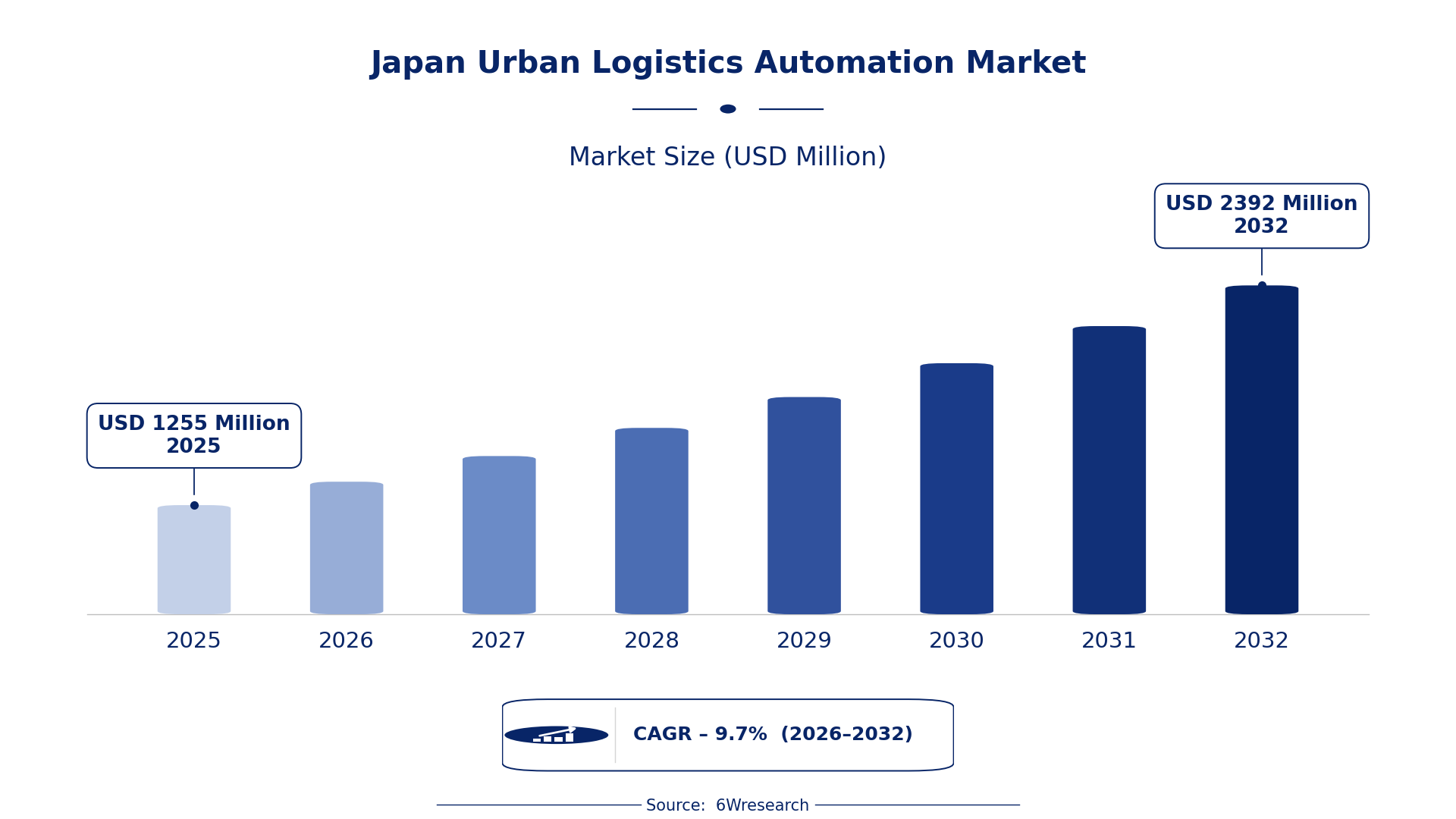
According to 6Wresearch internal database and industry insights, the Japan Urban Logistics Automation Market was valued at USD 1,255 Million in 2025 and is projected to reach USD 2,392 Million by 2032, growing at a CAGR of approximately 9.7% during 2026–2032.
Japan Urban Logistics Automation Market Highlights
| Report Metric | Details |
| Report Name | Japan Urban Logistics Automation Market (2026-2032) |
| Market Size 2025 | USD 1,255 Million |
| Market Size 2032 | USD 2,392 Million |
| Absolute Growth 2025–2032 | USD 1,137 Million |
| CAGR 2026–2032 | 9.7% |
| Peak Annual Growth | 11.8% in 2026 |
| Forecast Period | 2026–2032 |
| Historical Data | 2022–2025 |
| Base Year | 2025 |
| Leading Solution Type, 2025 | Autonomous Delivery Bots (37% share) |
| Leading Delivery Mode, 2025 | Last-Mile Delivery (52% share) |
| Leading Automation Feature, 2025 | AI Navigation (50% share) |
| Leading End User, 2025 | eCommerce Retailers (35% share) |
| Fastest-Growing Solution Type | Smart Sorting Systems (13.7% CAGR) |
| Fastest-Growing Delivery Mode | Fulfillment Centers (12.1% CAGR) |
| Fastest-Growing Automation Feature | Vision-Based Sorting (12.8% CAGR) |
| Fastest-Growing End User | Warehousing Providers (12.2% CAGR) |
| Growing Sector | eCommerce |
| Key End Users | eCommerce Retailers, Logistics Companies, Warehousing Providers, Quick Commerce Startups |
Japan Urban Logistics Automation Market Year-wise Growth Rate and Key Drivers (2022–2032)
This graph illustrates the annual growth rates of the market from 2022 to 2032, highlighting a steady upward trajectory and projected market expansion over the forecast period.
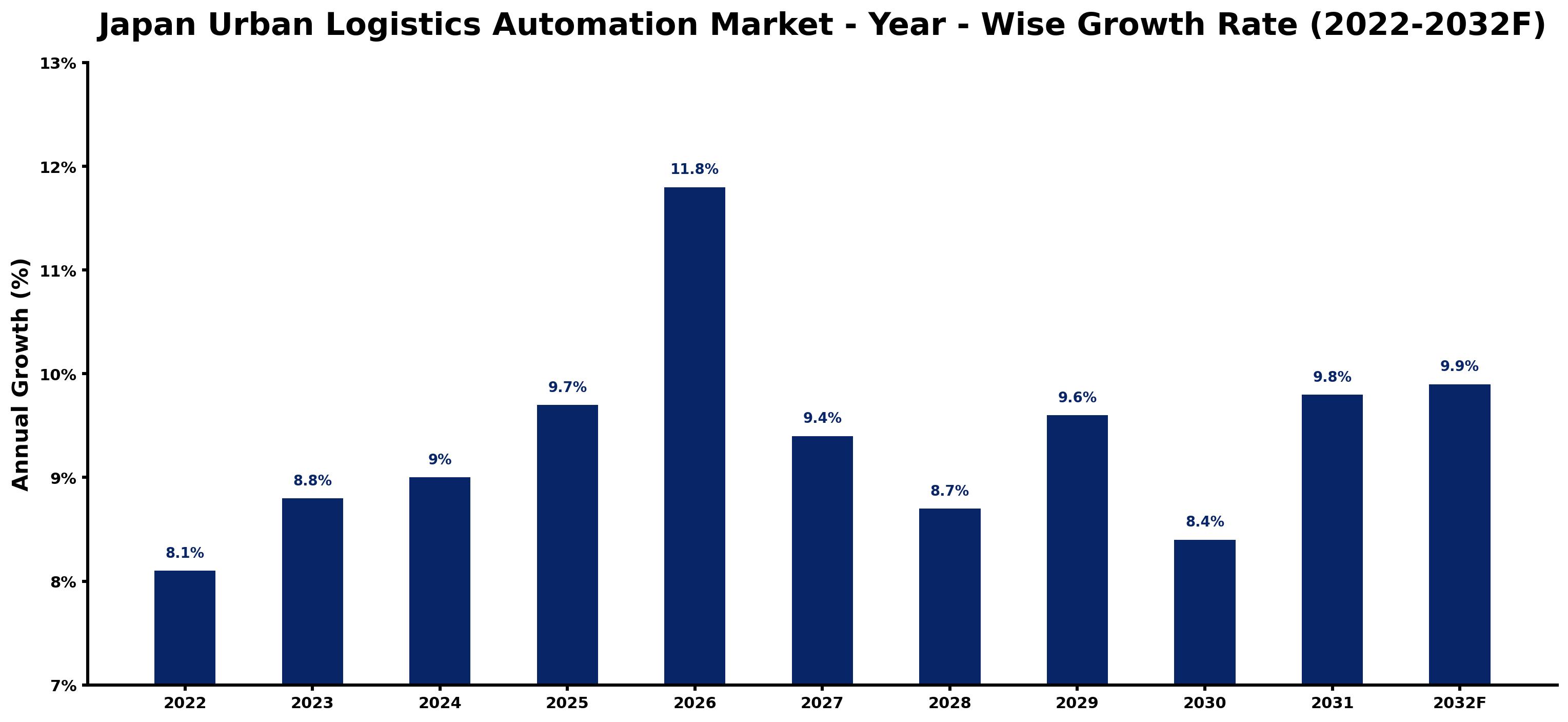
Year by year, the estimates below pair each growth rate with the development that shaped it.
| Year | Estimated Annual Growth (%) | Market Rationale |
| 2022 | 8.1 | The market showed steady demand as urbanisation increased logistics needs. |
| 2023 | 8.8 | Growth accelerated due to rising eCommerce activity and urban logistics automation adoption. |
| 2024 | 9.0 | Demand continued to rise with advancements in automation technologies and infrastructure. |
| 2025 | 9.7 | The market reached a peak as investments in logistics automation surged. |
| 2026 | 11.8 | Growth peaked as new technologies and delivery methods gained widespread acceptance. |
| 2027 | 9.4 | Demand growth slowed slightly due to market saturation in certain segments. |
| 2028 | 8.7 | A further slowdown occurred as competition intensified among logistics providers. |
| 2029 | 9.6 | Growth picked up again as new solutions emerged to meet urban delivery challenges. |
| 2030 | 8.4 | Demand growth decelerated as the market adjusted to new operational standards. |
| 2031 | 9.8 | The market saw renewed interest as eCommerce expanded into new sectors. |
| 2032 | 9.9 | Growth continued as urban logistics automation became essential for efficiency. |
Note: Market size estimations and growth projections presented in this report are based on 6Wresearch's proprietary forecasting methodology, utilizing the latest available industry data, government publications, and primary research inputs.
Japan Urban Logistics Automation Market Synopsis
Urban logistics automation utilises advanced technologies to optimise delivery processes in urban settings, incorporating autonomous delivery bots, smart sorting systems, and drone delivery. The Japan Urban Logistics Automation Market is expanding due to the booming eCommerce sector, which reached ¥19 trillion in 2022, and ongoing urbanisation. The government's Smart Logistics Initiative launched in 2023 promotes investments in automation, improving efficiency and reducing delivery times for logistics providers and eCommerce retailers.
Market Dynamics Impact Analysis (2026–2032)
| Factor | Type | Impact | Primary Segment Affected |
| Rising eCommerce demand drives the need for efficient delivery solutions. | Driver | High | Last-Mile Delivery |
| Increased investment in automation technologies enhances operational efficiency. | Driver | High | Smart Sorting Systems |
| Growing urban population creates a need for faster logistics solutions. | Opportunity | High | Urban Warehouses |
| Investment in AI navigation systems is expanding delivery capabilities. | Opportunity | Medium | AI Navigation |
| High initial investment costs can deter smaller logistics providers. | Restraint | High | Robotic Pickers |
| Limited infrastructure for drone delivery hampers widespread adoption. | Restraint | Medium | Drone Delivery |
| Competition among logistics providers can lead to price wars. | Challenge | High | Fulfillment Centers |
| Technological integration challenges may delay automation implementation. | Challenge | Medium | Smart Sorting Systems |
Evaluation of Drivers in Japan Urban Logistics Automation Market (2026–2032)
The main growth drivers and the segments they affect most are set out below.
| Drivers | Primary Segment Affected | Why It Matters (Evidence) |
| Growth in eCommerce sales increases demand for logistics automation. | Last-Mile Delivery | Japan's eCommerce market reached ¥19 trillion in 2022, driving logistics automation needs. |
| Investment in smart sorting systems improves operational efficiency. | Smart Sorting Systems | Over 200 major warehouses in Japan are adopting robotic pickers for improved efficiency. |
| Urbanisation increases the need for efficient delivery solutions. | Urban Warehouses | The total population of Japan is approximately 125 million, influencing logistics needs. |
| AI navigation systems improve delivery route optimisation. | AI Navigation | Implemented in 70% of new delivery vehicles, these systems enhance delivery efficiency. |
| Government initiatives promote automation in logistics. | Drone Delivery | The New Robot Strategy launched in 2015 supports automation technologies. |
Purchasing is picking up as Japan's eCommerce market reached ¥19 trillion in 2022, driving demand for logistics automation solutions. Urbanisation, with a population of approximately 125 million, creates a pressing need for efficient delivery systems. Investment in smart sorting systems is on the rise, with over 200 major warehouses adopting robotic pickers to improve efficiency. AI navigation systems are now implemented in 70% of new delivery vehicles, optimising routes and reducing delivery times. The New Robot Strategy, established in 2015, encourages the integration of automation technologies into logistics operations.
Evaluation of Restraints in Japan Urban Logistics Automation Market
Several factors work against faster growth; the main ones are summarised below.
| Market Restraint | Primary Segment Affected | Why It Matters (Evidence) |
| High initial investment costs limit access for smaller logistics providers. | Robotic Pickers | Smaller firms may struggle with the financial burden of adopting advanced technologies. |
| Limited infrastructure for drone delivery restricts operational capabilities. | Drone Delivery | Ongoing trials in urban areas like Tokyo indicate a need for improved infrastructure. |
| Regulatory hurdles can delay automation implementation in logistics. | Smart Sorting Systems | Compliance with standards such as ISO 9001 can slow down adoption rates. |
| Competition among logistics providers leads to price wars, affecting margins. | Fulfillment Centers | Intense competition may force providers to lower prices, impacting profitability. |
| Technological integration challenges hinder smooth operations. | Last-Mile Delivery | Logistics companies face difficulties in integrating new technologies into existing systems. |
Japan Urban Logistics Automation Market Challenges
Buyers in the logistics sector face intense competition, as quick commerce startups grew by 30% in 2023, forcing established firms to enhance their offerings or lower prices. Suppliers encounter rising operational costs, with Japan's national minimum wage increasing to JPY 1,055 per hour in October 2024, which tightens profit margins. Buyers experience service delays, as urban warehouses expand but face logistical bottlenecks that slow down operations. Regulatory pressures complicate matters, as the government aims to reduce logistics costs by 10% by 2025, pushing suppliers to adopt automation more rapidly.
Trends in the Japan Urban Logistics Automation Market
The shifts below are changing how Japan Urban Logistics Automation Market products are bought and supplied.
- Shift from Manual to Automated Sorting Systems: Japan's logistics sector is increasingly adopting automated sorting systems, with vision-based sorting technologies now used in 50% of sorting facilities. This shift improves accuracy and efficiency, benefiting logistics providers and eCommerce retailers.
- Transition to AI-Driven Navigation: The integration of AI navigation in delivery vehicles began in 2023, with 70% of new vehicles now equipped. This transition improves route optimisation, significantly reducing delivery times for logistics companies.
- Emergence of Quick Commerce Startups: Quick commerce startups have surged by 30% in 2023, reflecting a growing demand for rapid delivery services. This trend highlights the need for automation solutions to meet consumer expectations in urban areas.
- Expansion of Urban Warehouses: Urban warehouses are expanding to meet the demands of a growing population, with a focus on reducing delivery times. This trend is driven by the need for efficient logistics solutions in densely populated areas.
Investment Opportunities in the Japan Urban Logistics Automation Market
Where to invest in the Japan Urban Logistics Automation Market: the main openings are set out below.
- Growing Demand for Last-Mile Delivery Solutions: With Japan's eCommerce market reaching ¥19 trillion in 2022, there is an opportunity for last-mile delivery solutions. Logistics companies can invest in autonomous delivery bots to meet this demand.
- Investment in Smart Sorting Technologies: The need for efficient logistics operations creates an opportunity to supply smart sorting systems. Urban warehouses can partner with technology providers to improve their sorting capabilities.
- Adoption of Drone Delivery Technologies: Ongoing trials in urban areas indicate a growing interest in drone delivery. Companies can invest in drone technology to cater to logistics providers looking to innovate.
- Expansion of Fulfillment Centers: The rapid growth of eCommerce presents an opportunity to invest in fulfillment centers. Logistics companies can establish partnerships to improve their operational efficiency.
Government Initiatives in the Japan Urban Logistics Automation Market
The New Robot Strategy, established in 2015, aims to expand robot use across various sectors, including logistics. This policy encourages the adoption of automation technologies, benefiting logistics providers by improving operational efficiency and reducing costs. Additionally, Japan's Green Growth Strategy, updated in 2021, targets carbon neutrality by 2050, promoting investments in sustainable logistics solutions.
The Ministry of Land, Infrastructure, Transport and Tourism oversees the implementation of the New Robot Strategy, which promotes automation in logistics. This initiative supports logistics companies in implementing advanced technologies, helping them improve efficiency and reduce delivery times, ultimately benefiting eCommerce retailers and consumers.
Future Insight of the Japan Urban Logistics Automation Market
Japan's decarbonisation investment pipeline, targeting JPY 150 trillion over the next decade, will drive demand for logistics automation technologies. The ongoing integration of predictive analytics will streamline operations, enhancing efficiency across the sector. Trials for innovative delivery solutions will emerge from urban areas, creating new opportunities for logistics providers. As urban warehouses continue to grow, the push for automation will enable suppliers to deliver services more quickly and reliably, benefiting buyers significantly.
Market Segmentation Analysis
Japan Urban Logistics Automation Market report covers a detailed analysis of the following market segments:
By Solution Type – Autonomous Delivery Bots Lead, Smart Sorting Systems Expected to Grow Fastest
According to Saurav Kr Singh, Senior Research Analyst at 6Wresearch, Autonomous Delivery Bots took 37% of solution type revenue in 2025, more than any other category. Autonomous delivery bots lead the market due to their essential function in last-mile delivery, particularly in urban settings. Their widespread use in cities like Tokyo demonstrates their effectiveness in meeting the demand for quick delivery services. Smart Sorting Systems are projected to grow fastest, at a CAGR of 13.7% during 2026–2032. Smart sorting systems are rapidly gaining traction as they significantly improve sorting efficiency in logistics operations. Their adoption in 50% of sorting facilities showcases their vital role in supporting the growing eCommerce sector. Suppliers should concentrate on enhancing both autonomous delivery and sorting technologies to seize emerging market opportunities.
By Delivery Mode – Last-Mile Delivery Leads, Fulfillment Centers Expected to Grow Fastest
With 52% of delivery mode revenue in 2025, Last-Mile Delivery was the largest category. Last-mile delivery holds the largest share as it is critical for delivering goods directly to consumers' doorsteps. The expansion of eCommerce in Japan, which reached ¥19 trillion in 2022, underscores the importance of this delivery mode. Fulfillment Centers are set to record the highest CAGR in this split, 12.1% over 2026–2032. Fulfillment centers are experiencing the fastest growth due to their key role in managing inventory and order processing efficiently. The establishment of over 100 fulfillment centers dedicated to eCommerce logistics highlights their increasing importance in the supply chain. Buyers must invest in efficient fulfillment solutions to keep pace with the growing demand for last-mile delivery services.
By Automation Feature – AI Navigation Leads, Vision-Based Sorting Expected to Grow Fastest
In 2025, AI Navigation led the automation feature split with a 50% share. AI navigation is the predominant feature as it ensures accurate routing for delivery vehicles, which is crucial for maintaining timely deliveries. Its integration in 70% of new delivery vehicles highlights its importance in optimising urban logistics. Over 2026–2032, Vision-Based Sorting is expected to post the fastest growth, at a CAGR of 12.8%. Vision-based sorting is witnessing swift growth because it markedly increases accuracy in package sorting, essential for maintaining service quality. The rising implementation of this technology in logistics operations emphasises its critical role in operational success. This indicates that suppliers should focus on advancing navigation and sorting technologies to meet the evolving market requirements.
By End User – eCommerce Retailers Lead, Warehousing Providers Expected to Grow Fastest
eCommerce Retailers accounted for 35% of the market by end user in 2025. eCommerce retailers represent the largest user group of logistics automation solutions, significantly influencing the demand for efficient delivery systems. The remarkable growth of the eCommerce market, reaching ¥19 trillion in 2022, underscores their substantial impact. The quickest growth will come from Warehousing Providers, forecast to expand at a CAGR of 12.2% between 2026 and 2032. Warehousing providers are experiencing the fastest growth as they adopt automation to enhance operational efficiency. The increasing complexity of inventory management in warehousing drives the need for advanced automation solutions to streamline their processes. This suggests that suppliers must tailor their offerings to effectively meet the distinct requirements of both eCommerce and warehousing sectors.
Key Attractiveness of the Report
- 10 Years of Market Numbers
- Historical Data Starting from 2022 to 2025
- Base Year 2025
- Forecast Data until 2032
- Key Performance Indicators Impacting the Market
- Major Upcoming Developments and Projects
Key Highlights of the Report:
- Japan Urban Logistics Automation Market Outlook
- Market Size of Japan Urban Logistics Automation Market, 2025
- Forecast of Japan Urban Logistics Automation Market, 2032
- Historical Data and Forecast of Japan Urban Logistics Automation Revenues & Volume for the Period 2022-2032F
- Japan Urban Logistics Automation Market Trend Evolution
- Japan Urban Logistics Automation Market Drivers and Challenges
- Japan Urban Logistics Automation Price Trends
- Japan Urban Logistics Automation Porter's Five Forces
- Japan Urban Logistics Automation Industry Life Cycle
- Historical Data and Forecast of Japan Urban Logistics Automation Market Revenues & Volume By Solution Type for the Period 2022-2032F
- Historical Data and Forecast of Japan Urban Logistics Automation Market Revenues & Volume By Autonomous Delivery Bots for the Period 2022-2032F
- Historical Data and Forecast of Japan Urban Logistics Automation Market Revenues & Volume By Smart Sorting Systems for the Period 2022-2032F
- Historical Data and Forecast of Japan Urban Logistics Automation Market Revenues & Volume By Drone Delivery for the Period 2022-2032F
- Historical Data and Forecast of Japan Urban Logistics Automation Market Revenues & Volume By Robotic Pickers for the Period 2022-2032F
- Historical Data and Forecast of Japan Urban Logistics Automation Market Revenues & Volume By Delivery Mode for the Period 2022-2032F
- Historical Data and Forecast of Japan Urban Logistics Automation Market Revenues & Volume By Last-Mile Delivery for the Period 2022-2032F
- Historical Data and Forecast of Japan Urban Logistics Automation Market Revenues & Volume By Fulfillment Centers for the Period 2022-2032F
- Historical Data and Forecast of Japan Urban Logistics Automation Market Revenues & Volume By Aerial Delivery for the Period 2022-2032F
- Historical Data and Forecast of Japan Urban Logistics Automation Market Revenues & Volume By Urban Warehouses for the Period 2022-2032F
- Historical Data and Forecast of Japan Urban Logistics Automation Market Revenues & Volume By Automation Feature for the Period 2022-2032F
- Historical Data and Forecast of Japan Urban Logistics Automation Market Revenues & Volume By AI Navigation for the Period 2022-2032F
- Historical Data and Forecast of Japan Urban Logistics Automation Market Revenues & Volume By Vision-Based Sorting for the Period 2022-2032F
- Historical Data and Forecast of Japan Urban Logistics Automation Market Revenues & Volume By GPS/AI Controlled for the Period 2022-2032F
- Historical Data and Forecast of Japan Urban Logistics Automation Market Revenues & Volume By Machine Learning for the Period 2022-2032F
- Historical Data and Forecast of Japan Urban Logistics Automation Market Revenues & Volume By End User for the Period 2022-2032F
- Historical Data and Forecast of Japan Urban Logistics Automation Market Revenues & Volume By eCommerce Retailers for the Period 2022-2032F
- Historical Data and Forecast of Japan Urban Logistics Automation Market Revenues & Volume By Warehousing Providers for the Period 2022-2032F
- Historical Data and Forecast of Japan Urban Logistics Automation Market Revenues & Volume By Quick Commerce Startups for the Period 2022-2032F
- Historical Data and Forecast of Japan Urban Logistics Automation Market Revenues & Volume By Logistics Companies for the Period 2022-2032F
- Japan Urban Logistics Automation Import Export Trade Statistics
- Market Opportunity Assessment By Solution Type
- Market Opportunity Assessment By Delivery Mode
- Market Opportunity Assessment By Automation Feature
- Market Opportunity Assessment By End User
- Japan Urban Logistics Automation Top Companies Market Share
- Japan Urban Logistics Automation Competitive Benchmarking By Technical and Operational Parameters
- Japan Urban Logistics Automation Company Profiles
- Japan Urban Logistics Automation Key Strategic Recommendations
Market Covered
The following segment groups are covered in the report.
By Solution Type
- Autonomous Delivery Bots
- Smart Sorting Systems
- Drone Delivery
- Robotic Pickers
By Delivery Mode
- Last-Mile Delivery
- Fulfillment Centers
- Aerial Delivery
- Urban Warehouses
By Automation Feature
- AI Navigation
- Vision-Based Sorting
- GPS/AI Controlled
- Machine Learning
By End User
- eCommerce Retailers
- Warehousing Providers
- Quick Commerce Startups
- Logistics Companies































