Japan Urban Logistics Market Size & Growth Rate
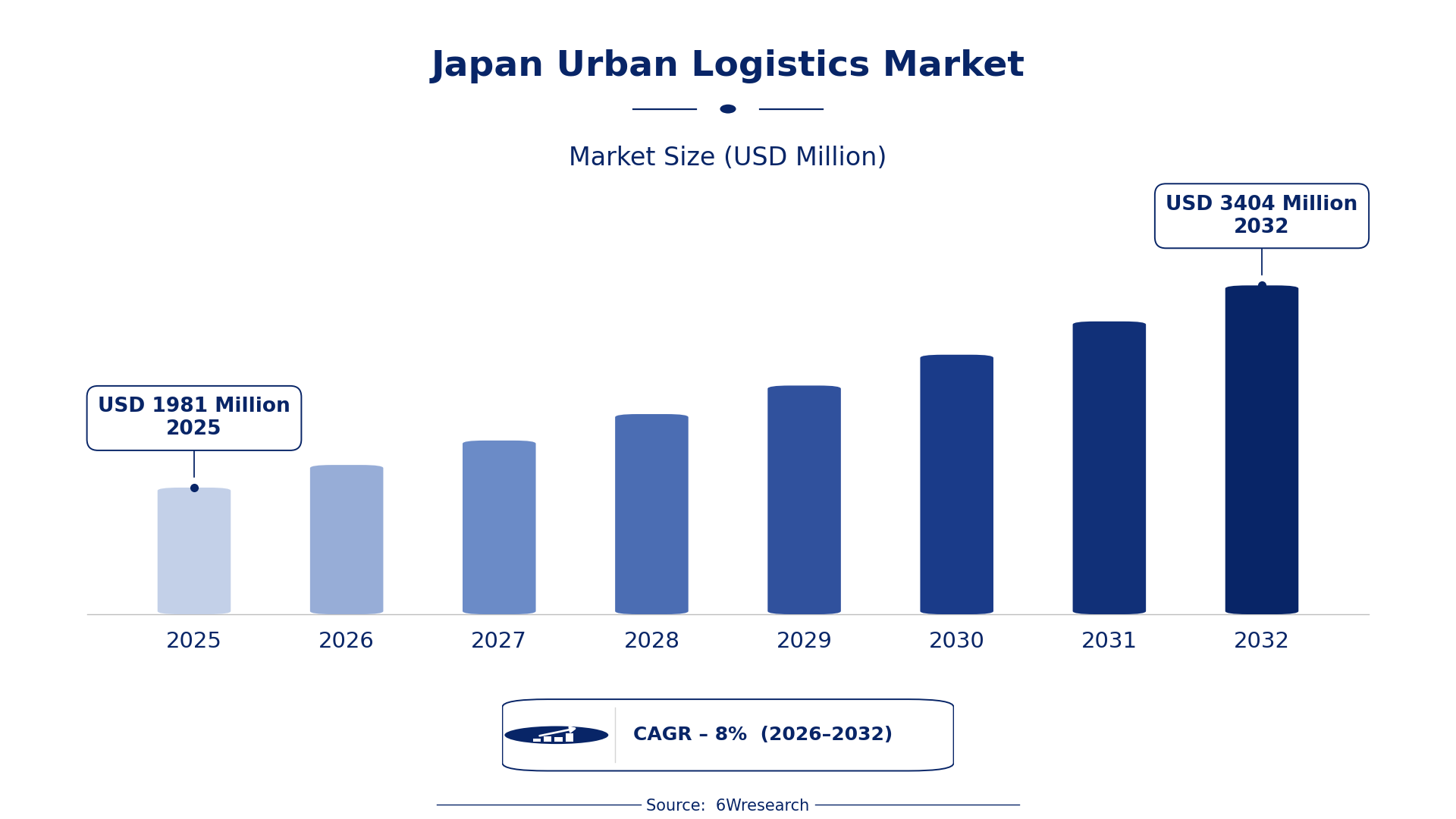
According to 6Wresearch internal database and industry insights, the Japan Urban Logistics Market was valued at USD 1,981 Million in 2025 and is projected to reach USD 3,404 Million by 2032, growing at a CAGR of approximately 8% during 2026–2032.
Japan Urban Logistics Market Highlights
| Report Metric | Details |
| Report Name | Japan Urban Logistics Market (2026-2032) |
| Market Size 2025 | USD 1,981 Million |
| Market Size 2032 | USD 3,404 Million |
| Absolute Growth 2025–2032 | USD 1,423 Million |
| CAGR 2026–2032 | 8% |
| Peak Annual Growth | 8.8% in 2032 |
| Forecast Period | 2026–2032 |
| Historical Data | 2022–2025 |
| Base Year | 2025 |
| Leading Logistics Type, 2025 | Last-Mile Delivery (48% share) |
| Leading Delivery Timeframe, 2025 | Same-Day (48% share) |
| Leading Technology Used, 2025 | Route Optimization AI (48% share) |
| Leading End User, 2025 | eCommerce Companies (44% share) |
| Fastest-Growing Logistics Type | Micro-fulfillment (11.1% CAGR) |
| Fastest-Growing Technology Used | IoT Tracking (11.7% CAGR) |
| Fastest-Growing End User | Grocery Retailers (10.8% CAGR) |
| Growing Sector | e-commerce |
| Key End Users | eCommerce Companies, Grocery Retailers, Logistics Aggregators, D2C Brands |
Japan Urban Logistics Market Year-wise Growth Rate and Key Drivers (2022–2032)
This graph illustrates the annual growth rates of the market from 2022 to 2032, highlighting a steady upward trajectory and projected market expansion over the forecast period.
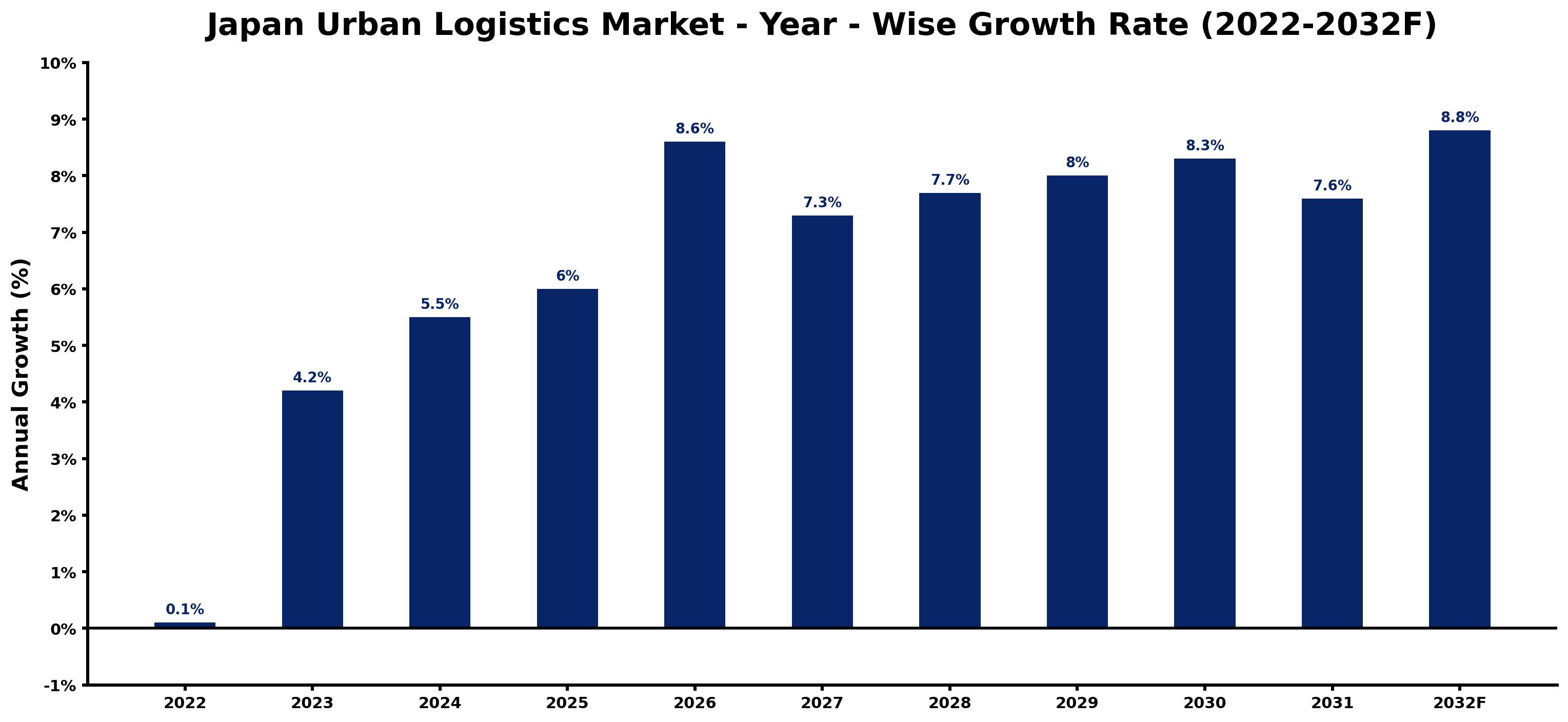
Below, each year's estimated growth is shown next to the factor that most influenced it.
| Year | Estimated Annual Growth (%) | Market Rationale |
| 2022 | 0.1 | The market maintained stable operations with minimal growth observed. |
| 2023 | 4.2 | Growth accelerated as urban logistics adapted to rising e-commerce demands. |
| 2024 | 5.5 | Increased investment in technology further boosted logistics efficiency across urban areas. |
| 2025 | 6.0 | The market peaked historically, driven by heightened demand for same-day delivery services. |
| 2026 | 8.6 | Investment in logistics technology is set to surge, propelling growth rates to new heights. |
| 2027 | 7.3 | Growth will slow slightly as market saturation begins to take effect in urban logistics. |
| 2028 | 7.7 | Demand for micro-fulfillment solutions is projected to increase, driving a resurgence in growth rates. |
| 2029 | 8.0 | The market will continue to expand as urban warehousing solutions gain traction. |
| 2030 | 8.3 | Technological advancements in route optimization will further support logistics efficiency. |
| 2031 | 7.6 | Growth is expected to decelerate as competition intensifies among logistics providers in urban areas. |
| 2032 | 8.8 | The market is projected to peak again, driven by innovations in delivery technology. |
Note: Market size estimations and growth projections presented in this report are based on 6Wresearch's proprietary forecasting methodology, utilizing the latest available industry data, government publications, and primary research inputs.
Japan Urban Logistics Market Synopsis
Urban logistics in Japan involves systems and processes that ensure the efficient movement of goods within cities, integrating advanced technologies like AI and IoT to optimize delivery routes. The Japan Urban Logistics Market is expanding due to the surge in e-commerce, with key drivers including rising demand for same-day delivery services, which have increased by 40% since 2020, and the implementation of smart logistics initiatives, such as the Tokyo Metropolitan Government's efforts to improve operational efficiency.
Market Dynamics Impact Analysis (2026–2032)
| Factor | Type | Impact | Primary Segment Affected |
| Rising e-commerce demand | Driver | High | Last-Mile Delivery |
| Investment in logistics technology | Driver | High | Micro-fulfillment |
| Urban warehousing expansion | Opportunity | Medium | Urban Warehousing |
| Adoption of route optimization technologies | Opportunity | Medium | Route Optimization AI |
| High operational costs | Restraint | High | Urban Warehousing |
| Limited space for logistics facilities | Restraint | Medium | Last-Mile Delivery |
| Competition among logistics providers | Challenge | High | Micro-fulfillment |
| Technological integration costs | Challenge | Medium | Route Optimization AI |
Evaluation of Drivers in Japan Urban Logistics Market (2026–2032)
The table below links each growth driver to the segment it affects and the evidence for it.
| Drivers | Primary Segment Affected | Why It Matters (Evidence) |
| Increased e-commerce sales | Last-Mile Delivery | The e-commerce sector is projected to reach ¥20 trillion by 2025, driving demand for efficient last-mile logistics. |
| Investment in technology | Micro-fulfillment | Investment in logistics technology reached ¥1 trillion in 2022, enhancing operational capabilities for rapid order processing. |
| Growing consumer preference for convenience | Same-Day | Same-day delivery services have increased by 40% since 2020, reflecting consumer demand for quick access to goods. |
| Urban population density | Urban Warehousing | Tokyo's average population density of 6,000 people per square kilometer necessitates close proximity warehousing solutions. |
| Integration of AI and IoT | Route Optimization AI | Route Optimization AI is used by 70% of logistics firms, improving delivery efficiency and reducing operational costs. |
Buyers are expanding capacity as the e-commerce sector in Japan is set to reach ¥20 trillion by 2025, driving demand for last-mile delivery services. Investment in logistics technology hit ¥1 trillion in 2022, enabling swift order processing through micro-fulfillment centres. Same-day delivery services have increased by 40% since 2020, reflecting consumer preference for convenience. Tokyo's high population density requires urban warehousing solutions. In addition, 70% of logistics companies are adopting Route Optimization AI, which improves delivery efficiency and manages operational costs effectively.
Evaluation of Restraints in Japan Urban Logistics Market
Below are the constraints most often cited by buyers and suppliers, with the segment each affects.
| Market Restraint | Primary Segment Affected | Why It Matters (Evidence) |
| High operational costs | Urban Warehousing | Japan's national weighted-average minimum wage rose to JPY 1,055 per hour in October 2024, increasing operational expenses. |
| Limited space for logistics facilities | Last-Mile Delivery | Urban areas face space constraints, limiting the establishment of new logistics facilities. |
| Increased competition among logistics providers | Micro-fulfillment | The influx of new entrants into the logistics market has intensified competition, affecting pricing strategies. |
| Technological integration costs | Route Optimization AI | The costs associated with integrating advanced technologies can deter smaller logistics providers. |
| Regulatory compliance challenges | Urban Warehousing | Strict adherence to ISO 9001 standards increases operational complexity for urban warehousing. |
Japan Urban Logistics Market Challenges
Inefficiencies in urban logistics cost producers in Japan approximately ¥1 trillion annually due to reliance on outdated technology. Many logistics companies continue to employ traditional methods, leading to operational costs that are 15% higher than necessary. As e-commerce demand rises, competition intensifies, with a 40% increase in same-day delivery services since 2020, straining resources. Buyers encounter inconsistent delivery times, with 80% of deliveries under 2 hours, but delays can occur, affecting customer satisfaction and repeat purchases.
Trends in the Japan Urban Logistics Market
The following changes are redrawing the Japan Urban Logistics Market.
- Tokyo's Smart Logistics Initiative: In 2023, the Tokyo Metropolitan Government launched a Smart Logistics initiative to improve urban logistics efficiency. This programme aims to streamline delivery processes, with urban warehousing space increasing by 15% in the last two years.
- Shift towards Same-Day Delivery: Since 2020, there has been a notable shift towards same-day delivery services, reflecting consumer demand for convenience. This trend has led to a 40% increase in same-day services in urban areas.
- Growing Adoption of IoT Tracking Solutions: IoT tracking solutions have seen a 50% adoption rate among logistics firms, improving real-time shipment tracking. This shift increases operational transparency and customer satisfaction.
- Expansion of Micro-fulfillment Centers: Micro-fulfillment centers are increasingly located within 5 km of urban centres, facilitating rapid order processing. This trend is driven by the need for efficiency in urban logistics.
Investment Opportunities in the Japan Urban Logistics Market
Investors looking at the Japan Urban Logistics Market should consider the following areas.
- Urban Warehousing Expansion in Tokyo: Tokyo's urban warehousing space has increased by 15% recently, creating opportunities for investment in storage solutions. Investors can collaborate with logistics aggregators to meet growing demand.
- Investment in Route Optimization Technologies: With 70% of logistics companies adopting Route Optimization AI, there is a gap for suppliers. Companies can enter the market by forming partnerships with local logistics firms.
- Growth in Grocery Retail Logistics: The grocery retail sector is expanding rapidly, with a projected growth rate of 10.8% for logistics services. Suppliers can target grocery retailers to improve delivery capabilities.
- Same-Day Delivery Services Demand: The demand for same-day delivery services is increasing, presenting opportunities for logistics providers. Companies can invest in technology to streamline operations and meet consumer expectations.
Government Initiatives in the Japan Urban Logistics Market
The Urban Renaissance Agency focuses on improving urban logistics infrastructure, aiming to boost efficiency in logistics operations. This agency has approved various projects to modernise urban logistics, ensuring compliance with quality standards. In 2022, the agency funded initiatives to upgrade urban warehousing facilities, which are critical for meeting consumer expectations. The agency also supports the development of micro-fulfillment centers to improve last-mile delivery capabilities.
The Ministry of Land, Infrastructure, Transport and Tourism promotes urban logistics efficiency through various programmes. The Logistics Efficiency Program aims to reduce delivery times by 25% by 2025, benefiting logistics providers and consumers alike. This ministry also oversees the implementation of standards that ensure quality management across the logistics sector.
Future Insight of the Japan Urban Logistics Market
Consumers will experience improved delivery services by 2032, driven by technological advancements. The Smart Logistics initiative from the Tokyo Metropolitan Government will enhance operational efficiency and streamline processes. Urban warehousing is expected to grow significantly, aligning with the increasing demand for e-commerce, projected to reach ¥20 trillion by 2025. Investment in logistics technology is anticipated to rise, with a focus on integrating AI and IoT solutions to optimise urban logistics.
Market Segmentation Analysis
Japan Urban Logistics Market report covers a detailed analysis of the following market segments:
By Logistics Type – Last-Mile Delivery Leads, Micro-fulfillment Expected to Grow Fastest
According to Saurav Kr Singh, Senior Research Analyst at 6Wresearch, Last-Mile Delivery accounted for 48% of the market by logistics type in 2025. Last-mile delivery is crucial for fulfilling e-commerce orders swiftly, making it essential in urban logistics. The projected growth of the e-commerce sector in Japan to ¥20 trillion by 2025 highlights the significant demand for effective last-mile solutions. Micro-fulfillment is set to record the highest CAGR in this split, 11.1% over 2026–2032. Micro-fulfillment is gaining traction as it allows for rapid order processing in urban environments, aligning with consumer expectations for speed. The development of micro-fulfillment centers within 5 km of urban areas is a notable factor driving this growth. Suppliers must enhance last-mile delivery capabilities to meet rising consumer expectations.
By Delivery Timeframe – Same-Day Leads and Records the Fastest Growth
Same-Day held 48% of the Japan Urban Logistics Market by delivery timeframe in 2025. Same-day delivery is increasingly preferred by consumers for its convenience, establishing it as a leading logistics option. The fact that 80% of deliveries in urban logistics are completed in under 2 hours underscores the urgency associated with this timeframe. Same-Day is also forecast to expand faster than any other category, at a CAGR of 10.3% over 2026–2032. Same-day delivery is also experiencing the fastest growth, as consumers increasingly demand immediate fulfilment of their orders. The 40% increase in same-day delivery services since 2020 exemplifies this trend. Buyers should prioritise logistics partners capable of providing reliable same-day delivery to remain competitive.
By Technology Used – Route Optimization AI Leads, IoT Tracking Expected to Grow Fastest
In 2025, Route Optimization AI led the technology used split with a 48% share. Route optimization technology is vital for improving delivery efficiency, allowing logistics firms to streamline their operations effectively. With 70% of urban logistics companies employing this technology, it has become a standard practice in the industry. IoT Tracking is projected to grow fastest, at a CAGR of 11.7% during 2026–2032. IoT tracking is essential for real-time visibility of shipments, enhancing accountability in logistics processes. The 50% adoption rate of IoT solutions among logistics firms indicates a growing reliance on this technology for operational success. Suppliers should invest in advanced technologies like IoT to enhance service offerings and meet client demands.
By End User – eCommerce Companies Lead, Grocery Retailers Expected to Grow Fastest
eCommerce Companies took 44% of end user revenue in 2025, more than any other category. eCommerce companies are the primary users driving demand for logistics services, particularly as online shopping continues to expand. Their reliance on efficient logistics solutions is underscored by the anticipated growth of the e-commerce sector in Japan. Over 2026–2032, Grocery Retailers are expected to post the fastest growth, at a CAGR of 10.8%. Grocery retailers are emerging as significant users for the rapid delivery of goods, responding to consumer preferences for convenience and speed. The increasing demand for quickly delivered fresh produce and essentials is a key factor in this growth. Logistics providers must tailor their services to meet the specific needs of grocery retailers to capture this expanding market.
Key Attractiveness of the Report
- 10 Years of Market Numbers
- Historical Data Starting from 2022 to 2025
- Base Year 2025
- Forecast Data until 2032
- Key Performance Indicators Impacting the Market
- Major Upcoming Developments and Projects
Key Highlights of the Report:
- Japan Urban Logistics Market Outlook
- Market Size of Japan Urban Logistics Market, 2025
- Forecast of Japan Urban Logistics Market, 2032
- Historical Data and Forecast of Japan Urban Logistics Revenues & Volume for the Period 2022-2032F
- Japan Urban Logistics Market Trend Evolution
- Japan Urban Logistics Market Drivers and Challenges
- Japan Urban Logistics Price Trends
- Japan Urban Logistics Porter's Five Forces
- Japan Urban Logistics Industry Life Cycle
- Historical Data and Forecast of Japan Urban Logistics Market Revenues & Volume By Logistics Type for the Period 2022-2032F
- Historical Data and Forecast of Japan Urban Logistics Market Revenues & Volume By Last-Mile Delivery for the Period 2022-2032F
- Historical Data and Forecast of Japan Urban Logistics Market Revenues & Volume By Micro-fulfillment for the Period 2022-2032F
- Historical Data and Forecast of Japan Urban Logistics Market Revenues & Volume By Consolidated Shipping for the Period 2022-2032F
- Historical Data and Forecast of Japan Urban Logistics Market Revenues & Volume By Urban Warehousing for the Period 2022-2032F
- Historical Data and Forecast of Japan Urban Logistics Market Revenues & Volume By Delivery Timeframe for the Period 2022-2032F
- Historical Data and Forecast of Japan Urban Logistics Market Revenues & Volume By Same-Day for the Period 2022-2032F
- Historical Data and Forecast of Japan Urban Logistics Market Revenues & Volume By <24 Hours for the Period 2022-2032F
- Historical Data and Forecast of Japan Urban Logistics Market Revenues & Volume By Scheduled for the Period 2022-2032F
- Historical Data and Forecast of Japan Urban Logistics Market Revenues & Volume By Instant Access for the Period 2022-2032F
- Historical Data and Forecast of Japan Urban Logistics Market Revenues & Volume By Technology Used for the Period 2022-2032F
- Historical Data and Forecast of Japan Urban Logistics Market Revenues & Volume By Route Optimization AI for the Period 2022-2032F
- Historical Data and Forecast of Japan Urban Logistics Market Revenues & Volume By Robotics for the Period 2022-2032F
- Historical Data and Forecast of Japan Urban Logistics Market Revenues & Volume By IoT Tracking for the Period 2022-2032F
- Historical Data and Forecast of Japan Urban Logistics Market Revenues & Volume By Inventory Automation for the Period 2022-2032F
- Historical Data and Forecast of Japan Urban Logistics Market Revenues & Volume By End User for the Period 2022-2032F
- Historical Data and Forecast of Japan Urban Logistics Market Revenues & Volume By eCommerce Companies for the Period 2022-2032F
- Historical Data and Forecast of Japan Urban Logistics Market Revenues & Volume By Grocery Retailers for the Period 2022-2032F
- Historical Data and Forecast of Japan Urban Logistics Market Revenues & Volume By Logistics Aggregators for the Period 2022-2032F
- Historical Data and Forecast of Japan Urban Logistics Market Revenues & Volume By D2C Brands for the Period 2022-2032F
- Japan Urban Logistics Import Export Trade Statistics
- Market Opportunity Assessment By Logistics Type
- Market Opportunity Assessment By Delivery Timeframe
- Market Opportunity Assessment By Technology Used
- Market Opportunity Assessment By End User
- Japan Urban Logistics Top Companies Market Share
- Japan Urban Logistics Competitive Benchmarking By Technical and Operational Parameters
- Japan Urban Logistics Company Profiles
- Japan Urban Logistics Key Strategic Recommendations
Market Covered
This report examines the market across the segments below.
By Logistics Type
- Last-Mile Delivery
- Micro-fulfillment
- Consolidated Shipping
- Urban Warehousing
By Delivery Timeframe
- Same-Day
- <24 Hours
- Scheduled
- Instant Access
By Technology Used
- Route Optimization AI
- Robotics
- IoT Tracking
- Inventory Automation
By End User
- eCommerce Companies
- Grocery Retailers
- Logistics Aggregators
- D2C Brands































