Japan Urban Maintenance Solutions Market Size & Growth Rate
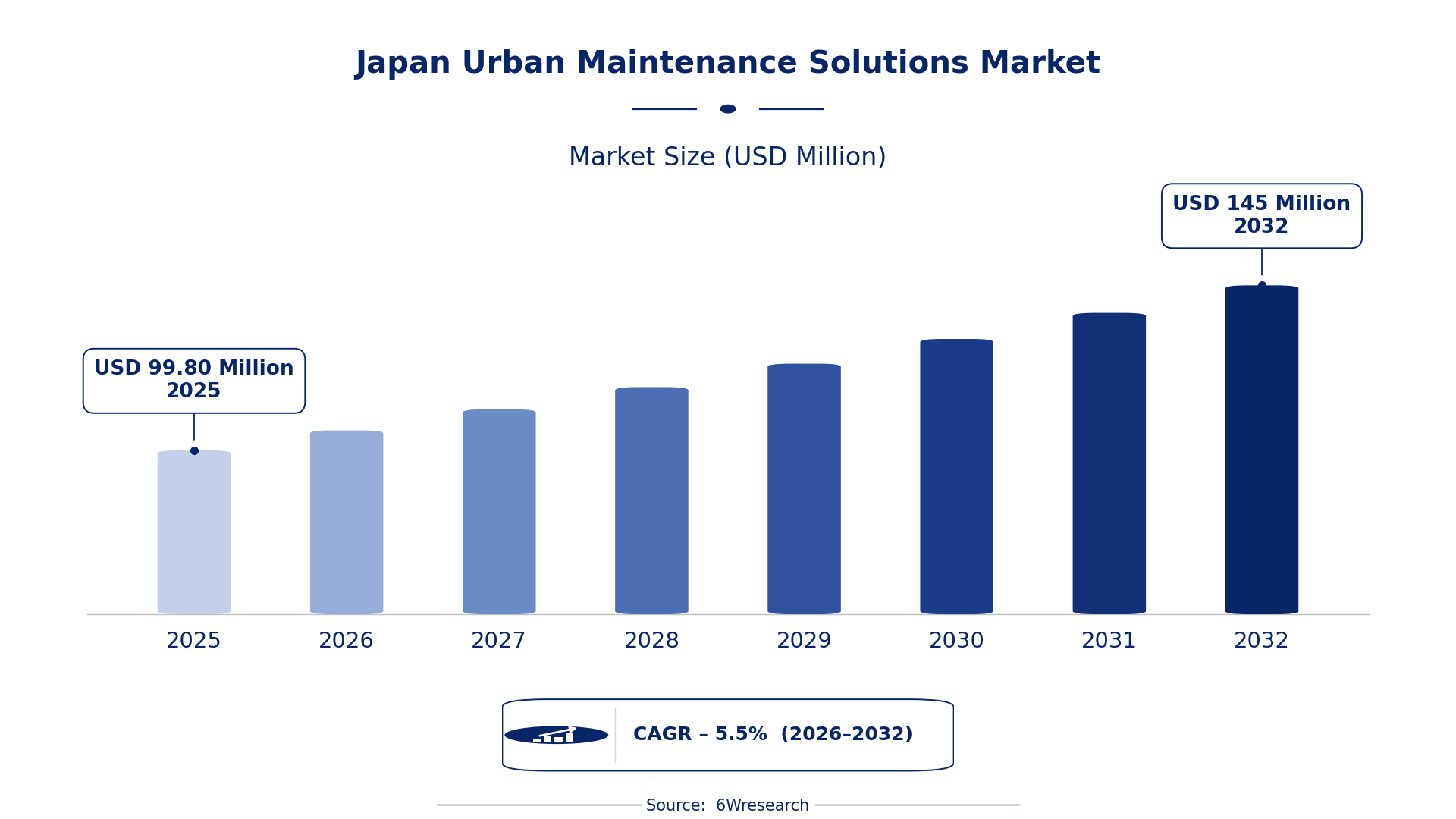
According to 6Wresearch internal database and industry insights, the Japan Urban Maintenance Solutions Market was valued at USD 99.80 Million in 2025 and is projected to reach USD 145 Million by 2032, growing at a CAGR of approximately 5.5% during 2026–2032.
Japan Urban Maintenance Solutions Market Highlights
| Report Metric | Details |
| Report Name | Japan Urban Maintenance Solutions Market (2026-2032) |
| Market Size 2025 | USD 99.80 Million |
| Market Size 2032 | USD 145 Million |
| Absolute Growth 2025–2032 | USD 45.20 Million |
| CAGR 2026–2032 | 5.5% |
| Peak Annual Growth | 6.7% in 2028 |
| Forecast Period | 2026–2032 |
| Historical Data | 2022–2025 |
| Base Year | 2025 |
| Leading Solution Type, 2025 | Infrastructure Repair (50% share) |
| Leading Application Area, 2025 | Roads (35% share) |
| Leading Automation Level, 2025 | Semi-Automated (37% share) |
| Leading End User, 2025 | Municipal Corporations (42% share) |
| Fastest-Growing Solution Type | Waste Management Tech (7.5% CAGR) |
| Fastest-Growing Application Area | Parks (6.9% CAGR) |
| Fastest-Growing Automation Level | IoT-Enabled (7.3% CAGR) |
| Fastest-Growing End User | Sanitation Authorities (6.8% CAGR) |
| Growing Sector | Parks |
| Key End Users | Roads, Buildings, Bridges, Sewers |
Japan Urban Maintenance Solutions Market Year-wise Growth Rate and Key Drivers (2022–2032)
This graph illustrates the annual growth rates of the market from 2022 to 2032, highlighting a steady upward trajectory and projected market expansion over the forecast period.
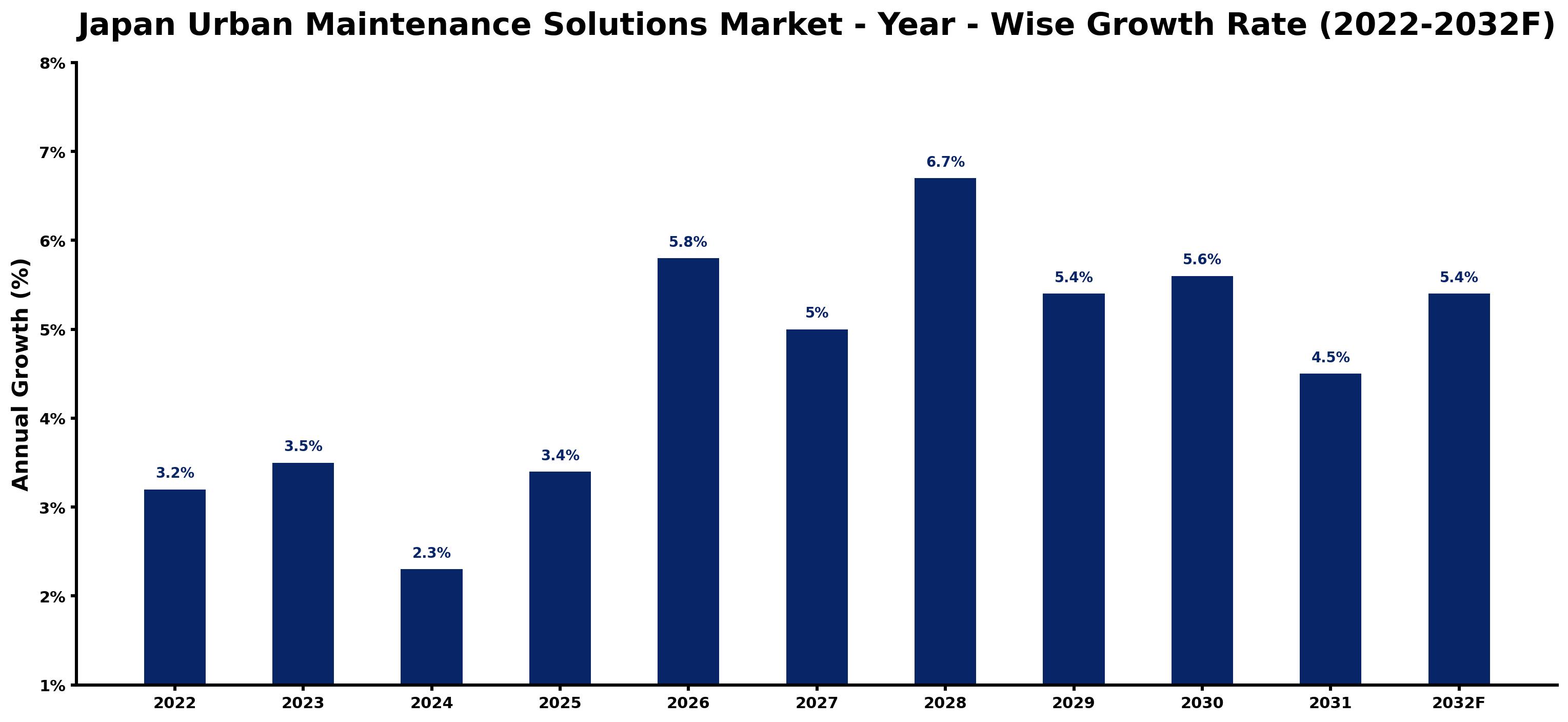
The table below sets out the estimated growth rate for each year and the main factor behind it.
| Year | Estimated Annual Growth (%) | Market Rationale |
| 2022 | 3.2 | The market showed steady growth as urban infrastructure maintenance gained priority. |
| 2023 | 3.5 | Demand increased due to heightened investment in urban infrastructure projects. |
| 2024 | 2.3 | Growth slowed as some municipalities faced budget constraints in maintenance funding. |
| 2025 | 3.4 | Investment in smart maintenance technologies led to faster growth than the previous year. |
| 2026 | 5.8 | Urban maintenance solutions are expected to gain traction with the introduction of new technologies. |
| 2027 | 5.0 | Growth is projected to slow as some sectors adjust to new technological requirements. |
| 2028 | 6.7 | Demand is expected to surge due to the implementation of advanced urban maintenance strategies. |
| 2029 | 5.4 | Growth is projected to moderate as market saturation begins in certain urban areas. |
| 2030 | 5.6 | Technological advancements will continue to drive demand for urban maintenance solutions. |
| 2031 | 4.5 | Growth is expected to slow as the market stabilises after a period of rapid expansion. |
| 2032 | 5.4 | Demand is projected to rise as urbanisation trends continue to evolve. |
Note: Market size estimations and growth projections presented in this report are based on 6Wresearch's proprietary forecasting methodology, utilizing the latest available industry data, government publications, and primary research inputs.
Japan Urban Maintenance Solutions Market Synopsis
Urban Maintenance Solutions encompass technologies and methodologies for maintaining urban infrastructure, ensuring public service functionality and sanitation. The Japan Urban Maintenance Solutions Market is expanding due to increased investment from municipal corporations, with the Tokyo Metropolitan Government allocating ¥50 billion annually for infrastructure repair. Urban population growth and the emphasis on sustainable practices are driving demand across various sectors.
Market Dynamics Impact Analysis (2026–2032)
| Factor | Type | Impact | Primary Segment Affected |
| Increased investment in urban infrastructure projects | Driver | High | Infrastructure Repair |
| Growing focus on sustainability and efficient waste management | Driver | High | Waste Management Tech |
| Emerging demand for IoT-enabled solutions in urban maintenance | Opportunity | High | Street Cleaning Tech |
| Rising urban population necessitating enhanced maintenance solutions | Opportunity | High | Facility Maintenance |
| Budget constraints faced by municipalities | Restraint | Medium | Infrastructure Repair |
| Limited adoption of fully autonomous technologies in maintenance | Restraint | Medium | Fully Autonomous |
| Competition from alternative maintenance solutions | Challenge | Medium | Waste Management Tech |
| Technological integration challenges for traditional maintenance practices | Challenge | Medium | Facility Maintenance |
Evaluation of Drivers in Japan Urban Maintenance Solutions Market (2026–2032)
The following drivers explain most of the expected growth.
| Drivers | Primary Segment Affected | Why It Matters (Evidence) |
| Increased funding for infrastructure repair projects | Infrastructure Repair | The Tokyo Metropolitan Government allocates ¥50 billion annually for infrastructure repair, driving demand for maintenance solutions. |
| Growing emphasis on sustainable waste management practices | Waste Management Tech | Japan generates approximately 45 million tons of waste annually, necessitating effective waste management technologies. |
| Implementation of smart city initiatives | Street Cleaning Tech | The AI Promotion Act (2025) establishes a national framework for AI research, development and use, boosting demand for advanced cleaning solutions. |
| Urban population growth in major cities | Facility Maintenance | Japan's population of approximately 125 million increases the need for efficient maintenance of public infrastructure. |
| Rising awareness of environmental standards | Waste Management Tech | ISO 14001 is a key standard in Japan, prompting investments in compliant waste management technologies. |
Urban population growth, currently around 125 million, drives demand for efficient facility maintenance. Japan generates approximately 45 million tons of waste annually, necessitating effective waste management practices. Compliance with ISO 14001 standards encourages investments in sustainable waste management technologies.
Evaluation of Restraints in Japan Urban Maintenance Solutions Market
These are the pressures that could keep growth below its potential.
| Market Restraint | Primary Segment Affected | Why It Matters (Evidence) |
| Budget constraints limiting maintenance funding | Infrastructure Repair | Municipalities face financial pressures, leading to reduced investment in essential maintenance solutions. |
| Slow adoption of fully autonomous maintenance technologies | Fully Autonomous | Limited technological readiness among municipalities hinders the integration of fully autonomous solutions. |
| Competition from alternative urban maintenance solutions | Waste Management Tech | Emerging technologies may divert investment away from traditional maintenance practices. |
| Resistance to change among traditional maintenance providers | Facility Maintenance | Established practices create barriers to adopting new maintenance technologies. |
| Insufficient training for new technologies | Street Cleaning Tech | Lack of skilled personnel limits the effective implementation of advanced cleaning solutions. |
Japan Urban Maintenance Solutions Market Challenges
Japan's urban maintenance solutions face a skills gap, as 30% of technicians are nearing retirement, which delays project timelines for municipal corporations. Intense competition among service providers leads to price wars, eroding profit margins for suppliers and hindering quality investments. Buyers encounter rising costs due to the Tokyo Metropolitan Government's ¥50 billion annual infrastructure repair budget, which may not cover all necessary upgrades, forcing municipalities to postpone critical projects. Supply chain disruptions arise from increased reliance on imported materials, resulting in project completion delays for public works departments.
Trends in the Japan Urban Maintenance Solutions Market
Several trends are reshaping the Japan Urban Maintenance Solutions Market; the most important are set out below.
- Shift Towards IoT-Enabled Maintenance Solutions: Since 2023, urban maintenance in Osaka has increasingly adopted IoT-enabled street cleaning systems, improving efficiency. This shift reflects a growing trend towards smart city initiatives, with urban areas investing in technology to streamline operations.
- Transition from Manual to Automated Waste Management: The introduction of smart waste management technologies has transformed urban maintenance practices. In 2023, Japan saw investments in automation, enhancing efficiency in waste collection and recycling processes.
- Emergence of Sustainable Practices in Urban Maintenance: The focus on sustainability has intensified since 2022, with urban maintenance solutions increasingly integrating eco-friendly technologies. This trend is illustrated by the growing adoption of ISO 14001 standards across various municipalities.
- Rise of Smart City Initiatives: The AI Promotion Act 2025 has catalysed urban maintenance innovations in Japan, promoting the use of advanced technologies. This initiative aims to improve urban infrastructure management and public services.
Investment Opportunities in the Japan Urban Maintenance Solutions Market
Below are the investment opportunities with the strongest case in the Japan Urban Maintenance Solutions Market.
- Investment in Smart Waste Management Technologies: With Japan generating approximately 45 million tons of waste annually, there is an opportunity to invest in smart waste management solutions. Municipal corporations are seeking advanced technologies to improve efficiency.
- Expansion of IoT-Enabled Solutions: The growing trend towards IoT-enabled maintenance solutions presents an opportunity for suppliers. Municipalities are increasingly looking for advanced technologies to enhance urban infrastructure management.
- Development of Eco-Friendly Maintenance Practices: As sustainability becomes a priority, there is a demand for eco-friendly urban maintenance solutions. Municipal corporations are focusing on compliance with ISO 14001 standards to improve waste management.
- Enhancement of Urban Infrastructure through Advanced Technologies: The implementation of smart city initiatives is driving demand for advanced urban maintenance technologies. Municipalities are investing in innovative solutions to improve public services and infrastructure.
Government Initiatives in the Japan Urban Maintenance Solutions Market
The Building Energy Efficiency Act (2015, amended 2022) requires all new buildings to meet energy standards from April 2025, impacting urban maintenance solutions by ensuring that infrastructure is energy-efficient and sustainable. The New Robot Strategy (2015) aims to expand robot use in various sectors, including urban maintenance, promoting technological advancements in infrastructure upkeep.
Municipal corporations benefit from the AI Promotion Act (2025), which establishes a national framework for AI research and development. This framework supports the integration of AI technologies in urban maintenance, improving operational efficiency and service delivery.
Future Insight of the Japan Urban Maintenance Solutions Market
The rollout of smart maintenance technologies will improve operational efficiency for buyers and suppliers. By 2032, urban parks will expand to cover approximately 1,200 square kilometres, fostering community interaction and ecological benefits. The Smart City Strategy 2023 will drive technological advancements, enhancing urban maintenance solutions. Improved urban infrastructure standards will elevate service quality and ensure sustainable practices, benefiting both suppliers and municipalities.
Market Segmentation Analysis
Japan Urban Maintenance Solutions Market report covers a detailed analysis of the following market segments:
By Solution Type – Infrastructure Repair Leads, Waste Management Tech Expected to Grow Fastest
According to Saurav Kr Singh, Senior Research Analyst at 6Wresearch, in 2025, Infrastructure Repair led the solution type split with a 50% share. Infrastructure repair dominates the market because it is essential for maintaining Japan's extensive road network, with over 1,000 km of roads in Tokyo alone. The substantial annual allocation of ¥50 billion by the Tokyo Metropolitan Government for infrastructure repair highlights its critical importance. The quickest growth will come from Waste Management Tech, forecast to expand at a CAGR of 7.5% between 2026 and 2032. Waste management technology is rapidly growing as Japan confronts the challenge of managing 45 million tons of waste each year. The adoption of ISO 14001 standards for waste management practices is a key factor driving this segment's growth. Suppliers must prioritise advancements in waste management technologies to cater to the increasing demands of urban authorities.
By Application Area – Roads Lead, Parks Expected to Grow Fastest
Roads held 35% of the Japan Urban Maintenance Solutions Market by application area in 2025. Roads represent the largest application area as they are essential for transportation and accessibility across urban environments. The extensive network of roads maintained in cities like Tokyo highlights their significance in urban maintenance. Parks are projected to grow fastest, at a CAGR of 6.9% during 2026–2032. Parks are the fastest-growing area due to the increasing emphasis on urban green spaces and recreation, with urban parks covering approximately 1,200 square kilometers in Japan. This trend is supported by initiatives aimed at improving public parks and recreational areas. Buyers should prioritise investments in park maintenance solutions to cater to the rising demand for urban green spaces.
By Automation Level – Semi-Automated Leads, IoT-Enabled Expected to Grow Fastest
Semi-Automated accounted for 37% of the market by automation level in 2025. Semi-automated solutions dominate the market as they are currently used in various maintenance tasks, albeit not widely adopted. This reflects a transitional phase in urban maintenance where technology is being integrated gradually. IoT-Enabled is set to record the highest CAGR in this split, 7.3% over 2026–2032. IoT-enabled solutions are gaining traction as smart city initiatives become more prevalent, particularly in urban areas like Osaka that have implemented IoT-enabled street cleaning systems. This shift towards automation is indicative of future trends in urban maintenance. Suppliers must adapt to the growing demand for IoT-enabled solutions to remain competitive in the market.
By End User – Municipal Corporations Lead, Sanitation Authorities Expected to Grow Fastest
Municipal Corporations took 42% of end user revenue in 2025, more than any other category. Municipal corporations dominate the market as they play a crucial role in overseeing urban maintenance throughout Japan. Their substantial budgets, such as the ¥50 billion allocated annually by the Tokyo Metropolitan Government, drive the demand for urban maintenance solutions. Over 2026–2032, Sanitation Authorities are expected to post the fastest growth, at a CAGR of 6.8%. Sanitation authorities are experiencing rapid growth as they increasingly prioritise effective waste management and urban cleanliness. The implementation of IoT-enabled street cleaning systems in Osaka exemplifies the urgent need for innovative solutions to tackle Japan's waste management challenges. Suppliers must tailor their offerings to meet the evolving requirements of sanitation authorities to remain competitive.
Key Attractiveness of the Report
- 10 Years of Market Numbers
- Historical Data Starting from 2022 to 2025
- Base Year 2025
- Forecast Data until 2032
- Key Performance Indicators Impacting the Market
- Major Upcoming Developments and Projects
Key Highlights of the Report:
- Japan Urban Maintenance Solutions Market Outlook
- Market Size of Japan Urban Maintenance Solutions Market, 2025
- Forecast of Japan Urban Maintenance Solutions Market, 2032
- Historical Data and Forecast of Japan Urban Maintenance Solutions Revenues & Volume for the Period 2022-2032F
- Japan Urban Maintenance Solutions Market Trend Evolution
- Japan Urban Maintenance Solutions Market Drivers and Challenges
- Japan Urban Maintenance Solutions Price Trends
- Japan Urban Maintenance Solutions Porter's Five Forces
- Japan Urban Maintenance Solutions Industry Life Cycle
- Historical Data and Forecast of Japan Urban Maintenance Solutions Market Revenues & Volume By Solution Type for the Period 2022-2032F
- Historical Data and Forecast of Japan Urban Maintenance Solutions Market Revenues & Volume By Infrastructure Repair for the Period 2022-2032F
- Historical Data and Forecast of Japan Urban Maintenance Solutions Market Revenues & Volume By Facility Maintenance for the Period 2022-2032F
- Historical Data and Forecast of Japan Urban Maintenance Solutions Market Revenues & Volume By Street Cleaning Tech for the Period 2022-2032F
- Historical Data and Forecast of Japan Urban Maintenance Solutions Market Revenues & Volume By Waste Management Tech for the Period 2022-2032F
- Historical Data and Forecast of Japan Urban Maintenance Solutions Market Revenues & Volume By Application Area for the Period 2022-2032F
- Historical Data and Forecast of Japan Urban Maintenance Solutions Market Revenues & Volume By Roads, Bridges for the Period 2022-2032F
- Historical Data and Forecast of Japan Urban Maintenance Solutions Market Revenues & Volume By Buildings, Parks for the Period 2022-2032F
- Historical Data and Forecast of Japan Urban Maintenance Solutions Market Revenues & Volume By Smart Sweepers for the Period 2022-2032F
- Historical Data and Forecast of Japan Urban Maintenance Solutions Market Revenues & Volume By Sewers, Dump Points for the Period 2022-2032F
- Historical Data and Forecast of Japan Urban Maintenance Solutions Market Revenues & Volume By Automation Level for the Period 2022-2032F
- Historical Data and Forecast of Japan Urban Maintenance Solutions Market Revenues & Volume By Semi-Automated for the Period 2022-2032F
- Historical Data and Forecast of Japan Urban Maintenance Solutions Market Revenues & Volume By AI-based Monitoring for the Period 2022-2032F
- Historical Data and Forecast of Japan Urban Maintenance Solutions Market Revenues & Volume By Fully Autonomous for the Period 2022-2032F
- Historical Data and Forecast of Japan Urban Maintenance Solutions Market Revenues & Volume By IoT-Enabled for the Period 2022-2032F
- Historical Data and Forecast of Japan Urban Maintenance Solutions Market Revenues & Volume By End User for the Period 2022-2032F
- Historical Data and Forecast of Japan Urban Maintenance Solutions Market Revenues & Volume By Public Works Dept. for the Period 2022-2032F
- Historical Data and Forecast of Japan Urban Maintenance Solutions Market Revenues & Volume By Municipal Corporations for the Period 2022-2032F
- Historical Data and Forecast of Japan Urban Maintenance Solutions Market Revenues & Volume By City Administrations for the Period 2022-2032F
- Historical Data and Forecast of Japan Urban Maintenance Solutions Market Revenues & Volume By Sanitation Authorities for the Period 2022-2032F
- Japan Urban Maintenance Solutions Import Export Trade Statistics
- Market Opportunity Assessment By Solution Type
- Market Opportunity Assessment By Application Area
- Market Opportunity Assessment By Automation Level
- Market Opportunity Assessment By End User
- Japan Urban Maintenance Solutions Top Companies Market Share
- Japan Urban Maintenance Solutions Competitive Benchmarking By Technical and Operational Parameters
- Japan Urban Maintenance Solutions Company Profiles
- Japan Urban Maintenance Solutions Key Strategic Recommendations
Market Covered
Segments analysed in this report are listed below.
By Solution Type
- Infrastructure Repair
- Facility Maintenance
- Street Cleaning Tech
- Waste Management Tech
By Application Area
- Roads
- Bridges
- Buildings
- Parks
- Smart Sweepers
- Sewers
- Dump Points
By Automation Level
- Semi-Automated
- AI-based Monitoring
- Fully Autonomous
- IoT-Enabled
By End User
- Public Works Dept.
- Municipal Corporations
- City Administrations
- Sanitation Authorities































