Japan Urban Micro-Mobility Market Size & Growth Rate
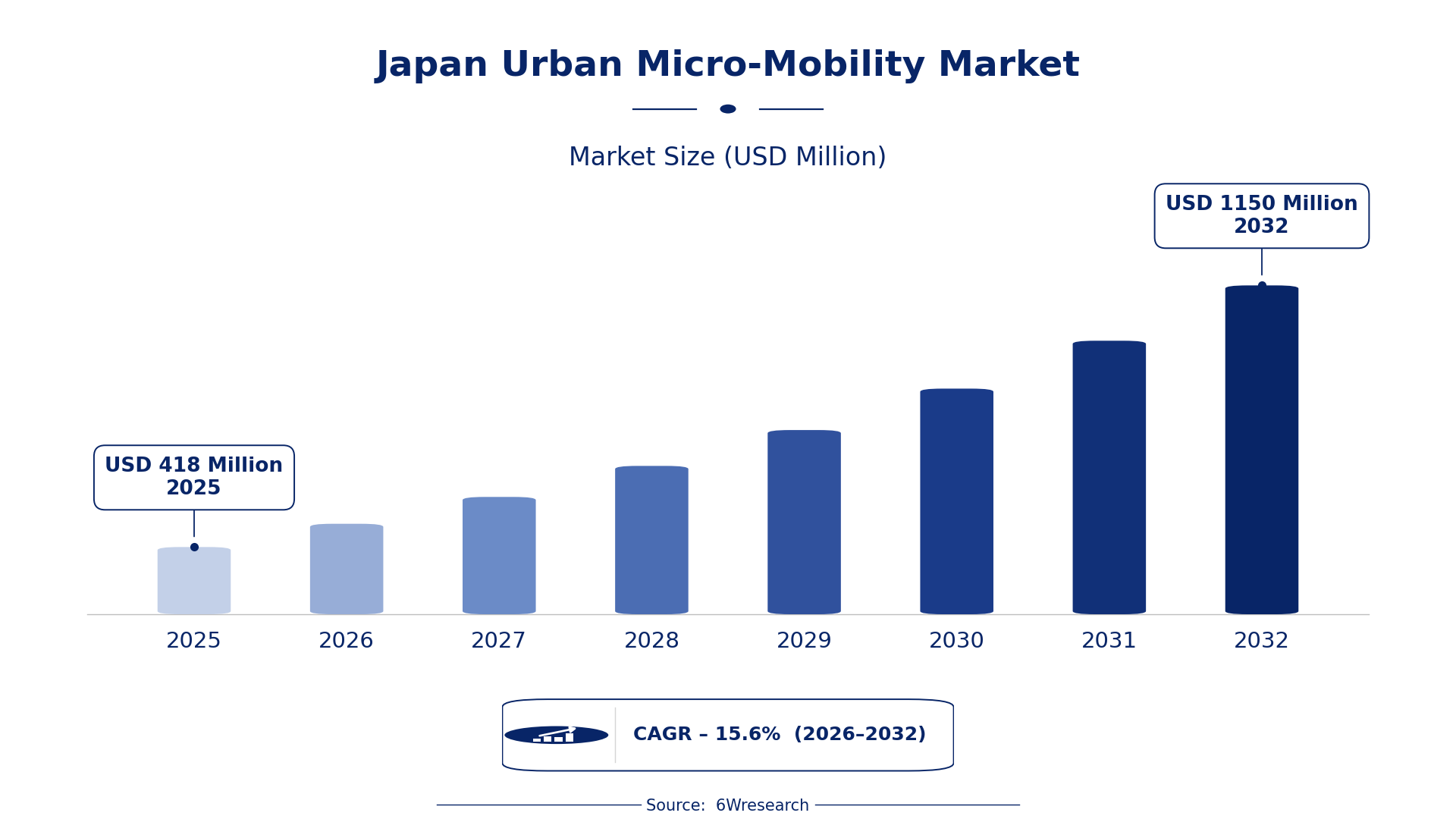
According to 6Wresearch internal database and industry insights, the Japan Urban Micro-Mobility Market was valued at USD 418 Million in 2025 and is projected to reach USD 1,150 Million by 2032, growing at a CAGR of approximately 15.6% during 2026–2032.
Japan Urban Micro-Mobility Market Highlights
| Report Metric | Details |
| Report Name | Japan Urban Micro-Mobility Market (2026-2032) |
| Market Size 2025 | USD 418 Million |
| Market Size 2032 | USD 1,150 Million |
| Absolute Growth 2025–2032 | USD 732 Million |
| CAGR 2026–2032 | 15.6% |
| Peak Annual Growth | 16.9% in 2030 |
| Forecast Period | 2026–2032 |
| Historical Data | 2022–2025 |
| Base Year | 2025 |
| Leading Vehicle Type, 2025 | e-Scooters (48% share) |
| Leading Energy Source, 2025 | Electric Battery (43% share) |
| Leading Sharing Type, 2025 | Dockless Sharing (40% share) |
| Leading End User, 2025 | Commuters (35% share) |
| Fastest-Growing Vehicle Type | e-Bikes (21.6% CAGR) |
| Fastest-Growing Energy Source | Lithium-Ion (17.8% CAGR) |
| Fastest-Growing Sharing Type | Subscription Model (22.2% CAGR) |
| Fastest-Growing End User | College Students (19.9% CAGR) |
| Growing Sector | Urban Transport |
| Key End Users | Commuters, College Students, Urban Youth |
Japan Urban Micro-Mobility Market Year-wise Growth Rate and Key Drivers (2022–2032)
This graph illustrates the annual growth rates of the market from 2022 to 2032, highlighting a steady upward trajectory and projected market expansion over the forecast period.
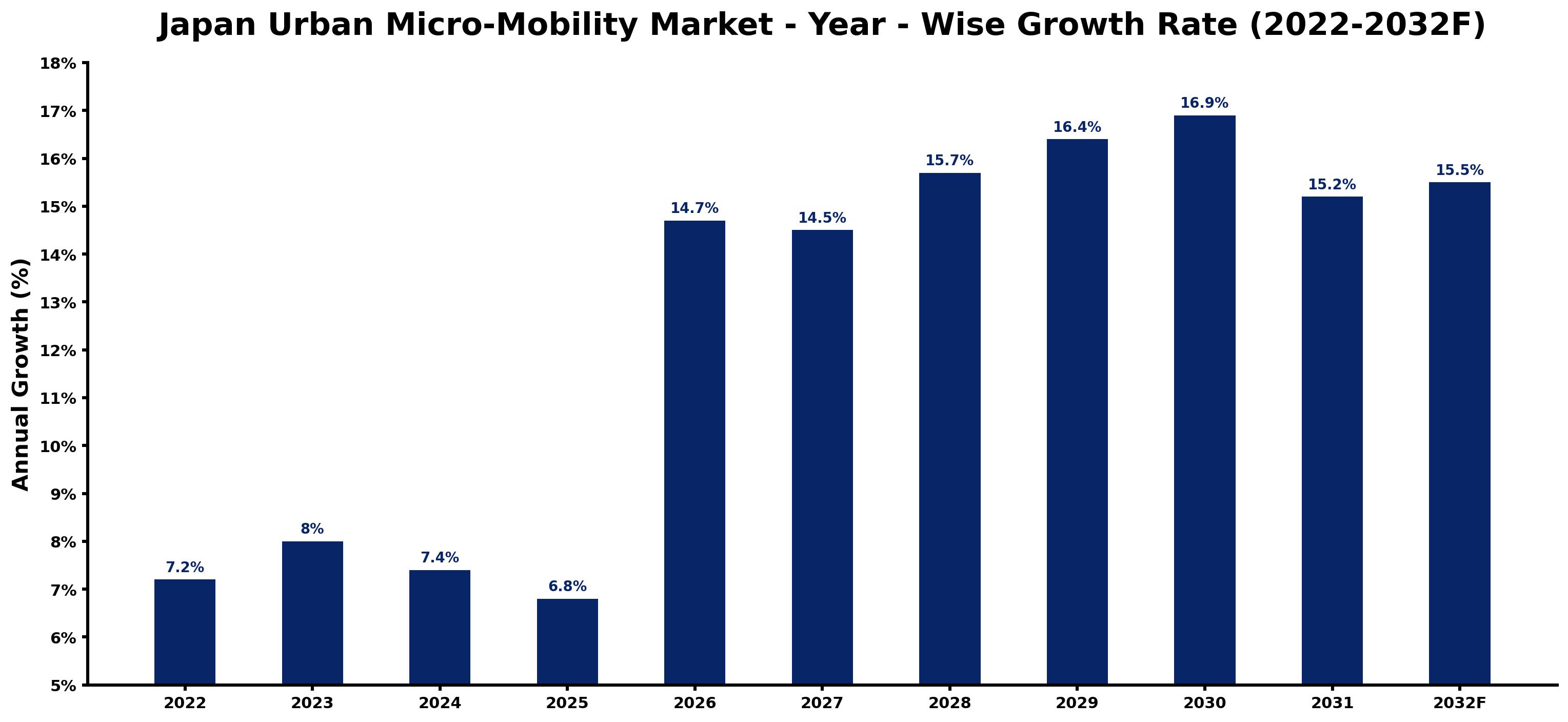
The following figures match every annual growth estimate with the main market development of that year, giving the reasoning behind each rise or slowdown.
| Year | Estimated Annual Growth (%) | Market Rationale |
| 2022 | 7.2 | The market showed steady growth with increasing urbanisation and a demand for efficient transport solutions. |
| 2023 | 8.0 | Growth accelerated due to the rising popularity of e-scooters among urban commuters. |
| 2024 | 7.4 | Growth slowed as the market adjusted to increased competition and saturation in major cities. |
| 2025 | 6.8 | The market continued to grow, but at a slower pace as the focus shifted to infrastructure improvements. |
| 2026 | 14.7 | Demand is expected to surge as new e-bike initiatives attract more users and expand the market. |
| 2027 | 14.5 | Growth is projected to slow slightly as the market stabilises following rapid expansions in previous years. |
| 2028 | 15.7 | The market will see renewed interest as urban youth increasingly adopt micro-mobility solutions. |
| 2029 | 16.4 | Demand is expected to rise further as technological advancements improve vehicle performance and safety. |
| 2030 | 16.9 | The peak growth year will reflect strong investments in infrastructure and consumer adoption of micro-mobility. |
| 2031 | 15.2 | Growth is projected to slow as the market matures, with established players dominating the sector. |
| 2032 | 15.5 | A slight increase in growth is expected as new models and services attract diverse user groups. |
Note: Market size estimations and growth projections presented in this report are based on 6Wresearch's proprietary forecasting methodology, utilizing the latest available industry data, government publications, and primary research inputs.
Japan Urban Micro-Mobility Market Synopsis
Urban micro-mobility includes e-scooters, e-bikes, and compact electric vehicles designed for short-distance travel in cities. The Japan Urban Micro-Mobility Market is growing due to a rising urban population, with approximately 92% of Japan's population residing in urban areas. Key buyer groups consist of commuters and urban youth, who are in search of efficient transport solutions. Initiatives like dockless e-scooter rentals in Osaka are improving access and convenience, driving market expansion.
Market Dynamics Impact Analysis (2026–2032)
| Factor | Type | Impact | Primary Segment Affected |
| Rising urban population driving demand for efficient transport solutions | Driver | High | e-Scooters |
| Government initiatives promoting electric vehicle infrastructure | Driver | High | e-Bikes |
| Increasing adoption of e-bikes among college students | Opportunity | Medium | e-Bikes |
| Expansion of dockless sharing models in urban areas | Opportunity | High | Dockless Sharing |
| Competition from traditional transport methods limiting growth | Restraint | Medium | Compact EVs |
| Infrastructure challenges affecting e-scooter deployment | Restraint | High | e-Scooters |
| Supply chain disruptions impacting battery availability | Challenge | High | Electric Battery |
| Regulatory hurdles delaying new service launches | Challenge | Medium | Dockless Sharing |
Evaluation of Drivers in Japan Urban Micro-Mobility Market (2026–2032)
These are the developments adding the most demand over the forecast period.
| Drivers | Primary Segment Affected | Why It Matters (Evidence) |
| Growing urban population increases demand for short-distance travel solutions | e-Scooters | With approximately 92% of Japan's population in urban areas, e-scooters are increasingly used for commuting. |
| Government initiatives support electric vehicle adoption and infrastructure development | e-Bikes | The Ministry of Environment has a program to encourage electric vehicle use in cities, promoting e-bike adoption. |
| Rising popularity of e-bikes among college students boosts market growth | e-Bikes | The demographic of college students is projected to increase e-bike adoption by 19.9% by 2032. |
| Dockless sharing models improve accessibility and convenience for users | Dockless Sharing | The dockless sharing model holds a 40% market share in 2025, driving user engagement. |
| Technological advancements improve vehicle performance and safety features | e-Scooters | Improvements in lithium-ion battery technology increase the efficiency of e-scooters, attracting more users. |
Orders continue to rise as urban populations grow, leading to increased demand for e-scooters and e-bikes. In 2023, over 10,000 e-scooter rentals were recorded monthly in Tokyo, underscoring their popularity. The college student demographic is expected to propel e-bike adoption, further stimulating demand. The dockless sharing model enhances accessibility for urban users, contributing to market growth. Ongoing advancements in battery technology are improving vehicle performance, making these micro-mobility options more attractive to consumers.
Evaluation of Restraints in Japan Urban Micro-Mobility Market
The main factors holding the market back are set out below.
| Market Restraint | Primary Segment Affected | Why It Matters (Evidence) |
| Competition from traditional transport methods limits e-scooter adoption | e-Scooters | Public transport remains a strong competitor, affecting e-scooter rental growth in urban areas. |
| Infrastructure challenges hinder the deployment of e-scooter services | e-Scooters | Insufficient charging stations and parking facilities restrict the expansion of e-scooter networks. |
| Supply chain disruptions impact the availability of lithium-ion batteries | Electric Battery | Battery shortages can delay the production and availability of e-scooters and e-bikes. |
| Regulatory hurdles slow down the introduction of new micro-mobility services | Dockless Sharing | Strict regulations can delay the launch of dockless e-scooter programs in various cities. |
| Consumer safety concerns regarding e-scooter usage affect market growth | e-Scooters | Accidents and safety issues can deter potential users from adopting e-scooters. |
Japan Urban Micro-Mobility Market Challenges
High rental costs for e-scooters in Tokyo restrict usage, resulting in only 10,000 rentals per month instead of potentially higher figures. Buyers encounter insufficient charging infrastructure, which delays access to these vehicles and can lead to missed commuting opportunities. Manufacturers face challenges with JIS safety standards, causing production delays that hinder their capacity to meet demand. Competition from traditional transport options remains strong, limiting market growth for micro-mobility solutions among urban commuters who often favour established methods.
Trends in the Japan Urban Micro-Mobility Market
The trends below show where the Japan Urban Micro-Mobility Market is heading.
- Shift towards E-Bike Adoption: In 2023, Kyoto introduced a subscription model for e-bike rentals, which has increased accessibility for users. This model is attracting more commuters, with e-bikes projected to grow at a rate of 21.6%.
- Transition to Dockless Sharing Models: Osaka's implementation of a dockless e-scooter pilot program in 2023 has changed how users access micro-mobility solutions. This model is gaining traction, with a 40% share expected in 2025.
- Emergence of Subscription Models for Rentals: The subscription model for e-bike rentals is gaining popularity, particularly among college students. This demographic is projected to increase adoption rates by 19.9% by 2032.
- Increased Focus on Battery Technology: The Battery Industry Strategy, targeting 150 GWh of domestic battery manufacturing capacity by 2030, is reshaping the market. Improved battery technology will increase the performance of micro-mobility vehicles.
Investment Opportunities in the Japan Urban Micro-Mobility Market
Below are the investment opportunities with the strongest case in the Japan Urban Micro-Mobility Market.
- Partnerships for E-Bike Rental Services: Local governments are seeking partnerships to expand e-bike rental services, with urban youth adoption projected to increase by 15% by 2026. Collaborating with municipalities can improve service reach.
- Investment in Charging Infrastructure: With the government allocating funds for electric vehicle infrastructure, there is a gap in charging stations. Investing in charging solutions can meet the growing demand for e-scooters and e-bikes.
- Expansion of Dockless Sharing Programs: The dockless sharing model is likely to see growth, particularly in urban areas. Targeting cities with high commuter populations can yield substantial returns as demand rises.
- Development of Lithium-Ion Battery Solutions: As lithium-ion batteries are the primary energy source for micro-mobility vehicles, investing in advanced battery technology can address supply chain issues and improve vehicle efficiency.
Government Initiatives in the Japan Urban Micro-Mobility Market
The GX Promotion Act, introduced in 2023, establishes a legal framework for promoting electric vehicles, building on the Electrical Appliance and Material Safety Act of 1961. This act updates safety regulations for micro-mobility vehicles, ensuring compliance with current standards.
The Ministry of Land, Infrastructure, Transport and Tourism supervises the approval of micro-mobility regulations and funds infrastructure projects. They allocate resources for developing charging stations and support initiatives to boost e-bike usage in urban areas.
Future Insight of the Japan Urban Micro-Mobility Market
Advancements in battery technology will reshape demand for e-scooters and e-bikes by 2032, enabling longer travel distances. The rollout of subscription models in cities like Kyoto will improve accessibility, attracting more users. Urban areas are expected to achieve a 20% reduction in traffic congestion by 2025 through targeted micro-mobility initiatives. A 15% increase in the urban youth demographic will further accelerate adoption, creating a more integrated transport network.
Market Segmentation Analysis
Japan Urban Micro-Mobility Market report covers a detailed analysis of the following market segments:
By Vehicle Type – e-Scooters Lead, e-Bikes Expected to Grow Fastest
According to Saurav Kr Singh, Senior Research Analyst at 6Wresearch, e-Scooters held 48% of the Japan Urban Micro-Mobility Market by vehicle type in 2025. E-scooters dominate the market due to their widespread use for short urban commutes, appealing to a broad demographic. In Tokyo, over 10,000 e-scooter rentals per month illustrate the strong demand from urban commuters. The quickest growth will come from e-Bikes, forecast to expand at a CAGR of 21.6% between 2026 and 2032. E-bikes are experiencing rapid growth, particularly for both commuting and leisure, with Kyoto's recent subscription model for e-bike rentals significantly contributing to this trend. The flexibility of subscription services is expected to attract a larger user base. Suppliers should focus on enhancing e-bike offerings to meet the rising demand in the market.
By Energy Source – Electric Battery Leads, Lithium-Ion Expected to Grow Fastest
With 43% of energy source revenue in 2025, Electric Battery was the largest category. Electric batteries are essential for powering all micro-mobility vehicles, making them the primary energy source in this market. Their widespread adoption across various vehicle types ensures a consistent supply for users. Lithium-Ion is set to record the highest CAGR in this split, 17.8% over 2026–2032. Lithium-ion batteries are the fastest-growing energy source, primarily used in e-scooters and e-bikes, due to their efficiency and lightweight properties. As demand for these vehicles increases, so will the need for lithium-ion technology. Buyers will benefit from advancements in battery technology, leading to improved performance and range.
By Sharing Type – Dockless Sharing Leads, Subscription Model Expected to Grow Fastest
The largest sharing type category in 2025 was Dockless Sharing, at 40% of revenue. Dockless sharing has become the preferred model in urban areas, providing users with convenient access to vehicles without the need for fixed stations. This model suits the fast-paced lifestyle of urban commuters, making it highly attractive. Subscription Model is projected to grow fastest, at a CAGR of 22.2% during 2026–2032. The subscription model for e-bike rentals is gaining traction, as evidenced by Kyoto's introduction of this service in 2023. This trend reflects a shift towards more sustainable and economical transportation solutions for users. Suppliers should consider developing subscription-based services to align with evolving consumer preferences in urban mobility.
By End User – Commuters Lead, College Students Expected to Grow Fastest
Commuters took 35% of end user revenue in 2025, more than any other category. Commuters represent the largest user group for micro-mobility, relying on these vehicles for daily travel within urban settings. The high concentration of this demographic in cities ensures a steady demand for e-scooters and e-bikes. Over 2026–2032, College Students are expected to post the fastest growth, at a CAGR of 19.9%. College students are emerging as a significant user base for e-bikes and scooters, with their numbers projected to increase as they adopt micro-mobility solutions. This demographic shift indicates a growing acceptance of these vehicles among younger individuals. Suppliers should tailor marketing strategies towards college campuses to effectively engage this expanding user segment.
Key Attractiveness of the Report
- 10 Years of Market Numbers
- Historical Data Starting from 2022 to 2025
- Base Year 2025
- Forecast Data until 2032
- Key Performance Indicators Impacting the Market
- Major Upcoming Developments and Projects
Key Highlights of the Report:
- Japan Urban Micro-Mobility Market Outlook
- Market Size of Japan Urban Micro-Mobility Market, 2025
- Forecast of Japan Urban Micro-Mobility Market, 2032
- Historical Data and Forecast of Japan Urban Micro-Mobility Revenues & Volume for the Period 2022-2032F
- Japan Urban Micro-Mobility Market Trend Evolution
- Japan Urban Micro-Mobility Market Drivers and Challenges
- Japan Urban Micro-Mobility Price Trends
- Japan Urban Micro-Mobility Porter's Five Forces
- Japan Urban Micro-Mobility Industry Life Cycle
- Historical Data and Forecast of Japan Urban Micro-Mobility Market Revenues & Volume By Vehicle Type for the Period 2022-2032F
- Historical Data and Forecast of Japan Urban Micro-Mobility Market Revenues & Volume By e-Scooters for the Period 2022-2032F
- Historical Data and Forecast of Japan Urban Micro-Mobility Market Revenues & Volume By e-Bikes for the Period 2022-2032F
- Historical Data and Forecast of Japan Urban Micro-Mobility Market Revenues & Volume By Compact EVs for the Period 2022-2032F
- Historical Data and Forecast of Japan Urban Micro-Mobility Market Revenues & Volume By Hoverboards for the Period 2022-2032F
- Historical Data and Forecast of Japan Urban Micro-Mobility Market Revenues & Volume By Energy Source for the Period 2022-2032F
- Historical Data and Forecast of Japan Urban Micro-Mobility Market Revenues & Volume By Electric Battery for the Period 2022-2032F
- Historical Data and Forecast of Japan Urban Micro-Mobility Market Revenues & Volume By Lithium-Ion for the Period 2022-2032F
- Historical Data and Forecast of Japan Urban Micro-Mobility Market Revenues & Volume By Solar Hybrid for the Period 2022-2032F
- Historical Data and Forecast of Japan Urban Micro-Mobility Market Revenues & Volume By Rechargeable Battery for the Period 2022-2032F
- Historical Data and Forecast of Japan Urban Micro-Mobility Market Revenues & Volume By Sharing Type for the Period 2022-2032F
- Historical Data and Forecast of Japan Urban Micro-Mobility Market Revenues & Volume By Dockless Sharing for the Period 2022-2032F
- Historical Data and Forecast of Japan Urban Micro-Mobility Market Revenues & Volume By Subscription Model for the Period 2022-2032F
- Historical Data and Forecast of Japan Urban Micro-Mobility Market Revenues & Volume By Fleet Ownership for the Period 2022-2032F
- Historical Data and Forecast of Japan Urban Micro-Mobility Market Revenues & Volume By Personal Ownership for the Period 2022-2032F
- Historical Data and Forecast of Japan Urban Micro-Mobility Market Revenues & Volume By End User for the Period 2022-2032F
- Historical Data and Forecast of Japan Urban Micro-Mobility Market Revenues & Volume By Commuters for the Period 2022-2032F
- Historical Data and Forecast of Japan Urban Micro-Mobility Market Revenues & Volume By College Students for the Period 2022-2032F
- Historical Data and Forecast of Japan Urban Micro-Mobility Market Revenues & Volume By City Transport Co. for the Period 2022-2032F
- Historical Data and Forecast of Japan Urban Micro-Mobility Market Revenues & Volume By Urban Youth for the Period 2022-2032F
- Japan Urban Micro-Mobility Import Export Trade Statistics
- Market Opportunity Assessment By Vehicle Type
- Market Opportunity Assessment By Energy Source
- Market Opportunity Assessment By Sharing Type
- Market Opportunity Assessment By End User
- Japan Urban Micro-Mobility Top Companies Market Share
- Japan Urban Micro-Mobility Competitive Benchmarking By Technical and Operational Parameters
- Japan Urban Micro-Mobility Company Profiles
- Japan Urban Micro-Mobility Key Strategic Recommendations
Market Covered
This report examines the market across the segments below.
By Vehicle Type
- e-Scooters
- e-Bikes
- Compact EVs
- Hoverboards
By Energy Source
- Electric Battery
- Lithium-Ion
- Solar Hybrid
- Rechargeable Battery
By Sharing Type
- Dockless Sharing
- Subscription Model
- Fleet Ownership
- Personal Ownership
By End User
- Commuters
- College Students
- City Transport Co.
- Urban Youth































