Japan Urban Mining Market Size & Growth Rate
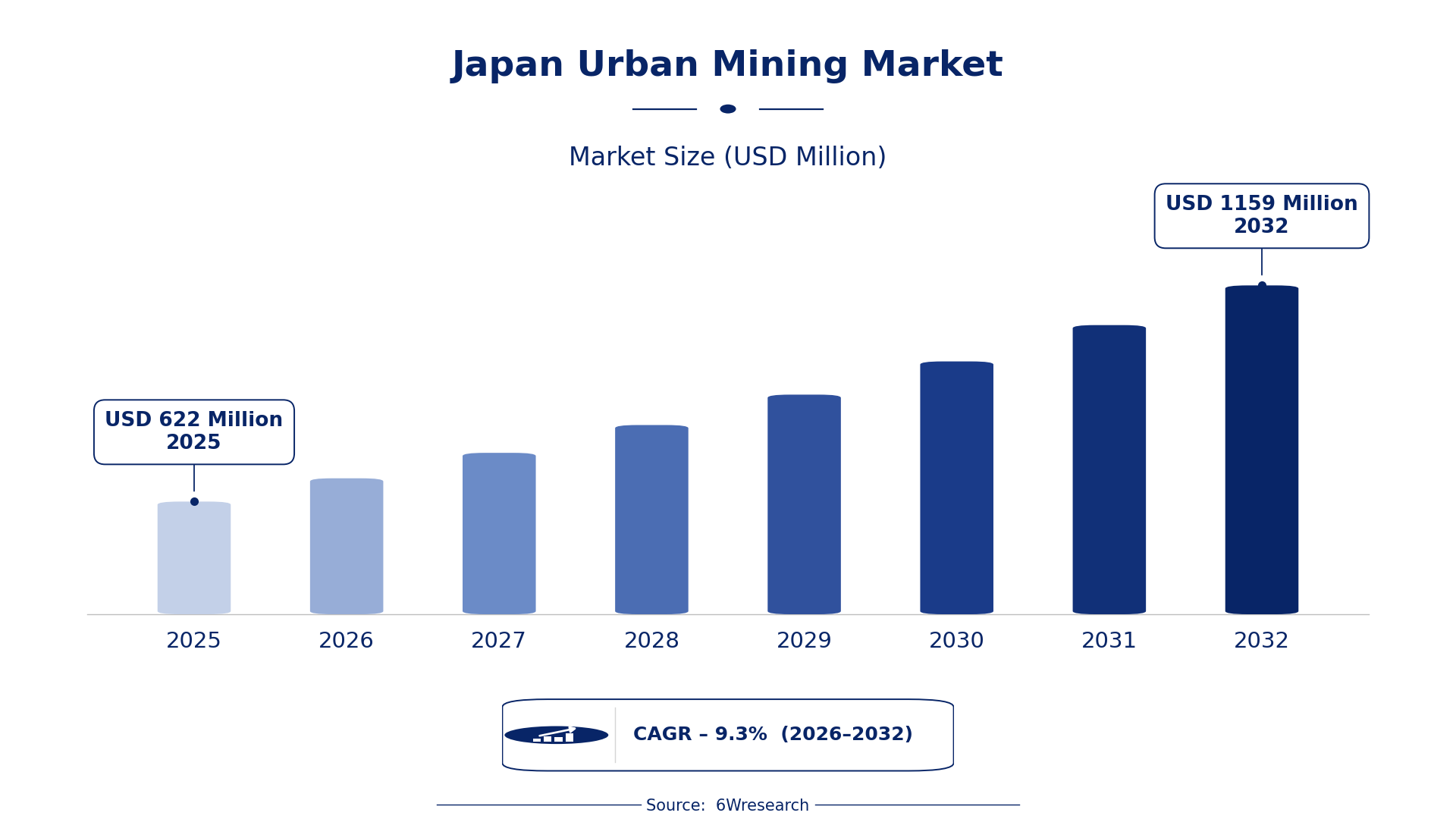
According to 6Wresearch internal database and industry insights, the Japan Urban Mining Market was valued at USD 622 Million in 2025 and is projected to reach USD 1,159 Million by 2032, growing at a CAGR of approximately 9.3% during 2026–2032.
Japan Urban Mining Market Highlights
| Report Metric | Details |
| Report Name | Japan Urban Mining Market (2026-2032) |
| Market Size 2025 | USD 622 Million |
| Market Size 2032 | USD 1,159 Million |
| Absolute Growth 2025–2032 | USD 537 Million |
| CAGR 2026–2032 | 9.3% |
| Peak Annual Growth | 11.5% in 2026 |
| Forecast Period | 2026–2032 |
| Historical Data | 2022–2025 |
| Base Year | 2025 |
| Leading Material Recovered, 2025 | Rare Earth Metals (49% share) |
| Leading Source Type, 2025 | E-Waste (45% share) |
| Leading Technology Used, 2025 | Chemical Leaching (40% share) |
| Leading End User, 2025 | Battery Manufacturers (48% share) |
| Fastest-Growing Material Recovered | Lithium (13.3% CAGR) |
| Fastest-Growing Source Type | Used EV Batteries (13.8% CAGR) |
| Fastest-Growing End User | Metal Recyclers (12.1% CAGR) |
| Growing Sector | recycling |
| Key End Users | Battery Manufacturers, Metal Recyclers, Refining Companies, EV Battery OEMs |
Japan Urban Mining Market Year-wise Growth Rate and Key Drivers (2022–2032)
This graph illustrates the annual growth rates of the market from 2022 to 2032, highlighting a steady upward trajectory and projected market expansion over the forecast period.
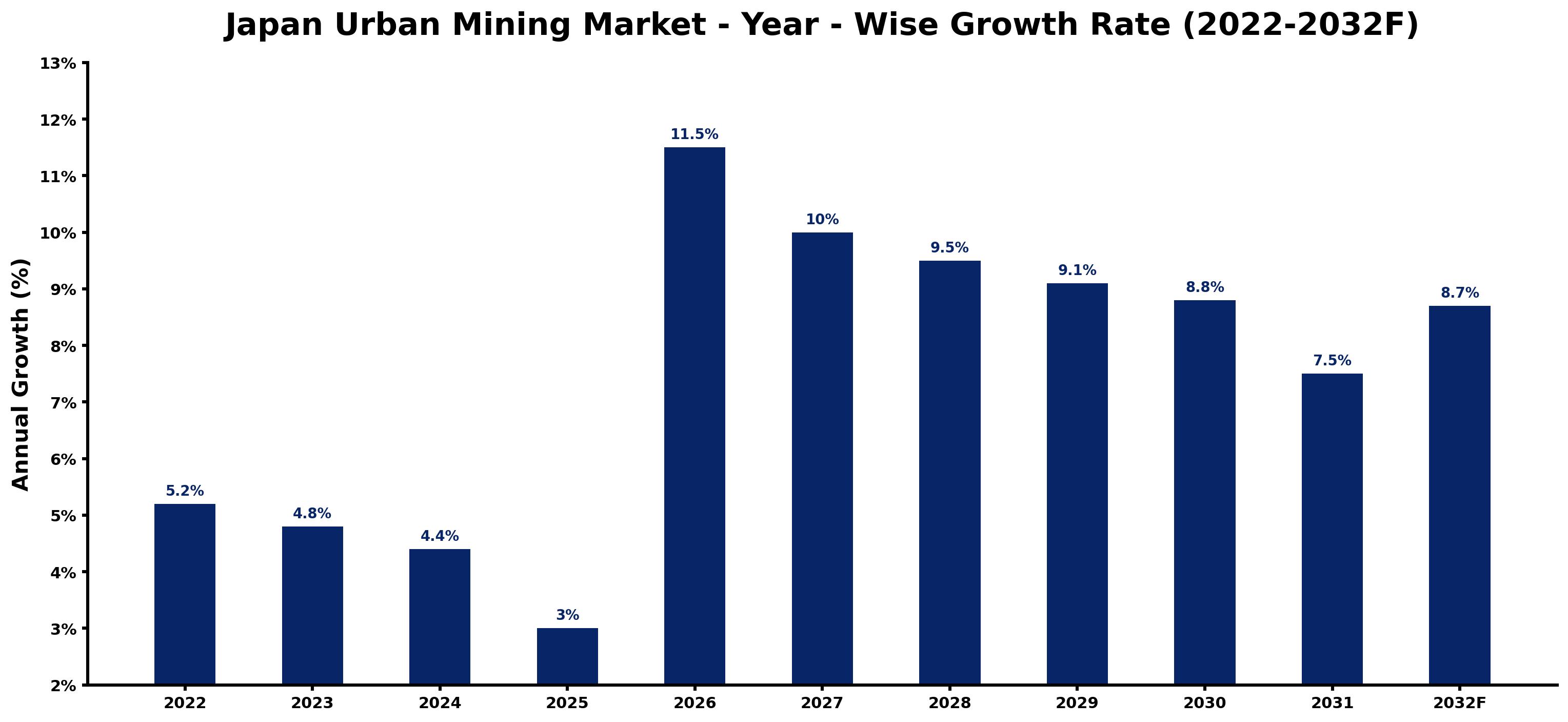
For each year, the table pairs the estimated growth rate with the leading influence on demand, showing how the drivers changed across the period.
| Year | Estimated Annual Growth (%) | Market Rationale |
| 2022 | 5.2 | The market experienced steady growth, driven by increasing e-waste generation. |
| 2023 | 4.8 | Growth slowed as recycling infrastructure faced operational challenges. |
| 2024 | 4.4 | Demand continued to rise, but at a slower pace due to market saturation. |
| 2025 | 3.0 | The market saw further slowdown as competition intensified among recyclers. |
| 2026 | 11.5 | Growth is expected to accelerate as new recycling technologies are adopted. |
| 2027 | 10.0 | Demand growth is projected to moderate as the market adjusts to new capacities. |
| 2028 | 9.5 | The market is expected to maintain a healthy pace, supported by rising demand for recovered materials. |
| 2029 | 9.1 | Growth is projected to slow slightly as the market stabilises after rapid expansion. |
| 2030 | 8.8 | Demand is expected to continue growing, driven by increasing battery production. |
| 2031 | 7.5 | Growth is projected to further slow as the market reaches maturity in several segments. |
| 2032 | 8.7 | The market is expected to rebound as sustainability efforts gain traction. |
Note: Market size estimations and growth projections presented in this report are based on 6Wresearch's proprietary forecasting methodology, utilizing the latest available industry data, government publications, and primary research inputs.
Japan Urban Mining Market Synopsis
Urban mining involves recovering valuable materials from urban waste, particularly electronic waste, through processes like recycling and extraction. This practice is essential for supplying raw materials for manufacturing and reducing environmental impact. The Japan Urban Mining Market is growing due to strong demand from domestic users, particularly in the electronic and automotive industries, and initiatives such as the Economic Security Promotion Act, which supports resource recovery and recycling efforts. In 2023, Japan allocated ¥10 billion for urban mining initiatives, further driving market growth.
Market Dynamics Impact Analysis (2026–2032)
| Factor | Type | Impact | Primary Segment Affected |
| Increasing e-waste generation drives demand for recycling services. | Driver | High | E-Waste |
| Growing lithium-ion battery production boosts demand for recovered materials. | Driver | High | Lithium |
| Rising consumer awareness about sustainability creates opportunities for urban mining. | Opportunity | High | Used EV Batteries |
| Expansion of recycling facilities in the Kanto region presents investment opportunities. | Opportunity | Medium | Rare Earth Metals |
| Competition among recyclers can limit profit margins. | Restraint | High | Metal Recyclers |
| High operational costs for advanced recycling technologies may deter new entrants. | Restraint | Medium | Chemical Leaching |
| Regulatory compliance can be complex and costly for new recyclers. | Challenge | High | Battery Manufacturers |
| Technological advancements require continuous investment, posing a risk for small operators. | Challenge | Medium | Refining Companies |
Evaluation of Drivers in Japan Urban Mining Market (2026–2032)
Demand rests on the following drivers, each shown with the segment it touches most.
| Drivers | Primary Segment Affected | Why It Matters (Evidence) |
| Growing e-waste generation increases the volume of recoverable materials. | E-Waste | Japan produced 1.2 million tons of e-waste in 2022, leading to higher recycling demand. |
| Rising lithium-ion battery production drives demand for recovered lithium. | Lithium | The lithium-ion battery market is projected to reach 1.5 million units by 2025, boosting recovery efforts. |
| Increased consumer awareness about sustainability encourages recycling participation. | Used EV Batteries | The Tokyo Metropolitan Government aims for a 30% recycling target by 2025, promoting urban mining. |
| Technological advancements in recycling methods enhance material recovery efficiency. | Chemical Leaching | Chemical leaching accounted for 40% of the technology used in urban mining in 2025. |
| Government initiatives support urban mining investments and infrastructure development. | Rare Earth Metals | In 2023, Japan allocated ¥10 billion for urban mining initiatives, fostering growth. |
Most of the extra volume comes from the Kanto region, where the concentration of recycling facilities is high. In 2022, Japan produced 1.2 million tons of e-waste, which has increased the demand for urban mining services. The projected growth of the lithium-ion battery market to 1.5 million units by 2025 further drives the need for recovered materials. Technological advancements, such as the adoption of chemical leaching, improve recovery rates and efficiency, attracting more investment into the sector.
Evaluation of Restraints in Japan Urban Mining Market
These are the pressures that could keep growth below its potential.
| Market Restraint | Primary Segment Affected | Why It Matters (Evidence) |
| High operational costs limit the feasibility of advanced recycling technologies. | Chemical Leaching | Investment in new technologies can be prohibitive, with costs exceeding ¥100 million for some facilities. |
| Regulatory compliance can be burdensome for recyclers, impacting operations. | Metal Recyclers | Recyclers must adhere to the PRTR Law, which requires extensive reporting and monitoring. |
| Market saturation in certain recycling segments can hinder growth potential. | E-Waste | With over 500 registered metal recyclers in Tokyo, competition is fierce. |
| Fluctuating prices of recovered materials can affect profitability. | Precious Metals | Market volatility can lead to unpredictable revenue streams for recyclers. |
| Limited public awareness about recycling programs can reduce participation rates. | Used Electronics | Despite initiatives, many consumers remain unaware of recycling options available. |
Japan Urban Mining Market Challenges
Producers face inconsistent availability of e-waste due to uneven collection rates across Japan, particularly in urban areas. This issue arises because recycling facilities in the Kanto region are overwhelmed, causing delays that can extend processing times for producers by several weeks. Skills shortages in recycling technologies hinder operations, resulting in a recovery rate drop of up to 20% for producers who rely on timely access to materials. High operational costs arise from compliance with standards like ISO 14001, which can increase expenses for producers by 15%, ultimately raising prices for buyers.
Trends in the Japan Urban Mining Market
The following changes are redrawing the Japan Urban Mining Market.
- Shift in Focus to E-Waste Recycling: Battery manufacturers are prioritising urban mining to secure raw materials. In 2023, Japan's lithium-ion battery market is projected to reach 1.5 million units, driving demand for recycled materials.
- Transition from Traditional to Advanced Recycling Methods: The adoption of chemical leaching is rising among recyclers in Japan. This method accounted for 40% of the technology used in urban mining by 2025, improving recovery efficiency.
- Growing Emphasis on Sustainability in Manufacturing: Manufacturers are increasingly sourcing recycled materials to meet sustainability targets. The Japan Battery Association is actively involved in recycling efforts, promoting the use of recovered materials.
- Expansion of Recycling Infrastructure in Kanto Region: The Kanto region is experiencing a surge in recycling facilities, with over 500 registered metal recyclers in Tokyo. This expansion supports Japan's goal of increasing e-waste recovery rates.
Investment Opportunities in the Japan Urban Mining Market
The following opportunities in the Japan Urban Mining Market pair current demand with a clear way in.
- Investment in Recycling Facilities in Kanto: The Kanto region is experiencing a surge in recycling facility investments, with a total installed capacity of 2 million tons per year. This presents opportunities for local partnerships and expansion.
- Growing Demand from Battery Manufacturers: With Japan's lithium-ion battery market projected to reach 1.5 million units by 2025, there is an opportunity for suppliers of recovered lithium and other materials.
- Support for Urban Mining Initiatives: Japan allocated ¥10 billion for urban mining initiatives in 2023, creating opportunities for new projects and partnerships in the recycling sector.
- Expansion of E-Waste Recycling Programs: The E-Waste Recycling Program targets a 50% recovery rate by 2025, presenting opportunities for recyclers to improve their operations and meet government targets.
Government Initiatives in the Japan Urban Mining Market
The Chemical Substances Control Law, enacted in 1973, requires rigorous evaluation and control of chemical substances in manufacturing and import. This law impacts urban mining by ensuring that recyclers adhere to safety standards when handling hazardous materials. The Economic Security Promotion Act of 2022 further supports supply-chain resilience for critical products, including those derived from urban mining, creating a more sustainable recycling industry.
In 2023, Japan allocated ¥10 billion for urban mining initiatives, overseen by the Ministry of the Environment. This funding supports the development of recycling infrastructure and promotes e-waste recycling programs, improving the overall effectiveness of urban mining efforts.
Future Insight of the Japan Urban Mining Market
Emerging urban mining initiatives will focus on enhancing material recovery by 2032. The total installed capacity for recycling in Japan is expected to reach 2 million tons per year, ensuring a more reliable supply of reclaimed materials for buyers. The 'E-Waste Recycling Program' aims for a 50% recovery rate by 2025, opening new opportunities for suppliers. Advances in recycling technologies will streamline extraction processes, enabling effective reclamation of valuable materials from urban waste.
Market Segmentation Analysis
Japan Urban Mining Market report covers a detailed analysis of the following market segments:
By Material Recovered – Rare Earth Metals Lead, Lithium Expected to Grow Fastest
According to Saurav Kr Singh, Senior Research Analyst at 6Wresearch, with 49% of material recovered revenue in 2025, Rare Earth Metals was the largest category. Rare earth metals are essential for Japan's electronics and batteries, creating a strong demand from manufacturers. The focus on sustainability, highlighted by the 'Green Growth Strategy', reinforces this segment's leading position. Over 2026–2032, Lithium is expected to post the fastest growth, at a CAGR of 13.3%. The lithium segment is rapidly expanding due to the increasing demand for batteries in electric vehicles, projected to reach 1.5 million units by 2025. This growth in electric vehicle adoption will further drive the recovery of lithium from urban waste. Suppliers should focus on rare earth metals to align with the increasing requirements of technology manufacturers.
By Source Type – E-Waste Leads, Used EV Batteries Expected to Grow Fastest
E-Waste held 45% of the Japan Urban Mining Market by source type in 2025. E-waste serves as the main source of recoverable materials in Japan, with 1.2 million tons generated in 2022, driving urban mining activities. The Ministry of the Environment's initiatives further reinforce e-waste's prominence as a source type. Used EV Batteries are projected to grow fastest, at a CAGR of 13.8% during 2026–2032. Used EV batteries are emerging as a crucial source due to the growing electric vehicle market, which is expected to see a surge in recycling efforts. This trend will likely continue as the demand for electric vehicles rises. Buyers should consider integrating used EV batteries into their sourcing strategies to capitalise on urban mining growth.
By Technology Used – Chemical Leaching Leads and Records the Fastest Growth
Chemical Leaching accounted for 40% of the market by technology used in 2025. Chemical leaching is widely adopted for material extraction, effectively recovering valuable resources from e-waste. Its prevalent use in Japan's recycling facilities underscores its importance in urban mining processes. Chemical Leaching is also forecast to expand faster than any other category, at a CAGR of 12.5% over 2026–2032. As the leading technology, chemical leaching's ongoing utilisation will improve material recovery efficiency, allowing it to maintain its dominant position. Its effectiveness in extracting rare materials ensures its continued relevance in urban mining. Suppliers must focus on enhancing chemical leaching technologies to boost recovery rates.
By End User – Battery Manufacturers Lead, Metal Recyclers Expected to Grow Fastest
Battery Manufacturers took 48% of end user revenue in 2025, more than any other category. Battery manufacturers are the key consumers of recovered materials, relying on urban mining to obtain essential components for their production processes. Their significant demand for rare earth metals reinforces their position as the leading end user in the market. The quickest growth will come from Metal Recyclers, forecast to expand at a CAGR of 12.1% between 2026 and 2032. Metal recyclers are witnessing rapid growth, driven by their essential role in urban mining and the increasing volume of e-waste. Their involvement in the recovery process is critical as the need for recycled materials intensifies. Suppliers should strengthen partnerships with metal recyclers to optimise resource recovery and address market needs.
Key Attractiveness of the Report
- 10 Years of Market Numbers
- Historical Data Starting from 2022 to 2025
- Base Year 2025
- Forecast Data until 2032
- Key Performance Indicators Impacting the Market
- Major Upcoming Developments and Projects
Key Highlights of the Report:
- Japan Urban Mining Market Outlook
- Market Size of Japan Urban Mining Market, 2025
- Forecast of Japan Urban Mining Market, 2032
- Historical Data and Forecast of Japan Urban Mining Revenues & Volume for the Period 2022-2032F
- Japan Urban Mining Market Trend Evolution
- Japan Urban Mining Market Drivers and Challenges
- Japan Urban Mining Price Trends
- Japan Urban Mining Porter's Five Forces
- Japan Urban Mining Industry Life Cycle
- Historical Data and Forecast of Japan Urban Mining Market Revenues & Volume By Material Recovered for the Period 2022-2032F
- Historical Data and Forecast of Japan Urban Mining Market Revenues & Volume By Rare Earth Metals for the Period 2022-2032F
- Historical Data and Forecast of Japan Urban Mining Market Revenues & Volume By Precious Metals for the Period 2022-2032F
- Historical Data and Forecast of Japan Urban Mining Market Revenues & Volume By Copper & Aluminum for the Period 2022-2032F
- Historical Data and Forecast of Japan Urban Mining Market Revenues & Volume By Lithium for the Period 2022-2032F
- Historical Data and Forecast of Japan Urban Mining Market Revenues & Volume By Source Type for the Period 2022-2032F
- Historical Data and Forecast of Japan Urban Mining Market Revenues & Volume By E-Waste for the Period 2022-2032F
- Historical Data and Forecast of Japan Urban Mining Market Revenues & Volume By Used Electronics for the Period 2022-2032F
- Historical Data and Forecast of Japan Urban Mining Market Revenues & Volume By Old Wiring & Motors for the Period 2022-2032F
- Historical Data and Forecast of Japan Urban Mining Market Revenues & Volume By Used EV Batteries for the Period 2022-2032F
- Historical Data and Forecast of Japan Urban Mining Market Revenues & Volume By Technology Used for the Period 2022-2032F
- Historical Data and Forecast of Japan Urban Mining Market Revenues & Volume By Chemical Leaching for the Period 2022-2032F
- Historical Data and Forecast of Japan Urban Mining Market Revenues & Volume By Thermal Treatment for the Period 2022-2032F
- Historical Data and Forecast of Japan Urban Mining Market Revenues & Volume By Mechanical Separation for the Period 2022-2032F
- Historical Data and Forecast of Japan Urban Mining Market Revenues & Volume By Solvent Extraction for the Period 2022-2032F
- Historical Data and Forecast of Japan Urban Mining Market Revenues & Volume By End User for the Period 2022-2032F
- Historical Data and Forecast of Japan Urban Mining Market Revenues & Volume By Battery Manufacturers for the Period 2022-2032F
- Historical Data and Forecast of Japan Urban Mining Market Revenues & Volume By Refining Companies for the Period 2022-2032F
- Historical Data and Forecast of Japan Urban Mining Market Revenues & Volume By Metal Recyclers for the Period 2022-2032F
- Historical Data and Forecast of Japan Urban Mining Market Revenues & Volume By EV Battery OEMs for the Period 2022-2032F
- Japan Urban Mining Import Export Trade Statistics
- Market Opportunity Assessment By Material Recovered
- Market Opportunity Assessment By Source Type
- Market Opportunity Assessment By Technology Used
- Market Opportunity Assessment By End User
- Japan Urban Mining Top Companies Market Share
- Japan Urban Mining Competitive Benchmarking By Technical and Operational Parameters
- Japan Urban Mining Company Profiles
- Japan Urban Mining Key Strategic Recommendations
Market Covered
The study includes the following segmentation.
By Material Recovered
- Rare Earth Metals
- Precious Metals
- Copper & Aluminum
- Lithium
By Source Type
- E-Waste
- Used Electronics
- Old Wiring & Motors
- Used EV Batteries
By Technology Used
- Chemical Leaching
- Thermal Treatment
- Mechanical Separation
- Solvent Extraction
By End User
- Battery Manufacturers
- Refining Companies
- Metal Recyclers
- EV Battery OEMs































