Japan Urban Mobility Battery Market Size & Growth Rate
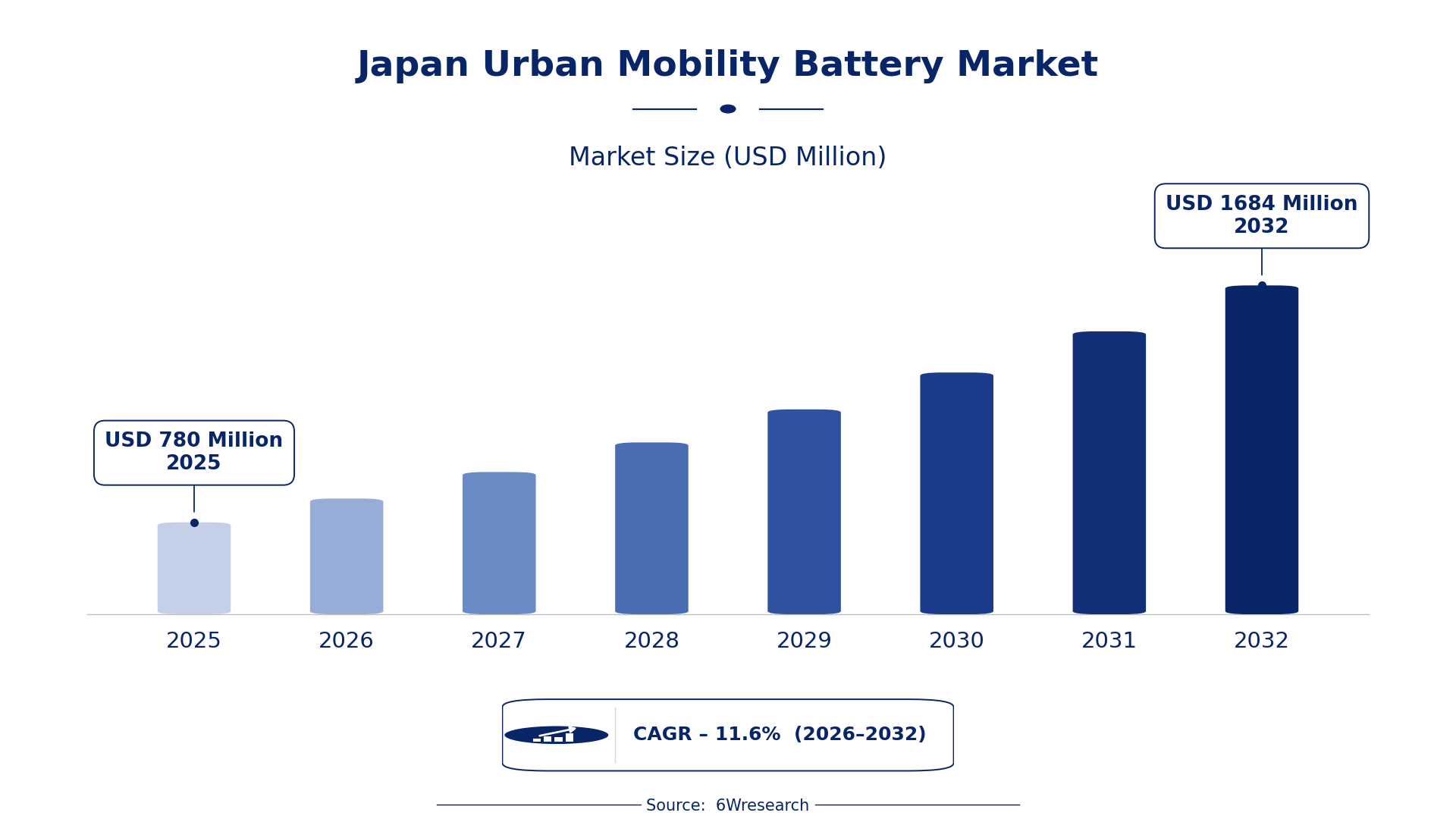
According to 6Wresearch internal database and industry insights, the Japan Urban Mobility Battery Market was valued at USD 780 Million in 2025 and is projected to reach USD 1,684 Million by 2032, growing at a CAGR of approximately 11.6% during 2026–2032.
Japan Urban Mobility Battery Market Highlights
| Report Metric | Details |
| Report Name | Japan Urban Mobility Battery Market (2026-2032) |
| Market Size 2025 | USD 780 Million |
| Market Size 2032 | USD 1,684 Million |
| Absolute Growth 2025–2032 | USD 904 Million |
| CAGR 2026–2032 | 11.6% |
| Peak Annual Growth | 13.5% in 2026 |
| Forecast Period | 2026–2032 |
| Historical Data | 2022–2025 |
| Base Year | 2025 |
| Leading Battery Type, 2025 | Lithium-Ion Batteries (45% share) |
| Leading Application Vehicle, 2025 | e-Bikes (38% share) |
| Leading Chemistry, 2025 | NMC/NCA (55% share) |
| Leading End User, 2025 | Mobility OEMs (41% share) |
| Fastest-Growing Battery Type | Solid-State Batteries (15.8% CAGR) |
| Fastest-Growing Application Vehicle | e-Scooters (15.1% CAGR) |
| Fastest-Growing Chemistry | Solid Electrolyte (16.2% CAGR) |
| Fastest-Growing End User | Battery Startups (14.2% CAGR) |
| Growing Sector | Urban transport solutions |
| Key End Users | Mobility OEMs, Fleet Operators, Charging Infrastructure Firms |
Japan Urban Mobility Battery Market Year-wise Growth Rate and Key Drivers (2022–2032)
This graph illustrates the annual growth rates of the market from 2022 to 2032, highlighting a steady upward trajectory and projected market expansion over the forecast period.
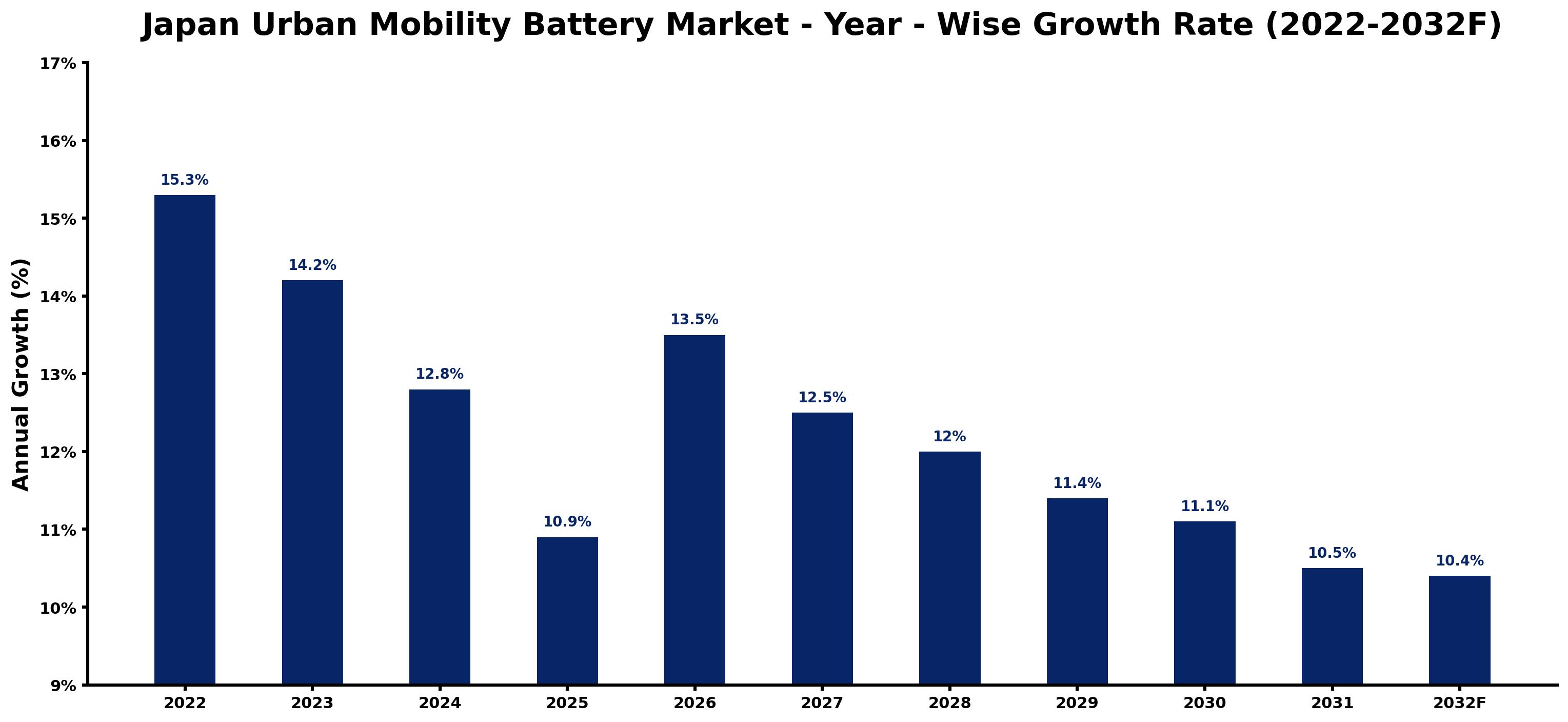
Below, each year's estimated growth is shown next to the factor that most influenced it.
| Year | Estimated Annual Growth (%) | Market Rationale |
| 2022 | 15.3 | The market experienced strong demand from urban mobility initiatives and electric vehicle adoption. |
| 2023 | 14.2 | Growth slowed due to market saturation and increased competition among battery suppliers. |
| 2024 | 12.8 | Demand continued to rise, driven by expanding e-bike usage and urban transport needs. |
| 2025 | 10.9 | Growth slowed further as infrastructure development lagged behind increasing vehicle registrations. |
| 2026 | 13.5 | Investment in battery technology is expected to surge, boosting demand for urban mobility solutions. |
| 2027 | 12.5 | A slowdown is projected as supply chain challenges impact battery availability. |
| 2028 | 12.0 | Demand is expected to remain steady, supported by ongoing urbanisation and electric vehicle adoption. |
| 2029 | 11.4 | Growth is projected to decelerate as the market adjusts to new technological advancements. |
| 2030 | 11.1 | The market is expected to stabilise as charging infrastructure expands to meet user needs. |
| 2031 | 10.5 | Demand growth is projected to continue slowing as market maturity sets in. |
| 2032 | 10.4 | The market is expected to grow steadily, driven by sustained urban mobility initiatives. |
Note: Market size estimations and growth projections presented in this report are based on 6Wresearch's proprietary forecasting methodology, utilizing the latest available industry data, government publications, and primary research inputs.
Japan Urban Mobility Battery Market Synopsis
Urban Mobility Batteries are lithium-ion batteries designed for electric vehicles, including e-bikes and compact EVs. These batteries are produced through the assembly of electrochemical cells and battery management systems. The Japan Urban Mobility Battery Market is expanding, driven by rising demand from domestic users and fleet operators, alongside substantial investments in electric vehicle infrastructure, with the government targeting 10,000 public charging stations by 2025. This growth reflects a shift towards sustainable urban transport solutions, improving mobility in Japan.
Market Dynamics Impact Analysis (2026–2032)
| Factor | Type | Impact | Primary Segment Affected |
| Increasing adoption of electric vehicles and e-bikes drives demand for Urban Mobility Batteries. | Driver | High | Lithium-Ion Batteries |
| Expansion of charging infrastructure enhances the usability of electric vehicles. | Driver | High | Fast-Charging Units |
| Growing urbanisation creates a need for efficient urban transport solutions. | Opportunity | High | e-Bikes |
| Emerging technologies in battery chemistry present new market entrants. | Opportunity | Medium | Solid-State Batteries |
| Supply chain disruptions affect battery production and availability. | Restraint | High | Lithium-Ion Batteries |
| Competition among battery manufacturers leads to price pressures. | Restraint | Medium | Swappable Battery Packs |
| High production costs for advanced battery technologies limit market entry. | Challenge | High | Solid-State Batteries |
| Regulatory compliance for safety standards can delay product launches. | Challenge | Medium | Fast-Charging Units |
Evaluation of Drivers in Japan Urban Mobility Battery Market (2026–2032)
The table below links each growth driver to the segment it affects and the evidence for it.
| Drivers | Primary Segment Affected | Why It Matters (Evidence) |
| Increased investment in electric vehicle infrastructure. | Fast-Charging Units | The government allocated ¥50 billion for electric vehicle infrastructure development, resulting in more charging stations and boosting battery demand. |
| Consumer interest in sustainable transport options. | e-Bikes | Japan's e-bike market reached 1.2 million units in 2022, prompting manufacturers to increase battery production. |
| Fleet operators transitioning to electric vehicles for logistics. | Delivery Fleets | Fleet operators are adopting electric vehicles to reduce emissions, driving demand for urban mobility batteries. |
| Advancements in battery chemistry. | Solid-State Batteries | Research institutions in Japan are focusing on solid-state battery technology, which is expected to improve performance and safety. |
| Government initiatives promoting electric mobility. | Mobility OEMs | The Japan Automotive Manufacturers Association supports the transition to electric mobility, increasing demand for batteries. |
The strongest pull on demand comes from increased investment in electric vehicle infrastructure, with substantial funding allocated for development, which will improve charging station availability. Consumer interest in sustainable transport options is rising, as Japan's e-bike market reached 1.2 million units in 2022, prompting manufacturers to boost production. Fleet operators are transitioning to electric vehicles for logistics, driving the demand for urban mobility batteries. Technological advancements in battery chemistry are being pursued by research institutions, which will enhance performance and safety.
Evaluation of Restraints in Japan Urban Mobility Battery Market
Below are the constraints most often cited by buyers and suppliers, with the segment each affects.
| Market Restraint | Primary Segment Affected | Why It Matters (Evidence) |
| Supply chain disruptions affecting battery production. | Lithium-Ion Batteries | Recent global supply chain issues have delayed the availability of critical materials, impacting production timelines. |
| Intense competition among battery manufacturers leading to price pressures. | Swappable Battery Packs | As many players enter the market, price competition has increased, affecting profitability for manufacturers. |
| High production costs for advanced battery technologies limiting market entry. | Solid-State Batteries | The development of solid-state batteries incurs high R&D costs, hindering new entrants. |
| Regulatory compliance for safety standards can delay product launches. | Fast-Charging Units | Manufacturers must adhere to JIS standards, which can extend the time to market. |
| Limited consumer awareness of battery recycling programs. | Lithium-Ion Batteries | The lack of awareness about recycling options can deter consumers from adopting electric vehicles. |
Japan Urban Mobility Battery Market Challenges
Japan's stringent JIS standards require suppliers to meet safety and performance benchmarks, which can delay product launches by up to six months, frustrating buyers who depend on timely access to urban mobility batteries. Intense competition among local manufacturers drives prices down, forcing suppliers to cut margins, which can lead to a 10% reduction in R&D budgets that hampers innovation for buyers. Rapid advancements in solid-state battery technology pressure existing suppliers to innovate quickly, risking obsolescence and leaving buyers with outdated options. Rising lithium prices can increase production costs by 15%, ultimately pushing prices higher for buyers in the urban mobility sector.
Trends in the Japan Urban Mobility Battery Market
The shifts below are changing how Japan Urban Mobility Battery Market products are bought and supplied.
- Shift from Conventional to Electric Transport: In 2022, Japan saw a notable shift towards electric transport, with over 300,000 EVs registered in Tokyo. This transition is reshaping urban mobility, prompting increased demand for Urban Mobility Batteries.
- Emergence of Swappable Battery Systems: Since 2023, swappable battery systems have gained popularity, especially in e-scooter applications. This trend is reflected by the increasing adoption of e-scooters, which are growing by 20% annually.
- Focus on Battery Recycling Initiatives: The Ministry of Economy, Trade and Industry has been promoting battery recycling initiatives, with several projects launched to improve sustainability. This focus is important as urban mobility solutions expand.
- Growth of Fast-Charging Infrastructure: The government aims to establish 10,000 public charging stations by 2025, significantly enhancing the accessibility of electric vehicles. This expansion is essential for supporting the growing EV market.
Investment Opportunities in the Japan Urban Mobility Battery Market
The following areas offer the clearest openings for investors and suppliers in the Japan Urban Mobility Battery Market.
- Collaborations with Charging Infrastructure Firms: Local partnerships are essential for expanding charging networks, with the government targeting 10,000 public stations by 2025. This presents a valuable opportunity for infrastructure firms to enhance their market presence.
- Investment in Solid-State Battery Development: Investing in solid-state battery technology is promising, with a projected growth rate of 15.8%. Research institutions are actively seeking collaborations to advance this sector and improve battery performance.
- Expansion into Urban Delivery Fleets: The growing demand for electric delivery fleets offers an opportunity, particularly in urban areas. Collaborating with logistics companies can facilitate market entry and meet rising demand.
- Supply of LFP Batteries for Safety-Conscious Consumers: With LFP batteries gaining traction due to their safety profile, targeting mobility OEMs for supply can meet increasing consumer demand for reliable and safe battery solutions.
Government Initiatives in the Japan Urban Mobility Battery Market
The Economic Security Promotion Act (2022) is important for Urban Mobility Battery producers, as it supports supply-chain resilience for critical products. This measure ensures that manufacturers can maintain consistent production levels, which is crucial for meeting the rising demand for electric vehicles and their batteries. Additionally, the Battery Industry Strategy (METI, August 2022) aims to strengthen domestic battery manufacturing capacity, further supporting local production efforts.
In 2023, the government allocated ¥50 billion for electric vehicle infrastructure development, administered by the Ministry of the Environment. This funding aims to improve charging station availability, directly benefiting Urban Mobility Battery users and encouraging further adoption of electric vehicles.
Future Insight of the Japan Urban Mobility Battery Market
By 2032, urban mobility battery buyers will see substantial improvements due to advancements in battery technology, enhancing performance and safety features. The integration of advanced battery management systems will boost energy efficiency, enabling electric vehicles to operate more effectively. The government's commitment to expanding charging infrastructure will facilitate access, with plans for 1,000 new public stations by 2025. Research institutions will drive innovations in battery recycling processes, reducing costs for suppliers and supporting sustainability initiatives.
Market Segmentation Analysis
Japan Urban Mobility Battery Market report covers a detailed analysis of the following market segments:
By Battery Type – Lithium-Ion Batteries Lead, Solid-State Batteries Expected to Grow Fastest
According to Saurav Kr Singh, Senior Research Analyst at 6Wresearch, Lithium-Ion Batteries took 45% of battery type revenue in 2025, more than any other category. Lithium-Ion Batteries dominate Japan's urban mobility market due to their extensive use in electric vehicles, especially in Tokyo where over 300,000 EVs are registered. Their established supply chain and compliance with JIS standards ensure reliability, making them the preferred choice for manufacturers. Solid-State Batteries are projected to grow fastest, at a CAGR of 15.8% during 2026–2032. Solid-State Batteries are set for rapid growth as research institutions in Japan focus on this technology, with promising applications anticipated in future electric vehicles. As advancements progress, lithium-ion's competitive edge may diminish, allowing solid-state technology to gain market traction. Suppliers should prioritise investments in solid-state technology to capitalise on its expected market growth.
By Application Vehicle – e-Bikes Lead, e-Scooters Expected to Grow Fastest
e-Bikes held 38% of the Japan Urban Mobility Battery Market by application vehicle in 2025. e-Bikes lead the market as a popular urban transport option, with Japan's market reaching 1.2 million units in 2022, reflecting strong consumer preference. Their practicality and efficiency in congested urban settings, especially in cities like Tokyo, drive their dominance. e-Scooters are set to record the highest CAGR in this split, 15.1% over 2026–2032. e-Scooters are rapidly gaining traction, with an annual adoption rate increase of 20% in urban areas, driven by their convenience for last-mile connectivity. This trend indicates a shift in urban mobility preferences towards more flexible transport solutions. Buyers should consider e-scooter options to meet the growing demand for versatile urban mobility solutions.
By Chemistry – NMC/NCA Leads, Solid Electrolyte Expected to Grow Fastest
In 2025, NMC/NCA led the chemistry split with a 55% share. NMC/NCA batteries are preferred for high-performance applications, particularly in electric vehicles that require efficiency and power. Their established reputation among manufacturers ensures consistent demand, particularly from those focused on advanced vehicle capabilities. Over 2026–2032, Solid Electrolyte is expected to post the fastest growth, at a CAGR of 16.2%. Solid Electrolyte technology is gaining attention as research advances, with expectations of improved battery safety and performance in future applications. As commercial viability increases, this chemistry could significantly influence market dynamics. Suppliers must keep a close watch on developments in solid electrolyte technology to maintain a competitive advantage.
By End User – Mobility OEMs Lead, Battery Startups Expected to Grow Fastest
With 41% of end user revenue in 2025, Mobility OEMs was the largest category. Mobility OEMs constitute the largest segment in the market as they are the primary manufacturers of electric vehicles that utilise urban mobility batteries. Their substantial investments in electric vehicle production create a strong demand for reliable and efficient battery solutions. The quickest growth will come from Battery Startups, forecast to expand at a CAGR of 14.2% between 2026 and 2032. Battery Startups are rapidly emerging as key innovators, attracting significant investment and interest for their potential to transform traditional battery technologies. Their adaptability and responsiveness to market demands position them for substantial growth in the coming years. Suppliers should explore partnerships with startups to access innovative battery solutions.
Key Attractiveness of the Report
- 10 Years of Market Numbers
- Historical Data Starting from 2022 to 2025
- Base Year 2025
- Forecast Data until 2032
- Key Performance Indicators Impacting the Market
- Major Upcoming Developments and Projects
Key Highlights of the Report:
- Japan Urban Mobility Battery Market Outlook
- Market Size of Japan Urban Mobility Battery Market, 2025
- Forecast of Japan Urban Mobility Battery Market, 2032
- Historical Data and Forecast of Japan Urban Mobility Battery Revenues & Volume for the Period 2022-2032F
- Japan Urban Mobility Battery Market Trend Evolution
- Japan Urban Mobility Battery Market Drivers and Challenges
- Japan Urban Mobility Battery Price Trends
- Japan Urban Mobility Battery Porter's Five Forces
- Japan Urban Mobility Battery Industry Life Cycle
- Historical Data and Forecast of Japan Urban Mobility Battery Market Revenues & Volume By Battery Type for the Period 2022-2032F
- Historical Data and Forecast of Japan Urban Mobility Battery Market Revenues & Volume By Lithium-Ion Batteries for the Period 2022-2032F
- Historical Data and Forecast of Japan Urban Mobility Battery Market Revenues & Volume By Solid-State Batteries for the Period 2022-2032F
- Historical Data and Forecast of Japan Urban Mobility Battery Market Revenues & Volume By Swappable Battery Packs for the Period 2022-2032F
- Historical Data and Forecast of Japan Urban Mobility Battery Market Revenues & Volume By Fast-Charging Units for the Period 2022-2032F
- Historical Data and Forecast of Japan Urban Mobility Battery Market Revenues & Volume By Application Vehicle for the Period 2022-2032F
- Historical Data and Forecast of Japan Urban Mobility Battery Market Revenues & Volume By e-Bikes, e-Scooters for the Period 2022-2032F
- Historical Data and Forecast of Japan Urban Mobility Battery Market Revenues & Volume By Compact EVs for the Period 2022-2032F
- Historical Data and Forecast of Japan Urban Mobility Battery Market Revenues & Volume By Delivery Fleets for the Period 2022-2032F
- Historical Data and Forecast of Japan Urban Mobility Battery Market Revenues & Volume By Two-Wheeler EVs for the Period 2022-2032F
- Historical Data and Forecast of Japan Urban Mobility Battery Market Revenues & Volume By Chemistry for the Period 2022-2032F
- Historical Data and Forecast of Japan Urban Mobility Battery Market Revenues & Volume By NMC/NCA for the Period 2022-2032F
- Historical Data and Forecast of Japan Urban Mobility Battery Market Revenues & Volume By Solid Electrolyte for the Period 2022-2032F
- Historical Data and Forecast of Japan Urban Mobility Battery Market Revenues & Volume By LFP for the Period 2022-2032F
- Historical Data and Forecast of Japan Urban Mobility Battery Market Revenues & Volume By Advanced Lithium for the Period 2022-2032F
- Historical Data and Forecast of Japan Urban Mobility Battery Market Revenues & Volume By End User for the Period 2022-2032F
- Historical Data and Forecast of Japan Urban Mobility Battery Market Revenues & Volume By Mobility OEMs for the Period 2022-2032F
- Historical Data and Forecast of Japan Urban Mobility Battery Market Revenues & Volume By Battery Startups for the Period 2022-2032F
- Historical Data and Forecast of Japan Urban Mobility Battery Market Revenues & Volume By Fleet Operators for the Period 2022-2032F
- Historical Data and Forecast of Japan Urban Mobility Battery Market Revenues & Volume By Charging Infrastructure Firms for the Period 2022-2032F
- Japan Urban Mobility Battery Import Export Trade Statistics
- Market Opportunity Assessment By Battery Type
- Market Opportunity Assessment By Application Vehicle
- Market Opportunity Assessment By Chemistry
- Market Opportunity Assessment By End User
- Japan Urban Mobility Battery Top Companies Market Share
- Japan Urban Mobility Battery Competitive Benchmarking By Technical and Operational Parameters
- Japan Urban Mobility Battery Company Profiles
- Japan Urban Mobility Battery Key Strategic Recommendations
Market Covered
Segments analysed in this report are listed below.
By Battery Type
- Lithium-Ion Batteries
- Solid-State Batteries
- Swappable Battery Packs
- Fast-Charging Units
By Application Vehicle
- e-Bikes
- e-Scooters
- Compact EVs
- Delivery Fleets
- Two-Wheeler EVs
By Chemistry
- NMC/NCA
- Solid Electrolyte
- LFP
- Advanced Lithium
By End User
- Mobility OEMs
- Battery Startups
- Fleet Operators
- Charging Infrastructure Firms































