Japan Urban Mobility Solutions Market Size & Growth Rate
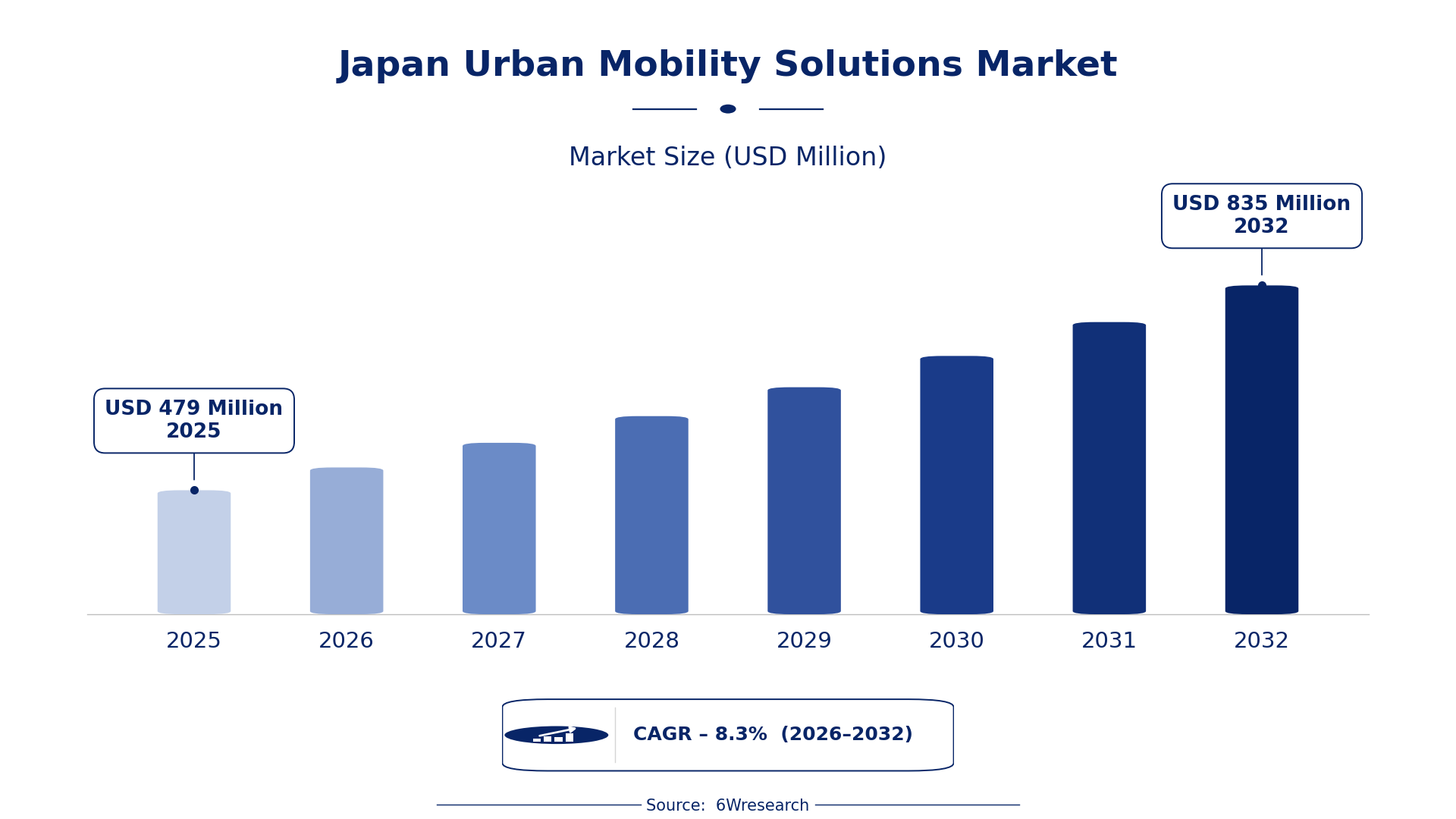
According to 6Wresearch internal database and industry insights, the Japan Urban Mobility Solutions Market was valued at USD 479 Million in 2025 and is projected to reach USD 835 Million by 2032, growing at a CAGR of approximately 8.3% during 2026–2032.
Japan Urban Mobility Solutions Market Highlights
| Report Metric | Details |
| Report Name | Japan Urban Mobility Solutions Market (2026-2032) |
| Market Size 2025 | USD 479 Million |
| Market Size 2032 | USD 835 Million |
| Absolute Growth 2025–2032 | USD 356 Million |
| CAGR 2026–2032 | 8.3% |
| Peak Annual Growth | 9.4% in 2028 |
| Forecast Period | 2026–2032 |
| Historical Data | 2022–2025 |
| Base Year | 2025 |
| Leading Solution Type, 2025 | Route Optimization (40% share) |
| Leading Platform Type, 2025 | App-Based (46% share) |
| Leading Deployment Model, 2025 | SaaS (36% share) |
| Leading End User, 2025 | Ride-Sharing Companies (49% share) |
| Fastest-Growing Solution Type | Fleet Management (11.8% CAGR) |
| Fastest-Growing Platform Type | Cloud-Based (11.9% CAGR) |
| Fastest-Growing Deployment Model | Hybrid (12.0% CAGR) |
| Fastest-Growing End User | Mobility-as-a-Service Firms (10.4% CAGR) |
| Growing Sector | Urban Mobility Solutions |
| Key End Users | Urban Consumers, Fleet Operators, Ride-Sharing Companies, Mobility-as-a-Service Firms |
Japan Urban Mobility Solutions Market Year-wise Growth Rate and Key Drivers (2022–2032)
This graph illustrates the annual growth rates of the market from 2022 to 2032, highlighting a steady upward trajectory and projected market expansion over the forecast period.
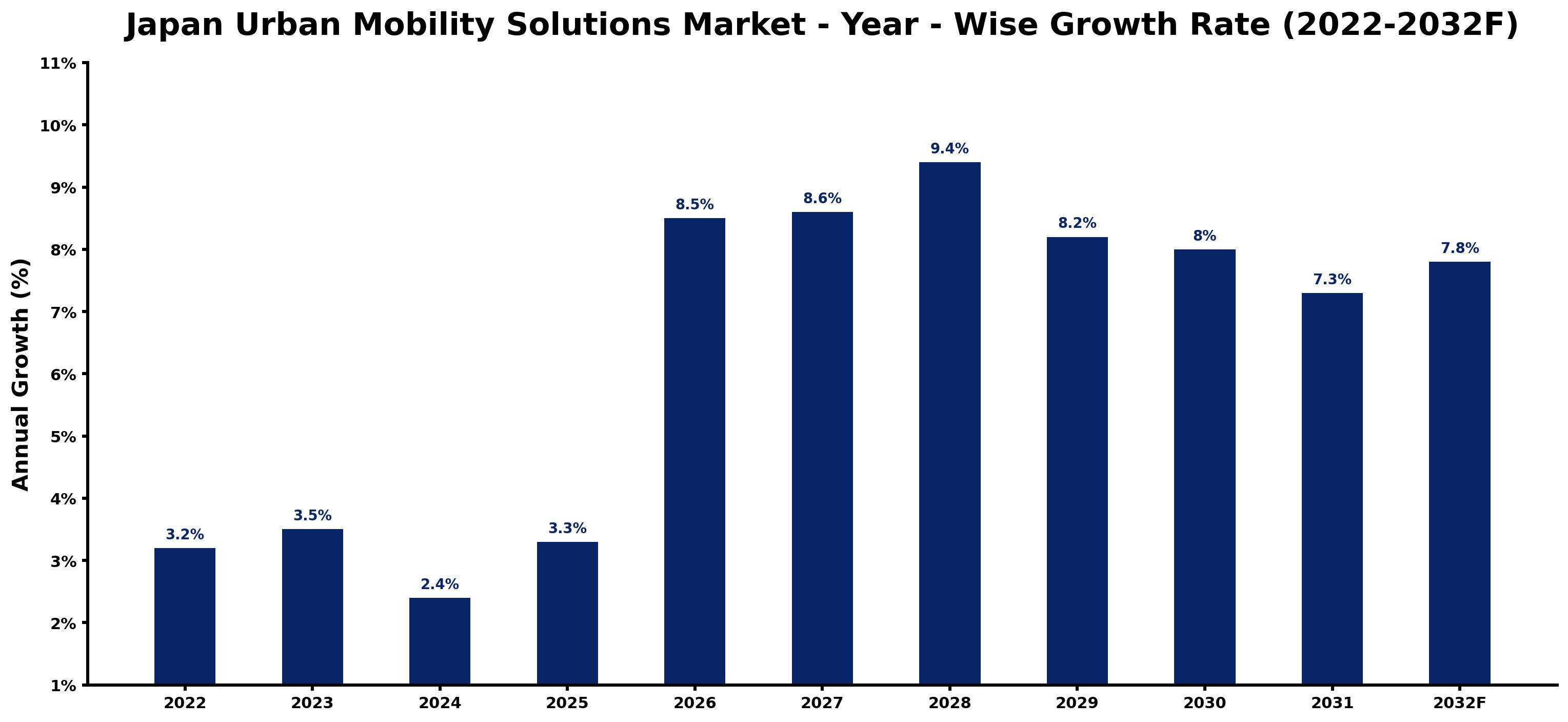
Below, each year's estimated growth is shown next to the factor that most influenced it.
| Year | Estimated Annual Growth (%) | Market Rationale |
| 2022 | 3.2 | The market experienced steady growth as urban mobility solutions gained traction among users. |
| 2023 | 3.5 | Demand increased due to heightened interest in sustainable transport solutions following the Tokyo 2020 Olympics. |
| 2024 | 2.4 | Growth slowed as market adjustments occurred after the initial surge in electric vehicle sales. |
| 2025 | 3.3 | The market rebounded with renewed investments in smart city initiatives and urban infrastructure. |
| 2026 | 8.5 | Rapid growth is anticipated as cloud-based solutions gain popularity among urban transport firms. |
| 2027 | 8.6 | Demand is expected to continue rising, driven by the increasing adoption of fleet management solutions. |
| 2028 | 9.4 | The market is projected to peak as urban consumers embrace app-based mobility solutions. |
| 2029 | 8.2 | Growth is expected to slow slightly as the market stabilises after reaching peak adoption rates. |
| 2030 | 8.0 | Demand is projected to remain strong, supported by ongoing investments in electric vehicle infrastructure. |
| 2031 | 7.3 | A slowdown is anticipated as market growth begins to normalise after previous peaks. |
| 2032 | 7.8 | Growth is expected to pick up again as new integrated transport services are introduced. |
Note: Market size estimations and growth projections presented in this report are based on 6Wresearch's proprietary forecasting methodology, utilizing the latest available industry data, government publications, and primary research inputs.
Japan Urban Mobility Solutions Market Synopsis
Urban Mobility Solutions encompass technologies and services aimed at improving transportation efficiency in cities. In Japan, the Japan Urban Mobility Solutions Market is flourishing, driven by a population of approximately 14 million in Tokyo and substantial investments in smart city initiatives. Factors such as the Act on Japanese Industrial Standards ensuring quality in electric vehicle charging and the ¥10 billion allocated for smart city initiatives are propelling market growth. As urban consumers increasingly adopt app-based solutions, the demand for effective mobility services is set to rise markedly.
Market Dynamics Impact Analysis (2026–2032)
| Factor | Type | Impact | Primary Segment Affected |
| Growing urban population and congestion in cities drive demand for efficient transport solutions. | Driver | High | Fleet Management |
| Increasing investment in electric vehicle infrastructure supports the adoption of urban mobility solutions. | Driver | High | EV Charging Integration |
| The rise of smart city initiatives presents opportunities for innovative mobility solutions. | Opportunity | High | Mobility-as-a-Service |
| Urban consumers are increasingly seeking integrated mobility services for convenience. | Opportunity | Medium | App-Based |
| High costs associated with implementing new technologies can limit adoption rates. | Restraint | Medium | Route Optimization |
| Regulatory challenges may hinder the rapid deployment of electric vehicle infrastructure. | Restraint | High | EV Charging Integration |
| Limited public awareness of new mobility solutions can slow market growth. | Challenge | Medium | Mobility-as-a-Service |
| Competition among various mobility service providers may lead to market saturation. | Challenge | High | Fleet Management |
Evaluation of Drivers in Japan Urban Mobility Solutions Market (2026–2032)
Demand rests on the following drivers, each shown with the segment it touches most.
| Drivers | Primary Segment Affected | Why It Matters (Evidence) |
| Increasing population density in urban areas drives demand for efficient fleet management solutions. | Fleet Management | Tokyo's population of approximately 14 million necessitates effective vehicle operations. |
| The growing number of electric vehicles requires extensive charging infrastructure to support usage. | EV Charging Integration | Over 1,000 charging stations in the Tokyo metropolitan area highlight this need. |
| The rise of smart city initiatives encourages investment in integrated mobility solutions. | Mobility-as-a-Service | The government allocated ¥10 billion for smart city initiatives in 2023. |
| The popularity of app-based solutions enhances user access to urban mobility services. | App-Based | 40% of urban consumers reported using app-based mobility solutions. |
| Cloud-based solutions are increasingly adopted to manage data and operations effectively. | Cloud-Based | 70% of urban transport firms are now utilising cloud-based solutions. |
Most of the extra volume comes from the increasing population density in urban areas, particularly in Tokyo, which has approximately 14 million residents. This density drives demand for efficient fleet management solutions, as over 50% of logistics companies in urban settings rely on these systems. The growing number of electric vehicles, with 30% of new vehicle sales being electric or hybrid in 2022, necessitates extensive charging infrastructure. Urban consumers are increasingly adopting app-based mobility solutions, with 40% usage reported, indicating a shift towards integrated transport services.
Evaluation of Restraints in Japan Urban Mobility Solutions Market
The main factors holding the market back are set out below.
| Market Restraint | Primary Segment Affected | Why It Matters (Evidence) |
| High costs associated with the implementation of new technologies can limit widespread adoption. | Route Optimization | Many urban transport firms face budget constraints when investing in advanced systems. |
| Regulatory challenges may hinder the rapid deployment of electric vehicle infrastructure. | EV Charging Integration | Compliance with national standards can slow down the installation of charging stations. |
| Limited public awareness of new mobility solutions can slow market growth. | Mobility-as-a-Service | Many potential users remain unaware of the benefits of integrated transport services. |
| Competition among various mobility service providers may lead to market saturation. | Fleet Management | An influx of new players can dilute market share and profitability for existing firms. |
| Consumer hesitance to switch from traditional transport modes can impede growth. | App-Based | Many urban consumers are accustomed to conventional transport methods. |
Japan Urban Mobility Solutions Market Challenges
Outdated infrastructure hampers technological integration, delaying the deployment of urban mobility solutions for municipalities. Buyers experience limited access to sustainable transport options, as only 30% of new vehicle sales are electric or hybrid, raising costs for consumers. Increased competition from international firms pressures local suppliers to lower prices, which erodes profit margins for producers. Cost constraints arise from the ¥10 billion allocated for smart city initiatives, diverting essential funds from urban mobility projects and extending timelines for local governments.
Trends in the Japan Urban Mobility Solutions Market
The following changes are redrawing the Japan Urban Mobility Solutions Market.
- Shift from Traditional to Integrated Mobility Solutions: In Japan, urban consumers are increasingly embracing integrated mobility solutions, with 40% of users adopting app-based services. This shift reflects a growing preference for convenience and efficiency in transportation.
- Transition from Conventional to Electric Vehicles: The rise in electric vehicle sales, with 30% of new vehicle sales in 2022 being electric or hybrid, indicates a transition towards sustainable transport solutions in urban areas.
- Emergence of Smart City Initiatives: The government allocated ¥10 billion for smart city initiatives in 2023, showcasing a commitment to improving urban mobility through technology and infrastructure investments.
- Prioritisation of Fleet Management Solutions: Fleet management solutions are increasingly prioritised by logistics companies, with over 50% of firms in urban areas adopting these systems to optimise operations.
Investment Opportunities in the Japan Urban Mobility Solutions Market
Below are the investment opportunities with the strongest case in the Japan Urban Mobility Solutions Market.
- Urban Consumers Seeking Sustainable Options: Urban consumers are increasingly looking for sustainable mobility solutions, with 30% of new vehicle sales being electric or hybrid in 2022. This trend creates opportunities for suppliers to invest in electric vehicle charging infrastructure, particularly in Tokyo, which has over 1,000 charging stations.
- Fleet Operators Adopting Advanced Management Tools: Fleet operators are adopting advanced fleet management solutions, which are used by over 50% of logistics companies in urban areas. The demand for efficient operations drives investment in software that optimises vehicle use and reduces costs.
- Ride-Sharing Companies Expanding Services: Ride-sharing companies are expanding their service offerings, with a growing reliance on app-based mobility solutions, which accounted for 46% of the platform type in 2025. This expansion presents opportunities for technology providers to enhance service integration.
- Government Initiatives Supporting Smart Cities: The government allocated ¥10 billion for smart city initiatives in 2023, creating a favourable environment for investments in urban mobility solutions. Companies can engage in partnerships with local governments to develop integrated transport services.
Government Initiatives in the Japan Urban Mobility Solutions Market
The Act on Japanese Industrial Standards governs the quality and safety of electric vehicle charging infrastructure, ensuring that producers meet national standards. This regulation affects buyers by providing assurance of quality and reliability in charging stations.
The Digital Agency oversees government efforts in digital transformation, approving projects that support urban mobility solutions. This agency's initiatives facilitate the development of integrated transport systems, benefiting both producers and consumers.
Future Insight of the Japan Urban Mobility Solutions Market
The introduction of integrated transport services in 2023 will transform urban mobility, providing suppliers with avenues for innovation. By 2025, the Tokyo Metropolitan Government aims to reduce traffic congestion by 25%, improving efficiency for logistics companies. Investment in IoT-enabled transport systems will modernise infrastructure, enhancing service delivery for urban users. A projected increase in electric vehicle adoption, with 40% of new vehicle sales expected to be electric or hybrid, will broaden options for buyers and stimulate market expansion.
Market Segmentation Analysis
Japan Urban Mobility Solutions Market report covers a detailed analysis of the following market segments:
By Solution Type – Route Optimization Leads, Fleet Management Expected to Grow Fastest
According to Saurav Kr Singh, Senior Research Analyst at 6Wresearch, the largest solution type category in 2025 was Route Optimization, at 40% of revenue. Route optimization holds the largest share due to its direct impact on improving travel efficiency and reducing congestion, which is crucial in densely populated regions like Tokyo. The need for effective route management is underscored by the city's population of around 14 million, driving demand for these solutions. Fleet Management is set to record the highest CAGR in this split, 11.8% over 2026–2032. Fleet management is experiencing rapid growth as logistics companies increasingly adopt these solutions to enhance vehicle operations in urban settings. With over 50% of logistics firms utilising fleet management tools, this trend indicates a strong push towards operational effectiveness. Suppliers should focus on developing fleet management solutions to cater to the growing needs of urban logistics.
By Platform Type – App-Based Leads, Cloud-Based Expected to Grow Fastest
App-Based took 46% of platform type revenue in 2025, more than any other category. App-based platforms dominate the market as they are directly used by consumers to access various mobility solutions, making them integral to urban transport. The increasing adoption of app-based services reflects changing consumer preferences in Japan's urban areas. The quickest growth will come from Cloud-Based, forecast to expand at a CAGR of 11.9% between 2026 and 2032. Cloud-based platforms are growing quickly because they provide essential data management and accessibility for mobility services, which is critical for urban transport efficiency. With 70% of urban transport firms adopting cloud solutions, this trend is set to continue. Buyers should consider investing in cloud-based platforms to improve data management capabilities in urban mobility.
By Deployment Model – SaaS Lead, Hybrid Expected to Grow Fastest
In 2025, SaaS led the deployment model split with a 36% share. SaaS is the leading deployment model as it offers scalable solutions that are essential for effective urban mobility management. This flexibility is particularly valuable for cities looking to adapt to changing transport needs. Over 2026–2032, Hybrid is expected to post the fastest growth, at a CAGR of 12.0%. The hybrid model is growing due to its applicability in specific cases where a combination of deployment strategies is beneficial. This model allows for tailored solutions that meet diverse urban mobility requirements. Suppliers should explore hybrid deployment options to cater to varied client needs in urban mobility.
By End User – Ride-Sharing Companies Lead, Mobility-as-a-Service Firms Expected to Grow Fastest
With 49% of end user revenue in 2025, Ride-Sharing Companies was the largest category. Ride-sharing companies lead the market as they directly implement urban mobility solutions to optimise their operations and improve service delivery. Their integral role in urban transport systems highlights their significance in this sector. Mobility-as-a-Service Firms are projected to grow fastest, at a CAGR of 10.4% during 2026–2032. Mobility-as-a-Service firms are rapidly gaining traction as primary users of integrated mobility solutions, indicating a shift towards more interconnected transport services. This growth reflects the increasing demand for seamless urban mobility options. Suppliers must align their offerings with the needs of mobility-as-a-Service firms to remain competitive in the market.
Key Attractiveness of the Report
- 10 Years of Market Numbers
- Historical Data Starting from 2022 to 2025
- Base Year 2025
- Forecast Data until 2032
- Key Performance Indicators Impacting the Market
- Major Upcoming Developments and Projects
Key Highlights of the Report:
- Japan Urban Mobility Solutions Market Outlook
- Market Size of Japan Urban Mobility Solutions Market, 2025
- Forecast of Japan Urban Mobility Solutions Market, 2032
- Historical Data and Forecast of Japan Urban Mobility Solutions Revenues & Volume for the Period 2022-2032F
- Japan Urban Mobility Solutions Market Trend Evolution
- Japan Urban Mobility Solutions Market Drivers and Challenges
- Japan Urban Mobility Solutions Price Trends
- Japan Urban Mobility Solutions Porter's Five Forces
- Japan Urban Mobility Solutions Industry Life Cycle
- Historical Data and Forecast of Japan Urban Mobility Solutions Market Revenues & Volume By Solution Type for the Period 2022-2032F
- Historical Data and Forecast of Japan Urban Mobility Solutions Market Revenues & Volume By Route Optimization for the Period 2022-2032F
- Historical Data and Forecast of Japan Urban Mobility Solutions Market Revenues & Volume By Fleet Management for the Period 2022-2032F
- Historical Data and Forecast of Japan Urban Mobility Solutions Market Revenues & Volume By Mobility-as-a-Service for the Period 2022-2032F
- Historical Data and Forecast of Japan Urban Mobility Solutions Market Revenues & Volume By EV Charging Integration for the Period 2022-2032F
- Historical Data and Forecast of Japan Urban Mobility Solutions Market Revenues & Volume By Platform Type for the Period 2022-2032F
- Historical Data and Forecast of Japan Urban Mobility Solutions Market Revenues & Volume By App-Based for the Period 2022-2032F
- Historical Data and Forecast of Japan Urban Mobility Solutions Market Revenues & Volume By Cloud-Based for the Period 2022-2032F
- Historical Data and Forecast of Japan Urban Mobility Solutions Market Revenues & Volume By Web & Mobile App for the Period 2022-2032F
- Historical Data and Forecast of Japan Urban Mobility Solutions Market Revenues & Volume By Charging Stations for the Period 2022-2032F
- Historical Data and Forecast of Japan Urban Mobility Solutions Market Revenues & Volume By Deployment Model for the Period 2022-2032F
- Historical Data and Forecast of Japan Urban Mobility Solutions Market Revenues & Volume By SaaS for the Period 2022-2032F
- Historical Data and Forecast of Japan Urban Mobility Solutions Market Revenues & Volume By Hybrid for the Period 2022-2032F
- Historical Data and Forecast of Japan Urban Mobility Solutions Market Revenues & Volume By Subscription for the Period 2022-2032F
- Historical Data and Forecast of Japan Urban Mobility Solutions Market Revenues & Volume By IoT-Enabled for the Period 2022-2032F
- Historical Data and Forecast of Japan Urban Mobility Solutions Market Revenues & Volume By End User for the Period 2022-2032F
- Historical Data and Forecast of Japan Urban Mobility Solutions Market Revenues & Volume By Ride-Sharing Companies for the Period 2022-2032F
- Historical Data and Forecast of Japan Urban Mobility Solutions Market Revenues & Volume By Mobility-as-a-Service Firms for the Period 2022-2032F
- Historical Data and Forecast of Japan Urban Mobility Solutions Market Revenues & Volume By Urban Consumers for the Period 2022-2032F
- Historical Data and Forecast of Japan Urban Mobility Solutions Market Revenues & Volume By Fleet Operators for the Period 2022-2032F
- Japan Urban Mobility Solutions Import Export Trade Statistics
- Market Opportunity Assessment By Solution Type
- Market Opportunity Assessment By Platform Type
- Market Opportunity Assessment By Deployment Model
- Market Opportunity Assessment By End User
- Japan Urban Mobility Solutions Top Companies Market Share
- Japan Urban Mobility Solutions Competitive Benchmarking By Technical and Operational Parameters
- Japan Urban Mobility Solutions Company Profiles
- Japan Urban Mobility Solutions Key Strategic Recommendations
Market Covered
The study includes the following segmentation.
By Solution Type
- Route Optimization
- Fleet Management
- Mobility-as-a-Service
- EV Charging Integration
By Platform Type
- App-Based
- Cloud-Based
- Web & Mobile App
- Charging Stations
By Deployment Model
- SaaS
- Hybrid
- Subscription
- IoT-Enabled
By End User
- Ride-Sharing Companies
- Mobility-as-a-Service Firms
- Urban Consumers
- Fleet Operators































