Japan Urban Parking Automation Market Size & Growth Rate
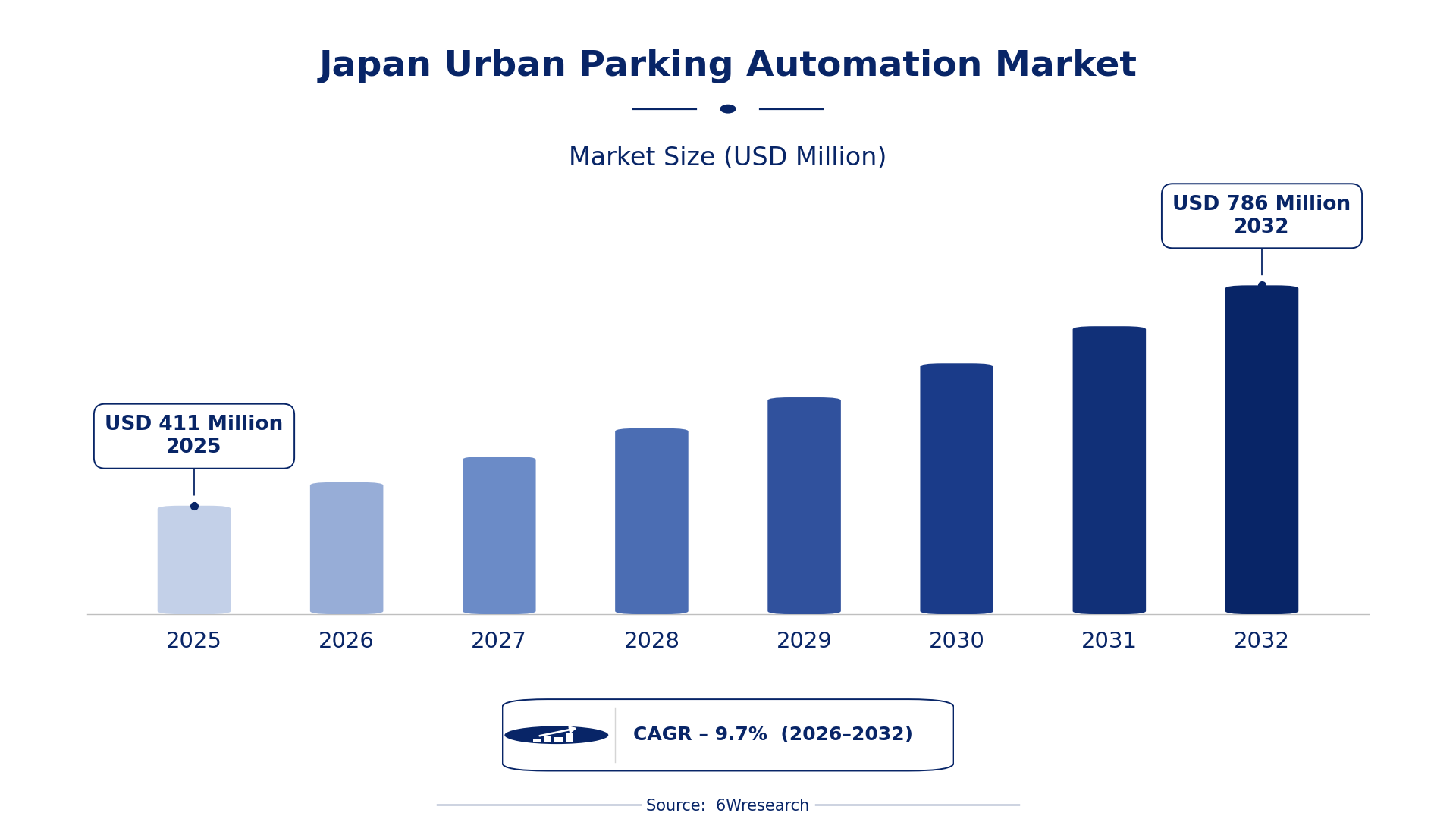
According to 6Wresearch internal database and industry insights, the Japan Urban Parking Automation Market was valued at USD 411 Million in 2025 and is projected to reach USD 786 Million by 2032, growing at a CAGR of approximately 9.7% during 2026–2032.
Japan Urban Parking Automation Market Highlights
| Report Metric | Details |
| Report Name | Japan Urban Parking Automation Market (2026-2032) |
| Market Size 2025 | USD 411 Million |
| Market Size 2032 | USD 786 Million |
| Absolute Growth 2025–2032 | USD 375 Million |
| CAGR 2026–2032 | 9.7% |
| Peak Annual Growth | 10.2% in 2028 |
| Forecast Period | 2026–2032 |
| Historical Data | 2022–2025 |
| Base Year | 2025 |
| Leading Parking Type, 2025 | Multi-Level Parking (46% share) |
| Leading Automation Type, 2025 | Fully Automated Systems (48% share) |
| Leading Technology Used, 2025 | Sensors + Robotics (47% share) |
| Leading End User, 2025 | Commercial Complexes (36% share) |
| Fastest-Growing Parking Type | Smart Meters (14.1% CAGR) |
| Fastest-Growing Automation Type | Self-Parking (13.8% CAGR) |
| Fastest-Growing Technology Used | AI Navigation (14.4% CAGR) |
| Growing Sector | Urban Parking Automation |
| Key End Users | Commercial Complexes, Municipal Corporations, Hotels & Airports, EV Users |
Japan Urban Parking Automation Market Year-wise Growth Rate and Key Drivers (2022–2032)
This graph illustrates the annual growth rates of the market from 2022 to 2032, highlighting a steady upward trajectory and projected market expansion over the forecast period.
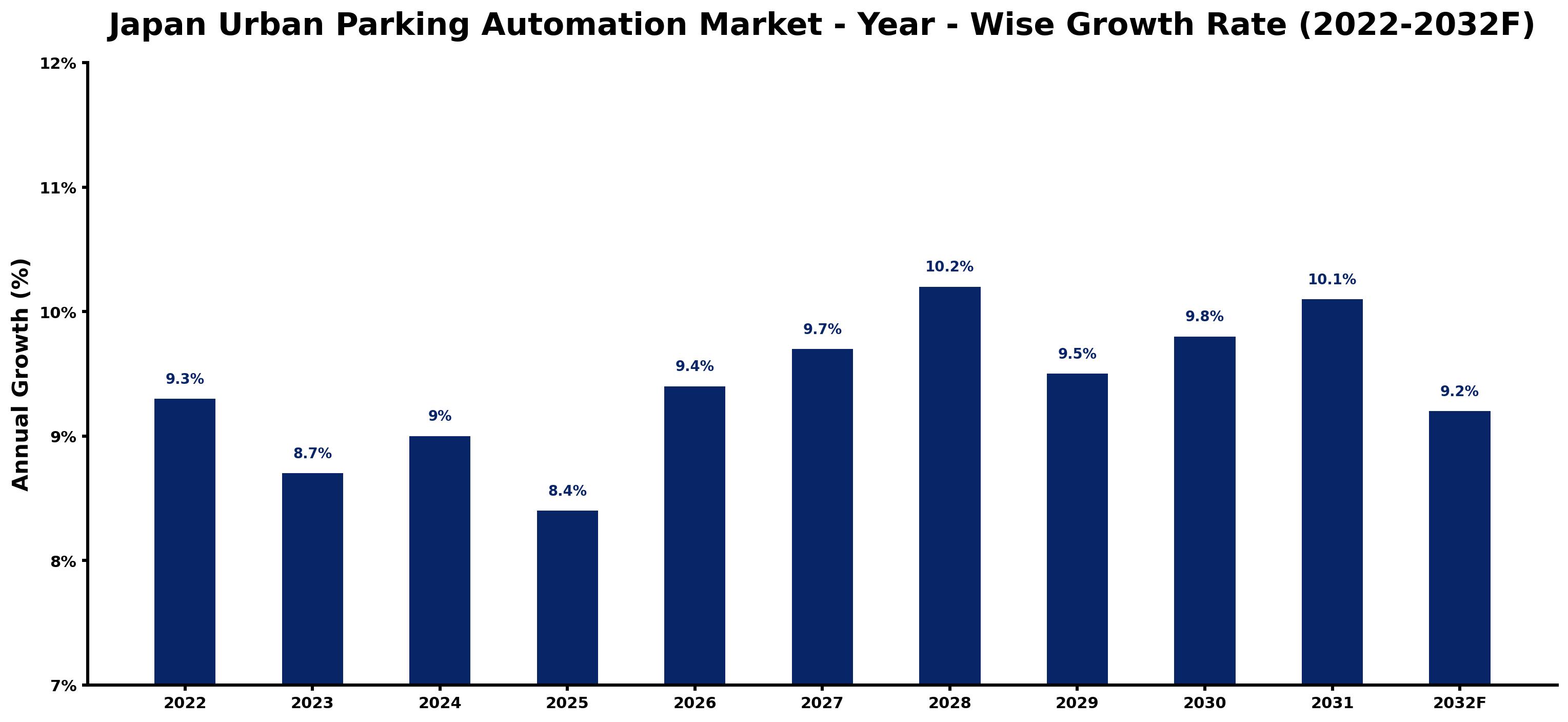
Each row of the following table gives one year's estimated growth and the event or demand shift that explains it.
| Year | Estimated Annual Growth (%) | Market Rationale |
| 2022 | 9.3 | The market experienced strong demand driven by urbanisation and smart city initiatives. |
| 2023 | 8.7 | Growth slowed due to market adjustments following a peak in 2022. |
| 2024 | 9.0 | Increased investments in automation technologies spurred faster growth compared to 2023. |
| 2025 | 8.4 | Market growth slowed due to saturation in some urban areas and increased competition. |
| 2026 | 9.4 | Growth is expected to accelerate as new smart parking projects launch in major cities. |
| 2027 | 9.7 | Rising demand for electric vehicle infrastructure is projected to support further growth. |
| 2028 | 10.2 | The market is expected to peak due to advancements in fully automated systems. |
| 2029 | 9.5 | Growth is projected to slow as market maturity sets in and competition intensifies. |
| 2030 | 9.8 | Increased adoption of AI navigation systems will boost market performance. |
| 2031 | 10.1 | The market is expected to rise as urban parking solutions become essential. |
| 2032 | 9.2 | Growth is projected to slow as the market stabilises after a period of rapid expansion. |
Note: Market size estimations and growth projections presented in this report are based on 6Wresearch's proprietary forecasting methodology, utilizing the latest available industry data, government publications, and primary research inputs.
Japan Urban Parking Automation Market Synopsis
Urban Parking Automation employs advanced technologies such as sensors, robotics, and IoT systems to optimise the use of parking spaces in urban settings. The Japan Urban Parking Automation Market is growing due to urbanisation and government initiatives that promote smart city technologies. By 2025, it is projected that 30% of parking spaces will be automated, reflecting the increasing demand for efficient parking solutions in Japan's densely populated cities.
Market Dynamics Impact Analysis (2026–2032)
| Factor | Type | Impact | Primary Segment Affected |
| Urbanisation drives the need for efficient parking solutions in densely populated areas. | Driver | High | Multi-Level Parking |
| Government initiatives promote smart city technologies, increasing investment in automation. | Driver | High | Fully Automated Systems |
| Growing demand for electric vehicles creates a need for more EV parking bays. | Opportunity | High | EV Parking Bays |
| The rise of commercial complexes necessitates advanced parking solutions for users. | Opportunity | High | Commercial Complexes |
| High installation costs of automated systems can deter smaller businesses from adopting. | Restraint | Medium | Valet Robots |
| Limited awareness among users about the benefits of smart parking technologies hampers adoption. | Restraint | Medium | Smart Meters |
| Competition among providers can lead to price wars, affecting profitability. | Challenge | High | Self-Parking |
| Technological integration challenges can delay project completion and increase costs. | Challenge | Medium | AI Navigation |
Evaluation of Drivers in Japan Urban Parking Automation Market (2026–2032)
Below are the drivers that matter most for revenue growth, with supporting evidence.
| Drivers | Primary Segment Affected | Why It Matters (Evidence) |
| Urbanisation increases demand for efficient parking solutions. | Multi-Level Parking | Tokyo, with over 14 million residents, has over 1,000 multi-level parking facilities to accommodate growing vehicle numbers. |
| Government initiatives promote smart city technologies, driving investment. | Fully Automated Systems | The Ministry of Land, Infrastructure, Transport and Tourism supports urban parking automation projects, approving initiatives that improve smart city infrastructure. |
| Rising electric vehicle adoption necessitates more EV parking bays. | EV Parking Bays | New commercial developments are mandated to include EV parking bays since 2021, increasing infrastructure availability. |
| Commercial complexes require advanced parking solutions to improve user experience. | Commercial Complexes | With 1,200 hotels and airports in Japan, demand for efficient parking solutions is significant. |
| Integration of AI navigation systems improves parking efficiency. | AI Navigation | AI navigation is being integrated into 60% of new parking projects, streamlining vehicle routing. |
Buyers are adding capacity as urbanisation increases the demand for efficient parking solutions, particularly in Tokyo, which has over 1,000 multi-level parking facilities. Investment in fully automated systems is rising, improving urban mobility. The need for EV parking bays has grown due to new mandates for commercial developments, supporting the expanding electric vehicle market. Commercial complexes, including hotels and airports, are seeking advanced parking solutions to enhance user experience. The integration of AI navigation systems into new projects is further boosting efficiency in urban parking.
Evaluation of Restraints in Japan Urban Parking Automation Market
The following restraints limit how fast demand can grow.
| Market Restraint | Primary Segment Affected | Why It Matters (Evidence) |
| High installation costs deter smaller businesses from adopting automated systems. | Valet Robots | The average cost of implementing a valet robot system can exceed JPY 10 million, limiting accessibility for small operators. |
| Limited awareness among users hampers the adoption of smart parking technologies. | Smart Meters | Despite 500,000 smart meter installations, many users remain unaware of their benefits, affecting uptake. |
| Technological integration challenges can delay project completion. | AI Navigation | Complexity in integrating AI systems into existing infrastructure can lead to project delays of up to six months. |
| Competition among providers can lead to price wars, affecting profitability. | Self-Parking | As more players enter the market, pricing pressure can reduce margins for existing providers. |
| Regulatory hurdles can complicate the deployment of new technologies. | EV Parking Bays | Compliance with local regulations can delay the installation of EV charging infrastructure. |
Japan Urban Parking Automation Market Challenges
In Tokyo, the average occupancy rate of parking spaces is 85%, resulting in supply shortages that frustrate drivers and complicate urban mobility. A lack of skilled workers in advanced technology hampers the implementation of urban parking automation, causing project delays that cost municipalities up to JPY 3 billion in lost efficiency. Intense competition among cities for smart parking investments leads to fragmented initiatives, confusing buyers and slowing adoption rates. Rapid technological advancements often outstrip existing regulatory frameworks, forcing suppliers to navigate outdated standards, which can delay project approvals and inflate costs for developers.
Trends in the Japan Urban Parking Automation Market
Buyers and suppliers in the Japan Urban Parking Automation Market are adjusting to the following trends.
- Shift towards Fully Automated Systems: The Tokyo Smart Parking Association promotes the adoption of fully automated systems, with projections indicating that 30% of parking spaces will be automated by 2025.
- Growth of EV Parking Bays: Since 2021, new commercial developments have mandated EV parking bays, reflecting a shift towards supporting electric vehicle infrastructure, with a target of 1 million charging stations by 2030.
- Increase in Smart Meter Installations: Urban areas have seen smart meter installations reach 500,000 units, improving real-time parking fee management and enhancing user experience.
- Integration of AI Navigation Systems: AI navigation systems are being integrated into 60% of new parking projects in urban areas, improving vehicle routing and parking efficiency.
Investment Opportunities in the Japan Urban Parking Automation Market
The opportunities below stand out in the Japan Urban Parking Automation Market for new entrants and existing suppliers.
- Partnerships for Smart Parking Solutions: Local governments are incentivising the installation of smart meters with subsidies, creating opportunities for partnerships in urban areas, with a funding amount of ¥3 billion in 2023.
- Commercial Complexes Seeking Advanced Solutions: With 1,200 hotels and airports requiring advanced parking solutions, suppliers can enter the market through joint ventures with local partners to improve service offerings.
- Gap in EV Charging Infrastructure: Japan aims to install 1 million EV charging stations by 2030, presenting an investment opportunity for technology providers in the EV sector.
- Supply of Valet Robot Systems: The deployment of over 200 valet robot systems in major cities indicates a growing need for automated vehicle handling solutions in busy locations.
Government Initiatives in the Japan Urban Parking Automation Market
The AI Promotion Act (2025) establishes a national framework for AI research and development, improving urban parking automation technologies. This law encourages innovation in AI applications, which is critical for enhancing parking efficiency and user experience.
The Ministry of Land, Infrastructure, Transport and Tourism funds urban parking automation projects, approving initiatives that support smart city infrastructure. In 2023, the government allocated ¥3 billion for smart city initiatives, aiding the development of advanced parking solutions.
Future Insight of the Japan Urban Parking Automation Market
Urban drivers will see a major shift as 30% of parking spaces are projected to be automated by 2025, driven by government support for smart city initiatives. Suppliers will encounter increased demand for advanced technologies, with AI navigation systems becoming standard in new projects. The target of installing 1 million EV charging stations by 2030 will significantly enhance the urban infrastructure. Local governments are incentivising smart meter installations through subsidies, creating opportunities for efficiency and innovation in space management.
Market Segmentation Analysis
Japan Urban Parking Automation Market report covers a detailed analysis of the following market segments:
By Parking Type – Multi-Level Parking Leads, Smart Meters Expected to Grow Fastest
According to Saurav Kr Singh, Senior Research Analyst at 6Wresearch, Multi-Level Parking held 46% of the Japan Urban Parking Automation Market by parking type in 2025. Multi-Level Parking holds the largest share as it provides efficient use of space in densely populated urban areas. For example, Tokyo's over 1,000 multi-level parking facilities effectively address the growing parking demand. Smart Meters are set to record the highest CAGR in this split, 14.1% over 2026–2032. Smart Meters are rapidly gaining traction as they enable real-time parking fee management, essential for optimising revenue in urban settings. The adoption rate of app-controlled parking systems, approximately 25%, reflects a trend towards smarter parking solutions. Suppliers should prioritise the development of smart meter technologies to satisfy the increasing demand for efficient parking management.
By Automation Type – Fully Automated Systems Lead, Self-Parking Expected to Grow Fastest
The largest automation type category in 2025 was Fully Automated Systems, at 48% of revenue. Fully Automated Systems lead this segment as they maximise space utilisation and reduce human error, making them particularly suitable for urban environments. Their widespread implementation aligns with government initiatives that advocate for smart city technologies. Self-Parking is projected to grow fastest, at a CAGR of 13.8% during 2026–2032. Self-Parking is experiencing rapid growth due to its convenience for users, making it a preferred choice for new parking projects. The integration of navigation systems into 60% of these projects further accelerates this trend. Buyers will gain advantages by investing in self-parking technologies to improve user experience and operational efficiency.
By Technology Used – Sensors + Robotics Lead, AI Navigation Expected to Grow Fastest
With 47% of technology used revenue in 2025, Sensors + Robotics was the largest category. Sensors + Robotics are the leading technology as they are essential for automation and efficiency in urban parking solutions. Their widespread use in over 70% of automated parking systems illustrates their importance. Over 2026–2032, AI Navigation is expected to post the fastest growth, at a CAGR of 14.4%. AI Navigation is rapidly becoming the fastest-growing technology because it improves vehicle routing and parking efficiency, addressing the challenges of urban congestion. With smart meter installations reaching 500,000 units, the demand for such technologies is clearly on the rise. Suppliers must prioritise advancements in AI navigation to stay competitive in the evolving urban parking automation market.
By End User – Commercial Complexes Lead and Record the Fastest Growth
Commercial Complexes took 36% of end user revenue in 2025, more than any other category. Commercial Complexes hold the largest share in this segment as they face high demand for efficient parking solutions, particularly in densely populated urban areas. These complexes require sophisticated parking systems to effectively manage the influx of visitors and ensure a smooth experience. Commercial Complexes are also forecast to expand faster than any other category, at a CAGR of 13.2% over 2026–2032. Commercial Complexes are also the fastest-growing end user segment because they are increasingly adopting advanced parking solutions to improve customer satisfaction. The growing urban population and limited parking availability further accelerate this trend. Suppliers must tailor their solutions to meet the unique requirements of commercial complexes to capitalise on this growth opportunity.
Key Attractiveness of the Report
- 10 Years of Market Numbers
- Historical Data Starting from 2022 to 2025
- Base Year 2025
- Forecast Data until 2032
- Key Performance Indicators Impacting the Market
- Major Upcoming Developments and Projects
Key Highlights of the Report:
- Japan Urban Parking Automation Market Outlook
- Market Size of Japan Urban Parking Automation Market, 2025
- Forecast of Japan Urban Parking Automation Market, 2032
- Historical Data and Forecast of Japan Urban Parking Automation Revenues & Volume for the Period 2022-2032F
- Japan Urban Parking Automation Market Trend Evolution
- Japan Urban Parking Automation Market Drivers and Challenges
- Japan Urban Parking Automation Price Trends
- Japan Urban Parking Automation Porter's Five Forces
- Japan Urban Parking Automation Industry Life Cycle
- Historical Data and Forecast of Japan Urban Parking Automation Market Revenues & Volume By Parking Type for the Period 2022-2032F
- Historical Data and Forecast of Japan Urban Parking Automation Market Revenues & Volume By Multi-Level Parking for the Period 2022-2032F
- Historical Data and Forecast of Japan Urban Parking Automation Market Revenues & Volume By Smart Meters for the Period 2022-2032F
- Historical Data and Forecast of Japan Urban Parking Automation Market Revenues & Volume By Valet Robots for the Period 2022-2032F
- Historical Data and Forecast of Japan Urban Parking Automation Market Revenues & Volume By EV Parking Bays for the Period 2022-2032F
- Historical Data and Forecast of Japan Urban Parking Automation Market Revenues & Volume By Automation Type for the Period 2022-2032F
- Historical Data and Forecast of Japan Urban Parking Automation Market Revenues & Volume By Fully Automated Systems for the Period 2022-2032F
- Historical Data and Forecast of Japan Urban Parking Automation Market Revenues & Volume By Partial Automation for the Period 2022-2032F
- Historical Data and Forecast of Japan Urban Parking Automation Market Revenues & Volume By Self-Parking for the Period 2022-2032F
- Historical Data and Forecast of Japan Urban Parking Automation Market Revenues & Volume By App-Controlled for the Period 2022-2032F
- Historical Data and Forecast of Japan Urban Parking Automation Market Revenues & Volume By Technology Used for the Period 2022-2032F
- Historical Data and Forecast of Japan Urban Parking Automation Market Revenues & Volume By Sensors + Robotics for the Period 2022-2032F
- Historical Data and Forecast of Japan Urban Parking Automation Market Revenues & Volume By IoT + Cloud Sync for the Period 2022-2032F
- Historical Data and Forecast of Japan Urban Parking Automation Market Revenues & Volume By AI Navigation for the Period 2022-2032F
- Historical Data and Forecast of Japan Urban Parking Automation Market Revenues & Volume By RFID + Smart Grid for the Period 2022-2032F
- Historical Data and Forecast of Japan Urban Parking Automation Market Revenues & Volume By End User for the Period 2022-2032F
- Historical Data and Forecast of Japan Urban Parking Automation Market Revenues & Volume By Commercial Complexes for the Period 2022-2032F
- Historical Data and Forecast of Japan Urban Parking Automation Market Revenues & Volume By Municipal Corporations for the Period 2022-2032F
- Historical Data and Forecast of Japan Urban Parking Automation Market Revenues & Volume By Hotels & Airports for the Period 2022-2032F
- Historical Data and Forecast of Japan Urban Parking Automation Market Revenues & Volume By EV Users for the Period 2022-2032F
- Japan Urban Parking Automation Import Export Trade Statistics
- Market Opportunity Assessment By Parking Type
- Market Opportunity Assessment By Automation Type
- Market Opportunity Assessment By Technology Used
- Market Opportunity Assessment By End User
- Japan Urban Parking Automation Top Companies Market Share
- Japan Urban Parking Automation Competitive Benchmarking By Technical and Operational Parameters
- Japan Urban Parking Automation Company Profiles
- Japan Urban Parking Automation Key Strategic Recommendations
Market Covered
The report covers the following segments.
By Parking Type
- Multi-Level Parking
- Smart Meters
- Valet Robots
- EV Parking Bays
By Automation Type
- Fully Automated Systems
- Partial Automation
- Self-Parking
- App-Controlled
By Technology Used
- Sensors + Robotics
- IoT + Cloud Sync
- AI Navigation
- RFID + Smart Grid
By End User
- Commercial Complexes
- Municipal Corporations
- Hotels & Airports
- EV Users































