Japan Urban Planning Technology Market Size & Growth Rate
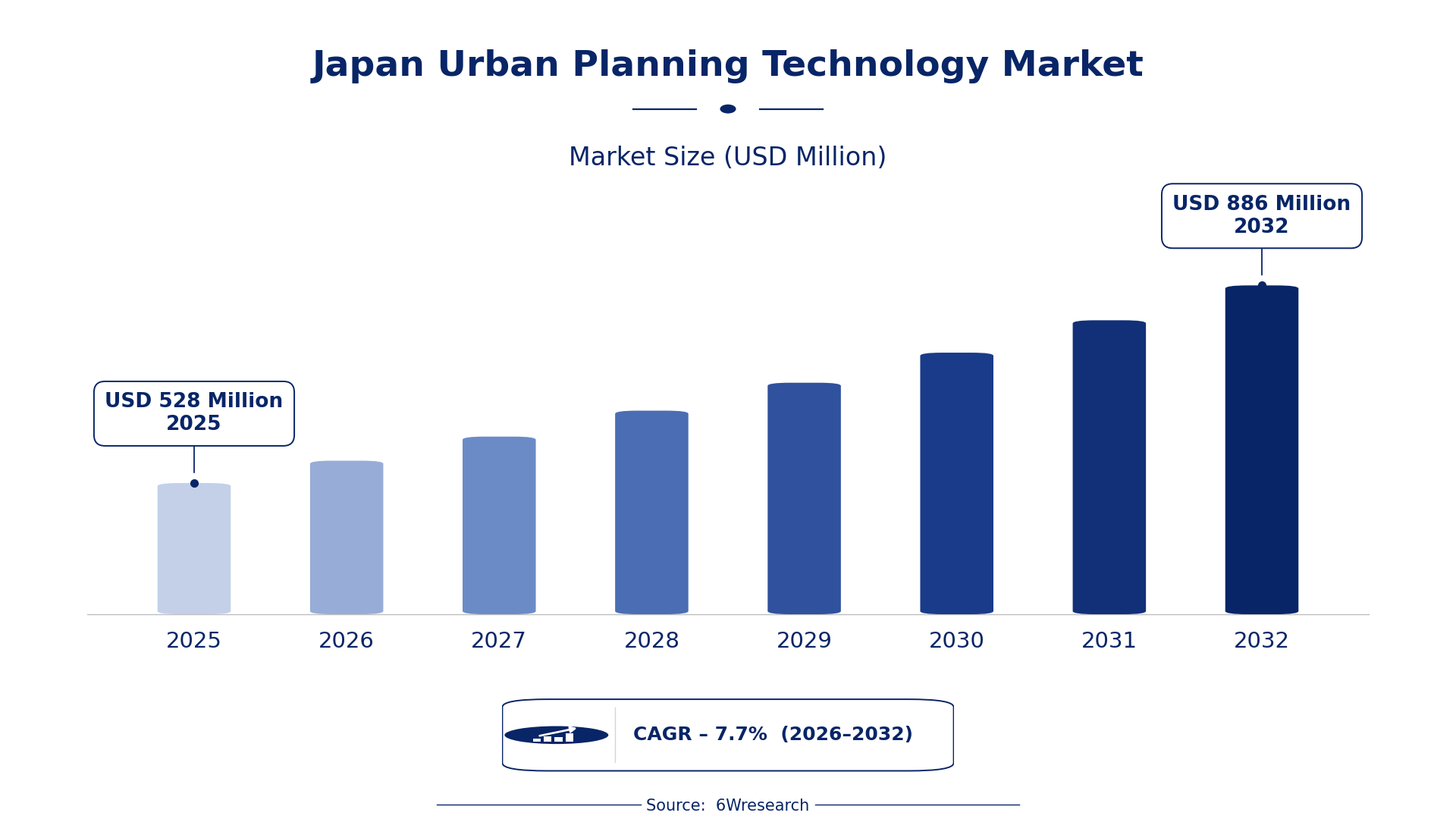
According to 6Wresearch internal database and industry insights, the Japan Urban Planning Technology Market was valued at USD 528 Million in 2025 and is projected to reach USD 886 Million by 2032, growing at a CAGR of approximately 7.7% during 2026–2032.
Japan Urban Planning Technology Market Highlights
| Report Metric | Details |
| Report Name | Japan Urban Planning Technology Market (2026-2032) |
| Market Size 2025 | USD 528 Million |
| Market Size 2032 | USD 886 Million |
| Absolute Growth 2025–2032 | USD 358 Million |
| CAGR 2026–2032 | 7.7% |
| Peak Annual Growth | 8.5% in 2032 |
| Forecast Period | 2026–2032 |
| Historical Data | 2022–2025 |
| Base Year | 2025 |
| Leading Planning Type, 2025 | 3D Urban Modeling (44% share) |
| Leading Tool Used, 2025 | BIM Software (42% share) |
| Leading Output Format, 2025 | 3D Simulation (41% share) |
| Leading End User, 2025 | City Architects (38% share) |
| Fastest-Growing Planning Type | Transport Simulation (11.0% CAGR) |
| Fastest-Growing Tool Used | AI-Driven Mobility Tools (10.4% CAGR) |
| Fastest-Growing Output Format | Predictive Traffic Maps (11.1% CAGR) |
| Fastest-Growing End User | Urban Designers (10.0% CAGR) |
| Growing Sector | Urban infrastructure development |
| Key End Users | Local Authorities, City Architects, Engineering Firms, Urban Designers |
Japan Urban Planning Technology Market Year-wise Growth Rate and Key Drivers (2022–2032)
This graph illustrates the annual growth rates of the market from 2022 to 2032, highlighting a steady upward trajectory and projected market expansion over the forecast period.
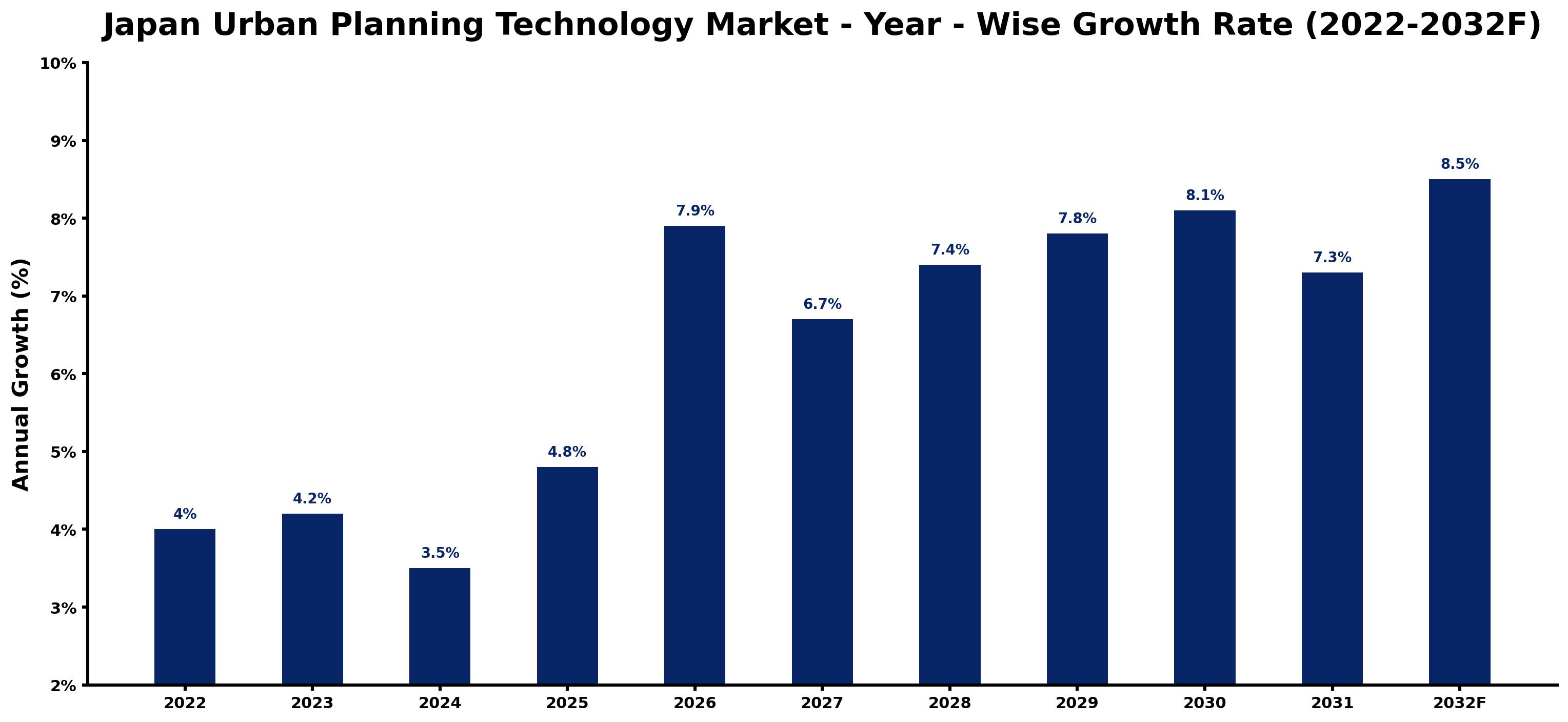
Year by year, the estimates below pair each growth rate with the development that shaped it.
| Year | Estimated Annual Growth (%) | Market Rationale |
| 2022 | 4.0 | The market demonstrated steady activity with a 4.0% growth rate. |
| 2023 | 4.2 | Growth accelerated due to increased urbanisation and infrastructure needs. |
| 2024 | 3.5 | A slowdown occurred as project completions reduced demand for new solutions. |
| 2025 | 4.8 | Demand surged as local authorities adopted advanced technologies for planning. |
| 2026 | 7.9 | Increased investment in smart city initiatives is expected to drive higher growth rates. |
| 2027 | 6.7 | A slight slowdown will follow as some projects reach completion. |
| 2028 | 7.4 | Growth will resume as urban planners seek new solutions for cities. |
| 2029 | 7.8 | Demand will continue to rise with the implementation of predictive traffic maps. |
| 2030 | 8.1 | The market will expand further as urban planning technologies gain traction. |
| 2031 | 7.3 | A slowdown will be noted as the market adjusts to prior growth levels. |
| 2032 | 8.5 | Demand will peak as urban planning technology becomes essential for cities. |
Note: Market size estimations and growth projections presented in this report are based on 6Wresearch's proprietary forecasting methodology, utilizing the latest available industry data, government publications, and primary research inputs.
Japan Urban Planning Technology Market Synopsis
Urban Planning Technology includes a range of tools and methodologies aimed at designing urban environments, primarily through software development and advanced technologies like GIS and BIM. The Japan Urban Planning Technology Market is growing as urbanisation accelerates, with local authorities increasingly adopting predictive traffic maps and GIS mapping to enhance city planning. Initiatives such as smart city projects in Osaka Prefecture and the Ministry of Land, Infrastructure, Transport and Tourism's new urban planning initiative are driving demand for practical solutions. In 2023, the government allocated funds for infrastructure design improvements, further expanding the market's potential.
Market Dynamics Impact Analysis (2026–2032)
| Factor | Type | Impact | Primary Segment Affected |
| Increased urbanisation in major cities | Driver | High | Transport Simulation |
| Growing investment in smart city projects | Driver | High | BIM Software |
| Need for efficient land-use planning | Opportunity | High | Land-Use Planning |
| Demand for sustainable urban development practices | Opportunity | High | Infrastructure Design |
| High competition among urban planning technology providers | Restraint | Medium | 3D Urban Modeling |
| Limited awareness of advanced planning tools | Restraint | Medium | GIS Mapping |
| Challenges in integrating new technologies | Challenge | High | CAD/BIM Integration |
| High costs associated with advanced software solutions | Challenge | Medium | AI-Driven Mobility Tools |
Evaluation of Drivers in Japan Urban Planning Technology Market (2026–2032)
The following drivers explain most of the expected growth.
| Drivers | Primary Segment Affected | Why It Matters (Evidence) |
| Urbanisation in Tokyo | Transport Simulation | Tokyo's over 13 million residents drive demand for traffic flow analysis tools, leading to increased purchases of transport simulation software. |
| Investment in smart city initiatives | BIM Software | Osaka Prefecture's smart city projects are boosting the adoption of BIM software for efficient urban planning. |
| Government funding for infrastructure improvements | Infrastructure Design | In 2023, allocated funds for urban infrastructure design improvements are increasing demand for related technologies. |
| Adoption of predictive traffic maps | GIS Mapping | Local authorities are increasingly using predictive traffic maps to improve city planning and traffic management. |
| Focus on sustainable urban development | Land-Use Planning | The Urban Renaissance Agency's promotion of sustainable practices is driving demand for land-use planning tools. |
What keeps demand rising is the urbanisation of cities, where high population densities require advanced transport simulation tools for effective traffic management. Increased investment in smart city projects is driving the adoption of BIM software, which improves urban planning efficiency. In 2023, funding for infrastructure improvements is projected to boost demand for design technologies. Authorities are using predictive traffic maps more frequently, resulting in higher purchases of GIS mapping tools. The promotion of sustainable practices is driving the need for efficient land-use planning solutions.
Evaluation of Restraints in Japan Urban Planning Technology Market
The table below lists the restraints and the evidence behind each.
| Market Restraint | Primary Segment Affected | Why It Matters (Evidence) |
| High competition among providers | 3D Urban Modeling | Intense competition in urban planning technology limits market share for individual providers, impacting pricing strategies. |
| Limited awareness of advanced tools | GIS Mapping | Many local authorities lack knowledge about the benefits of advanced GIS mapping, hindering adoption rates. |
| Integration challenges with existing systems | CAD/BIM Integration | Difficulties in integrating new CAD/BIM technologies with legacy systems can delay project timelines. |
| High costs of advanced software | AI-Driven Mobility Tools | The investment required for AI-driven tools can deter smaller municipalities from adopting these technologies. |
| Regulatory hurdles in technology adoption | BIM Software | Compliance with JIS Z 8401 standards complicates the implementation of new BIM software solutions. |
Japan Urban Planning Technology Market Challenges
Local firms encounter high costs due to fierce competition from advanced urban planning technologies, which compress profit margins for producers. Importers face software delivery delays stemming from supply chain issues, potentially extending project timelines for engineering firms by three months. Technology integration is slow, causing inefficiencies in urban infrastructure projects that can inflate costs by 20% for local authorities. Skills shortages in advanced software usage restrict the effectiveness of urban planning initiatives, resulting in potential project overruns that can exceed budgets by 15% for local governments.
Trends in the Japan Urban Planning Technology Market
Below are the shifts with the largest effect on the Japan Urban Planning Technology Market.
- City Architects Adopting Advanced Tools: City Architects are increasingly employing advanced urban planning technologies, holding a 38% share in 2025. This trend is evident in the adoption of BIM software, which enhances efficiency in urban design.
- Growth of Predictive Traffic Maps: Predictive traffic maps are gaining popularity among local authorities, projected to grow at an 11.1% CAGR. This trend arises from the need for improved traffic management in urban areas.
- Rise of Smart City Projects: Smart city projects initiated in Osaka Prefecture are driving the use of urban planning technology. With substantial investments, these projects are reshaping urban environments and boosting demand.
- Increased Focus on Sustainable Practices: Since 2023, there has been a heightened emphasis on sustainable urban development practices. Initiatives by the Urban Renaissance Agency are motivating local authorities to adopt new planning technologies.
Investment Opportunities in the Japan Urban Planning Technology Market
Where to invest in the Japan Urban Planning Technology Market: the main openings are set out below.
- Gap in Sustainable Urban Solutions: With Japan's urban population projected to grow, there is a gap for sustainable urban planning solutions. Local authorities need advanced tools to manage urban growth effectively.
- Demand from Local Authorities: Local authorities are increasingly seeking urban planning technologies to improve city management. Investing in GIS mapping tools can meet this rising demand effectively.
- Supply of Advanced Planning Software: There is a strong opportunity to supply advanced urban planning software solutions. Collaborating with local authorities can facilitate entry into the market.
- Entry through Joint Ventures: With the growing demand for urban planning technology, forming joint ventures with local firms can provide access to the market. This approach can enhance local expertise and market penetration.
Government Initiatives in the Japan Urban Planning Technology Market
The Industrial Standardization Act, amended in 2019, establishes product and test standards for urban planning technology. Compliance with JIS Z 8401 is required for producers, ensuring quality and safety in urban planning tools. This regulatory framework supports the development of dependable urban planning technologies that adhere to industry standards.
The Digital Agency, established in September 2021, spearheads the government's digital transformation efforts. It funds projects that enhance urban planning technologies, promoting innovation and efficiency in the sector. In 2023, the agency allocated over ¥30 billion for urban planning initiatives, directly benefiting local authorities and bolstering their capabilities.
Future Insight of the Japan Urban Planning Technology Market
By 2032, local authorities will increasingly employ advanced GIS mapping for urban infrastructure planning, improving decision-making processes. The government's urban planning initiative will stimulate investment in smart city projects, encouraging collaboration among various stakeholders. As BIM software adoption increases, suppliers will need to deliver integrated solutions to satisfy the rising demand for efficient urban development. Funding for infrastructure design improvements is projected to exceed ¥500 billion, strengthening urban planning capabilities across Japan.
Market Segmentation Analysis
Japan Urban Planning Technology Market report covers a detailed analysis of the following market segments:
By Planning Type – 3D Urban Modeling Leads, Transport Simulation Expected to Grow Fastest
According to Saurav Kr Singh, Senior Research Analyst at 6Wresearch, in 2025, 3D Urban Modeling led the planning type split with a 44% share. 3D Urban Modeling holds the largest share as it is essential for visualising urban designs, which aids city planners in making informed decisions. The extensive use of this technology by the Tokyo Metropolitan Government underscores its importance in enhancing urban development initiatives. The quickest growth will come from Transport Simulation, forecast to expand at a CAGR of 11.0% between 2026 and 2032. Transport Simulation is growing rapidly due to its critical role in analysing traffic flow, especially following the recent urban planning initiative by Japan's Ministry of Land, Infrastructure, Transport and Tourism. This focus on optimising transportation systems is expected to further drive demand for this technology. Suppliers should concentrate on enhancing transport simulation capabilities to align with the increasing demand from urban planners.
By Tool Used – BIM Software Leads, AI-Driven Mobility Tools Expected to Grow Fastest
With 42% of tool used revenue in 2025, BIM Software was the largest category. BIM Software is the leading tool as it is integral for building information modelling, which is vital in the construction sector. Its widespread adoption among local authorities and engineering firms solidifies its position in urban planning technology. Over 2026–2032, AI-Driven Mobility Tools are expected to post the fastest growth, at a CAGR of 10.4%. AI-Driven Mobility Tools are rapidly gaining traction as they support transportation planning, particularly in smart city initiatives like those in Osaka Prefecture. The increasing focus on efficiency in urban mobility is a key factor driving this segment's growth. Buyers should invest in AI-driven tools to improve urban mobility solutions and stay competitive.
By Output Format – 3D Simulation Leads, Predictive Traffic Maps Expected to Grow Fastest
3D Simulation took 41% of output format revenue in 2025, more than any other category. 3D Simulation is preferred for visualising urban projects, making it a popular choice among city planners. Its ability to create realistic visualisations enhances stakeholder engagement and supports effective decision-making processes. Predictive Traffic Maps are projected to grow fastest, at a CAGR of 11.1% during 2026–2032. Predictive Traffic Maps are vital for forecasting traffic patterns, which is increasingly important as urban areas expand. The reliance on data-driven insights for city planning is propelling the growth of this segment. Suppliers must prioritise the development of advanced predictive traffic mapping solutions to meet urban planning demands.
By End User – City Architects Lead, Urban Designers Expected to Grow Fastest
The largest end user category in 2025 was City Architects, at 38% of revenue. City Architects are the primary users of urban planning technology, directly influencing the design and implementation of urban projects. Their expertise in creating functional and aesthetic urban spaces drives the demand for advanced planning tools. Urban Designers are set to record the highest CAGR in this split, 10.0% over 2026–2032. Urban Designers are rapidly becoming key users for creating urban spaces, particularly as cities focus on sustainable development practices. Their role in shaping urban environments is expanding, leading to increased demand for specialised tools. Suppliers should tailor their offerings to meet the specific needs of urban designers to capture this growing market.
Key Attractiveness of the Report
- 10 Years of Market Numbers
- Historical Data Starting from 2022 to 2025
- Base Year 2025
- Forecast Data until 2032
- Key Performance Indicators Impacting the Market
- Major Upcoming Developments and Projects
Key Highlights of the Report:
- Japan Urban Planning Technology Market Outlook
- Market Size of Japan Urban Planning Technology Market, 2025
- Forecast of Japan Urban Planning Technology Market, 2032
- Historical Data and Forecast of Japan Urban Planning Technology Revenues & Volume for the Period 2022-2032F
- Japan Urban Planning Technology Market Trend Evolution
- Japan Urban Planning Technology Market Drivers and Challenges
- Japan Urban Planning Technology Price Trends
- Japan Urban Planning Technology Porter's Five Forces
- Japan Urban Planning Technology Industry Life Cycle
- Historical Data and Forecast of Japan Urban Planning Technology Market Revenues & Volume By Planning Type for the Period 2022-2032F
- Historical Data and Forecast of Japan Urban Planning Technology Market Revenues & Volume By 3D Urban Modeling for the Period 2022-2032F
- Historical Data and Forecast of Japan Urban Planning Technology Market Revenues & Volume By Transport Simulation for the Period 2022-2032F
- Historical Data and Forecast of Japan Urban Planning Technology Market Revenues & Volume By Land-Use Planning for the Period 2022-2032F
- Historical Data and Forecast of Japan Urban Planning Technology Market Revenues & Volume By Infrastructure Design for the Period 2022-2032F
- Historical Data and Forecast of Japan Urban Planning Technology Market Revenues & Volume By Tool Used for the Period 2022-2032F
- Historical Data and Forecast of Japan Urban Planning Technology Market Revenues & Volume By BIM Software for the Period 2022-2032F
- Historical Data and Forecast of Japan Urban Planning Technology Market Revenues & Volume By AI-Driven Mobility Tools for the Period 2022-2032F
- Historical Data and Forecast of Japan Urban Planning Technology Market Revenues & Volume By GIS Mapping for the Period 2022-2032F
- Historical Data and Forecast of Japan Urban Planning Technology Market Revenues & Volume By CAD/BIM Integration for the Period 2022-2032F
- Historical Data and Forecast of Japan Urban Planning Technology Market Revenues & Volume By Output Format for the Period 2022-2032F
- Historical Data and Forecast of Japan Urban Planning Technology Market Revenues & Volume By 3D Simulation for the Period 2022-2032F
- Historical Data and Forecast of Japan Urban Planning Technology Market Revenues & Volume By Predictive Traffic Maps for the Period 2022-2032F
- Historical Data and Forecast of Japan Urban Planning Technology Market Revenues & Volume By Zoning Reports for the Period 2022-2032F
- Historical Data and Forecast of Japan Urban Planning Technology Market Revenues & Volume By Infrastructure Blueprints for the Period 2022-2032F
- Historical Data and Forecast of Japan Urban Planning Technology Market Revenues & Volume By End User for the Period 2022-2032F
- Historical Data and Forecast of Japan Urban Planning Technology Market Revenues & Volume By City Architects for the Period 2022-2032F
- Historical Data and Forecast of Japan Urban Planning Technology Market Revenues & Volume By Urban Designers for the Period 2022-2032F
- Historical Data and Forecast of Japan Urban Planning Technology Market Revenues & Volume By Local Authorities for the Period 2022-2032F
- Historical Data and Forecast of Japan Urban Planning Technology Market Revenues & Volume By Engineering Firms for the Period 2022-2032F
- Japan Urban Planning Technology Import Export Trade Statistics
- Market Opportunity Assessment By Planning Type
- Market Opportunity Assessment By Tool Used
- Market Opportunity Assessment By Output Format
- Market Opportunity Assessment By End User
- Japan Urban Planning Technology Top Companies Market Share
- Japan Urban Planning Technology Competitive Benchmarking By Technical and Operational Parameters
- Japan Urban Planning Technology Company Profiles
- Japan Urban Planning Technology Key Strategic Recommendations
Market Covered
Coverage by segment is as follows.
By Planning Type
- 3D Urban Modeling
- Transport Simulation
- Land-Use Planning
- Infrastructure Design
By Tool Used
- BIM Software
- AI-Driven Mobility Tools
- GIS Mapping
- CAD/BIM Integration
By Output Format
- 3D Simulation
- Predictive Traffic Maps
- Zoning Reports
- Infrastructure Blueprints
By End User
- City Architects
- Urban Designers
- Local Authorities
- Engineering Firms































