Japan Urban Sanitation Automation Market Size & Growth Rate
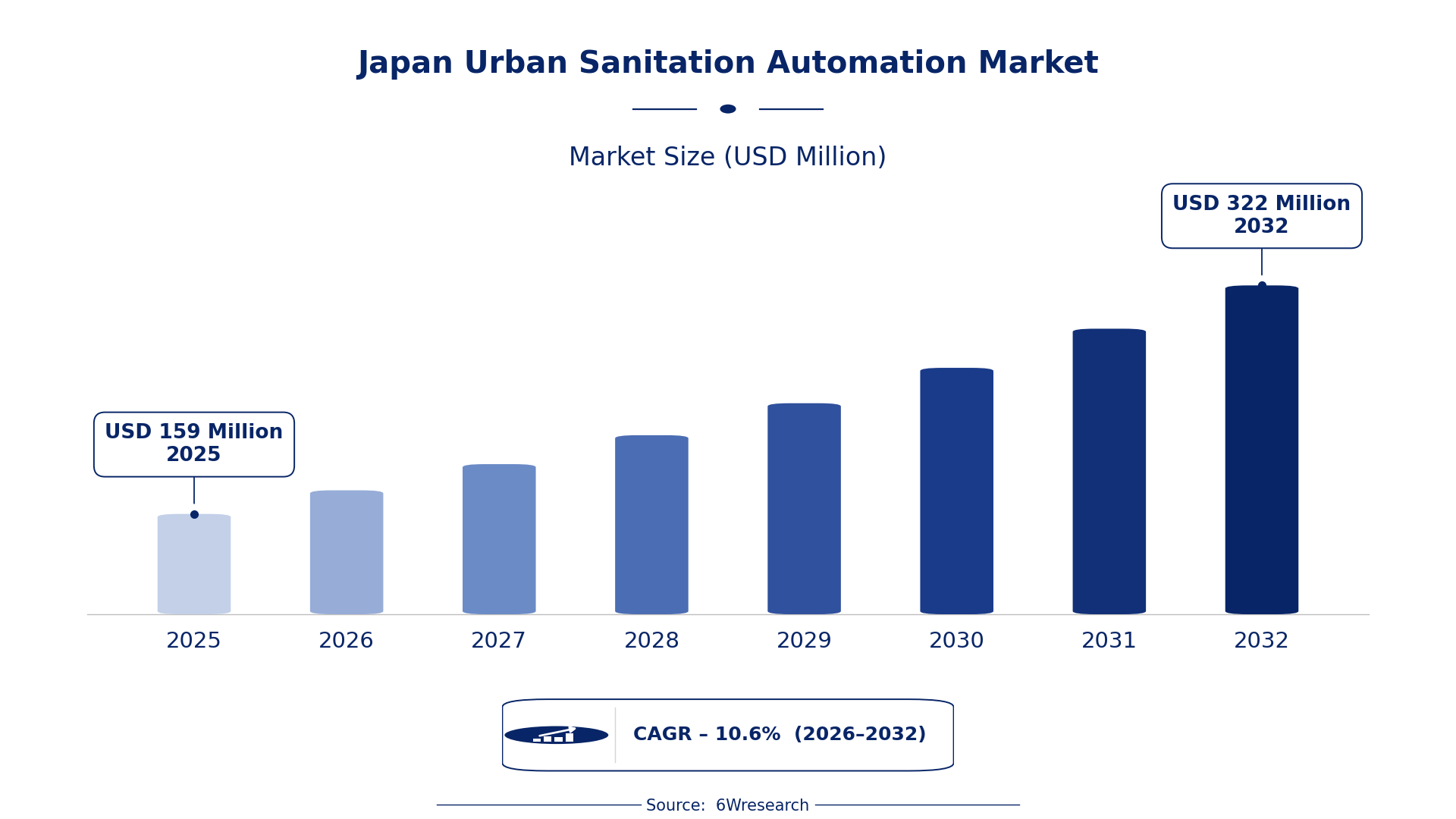
According to 6Wresearch internal database and industry insights, the Japan Urban Sanitation Automation Market was valued at USD 159 Million in 2025 and is projected to reach USD 322 Million by 2032, growing at a CAGR of approximately 10.6% during 2026–2032.
Japan Urban Sanitation Automation Market Highlights
| Report Metric | Details |
| Report Name | Japan Urban Sanitation Automation Market (2026-2032) |
| Market Size 2025 | USD 159 Million |
| Market Size 2032 | USD 322 Million |
| Absolute Growth 2025–2032 | USD 163 Million |
| CAGR 2026–2032 | 10.6% |
| Peak Annual Growth | 11.8% in 2028 |
| Forecast Period | 2026–2032 |
| Historical Data | 2022–2025 |
| Base Year | 2025 |
| Leading Sanitation Type, 2025 | Smart Waste Disposal (44% share) |
| Leading Technology Used, 2025 | IoT-Enabled Bins (48% share) |
| Leading Automation Level, 2025 | Full Automation (40% share) |
| Leading End User, 2025 | Municipal Bodies (37% share) |
| Fastest-Growing Sanitation Type | Robotic Sewer Cleaning (15.0% CAGR) |
| Fastest-Growing Technology Used | Vision + Robotics (15.1% CAGR) |
| Fastest-Growing Automation Level | Semi-Autonomous (14.1% CAGR) |
| Fastest-Growing End User | City Corporations (13.3% CAGR) |
| Growing Sector | Urban sanitation |
| Key End Users | Municipal Bodies, City Corporations, Public Health Departments |
Japan Urban Sanitation Automation Market Year-wise Growth Rate and Key Drivers (2022–2032)
This graph illustrates the annual growth rates of the market from 2022 to 2032, highlighting a steady upward trajectory and projected market expansion over the forecast period.
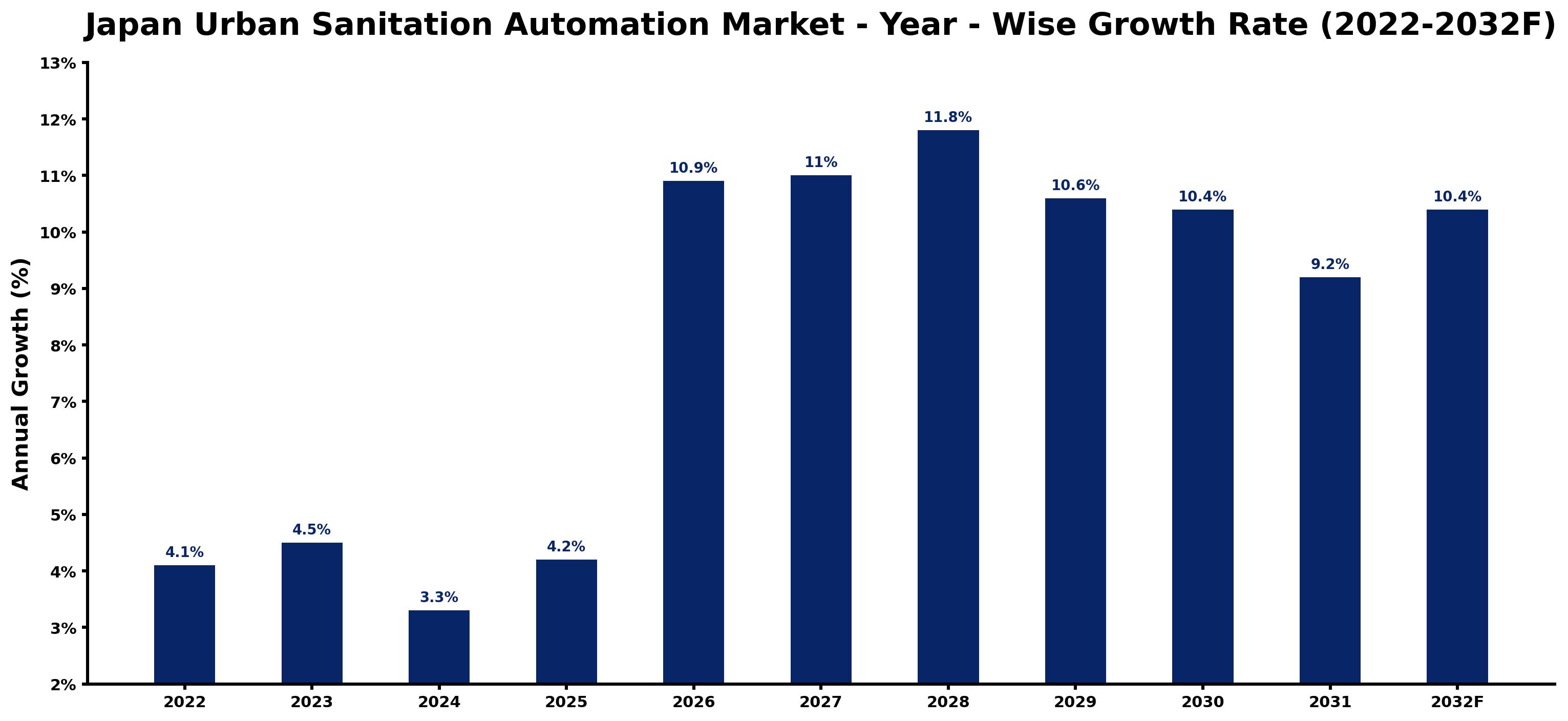
For each year, the table pairs the estimated growth rate with the leading influence on demand, showing how the drivers changed across the period.
| Year | Estimated Annual Growth (%) | Market Rationale |
| 2022 | 4.1 | The market experienced steady demand from municipal bodies focused on urban sanitation. |
| 2023 | 4.5 | Growth was driven by the initiation of smart waste disposal pilot programs in Tokyo. |
| 2024 | 3.3 | The market saw a slowdown due to adjustments in urban sanitation budgets. |
| 2025 | 4.2 | Increased investments in public toilet system upgrades contributed to market growth. |
| 2026 | 10.9 | Demand is expected to surge as cities adopt full automation in sanitation processes. |
| 2027 | 11.0 | The market will continue to grow with rising adoption of robotic sewer cleaning technologies. |
| 2028 | 11.8 | Peak growth is projected as urban planners integrate advanced sanitation solutions. |
| 2029 | 10.6 | A slight slowdown is expected as the market matures and competition intensifies. |
| 2030 | 10.4 | Growth will moderate as cities focus on maintaining existing sanitation infrastructure. |
| 2031 | 9.2 | The market is projected to continue expanding with ongoing investments in AI monitoring systems. |
| 2032 | 10.4 | Growth is expected to accelerate again with renewed focus on sustainable urban sanitation solutions. |
Note: Market size estimations and growth projections presented in this report are based on 6Wresearch's proprietary forecasting methodology, utilizing the latest available industry data, government publications, and primary research inputs.
Japan Urban Sanitation Automation Market Synopsis
Urban sanitation automation utilises advanced technologies such as IoT, robotics, and AI to improve waste management and public hygiene. The Japan Urban Sanitation Automation Market is primarily driven by municipal bodies and city corporations aiming to improve urban living standards. Growth in the market stems from increased investments in smart sanitation technologies, propelled by initiatives like the smart waste disposal pilot program in Tokyo and the goal for 100% automated public toilets by 2025, which together promote greater efficiency and sustainability in urban environments.
Market Dynamics Impact Analysis (2026–2032)
| Factor | Type | Impact | Primary Segment Affected |
| Increased urban population density drives demand for efficient waste management solutions. | Driver | High | Smart Waste Disposal |
| Technological advancements in robotics enhance sewer maintenance operations. | Driver | High | Robotic Sewer Cleaning |
| Growing public health awareness creates opportunities for improved sanitation systems. | Opportunity | High | Public Toilet Systems |
| Investment in smart sanitation technologies is rising due to urban planning initiatives. | Opportunity | High | IoT-Enabled Bins |
| Budget constraints limit the implementation of advanced sanitation technologies. | Restraint | Medium | AI Monitoring Systems |
| Regulatory compliance can delay the adoption of new sanitation solutions. | Restraint | Medium | Vision + Robotics |
| Competition among local governments can hinder collaboration on sanitation projects. | Challenge | Medium | Municipal Bodies |
| Technological integration challenges may slow down the adoption of automation. | Challenge | Medium | Full Automation |
Evaluation of Drivers in Japan Urban Sanitation Automation Market (2026–2032)
Demand rests on the following drivers, each shown with the segment it touches most.
| Drivers | Primary Segment Affected | Why It Matters (Evidence) |
| Rising urban populations | Smart Waste Disposal | Tokyo's 13 million residents demand efficient waste management solutions, increasing the need for smart waste disposal technologies. |
| Investment in robotic sewer cleaning | Robotic Sewer Cleaning | Osaka's investment enhances infrastructure maintenance, leading to higher demand for robotic cleaning solutions. |
| Public health initiatives | AI Monitoring Systems | Public health departments focus on real-time data collection, driving the adoption of AI monitoring systems for improved sanitation. |
| Integration of smart sanitation technologies | Public Toilet Systems | Urban planners are incorporating advanced sanitation solutions, boosting demand for automated public toilet systems. |
| Collaboration with tech firms | IoT-Enabled Bins | Local governments partner with technology firms to develop IoT-enabled bins, enhancing waste management efficiency. |
Volumes grow on the back of rising urban populations, with Tokyo's 13 million residents demanding efficient waste management solutions. Urban planners are increasingly focusing on integrating smart sanitation technologies, facilitating effective waste management practices. AI monitoring systems are promoted for providing real-time data, aiding decision-making in urban sanitation. These factors significantly boost the market as cities strive for improved living standards.
Evaluation of Restraints in Japan Urban Sanitation Automation Market
The key brakes on demand, and where they bite hardest, are shown below.
| Market Restraint | Primary Segment Affected | Why It Matters (Evidence) |
| Outdated waste management systems | Smart Waste Disposal | Urban residents face inefficiencies due to outdated systems, delaying necessary upgrades and impacting public hygiene. |
| Rising operational costs | Robotic Sewer Cleaning | Producers struggle with increased costs as Japan's minimum wage rises, pressuring budgets for sanitation improvements. |
| Compliance with JIS Z 9901 standards | AI Monitoring Systems | Regulatory hurdles from compliance extend project timelines and inflate costs for producers implementing AI solutions. |
| Technology advancements outpacing infrastructure | Public Toilet Systems | Rapid technology advancements complicate effective waste disposal solutions, increasing maintenance costs for local governments. |
| Increased maintenance costs | IoT-Enabled Bins | Local governments face higher maintenance costs due to the complexity of integrating smart sanitation technologies. |
Japan Urban Sanitation Automation Market Challenges
Urban residents encounter inefficiencies due to outdated waste management systems, delaying necessary upgrades and affecting public hygiene. Producers face rising operational costs as Japan's minimum wage increased to JPY 1,055 per hour, straining budgets for sanitation improvements. Compliance with standards like JIS Z 9901 presents regulatory hurdles, extending project timelines and inflating costs for producers. Technology advancements outpace infrastructure adaptation, complicating effective waste disposal solutions and leading to increased maintenance costs for local governments.
Trends in the Japan Urban Sanitation Automation Market
The shifts below are changing how Japan Urban Sanitation Automation Market products are bought and supplied.
- Shift towards Smart Waste Management Solutions: In 2023, Tokyo initiated a smart waste disposal pilot program, aiming to improve waste collection efficiency for over 13 million residents. This initiative reflects a broader trend towards integrating technology in urban sanitation, enhancing operational effectiveness.
- Transition to Fully Automated Public Toilets: The Tokyo Metropolitan Government aims for 100% automated public toilets by 2025, marking a shift in urban sanitation. This change is driven by the need for improved hygiene and accessibility for millions of users in the city.
- Emergence of AI in Urban Sanitation: AI monitoring systems are increasingly adopted for urban sanitation, with public health departments using real-time data to inform health policies. This trend is evident as cities focus on enhancing urban living conditions through technology.
- Growing Adoption of IoT-Enabled Bins: The Kanto region leads in the adoption of IoT-enabled bins, facilitating smart waste collection and monitoring. This trend supports efficient waste management practices, with local governments investing in innovative technology.
Investment Opportunities in the Japan Urban Sanitation Automation Market
Where to invest in the Japan Urban Sanitation Automation Market: the main openings are set out below.
- Investment in Smart Waste Disposal Technologies: With the Tokyo pilot program underway, now is an opportune moment to invest in smart waste disposal solutions. Municipal bodies are actively seeking technologies to improve waste management efficiency, creating opportunities for local partnerships and innovation.
- Supply of Robotic Sewer Cleaning Solutions: As Osaka invests in robotic sewer cleaning technologies, demand for advanced solutions is on the rise. Suppliers can enter this market by collaborating with local governments to provide tailored services that meet specific needs.
- Development of AI Monitoring Systems: The increasing focus on public health data analytics presents an opportunity to supply AI monitoring systems. Urban planners and public health departments are seeking solutions that improve decision-making and urban living standards, driving demand for technology.
- Enhancement of Public Toilet Systems: The push for upgraded public toilet systems in urban areas creates a demand for innovative solutions. Local governments are looking for partners to develop accessible and hygienic facilities, providing a clear entry route for suppliers.
Government Initiatives in the Japan Urban Sanitation Automation Market
The New Robot Strategy, established in 2015, aims to expand the use of robotics across various sectors, including urban sanitation automation. This policy framework encourages the integration of advanced technologies in waste management, promoting efficiency and sustainability in urban environments. The GX Promotion Act of 2023 further supports these initiatives by establishing a legal basis for decarbonisation efforts, targeting investments in smart sanitation technologies over the next decade.
Local governments utilise the AI Promotion Act, enacted in 2025, to implement AI monitoring systems in urban sanitation. This act provides a framework for AI research and development, enabling municipalities to improve public health monitoring. Additionally, the Japan Environmental Management Association oversees sanitation technology standards, ensuring compliance and promoting innovation in urban sanitation solutions.
Future Insight of the Japan Urban Sanitation Automation Market
The rollout of automated public toilets in Kyoto will set a precedent for urban sanitation improvements. By 2032, the adoption of smart sanitation technologies will streamline waste management, with Kanto region's IoT-enabled bins projected to cut operational costs by 30%. Osaka's investment in robotic sewer cleaning will simplify infrastructure upkeep, benefiting local authorities. Collaboration between local governments and technology firms will drive the development of innovative sanitation solutions, enhancing urban living standards across Japan.
Market Segmentation Analysis
Japan Urban Sanitation Automation Market report covers a detailed analysis of the following market segments:
By Sanitation Type – Smart Waste Disposal Leads, Robotic Sewer Cleaning Expected to Grow Fastest
According to Saurav Kr Singh, Senior Research Analyst at 6Wresearch, in 2025, Smart Waste Disposal led the sanitation type split with a 44% share. Smart waste disposal holds the largest share due to its critical role in efficient waste management, especially in densely populated areas like Tokyo. The implementation of smart bins by municipal authorities is a key factor in enhancing urban sanitation. Over 2026–2032, Robotic Sewer Cleaning is expected to post the fastest growth, at a CAGR of 15.0%. Robotic sewer cleaning is experiencing rapid growth, particularly as cities like Osaka invest in advanced technologies to maintain their sewer systems. This segment's expansion is driven by the increasing need for efficient infrastructure maintenance solutions in urban settings. Suppliers should prioritise the development of robotic technologies to meet the rising demand from municipalities.
By Technology Used – IoT-Enabled Bins Lead, Vision + Robotics Expected to Grow Fastest
The largest technology used category in 2025 was IoT-Enabled Bins, at 48% of revenue. IoT-enabled bins dominate the market as they provide essential capabilities for effective waste collection and monitoring, allowing municipalities to optimise their sanitation strategies. Their adoption in regions such as Kanto illustrates their importance in urban waste management. The quickest growth will come from Vision + Robotics, forecast to expand at a CAGR of 15.1% between 2026 and 2032. Vision and robotics technology is on the rise, fuelled by the increasing demand for automated inspection and cleaning in urban environments. As cities strive for improved operational efficiency, this technology is becoming vital for sanitation operations. Buyers should invest in IoT-enabled solutions to enhance waste management efficiency and lower operational costs.
By Automation Level – Full Automation Leads, Semi-Autonomous Expected to Grow Fastest
Full Automation took 40% of automation level revenue in 2025, more than any other category. Full automation leads the market as it maximises operational efficiency in sanitation, streamlining waste management processes in urban areas. This approach is particularly beneficial for municipalities aiming to achieve sustainability goals by 2025. Semi-Autonomous is set to record the highest CAGR in this split, 14.1% over 2026–2032. Semi-autonomous systems are gaining traction as they assist human operators in sanitation tasks, making them ideal for urban areas with limited resources. This trend indicates a shift towards more flexible sanitation solutions that improve workforce productivity. Suppliers should focus on developing semi-autonomous technologies to address the changing requirements of urban sanitation operations.
By End User – Municipal Bodies Lead, City Corporations Expected to Grow Fastest
Municipal Bodies held 37% of the Japan Urban Sanitation Automation Market by end user in 2025. Municipal bodies are the primary users of sanitation automation technologies, responsible for maintaining public hygiene and waste management in urban areas. Their significant investments in smart sanitation solutions underscore their pivotal role in this market. City Corporations are projected to grow fastest, at a CAGR of 13.3% during 2026–2032. City corporations are rapidly adopting sanitation solutions to improve urban management, motivated by the need to enhance public health and environmental standards. Their proactive approach to integrating advanced technologies is driving growth in this segment. Suppliers should customise their offerings to align with the specific needs of city corporations, ensuring they support urban management objectives.
Key Attractiveness of the Report
- 10 Years of Market Numbers
- Historical Data Starting from 2022 to 2025
- Base Year 2025
- Forecast Data until 2032
- Key Performance Indicators Impacting the Market
- Major Upcoming Developments and Projects
Key Highlights of the Report:
- Japan Urban Sanitation Automation Market Outlook
- Market Size of Japan Urban Sanitation Automation Market, 2025
- Forecast of Japan Urban Sanitation Automation Market, 2032
- Historical Data and Forecast of Japan Urban Sanitation Automation Revenues & Volume for the Period 2022-2032F
- Japan Urban Sanitation Automation Market Trend Evolution
- Japan Urban Sanitation Automation Market Drivers and Challenges
- Japan Urban Sanitation Automation Price Trends
- Japan Urban Sanitation Automation Porter's Five Forces
- Japan Urban Sanitation Automation Industry Life Cycle
- Historical Data and Forecast of Japan Urban Sanitation Automation Market Revenues & Volume By Sanitation Type for the Period 2022-2032F
- Historical Data and Forecast of Japan Urban Sanitation Automation Market Revenues & Volume By Smart Waste Disposal for the Period 2022-2032F
- Historical Data and Forecast of Japan Urban Sanitation Automation Market Revenues & Volume By Robotic Sewer Cleaning for the Period 2022-2032F
- Historical Data and Forecast of Japan Urban Sanitation Automation Market Revenues & Volume By AI Monitoring Systems for the Period 2022-2032F
- Historical Data and Forecast of Japan Urban Sanitation Automation Market Revenues & Volume By Public Toilet Systems for the Period 2022-2032F
- Historical Data and Forecast of Japan Urban Sanitation Automation Market Revenues & Volume By Technology Used for the Period 2022-2032F
- Historical Data and Forecast of Japan Urban Sanitation Automation Market Revenues & Volume By IoT-Enabled Bins for the Period 2022-2032F
- Historical Data and Forecast of Japan Urban Sanitation Automation Market Revenues & Volume By Vision + Robotics for the Period 2022-2032F
- Historical Data and Forecast of Japan Urban Sanitation Automation Market Revenues & Volume By Air Quality + Garbage Sensors for the Period 2022-2032F
- Historical Data and Forecast of Japan Urban Sanitation Automation Market Revenues & Volume By Auto Flush/Touchless Ops for the Period 2022-2032F
- Historical Data and Forecast of Japan Urban Sanitation Automation Market Revenues & Volume By Automation Level for the Period 2022-2032F
- Historical Data and Forecast of Japan Urban Sanitation Automation Market Revenues & Volume By Full Automation for the Period 2022-2032F
- Historical Data and Forecast of Japan Urban Sanitation Automation Market Revenues & Volume By Semi-Autonomous for the Period 2022-2032F
- Historical Data and Forecast of Japan Urban Sanitation Automation Market Revenues & Volume By Real-Time for the Period 2022-2032F
- Historical Data and Forecast of Japan Urban Sanitation Automation Market Revenues & Volume By Smart Interface for the Period 2022-2032F
- Historical Data and Forecast of Japan Urban Sanitation Automation Market Revenues & Volume By End User for the Period 2022-2032F
- Historical Data and Forecast of Japan Urban Sanitation Automation Market Revenues & Volume By Municipal Bodies for the Period 2022-2032F
- Historical Data and Forecast of Japan Urban Sanitation Automation Market Revenues & Volume By City Corporations for the Period 2022-2032F
- Historical Data and Forecast of Japan Urban Sanitation Automation Market Revenues & Volume By Public Health Dept. for the Period 2022-2032F
- Historical Data and Forecast of Japan Urban Sanitation Automation Market Revenues & Volume By Urban Planners for the Period 2022-2032F
- Japan Urban Sanitation Automation Import Export Trade Statistics
- Market Opportunity Assessment By Sanitation Type
- Market Opportunity Assessment By Technology Used
- Market Opportunity Assessment By Automation Level
- Market Opportunity Assessment By End User
- Japan Urban Sanitation Automation Top Companies Market Share
- Japan Urban Sanitation Automation Competitive Benchmarking By Technical and Operational Parameters
- Japan Urban Sanitation Automation Company Profiles
- Japan Urban Sanitation Automation Key Strategic Recommendations
Market Covered
This report examines the market across the segments below.
By Sanitation Type
- Smart Waste Disposal
- Robotic Sewer Cleaning
- AI Monitoring Systems
- Public Toilet Systems
By Technology Used
- IoT-Enabled Bins
- Vision + Robotics
- Air Quality + Garbage Sensors
- Auto Flush/Touchless Ops
By Automation Level
- Full Automation
- Semi-Autonomous
- Real-Time
- Smart Interface
By End User
- Municipal Bodies
- City Corporations
- Public Health Dept.
- Urban Planners































