Japan Urban Transport Automation Market Size & Growth Rate
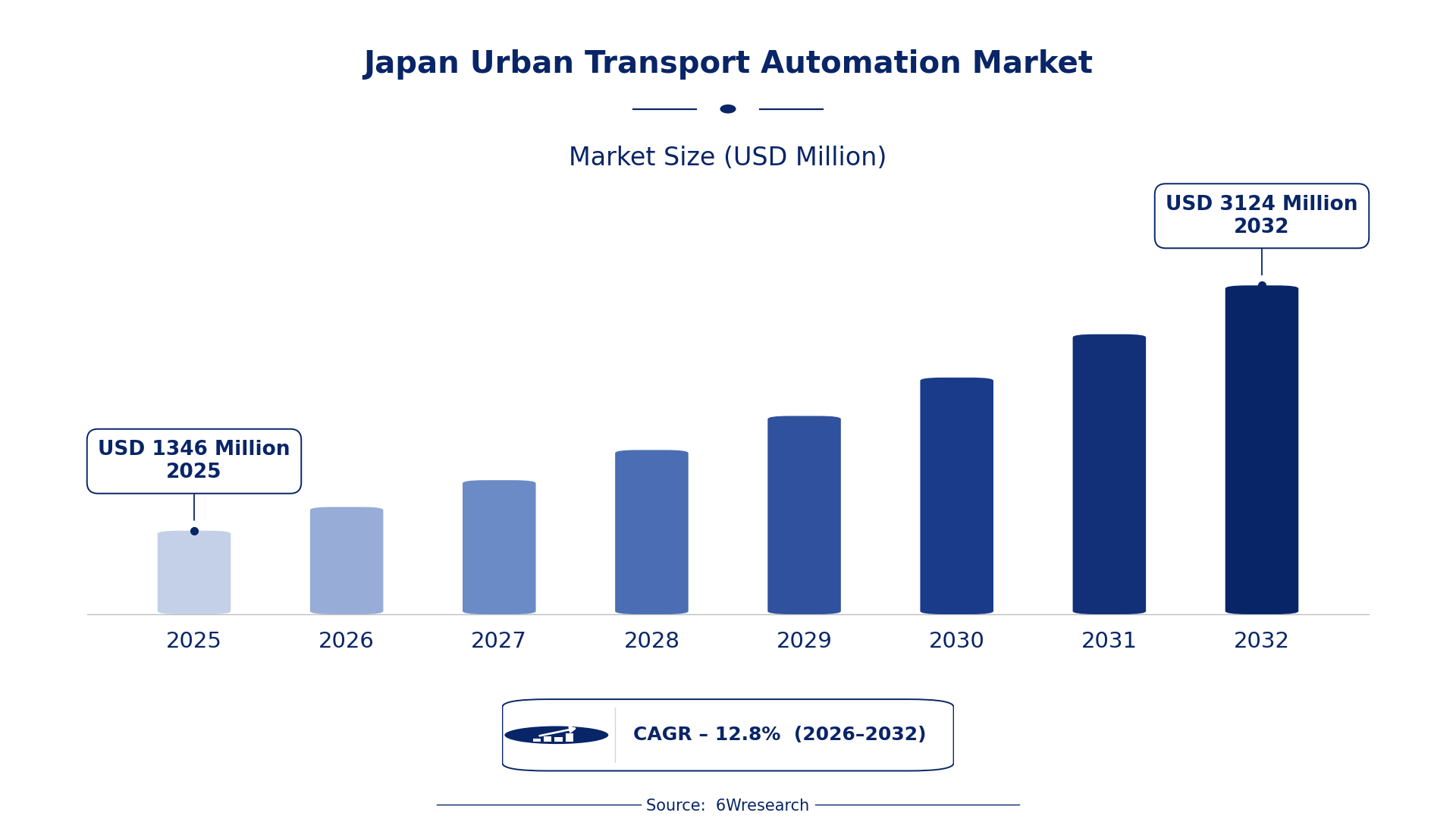
According to 6Wresearch internal database and industry insights, the Japan Urban Transport Automation Market was valued at USD 1,346 Million in 2025 and is projected to reach USD 3,124 Million by 2032, growing at a CAGR of approximately 12.8% during 2026–2032.
Japan Urban Transport Automation Market Highlights
| Report Metric | Details |
| Report Name | Japan Urban Transport Automation Market (2026-2032) |
| Market Size 2025 | USD 1,346 Million |
| Market Size 2032 | USD 3,124 Million |
| Absolute Growth 2025–2032 | USD 1,778 Million |
| CAGR 2026–2032 | 12.8% |
| Peak Annual Growth | 14.3% in 2026 |
| Forecast Period | 2026–2032 |
| Historical Data | 2022–2025 |
| Base Year | 2025 |
| Leading Automation Type, 2025 | Autonomous Buses (40% share) |
| Leading Transport Mode, 2025 | Electric Vehicles (47% share) |
| Leading System Integration, 2025 | GPS (43% share) |
| Leading End User, 2025 | Public Transit Depts. (44% share) |
| Fastest-Growing Automation Type | Smart Traffic Systems (17.8% CAGR) |
| Fastest-Growing Transport Mode | Road Vehicles (16.3% CAGR) |
| Fastest-Growing System Integration | LIDAR (19.1% CAGR) |
| Fastest-Growing End User | City Governments (15.7% CAGR) |
| Growing Sector | Public Transport |
| Key End Users | Public Transit Departments, City Governments, Transit Agencies, Urban Planners |
Japan Urban Transport Automation Market Year-wise Growth Rate and Key Drivers (2022–2032)
This graph illustrates the annual growth rates of the market from 2022 to 2032, highlighting a steady upward trajectory and projected market expansion over the forecast period.
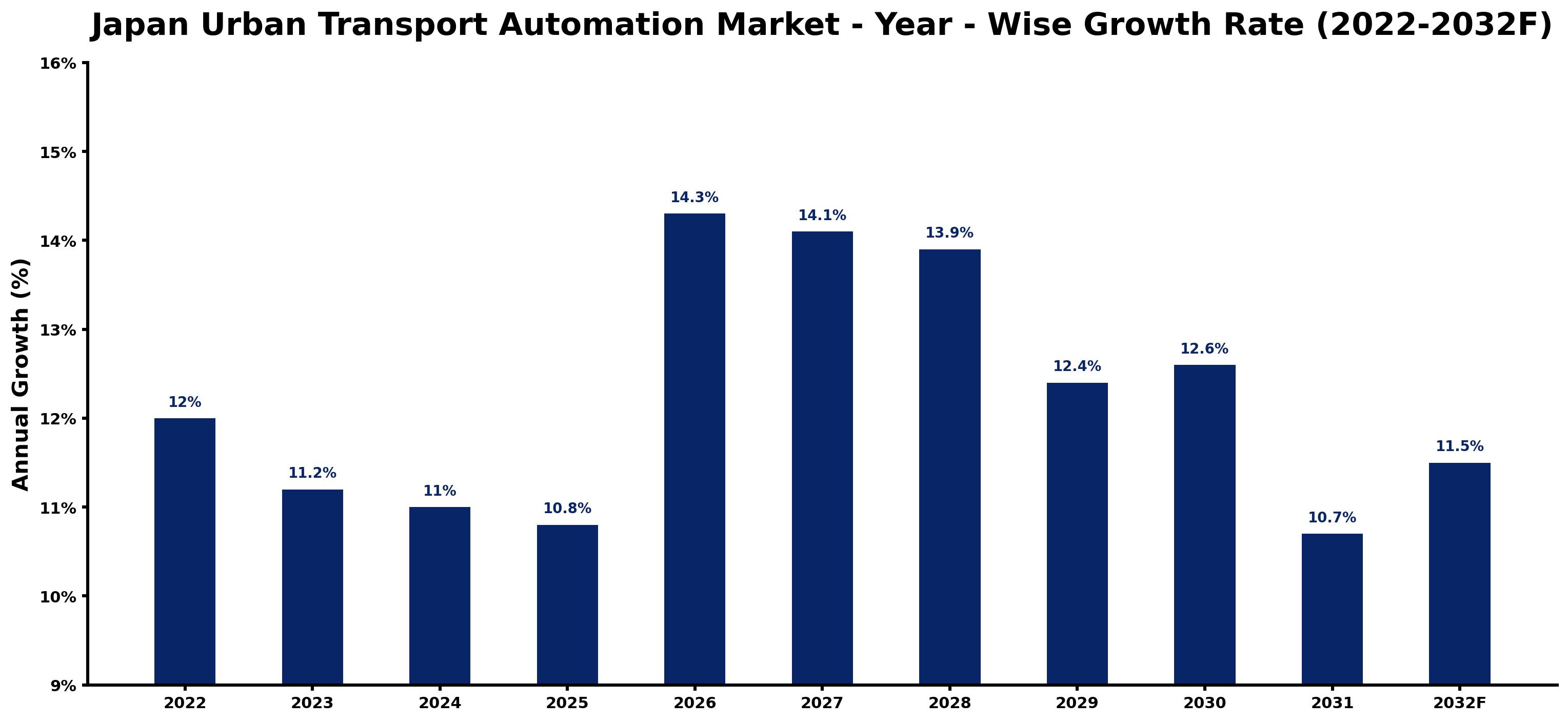
Each row of the following table gives one year's estimated growth and the event or demand shift that explains it.
| Year | Estimated Annual Growth (%) | Market Rationale |
| 2022 | 12.0 | The market experienced strong growth due to increased urbanisation and technological advancements. |
| 2023 | 11.2 | Demand continued to rise, although at a slower pace as market maturity began to set in. |
| 2024 | 11.0 | Growth slowed further as competition intensified and market saturation became apparent. |
| 2025 | 10.8 | The market maintained positive growth, driven by ongoing investments in smart traffic systems. |
| 2026 | 14.3 | Growth is expected to accelerate sharply as public transit departments adopt advanced automation technologies. |
| 2027 | 14.1 | Demand will remain strong, although growth is projected to decelerate slightly as projects mature. |
| 2028 | 13.9 | The market is expected to continue expanding, supported by rising urban populations and infrastructure investments. |
| 2029 | 12.4 | Growth will slow as the focus shifts towards optimising existing systems rather than new implementations. |
| 2030 | 12.6 | Demand is projected to pick up again as city governments increase investments in smart transport solutions. |
| 2031 | 10.7 | Growth is expected to slow as the market stabilises, with a focus on improving existing systems. |
| 2032 | 11.5 | Demand is expected to rise as urban transport needs evolve and new technologies emerge. |
Note: Market size estimations and growth projections presented in this report are based on 6Wresearch's proprietary forecasting methodology, utilizing the latest available industry data, government publications, and primary research inputs.
Japan Urban Transport Automation Market Synopsis
Urban Transport Automation encompasses technologies that improve the efficiency and safety of urban transport systems through solutions such as autonomous vehicles and smart traffic management. The Japan Urban Transport Automation Market is growing due to rising urbanisation, particularly in Tokyo, where a population of approximately 14 million creates strong demand. Major investments, including the ¥10 billion allocated by the Tokyo Metropolitan Government for smart traffic solutions in 2023, are driving this expansion. Public transit departments are utilising AI for real-time scheduling, opening new avenues for automation technologies.
Market Dynamics Impact Analysis (2026–2032)
| Factor | Type | Impact | Primary Segment Affected |
| Growing urban populations drive demand for efficient transport solutions. | Driver | High | Smart Traffic Systems |
| Investment in smart traffic solutions is increasing. | Driver | High | Autonomous Buses |
| The need for sustainable transport solutions creates opportunities for automation. | Opportunity | High | Fare Automation |
| Public transit departments are seeking advanced technologies to improve services. | Opportunity | High | Real-Time Scheduling |
| Competition among suppliers may limit market entry for new players. | Restraint | Medium | Smart Traffic Systems |
| Technological integration challenges can slow adoption rates. | Restraint | Medium | Autonomous Buses |
| High initial investment costs can deter smaller municipalities from adopting new technologies. | Challenge | High | Fare Automation |
| Rapid technological advancements may outpace regulatory frameworks, complicating implementation. | Challenge | High | Real-Time Scheduling |
Evaluation of Drivers in Japan Urban Transport Automation Market (2026–2032)
These are the developments adding the most demand over the forecast period.
| Drivers | Primary Segment Affected | Why It Matters (Evidence) |
| Increasing urbanisation necessitates efficient transport systems. | Smart Traffic Systems | Tokyo's population of approximately 14 million drives demand for improved traffic management solutions. |
| Public investment in transport automation technologies is rising. | Autonomous Buses | The Tokyo Metropolitan Government allocated ¥10 billion for smart traffic solutions in 2023. |
| AI adoption in public transit improves operational efficiency. | Real-Time Scheduling | Public transit departments are implementing AI for scheduling, improving service reliability. |
| Integration of smart technologies reduces congestion. | Fare Automation | Smart traffic systems have been shown to reduce congestion by 15% in major cities. |
| Technological advancements in automation improve safety and efficiency. | Autonomous Buses | The deployment of over 1,200 autonomous buses in Tokyo's pilot programs demonstrates innovation. |
Orders keep climbing as urbanisation drives the demand for efficient transport systems, particularly in Tokyo, which has a population of approximately 14 million. Public investment, such as the ¥10 billion allocated for smart traffic solutions in 2023, supports the implementation of advanced technologies. AI adoption in public transit for real-time scheduling improves service reliability, while smart traffic systems have reduced congestion in major cities by 15%.
Evaluation of Restraints in Japan Urban Transport Automation Market
The following restraints limit how fast demand can grow.
| Market Restraint | Primary Segment Affected | Why It Matters (Evidence) |
| High initial investment costs can deter smaller municipalities from adopting new technologies. | Fare Automation | Many smaller public transit departments lack the capital for advanced automation solutions. |
| Technological integration challenges can slow adoption rates. | Autonomous Buses | Existing infrastructure may not support the integration of new technologies. |
| Competition among suppliers may limit market entry for new players. | Smart Traffic Systems | Established players dominate, making it difficult for newcomers to gain market share. |
| Regulatory hurdles can delay project implementations. | Real-Time Scheduling | Compliance with existing regulations can slow the rollout of new technologies. |
| Rapid technological advancements may outpace regulatory frameworks. | Smart Traffic Systems | Regulations may not keep pace with innovations, complicating implementation. |
Japan Urban Transport Automation Market Challenges
Tokyo's fare automation systems handle over 30 million transactions daily, creating pressure on operators to swiftly adopt new technologies. This demand arises from Tokyo's population of approximately 14 million, leading to delays in system upgrades for transport operators. Suppliers encounter difficulties due to rising labour costs, as Japan's national minimum wage increased to JPY 1,055 per hour in October 2024, complicating the recruitment of skilled engineers for complex projects. Competition escalates as over 50% of city governments plan to implement smart traffic systems by 2025, compelling buyers to invest heavily to sustain their market position.
Trends in the Japan Urban Transport Automation Market
Buyers and suppliers in the Japan Urban Transport Automation Market are adjusting to the following trends.
- Shift towards Smart Traffic Management: Over 50% of city governments are planning to implement smart traffic systems by 2025, reflecting a shift in urban transport strategies. This trend aims to reduce congestion and improve safety, with smart systems projected to enhance traffic flow by 15%.
- Transition from Manual to Automated Fare Systems: The adoption of automated fare systems is increasing, with Tokyo processing over 30 million transactions daily. This shift streamlines payment processes and improves user experience, encouraging more public transport usage.
- Emergence of AI in Urban Transport: Public transit departments are increasingly implementing AI for real-time scheduling, improving service reliability. This trend is expected to grow as more cities recognise the benefits of automation in enhancing operational efficiency.
- Integration of LIDAR Technology: LIDAR technology is being adopted in over 200 urban projects across Japan, improving vehicle perception and safety. This integration supports the development of autonomous vehicles and smart traffic systems.
Investment Opportunities in the Japan Urban Transport Automation Market
Below are the investment opportunities with the strongest case in the Japan Urban Transport Automation Market.
- Gap in Smart Traffic Solutions: With over 50% of city governments planning to implement smart traffic systems by 2025, there is an opportunity for suppliers to provide effective solutions. Collaborating with city governments can facilitate market entry.
- Demand for Sustainable Transport Solutions: Japan's target for a 46% cut in greenhouse-gas emissions by 2030 creates a demand for eco-friendly transport technologies. Public transit departments are key buyers looking for sustainable solutions.
- Investment in Real-Time Scheduling Technologies: As public transit departments seek to improve service reliability, there is a growing opportunity in real-time scheduling technologies. Partnerships with transit agencies can help suppliers tap into this demand.
- Expansion of Autonomous Vehicle Programs: The deployment of over 1,200 autonomous buses in Tokyo highlights the demand for automation in public transport. Suppliers can enter the market by collaborating with local transit agencies.
Government Initiatives in the Japan Urban Transport Automation Market
The GX Promotion Act of 2023 provides a legal framework for sustainable transport initiatives, building on previous laws such as the Urban Planning Act of 1968. This act encourages the adoption of green technologies in urban transport, requiring producers to invest in eco-friendly solutions and comply with new standards.
The Smart Mobility Challenge 2023, funded by the Ministry of Land, Infrastructure, Transport and Tourism, supports urban transport solutions with a budget of ¥5 billion. This initiative aims to promote the integration of advanced technologies in urban transport systems.
Future Insight of the Japan Urban Transport Automation Market
Public Transit Departments will increasingly adopt AI for scheduling, streamlining operations in urban transport. By 2032, Japan's urban rail network, which spans over 27,000 km, will witness a deeper integration of automation technologies, benefiting both buyers and suppliers. The Smart Mobility Challenge 2023 will drive innovation, encouraging solutions that support the nation's decarbonisation goals. As the Urban Transport Automation Association develops standards, collaboration among stakeholders will improve project outcomes, ultimately benefiting transport operators and city planners.
Market Segmentation Analysis
Japan Urban Transport Automation Market report covers a detailed analysis of the following market segments:
By Automation Type – Autonomous Buses Lead, Smart Traffic Systems Expected to Grow Fastest
According to Saurav Kr Singh, Senior Research Analyst at 6Wresearch, Autonomous Buses took 40% of automation type revenue in 2025, more than any other category. Autonomous buses dominate the market due to their significant deployment in public transport, particularly in Tokyo where over 1,200 units are in pilot programs. This widespread implementation highlights the focus on enhancing urban transport efficiency and safety. Over 2026–2032, Smart Traffic Systems are expected to post the fastest growth, at a CAGR of 17.8%. Smart traffic systems are rapidly gaining traction as cities invest heavily, with ¥10 billion earmarked for smart traffic solutions in 2023. This investment is expected to improve traffic flow and attract further advancements in urban transport automation. Suppliers should prioritise the development of smart traffic solutions to meet the increasing demand for efficient urban transport management.
By Transport Mode – Electric Vehicles Lead, Road Vehicles Expected to Grow Fastest
Electric Vehicles accounted for 47% of the market by transport mode in 2025. Electric vehicles hold the largest share as they are integral to Japan's eco-friendly transport initiatives, aligning with national goals to cut greenhouse gas emissions by 46% by 2030. Their adoption is supported by various policies promoting sustainable transport solutions. Road Vehicles are projected to grow fastest, at a CAGR of 16.3% during 2026–2032. Road vehicles are experiencing the fastest growth as they increasingly integrate with urban transport systems, responding to the rising demand for efficient and flexible transport options. This trend is driven by urban planning initiatives that prioritise accessibility and sustainability. Buyers must consider the transition to electric and road vehicles to align with environmental policies and urban transport strategies.
By System Integration – GPS Leads, LIDAR Expected to Grow Fastest
The largest system integration category in 2025 was GPS, at 43% of revenue. GPS technology leads the market as it is essential for navigation and tracking in urban transport, facilitating effective route management and safety. Its established presence across various transport applications reinforces its dominant market position. LIDAR is set to record the highest CAGR in this split, 19.1% over 2026–2032. LIDAR technology is witnessing rapid growth, with adoption in over 200 urban projects across Japan enhancing vehicle perception. This surge is fuelled by the rising need for advanced safety features in urban transport systems. Suppliers should concentrate on LIDAR technology to address the growing demand for improved safety and navigation capabilities in urban transport.
By End User – Public Transit Depts. Leads, City Governments Expected to Grow Fastest
In 2025, Public Transit Depts. led the end user split with a 44% share. Public transit departments are the primary users of automation technologies, implementing solutions that enhance service efficiency and reliability in urban transport. Their pivotal role in managing public transport systems solidifies their leading position in the market. The quickest growth will come from City Governments, forecast to expand at a CAGR of 15.7% between 2026 and 2032. City governments are the fastest-growing end users as they actively adopt urban transport policies that integrate automation technologies. Their commitment to modernising transport infrastructure is crucial for achieving sustainable urban development. Suppliers should engage with city governments to align their products with the shifting urban transport policies and initiatives.
Key Attractiveness of the Report
- 10 Years of Market Numbers
- Historical Data Starting from 2022 to 2025
- Base Year 2025
- Forecast Data until 2032
- Key Performance Indicators Impacting the Market
- Major Upcoming Developments and Projects
Key Highlights of the Report:
- Japan Urban Transport Automation Market Outlook
- Market Size of Japan Urban Transport Automation Market, 2025
- Forecast of Japan Urban Transport Automation Market, 2032
- Historical Data and Forecast of Japan Urban Transport Automation Revenues & Volume for the Period 2022-2032F
- Japan Urban Transport Automation Market Trend Evolution
- Japan Urban Transport Automation Market Drivers and Challenges
- Japan Urban Transport Automation Price Trends
- Japan Urban Transport Automation Porter's Five Forces
- Japan Urban Transport Automation Industry Life Cycle
- Historical Data and Forecast of Japan Urban Transport Automation Market Revenues & Volume By Automation Type for the Period 2022-2032F
- Historical Data and Forecast of Japan Urban Transport Automation Market Revenues & Volume By Autonomous Buses for the Period 2022-2032F
- Historical Data and Forecast of Japan Urban Transport Automation Market Revenues & Volume By Smart Traffic Systems for the Period 2022-2032F
- Historical Data and Forecast of Japan Urban Transport Automation Market Revenues & Volume By Fare Automation for the Period 2022-2032F
- Historical Data and Forecast of Japan Urban Transport Automation Market Revenues & Volume By Real-Time Scheduling for the Period 2022-2032F
- Historical Data and Forecast of Japan Urban Transport Automation Market Revenues & Volume By Transport Mode for the Period 2022-2032F
- Historical Data and Forecast of Japan Urban Transport Automation Market Revenues & Volume By Electric Vehicles for the Period 2022-2032F
- Historical Data and Forecast of Japan Urban Transport Automation Market Revenues & Volume By Road Vehicles for the Period 2022-2032F
- Historical Data and Forecast of Japan Urban Transport Automation Market Revenues & Volume By Rail/Metro for the Period 2022-2032F
- Historical Data and Forecast of Japan Urban Transport Automation Market Revenues & Volume By Multi-Modal for the Period 2022-2032F
- Historical Data and Forecast of Japan Urban Transport Automation Market Revenues & Volume By System Integration for the Period 2022-2032F
- Historical Data and Forecast of Japan Urban Transport Automation Market Revenues & Volume By GPS, LIDAR, AI for the Period 2022-2032F
- Historical Data and Forecast of Japan Urban Transport Automation Market Revenues & Volume By AI + IoT for the Period 2022-2032F
- Historical Data and Forecast of Japan Urban Transport Automation Market Revenues & Volume By RFID + Mobile App for the Period 2022-2032F
- Historical Data and Forecast of Japan Urban Transport Automation Market Revenues & Volume By Cloud-Based Platforms for the Period 2022-2032F
- Historical Data and Forecast of Japan Urban Transport Automation Market Revenues & Volume By End User for the Period 2022-2032F
- Historical Data and Forecast of Japan Urban Transport Automation Market Revenues & Volume By Public Transit Depts. for the Period 2022-2032F
- Historical Data and Forecast of Japan Urban Transport Automation Market Revenues & Volume By City Governments for the Period 2022-2032F
- Historical Data and Forecast of Japan Urban Transport Automation Market Revenues & Volume By Transit Agencies for the Period 2022-2032F
- Historical Data and Forecast of Japan Urban Transport Automation Market Revenues & Volume By Urban Planners for the Period 2022-2032F
- Japan Urban Transport Automation Import Export Trade Statistics
- Market Opportunity Assessment By Automation Type
- Market Opportunity Assessment By Transport Mode
- Market Opportunity Assessment By System Integration
- Market Opportunity Assessment By End User
- Japan Urban Transport Automation Top Companies Market Share
- Japan Urban Transport Automation Competitive Benchmarking By Technical and Operational Parameters
- Japan Urban Transport Automation Company Profiles
- Japan Urban Transport Automation Key Strategic Recommendations
Market Covered
Coverage by segment is as follows.
By Automation Type
- Autonomous Buses
- Smart Traffic Systems
- Fare Automation
- Real-Time Scheduling
By Transport Mode
- Electric Vehicles
- Road Vehicles
- Rail/Metro
- Multi-Modal
By System Integration
- GPS
- LIDAR
- AI
- AI + IoT
- RFID + Mobile App
- Cloud-Based Platforms
By End User
- Public Transit Depts.
- City Governments
- Transit Agencies
- Urban Planners































