Japan Urban Transport Solutions Market Size & Growth Rate
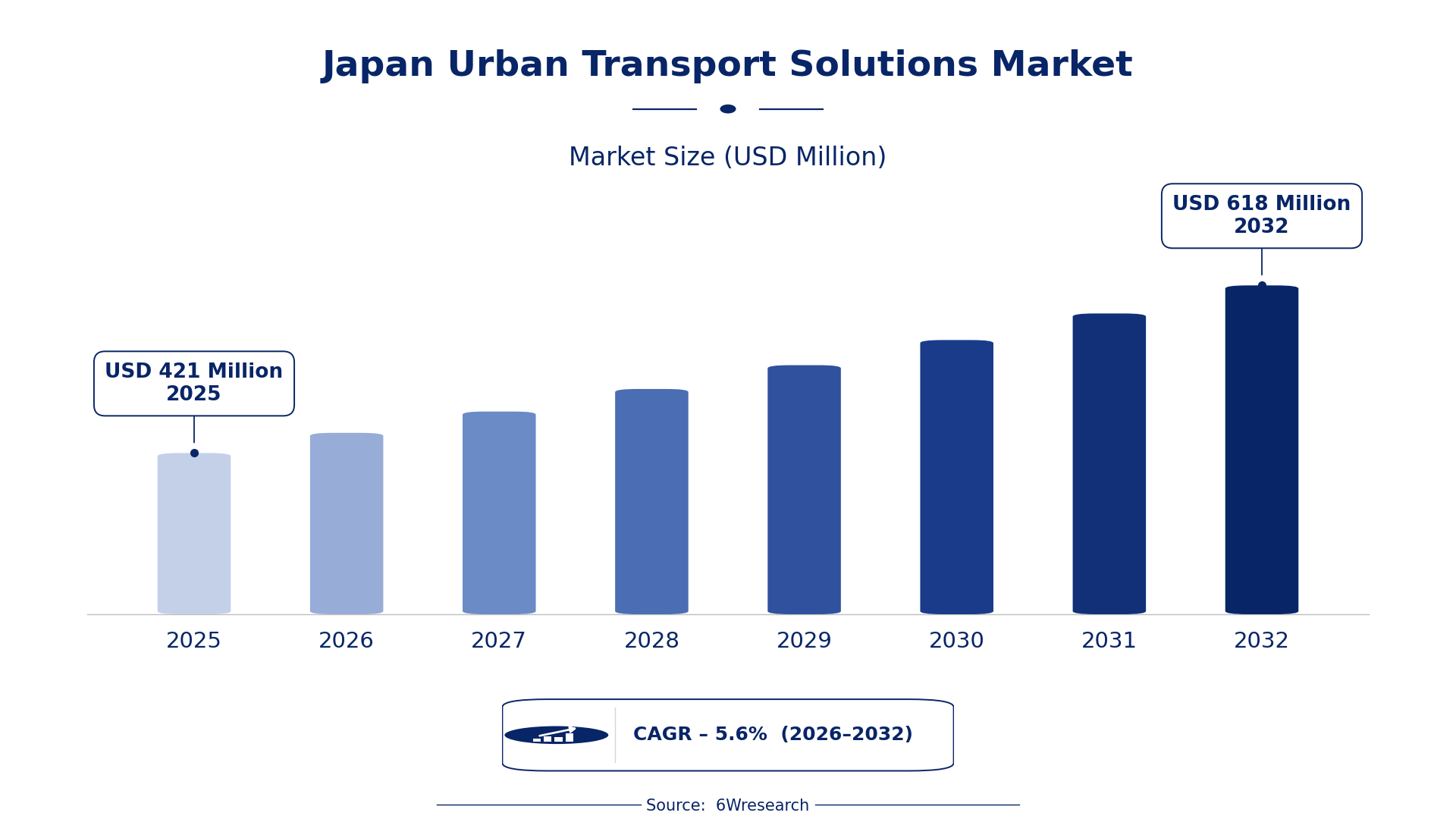
According to 6Wresearch internal database and industry insights, the Japan Urban Transport Solutions Market was valued at USD 421 Million in 2025 and is projected to reach USD 618 Million by 2032, growing at a CAGR of approximately 5.6% during 2026–2032.
Japan Urban Transport Solutions Market Highlights
| Report Metric | Details |
| Report Name | Japan Urban Transport Solutions Market (2026-2032) |
| Market Size 2025 | USD 421 Million |
| Market Size 2032 | USD 618 Million |
| Absolute Growth 2025–2032 | USD 197 Million |
| CAGR 2026–2032 | 5.6% |
| Peak Annual Growth | 6.4% in 2032 |
| Forecast Period | 2026–2032 |
| Historical Data | 2022–2025 |
| Base Year | 2025 |
| Leading Solution Type, 2025 | Mobility-as-a-Service (37% share) |
| Leading Integration Model, 2025 | API Integration (34% share) |
| Leading Application Mode, 2025 | Public & Private Transit (51% share) |
| Leading End User, 2025 | Mobility Platforms (48% share) |
| Fastest-Growing Solution Type | Electric Fleet Management (8.2% CAGR) |
| Fastest-Growing Integration Model | Smart Charging (7.7% CAGR) |
| Fastest-Growing Application Mode | Urban Transit Fleets (7.8% CAGR) |
| Fastest-Growing End User | Transport Companies (7.3% CAGR) |
| Growing Sector | Urban Mobility Solutions |
| Key End Users | Municipalities, Transport Companies, Fleet Managers |
Japan Urban Transport Solutions Market Year-wise Growth Rate and Key Drivers (2022–2032)
This graph illustrates the annual growth rates of the market from 2022 to 2032, highlighting a steady upward trajectory and projected market expansion over the forecast period.
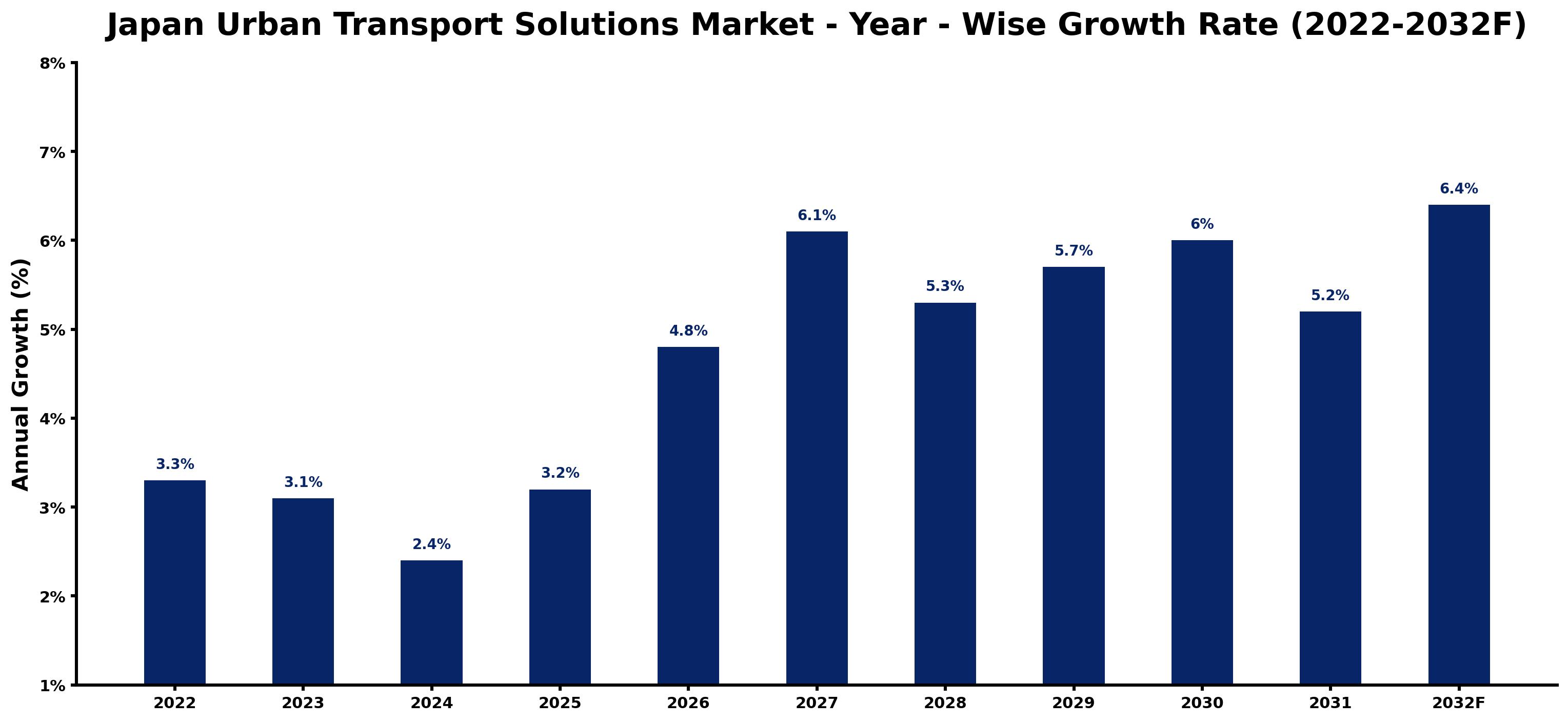
Below, each year's estimated growth is shown next to the factor that most influenced it.
| Year | Estimated Annual Growth (%) | Market Rationale |
| 2022 | 3.3 | The market experienced steady growth due to strong urbanisation trends and demand for transport solutions. |
| 2023 | 3.1 | Demand growth slowed as municipalities reassessed transport needs amidst economic fluctuations. |
| 2024 | 2.4 | Continued urbanisation and e-commerce growth maintained market expansion, albeit at a reduced pace. |
| 2025 | 3.2 | Investment in smart transport technologies spurred growth as cities aimed to improve mobility. |
| 2026 | 4.8 | The introduction of new digital transport solutions is expected to accelerate market growth as urban areas modernise. |
| 2027 | 6.1 | Rising electric vehicle adoption in urban fleets will boost demand for fleet management solutions. |
| 2028 | 5.3 | Growth is projected to moderate as cities focus on integrating existing systems with new technologies. |
| 2029 | 5.7 | An increased focus on last-mile logistics will drive demand for efficient transport solutions. |
| 2030 | 6.0 | The push for sustainable urban transport will lead to higher investments in new technologies. |
| 2031 | 5.2 | Demand growth is expected to slow as cities face challenges in implementing new technologies. |
| 2032 | 6.4 | The market is projected to peak as urban areas fully embrace smart transport solutions and technologies. |
Note: Market size estimations and growth projections presented in this report are based on 6Wresearch's proprietary forecasting methodology, utilizing the latest available industry data, government publications, and primary research inputs.
Japan Urban Transport Solutions Market Synopsis
Urban Transport Solutions encompass technologies and services designed to improve urban mobility through advanced software and data analytics. The Japan Urban Transport Solutions Market is experiencing robust growth, driven by an urban population of approximately 126 million that demands efficient public transport systems and fleet management. Key factors propelling this growth include the Tokyo Smart City initiative, which aims for integrated mobility solutions by 2025, and a government target of 50% electric vehicle adoption in urban fleets by 2030.
Market Dynamics Impact Analysis (2026–2032)
| Factor | Type | Impact | Primary Segment Affected |
| Growing urban population necessitates advanced transport solutions. | Driver | High | Public & Private Transit |
| Investment in smart transport technologies is increasing. | Driver | High | Mobility-as-a-Service |
| Rising demand for last-mile delivery services driven by e-commerce. | Opportunity | High | Last-Mile Logistics |
| Need for sustainable transport solutions is expanding. | Opportunity | Medium | Electric Fleet Management |
| Integration challenges among various transport services hinder efficiency. | Restraint | Medium | API Integration |
| High costs of implementing smart transport technologies limit adoption. | Restraint | High | Transport Planning Tools |
| Limited infrastructure for electric vehicle charging affects fleet management. | Challenge | High | Electric Fleet Management |
| Competition among transport solutions providers creates market pressure. | Challenge | Medium | Mobility Platforms |
Evaluation of Drivers in Japan Urban Transport Solutions Market (2026–2032)
Key forces behind demand, with the segment each one moves most, are listed below.
| Drivers | Primary Segment Affected | Why It Matters (Evidence) |
| Urban population growth drives demand for efficient public transport. | Public & Private Transit | Japan's urban population of 126 million necessitates advanced transport systems for effective mobility. |
| Investment in smart transport technologies is increasing. | Mobility-as-a-Service | The government's 5-year plan to invest in smart transport technologies supports market growth. |
| E-commerce growth boosts last-mile delivery needs. | Last-Mile Logistics | Last-mile delivery services are projected to grow, driven by increasing e-commerce demands. |
| Electric vehicle adoption is rising in urban fleets. | Electric Fleet Management | The government targets 50% electric vehicle adoption in urban fleets by 2030, enhancing fleet management. |
| Integration of transport services is becoming essential. | API Integration | The Tokyo Smart City initiative focuses on integrating mobility solutions, driving demand for API integration services. |
Spending rises because urban population growth drives demand for efficient public transport solutions. Japan's urban population of approximately 126 million necessitates advanced systems, prompting municipalities to invest in new technologies. The push for electric vehicle adoption targets 50% by 2030, creating demand for fleet management solutions. E-commerce growth is significantly increasing last-mile delivery needs, leading to greater demand for efficient logistics solutions. The focus on integrated mobility solutions is reshaping urban transport, resulting in heightened demand for API integration services.
Evaluation of Restraints in Japan Urban Transport Solutions Market
Several factors work against faster growth; the main ones are summarised below.
| Market Restraint | Primary Segment Affected | Why It Matters (Evidence) |
| Stringent regulations on technology implementation cause delays in project execution. | Public & Private Transit | Transport companies often face compliance challenges, resulting in project timelines extending by up to six months. |
| Rising operational costs due to increased demand for sustainable solutions. | Electric Fleet Management | The push for eco-friendly technologies has led to a 20% rise in operational expenses for transport providers. |
| Shortage of skilled professionals in data analytics affects project efficiency. | Route Optimization AI | Municipalities struggle to find qualified personnel, leading to prolonged timelines for developing efficient transport systems. |
| Intense competition from emerging players pressures established providers. | Mobility Platforms | Established companies must adapt quickly to maintain their market share in a sector serving over 126 million urban residents. |
| Limited funding for innovative transport projects restricts development. | Transport Planning Tools | Budget constraints in municipalities hinder investment in advanced transport solutions. |
Japan Urban Transport Solutions Market Challenges
Japan's urban transport sector grapples with strict regulations that complicate the implementation of new technologies, causing delays of up to six months for transport companies. Buyers face rising costs as the demand for sustainable solutions increases, pushing operational expenses up by 20%. A shortage of skilled professionals in data analytics hinders the development of efficient transport systems, resulting in extended project timelines for municipalities. Competition from emerging players forces established providers to adapt rapidly, threatening their market position in a sector catering to over 126 million urban residents.
Trends in the Japan Urban Transport Solutions Market
The following changes are redrawing the Japan Urban Transport Solutions Market.
- Shift towards Integrated Mobility Solutions: Tokyo is advancing towards integrated mobility solutions with the Smart City initiative, aiming for improved transport by 2025. This initiative is set to enhance user experience and operational efficiency, positively impacting urban transport.
- Transition to Electric Fleet Management: Japan is moving towards electric fleet management, targeting 50% electric vehicle adoption by 2030. This shift is supported by government initiatives and growing environmental awareness, leading to increased demand for electric fleet solutions.
- Public Transit Modernisation Prioritised: Municipalities are prioritising the modernisation of public transit systems to improve efficiency and sustainability. The Tokyo Metropolitan area, with over 37 million residents, is a key focus for these enhancements, necessitating advanced transport solutions.
- Last-Mile Logistics Gaining Importance: E-commerce growth is driving the importance of last-mile logistics solutions in urban areas. As online shopping increases, demand for efficient delivery systems is expected to rise, impacting transport planning.
Investment Opportunities in the Japan Urban Transport Solutions Market
The opportunities below stand out in the Japan Urban Transport Solutions Market for new entrants and existing suppliers.
- Collaborate with Local Governments for Smart Solutions: Local governments are seeking partnerships to implement smart transport solutions, driven by a 5-year investment plan. Engaging with municipalities can facilitate entry into the market and support urban mobility initiatives.
- Invest in Electric Vehicle Infrastructure: The push for 50% electric vehicle adoption by 2030 creates opportunities for infrastructure development. Suppliers can target urban areas, particularly in Tokyo, to provide charging solutions and support fleet management.
- Focus on Last-Mile Delivery Solutions: The growth of e-commerce presents opportunities for last-mile delivery solutions. Suppliers should invest in technologies that improve efficiency and reliability in urban logistics, particularly in densely populated regions.
- Develop API Integration Services: With the Smart City initiative focusing on integrated mobility, there is a demand for API integration services. Companies can enter the market by offering solutions that connect various transport services.
Government Initiatives in the Japan Urban Transport Solutions Market
The Electrical Appliance and Material Safety Act (1961) regulates the safety of electrical appliances and materials sold in Japan, ensuring that urban transport solutions comply with safety standards. Following this, the AI Promotion Act (2025) establishes a national framework for AI research and development, encouraging innovation in urban transport technologies. These laws create a structured environment for producers to develop and implement advanced transport solutions that meet regulatory requirements.
The Digital Agency, established in September 2021, leads the government's digital transformation efforts. This agency supports municipalities in adopting smart transport solutions, providing funding for projects that enhance urban mobility. By facilitating the integration of technology in public transport, the agency helps ensure that urban transport solutions align with modern standards, ultimately benefiting users and improving service efficiency.
Future Insight of the Japan Urban Transport Solutions Market
The rollout of integrated mobility solutions will transform urban transport by 2025. By 2032, electric vehicle adoption in urban fleets will reach 50%, supporting government initiatives. The adoption of ISO 37120 standards will streamline sustainable practices in transport planning. Growth in last-mile delivery services will reshape logistics, driven by the expanding e-commerce sector, fundamentally changing urban mobility.
Market Segmentation Analysis
Japan Urban Transport Solutions Market report covers a detailed analysis of the following market segments:
By Solution Type – Mobility-as-a-Service Leads, Electric Fleet Management Expected to Grow Fastest
According to Saurav Kr Singh, Senior Research Analyst at 6Wresearch, with 37% of solution type revenue in 2025, Mobility-as-a-Service was the largest category. Mobility-as-a-Service holds the largest share due to its ability to provide integrated transport solutions that cater to Japan's urban population of approximately 126 million. This model is exemplified by the Tokyo Smart City initiative, which aims to enhance mobility solutions by 2025. Electric Fleet Management is projected to grow fastest, at a CAGR of 8.2% during 2026–2032. Electric Fleet Management is growing rapidly as the government targets 50% electric vehicle adoption in urban fleets by 2030, significantly increasing the demand for efficient fleet operations. This trend will further widen the lead of Mobility-as-a-Service as it incorporates electric solutions into its framework. Suppliers should prioritise developing solutions that align with government initiatives to capture emerging opportunities in the market.
By Integration Model – API Integration Leads, Smart Charging Expected to Grow Fastest
API Integration took 34% of integration model revenue in 2025, more than any other category. API Integration leads the market as it enables connectivity between various transport services, essential for creating seamless urban mobility experiences. This integration is particularly important in densely populated areas like the Tokyo Metropolitan region, home to over 37 million residents. Smart Charging is set to record the highest CAGR in this split, 7.7% over 2026–2032. Smart Charging is the fastest-growing segment, driven by the increasing need for charging infrastructure to support the rising number of electric vehicles. As API Integration continues to dominate, its growth will be further supported by advancements in charging technologies. Buyers must invest in advanced integration solutions to ensure compatibility with evolving transport technologies.
By Application Mode – Public & Private Transit Leads, Urban Transit Fleets Expected to Grow Fastest
The largest application mode category in 2025 was Public & Private Transit, at 51% of revenue. Public & Private Transit dominates the market, being crucial for managing urban public transport systems that meet the high demand in Japan's urban areas. The punctuality of Japan's public transport system, with an average delay of less than a minute, highlights the need for efficient transit solutions. The quickest growth will come from Urban Transit Fleets, forecast to expand at a CAGR of 7.8% between 2026 and 2032. Urban Transit Fleets are experiencing rapid growth as cities strive to optimise their transport services to meet the needs of their residents. This growth will reinforce the importance of Public & Private Transit in urban mobility strategies. Suppliers should focus on developing tailored solutions for urban transit fleets to address the increasing demand for efficient transport services.
By End User – Mobility Platforms Lead, Transport Companies Expected to Grow Fastest
Mobility Platforms accounted for 48% of the market by end user in 2025. Mobility Platforms capture the largest share as they integrate various transport services for users, facilitating seamless travel across urban areas. This integration is vital in Japan, where urban mobility remains a pressing concern for both residents and municipalities. Over 2026–2032, Transport Companies are expected to post the fastest growth, at a CAGR of 7.3%. Transport Companies are the fastest-growing end user segment, as they seek solutions to improve operational efficiency amidst rising e-commerce demands. This growth will further solidify the role of Mobility Platforms in supporting the needs of transport companies. Providers must tailor their offerings to meet the specific needs of transport companies to capitalise on this growth opportunity.
Key Attractiveness of the Report
- 10 Years of Market Numbers
- Historical Data Starting from 2022 to 2025
- Base Year 2025
- Forecast Data until 2032
- Key Performance Indicators Impacting the Market
- Major Upcoming Developments and Projects
Key Highlights of the Report:
- Japan Urban Transport Solutions Market Outlook
- Market Size of Japan Urban Transport Solutions Market, 2025
- Forecast of Japan Urban Transport Solutions Market, 2032
- Historical Data and Forecast of Japan Urban Transport Solutions Revenues & Volume for the Period 2022-2032F
- Japan Urban Transport Solutions Market Trend Evolution
- Japan Urban Transport Solutions Market Drivers and Challenges
- Japan Urban Transport Solutions Price Trends
- Japan Urban Transport Solutions Porter's Five Forces
- Japan Urban Transport Solutions Industry Life Cycle
- Historical Data and Forecast of Japan Urban Transport Solutions Market Revenues & Volume By Solution Type for the Period 2022-2032F
- Historical Data and Forecast of Japan Urban Transport Solutions Market Revenues & Volume By Mobility-as-a-Service for the Period 2022-2032F
- Historical Data and Forecast of Japan Urban Transport Solutions Market Revenues & Volume By Electric Fleet Management for the Period 2022-2032F
- Historical Data and Forecast of Japan Urban Transport Solutions Market Revenues & Volume By Route Optimization AI for the Period 2022-2032F
- Historical Data and Forecast of Japan Urban Transport Solutions Market Revenues & Volume By Transport Planning Tools for the Period 2022-2032F
- Historical Data and Forecast of Japan Urban Transport Solutions Market Revenues & Volume By Integration Model for the Period 2022-2032F
- Historical Data and Forecast of Japan Urban Transport Solutions Market Revenues & Volume By API Integration for the Period 2022-2032F
- Historical Data and Forecast of Japan Urban Transport Solutions Market Revenues & Volume By Smart Charging for the Period 2022-2032F
- Historical Data and Forecast of Japan Urban Transport Solutions Market Revenues & Volume By Multimodal Planning for the Period 2022-2032F
- Historical Data and Forecast of Japan Urban Transport Solutions Market Revenues & Volume By Software + Simulation for the Period 2022-2032F
- Historical Data and Forecast of Japan Urban Transport Solutions Market Revenues & Volume By Application Mode for the Period 2022-2032F
- Historical Data and Forecast of Japan Urban Transport Solutions Market Revenues & Volume By Public & Private Transit for the Period 2022-2032F
- Historical Data and Forecast of Japan Urban Transport Solutions Market Revenues & Volume By Urban Transit Fleets for the Period 2022-2032F
- Historical Data and Forecast of Japan Urban Transport Solutions Market Revenues & Volume By Last-Mile Logistics for the Period 2022-2032F
- Historical Data and Forecast of Japan Urban Transport Solutions Market Revenues & Volume By Public Infrastructure for the Period 2022-2032F
- Historical Data and Forecast of Japan Urban Transport Solutions Market Revenues & Volume By End User for the Period 2022-2032F
- Historical Data and Forecast of Japan Urban Transport Solutions Market Revenues & Volume By Mobility Platforms for the Period 2022-2032F
- Historical Data and Forecast of Japan Urban Transport Solutions Market Revenues & Volume By Transport Companies for the Period 2022-2032F
- Historical Data and Forecast of Japan Urban Transport Solutions Market Revenues & Volume By Courier Aggregators for the Period 2022-2032F
- Historical Data and Forecast of Japan Urban Transport Solutions Market Revenues & Volume By Governments for the Period 2022-2032F
- Japan Urban Transport Solutions Import Export Trade Statistics
- Market Opportunity Assessment By Solution Type
- Market Opportunity Assessment By Integration Model
- Market Opportunity Assessment By Application Mode
- Market Opportunity Assessment By End User
- Japan Urban Transport Solutions Top Companies Market Share
- Japan Urban Transport Solutions Competitive Benchmarking By Technical and Operational Parameters
- Japan Urban Transport Solutions Company Profiles
- Japan Urban Transport Solutions Key Strategic Recommendations
Market Covered
The study includes the following segmentation.
By Solution Type
- Mobility-as-a-Service
- Electric Fleet Management
- Route Optimization AI
- Transport Planning Tools
By Integration Model
- API Integration
- Smart Charging
- Multimodal Planning
- Software + Simulation
By Application Mode
- Public & Private Transit
- Urban Transit Fleets
- Last-Mile Logistics
- Public Infrastructure
By End User
- Mobility Platforms
- Transport Companies
- Courier Aggregators
- Governments































