Japan Urban Transportation Market Size & Growth Rate
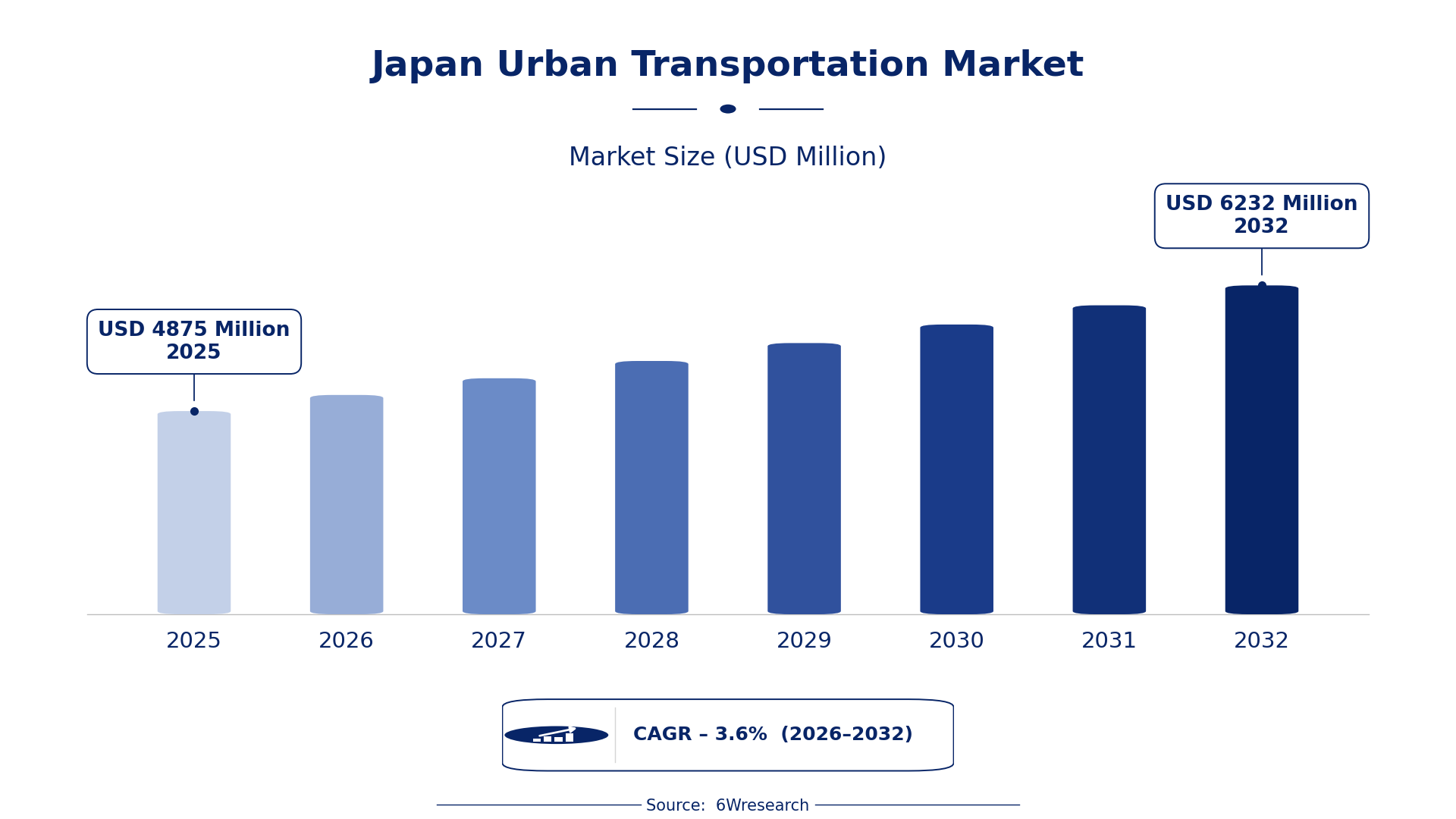
According to 6Wresearch internal database and industry insights, the Japan Urban Transportation Market was valued at USD 4,875 Million in 2025 and is projected to reach USD 6,232 Million by 2032, growing at a CAGR of approximately 3.6% during 2026–2032.
Japan Urban Transportation Market Highlights
| Report Metric | Details |
| Report Name | Japan Urban Transportation Market (2026-2032) |
| Market Size 2025 | USD 4,875 Million |
| Market Size 2032 | USD 6,232 Million |
| Absolute Growth 2025–2032 | USD 1,357 Million |
| CAGR 2026–2032 | 3.6% |
| Peak Annual Growth | 4.2% in 2028 |
| Forecast Period | 2026–2032 |
| Historical Data | 2022–2025 |
| Base Year | 2025 |
| Leading Transportation Mode, 2025 | Public Transit (34% share) |
| Leading Fuel Type, 2025 | Electric/Diesel (44% share) |
| Leading Network Type, 2025 | Fixed Routes (38% share) |
| Leading End User, 2025 | Commuters (45% share) |
| Fastest-Growing Transportation Mode | Micro-Mobility (4.6% CAGR) |
| Fastest-Growing Fuel Type | Battery (5.4% CAGR) |
| Fastest-Growing Network Type | Dynamic Routes (5.0% CAGR) |
| Fastest-Growing End User | App Users (4.7% CAGR) |
| Growing Sector | Urban Transportation |
| Key End Users | Commuters, App Users, Students, Workers |
Japan Urban Transportation Market Year-wise Growth Rate and Key Drivers (2022–2032)
This graph illustrates the annual growth rates of the market from 2022 to 2032, highlighting a steady upward trajectory and projected market expansion over the forecast period.
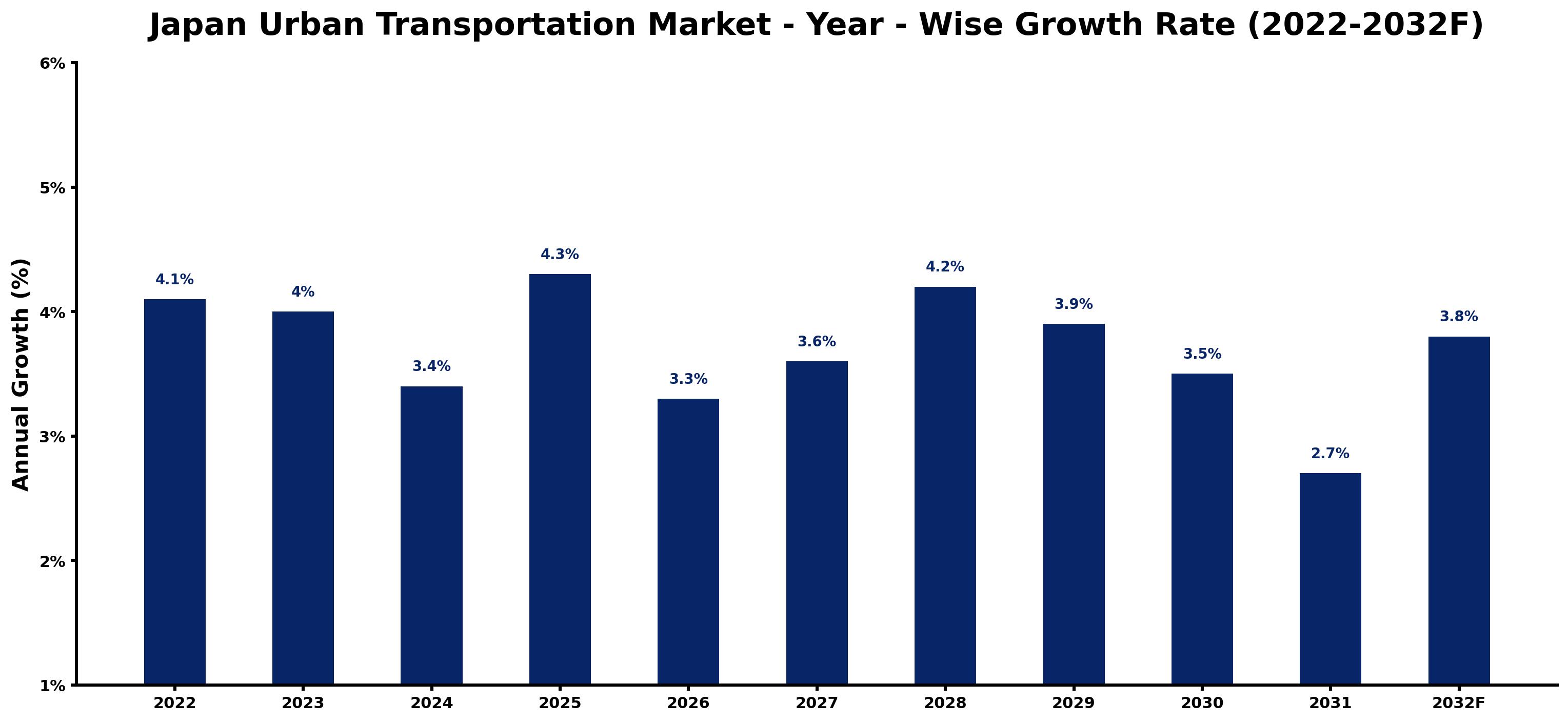
The yearly estimates that follow link every growth rate to its principal driver, so readers can see why the pace changed in each period.
| Year | Estimated Annual Growth (%) | Market Rationale |
| 2022 | 4.1 | The market exhibited strong demand due to urban population growth and reliance on public transit systems. |
| 2023 | 4.0 | Growth slowed as urban transportation systems adjusted to evolving commuting patterns. |
| 2024 | 3.4 | Demand continued to slow as electric vehicle adoption stabilised and infrastructure developed. |
| 2025 | 4.3 | Growth accelerated again, driven by increased public transit usage and electric vehicle sales. |
| 2026 | 3.3 | A slowdown is expected as the market stabilises following heightened electric vehicle registrations. |
| 2027 | 3.6 | Growth is projected to resume as urban areas expand their public transport networks and services. |
| 2028 | 4.2 | Demand is expected to peak with investments in infrastructure and electric vehicle incentives. |
| 2029 | 3.9 | A slowdown is anticipated as the market adjusts to new transportation technologies and user preferences. |
| 2030 | 3.5 | Growth is projected to slow further as urban transportation systems face capacity challenges. |
| 2031 | 2.7 | The market is expected to continue growing at a slower pace due to evolving commuter habits. |
| 2032 | 3.8 | Growth is projected to accelerate again as urban mobility solutions diversify and expand. |
Note: Market size estimations and growth projections presented in this report are based on 6Wresearch's proprietary forecasting methodology, utilizing the latest available industry data, government publications, and primary research inputs.
Japan Urban Transportation Market Synopsis
Urban transportation in Japan encompasses various modes including public transit, ride-hailing, and micro-mobility solutions, driven by advanced technology and sustainability efforts. The Tokyo Metro operates over 290 km of subway lines, serving approximately 8 million passengers daily. The Japan Urban Transportation Market is expanding due to rising urban populations, increased electric vehicle adoption, and government initiatives aimed at improving public transit infrastructure, targeting a 20% electric vehicle share by 2025 and improving overall transport efficiency.
Market Dynamics Impact Analysis (2026–2032)
| Factor | Type | Impact | Primary Segment Affected |
| Growing urban population and commuter reliance on public transit | Driver | High | Public Transit |
| Increased adoption of electric vehicles and sustainability initiatives | Driver | High | Electric/Diesel |
| Expansion of micro-mobility solutions in urban areas | Opportunity | Medium | Micro-Mobility |
| Investment in electric vehicle infrastructure and subsidies | Opportunity | High | Electric/Diesel |
| Infrastructure constraints limiting service expansion | Restraint | High | Public Transit |
| Competition from ride-hailing services affecting public transit usage | Restraint | Medium | Ride-Hailing |
| High costs associated with electric vehicle infrastructure development | Challenge | High | Electric/Diesel |
| Regulatory hurdles in implementing new transportation technologies | Challenge | Medium | Micro-Mobility |
Evaluation of Drivers in Japan Urban Transportation Market (2026–2032)
The main growth drivers and the segments they affect most are set out below.
| Drivers | Primary Segment Affected | Why It Matters (Evidence) |
| Increased public transit usage due to urban population growth | Public Transit | Tokyo's population exceeds 37 million, driving demand for efficient transport solutions. |
| Rising electric vehicle registrations supported by government incentives | Electric/Diesel | In 2022, registered electric vehicles in Japan surpassed 300,000 units, boosting purchases. |
| Growing popularity of ride-hailing services in urban areas | Ride-Hailing | User adoption of ride-hailing has increased by 15% since 2021, reflecting changing preferences. |
| Expansion of micro-mobility solutions for short-distance travel | Micro-Mobility | The government launched a program in 2023 to promote micro-mobility in urban settings. |
| Investment in electric vehicle infrastructure by local governments | Electric/Diesel | Tokyo Metropolitan Government initiated a subsidy program for electric vehicle purchases. |
Behind the steady rise in orders sits the increasing public transit usage, leading to heightened demand for efficient transport solutions. In 2022, electric vehicle registrations surpassed 300,000 units, supported by incentives that encourage purchases. The popularity of ride-hailing services has surged, with a 15% increase in user adoption since 2021, reflecting changing commuter preferences. Local governments are investing in electric vehicle infrastructure, improving urban transportation options and meeting user needs.
Evaluation of Restraints in Japan Urban Transportation Market
Below are the constraints most often cited by buyers and suppliers, with the segment each affects.
| Market Restraint | Primary Segment Affected | Why It Matters (Evidence) |
| Infrastructure constraints limiting service expansion | Public Transit | Japan's urban transport systems face capacity challenges, restricting service improvements. |
| Competition from ride-hailing services affecting public transit usage | Ride-Hailing | Ride-hailing services are drawing users away from traditional public transport options. |
| High costs associated with electric vehicle infrastructure development | Electric/Diesel | Developing necessary infrastructure for electric vehicles incurs considerable financial burdens. |
| Regulatory hurdles in implementing new transportation technologies | Micro-Mobility | Strict regulations can delay the introduction of new transport solutions. |
| Limited consumer awareness regarding micro-mobility options | Micro-Mobility | Many potential users remain unaware of the benefits and availability of micro-mobility solutions. |
Japan Urban Transportation Market Challenges
Urban transportation buyers face outdated technology, with many systems relying on legacy infrastructure, delaying services for over 8 million daily commuters. Intense competition among public transit operators leads to lower fares, which reduces profitability and limits investment in necessary upgrades. Supply chain issues arise from the dependence on imported components for electric vehicles, causing production delays and increasing costs for manufacturers. Buyers encounter limited ride-hailing options due to regulatory restrictions, resulting in longer wait times and decreased convenience for urban users.
Trends in the Japan Urban Transportation Market
Several trends are reshaping the Japan Urban Transportation Market; the most important are set out below.
- Shift towards Electric and Hybrid Vehicles: The trend towards electric and hybrid vehicles has accelerated, with over 300,000 registered electric vehicles in Japan as of 2022. This shift reflects a growing commitment to sustainability in urban transportation.
- Transition from Traditional Public Transit to Micro-Mobility Solutions: Since 2023, urban areas have increasingly adopted micro-mobility solutions, with government programs promoting their use. This transition is reshaping urban transport, catering to short-distance travel needs.
- Emergence of Dynamic Routing in Urban Transport: Dynamic routing has gained traction since 2026, enhancing flexibility in urban transport. This approach allows for more responsive service based on real-time demand, improving user experience.
- Increased Adoption of Ride-Hailing Services: The rise in ride-hailing services has been notable since 2021, with a 15% increase in user adoption. This trend indicates a shift in consumer preferences towards convenience and flexibility.
Investment Opportunities in the Japan Urban Transportation Market
The following areas offer the clearest openings for investors and suppliers in the Japan Urban Transportation Market.
- Investment in Electric Vehicle Infrastructure: The Tokyo Metropolitan Government's subsidy program for electric vehicle purchases creates a major opportunity for infrastructure investment. With over 300,000 registered electric vehicles, suppliers can meet growing demand for charging stations and support services.
- Expansion of Micro-Mobility Solutions in Urban Areas: The 2023 government initiative to promote micro-mobility solutions presents a timely opportunity for investment. Urban areas are increasingly looking for sustainable transport options to cater to short-distance travel needs, enhancing local mobility.
- Development of Dynamic Routing Technologies: With the rise of dynamic routing, there is a gap in technology solutions. Suppliers can invest in software and platforms to improve urban transport flexibility and efficiency, meeting evolving commuter demands.
- Enhancing Public Transit Systems: The ongoing urban population growth, exceeding 37 million in Tokyo, necessitates improvements in public transit. Investment in infrastructure and services can effectively meet the increasing demand for reliable transportation.
Government Initiatives in the Japan Urban Transportation Market
The Hydrogen Society Promotion Act, introduced in 2024, supports low-carbon hydrogen and ammonia supply chains, adding to existing laws like the Electrical Appliance and Material Safety Act. This measure encourages producers to invest in sustainable technologies and ensures safety standards for electric vehicles. The Act aims to facilitate the transition towards cleaner energy sources and reduce carbon emissions in urban transportation while promoting innovative solutions.
The Ministry of Land, Infrastructure, Transport and Tourism oversees urban transportation regulations, approving projects that improve public transit systems and fund initiatives aimed at increasing electric vehicle adoption. This agency plays a significant role in ensuring compliance with safety standards and promoting efficient transport solutions, benefiting both producers and consumers.
Future Insight of the Japan Urban Transportation Market
By 2032, urban transportation will evolve as public transit systems enhance efficiency and reliability for users. The number of registered electric vehicles will surpass 1 million, supported by government incentives and growing consumer demand. New government programmes will promote micro-mobility solutions, addressing congestion in urban areas. Stricter environmental standards will push suppliers to adopt sustainable practices, leading to cleaner transportation options.
Market Segmentation Analysis
Japan Urban Transportation Market report covers a detailed analysis of the following market segments:
By Transportation Mode – Public Transit Leads, Micro-Mobility Expected to Grow Fastest
According to Saurav Kr Singh, Senior Research Analyst at 6Wresearch, Public Transit took 34% of transportation mode revenue in 2025, more than any other category. Public transit is the backbone of urban transportation in Japan, with extensive networks like Tokyo Metro serving millions daily. This established infrastructure meets the commuting needs of a large population, particularly in densely populated areas such as Tokyo. The quickest growth will come from Micro-Mobility, forecast to expand at a CAGR of 4.6% between 2026 and 2032. Micro-mobility solutions are gaining traction due to the government's recent programme promoting their use in urban areas. This shift towards short-distance travel options aligns with the increasing demand for sustainable transportation alternatives. Suppliers should focus on developing micro-mobility solutions to cater to the evolving preferences of urban commuters.
By Fuel Type – Electric/Diesel Leads, Battery Expected to Grow Fastest
In 2025, Electric/Diesel led the fuel type split with a 44% share. Electric and diesel fuels dominate urban transportation, particularly in public transit systems and commercial vehicles, ensuring reliability and efficiency. The substantial number of registered electric vehicles indicates a strong market presence for these fuel types. Over 2026–2032, Battery is expected to post the fastest growth, at a CAGR of 5.4%. Battery technology is rapidly advancing, particularly in electric vehicles and scooters, attracting attention from both consumers and manufacturers. The government's goal to increase electric vehicle adoption further fuels this growth. Buyers should consider investing in battery technology to stay ahead in the competitive urban transportation market.
By Network Type – Fixed Routes Lead, Dynamic Routes Expected to Grow Fastest
With 38% of network type revenue in 2025, Fixed Routes was the largest category. Fixed routes are the standard for public transportation systems, providing structured and reliable service to commuters across major cities. This established model ensures consistent access to transit options for a large user base. Dynamic Routes are projected to grow fastest, at a CAGR of 5.0% during 2026–2032. Dynamic routes are becoming increasingly popular, particularly in ride-hailing services, as they offer flexibility and convenience to users. The rise in user adoption of these services indicates a shift towards more adaptable transit solutions. Suppliers must adapt their offerings to include dynamic routing options to meet changing consumer demands.
By End User – Commuters Lead, App Users Expected to Grow Fastest
The largest end user category in 2025 was Commuters, at 45% of revenue. Commuters represent the largest segment of public transport users, relying on systems like Tokyo Metro for their daily travel needs. This extensive network serves around 8 million passengers each day, reinforcing their significant share in the market. App Users are set to record the highest CAGR in this split, 4.7% over 2026–2032. App users are rapidly increasing, particularly as ride-hailing services see a 15% rise in adoption since 2021 among urban dwellers. This trend indicates a shift towards more convenient transportation options, suggesting that the lead of commuters will continue to grow as technology integrates further into daily travel. This trend indicates that suppliers should prioritise developing user-friendly applications to capture the interest of the growing urban commuter population.
Key Attractiveness of the Report
- 10 Years of Market Numbers
- Historical Data Starting from 2022 to 2025
- Base Year 2025
- Forecast Data until 2032
- Key Performance Indicators Impacting the Market
- Major Upcoming Developments and Projects
Key Highlights of the Report:
- Japan Urban Transportation Market Outlook
- Market Size of Japan Urban Transportation Market, 2025
- Forecast of Japan Urban Transportation Market, 2032
- Historical Data and Forecast of Japan Urban Transportation Revenues & Volume for the Period 2022-2032F
- Japan Urban Transportation Market Trend Evolution
- Japan Urban Transportation Market Drivers and Challenges
- Japan Urban Transportation Price Trends
- Japan Urban Transportation Porter's Five Forces
- Japan Urban Transportation Industry Life Cycle
- Historical Data and Forecast of Japan Urban Transportation Market Revenues & Volume By Transportation Mode for the Period 2022-2032F
- Historical Data and Forecast of Japan Urban Transportation Market Revenues & Volume By Public Transit for the Period 2022-2032F
- Historical Data and Forecast of Japan Urban Transportation Market Revenues & Volume By Ride-Hailing for the Period 2022-2032F
- Historical Data and Forecast of Japan Urban Transportation Market Revenues & Volume By Micro-Mobility for the Period 2022-2032F
- Historical Data and Forecast of Japan Urban Transportation Market Revenues & Volume By Private Transport for the Period 2022-2032F
- Historical Data and Forecast of Japan Urban Transportation Market Revenues & Volume By Fuel Type for the Period 2022-2032F
- Historical Data and Forecast of Japan Urban Transportation Market Revenues & Volume By Electric/Diesel for the Period 2022-2032F
- Historical Data and Forecast of Japan Urban Transportation Market Revenues & Volume By Gasoline/Electric for the Period 2022-2032F
- Historical Data and Forecast of Japan Urban Transportation Market Revenues & Volume By Battery for the Period 2022-2032F
- Historical Data and Forecast of Japan Urban Transportation Market Revenues & Volume By Hybrid Vehicles for the Period 2022-2032F
- Historical Data and Forecast of Japan Urban Transportation Market Revenues & Volume By Network Type for the Period 2022-2032F
- Historical Data and Forecast of Japan Urban Transportation Market Revenues & Volume By Fixed Routes for the Period 2022-2032F
- Historical Data and Forecast of Japan Urban Transportation Market Revenues & Volume By Dynamic Routes for the Period 2022-2032F
- Historical Data and Forecast of Japan Urban Transportation Market Revenues & Volume By Shared for the Period 2022-2032F
- Historical Data and Forecast of Japan Urban Transportation Market Revenues & Volume By Self-Owned for the Period 2022-2032F
- Historical Data and Forecast of Japan Urban Transportation Market Revenues & Volume By End User for the Period 2022-2032F
- Historical Data and Forecast of Japan Urban Transportation Market Revenues & Volume By Commuters for the Period 2022-2032F
- Historical Data and Forecast of Japan Urban Transportation Market Revenues & Volume By App Users for the Period 2022-2032F
- Historical Data and Forecast of Japan Urban Transportation Market Revenues & Volume By Students, Workers for the Period 2022-2032F
- Historical Data and Forecast of Japan Urban Transportation Market Revenues & Volume By Households for the Period 2022-2032F
- Japan Urban Transportation Import Export Trade Statistics
- Market Opportunity Assessment By Transportation Mode
- Market Opportunity Assessment By Fuel Type
- Market Opportunity Assessment By Network Type
- Market Opportunity Assessment By End User
- Japan Urban Transportation Top Companies Market Share
- Japan Urban Transportation Competitive Benchmarking By Technical and Operational Parameters
- Japan Urban Transportation Company Profiles
- Japan Urban Transportation Key Strategic Recommendations
Market Covered
Segments analysed in this report are listed below.
By Transportation Mode
- Public Transit
- Ride-Hailing
- Micro-Mobility
- Private Transport
By Fuel Type
- Electric/Diesel
- Gasoline/Electric
- Battery
- Hybrid Vehicles
By Network Type
- Fixed Routes
- Dynamic Routes
- Shared
- Self-Owned
By End User
- Commuters
- App Users
- Students
- Workers
- Households































