Japan Urea & Ammonia-Based Fertilizer Market Size & Growth Rate
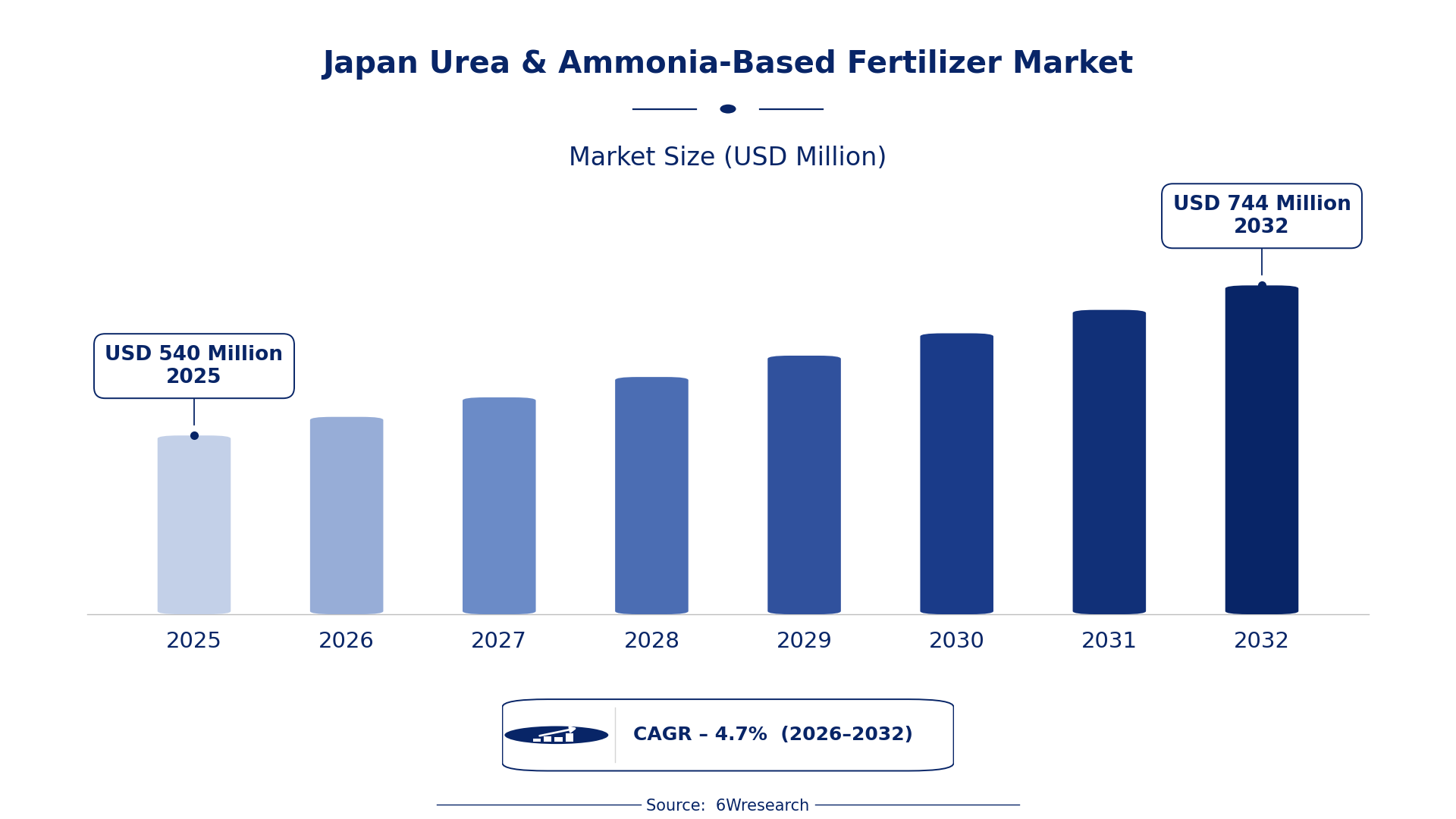
According to 6Wresearch internal database and industry insights, the Japan Urea & Ammonia-Based Fertilizer Market was valued at USD 540 Million in 2025 and is projected to reach USD 744 Million by 2032, growing at a CAGR of approximately 4.7% during 2026–2032.
Japan Urea & Ammonia-Based Fertilizer Market Highlights
| Report Metric | Details |
| Report Name | Japan Urea & Ammonia-Based Fertilizer Market (2026-2032) |
| Market Size 2025 | USD 540 Million |
| Market Size 2032 | USD 744 Million |
| Absolute Growth 2025–2032 | USD 204 Million |
| CAGR 2026–2032 | 4.7% |
| Peak Annual Growth | 5.4% in 2032 |
| Forecast Period | 2026–2032 |
| Historical Data | 2022–2025 |
| Base Year | 2025 |
| Leading Fertilizer Type, 2025 | Urea Granules (37% share) |
| Leading Application Method, 2025 | Broadcast Spreading (42% share) |
| Leading Crop Type, 2025 | Cereal Crops (46% share) |
| Leading End User, 2025 | Large Farms (47% share) |
| Fastest-Growing Fertilizer Type | Coated Urea (6.6% CAGR) |
| Fastest-Growing Application Method | Drip Fertigation (6.3% CAGR) |
| Fastest-Growing Crop Type | Fruits & Vegetables (6.8% CAGR) |
| Fastest-Growing End User | Greenhouse Growers (6.4% CAGR) |
| Growing Sector | Agriculture |
| Key End Users | Large Farms, Greenhouse Growers, Precision Farmers, Irrigated Farms |
Japan Urea & Ammonia-Based Fertilizer Market Year-wise Growth Rate and Key Drivers (2022–2032)
This graph illustrates the annual growth rates of the market from 2022 to 2032, highlighting a steady upward trajectory and projected market expansion over the forecast period.
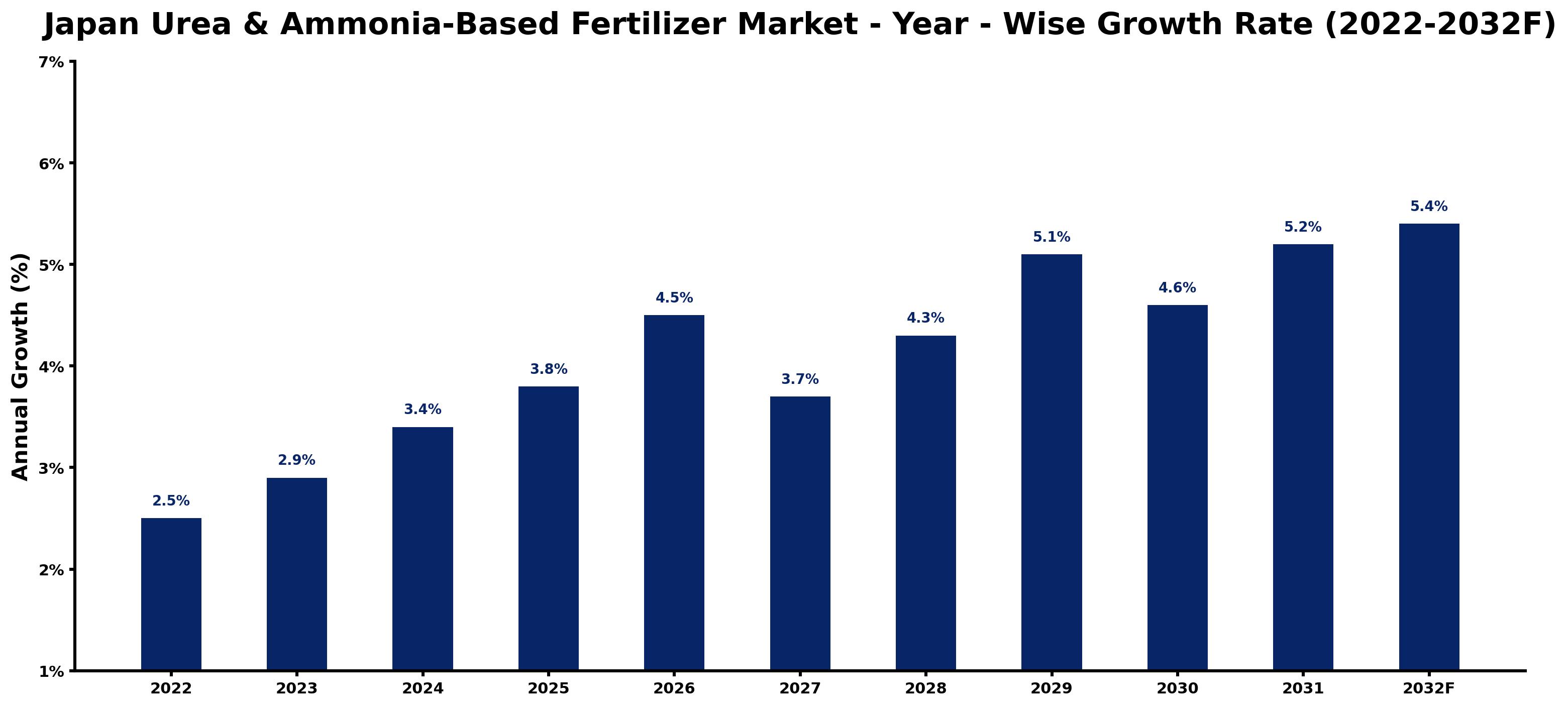
The following figures match every annual growth estimate with the main market development of that year, giving the reasoning behind each rise or slowdown.
| Year | Estimated Annual Growth (%) | Market Rationale |
| 2022 | 2.5 | The market showed stable demand from agricultural producers in Japan. |
| 2023 | 2.9 | Demand increased due to improved crop yields and agricultural practices. |
| 2024 | 3.4 | Growth continued as farmers adopted more efficient fertilizer application methods. |
| 2025 | 3.8 | The market reached a peak growth rate, driven by rising agricultural output. |
| 2026 | 4.5 | A surge in investment in sustainable farming practices is expected to support growth. |
| 2027 | 3.7 | Growth is projected to slow slightly as market saturation begins to set in. |
| 2028 | 4.3 | Demand is expected to pick up again with new technologies in fertilizer application. |
| 2029 | 5.1 | Focus on high-yield crops will boost fertilizer consumption significantly. |
| 2030 | 4.6 | Growth is projected to moderate as the market adjusts to previous highs. |
| 2031 | 5.2 | Demand will rise again as large farms expand their operations. |
| 2032 | 5.4 | The market is expected to peak, driven by advancements in fertilizer technology. |
Note: Market size estimations and growth projections presented in this report are based on 6Wresearch's proprietary forecasting methodology, utilizing the latest available industry data, government publications, and primary research inputs.
Japan Urea & Ammonia-Based Fertilizer Market Synopsis
Urea and ammonia-based fertilizers play a crucial role in boosting crop yields in agriculture, primarily produced through the synthesis of ammonia and carbon dioxide. The Japan Urea & Ammonia-Based Fertilizer Market is growing due to increasing demand from large-scale farms and greenhouse operations, with the average farm size around 1.5 hectares. Government initiatives support sustainable agriculture, such as the Hydrogen Society Promotion Act, while the total area under cultivation is approximately 4.5 million hectares, ensuring consistent demand for fertilizers.
Market Dynamics Impact Analysis (2026–2032)
| Factor | Type | Impact | Primary Segment Affected |
| Rising adoption of precision farming techniques | Driver | High | Drip Fertigation |
| Increased focus on sustainable agricultural practices | Driver | High | Urea Granules |
| Growing demand for high-yield crops | Opportunity | High | Fruits & Vegetables |
| Expansion of greenhouse operations | Opportunity | Medium | Greenhouse Growers |
| Regulatory compliance costs for producers | Restraint | High | Urea Granules |
| Limited availability of certain fertilizer types | Restraint | Medium | Ammonium Nitrate |
| High production costs affecting profitability | Challenge | High | Urea-Ammonium Nitrate (UAN) |
| Competition from imported fertilizers | Challenge | Medium | Coated Urea |
Evaluation of Drivers in Japan Urea & Ammonia-Based Fertilizer Market (2026–2032)
The factors lifting demand, and the evidence behind each, are summarised below.
| Drivers | Primary Segment Affected | Why It Matters (Evidence) |
| Increased investment in precision farming | Drip Fertigation | This method improves nutrient delivery efficiency, leading to higher crop yields in regions like Hokkaido. |
| Growing awareness of sustainable agriculture | Urea Granules | Farmers are adopting eco-friendly practices, with urea used in rice paddies accounting for 40% of nitrogen applications. |
| Rising production of horticultural crops | Ammonium Nitrate | This fertilizer is essential for 30% of horticultural crop production, particularly in Tohoku. |
| Expansion of large-scale farming operations | Cereal Crops | With an average farm size of 1.5 hectares, larger farms are increasing fertilizer purchases. |
| Government subsidies for fertilizer use | Urea-Ammonium Nitrate (UAN) | In 2023, ¥10 billion was allocated for fertilizer subsidies, boosting demand. |
What keeps demand rising is the increasing investment in precision farming techniques, particularly in regions like Hokkaido, which improves nutrient delivery efficiency. In 2022, urea was used in rice paddies, accounting for a significant portion of nitrogen applications, reflecting a growing awareness of sustainable practices. The production of horticultural crops is also rising, with ammonium nitrate being essential for this sector in Tohoku. As large-scale farming operations expand, the average farm size leads to increased fertilizer purchases.
Evaluation of Restraints in Japan Urea & Ammonia-Based Fertilizer Market
The main factors holding the market back are set out below.
| Market Restraint | Primary Segment Affected | Why It Matters (Evidence) |
| High production costs due to raw material prices | Urea Granules | Producers face increased costs, affecting pricing strategies and profitability. |
| Regulatory compliance affecting supply chain efficiency | Ammonium Nitrate | Strict regulations cause delays in distribution, impacting market responsiveness. |
| Limited availability of certain fertilizer types | Coated Urea | Supply constraints hinder farmers' access to necessary fertilizers. |
| Market saturation in some agricultural regions | Urea-Ammonium Nitrate (UAN) | Increased competition limits growth potential for established products. |
| Environmental regulations impacting production methods | Drip Fertigation | Producers must invest in compliance, raising operational costs. |
Japan Urea & Ammonia-Based Fertilizer Market Challenges
High skill gaps in the workforce impede producers from adopting efficient fertilizer application techniques, resulting in lower crop yields for farmers. Stringent regulations under the Fertilizer Control Law create compliance challenges, causing delays of up to six months in product availability for agricultural producers. Slow adoption of advanced technologies, such as controlled release fertilizers, raises operational costs for large-scale farms, which can diminish profit margins. Disruptions in the supply chain, particularly through the Japan Agricultural Cooperatives, can delay fertilizer deliveries, affecting planting schedules for farmers in Hokkaido and Tohoku regions.
Trends in the Japan Urea & Ammonia-Based Fertilizer Market
Four trends stand out in the Japan Urea & Ammonia-Based Fertilizer Market.
- Shift towards Controlled Release Fertilizers: The trend towards controlled release fertilizers began in 2022 as precision farmers sought improved nutrient availability. This shift is evident in regions like Kanto, where adoption rates have increased significantly.
- Transition from Traditional to Precision Farming: Since 2023, precision farming techniques have gained traction among large farms, particularly in Hokkaido, resulting in a notable increase in fertilizer efficiency.
- Emergence of Sustainable Practices in Agriculture: The Hydrogen Society Promotion Act, enacted in 2024, has prompted farmers to adopt more sustainable practices, resulting in a rise in organic fertilizer use.
- Growing Demand for Horticultural Crops: The focus on horticultural crops has intensified since 2024, with farmers in Tohoku increasing fertilizer application to meet rising consumer demand.
Investment Opportunities in the Japan Urea & Ammonia-Based Fertilizer Market
Investors looking at the Japan Urea & Ammonia-Based Fertilizer Market should consider the following areas.
- Investment in Sustainable Fertilizer Solutions: With the government allocating ¥10 billion for fertilizer subsidies in 2023, there is an opportunity to invest in sustainable fertilizer solutions, particularly for large farms.
- Expansion of Greenhouse Operations: The increase in greenhouse operations presents an opportunity to supply specialized fertilizers, particularly in regions like Kanto, where demand has surged.
- Development of Controlled Release Fertilizers: The market for controlled release fertilizers is growing, offering opportunities for producers to innovate and capture market share.
- Collaboration with Agricultural Cooperatives: Partnering with the Japan Agricultural Cooperatives (JA) can facilitate entry into the fertilizer market, utilising their extensive distribution networks.
Government Initiatives in the Japan Urea & Ammonia-Based Fertilizer Market
The Industrial Standardization Act, established in 1949 and amended in 2019, governs the quality standards for fertilizers in Japan. Compliance with these standards is essential for producers to ensure product safety and efficacy, impacting market competitiveness. Additionally, the Act against Unjustifiable Premiums and Misleading Representations regulates the distribution of fertilizers, ensuring that products meet safety and quality requirements, which is vital for maintaining consumer trust.
The Hydrogen Society Promotion Act enables buyers to access subsidies for sustainable fertilizers, enhancing their purchasing power and promoting environmentally friendly practices in agriculture. The Ministry of Agriculture allocated ¥10 billion for fertilizer subsidies in 2023, supporting farmers in adopting these practices.
Future Insight of the Japan Urea & Ammonia-Based Fertilizer Market
Investment in agricultural technology will surge, driven by government initiatives aimed at enhancing crop productivity, creating demand for advanced fertilizer solutions. The adoption of ISO 14001 standards will compel suppliers to improve their environmental practices, aligning with sustainable agriculture goals. The total area under cultivation is projected to rise, necessitating innovations in fertilizer technology to support increased agricultural output. As precision farming becomes more prevalent, buyers will benefit from improved crop yields and enhanced resource efficiency.
Market Segmentation Analysis
Japan Urea & Ammonia-Based Fertilizer Market report covers a detailed analysis of the following market segments:
By Fertilizer Type – Urea Granules Lead, Coated Urea Expected to Grow Fastest
According to Saurav Kr Singh, Senior Research Analyst at 6Wresearch, Urea Granules took 37% of fertilizer type revenue in 2025, more than any other category. Urea Granules hold the largest share due to their widespread use across various crops, particularly in rice paddies. This segment benefits from a strong installed base, with approximately 4 million tons produced in Japan in 2022. The quickest growth will come from Coated Urea, forecast to expand at a CAGR of 6.6% between 2026 and 2032. Coated Urea is experiencing rapid growth as precision farming techniques gain popularity, allowing for controlled nutrient release. This method is increasingly adopted by farmers seeking to optimise crop yields while minimising environmental impact. Suppliers should focus on developing coated products to meet the rising demand for precision agriculture.
By Application Method – Broadcast Spreading Leads, Drip Fertigation Expected to Grow Fastest
The largest application method category in 2025 was Broadcast Spreading, at 42% of revenue. Broadcast Spreading is the leading application method as it is commonly employed for distributing fertilizers across large areas. Its simplicity and effectiveness make it a preferred choice among agricultural producers in Japan. Drip Fertigation is set to record the highest CAGR in this split, 6.3% over 2026–2032. Drip Fertigation is the fastest-growing method, driven by its efficiency in delivering water and nutrients directly to plants. This approach is particularly appealing to farmers looking to maximise resource use in limited water scenarios. Buyers may need to invest in advanced application technologies to improve efficiency and crop yields.
By Crop Type – Cereal Crops Lead, Fruits & Vegetables Expected to Grow Fastest
With 46% of crop type revenue in 2025, Cereal Crops was the largest category. Cereal Crops dominate the market due to their essential role in food production across Japan, with extensive cultivation in regions such as Hokkaido and Tohoku. This segment's strong presence is supported by the significant nitrogen use in rice paddies, which are vital for maintaining yields. Over 2026–2032, Fruits & Vegetables are expected to post the fastest growth, at a CAGR of 6.8%. Fruits & Vegetables are seeing rapid growth as consumer preferences shift towards fresh produce and health-oriented diets. The increasing demand for high-quality, nutritious food is propelling this segment forward, creating opportunities for suppliers. Suppliers should tailor their offerings to meet the specific nutritional needs of high-value crops to capitalise on market trends.
By End User – Large Farms Lead, Greenhouse Growers Expected to Grow Fastest
In 2025, Large Farms led the end user split with a 47% share. Large Farms are the primary consumers of fertilizers, driven by their expansive operations and high input requirements for crop production. Their significant contribution to the agricultural sector ensures a steady demand for urea and ammonia-based fertilizers. Greenhouse Growers are projected to grow fastest, at a CAGR of 6.4% during 2026–2032. Greenhouse Growers are the fastest-growing end user segment, as they utilise fertilizers intensively to optimise growth in controlled environments. The rising popularity of greenhouse farming is significantly contributing to this segment's rapid expansion. Suppliers need to focus on the unique needs of greenhouse operations to effectively engage with this growing market.
Key Attractiveness of the Report
- 10 Years of Market Numbers
- Historical Data Starting from 2022 to 2025
- Base Year 2025
- Forecast Data until 2032
- Key Performance Indicators Impacting the Market
- Major Upcoming Developments and Projects
Key Highlights of the Report:
- Japan Urea & Ammonia-Based Fertilizer Market Outlook
- Market Size of Japan Urea & Ammonia-Based Fertilizer Market, 2025
- Forecast of Japan Urea & Ammonia-Based Fertilizer Market, 2032
- Historical Data and Forecast of Japan Urea & Ammonia-Based Fertilizer Revenues & Volume for the Period 2022-2032F
- Japan Urea & Ammonia-Based Fertilizer Market Trend Evolution
- Japan Urea & Ammonia-Based Fertilizer Market Drivers and Challenges
- Japan Urea & Ammonia-Based Fertilizer Price Trends
- Japan Urea & Ammonia-Based Fertilizer Porter's Five Forces
- Japan Urea & Ammonia-Based Fertilizer Industry Life Cycle
- Historical Data and Forecast of Japan Urea & Ammonia-Based Fertilizer Market Revenues & Volume By Fertilizer Type for the Period 2022-2032F
- Historical Data and Forecast of Japan Urea & Ammonia-Based Fertilizer Market Revenues & Volume By Urea Granules for the Period 2022-2032F
- Historical Data and Forecast of Japan Urea & Ammonia-Based Fertilizer Market Revenues & Volume By Ammonium Nitrate for the Period 2022-2032F
- Historical Data and Forecast of Japan Urea & Ammonia-Based Fertilizer Market Revenues & Volume By Urea-Ammonium Nitrate (UAN) for the Period 2022-2032F
- Historical Data and Forecast of Japan Urea & Ammonia-Based Fertilizer Market Revenues & Volume By Coated Urea for the Period 2022-2032F
- Historical Data and Forecast of Japan Urea & Ammonia-Based Fertilizer Market Revenues & Volume By Application Method for the Period 2022-2032F
- Historical Data and Forecast of Japan Urea & Ammonia-Based Fertilizer Market Revenues & Volume By Broadcast Spreading for the Period 2022-2032F
- Historical Data and Forecast of Japan Urea & Ammonia-Based Fertilizer Market Revenues & Volume By Spray Application for the Period 2022-2032F
- Historical Data and Forecast of Japan Urea & Ammonia-Based Fertilizer Market Revenues & Volume By Drip Fertigation for the Period 2022-2032F
- Historical Data and Forecast of Japan Urea & Ammonia-Based Fertilizer Market Revenues & Volume By Controlled Release for the Period 2022-2032F
- Historical Data and Forecast of Japan Urea & Ammonia-Based Fertilizer Market Revenues & Volume By Crop Type for the Period 2022-2032F
- Historical Data and Forecast of Japan Urea & Ammonia-Based Fertilizer Market Revenues & Volume By Cereal Crops for the Period 2022-2032F
- Historical Data and Forecast of Japan Urea & Ammonia-Based Fertilizer Market Revenues & Volume By Horticultural Crops for the Period 2022-2032F
- Historical Data and Forecast of Japan Urea & Ammonia-Based Fertilizer Market Revenues & Volume By Fruits & Vegetables for the Period 2022-2032F
- Historical Data and Forecast of Japan Urea & Ammonia-Based Fertilizer Market Revenues & Volume By Rice & Paddy Fields for the Period 2022-2032F
- Historical Data and Forecast of Japan Urea & Ammonia-Based Fertilizer Market Revenues & Volume By End User for the Period 2022-2032F
- Historical Data and Forecast of Japan Urea & Ammonia-Based Fertilizer Market Revenues & Volume By Large Farms for the Period 2022-2032F
- Historical Data and Forecast of Japan Urea & Ammonia-Based Fertilizer Market Revenues & Volume By Greenhouse Growers for the Period 2022-2032F
- Historical Data and Forecast of Japan Urea & Ammonia-Based Fertilizer Market Revenues & Volume By Irrigated Farms for the Period 2022-2032F
- Historical Data and Forecast of Japan Urea & Ammonia-Based Fertilizer Market Revenues & Volume By Precision Farmers for the Period 2022-2032F
- Japan Urea & Ammonia-Based Fertilizer Import Export Trade Statistics
- Market Opportunity Assessment By Fertilizer Type
- Market Opportunity Assessment By Application Method
- Market Opportunity Assessment By Crop Type
- Market Opportunity Assessment By End User
- Japan Urea & Ammonia-Based Fertilizer Top Companies Market Share
- Japan Urea & Ammonia-Based Fertilizer Competitive Benchmarking By Technical and Operational Parameters
- Japan Urea & Ammonia-Based Fertilizer Company Profiles
- Japan Urea & Ammonia-Based Fertilizer Key Strategic Recommendations
Market Covered
The following segment groups are covered in the report.
By Fertilizer Type
- Urea Granules
- Ammonium Nitrate
- Urea-Ammonium Nitrate (UAN)
- Coated Urea
By Application Method
- Broadcast Spreading
- Spray Application
- Drip Fertigation
- Controlled Release
By Crop Type
- Cereal Crops
- Horticultural Crops
- Fruits & Vegetables
- Rice & Paddy Fields
By End User
- Large Farms
- Greenhouse Growers
- Irrigated Farms
- Precision Farmers































