Japan Urinary Control Systems Market Size & Growth Rate
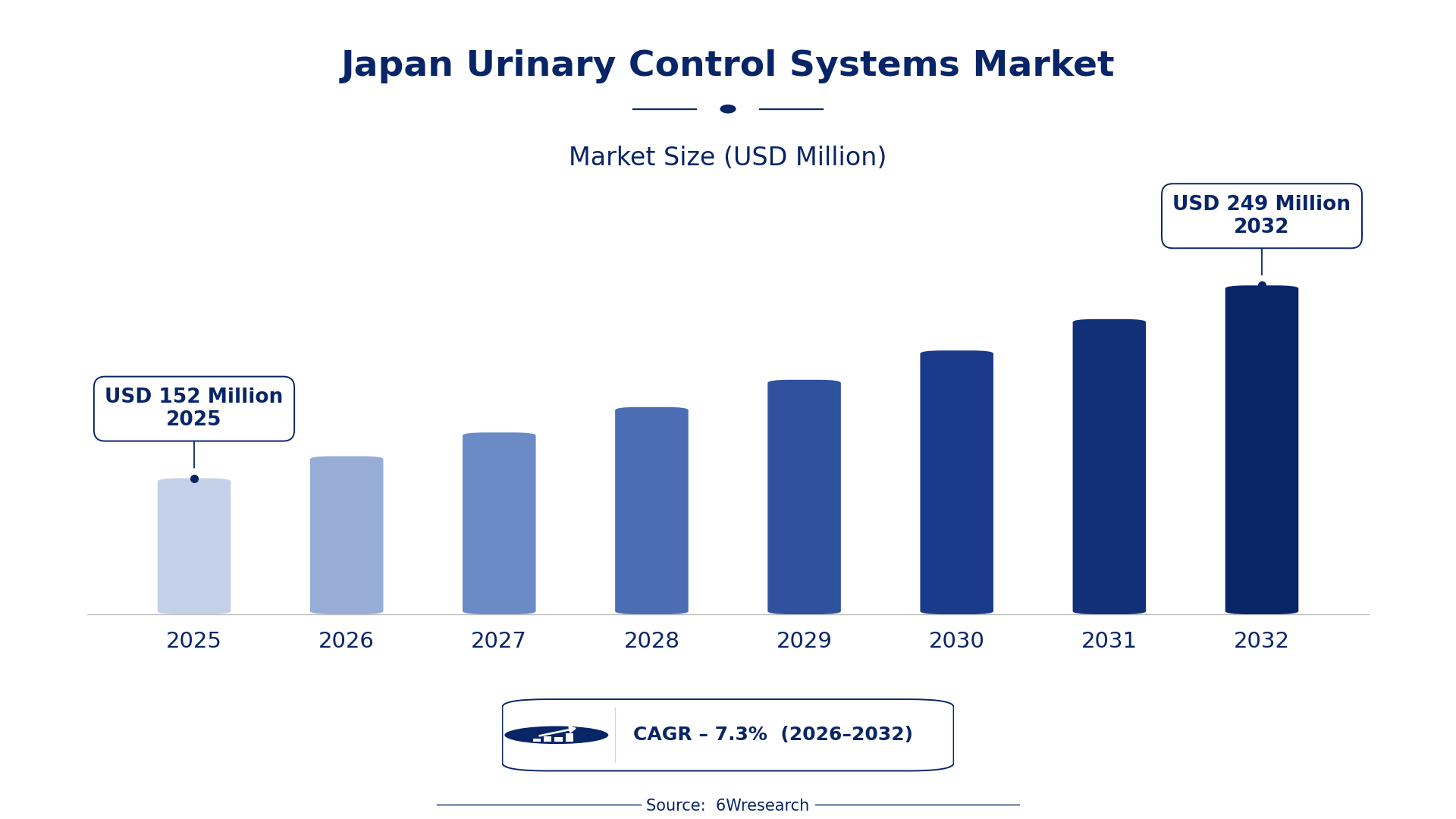
According to 6Wresearch internal database and industry insights, the Japan Urinary Control Systems Market was valued at USD 152 Million in 2025 and is projected to reach USD 249 Million by 2032, growing at a CAGR of approximately 7.3% during 2026–2032.
Japan Urinary Control Systems Market Highlights
| Report Metric | Details |
| Report Name | Japan Urinary Control Systems Market (2026-2032) |
| Market Size 2025 | USD 152 Million |
| Market Size 2032 | USD 249 Million |
| Absolute Growth 2025–2032 | USD 97 Million |
| CAGR 2026–2032 | 7.3% |
| Peak Annual Growth | 8.1% in 2030 |
| Forecast Period | 2026–2032 |
| Historical Data | 2022–2025 |
| Base Year | 2025 |
| Leading Product Type, 2025 | External Devices (41% share) |
| Leading Technology Type, 2025 | Electrical Stimulation (37% share) |
| Leading Use Condition, 2025 | Urge Incontinence (49% share) |
| Leading End User, 2025 | Elderly Patients (42% share) |
| Fastest-Growing Product Type | Internal Implants (10.2% CAGR) |
| Fastest-Growing Technology Type | Hydraulic-Controlled (10.3% CAGR) |
| Fastest-Growing Use Condition | Severe UI (9.4% CAGR) |
| Fastest-Growing End User | Urology Clinics (9.5% CAGR) |
| Growing Sector | Elderly care |
| Key End Users | Elderly Patients, Urology Clinics, Hospitals, Home Users |
Japan Urinary Control Systems Market Year-wise Growth Rate and Key Drivers (2022–2032)
This graph illustrates the annual growth rates of the market from 2022 to 2032, highlighting a steady upward trajectory and projected market expansion over the forecast period.
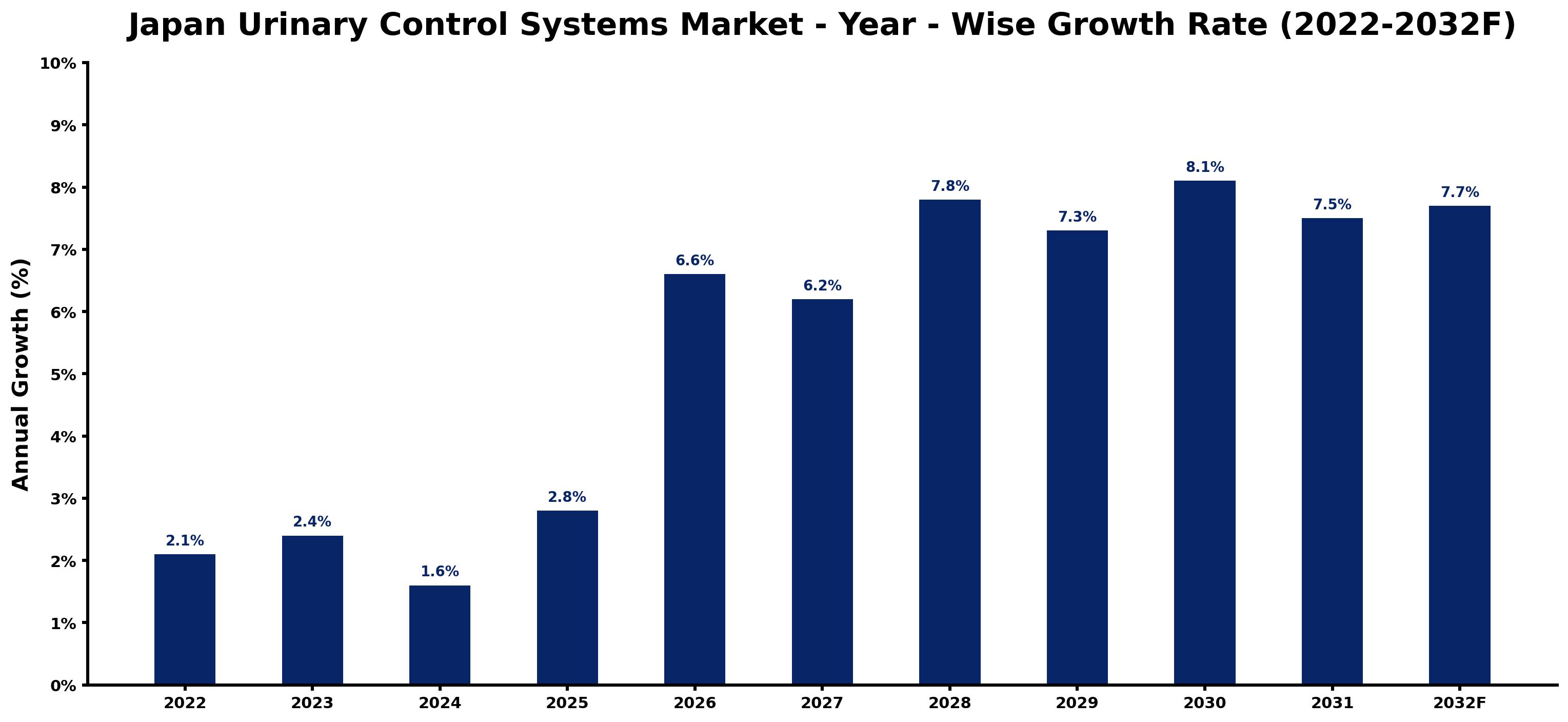
Below, each year's estimated growth is shown next to the factor that most influenced it.
| Year | Estimated Annual Growth (%) | Market Rationale |
| 2022 | 2.1 | The market experienced steady demand from healthcare facilities managing incontinence. |
| 2023 | 2.4 | Growth accelerated due to increased awareness of urinary incontinence treatments. |
| 2024 | 1.6 | Demand growth slowed as market conditions stabilised after previous increases. |
| 2025 | 2.8 | The market saw renewed interest driven by advancements in device technology. |
| 2026 | 6.6 | Growth surged as healthcare expenditure on urology surpassed 1 trillion yen. |
| 2027 | 6.2 | Demand growth moderated as the market adjusted to previous high rates. |
| 2028 | 7.8 | Investments in urology clinics are expected to boost market growth. |
| 2029 | 7.3 | Demand growth slowed as the market began to stabilise after rapid expansion. |
| 2030 | 8.1 | The market peaked with strong demand for advanced urinary control systems. |
| 2031 | 7.5 | Growth decelerated as the market adjusted to the peak demand levels. |
| 2032 | 7.7 | Continued investments in elderly care will drive sustained market growth. |
Note: Market size estimations and growth projections presented in this report are based on 6Wresearch's proprietary forecasting methodology, utilizing the latest available industry data, government publications, and primary research inputs.
Japan Urinary Control Systems Market Synopsis
Urinary Control Systems are medical devices designed to manage urinary incontinence through both external and internal solutions, particularly important for elderly patients and those recovering from surgery. The Japan Urinary Control Systems Market is growing as awareness of incontinence treatments increases, with over 5 million patients requiring solutions each year. Urology clinics and hospitals play a central role in providing these solutions, supported by government health initiatives that aim to raise treatment awareness among the elderly population. This growth results from technological advancements and demographic changes, creating a favourable environment for market development.
Market Dynamics Impact Analysis (2026–2032)
| Factor | Type | Impact | Primary Segment Affected |
| Rising elderly population | Driver | High | Elderly Patients |
| Advancements in device technology | Driver | High | Internal Implants |
| Growing demand for pelvic floor trainers | Opportunity | High | Pelvic Floor Trainers |
| Increased funding for urology healthcare | Opportunity | High | Urology Clinics |
| High costs of advanced devices | Restraint | Medium | Catheters |
| Limited awareness among some demographics | Restraint | Medium | Home Users |
| Supply chain disruptions | Challenge | High | External Devices |
| Regulatory compliance costs | Challenge | Medium | Internal Implants |
Evaluation of Drivers in Japan Urinary Control Systems Market (2026–2032)
The main growth drivers and the segments they affect most are set out below.
| Drivers | Primary Segment Affected | Why It Matters (Evidence) |
| Increased healthcare spending | Urology Clinics | Japan's healthcare expenditure on urology is projected to exceed 1 trillion yen in 2023, prompting clinics to invest in urinary control systems. |
| Growing elderly population | Elderly Patients | Approximately 30% of the elderly population in Japan experiences urinary incontinence, driving demand for effective management solutions. |
| Advancements in medical technology | Internal Implants | Innovations in device safety and effectiveness encourage hospitals to adopt new urinary control systems. |
| Government health initiatives | Urology Clinics | In 2023, initiatives to increase awareness of incontinence treatments are leading to higher patient engagement and demand. |
| Rising awareness of incontinence issues | Pelvic Floor Trainers | Urology clinics report a rising demand for pelvic floor trainers among elderly patients, improving rehabilitation efforts. |
A wider customer base explains much of the growth, as approximately 30% of the elderly population in Japan experiences urinary incontinence. This demographic drives demand for effective solutions, prompting urology clinics to invest heavily in urinary control systems. Japan's healthcare expenditure on urology is projected to exceed 1 trillion yen in 2023, further supporting this trend. Technological advancements in device safety and effectiveness are encouraging hospitals to adopt advanced internal implants.
Evaluation of Restraints in Japan Urinary Control Systems Market
The key brakes on demand, and where they bite hardest, are shown below.
| Market Restraint | Primary Segment Affected | Why It Matters (Evidence) |
| High costs of advanced devices | Catheters | The costs associated with advanced urinary control devices can limit accessibility for some healthcare facilities, particularly smaller clinics. |
| Limited awareness among some demographics | Home Users | Despite rising awareness, some elderly individuals remain unaware of available urinary control solutions, hindering market growth. |
| Supply chain disruptions | External Devices | Delays in the availability of essential urinary control systems can hinder healthcare providers from meeting patient needs. |
| Regulatory compliance costs | Internal Implants | The expenses related to meeting regulatory requirements can deter smaller manufacturers from entering the market. |
| Market saturation in urban areas | Urology Clinics | In major cities like Tokyo and Osaka, the market may face saturation, limiting growth opportunities for new entrants. |
Japan Urinary Control Systems Market Challenges
Urology clinics in Japan face fierce competition from alternative therapies for urinary incontinence, which can delay timely treatment for patients. A lack of skilled technicians hampers suppliers, resulting in production delays that may extend lead times for hospitals by up to 30%. Increasing costs of advanced materials have raised production expenses, compelling clinics to increase prices, which could deter low-income patients from accessing necessary treatments. Buyers encounter challenges due to the average hospital stay of 5 days for post-surgical patients, creating urgency for rapid access to urinary control systems to ensure comfort and recovery.
Trends in the Japan Urinary Control Systems Market
Buyers and suppliers in the Japan Urinary Control Systems Market are adjusting to the following trends.
- Focus on elderly care solutions: Urology clinics are prioritising elderly care solutions, with over 5 million patients needing urinary control annually. This shift is reflected in the increasing demand for pelvic floor trainers.
- Adoption of advanced internal implants: The adoption of advanced internal implants is becoming more common in Japan, with a projected CAGR of 10.2% for this segment, driven by technological advancements.
- Expansion of home user segment: The home user segment is expanding as more elderly patients seek personal management solutions for urinary incontinence, reflecting changing consumer preferences.
- Increased funding for urology healthcare: Government health initiatives are providing increased funding for urology healthcare, aiming to improve awareness and treatment options for urinary incontinence among the elderly.
Investment Opportunities in the Japan Urinary Control Systems Market
The following areas offer the clearest openings for investors and suppliers in the Japan Urinary Control Systems Market.
- Partnerships with urology clinics: Establishing partnerships with urology clinics is timely, as over 5 million patients require urinary control solutions annually, presenting a strong market opportunity.
- Investing in pelvic floor trainers: With a growing elderly population, investing in pelvic floor trainers offers a valuable opportunity, as urology clinics report increasing demand for these devices.
- Approval for new urinary control devices: Obtaining approval for new urinary control devices can capitalise on the expanding market, particularly among elderly patients seeking effective solutions.
- Focus on home user solutions: The rising awareness of urinary incontinence among the elderly creates an opportunity for home user solutions, with a substantial portion of the market yet to be addressed.
Government Initiatives in the Japan Urinary Control Systems Market
The Electrical Appliance and Material Safety Act regulates the safety of electrical appliances and materials in Japan, ensuring that urinary control systems meet safety standards. This measure complements the Long-Term Care Insurance Act, which funds nursing care and support services for older people, improving the overall care environment for elderly patients. The combination of these laws ensures the safety and accessibility of urinary control systems for users.
The PMDA oversees the review of medical devices, ensuring that urinary control systems are safe and effective. Additionally, AMED funds medical research and development, supporting advancements in urinary control technologies and improving the overall quality of care for patients.
Future Insight of the Japan Urinary Control Systems Market
By 2032, government health programmes will drive a shift towards greater awareness and access to urinary control solutions for the elderly, with funding initiatives supporting low-income patients. The Japanese Urological Association will refine standards for urinary incontinence management, improving device quality and safety. Urology clinics are expected to expand their installed base of urinary control systems, currently over 100,000 units, to meet rising demand. Advancements in materials and design will improve the effectiveness and comfort of these systems, benefiting both buyers and suppliers.
Market Segmentation Analysis
Japan Urinary Control Systems Market report covers a detailed analysis of the following market segments:
By Product Type – External Devices Lead, Internal Implants Expected to Grow Fastest
According to Saurav Kr Singh, Senior Research Analyst at 6Wresearch, with 41% of product type revenue in 2025, External Devices was the largest category. External devices hold the largest share as they are directly used for managing urinary incontinence, especially among the elderly population. With approximately 30% of the elderly in Japan experiencing incontinence, these devices are essential in healthcare facilities across the country. The quickest growth will come from Internal Implants, forecast to expand at a CAGR of 10.2% between 2026 and 2032. Internal implants are seeing rapid growth due to advancements in surgical techniques and increasing patient acceptance for long-term control solutions. The government's initiatives to raise awareness of incontinence treatments are further propelling the demand for these implants. Suppliers should consider expanding their product lines to include more internal implants to align with the growing market needs.
By Technology Type – Electrical Stimulation Leads, Hydraulic-Controlled Expected to Grow Fastest
Electrical Stimulation accounted for 37% of the market by technology type in 2025. Electrical stimulation technology holds the largest share as it is widely used in therapy for urinary incontinence, particularly in rehabilitation settings. Its established presence in urology clinics ensures a steady demand from healthcare providers who require effective treatment options for their patients. Hydraulic-Controlled is projected to grow fastest, at a CAGR of 10.3% during 2026–2032. Hydraulic-controlled systems are witnessing rapid growth due to their effectiveness in managing specific severe cases, which are becoming more recognised in treatment protocols. As healthcare professionals increasingly seek tailored solutions, this segment is likely to expand quickly, further widening the lead of electrical stimulation technology. Suppliers should prioritise advancements in hydraulic-controlled technologies to capitalise on the increasing demand in this market.
By Use Condition – Urge Incontinence Leads, Severe UI Expected to Grow Fastest
The largest use condition category in 2025 was Urge Incontinence, at 49% of revenue. Urge incontinence is the leading condition addressed by urinary control systems, as it affects approximately 30% of the elderly population in Japan. This high prevalence ensures a consistent demand for effective management solutions. Over 2026–2032, Severe UI is expected to post the fastest growth, at a CAGR of 9.4%. Severe UI is seeing the fastest growth as healthcare providers increasingly recognise the need for specialised solutions in critical cases. The focus on improving quality of life for patients drives this segment's expansion. Suppliers should prioritise the development of products specifically designed for severe UI to capture this growing market.
By End User – Elderly Patients Lead, Urology Clinics Expected to Grow Fastest
Elderly Patients took 42% of end user revenue in 2025, more than any other category. Elderly patients represent the largest user group for urinary control systems, as they are the most affected demographic by incontinence issues. The ongoing initiatives to subsidise devices for low-income elderly patients further solidify this segment's importance. Urology Clinics are set to record the highest CAGR in this split, 9.5% over 2026–2032. Urology clinics are rapidly expanding their services to meet the rising demand for urinary control solutions, particularly as awareness of treatment options increases. This trend is likely to accelerate as more patients seek assistance from these facilities. Manufacturers should strengthen partnerships with urology clinics to ensure their products are readily available to patients.
Key Attractiveness of the Report
- 10 Years of Market Numbers
- Historical Data Starting from 2022 to 2025
- Base Year 2025
- Forecast Data until 2032
- Key Performance Indicators Impacting the Market
- Major Upcoming Developments and Projects
Key Highlights of the Report:
- Japan Urinary Control Systems Market Outlook
- Market Size of Japan Urinary Control Systems Market, 2025
- Forecast of Japan Urinary Control Systems Market, 2032
- Historical Data and Forecast of Japan Urinary Control Systems Revenues & Volume for the Period 2022-2032F
- Japan Urinary Control Systems Market Trend Evolution
- Japan Urinary Control Systems Market Drivers and Challenges
- Japan Urinary Control Systems Price Trends
- Japan Urinary Control Systems Porter's Five Forces
- Japan Urinary Control Systems Industry Life Cycle
- Historical Data and Forecast of Japan Urinary Control Systems Market Revenues & Volume By Product Type for the Period 2022-2032F
- Historical Data and Forecast of Japan Urinary Control Systems Market Revenues & Volume By External Devices for the Period 2022-2032F
- Historical Data and Forecast of Japan Urinary Control Systems Market Revenues & Volume By Internal Implants for the Period 2022-2032F
- Historical Data and Forecast of Japan Urinary Control Systems Market Revenues & Volume By Catheters for the Period 2022-2032F
- Historical Data and Forecast of Japan Urinary Control Systems Market Revenues & Volume By Pelvic Floor Trainers for the Period 2022-2032F
- Historical Data and Forecast of Japan Urinary Control Systems Market Revenues & Volume By Technology Type for the Period 2022-2032F
- Historical Data and Forecast of Japan Urinary Control Systems Market Revenues & Volume By Electrical Stimulation for the Period 2022-2032F
- Historical Data and Forecast of Japan Urinary Control Systems Market Revenues & Volume By Hydraulic-Controlled for the Period 2022-2032F
- Historical Data and Forecast of Japan Urinary Control Systems Market Revenues & Volume By Disposable for the Period 2022-2032F
- Historical Data and Forecast of Japan Urinary Control Systems Market Revenues & Volume By App-Integrated for the Period 2022-2032F
- Historical Data and Forecast of Japan Urinary Control Systems Market Revenues & Volume By Use Condition for the Period 2022-2032F
- Historical Data and Forecast of Japan Urinary Control Systems Market Revenues & Volume By Urge Incontinence for the Period 2022-2032F
- Historical Data and Forecast of Japan Urinary Control Systems Market Revenues & Volume By Severe UI for the Period 2022-2032F
- Historical Data and Forecast of Japan Urinary Control Systems Market Revenues & Volume By Post-Surgical Cases for the Period 2022-2032F
- Historical Data and Forecast of Japan Urinary Control Systems Market Revenues & Volume By Mild UI for the Period 2022-2032F
- Historical Data and Forecast of Japan Urinary Control Systems Market Revenues & Volume By End User for the Period 2022-2032F
- Historical Data and Forecast of Japan Urinary Control Systems Market Revenues & Volume By Elderly Patients for the Period 2022-2032F
- Historical Data and Forecast of Japan Urinary Control Systems Market Revenues & Volume By Urology Clinics for the Period 2022-2032F
- Historical Data and Forecast of Japan Urinary Control Systems Market Revenues & Volume By Hospitals for the Period 2022-2032F
- Historical Data and Forecast of Japan Urinary Control Systems Market Revenues & Volume By Home Users for the Period 2022-2032F
- Japan Urinary Control Systems Import Export Trade Statistics
- Market Opportunity Assessment By Product Type
- Market Opportunity Assessment By Technology Type
- Market Opportunity Assessment By Use Condition
- Market Opportunity Assessment By End User
- Japan Urinary Control Systems Top Companies Market Share
- Japan Urinary Control Systems Competitive Benchmarking By Technical and Operational Parameters
- Japan Urinary Control Systems Company Profiles
- Japan Urinary Control Systems Key Strategic Recommendations
Market Covered
Coverage by segment is as follows.
By Product Type
- External Devices
- Internal Implants
- Catheters
- Pelvic Floor Trainers
By Technology Type
- Electrical Stimulation
- Hydraulic-Controlled
- Disposable
- App-Integrated
By Use Condition
- Urge Incontinence
- Severe UI
- Post-Surgical Cases
- Mild UI
By End User
- Elderly Patients
- Urology Clinics
- Hospitals
- Home Users































