Japan Urological Surgical Devices Market Size & Growth Rate
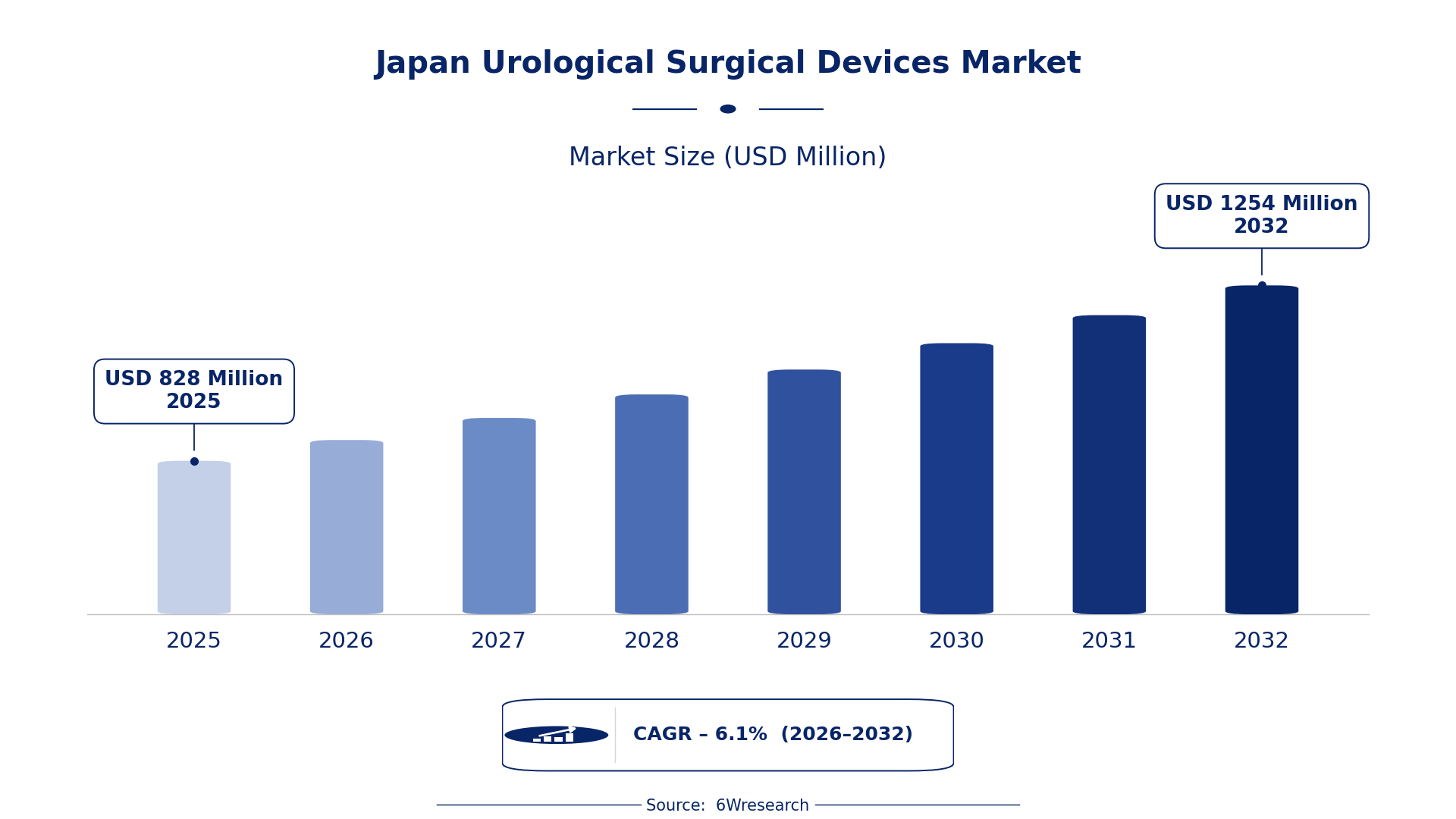
According to 6Wresearch internal database and industry insights, the Japan Urological Surgical Devices Market was valued at USD 828 Million in 2025 and is projected to reach USD 1,254 Million by 2032, growing at a CAGR of approximately 6.1% during 2026–2032.
Japan Urological Surgical Devices Market Highlights
| Report Metric | Details |
| Report Name | Japan Urological Surgical Devices Market (2026-2032) |
| Market Size 2025 | USD 828 Million |
| Market Size 2032 | USD 1,254 Million |
| Absolute Growth 2025–2032 | USD 426 Million |
| CAGR 2026–2032 | 6.1% |
| Peak Annual Growth | 7.0% in 2026 |
| Forecast Period | 2026–2032 |
| Historical Data | 2022–2025 |
| Base Year | 2025 |
| Leading Device Type, 2025 | Resectoscopes (43% share) |
| Leading Procedure Type, 2025 | TURP (44% share) |
| Leading Operation Mode, 2025 | Manual/Electric (33% share) |
| Leading End User, 2025 | Surgical Hospitals (48% share) |
| Fastest-Growing Device Type | Laparoscopes (8.4% CAGR) |
| Fastest-Growing Procedure Type | Nephrectomy (8.6% CAGR) |
| Fastest-Growing Operation Mode | Minimally Invasive (8.5% CAGR) |
| Fastest-Growing End User | Urology Surgeons (7.8% CAGR) |
| Growing Sector | surgical interventions |
| Key End Users | hospitals, surgical centers, urology specialists |
Japan Urological Surgical Devices Market Year-wise Growth Rate and Key Drivers (2022–2032)
This graph illustrates the annual growth rates of the market from 2022 to 2032, highlighting a steady upward trajectory and projected market expansion over the forecast period.
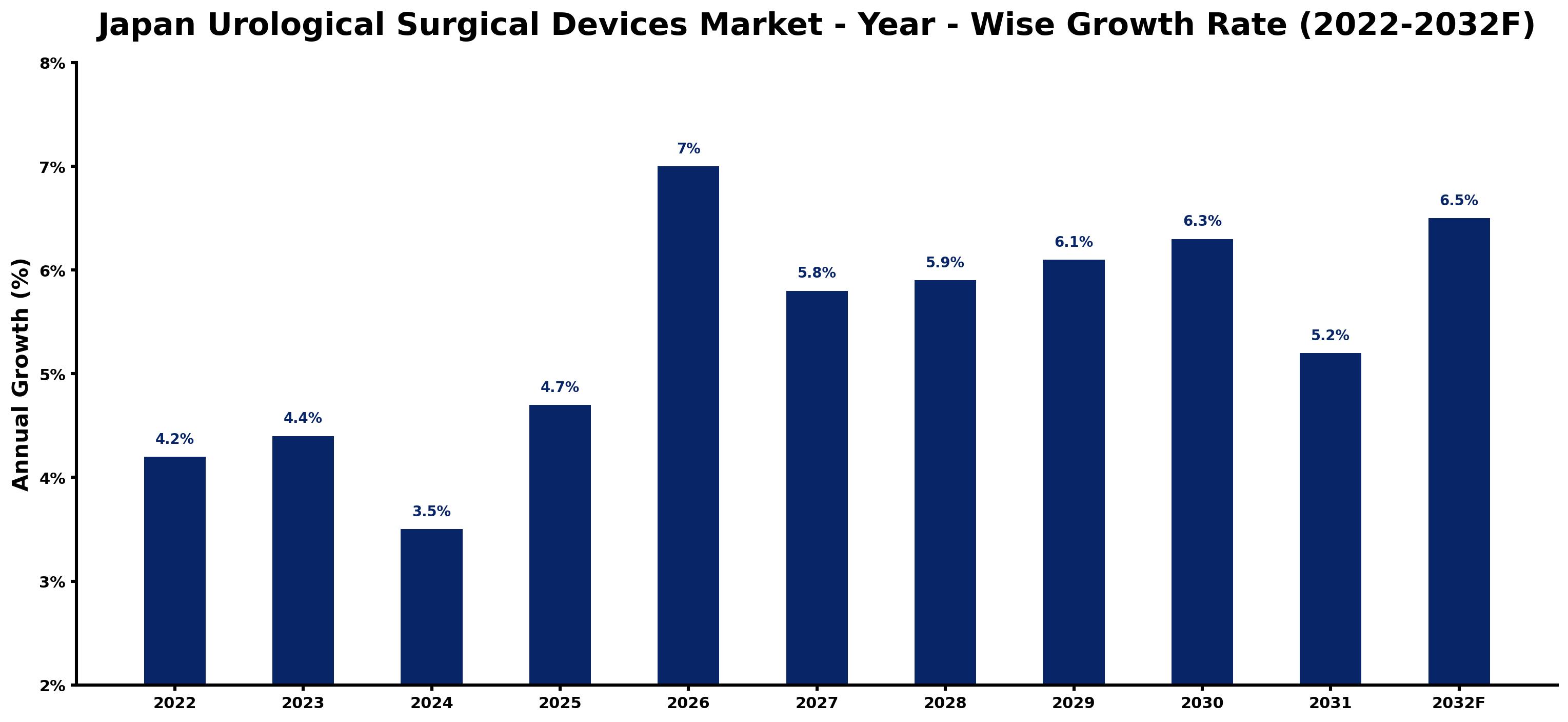
Below, each year's estimated growth is shown next to the factor that most influenced it.
| Year | Estimated Annual Growth (%) | Market Rationale |
| 2022 | 4.2 | The market showed steady growth as hospitals increased surgical interventions for urological conditions. |
| 2023 | 4.4 | Demand rose due to a higher number of procedures performed across surgical facilities. |
| 2024 | 3.5 | Growth slowed as hospitals faced challenges in adopting new technologies for urological surgeries. |
| 2025 | 4.7 | The market rebounded with improved surgical techniques and an increase in nephrectomy procedures. |
| 2026 | 7.0 | Growth is expected to peak as hospitals embrace minimally invasive techniques and advanced device technology. |
| 2027 | 5.8 | A slight slowdown is projected as hospitals adjust to the new operational standards and technologies. |
| 2028 | 5.9 | Growth is expected to resume as more facilities adopt outpatient procedures for urological surgeries. |
| 2029 | 6.1 | Demand is projected to increase with a focus on training more specialists in advanced techniques. |
| 2030 | 6.3 | The market will continue to expand as hospitals invest in new surgical devices and technologies. |
| 2031 | 5.2 | A slowdown is anticipated as market saturation begins to affect growth rates. |
| 2032 | 6.5 | Growth is expected to accelerate again as the demand for outpatient surgeries increases. |
Note: Market size estimations and growth projections presented in this report are based on 6Wresearch's proprietary forecasting methodology, utilizing the latest available industry data, government publications, and primary research inputs.
Japan Urological Surgical Devices Market Synopsis
Urological surgical devices are specialized instruments used in diagnosing and treating urological conditions, made from high-grade stainless steel and advanced polymers. The Japan Urological Surgical Devices Market is growing, driven by an aging population projected to reach 29.3% aged 65 or older by 2024. Factors such as over 200,000 TURP procedures performed annually, advancements in minimally invasive surgery, and rising healthcare expenditures of approximately JPY 46.7 trillion are increasing demand for these devices across surgical hospitals and urology centres.
Market Dynamics Impact Analysis (2026–2032)
| Factor | Type | Impact | Primary Segment Affected |
| Increasing number of TURP procedures annually | Driver | High | TURP |
| Growing adoption of minimally invasive surgical techniques | Driver | High | Minimally Invasive |
| Expansion of outpatient surgical facilities | Opportunity | Medium | Surgical Hospitals |
| Rising demand for advanced imaging technologies | Opportunity | Medium | Endoscopic Cameras |
| High costs associated with advanced surgical devices | Restraint | High | Ablation Devices |
| Limited availability of trained urology specialists | Restraint | Medium | Urology Surgeons |
| Technological advancements require continuous investment | Challenge | High | Laparoscopes |
| Competition from imported surgical devices | Challenge | Medium | Resectoscopes |
Evaluation of Drivers in Japan Urological Surgical Devices Market (2026–2032)
These are the developments adding the most demand over the forecast period.
| Drivers | Primary Segment Affected | Why It Matters (Evidence) |
| Aging population increasing surgical needs | TURP | With 29.3% of the population aged 65 or older, hospitals are performing over 200,000 procedures annually. |
| Rising healthcare expenditure | Ablation Devices | Japan's national medical care expenditure reached JPY 46.7 trillion, facilitating investments in advanced medical devices. |
| Focus on outpatient procedures | Endoscopic Cameras | Endoscopic cameras are essential in over 70% of urological surgeries, driving demand for improved imaging solutions. |
| Increase in urology specialists | Urology Surgeons | With approximately 1,500 specialists practicing, the demand for surgical devices is rising as more surgeries are performed. |
| Technological advancements in surgical devices | Minimally Invasive | Innovations in device technology are enabling less invasive procedures, increasing the number of surgeries performed. |
A wider customer base explains much of the growth, as Japan's aging population increases the demand for urological surgeries. In 2023, over 200,000 procedures were performed, reflecting the need for advanced surgical instruments. The national medical care expenditure, approximately JPY 46.7 trillion, supports investments in new technologies. The presence of around 1,500 urology specialists further drives the need for effective surgical instruments in hospitals and surgical centres. As hospitals adopt new technologies, the demand for specialized devices continues to rise.
Evaluation of Restraints in Japan Urological Surgical Devices Market
Several factors work against faster growth; the main ones are summarised below.
| Market Restraint | Primary Segment Affected | Why It Matters (Evidence) |
| High costs of advanced surgical devices | Ablation Devices | The high costs associated with advanced devices limit their adoption in some hospitals, affecting overall market growth. |
| Limited training opportunities for specialists | Urology Surgeons | The shortage of trained urology specialists restricts the effective use of advanced surgical devices in the market. |
| Regulatory hurdles for new devices | Laparoscopes | New devices face stringent approval processes, delaying their entry into the market and affecting availability. |
| Competition from imported devices | Resectoscopes | Domestic manufacturers face competition from lower-cost imported devices, impacting market share and pricing strategies. |
| Market saturation in certain regions | Surgical Hospitals | High numbers of surgical hospitals in metropolitan areas may lead to market saturation, slowing growth. |
Japan Urological Surgical Devices Market Challenges
In 2023, Japan's hospitals face intense competition for urological surgical devices, driven by an aging population that demands more procedures. This competition leads to procurement delays for hospitals, as they struggle to secure reliable suppliers amid rising demand. The cost of high-grade stainless steel has surged by 15%, increasing production expenses for manufacturers and forcing hospitals to reconsider their budgets for surgical equipment. A shortage of urology specialists, with only about 1,500 practitioners available, results in longer wait times for patients needing advanced treatments, impacting their access to timely care.
Trends in the Japan Urological Surgical Devices Market
The trends below show where the Japan Urological Surgical Devices Market is heading.
- Shift towards Outpatient Surgical Procedures: Hospitals are increasingly adopting minimally invasive techniques, leading to a growing trend towards outpatient surgeries. In 2023, over 200,000 TURP procedures highlighted this shift and its impact on device demand.
- Transition to Advanced Imaging Technologies: The use of advanced imaging technologies, such as endoscopic cameras, is becoming more common, essential in over 70% of urological surgeries. This transition improves surgical precision and patient outcomes.
- Emergence of Minimally Invasive Techniques: Minimally invasive techniques have gained traction in Japan, with a projected 20% increase in such surgeries by 2025. This trend is driving demand for specialized devices and training.
- Focus on Quality Management Standards: The adoption of ISO 13485 standards is becoming more prevalent among manufacturers, ensuring quality management in medical devices. This focus supports the reliability of urological surgical devices.
Investment Opportunities in the Japan Urological Surgical Devices Market
Investors looking at the Japan Urological Surgical Devices Market should consider the following areas.
- Collaborate with Local Hospitals: Now is an ideal time to partner with hospitals in the Tokyo metropolitan area, where surgical facilities are concentrated. This collaboration can facilitate the introduction of advanced surgical devices.
- Invest in Training Programs: Investing in training programs for urology specialists is timely, especially in regions with fewer trained professionals. This investment can improve device usage and surgical outcomes.
- Pursue Regulatory Approvals: With the increasing demand for advanced surgical devices, pursuing regulatory approvals can open new market opportunities. The Pharmaceuticals and Medical Devices Agency (PMDA) oversees this process.
- Target Outpatient Facilities: Expanding product offerings to outpatient facilities is timely, as these centers are increasingly performing urological surgeries. Targeting surgical hospitals can improve market penetration.
Government Initiatives in the Japan Urological Surgical Devices Market
The PMD Act regulates the approval and quality of medical devices, ensuring that urological surgical instruments meet safety and efficacy standards. This law impacts manufacturers by requiring rigorous testing and reporting before market entry, with the Pharmaceuticals and Medical Devices Agency overseeing these processes. Additionally, the Industrial Standardization Act governs product standards, influencing how devices are manufactured and marketed in Japan.
The Pharmaceuticals and Medical Devices Agency (PMDA) oversees the approval process for new medical devices, including urological instruments. Hospitals rely on PMDA's assessments to ensure that the devices they use are safe and effective, which is vital for maintaining high standards of patient care.
Future Insight of the Japan Urological Surgical Devices Market
Investment in outpatient surgical centres will expand capacity for urological procedures by 2025. By 2032, the adoption of advanced training programmes for urology specialists will improve skill levels, enhancing patient care. The integration of ISO 13485 standards will elevate quality management in urological devices, benefiting hospitals and suppliers alike. As the number of surgical centres rises, the efficiency of urological procedures will increase, aligning with the growing demand for minimally invasive techniques.
Market Segmentation Analysis
Japan Urological Surgical Devices Market report covers a detailed analysis of the following market segments:
By Device Type – Resectoscopes Lead, Laparoscopes Expected to Grow Fastest
According to Saurav Kr Singh, Senior Research Analyst at 6Wresearch, in 2025, Resectoscopes led the device type split with a 43% share. Resectoscopes maintain the largest share as they are essential for performing TURP procedures, which are prevalent in Japan's healthcare system. With over 200,000 TURP procedures conducted annually, the demand for these devices is consistently high. Laparoscopes are projected to grow fastest, at a CAGR of 8.4% during 2026–2032. Laparoscopes are rapidly gaining traction due to the increasing preference for minimally invasive surgeries, supported by government initiatives aiming for a 20% rise in such procedures by 2025. This trend indicates a broader shift towards advanced surgical techniques among medical professionals. Suppliers should prioritise the availability of laparoscopes to cater to the growing demand for minimally invasive surgical solutions.
By Procedure Type – TURP Leads, Nephrectomy Expected to Grow Fastest
TURP held 44% of the Japan Urological Surgical Devices Market by procedure type in 2025. TURP is the most frequently performed procedure for prostate issues, with over 200,000 procedures conducted annually in Japan. This prevalent use underscores the significant demand for associated urological surgical devices. Nephrectomy is set to record the highest CAGR in this split, 8.6% over 2026–2032. Nephrectomy is experiencing rapid growth due to an increasing number of kidney removal cases, reflecting advancements in surgical techniques and patient management. This trend indicates a shift towards more complex urological surgeries. Suppliers must prepare for an uptick in nephrectomy procedures, ensuring they have adequate stock of necessary surgical devices.
By Operation Mode – Manual/Electric Leads, Minimally Invasive Expected to Grow Fastest
Manual/Electric accounted for 33% of the market by operation mode in 2025. Manual/Electric operation modes are predominant as they offer versatility across a range of urological devices, accommodating various surgical preferences. This flexibility is vital in a market characterised by diverse surgical practices. Over 2026–2032, Minimally Invasive is expected to post the fastest growth, at a CAGR of 8.5%. Minimally invasive techniques are rapidly becoming preferred options as both patients and surgeons seek less invasive alternatives, resulting in a shift in operational modes. This trend aligns with government objectives to increase minimally invasive surgeries by 2025. Suppliers must focus on developing and marketing minimally invasive devices to align with evolving market preferences.
By End User – Surgical Hospitals Lead, Urology Surgeons Expected to Grow Fastest
Surgical Hospitals took 48% of end user revenue in 2025, more than any other category. Surgical hospitals are the primary users of urological devices, equipped with the necessary infrastructure to perform complex surgeries. Their concentration in regions like Tokyo enhances the demand for these specialized instruments. The quickest growth will come from Urology Surgeons, forecast to expand at a CAGR of 7.8% between 2026 and 2032. Urology surgeons are seeing the fastest growth as the number of specialists rises, driven by the increasing prevalence of urological conditions in the aging population. Their role is crucial in utilising advanced surgical devices effectively. Suppliers should focus on building relationships with urology surgeons to align their offerings with the evolving requirements of this growing practitioner group.
Key Attractiveness of the Report
- 10 Years of Market Numbers
- Historical Data Starting from 2022 to 2025
- Base Year 2025
- Forecast Data until 2032
- Key Performance Indicators Impacting the Market
- Major Upcoming Developments and Projects
Key Highlights of the Report:
- Japan Urological Surgical Devices Market Outlook
- Market Size of Japan Urological Surgical Devices Market, 2025
- Forecast of Japan Urological Surgical Devices Market, 2032
- Historical Data and Forecast of Japan Urological Surgical Devices Revenues & Volume for the Period 2022-2032F
- Japan Urological Surgical Devices Market Trend Evolution
- Japan Urological Surgical Devices Market Drivers and Challenges
- Japan Urological Surgical Devices Price Trends
- Japan Urological Surgical Devices Porter's Five Forces
- Japan Urological Surgical Devices Industry Life Cycle
- Historical Data and Forecast of Japan Urological Surgical Devices Market Revenues & Volume By Device Type for the Period 2022-2032F
- Historical Data and Forecast of Japan Urological Surgical Devices Market Revenues & Volume By Resectoscopes for the Period 2022-2032F
- Historical Data and Forecast of Japan Urological Surgical Devices Market Revenues & Volume By Laparoscopes for the Period 2022-2032F
- Historical Data and Forecast of Japan Urological Surgical Devices Market Revenues & Volume By Ablation Devices for the Period 2022-2032F
- Historical Data and Forecast of Japan Urological Surgical Devices Market Revenues & Volume By Endoscopic Cameras for the Period 2022-2032F
- Historical Data and Forecast of Japan Urological Surgical Devices Market Revenues & Volume By Procedure Type for the Period 2022-2032F
- Historical Data and Forecast of Japan Urological Surgical Devices Market Revenues & Volume By TURP for the Period 2022-2032F
- Historical Data and Forecast of Japan Urological Surgical Devices Market Revenues & Volume By Nephrectomy for the Period 2022-2032F
- Historical Data and Forecast of Japan Urological Surgical Devices Market Revenues & Volume By BPH Treatment for the Period 2022-2032F
- Historical Data and Forecast of Japan Urological Surgical Devices Market Revenues & Volume By Bladder Tumor Removal for the Period 2022-2032F
- Historical Data and Forecast of Japan Urological Surgical Devices Market Revenues & Volume By Operation Mode for the Period 2022-2032F
- Historical Data and Forecast of Japan Urological Surgical Devices Market Revenues & Volume By Manual/Electric for the Period 2022-2032F
- Historical Data and Forecast of Japan Urological Surgical Devices Market Revenues & Volume By Minimally Invasive for the Period 2022-2032F
- Historical Data and Forecast of Japan Urological Surgical Devices Market Revenues & Volume By Laser for the Period 2022-2032F
- Historical Data and Forecast of Japan Urological Surgical Devices Market Revenues & Volume By Digital Imaging for the Period 2022-2032F
- Historical Data and Forecast of Japan Urological Surgical Devices Market Revenues & Volume By End User for the Period 2022-2032F
- Historical Data and Forecast of Japan Urological Surgical Devices Market Revenues & Volume By Surgical Hospitals for the Period 2022-2032F
- Historical Data and Forecast of Japan Urological Surgical Devices Market Revenues & Volume By Urology Surgeons for the Period 2022-2032F
- Historical Data and Forecast of Japan Urological Surgical Devices Market Revenues & Volume By Day-Care Centers for the Period 2022-2032F
- Historical Data and Forecast of Japan Urological Surgical Devices Market Revenues & Volume By Hospitals for the Period 2022-2032F
- Japan Urological Surgical Devices Import Export Trade Statistics
- Market Opportunity Assessment By Device Type
- Market Opportunity Assessment By Procedure Type
- Market Opportunity Assessment By Operation Mode
- Market Opportunity Assessment By End User
- Japan Urological Surgical Devices Top Companies Market Share
- Japan Urological Surgical Devices Competitive Benchmarking By Technical and Operational Parameters
- Japan Urological Surgical Devices Company Profiles
- Japan Urological Surgical Devices Key Strategic Recommendations
Market Covered
Coverage by segment is as follows.
By Device Type
- Resectoscopes
- Laparoscopes
- Ablation Devices
- Endoscopic Cameras
By Procedure Type
- TURP
- Nephrectomy
- BPH Treatment
- Bladder Tumor Removal
By Operation Mode
- Manual/Electric
- Minimally Invasive
- Laser
- Digital Imaging
By End User
- Surgical Hospitals
- Urology Surgeons
- Day-Care Centers
- Hospitals































